The Sun's Closest Neighbour
 The Sun’s closest known star was discovered a century ago. But scientists have speculated ever since that an even closer star could be lurking undetected in our immediate neighbourhood.
 The search for this hidden star may soon be at an end. If it exists at all, the orbiting WISE telescope, a NASA-funded mission, will already have found it. In fact, one team of researchers have made it a personal goal to claim the discovery for themselves.
In 1984, scientists discovered that mass extinctions on Earth happen on a regular cycle, every 26 million years or so. They proposed that this was due to periodic comet impacts with our planet. This led some astronomers to suggest that a distant, as-yet-undetected companion star to the Sun is periodically sweeping through the Oort cloud, a vast ocean of comets surrounding the Solar System, each time sending a deadly shower of comets our way. This shower of death, every 26 million years, could explain the regular catastrophic extinctions visible in the fossil record. This mystery star has been called ‘Nemesis’ by some, though others have called it the ‘Death Star’.
The Nemesis hypothesis is now largely out of favour with scientists, mainly because such a distant star would be unable to remain in a stable orbit over a long enough time period to explain the extinction record. Some researchers have also questioned whether all mass extinctions are caused by impact events, or that these do indeed occur periodically. However, many astronomers still agree that a nearby brown dwarf could account for the observed asymmetry in the arrival directions of newly discovered comets. This object (now often referred to as ‘Tyche’), if it exists, won’t be the harbinger of death it once was, but it will nevertheless be an important discovery.
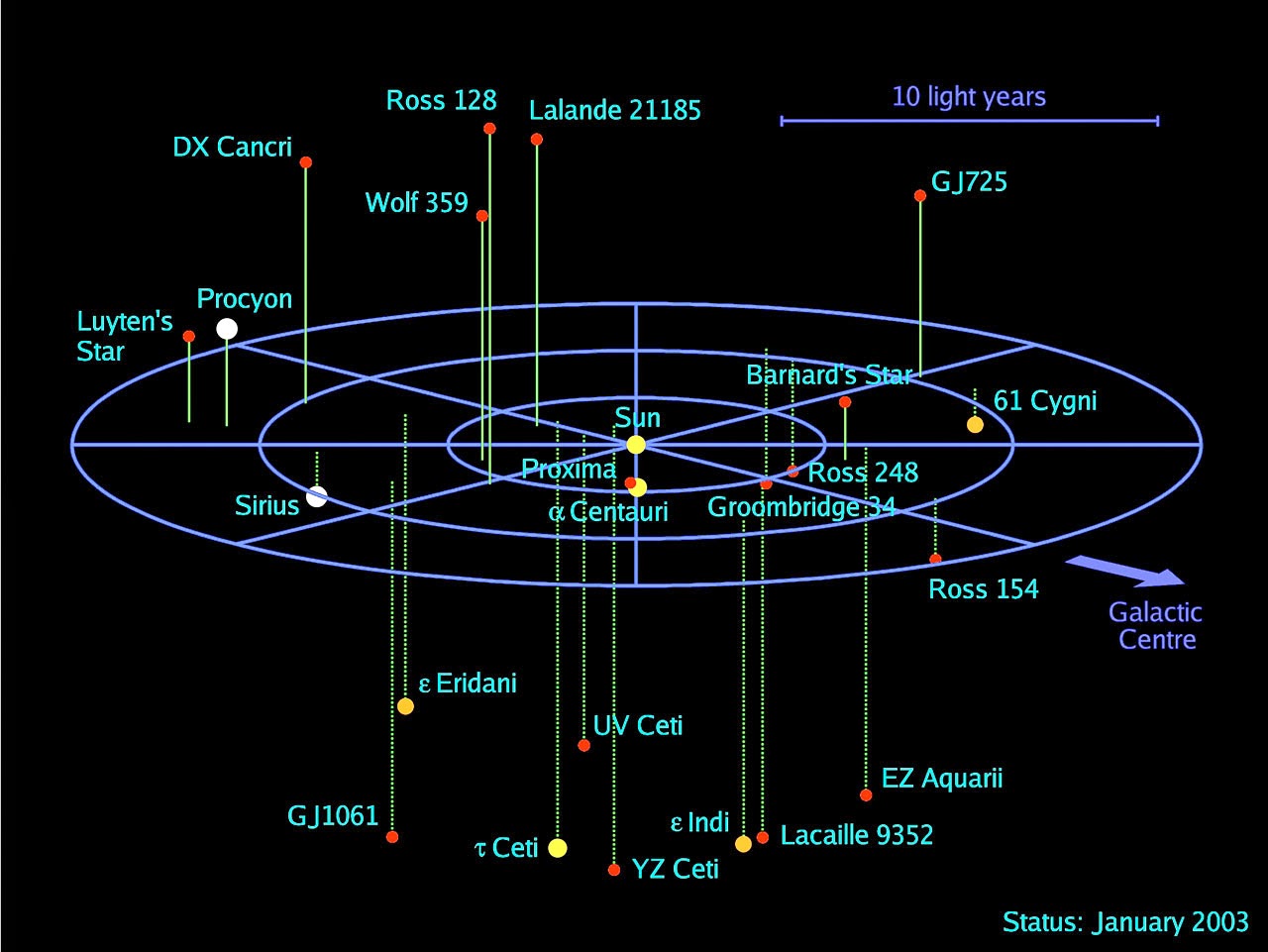
Our nearest stellar neighbour is, currently, an 11th magnitude star known as Proxima Centauri. This insignificant little star appears to be orbiting its parent binary system, Alpha Centauri, at a distance of about 0.21 light years, taking about half a million years to complete its orbit. Best estimates put the distance to Proxima Centauri at 4.2 light years. But the star’s motion through space is bringing it ever closer to us – its closest approach will be in about 26,700 years when it will be within about 3.1 light years of the Sun.
In about 33,000 years, however, another star, Ross 248, will overtake Proxima Centauri to be our closest neighbour. Ross 248 will approach to within 3 light years in about 36,000 years time, but will relinquish the record again to Proxima Centauri about 6,000 years later.
For nearly a century astronomers have searched the skies in vain for a star closer than Proxima Centauri. Even the Hipparcos satellite mission of the 1990s, which measured the distances to millions of stars, only confirmed what we already believed. Interestingly, Hipparcos did discover that one star, Gliese 710, will one day be only 1.3 light years from the Sun, but not for another 1.4 million years! For the moment, we’re stuck with Proxima Centauri.
Of course, just because we haven’t discovered a closer star doesn’t mean there isn’t one. But we can be reasonably sure it isn’t a star like Proxima Centauri or Ross 248. These stars are ‘red dwarfs’ - small, low-mass, and relatively cool stars which are intrinsically very faint. Even the largest red dwarfs have less than 40% of the Sun’s mass and less than 10% its luminosity. Even so, red dwarfs are the most numerous stars in the Milky Way – twenty of the thirty nearest stars to the Sun are red dwarfs, and none of these can be seen with the naked eye!
Although very faint, any red dwarf closer than Proxima Centauri would be easily detectable with modern telescopes. So after a century of fruitless searching, astronomers have concluded that if such a star exists, it must be much dimmer and much cooler than the average red dwarf star.
This is where the WISE telescope comes in. Although of moderate size, WISE is an infrared telescope, specifically designed to look for the faint traces of heat from such cool objects. At the distance of Proxima Centuri, WISE could easily detect a star 100 million times less luminous than the Sun.
Such incredibly dim and cool stars are known as ‘brown dwarfs’. They were first detected in 1995. Now, more than 800 have been found using data from the 2MASS survey, the Sloan Digital Sky Survey and the Spitzer Space Telescope, amongst others. WISE itself has found almost 4000 brown dwarfs.
Brown dwarfs are failed stars - they bridge the gap between giant planets (like Jupiter) and very low mass stars (red dwarfs), their masses lying between about 5 and 90 Jupiter masses. Because of their low mass, their central temperature is not high enough to maintain thermonuclear fusion reactions. It has been shown that brown dwarfs form just like any other star, when a cloud of gas and dust contracts under its own gravity, except that the central star never attains quite enough mass to become a ‘real’ star. Brown dwarfs don’t ‘shine’ in the way normal stars do – they ‘glow’, gradually cooling off by radiating away their internal heat. They are therefore extremely faint, being essentially invisible in optical light, although they can still be detected in the infrared region of the spectrum.
There are three classes of brown dwarf. The warmest, the L dwarfs (1200-2000°C) have clouds of dust and aerosols in their high atmosphere, while the T dwarfs (lower than 1200°C) appear to have methane forming in their atmospheres. The coolest stars of all, the ‘ultra-cool’ Y dwarfs, with temperatures less than about 200°C, have so far not been detected, although some candidates exist. WISE, however, is ideally suited to confirm the first Y-dwarf detection.
Brown dwarfs bear some similarities with gas giant planets and some similarities with the coolest red dwarf stars, but can’t really be classed as either. While red dwarfs have surface temperatures of more than about 3700°C, brown dwarfs are never hotter than about 2000°C. They are therefore extremely difficult to detect in the optical part of the spectrum. Most of their emission lies in the infrared region. If red dwarfs are the red embers of a dying fire, then brown dwarfs are the smouldering ash.
Most brown dwarfs discovered to date are thought to belong to the coolest known class of brown dwarfs, called T dwarfs. Others belong to the slightly warmer group called L dwarfs. These T and L classes are part of the much larger system of categorising stars according to their temperature; for example, the hottest, most massive stars are the O stars whilst our mid-temperature Sun is a G star. Although very faint, brown dwarfs may be even more numerous than red dwarfs and are easily spotted in WISE data.
WISE, or the Wide-field Infrared Survey Explorer, was a NASA instrument orbiting 500 km above the Earth’s surface. The satellite is in a polar orbit designed so that the telescope always looks away from the Earth and 90° away from the Sun. During each 95-minute orbit WISE took a string of pictures, once every 11 seconds, continuously sweeping out swaths of sky 47-arcminutes wide, or about one-and-a-half times the diameter of the moon. Over the course of six months this band of pictures circled around and eventually mapped the entire sky.
The WISE telescope itself has a diameter of 40cm and contains four infrared detectors each with a million pixels. WISE takes four simultaneous images of the same patch of sky with these four detectors, each tuned to a different infrared wavelength. Because WISE is designed to detect the radiation from extremely cool objects, the detectors must themselves be cooled to prevent them picking up their own ‘heat’ signature. So the entire telescope is housed in an enormous thermos flask and cooled with frozen hydrogen down to about 15 degrees above absolute zero (-258°C). The advanced technology employed means that WISE was hundreds of times more sensitive than its infrared predecessors.
Launched on 14thDecember 2009, WISE was put into space with about nine months supply of frozen hydrogen. Right on cue in October 2010 the supply was finally depleted and the telescope and detectors began to warm up. But this didn’t spell the end of the mission. By the time the coolant ran out the satellite had already surveyed the entire sky about one and a half times and the instrument continued working until early 2011. Astronomers are still sifting through the data years after its primary mission ended. WISE was put into hibernation upon completing its primary mission in 2011. In September 2013, it was reactivated, renamed NEOWISE and assigned a new mission to assist NASA's efforts to identify the population of potentially hazardous near-Earth objects. NEOWISE will also characterize previously known asteroids and comets to better understand their sizes and compositions.
WISE was designed so that brown dwarfs are bright in the second of the instruments four filters. When the telescope makes three-colour images using the three shortest wavelength bands, brown dwarfs pop out as green. Finding these green objects in the reams of WISE images is time consuming. Once a candidate is found, however, the researchers then have to check it isn’t a dust-obscured galaxy often found masquerading as a brown dwarf. Finally they measure the object’s parallax (and so distance) using data from the Hubble Space Telescope, the Spitzer Space Telescope and other ground-based observatories. With its spectacular imaging capabilities and supreme sensitivity, the WISE data is expected to uncover millions of objects never before seen, ranging from near-Earth asteroids to young galaxies more than ten billion light-years away. By October 2010, over 33,500 new asteroids and comets and nearly 154,000 solar system objects were found by WISE.
The coolest brown dwarf WISE discovered has a temperature between -48°C and -13°C. But astronomers believe even colder brown dwarfs exist and they call these ‘Y dwarfs’. None have yet been discovered, but the WISE scientists are convinced it’s only a matter of time. WISE should be able to see a 200°C brown dwarf out to a distance of about 75 light years and brown dwarfs as cool as -120°C out as far as ten light years! With this degree of sensitivity, any brown dwarf closer to the Sun than Proxima Centauri will not go unnoticed by the WISE team. If it's not in the WISE data, it’s probably not worth finding! WISE actually discovered the third nearest star to the Sun, called Luhman 16, at a distance of just 6.6 light years. But other, closer stars may still be hiding in the WISE data.
Some young brown dwarfs have been discovered to have disks of material around them, perhaps indicating the ability to form planets. So, WISE might not only find the Sun’s nearest star, but it’s nearest planetary system too! That is, once astronomers have finished sifting through their data!


No comments have been added yet.