A Valentine to The Women of New Jersey (And Another "Hidden" Testament To Diversity)
In October 2014, I had the honor of making a presentation on Norman Rockwell and people of color to a long-established women's book club based in Metuchen, New Jersey. The president of the group informed me that the ladies of this book club did not come out just for coffee and cookies: they were incisive and focused in their interactions with their guest authors. Thanks to this heads up, I did even deeper pre-program research than usual and found a wonderful connection between New Jersey's women, diversity, and the often hidden messages in American illustration.
Contrary to popular belief, 1920 was not the first time American women got the vote. The women of New Jersey had the suffrage for the first thirty-one years of our nation's history, from 1776 – 1807.
The first constitution for the state of New Jersey granted the vote to "all inhabitants of this colony, of full age, who are worth fifty pounds ... and have resided in the county ... for twelve months." Although married women could own no property in their name and therefore could not vote, single women who met all of the other criteria could. Between 1776 and 1807, unmarried women voters in New Jersey regularly spoke out on issues and participated in elections.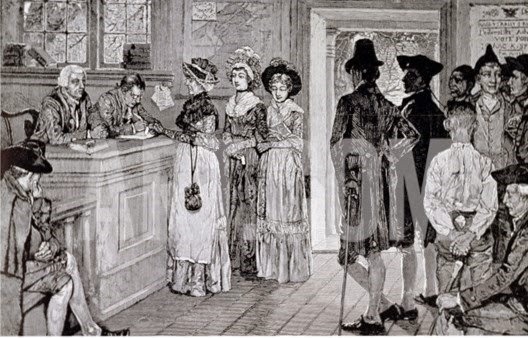 Women at the Polls in New Jersey in the Good Old Times (Howard Pyle, 1880)
This bright spot in American history was captured by the famous illustrator Howard Pyle in his 1880 drawing for Harper's Weekly magazine entitled, Women at the Polls in New Jersey in the Good Old Times. In it, women are shown lining up, casting their vote.
These women are presumably all single, of "full age", and each worth at least fifty pounds. But they are not all white. Look carefully at the last woman in line, the woman standing in the shadow on the other side of the open doorway. (You may have to "blow up" the picture on your computer to see the detail. I was able to study the original drawing at the Museum of American Illustration in Newport, Rhode Island.)
This New Jersey woman voter is black, with a gold earring in her ear and a small smile upon her face. Hidden in plain sight, she is Howard Pyle's testimony to New Jersey's racial as well as gender "good old times".
Those good times disappeared in 1808 when, as part of a political deal that also denied the vote to aliens and any non-taxpayers, the New Jersey legislature ignored its constitution and restricted the vote to white male citizens who paid taxes. But for the first 31 years of our Republic, at least some of the women of New Jersey, black and white, were able to exercise their "inalienable right".
So, I post this Valentine to those first women New Jersey voters, and to my friends from the women's book club in New Jersey who continue in that same strong spirit.
Contrary to popular belief, 1920 was not the first time American women got the vote. The women of New Jersey had the suffrage for the first thirty-one years of our nation's history, from 1776 – 1807.
The first constitution for the state of New Jersey granted the vote to "all inhabitants of this colony, of full age, who are worth fifty pounds ... and have resided in the county ... for twelve months." Although married women could own no property in their name and therefore could not vote, single women who met all of the other criteria could. Between 1776 and 1807, unmarried women voters in New Jersey regularly spoke out on issues and participated in elections.
 Women at the Polls in New Jersey in the Good Old Times (Howard Pyle, 1880)
This bright spot in American history was captured by the famous illustrator Howard Pyle in his 1880 drawing for Harper's Weekly magazine entitled, Women at the Polls in New Jersey in the Good Old Times. In it, women are shown lining up, casting their vote.
These women are presumably all single, of "full age", and each worth at least fifty pounds. But they are not all white. Look carefully at the last woman in line, the woman standing in the shadow on the other side of the open doorway. (You may have to "blow up" the picture on your computer to see the detail. I was able to study the original drawing at the Museum of American Illustration in Newport, Rhode Island.)
This New Jersey woman voter is black, with a gold earring in her ear and a small smile upon her face. Hidden in plain sight, she is Howard Pyle's testimony to New Jersey's racial as well as gender "good old times".
Those good times disappeared in 1808 when, as part of a political deal that also denied the vote to aliens and any non-taxpayers, the New Jersey legislature ignored its constitution and restricted the vote to white male citizens who paid taxes. But for the first 31 years of our Republic, at least some of the women of New Jersey, black and white, were able to exercise their "inalienable right".
So, I post this Valentine to those first women New Jersey voters, and to my friends from the women's book club in New Jersey who continue in that same strong spirit.


No comments have been added yet.