Jump to ratings and reviews
Rate this book

John Tyler, the Accidental President

Rate this book
The first vice president to become president on the death of the incumbent, John Tyler (1790-1862) was derided by critics as "His Accidency." Yet he proved to be a bold leader who used the malleable executive system to his advantage. In this biography of the tenth President of the United States, Edward P. Crapol challenges previous depictions of Tyler as a die-hard advocate of states' rights, limited government, and a strict interpretation of the Constitution.

In pursuit of his agenda, Crapol argues, Tyler exploited executive prerogatives and manipulated constitutional requirements in ways that violated his professed allegiance to a strict interpretation of the Constitution. He set precedents that his successors in the White House invoked to create an American empire and expand presidential power.

Crapol also highlights Tyler's enduring faith in America's national destiny and his belief that boundless territorial expansion would preserve the Union as a slaveholding republic. When Tyler, a Virginian, opted for secession and the Confederacy in 1861, he was stigmatized as America's "traitor" president for having betrayed the republic he once led. As Crapol demonstrates, Tyler's story anticipates the modern imperial presidency in all its power and grandeur, as well as its darker side.

344 pages, Hardcover

First published October 1, 2006

52 people are currently reading
2811 people want to read

About the author

Edward P. Crapol

4 books3 followers
Edward P. Crapol is a professor in the Department of History at the College of William and Mary. His appointments include: Assistant Professor of History, 1967-1971; Associate Professor of History, 1971-1978; Professor of History, 1978-1994; Chancellor Professor of History, 1994-1999; William E. Pullen Professor of History, 1999-2004; William E. Pullen Professor of History, Emeritus, 2004.

Ratings & Reviews

What do you think?
Rate this book

Friends & Following

Create a free account to discover what your friends think of this book!

Community Reviews

5 stars
768 (31%)
4 stars
689 (28%)
3 stars
681 (28%)
2 stars
228 (9%)
1 star
50 (2%)
Displaying 1 - 30 of 171 reviews
Profile Image for Brian Willis.
691 reviews47 followers
June 27, 2019
This is the only full length examination of Tyler's presidency available other than the brief volumes of the American President series. If your goal is to read a bio of every POTUS, this is probably the one to choose.

Tyler ascended to the Presidency upon the death of William Henry Harrison and one of his accomplishments was simply asserting the powers of the VP to take over the Presidency rather than being treated as a temporary President, leading eventually to the powers invested in the 25th Amendment. However, he was a Whig in name but a (at the time conservative states' rights advocates) Democrat in ideology. One of the first things he did was to assert an authoritarian relationship with his cabinet, upset the Whigs with his first policies, and getting expelled from his own political party, the only POTUS to be disowned by his political party while in office. He supported the spread of slavery. He supported an expansionist policy for the US, essentially responsible for claiming Texas as a territory. After losing an election in which he wasn't even a candidate for President. Upon the advent of the Civil War, he chose to side with the Confederacy and was elected to the CSA Congress when he died. His reputation has suffered ever since.

I wasn't entirely convinced by Crapol's insistence that Tyler is underrated. I do buy that Crapol has rightfully finally drawn out his portfolio of beliefs much more fully than in any other account. I did learn a bit more than previously. I do still believe that Tyler is bottom 5 all time of POTUS, with legitimate claims to the worst (his political ineptitude alone would do that alongside his pro-slavery views and the fact that he committed treason in the Civil War). Nonetheless, this is the book for POTUS 10 information with depth.
Profile Image for Christopher Saunders.
1,048 reviews960 followers
March 5, 2020
Edward Crapol's John Tyler: The Accidental President provides a surprisingly sympathetic treatment of the tenth President of the United States. Tyler is remembered, if at all, as the first president to take office after the death of his predecessor (William Henry Harrison) and for rendering the Mexican War inevitable with his last second decision to annex Texas. In fact, Crapol shows, his was an eventful presidency, with a number of worthy achievements that supplement (if not balance) his well-known failures. Crapol shows Tyler as a self-conscious successor to the Jefferson-Madison school of "small government" Virginian aristocrats, which ironically (through his distaste for Andrew Jackson) drew him to the Whig Party, whose credo nominally embraced government activism. This led to an immediate split with his own party, handicapping his domestic agenda and rendering him a largely inert president who was lame-ducked within a few months of taking office. Though not completely inert, as Crapol shows; Tyler did score substantial advances in foreign policy, negotiating a major border agreement with Britain over Canada and opening relations with China and other Asian states. Crapol nonetheless shows how Tyler's Texas decision eclipsed his positive actions, along with his moral obtuseness re: slavery that, later in life, led him to join the Confederate government. The result is probably more empathetic towards Tyler than most modern readers would like, but as a careful study of a difficult figure it's worthwhile.
Profile Image for Nathan.
523 reviews4 followers
September 25, 2013
It's nice to see Tyler get some press, if only because he hasn't got a lot of it. Crapol, fortunately, doesn't make too much of his obscurity by rambling on about his unknownness in an effort to cast his study as more groundbreaking than it is. 
The tone is beautifully evenhanded and matter-of-fact; Crapol simply gets on with his story, as confidently and unapologetically as if he were treating Jefferson, Lincoln, or any other historical heavyweight. 

Tyler, it turns out, does have a story worth telling. 25 years before Lincoln, the deep and complex issues of slavery, suffrage and secession were rippling through America's political and social landscape, years before exploding into civil war.  Crapol, to his considerable credit, refuses to excuse Tyler's unabashed racist and paternalist attitudes towards people of color, while noting that such attitudes were hardly uncommon in American society in general at the time. Crapol does an excellent job of pointing out the especial irony in Tyler's ironclad commitment to liberties enshrined in the Constitution and his blindness to the contradiction inherent in his ownership of human chattel. 

Tyler's driving passion was nationalist expansionism, and the events of the book are easily viewed through this lens. While the particulars cannot quite escape the dryness and  tedium inherent in such matters, Crapol gamely plows through. He sketches out the basic plots of the Wanghia Treaty (a really interesting affair that could use a deeper analysis) and the Webster-Ashburton Treaty (hardly more than a footnote), but declines to delve very far into them.
He has an irritating habit of referring to an issue with nothing more than a simple sentence that, while keeping the book's scope to it's midrange focus, can sometimes leave more unsaid than needs to be. But in general, these glimpses under the hood of political machinery are fascinating. 

In so illustrating this, the book provides an utterly fascinating look at the unrest and politicking that went on behind the scenes in the months and weeks before Fort Sumter. I'm relatively well-read in Civil War history, so it was fun to be making connections and seeing causes. Tyler's personal role sometimes, unfortunately, takes a backseat here, but that might be partially because of his ambivalence to the situation and the fact that it quickly progressed beyond his control. Still, Tyler doesn't get off easily for his ambivalence on the slave issue; Crapol calls it like it is. 

I wish the issue hadn't dominated so much of Tyler's personal life. As prominent a role as it plays in his political life, bringing so much of it into the portrait of the private Tyler feels a little like overkill. On the other hand, Tyler's personal reserve and the social proprieties of the day work against a full treatment of this aspect, and I think Crapol did a decent job considering. 

That's what this book is, a decent job. A little too much is left unsaid, and other material is overdone, but with relatively little written about him, Tyler deserves a mention in popular history and he gets it, fairly and accessibly in a slick, friendly job here. 
Profile Image for Joy D.
3,134 reviews330 followers
October 17, 2023
“He [Tyler] seemed oblivious to yet another contradiction in his ideology. Just as slavery mocked Tyler’s notion of free America’s global mission, the chase for national glory ultimately would clash with his traditional Jeffersonian view of limited government.”

This book is a biography of tenth US President, John Tyler (1790-1862). He is known as the first Vice President to assume the Presidency (after the death of William Henry Harrison), setting a precedent that still endures. He is not particularly well-remembered these days, and this book provides an informative series of essays on his key characteristics and accomplishments, including:

- Pro-slavery stance: John Tyler was a slave-owner. While he sought to eliminate the slave markets in Washington D.C., he was a plantation owner who believed in the “southern way of life” that “required” slaves.
- Non-recognition of Haiti: After Haiti gained independence (after a slave revolt), Tyler refused to recognize it as a country. This reluctance can be traced directly to racism.
- Recognition of Hawaii: In order to provide the US access to the Eastern hemisphere, Tyler recognized Hawaii as an independent territory.
- Diplomacy with China: He sent a diplomat to open trade discussions with China, along with a rather condescending letter that, fortunately for him, was not delivered until diplomatic relations had been established.
- Pre-annexation of Texas: He facilitated the preliminary negotiations that eventually led to the annexation of Texas (which occurred after his term ended).
- Joining the Confederacy: He is considered a “traitor president” due to voting for secession and joining the Confederacy in 1861 at the start of the American Civil War.

The primary advantage of this biography is the wealth of information provided on a lesser-known President. Tyler is not a particularly admirable person, nor does Crapol attempt to fully redeem him. It does not provide much about his personal life or his pre-presidential public service. His first wife died in 1842, he married his second wife during his presidency, and had a total of fifteen children. I enjoyed the thematic approach to this book, though it may be less effective for those who prefer a chronological account. I did not particularly care for the author’s continued use of the euphemism for slavery (i.e., “the peculiar institution”), but overall, this is an accessible, well-researched biography, and I learned a lot from reading it.
Profile Image for Jeremy Perron.
158 reviews26 followers
March 6, 2012
Edward P. Crapol tells the story of one of America's least known presidents, John Tyler. Known as `His Accidentcy', John Tyler was the first person to achieve the presidency via succession rather than election. That singular action makes him important because it cemented and important constitutional precedent. Crapol `s narrative is at times odd; he seems to swing back in forth through different parts of President Tyler's life throughout the work.

Crapol tells his story beginning at the birth of the future president. John Tyler was born into on the finest families in Virginia. Tyler's father, also John Tyler, was the college roommate of Thomas Jefferson. Tyler himself, during his career, would give the oration at the funeral of Thomas Jefferson.

Tyler would be a defender of Southern principals during his career; he would defend the expansion of slavery under James Madison's absurd `diffusion' theory* and stood for States' rights against what he viewed as the entrenching Federal government.

Tyler would go on to serve in several offices, in the state legislature, the in United States House of Representatives, as Governor of Virginia, and the United States Senate. He would even serve in the office of President Pro Tempore in the U.S. Senate. After the break-up of the Democratic-Republican Party, Tyler joined the Jacksonians, but would ultimately turn to the newly forming Whig Party. He would run for vice president on one of the Whig tickets in 1836, and then in 1840 he would be the vice presidential nominee on the unified Whig ticket under William Henry Harrison. Known as `Tippecanoe and Tyler too,' the pair would go on to win the election. Tyler would serve as Vice President of the United States for one month, and then President Harrison died.

The Constitution did not specify what happened if the president actually died, some thought the Vice President would become President, John Adams, the first Vice President, said so himself in the beginning. Others thought that he would serve until Congress scheduled a new election to elect someone to fill in the rest of the remaining term. Tyler declared that he was the President and would not even open mail that did not acknowledge him as such. The Congress decided to side with the new President, and the Chief Justice, Rodger Taney**, swore in the tenth President of the United States.

"John Tyler made the most of having been forewarned and forearmed. He met the challenge of being the first vice president to navigate the uncharted waters of presidential succession in the young republic by establishing the Tyler precedent. From this time forward, the vice presidency assumed new importance. The holder of the formally disdained office now found himself a heartbeat away from the chief executive's chair and, thanks to John Tyler, the presidency as an institution became independent of death. The man who had been mocked `His Accidency' accomplished what he had set out to do. He ignored the objections to those who claimed the framers had not intended the vice president to become president in his own right on the death of an incumbent." p.27

Tyler, who for years had argued for executive restraint, embodies on a policy that would get him ejected from the Whig Party***. He would veto a new national bank bill, complete the Webster-Ashburton Treaty to straighten the U.S. boarder with British Canada, and lead several foreign policy initiatives that would lead to the annexation of Texas and the opening of China. Members of the House of Representatives, led by John Quincy Adams, would try to have Tyler impeached for abusing the veto power.

He would be nominated by no party in 1844, and thus retired from office as the first president never to be elected in his own right. During the last years of his life he tried to stop the South from succeeding from the Union; but when he failed, he stood for and was elected to the Congress of the Confederate States of America. He would die before he could serve in that Congress, but he would be the only president to die a traitor. Edward Crapol tells an incredible tale of a president most would find dull.

*Expand slavery and it will disappear.

**Years before he would disgrace himself and the court with Dred Scot.

***The only president in history to be kicked out of his own party.
Profile Image for Steve.
340 reviews1,183 followers
December 28, 2013
http://bestpresidentialbios.com/2013/...

“John Tyler: The Accidental President” was published in 2006 and is Edward Crapol’s third book. Crapol is a retired Professor of American History at the College of William and Mary where he began working in 1967 (and from which John Tyler himself graduated in 1807).

Crapol’s biography began as a book focused on the foreign policy of the Tyler administration. But after commencing research, he decided to expand the scope to a broader swath of Tyler’s life. While few readers will find it an ideal full-scale biography, equally few will be surprised at its origin since one of its strengths lies in its discussion of foreign affairs (the annexation of Texas, in particular).

The author’s central premise is immediately apparent: although Tyler was not a great president, he was often a bold and effective leader and was certainly “less bad” than history remembers. Of course when the bar is set that low on page three, it is not surprising that the point seems reasonably proved by the book’s end.

Crapol appropriately credits Tyler for establishing precedent relating to vice presidential succession in the event of a chief executive’s death (it had been vaguely understood to that point) and argues that Tyler was not a fervent States’ rights supporter – as claimed by earlier biographer Oliver Chitwood. Instead, this author contends, Tyler was willing to bend his principles when expedient – such as the case of annexation of Texas without Senate ratification.

But while he consistently defends Tyler’s legacy, this biography is no blind apology for John Tyler. At numerous points in the book Crapol berates Tyler for his occasionally poor decisions, his pathological inability to recognize the horror of slavery, and for being the first and only “traitor president” of the United States (by supporting the South’s secession from the Union).

Crapol’s biography is dense at times but is not quite long or expansive enough to be considered a true “full-scale” biography. Very little of Tyler’s personal life is discussed and Tyler’s interaction with his family and friends is rarely witnessed. While there seems to be a dearth of historical evidence relating to his private life, early in the book the author states that Tyler was much warmer and more affectionate than is often presumed. He seems to hint that a colorful portrait of Tyler will soon emerge…but it does not.

More critically, this biography is thematic rather than chronological and often reads like a series of essays that wander into unnecessary tangents. The book also focuses on Tyler’s presidency at the apparent expense of his three decades of public service prior to becoming vice president. Equally puzzling to me was the author’s failure to focus more attention on Tyler’s decision to accept the vice presidential nomination from a political party with which he almost never agreed (the Whigs). That decision, of course, ultimately led to the destruction of his political future and, fairly or not, his legacy.

To be clear, this book has its share of strong points – Crapol’s introduction provides an excellent roadmap for the book, his analysis is often insightful and he is willing to be provocative where the evidence (if not sentiment) is on his side. But I expect a broader perspective from a presidential biography and I found the book’s focus inconsistent and often awkward. Crapol’s biography has much merit as a supplemental work but cannot replace Chitwood’s as the definitive biography of John Tyler.

Overall rating: 3½ stars
Profile Image for Frank Theising.
395 reviews37 followers
January 20, 2021
Continuing my journey through presidential biographies. John Tyler, the nation’s tenth president, and first to assume the office upon the death of the sitting president, is an interesting one that I knew little about. John Tyler: The Accidental President does a respectable job of filling in the blanks for me. The book is not laid out chronologically, which always drives my analytical mind crazy. Instead the chapters are organized by topics (slavery, Texas annexation, foreign relations, etc). As a result, I feel like some areas (foreign policy, post-presidential decisions) get a ton of attention to the point of being repetitive and other areas (family life, pre-presidential career) are given short shrift. In starting out, the author’s attempts to show that Tyler deserves to be considered an effective (though not great) chief executive who is too often neglected by historians for the many precedents he set (and are still called upon to this day). The author remains pretty fair throughout, praising and criticizing him where warranted. 3 Stars.

What follows are my notes on the book:

John Tyler was born into a wealthy, aristocratic plantation family in 1790. His father served in the Virginia state government before becoming a judge. His father sent him to William and Mary to be educated. Bishop James Madison (not the president), the college's president served as an influential mentor to Tyler. His father became governor of Virginia. Tyler was admitted to the state bar as a lawyer.

By age 21, he was elected to the VA House of Delegates. He served five, 1-year terms. He was a staunch supporter of state’s rights and aligned with the Democrats on other prominent issues of the day (like opposition to a national bank). In the War of 1812, he served as a Captain of the Charles City Rifles but saw no major action. He was elected to the US House of Representatives in 1816. He was a strict constructionist and opposed government actions to conduct internal improvements and other unconstitutional legislation. He began to butt heads with General Andrew Jackson (over his conduct in Florida).

When Congress began debate over admitting Missouri to the Union, Tyler advocated for admitting the state as a slave state. Tyler supported slavery but opposed the slave trade. He advocated for the theory of “diffusion,” i.e. dispersing the existing slave population into new territory to make the institution rarer and easier for the states to abolish slavery on their own timelines. With a downturn in his health, he did not seek reelection to the House.

However he quickly became active again in state politics. After another stint in the VA House of Delegates, he was elected governor of Virginia, a largely powerless position but one that gave him a platform to speak out on his views. In 1827, he was elected to the US Senate (resigning his position as governor). With his strict constructionist beliefs, he repeatedly clashed with the “imperial” President Andrew Jackson and his Democratic supporters.

During the Nullification Crisis of 1832 (South Carolina threatened to succeed and Jackson responded with military force), Tyler formally broke with Jackson and the Democrat Party. Tyler was slowly being draw into the Whig Party. Tyler was thrown around as a VP candidate in 1836 but had no realistic pathway. After the election he returned to VA and once again was elected to the House of Delegates.

After the Panic of 1837, the Whigs convened in 1839 to select their presidential candidate to challenge Martin Van Buren. William Henry Harrison, Winfield Scott, and Henry Clay were the main contenders. The convention deadlocked at first but ultimately selected Harrison. Tyler was selected as the VP candidate without any serious debate (up until then, the VP was largely an afterthought as no president had ever failed to complete his 4 year term). As a Southern slaveholder, his addition helped geographically balance the ticket as well as put VA into play for the Whigs.

The Whig platform was intentionally vague, mostly built on opposition to Van Buren and his poor handling of the economy. The campaign was the first in American history (though certainly not the last) to run on slick advertising over substance. The image of the down to earth, log cabin, cider-drinking “Tippecanoe and Tyler Too” worked wonders (even though both men were from aristocratic backgrounds). Patriotic and catchy campaign songs were repeated all across the country.

After a 2-hour inauguration speech in freezing weather, Harrison became ill and died one month into his presidency. This was unprecedented in US history and Tyler boldly assumed leadership, setting out his own course. While the Constitution was vague on exactly what happened (did the VP become president or was he merely acting president?...an issue that was not formally resolved until the passage of the 25th Amendment in 1967). Despite his strict constructionist views, Tyler chose the assume the full title and authorities of the president. He began signing his letters as President and turned away unanswered any correspondence that included the phrase “acting president Tyler” (especially from his antagonist John Quincy Adams). Tyler was labeled “His Accidency” by his opponents.

Clay was the Whig of his era and initially assumed he would be the power behind the throne in a Tyler presidency. He was sorely mistaken as Tyler had his own ideas for leading the country. Tyler’s views were much more in line with traditional Democratic positions than Whig positions and he quickly found himself a man without a party as he broke with Whigs in general, and Henry Clay in particular. His vetoes of the second bank bill and a bill to raise tariffs formalized their split. The Whigs attempted to impeach Tyler, but lost control of the House before they could attempt it.

Ironically, once in the presidential chair, he quickly abandoned many of his strict constructionist views as they held him back for achieving his desired objectives (annexation of Texas and territorial expansion into the Caribbean and Pacific. In this respect, he was the forerunner of the much more successful Polk. With his foreign policy focus, Tyler almost led the nation into war with Great Britain twice. The first, over a slave mutiny aboard the slave ship Creole that found safe harbor in the Bahamas and the freeing of US “property.” The second over the execution of British subjects by a state government. The British sent Baron Ashburton to the US with the full power to resolve all open disputes. War was averted and he and Secretary of State Daniel Webster signed the Webster-Ashburton Treaty, formalizing the boundary between Maine and Canada. The ongoing dispute of the boundary in Oregon remained unresolved to Tyler’s chagrin.

Other foreign policy accomplishments include sending Caleb Cushing to China to establish access to Chinese ports and trade and the extension of the Monroe Doctrine to Hawaii (sometimes referred to as the Tyler Doctrine). The biggest feather in his cap however was the annexation of Texas. Both the US and the Republic of Texas had attempted this in the past but for one or another party to get cold feet. Tyler orchestrated the annexation through several seemingly underhanded actions including using secret service funds to conduct negotiations and promises of military protection to Texas against Mexico (violating his belief in the separation of the sword and the checkbook). He also replaced Webster with South Carolinian John C. Calhoun who was more amenable to annexation as it would add another slave state to the Union. Fearing he would not be able to accomplish the annexation by treaty (the historical precedent), Tyler engineered for Congress to annex the territory by joint resolution. Another precedent-breaking innovation by the supposed strict constructionist.

In 1844, he was aboard the USS Princeton when a cannon exploded killing his new Secretary of State, Secretary of the Navy, and several other representatives and naval officers. These were key losses that further set him back in carrying out his expansionist agenda.

Tyler fathered more children than any other president. He had 8 kids with his first wife. He married his second wife in 1844 (while a sitting president) and she gave him 7 more children. They lived an “idyllic” life on their Virginia plantation Sherwood Forrest. He was a benevolent slave owner but unlike other founding fathers he made no provision to free his slaves upon his death. He intended to pass them on to his children when they came of age.

Tyler was rabidly suspicious of the British and viewed absolutist movement as a British ploy to divide the United States. John Brown’s famous raid on Harpers Ferry spurred his fears of slave revolt in the lead up to the Civil War. Tyler had always been a vocal and ardent Unionist, however his attitude slowly changed during his years after the presidency. He represented Virginia at a peace conference in 1861 in an attempt to prevent civil war. Some scholars argue this was mere posturing by Tyler but the author argues his beliefs were sincere. However, he ultimately rejected the outcome of the peace conference as it did not do enough to protect the rights of slave owners.

Virginia elected Tyler to represent them at the VA Secession Convention, by which point Tyler had abandoned all hope of compromise. He voted with the majority to secede from the Union. In doing so, Tyler has the undesirable status as the only “traitor president” in US history. Were Americans not ignorant of our own history, his name would probably be up there with Benedict Arnold in the collective imagination. He was elected to the Confederate House of Representatives in 1861.

As US gunboats patrolled the James River, his plantation fell into ruin as his slaves were freed. He grew extremely sick in 1862 and died in February of that year. He did not live to see the defeat of the Confederacy and the emancipation of the slaves.

His legacy is obviously a very mixed bag. He displayed strong leadership and achieved many of his desired ends while being handicapped by the fact that he did not have any party behind him. However, his decision at the end of his life to choose slavery over Union certainly seems to have overshadowed any good he accomplished while in office. That said, if the average American remembers him at all, it is as an afterthought of the catchy campaign slogan “Tippecanoe and Tyler Too.”
Profile Image for Christopher Litsinger.
747 reviews13 followers
November 17, 2012
This book ignores all most all of Tyler's life with the exception of his presidency, which is frustrating at times. I personally found the chapter on Hawaii and the Pacific interesting, but probably because I always thought of Hawaii as a strange sort of add-on to the U.S. without really thinking about its strategic importance- especially in the age of sail powered transportation.
It's sort of interesting to me that Tyler's legacy as the first VP to ascend to the presidency resounds more today than the fact that he was the only president to become a traitor- supporting the succession of the South.
So why am I giving the book 1 star? Things like this:
Rarely, if ever, did he make disparaging racist remarks about free or enslaved blacks in either his private correspondence or his public discourse.

Rarely, if ever? Which is it. You're the biographer, damnit, make the call.
Then there's his analysis of Tyler's writing and supposed meaning, like this:
Virginia, Tyler declared, “will never consent to have her blacks cribbed and confined within proscribed and specified limits — and thus be involved in the consequences of a war of the races in some 20 or 30 years. She must have expansion, and if she cannot obtain for herself and sisters that expansion in the Union, she may sooner or later look to Mexico, the West India Islands, and Central America as the ultimate reservations of the African race.”
John Tyler’s anguish about a future in which slavery would be “cribbed and confined” revealed a man who above all else was terrified that white supremacy was jeopardized. For the former president and a decided majority of his fellow southerners, discarding the pearl of Union became preferable to the horrible prospect of living in a sea of freed black bondsmen.

So maybe it's true that Tyler was terrified by the threat to so called white supremacy, but do you really get that from "cribbed and confined"?
So I learned a reasonable bit, but boy was it hard to get through this book.
Profile Image for Bill.
315 reviews107 followers
July 18, 2021
I first read this book shortly after it came out, so it’s been, what, 15 years? I’m looking forward to reading Christopher Leahy’s well-received Tyler biography that was published last year, so I thought I’d reread this first to establish something of a baseline. I remembered the broad outline of Tyler’s story and many of the anecdotes and analyses that Crapol offers, but didn’t remember having strong feelings about this book the first time I read it. Now it’s all coming back to me.

The information that Crapol imparts is sound, but the book itself is just kind of oddly constructed. It’s not strictly thematic but not completely chronological - it’s sort of both but also neither. There are only seven chapters, so each focuses on a theme like expansionism, slavery, international relations, etc. And while they’re roughly in the order in which things actually occurred, Crapol jumps around in time a lot, referring to things that haven’t happened yet, going back to fill in the details of things that happened earlier, and hopscotching around a bit in order to make these broadly thematic chapters work.

In his acknowledgments, Crapol also said he originally planned to make this a study of Tyler’s presidency, but ultimately decided to expand it into a “full-scale biography.” And yet it’s really not that at all - it’s very much a study of Tyler’s presidency, with a thoughtful final chapter on Tyler’s post-presidential life and defection to the Confederate cause, but little about his pre-presidential or personal life. There’s also little about the banking debate early in Tyler’s presidency, and little exploration of his relationship with Henry Clay, as Crapol seems to simply pick and choose the particular themes he wants to focus on, while leaving out the rest.

And the through line of the book is mostly Tyler’s position on slavery, and how his decisions were influenced by that, yet the middle chapters veer off into long discussions about his foreign policy successes in the Pacific and in dealing with England. So while the book seems to want to focus on Tyler’s legacy as it pertains to slavery and the Union, these middle chapters are more broadly about his entire presidential legacy, and don’t seem to fit into the story as seamlessly as they ought to.

Ultimately, Crapol is never quite clear in his analysis of Tyler’s motives in pursuing the annexation of Texas, which became the capstone of his presidency. He labels Tyler as being “proslavery”, but also discusses Tyler’s theory that expanding the country’s territory would actually allow for the diffusion and eventual end of slavery. Tyler was an unrepentant slaveowner and an eventual secessionist, but also spent his entire career committed to preserving the Union. Was Tyler being deceitful in downplaying the expansion of slavery as a primary motive for acquiring Texas, or was he honestly more interested in expansionism for its own sake? We never really get a satisfactory answer.

Crapol does largely achieve his goal of providing “a just and fair accounting of John Tyler’s life and presidency” - he takes Tyler to task for his faults, and gives him credit for his successes. But the book is not the full biography it purports to be, nor is it a satisfactorily thorough analysis of the lasting impact of Tyler’s presidency, and whether he deserves to be ranked as low as he is in just about every presidential greatness poll. I found Norma Lois Peterson’s The Presidencies of William Henry Harrison and John Tyler to be a better analysis of Tyler’s presidency, and hopefully Leahy’s President without a Party: The Life of John Tyler will prove to be a better portrayal of his full life.
Profile Image for Gregory.
341 reviews1 follower
March 3, 2023
Little has been written about John Tyler, tenth president of the United States, and the first vice president to assume the presidency on the chief executive’s death. In part this is due to the fact that there are few personal records of him because most of his papers were destroyed during the Civil War, and partly because he was considered to be an inconsequential president.

Edward Crapol, a diplomatic historian at William & Mary College in Virginia – incidentally or perhaps not, John Tyler’s alma mater – argues that the tenth chief executive was a much more consequential and better president than he has traditionally been credited for. Crapol rests this assertion on what he considers to be Tyler’s historic precedent-setting transition from the vice presidency to the presidency on William Henry Harrison’s death, his expansion of executive power, and his foreign policy accomplishments.

To summarize, these foreign policy achievements are an historic trade treaty with China, which sets the path towards the Open Door policy; the Tyler Doctrine that placed Hawaii in the American sphere of influence by extending the Monroe Doctrine to islands; and the important Webster-Ashburton Treaty, for which the president has received too little credit.

Regarding the expansion of presidential powers, Tyler used secret, discretionary funds for policy purposes, including a bogus propaganda campaign to convince Maine voters to support the Ashburton Treaty; funded an ambassador of slavery, as John Quincy Adams dubbed Duff Green, to Great Britain to undermine abolitionists there trying to shape British policy towards American slavery; sending military assets to Fort Jessup and the Gulf of Mexico to protect Texas from Mexican hostility, even though it was not part of the United States; and adding Texas to the United States. Although he failed at first to secure enough votes to ratify a treaty his administration negotiated, he later supported a joint resolution that brought Texas into the Union.

Crapol frequently points out that Tyler did not live up to his small government, states’ rights, Jeffersonian ideals. Crapol paints Tyler as more of a pragmatist who used power to advance his agenda in a way that is more reminiscent of a modern president than his own nineteenth century contemporaries. Crapol never really explains this enormous gap between Tyler’s so-called ideals and his actions. Why does he talk one way and act another? Another theme that Crapol does not come to terms with is Tyler’s lack of loyalty. He abandons his party, his principles, and ultimately, his country.

The book focuses on foreign policy with only a passing notice of domestic politics. The author repeatedly uses phrases like “the south’s peculiar institution,” “celestial kingdom,” and gracious,” among others to the point where it becomes distracting.

Crapol has won me over to the idea that Tyler made important policy initiatives that paid dividends later in the nineteenth century, but he has done nothing to convince me that Tyler wasn’t a terrible president who promoted the expansion of slavery and who ultimately betrayed his country and oath to preserve, protect, and defend the constitution of the United States.
Profile Image for David.
Author 20 books403 followers
May 14, 2022

“He has been called a mediocre man; but this is unwarranted flattery. He was a politician of monumental littleness.”

— Theodore Roosevelt, writing about John Tyler


Let's face it folks, we're in the presidential doldrums here. There was a long string of C-listers between Andrew Jackson and Abraham Lincoln that only the sort of person who memorizes presidents remembers. And yet, as I trudge through presidential biographies, I am once again rewarded. Not because John Tyler was fascinating (he wasn't) or because this biography of him was exceptional (it's okay), but because there are so many little details about both the man and his times that you'd never learn without reading about him at length that I feel my knowledge of American history continuing to be enriched. Reading presidential biographies in order is almost like diving into another season of that show you like on Netflix. Not every episode is a banger, but they're all building up to something. Look, here's Henry Clay again: what will he do this season? Martin Van Buren? So last season. Whoa, John Quincy Adams is still around! And that guy Lincoln keeps reappearing: I feel like he's going to be important eventually.

John Tyler was actually kind of interesting, in that he set a lot of precedents (most of them not particularly good) and Edward Crapol's rather dry but very readable biography paints him as a fairly capable if not exceptional politician. Teddy Roosevelt's criticism (which pissed off Tyler's descendants enough to provoke angry letters) was perhaps a little harsh.

(Tyler met Charles Dickens, who seemed to like him.)


“Popularity, I have always thought, may aptly be compared to a coquette—the more you woo her, the more apt is she to elude your embrace.”

— John Tyler

John Tyler was yet another wealthy Virginian born on a plantation, and Crapol skips quickly through his early political career. His father was Governor of Virginia, and John Tyler would be a congressman, governor, and senator himself. Initially a supporter of Andrew Jackson, he broke with the Democrats and Jackson on a number of issues, and somehow ended up joining Henry Clay's Whig Party, and somehow ended up on William Henry Harrison's ticket in 1836, and again in 1840. Crapol is light on the details of how he got there, because history is light on details: at the time, nobody really cared much about the VP slot.

The joke was on the Whigs. William Henry Harrison died a month into his term, making John Tyler the first vice president to assume the office of the presidency.

"His Accidency"

Since there was no precedent for a VP taking office, it wasn't entirely clear to Tyler's contemporaries what was supposed to happen next. The Constitution said that the vice president inherited the president's "powers and responsibilities," but it did not explicitly say the VP was to finish out the original president's term in office. Many Congressman and Senators thought the VP was only meant to be a placeholder until a "real" president was selected.

John Tyler begged to differ, and he simply stepped in, assumed the office, and made it clear that he was Harrison's replacement and he was going to stay. By doing so, he established the precedent which continues to this day.

Throughout his term, his detractors called him "His Accidency," and he sometimes received letters addressed to "Vice President/Acting President Tyler." He returned these unopened.

John Tyler, elected on the Whig ticket, promptly began vetoing every important piece of legislation the Whigs wanted, like the National Bank. Henry Clay was furious, called Tyler a traitor, and the Whigs expelled Tyler from the party. When he ran for reelection in 1844, he did so without a party.

In fairness, Tyler had never pretended to be in favor of the National Bank or a lot of other Whig causes. This is where having already read biographies of William Henry Harrison and Henry Clay was helpful, because Crapol only briefly discusses the origins of the Whig Party and their (brief) role in American history. The Whigs were never a cohesive party with a unified platform: they were mostly an anti-Jackson party, and in Henry Clay's mind, a "Get Henry Clay elected president" party. They were an uneasy alliance of pro-slavery Southerners and northern abolitionists, with an anti-Masonic fringe. The only thing they really all had in common was hating Andrew Jackson, and Jackson had been out of office for years now. Putting a slave-owning Southerner in the White House who immediately turned on them was a massive self-own for the Whigs, and they pretty much fell apart after this.

Tyler called himself a "Jeffersonian Democrat," but most politicians did by then. Like Jefferson, he proved rather flexible in his adherence to Constitutional principles, while fancying himself a strict constructionist.

The Whigs weren't the only ones he pissed off, and Tyler also had the distinction of being the first president to have impeachment proceedings initiated against him. (They didn't get very far, but he was quite stung by it; one trait of Tyler that Crapol makes clear is that while he wasn't an unusually egotistical man — for a politician — he was very concerned about his reputation and his historical legacy.)

During his (almost) four years in office, Tyler did actually prove to be rather assertive and while historians usually put him towards the bottom in presidential rankings, he did accomplish a few things.

He was the first president to expand America's influence into the Pacific. He never quite got the "window to the Pacific" he wanted (it would be his successor, Polk, who would acquire the west coast), but Crapol spends a chapter talking about Hawaii and its place in geopolitical strategy at the time. The Kingdom of Hawaii sent a number of envoys to Washington and Europe, trying to secure their sovereignty. The Hawaiian king did not know much about international politics, but he quickly grasped the need to get up to speed and tried to assemble a diplomatic corps, which included a prince who actually got an audience with Tyler. The Hawaiians skillfully played the "Britain" card — Tyler was an Anglophobe who had fought in the War of 1812, and the United States had reason to mistrust Britain's designs in the Pacific. Tyler tried, more or less, to expand the Monroe Doctrine to the entire Pacific. Throughout the 1840s, tensions with Britain were high and there was even the possibility of another war. At one point, a British naval commander actually annexed Hawaii (they later restored Hawaii's sovereignty, such as it was).

The British, for their part, found President Tyler frustrating to deal with. What they considered duplicitous dealings, Americans considered normal politics. Crapol describes a young Queen Victoria basically going "wtf?" at some of Tyler's communications, with her ministers trying to explain what he's going on about.

Tyler was also the first president to send a diplomatic envoy to China. He accurately saw the potential of such a vast market, one that currently only Britain had access to. He fortunately sent a very competent ambassador, because one of the most comical episodes Crapol describes is President Tyler writing a letter to the Emperor of China that read like the letters presidents wrote to Native American tribes: paternalistic and using the sort of language you'd use to explain things to a small child. His ambassador wisely held onto the letter until after he'd already established relationships in the Celestial court, and then he and the Chinese foreign minister had a good laugh over it.

The Princeton Disaster

In another precedent, Tyler was the first president to get married in office. His first wife, Letitia, passed away shortly after he took office. Tyler began wooing a wealthy New York socialite named Julia Gardiner who was thirty years younger than him. Miss Gardiner found him charming but reportedly reacted with shock and dismay when Tyler told her he actually wanted to marry her.

Then came the disaster of the USS Princeton.

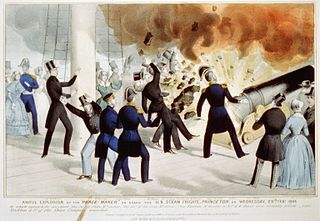
Princeton explosion

In February 1844, President Tyler and a crowd of VIPs, including Julia Gardiner and her father, were cruising along the Potomac in the steamship Princeton. The Princeton periodically fired its big gun, the "Peacemaker," and everyone was having a grand time, a little drunk, and Tyler's Secretary of the Navy ordered the reluctant captain of the ship to fire the gun one more time.

Tyler was doing a bit of wooing with Julia down below decks when the Peacemaker exploded. It killed her father and several other people, including Tyler's Secretary of State and Secretary of the Navy. It was the largest number of government officials killed in a single disaster in U.S. history.

The Princeton disaster was a personal and political tragedy: Tyler knew his hopes of reelection had just been crippled with the loss of his most important allies. But, in the aftermath somehow Julia came around to accepting Tyler's marriage suit. People snickered, but by all accounts they were quite happy together. Julia really liked being First Lady, and she also, it turns out, really liked being mistress of a Southern plantation with slaves and even livery on her carriage.

By the time he died, Tyler had had fifteen children between his two wives. Incidentally, one of his grandchildren is still alive (as of 2022!). Yes, John Tyler, born in 1790, has a living grandson. (How? His son also married a much younger woman, hence John Tyler's grandson being born over 60 years after he died.)

While waging a losing campaign for reelection, Tyler's last act in office was negotiating the annexation of Texas. This was very important to him, and he would fight for his historical legacy and his role in bringing Texas into the union long after he left office. He would sometimes skirmish with his former Secretary of State (whom he unwisely chose to replace the one who died on the Princeton), John C. Calhoun, who tried to claim credit for annexing Texas, and also with former Texas President and later senator, Sam Houston, who thought Tyler tried to claim too much credit.

Acquiring Texas was a legitimate accomplishment, and fit with Tyler's vision of territorial expansion. The problem was, he did so essentially by executive fiat, ignoring inconvenient questions of Constitutionality (echoing Thomas Jefferson's legally dubious Louisiana Purchase in 1803). Some historians blame John Tyler for reviving Andrew Jackson's "imperial presidency" and setting a precedent for presidents expanding their powers, which needless to say, their successors never try to reduce.

Of course, annexing Texas also triggered the Mexican-American war, and because Texas entered the union as a slave state, it was a major blow against abolitionists, as John Tyler intended.

And Tyler was unquestionably a white supremacist. He opposed recognizing Haiti because Southerners were scared shitless by the Haitian revolution, and he later encouraged the Dominican Republic's revolt against Haiti, just because the Dominicans tried to emphasize how "not black" they were.

Tyler and Slavery

Tyler was, by the standards of his time, a "Southern moderate." Meaning, he was firmly pro-South and pro-slavery, and like many of his slave-owning predecessors, engaged in elaborate mental gymnastics to acknowledge that slavery was a nasty and brutal business and yet vital to the social and economic order.

As a senator, he was so sickened by the sight of slave markets in Washington, D.C. that he unsuccessfully tried to make them illegal (the markets, but not slavery) in the capital. As the divide between slave vs. non-slave states sharpened, he would advocate his "diffusion theory," which was basically that by allowing slavery in more states, it would become more "spread out" with relatively fewer people actually owning slaves, and eventually it would... go away or something.

It wasn't a particularly logical theory, but it demonstrated the cognitive dissonance many such Southerners wrestled with. Tyler seemed unaware that he was implicitly acknowledging the fundamental immorality of slavery as he offered apologetics and mitigation strategies to preserve slavery while promising that someday, it would not be an issue.

To his credit, Crapol is neither uncritical nor overly moralizing in his assessment of Tyler. He clearly recognizes slavery as a moral evil that Tyler was guilty of, and points out his hypocrisy and participation in the "peculiar institution," while also letting the man defend himself in his own words (and pointing out where his words did not match reality). For example, Tyler clearly thought of himself as a kind and benevolent master whose slaves were better off under his care. Yet some accounts by former slaves (which Crapol acknowledges are historically dubious) characterize him as ill-tempered and mean. He might not have been a flogging, raping sort of slavemaster, but he definitely sold "troublesome" slaves down the river to Deep South plantations. Crapol tells an anecdote about one of his favorite slaves, named Eliza Ann, whom Tyler mentioned needing to sell in order to cover his expenses as a new congressman. He was apparently trying to sell her to a family friend, but thence Eliza Ann disappears from history, and no one knows what ever happened to her. Tyler never mentions her again.

His wife, Julia, completely embraced the "peculiar institution." After they had left the White House, she briefly won acclaim throughout the South by writing a letter, published in newspapers, rebuking the Duchess of Sutherland and other English ladies who had criticized American slavery. Her response was basically "lol myob, aren't there lots of poor people in England, and what about the Irish?"

The Traitor President

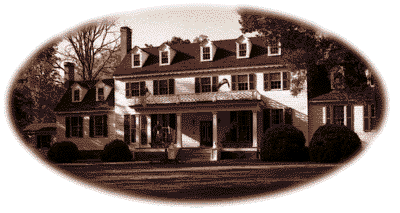
After Tyler left the White House, he retired to his Virginia plantation. He called his estate "Sherwood Forest."

Sherwood Forest

His plan, like Jefferson's, was to live the life of an idyllic country gentleman (with slaves) and be a wise, respected elder statesman. But the country was moving towards disunion.

It took a long time for Tyler to fully come over to the secessionist side. When the Southern states held a conference in which they argued that the American law against African slave trading should be abolished, and the African slave trade reopened, Tyler opposed it. The Southerners argued that if trading in slaves was immoral, then slavery itself was immoral. Yup, they almost got it. Except they worked backwards and said that since slavery was a good thing, there was therefore nothing wrong with the African slave trade, and the law against it was just a slap in the face to Southerners. Tyler's influence helped quash this resolution, but he continued to struggle futilely to prevent a break-up. He continued to believe in the union almost until the end. After Lincoln was elected, Southerners threatened to secede if the U.S. didn't open up new slave territories to even the balance. Tyler was a member of the Southern delegation that met with Lincoln. It didn't go well, as Lincoln basically gave them an "Elections have consequences" speech.

After the failure of the Virginia Peace Conference, which some historians believe was just a stalling tactic that Tyler was complicit in (Crapol appears to share this view), it was Tyler's granddaughter Letitia who raised the Confederate flag for the first time in Charleston. John Tyler was elected to the newly-formed Confederate Congress, but he died before its first session.

Later, his mansion was sacked by Negro troops during the war, including some of his former slaves. His widow Julia was most put out.

John Tyler is the only U.S. President who served under the Confederacy, which blackened his place in history as the only "traitor president." According to Crapol, he died in ignominy: no flags were lowered to half mast, there was no official recognition of his death from the White House. Only many years later was Congress ready to let bygones be bygones enough to grant his widow a small pension.

This is not the longest biography available about John Tyler: there is apparently a massive two-volume set that was supposed to be three volumes before the author got bored. But if you are trekking through presidential biographies and want some substantial but not massive coverage of each president, I think this one is a good, modern take on POTUS #10. Tyler won't be anyone's favorite president, but I appreciated seeing how he attempted to maneuver within the politics of his time. He definitely considered himself a moral and patriotic figure, and had enough of a conscience to perceive the cracks in his worldview, but not enough to change anything. He was neither brilliant nor incompetent, and his presidency, while not very accomplished, I don't think can fairly be called a complete failure, as he accomplished the few things that were probably within his reach. Except, you know, maybe preventing a civil war.
Profile Image for Christopher.
1,278 reviews45 followers
February 6, 2024
A disjointed look into a disjointed presidency.

Crapol's 2006 biography of the 10th president is a bit like its subject. All over the map. In much the same way that Tyler was a patrician Virginian who aped at being common and who claimed to be both a strict constructionist and Union man until presented opportunities to expand American territory or ultimately side with the Confederacy, Crapol never quite settles on a single narrative for his subject.

Neither totally chronological nor thematic, the book ping pongs between the two approaches and frequently inserts seemingly random excerpts (usually from family members) discussing Tyler's legacy.

It's unfortunate because despite being "His Accidency" and thr first vice president to assume the presidency following the chief executive's death, Tyler's administration was very much his own and his work to cement his authority AS president (rather than a mere placeholder) as well as his myriad efforts to expand American influence in the Hawaiian Islands and amex Texas (and the very creative ways he went about it) is fertile ground for some solid history, especially as Tyler's putative expansionism paved the way to Polk and full blown Manifest Destiny.

Tyler's post presidential life where he was really the first and only "traitor" president (in that he voted for Virginia to secede and supported the Confederacy) was another target of opportunity that, while handled competently, still feels relatively disconnected.

Alas, Crapol's odd literary choices meant that the book could never really settle into a groove to tell this story, and the effect is a scattershot and disjointed affair.
This entire review has been hidden because of spoilers.
Profile Image for Ramsey Meadows.
316 reviews27 followers
November 2, 2023
The writing was fine. Like all biographies, it's very informative. I feel like it tried to take a positive view of a fairly unimportant president. He was a traitor to the country he led, which is his most unforgivable sin. His best accomplishment was becoming president after Harrison died.
Profile Image for Joshua.
Author 6 books38 followers
April 29, 2017
Most modern Americans, if pressed to remember a single thing about Tyler, would think only that he wasn't very good. This book definitely helps to rescue Tyler from the darkness, and Crapol does a serviceable job with his thesis, to use Tyler's tragic failures as a kind of metaphor for the ider failures and anachronisms of the south. My first complaint was that Crapol spent very little time on Tyler's youth. I am more used to these biographies spending quite a bit of time there, but I don't think it is a major flaw in the book.

Here are some things that Tyler did that this book taught me: Despite his strict constructionist views, Tyler helped to hugely grow the strength of the executive and threaten legislative dominance. He used secret service funds to avoid congressional oversight, in paying Duff Green to be his "ambassador of slavery" in England, and in (probably) using agents in the Dominican/Haitian war. He dramatically increased presidential war powers by promising Texas military protection and moving troops to prove it.

Tyler's most important contribution to history is the "Tyler precedent" which forever instituted the precedent of VPs becoming president if the President vacates the seat. But he also was a driving and effective force in Pacific diplomacy, making definitive moves to secure Hawaii within the US sphere of influence, gaining access to China and both using missionaries and civilians as political tools and insisting on official protection of US citizens abroad.

He wasn't an incredible president. Crapol certainly does his best to paint Tyler kindly, and honestly too much at times - my largest complaint is that Crapol insists any later president arguing for Jeffersonian expansionism and American exceptionalism is echoing Tyler precedent. Tyler also bumbled quite a bit with his diplomacy with England. His use of joint-resolution instead of Senate treaty ratification in annexing Texas had long-term effects that fairly clearly were extra-constitutional. Worst, and probably best presented in this book, Tyler chose slavery over the Union. Crapol really does try to minimize this by pointing to Tyler's early statements about the moral issues with slavery. While not inaccurate, it is also true that in the end, Tyler is the only traitor president in US history because he really did believe in slavery as an institution.

The tragic thing for the union was that slavery became more important than anything else. Quotes from the text to support this are abundant: in 1860, Lincoln was asked to give up his victory. He said "we are told in advance, the government shall be broken up, unless we surrender to those we have beaten, before we take office."(p258). He pointed out accurately that "[they] will repeat the experiment on us ad libitum. A year will not pass, till we shall have to take Cuba as a condition upon which they will stay in the union." The driving wedge of slavery was most importantly in the South's growing certainty in slavery as a positive good (constantly argued and more and more believed by whites in the south) and the refusal to consider it as a moral issue. They pushed for empire, like Tyler, because they believed that continuing to move West (and south, and etc.) was necessary as a 'safety valve' for the union, largely as a distraction from slavery. Even by the 1820s, despite widespread beliefs, the idea of 'diffusion' was nonsense. The south wished to grow and to continue their spread of a slave republic. Growing international pressure pressed the North, who pressed the South, who entrenched. Their arguments became more and more hysterical.

Tyler left the union and became the only traitor president. The south started the war, first by seceding, then by attacking Fort Sumter. The North was standing in the way of the growth of the US, and most importantly, they were preventing the spread of slavery. The fact was that the Southern states had become incompatible with union. The north was not less racist than the south, or any more happy to live with blacks on even footing. But the south made it their sine qua non - that their destiny, slavery included, could not be trod upon by any force or threat, including the abolitionists. This was the tragedy of Tyler and the south: as Crapol says, "president Tyler rejected that vision of the future and abandoned both the union and his lifelong pursuit of national destiny...[he betrayed] his loyalty and commitment to what he had once defined as "the first great American interest" - the preservation of the union."(p283). Once slavery became more important than the republic and the union, war was unavoidable.
Profile Image for Paul.
245 reviews2 followers
April 19, 2010
South's peculiar institution....this is the phrase the author kept using instead of the word "slavery." After the 50th time, it got old. I will admit that the last half of this book was much better than the first half. But the big problem is this book reads more like a giant essay than a chronological biography. About 75% of the book deals with any correspondence Tyler may have had that reveals his views on slavery. The most interesting part of the book deals with the annexation of Texas, which Tyler deserves more credit than he gets from the history books. The author does a great job of detailing this. But you have to read 200 pages until you hear about this. You get detailed accounts of events (like a particular parade in NY) spread over 4-5 pages that should be summed up in a paragraph or two. It's also very repetitive at times.

There is VERY little mention of the early days of Tyler (pre-Presidency). In fact, the author totally breezes over his inauguration. And the death of his first wife. And the birth of any of his children. As I said, this is not a true biography, and my rating reflects the fact that this is more about the account than the man, because I truly find Tyler to be a fascinating President.

Peculiar institution? More like peculiar book. After many days of nodding off reading this book, I am glad to say I am finished.
Profile Image for Joshua Evan.
939 reviews11 followers
December 27, 2017
Not a traditional biography Crapol focuses almost solely on Tyler’s one term as president, which began after the death of incumbent Wm Henry Harrison in April 1841. The first VP to assume the office of President, Crapol highlights Tyler’s bold moves to assume power at a time where no precedent had been set.

At the same time Tyler is easily one of the most blatantly racist Commanders-in-Chiefs, an unapologetic slave expansionist who considered abolitionists rabble-rousers and believed that Britain hoped to sow seeds of discord in the US by spreading abolitionism in Texas. Oh, and he supported secession and joined the Confederate Congress.

Of note:

* He helped protect Hawaii’s sovereignty, expanding the Monroe Doctrine to the Pacific (Even if using an ulterior motive to stop British imperial expansion)
* Made first forays into China
* instrumental in annexation of Texas ... although again in the hopes of expanding slavery.
Profile Image for Melanie.
2,704 reviews14 followers
April 28, 2020
Not much is available on “Tyler too” as you will find in the conclusion his personal papers were destroyed in the Civil War. He set the precedent for the VP becoming POTUS, he is responsible for the Tyler doctrine, and annexed Texas. He was the first POTUS to have impeachment brought before the House, and if you knew history you already know he wasn’t impeached. He is also our only POTUS to be considered a traitor. I also learn he has a living grandson around today - older men marrying younger women kind of thing. It was scary how much relates to what is happening today. Overall an informative but not great book. It is divided into subject sections rather than chronological so it is hard to picture what happened when because I doubt they were clean lines, and this format lead to repetition of some parts. I was also bothered by the constant use of “peculiar institution” for slavery.
Profile Image for Brian Pate.
425 reviews30 followers
May 22, 2019
What if a racist, white supremacist somehow ended up in the White House?

This has happened more than once, but perhaps most notably in the succession of John Tyler to the presidency upon the death of WHH in 1841. Crapol makes the case that Tyler might have been our most pro-slavery president. He concludes with a fascinating analysis of Tyler's betrayal of the US by being elected to the Confederate House of Representatives.

This is not a biography proper, but rather an interesting analysis of Tyler's administration. His major achievements included the Webster-Ashburton treaty (1842), avoiding war with Great Britain, and preparing for the annexation of Texas.

Tyler believed in American exceptionalism, though he himself was infected with many of America's darkest flaws. To her credit, America is greater than the worst of her leaders.
403 reviews7 followers
June 4, 2020
While Tyler will never go down as one of the great presidents, his accidental term in office did set the table for many important events in US history; namely Texas annexation, recognizing Hawaii, and was a further presidential catalyst for the Civil War. There was an interesting story how he avoided death while in office due to a distraction that held him up from being in the line of an exploding cannon that claimed the lives of those in the vicinity. Ultimately, Tyler was a traitor to the Union and died with that moniker as well as being labeled as having abused many presidential powers while in office.
Profile Image for Stevejs298.
361 reviews3 followers
July 3, 2019
This biography provided lots of information on Tyler (Which was pretty easy because my knowledge base was zero). The book also gave me lots to think about regarding America in that time period in general, as well as similarities between issues then and now. Some frightening parallels on how the issue of slavery was characterized then, with how climate change is characterized now.
50 reviews
February 2, 2022
Tough subject, tougher balance to strike—between studiously explaining the moral framework of different factions in the late antebellum era without giving quarter to particularly contorted rationales which perpetuated slavery and other evils which we, in retrospect, can see clearly. John Tyler was certainly a flawed man and an accidental President. Though he never poses it this way, Crapol seems intrigued by the question: would Tyler’s legacy have been better if he’d been born and risen to office a decade or two earlier? Could he have been great in a different time?

Ultimately, Tyler’s life and presidency fail to excite, despite the fact that his era was filled with great social change and political maneuvering. I think this is in spite of Crapol’s best efforts. It’s just that all else is lost in the coming and overwhelming wave of the Civil War. The book is well done and thorough; though it demonstrates that the subject, John Tyler, certainly earned his reputation for mediocrity.
Profile Image for Alexandra.
757 reviews35 followers
December 9, 2021
Good book that hit important points without dragging on too long. Stylistically I don't think it was written that well, but I learned a lot, given that Tyler is an oft-passed over president who is really only mentioned in our history classes as the guy who solidified the mechanism of VP succeeding the President.

It was particularly interesting in illustrating how much Tyler did in international relations, and I thought the author did a good job of reiterating that Tyler's racial/slaveholding views were repellent and directly contradicted the fundamentals of what America wanted to me while also analyzing his arguments in the context of their time. At no point did I feel like Crapol was trying to vindicate or soften Tyler's reprehensible beliefs, but rather elucidate where they came from in juxtaposition with the time period.
Profile Image for Christy.
62 reviews
October 13, 2021
Lots of information but not presented in an easily readable or interesting way.
Profile Image for Dawn.
59 reviews
July 9, 2024
Very in-depth biography which was exactly what I was looking for.
Profile Image for Drew.
27 reviews
November 3, 2025
The author is both super based and presenting a compelling defense of Tyler’s horrible record. Came away impressed anyone could make him remotely interesting.
Profile Image for Darrell.
454 reviews11 followers
June 29, 2023
John Tyler was born into wealth and privilege on a Virginia slave plantation. (Incidentally, he was born just twenty miles from his future running mate William Henry Harrison.) His father Judge John Tyler was Thomas Jefferson's roommate at William and Mary and was elected governor three times. John Tyler was educated at the prestigious College of William and Mary himself and went on to practice law.

Tall and slender, Tyler was warm and affectionate and had a keen sense of humor. He relished parties and preferred champagne to hard cider (even though hard cider was an integral part of his vice presidential campaign). He liked to dance the Virginia Reel and play the fiddle. He fathered 15 children, the most of any president. He had toddlers underfoot until he was in his early seventies. He was a good public speaker and a prolific writer of letters and political tracts. He loved books and frequently quoted Shakespeare. There were 1,200 books in his library at the time of his death.

In 1813, at the age of 23, he inherited land and 13 slaves when his father died. In the same year, he obtained additional slaves from his marriage to Letitia Christian. He probably owned several hundred slaves over the course of his lifetime. Unlike other presidents, he never freed a slave, not even in his will.

He was elected to the Virginia House of Delegates at the age of 21. Tyler went on to serve in the US House and Senate. He was the governor of Virginia in 1826.

President Jackson's administration was okay with South Carolina's act of censorship in confiscating anti-slavery mail. As senator, Tyler and other southerners resolved to punish anyone printing anti-slavery pamphlets with "condign punishment, without resort to any other tribunal." Fortunately, the Williamsburg Resolution (which basically called for lynching abolitionists) was never carried out.

Tyler tried unsuccessfully to get slave auctions banned from DC while in the Senate because he found them distasteful. He was opposed to the slave trade, but not slavery itself. He thought slavery was unfortunate, but he was economically and politically dependent upon it.

Tyler thought the gag rule (which prevented any discussion of slavery in Congress) was counterproductive, and didn't vote on it. He resigned from the Senate because he refused to obey the Virginia legislature's instructions to vote to expunge the censure of President Andrew Jackson.

When President Harrison died in 1841, he was the first president to die in office. The constitution was unclear on whether the vice president became president outright or was only acting president until an election could be held. Vice President Tyler set precedent by taking charge and behaving as if he were president. Some people still referred to him as Acting President even three years later, but he paid them no mind.

He surprised his fellow Whigs by vetoing the national bank and tariff legislation. The Whigs considered him a traitor. His entire cabinet resigned except for Secretary of State Daniel Webster. The Whigs kicked him out of the party, and tried to impeach him. (Tyler was the first president to be confronted with impeachment hearings in Congress.) He was so unpopular, he received several death threats.

He was critical of Jackson for exercising too much presidential power, but once Tyler was president himself, a strong executive suddenly wasn't so bad.

Unlike the austerity and simplicity of John Quincy Adams' lifestyle, Tyler's White House had an aristocratic display of wealth, including slaves. There were rumors he fathered children with his slaves from journalist Joshua Leavitt, who was considered credible. A slave named John Tyler claimed to be his son. There was also a rumor of a slave named Charles Tyler who fled to England. (There are black people in Virginia today whose family legend says they were descended from Tyler, but no DNA testing has been done yet.)

Tyler stocked his cabinet with pro-slavery people and even sent an "ambassador of slavery" to England. Tyler believed the conspiracy theory that England wasn't really interested in the welfare of slaves, but used abolitionists to try to destroy America.

In order to prevent England from freeing slaves as they had during the Revolutionary War, Tyler improved the navy. He also created the Naval Observatory.

Tyler refused to recognize Haiti, despite it being a US trading partner since the 1790s, due to his racism. In early 1845, the Spanish-speaking Dominican Republic broke from the rest of Haiti and presented themselves as whiter than the other half of the island. They sought aid from America. Tyler jumped at the chance to destabilize the island. Towards the end of his term, there's evidence he sent arms and military supplies.

British subject Alexander McLeod was charged with the murder of an American in the burning of the Caroline by New York state. Tyler was worried McLeod's execution would start a war with Britain. The Constitution didn't give the federal government authority over the case, so Tyler couldn't prevent the execution, but he wanted to avoid war and promised Britain he'd get the law changed so this wouldn't happen again.

Tyler used secret agents to determine Britain's military strength, to sabotage Haiti, to promote slavery in Europe, and to convince Maine to settle its boundary dispute with Canada with a propaganda campaign and not provoke war with England. This last act violated state sovereignty, (Tyler is perhaps the first president to use public funds on a secret propaganda campaign) but was a major diplomatic accomplishment. He also worked with England to suppress the slave trade. (Jefferson had banned the slave trade, but Tyler actually did something to enforce the ban.)

McLeod ended up being acquitted and Tyler kept his promise to change the law. Even though he was a states right advocate, he saw the need for federal authority in some cases.

A few weeks later, tensions flared again when a slave revolt aboard the Creole led to slaves receiving their freedom in the British colony of the Bahamas. The British didn't even return the slaves who'd murdered their captors. Tyler smoothed this over. A treaty was signed that in the future, US and Britain would extradite persons charged with crimes.

Despite being in favor of free trade, he compromised his principles and signed the highly protective tariff of 1842, probably to meet the desperate revenue needs of the federal government.

Oregon was under dispute between the US and England at this time. Tyler used delay tactics in negotiations with England while secretly sending hundreds of pioneers to settle Oregon.

Dr. Peter Parker recommended Tyler send a representative to China to end the Opium Wars. This didn't happen, but two years later, Tyler did negotiate America's first peace treaty with China which opened up trade.

The monarchy of Hawaii was heavily influenced by protestant American missionaries and merchants. They got King Kamehameha III to outlaw Catholicism on the island. The French were outraged and sent a frigate to blockade the islands. In July 1839, Hawaii once again allowed Catholics and gave tariff concessions to the French. The Americans were worried the French intended to take possession of the islands.

One of his American advisors, William Richards, created a Hawaiian constitution and bill of rights. Hawaii was an important center of the whaling industry and a gateway to trade with China.

Tyler was reluctant to meet with Hawaii's dark-skinned ambassador or recognize Hawaiian independence (perhaps viewing it as another Haiti). He relented when it was pointed out Britain might colonize Hawaii if the US did nothing. The US recognized Hawaiian independence and promised not to take over the islands.

The Tyler Doctrine promised America would protect Hawaiian independence and warned other nations not to attempt to colonize the islands. It extended the Monroe Doctrine to the Central Pacific.

Tyler wanted to annex Texas from his first day in office, but abolitionist sentiment was a barrier. Secretary of State Daniel Webster was also opposed. In May 1843, he forced Webster and other anti-Texas members of his administration to resign and kicked the Texas campaign into high gear. Since the Whigs considered him a traitor, he was a man without a party and needed to annex Texas to get reelected president. He promised favors to postmasters who would distribute his campaign biography.

American settlers in the Mexican territory of Texas had claimed independence from Mexico and wanted to become an American state. Tyler was worried Britain had plans to do away with slavery in Texas (they didn't, but he didn't believe them) and considered it urgent to make Texas a state before this could happen. Abolitionists were opposed to adding another slave state.

Mexico, which had been fighting the recently arrived Americans in Texas for the past eight years, said they would declare war if Texas was annexed, but Tyler didn't believe them.

Tyler took a cruise on the Potomac aboard the frigate USS Princeton, a state of the art warship along with his future wife Julia Gardiner and others. A wrought iron cannon called The Peacemaker was fired several times during the cruise. Eventually, the captain said no more guns tonight, but the secretary of the navy pulled rank and insisted on one more firing. Tyler stayed below deck to listen to his son-in-law sing, which may have saved his life.

The Peacemaker exploded and killed several people including his girlfriend's father, Secretary of State Upshur, Secretary of the Navy Gilmer, Tyler's slave Henry, and several others.

He'd lost two of his best friends. He comforted Julia and married her four months later. He was 54 and she was 24. They lived happily together for almost two decades and had seven children together.

The loss of Upshur and Gilmer delayed his Texas annexation plans. To prepare for a possible war with Mexico, Tyler deployed military forces to the Texas border without the knowledge of Congress. He wanted the treaty with Texas to be kept secret until after the Senate ratified it, but it leaked to the press. The document indicated the real reason to annex Texas would be to preserve slavery, not to help the economic interests of the country as a whole as Tyler wanted the public to believe.

The leading candidates for the Whig and Democratic presidential nominations (Tyler ran for reelection as a third party candidate), were opposed to annexation, as was Tyler's own Secretary of Treasury John C. Spencer who refused to finance the naval force to the Gulf of Mexico. (He viewed it as illegal since Tyler didn't get Congressional approval.)

The Democrats elected dark horse candidate James K. Polk instead of front runner Martin Van Buren. Since Polk was in favor of annexation, Tyler withdrew from the race and threw his support behind Polk. Polk barely won the popular election.

The annexation treaty failed to get 2/3 of the Senate. Tyler then called for a joint resolution which only required a bare majority. Congress argued over whether this was constitutional or not, but ended up voting to let the president decide annexation, assuming president-elect Polk would make the decision. (Polk apparently said he'd renegotiate the annexation to get Mexico's approval and not make Texas a slave state.) However, Tyler surprised them by annexing Texas in his final days in office, making him responsible for the Mexican American War.

Although Tyler himself didn't profit from admitting Texas into the union, many of his advisors were speculators and did profit, making his administration seem corrupt. In fact, annexation wouldn't have passed the Senate except for the vote of Benjamin Tappan who was originally against, but changed his vote in order to get $50,000 in Texas bonds.

At a farewell party, he joked that people could no longer call him a president without a party. He retired to his Sherwood Forest plantation in Virginia.

There's conflicting accounts regarding whether Tyler was a kind or harsh slave master. A white visitor claimed his slaves were uniformly happy, while a former slave claimed Tyler was cruel. He didn't free his slaves upon his death. They trashed his estate after the Civil War, so it doesn't seem like they liked him much.

When Lincoln became president-elect and southern states seceded, Tyler convinced President Buchanan not to take military action against the seceded states. He voted for Virginia to secede from the Union, negotiated terms for Virginia's admission into the Confederate States of America, and got the capital of the Confederacy moved from Alabama to Virginia. He was representative-elect in the Confederate Congress at the time of his death in 1862, making him the only traitor president.

Except for Tyler's mother-in-law, the rest of the Gardiner family was on the Union side, breaking the Tyler family apart. Virginia was also divided with West Virginia breaking off from the rest of the state and joining the Union.

Two of his fellow William and Mary classmates and native born Virginians, General Winfield Scott (appointed general by Tyler) and Senator John J. Crittenden of Kentucky, opposed secession and remained loyal to the Union. Crittenden pointed out that the slave states could have blocked any attempt to end slavery if they had remained with the union. Even Tyler's former classmates considered him a traitor.
Profile Image for Joe.
389 reviews8 followers
October 3, 2024
An author loses a lot of credibility when he basically opens a book by saying that John Tyler was one of the most devoted Americans ever but adds, until he sided with his home state in the Civil War. Of course that is not exactly how it is written but pretty close and I had a hard time deciding what was true going forward.
That being said, Tyler did have a few good moments. The most important came when William Henry Harrison died just months into his presidency. This was the first time it had happened and many people thought the Vice President should simply become the interim president until a new election could be held. Tyler said "nope" and presidential succession was confirmed.
Profile Image for Steven Peterson.
Author 19 books324 followers
January 29, 2010
John Tyler was referred to derisively as "The Accidental President." Why? He was the Vice-President elected as Old Tippecanoe, William Henry Harrison, became President. Within a shockingly short period, Harrison dies and Tyler became acting President. Since he was the first Vice President to ascend to the presidency, there were no precedents to guide him and the country. One of his major contributions was, simply, to take firm hold of the Presidency and act as if he were President.

This biography does a nice job of introducing us to one of the lesser known presidents of the United States. Edward Crapol, the author, believes that (page 3) ". . .[Tyler:] was a stronger and more effective president than generally remembered." If one accept that sentiment by book's end, then Crapol has written an effective work. If one does not accept that conclusion, then this book, obviously, will not be compelling.

Tyler was one of those cross-pressured southern politicians who was, on the one hand, most uncomfortable with slavery as an institution, but, on the other, wed to the ways of the South, which, of course, were based on slavery. Crapol argues that Tyler felt that by expanding the size of the republic, "diffusion" would occur. That is (page 37), "Development over space would thin out and diffuse the slave population and, with fewer blacks in some of the older slave states of the upper south, it might become politically feasible to abolish slavery in states like Virginia." Tyler himself, it should be mentioned, was a slaveholder.

As a result of this "diffusion" argument, Tyler was even more motivated to expand the republic when he became president. He appears to have believed in a national manifest destiny, with the scope of the American state expanding from sea to sea. Among key initiatives that suggested his expansive view of America's destiny: his keenness on advancing American interests around the Pacific Rim (from Hawaii to China); his movement toward annexing the Republic of Texas as one of the American states (as a slave state); his interest in considering California as a potential free state.

Interestingly, some have suggested that Tyler's efforts to exercise power mark him as historically important. The author notes that (page 281) "Arthur Schlesinger, a historian who has traced the development of what he has labeled `the imperial presidency,' credited John Tyler, along with James K. Polk, for the rescue and deliverance of the Jacksonian doctrine of presidential power and independence." In the end, Tyler's desire to serve a second term was thwarted, as the enemies within his party made that impossible.

The last part of his life is somewhat unfortunate. He ended up supporting secession and lived long enough to see the early part of the Civil War.

This book is interesting for making the case that Tyler is a more important figure than often recognized. The author provides good context and enough detail for readers to determine if they concur in that judgment.
Profile Image for Debbie.
58 reviews8 followers
November 14, 2008
This book did show some positive sides of this 'traitorous accidental president' - like the annexation of Texas, open relationships with Hawaii/Pacific and China, and most importantly his bold actions in taking over as president when President Harrison died, thus setting the precedence for all following which eventually led to the 24th (or 25th - can't remember) amendment to the constitution that the Vice President would take over if the President was no longer able to hold the office. He did have a lot of weak areas and bias opinions - but I think every President does. Just some shine out more to the public depending on what the state of the country is in. One thing I found interesting was in one of his quotes showing his discrimination towards blacks he stated something to the effect that if Virginia stayed with the union (this was after he was president) and followed the lead of how northerners and abolitionists were heading that the congress might find themselves sharing the rows in congress with 'men like Fredrick Douglas'. He was worried about being in Congress with a black man - and now we have a president that is! This country has come a long way. It's been through a lot and will still go through a lot - but I still think it is the best country in the world. Reading about the presidents and how each one helped shape it a little at a time has strengthened my patriotism in the great United States of America.
Displaying 1 - 30 of 171 reviews

Can't find what you're looking for?

Get help and learn more about the design.