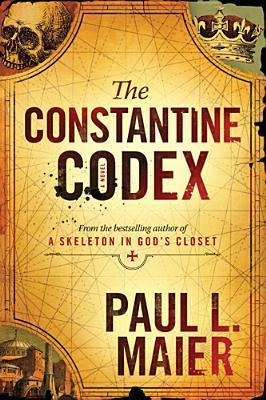
Harvard Professor Jonathan Weber is finally enjoying a season of peace when a shocking discovery thrusts him into the national spotlight once again. While touring monasteries in Greece, Jon and his wife Shannon―a seasoned archaeologist―uncover an ancient biblical manuscript containing the lost ending of Mark and an additional book of the Bible. If proven authentic, the codex could forever change the way the world views the holy Word of God. As Jon and Shannon work to validate their find, it soon becomes clear that there are powerful forces who don’t want the codex to go public. When it’s stolen en route to America, Jon and Shannon are swept into a deadly race to find the manuscript and confirm its authenticity before it’s lost forever.
Paul L. Maier was an American historian and novelist. He wrote several works of scholarly and popular non-fiction about Christianity and novels about Christian historians. He was the Russell H. Seibert Professor of Ancient History at Western Michigan University, from which he retired in 2011, retaining the title of professor emeritus in the Department of History. He previously served as Third Vice President of the Lutheran Church–Missouri Synod.
Only if Indiana Jones were to discover a lost book of the Bible, battle his way past Islamic terrorists and later sneak into the inner recesses of the Vatican — only then, would an adventure story compare favorably with those envisioned by Dr. Paul Maier, professor of ancient history at Western Michigan University. Dr. Maier is famous for his academic work which includes accessible editions of Eusebius and Josephus. His fiction works, however, have sold millions of copies, and with A Skeleton in God’s Closet, he virtually created a new genre of fiction: the archeological/theological thriller.
The Constantine Codex, released by Tyndale House just this May, is the third book in the “Skeleton” series. It continues the story of archeologist and Christian scholar Jonathan Weber and his escapades. The tale begins with the discovery of a few leaves from the lost works on early church history written by Hegesippus, on whom Eusebius leaned in part for his monumental work on the early church. The contents of those leaves hint at a previously unknown book from the pen of Luke, the author of a Gospel (bearing his name), and the book of Acts — both of which are in the Christian New Testament. Fascinated by the implications, Jonathan Weber and his wife Shannon (who unearthed the missing leaves) plan to embark on a mission of discovery — searching for authentication of their discovery, and the cooperation of the librarians of many of the greatest treasures of ancient Biblical manuscripts. Before they can leave, a world-wide commotion erupts over the Arabic translation of Weber’s influential textbook on the New Testament, and Weber ends up on the receiving end of a fatwa (a death warrant given by a Muslim ayatollah). With the CIA fearing for their safety, the Webers push on and embark on their trip in pursuit of a lost chapter of church history. What they eventually find will change their lives, and the history of Christianity, forever.
This fast-paced tale takes the Webers from the Roman tomb of St. Paul, to a dark subterranean chamber reserved for manuscripts in disrepair, and leads to a world-class debate with a leading Muslim intellectual in no less a venue than the Hagia Sophia. And all of this pales in comparison to the incredible discovery of lost portions of the New Testament and the challenge this presents to Weber and his foundation of leading Christian scholars of multiple disciplines.
As Maier weaves this tale he includes equal potions of intrigue and suspense, with wonder and raw emotion. His technical discussion of the authentication of manuscript finds and ancient scribal practices is spot on, and his ability to describe and draw you into the scene is superb. Archeology, theology, textual criticism, church history and intra-church politics — all of these disciplines and more are tapped as Maier expertly crafts this story. The result is a tale which is intellectually satisfying, experientially rich and a fantastic read to boot.
Maier is a master writer, and The Constantine Codex stands testimony to that. Having not read Maier before, I was pleased to find that this did not detract from following the storyline of this book at all. If you’re looking for a great adventure tale, and especially if you are fascinated by archeology, theology or textual studies, you will want to read this book.
Disclaimer: This book was provided by Tyndale House Publishers via Glass Road Public Relations. I was under no obligation to offer a favorable review.
I had the pleasure of attending several seminars of Paul Meier's about 10 years ago. He has devoted his life to deep study of scripture and ancient civilizations and he is VERY smart...yet he has a way of speaking that is not condescending but rather allows those of us who have not studied these topics to really understand. Unfortunately in his fictional works, this can come across as condescending. Since I've heard him speak before I very much identify with him as the Jon Webber character. I loved the premise of the novel...the thing I had the most trouble with was the description and dialogue between Jon and Shannon. It did not seem realistic at all.
If you are looking for a Dan Brown type novel, this book will not be for you. Actually that will be a compliment to this author as he coauthored a book refuting much of what was passed off as fact in The Davinci Code.
When Maier writes historical fiction, it is wonderful (I highly recommend his book on Pontius Pilate). But when he writes more (near) future fiction, the storyline falters. This book did well in describing church history when needed, and even how ancient textual codices were written. But the ecumenical sentiments and beliefs about an open canon which were present in the book were not as agreeable.
On a archaeological dig Shannon is disappointed at what she has unearthed, hoping to have found something of more value she decides to visit an old church built on ancient grounds. There in the dusty caverns of the library she comes across a codex (or letters) tucked into a book. Not knowing exactly what she has stumbled upon she asks to take the manuscript home with her for her husband Jon, a Professor and renowned author, to look at. Upon looking at it they find what appears to be an important manuscript that may rival the dead sea scrolls.
However, before they can discover more controversy over Jon's book erupts and threatens to tear apart their world as the Muslims declare a Fatwa on Jon. Thus the non stop action, suspense, twists and turns begin.
Though the plot is very well developed and the story line is good I found this book difficult for more to get involved in. In fact I had to begin it again several times after putting it back on my "to be read" shelf behind the other books there. It is no fault of the author - I believe those who enjoy books that are based on such themes would greatly enjoy this. The author has done an extraordinary job at developing every part of this book. The characters and plot are well developed and the descriptive nature is wonderful. One can actually imagine one's self in the places and feel the tension and excitement at each twist and turn.
If you read the Da Vinci Code you will love this book because it is similar only more action packed.
If you have read and enjoyed other books by this author I have no doubt you will enjoy this one also. I just expected something different and found it to be a little dry at parts.
Thank you to Glass Roads Public Relations for this review copy.
Although this was book 3 in a series, it reads well as a stand alone. A cross between Dan Brown's Da Vinci Code and Indiana Jones, this book kept my interest throughout. Harvard Professor Jonathan Weber is finally enjoying a season of peace when a shocking discovery thrusts him into the national spotlight once again. While touring monasteries in Greece, Jon and his wife Shannon--a seasoned archaeologist--uncover an ancient biblical manuscript containing the lost ending of Mark and an additional book of the Bible. Filled with wonderful references to the Bible, this book although fiction definitely made me wonder if there are more hidden treasures just waiting to be found similar to the Dead Sea Scrolls. Good characters, intriguing plot and good research made this a very good read. I will definitely go back and read books 1 and 2 in this series.
The premise is intriguing. A biblical scholar and his wife discover a copy of the New Testament older than any that currently exists – going back to the time of the emperor Constantine. This by itself would be a major find and a boon to biblical scholarship but there’s more, it’s not just an older copy but one with additional text never before seen. This raises the question of canonicity – should this new material be included in the Bible? Against this backdrop the protagonist also finds himself involved in a Christian / Muslim debate before a world-wide audience which subjects him to the wrath of radical Muslims.
Given the potential in this plot, I dove into this book with much excitement – most of which quickly evaporated. The book is not well written. It is full of clichés and the descriptive language is often downright corny:
“Silence in the room was deafening…” (p. 263)
“The explosive joy suffusing Jon when they kissed rapturously after that first hug he later called “one of the greatest moments in my life.” (p. 370)
The historical data woven into the story often seems tacked on just to get the information in rather than flowing naturally from the plot. For example, when crossing to Mt. Athos, we read:
“Jon could only hope that the weather would stay favorable, recalling that a fierce storm had destroyed an entire Persian fleet off the coast of Mount Athos in 492 BC, two years before the great Battle of Marathon.” (p. 75)
What does a storm that happened over two thousand years ago have to do with the outlook for the weather today? That’s like going to Naples and saying, “he could only hope the volcano didn’t erupt destroying the city, recalling that Pompeii and Herculaneum were destroyed by it in 79 AD”
The plot has great potential for intrigue and excitement but unfortunately everything happens easily and right on queue. There’s little suspense and no attempt to make very unlikely events seem believable. After hundreds of years, one of the most sought after copies of the New Testament in all of history is found simply lying at the bottom of a bookshelf in plain sight in the Orthodox patriarchate in Istanbul after a five minute survey of the room by our heroes.
But, what bothered me the most were the theological assumptions of the book. To be sure, this is a work of fiction, but all fiction is to some degree based on truth. And for Christian writers, when writing fiction that touches on theological topics, precision and accuracy are as important as in non-fiction books – perhaps more so. To be fair, there were several times when theological topics were handled well. For example there’s a good discussion about the double standard that exists when criticizing Islam as opposed to Christianity. But, there were also times when precision was required but was lacking. For example, when thinking about the whys of monasticism Jon (one of the main characters) notes that it is common among the world’s faiths. He also notes that St. Paul spent three years in the desert after his conversion then, without skipping a beat, relates the story of Siddhartha Gautama, who left his wife and child to explore the meaning of life:
He was there for seven years until he finally found the answer while sitting under the Bodhi tree and became the first “Buddha,” or “Enlightened One.” (p. 56)
He wonders (“ruminates”) to himself why such behavior is common and concludes that perhaps it’s easier to hear God in the desert. But the passage makes no differentiation at all between Buddha’s experience and Paul’s. Did Buddha find the “the answer” and was his experience as legitimate as Paul’s? I doubt Maier (or his character Jon) would answer “yes” but lack of precision leaves the reader wondering.
Then there is the fawning deference given to Roman Catholicism and Eastern Orthodoxy:
“…it was quite an honor to be hugged by no less than the eastern pope himself—and even be kissed on both cheeks.” (p. 234)
“Wow! Coming from the pope himself, that’s . . . quite humbling.” (p. 288)
This kind of effusion happened whenever Roman Catholic or Orthodox leaders were encountered. It was like listening to a teenage girl who vows never to wash her cheek again after being kissed by Justin Bieber. The deference also showed itself in other ways. Those who use the questionable longer ending of Mark’s gospel to sanction snake handling are “pathetic” (no argument there) but the Orthodox monk who thinks his monastery has the finger of John the Baptist among their relics is “sincere” and a “dear brother.” This double standard seems to be a result of the author’s selective ecumenism as revealed in a passage about Jon and his Roman Catholic friend:
As they matured, however, each had moved from a right-wing conservatism to a centrist, more ecumenical stance. (p. 293)
Christian maturity is the willingness to ignore real and significant theological issues – things such as the nature of justification – and those who don’t are “right-wing conservatives” who probably use the Bible like a talisman (p. 102) – which is apparently worse than using the petrified body parts of saints that way.
The overarching assumption of the book is the existence of a “Christendom” where the Reformation never took place (or has little importance) and the Church is primarily Roman Catholicism and Eastern Orthodoxy – with a bone thrown to a couple of the more liturgical protestant denominations (the main character is Lutheran). Trouble is, “Christendom” no longer exists – if it ever really did. In the end, it’s not just a lost codex that needs to be rescued from the early middle ages but the world-view of the characters in this book as well.
I give it three stars, because I like the theme of the plot line: a discovery of an ancient manuscript with far-reaching consequences and how that potentially work out.
This book is far less suspenseful than Maier’s other books and the unrealistic and condescending way Shannon is portrayed as Jon’s counterpart, almost made me give it a 2-star ranking. I’d recommend the author to simply leave out Shannon in any next publication or give her more academic prominence in the story instead of letting her only complement Jon.
Ik vond het echt een goed verhaal. Historisch gezien was het enorm goed onderbouwd, alleen ik vond het wel jammer dat richting het einde van het boek het verhaal opeens enorm versnelde. Hierdoor vond ik het einde een beetje een anticlimax
For the word of God is alive and active. Sharper than any double-edged sword, it penetrates even to dividing soul and spirit, joints and marrow; it judges the thoughts and attitudes of the heart. ~Hebrews 4:12~
Sometimes I take for granted the power and beauty of the Scriptures. I recently finished a book that brought this home to me in an entertaining way: The Constantine Codex by Paul L. Maier.
In this novel, archeologists Jon and Shannon Weber uncover an ancient biblical manuscript containing the lost ending of Mark plus another letter from a New Testament author. At first, I couldn’t suspend my disbelief long enough to really get into the story. So I did some reading about The Dead Sea Scrolls, which were uncovered in 1947—during modern times—to remind myself that God’s world still holds many wonders and mysteries yet to be discovered.
The Constantine Codex is fast-paced, exciting, and informational. Since Jon Weber has friends all over the globe, the action takes place in exotic lands as well as here at home. And since he’s a Harvard professor, he and his colleagues are able to both explain the significance of the ancient texts and debate the merits of their faith systems as they do so. Somehow Jon ends up with a possible fatwa on his head, explores crypts with the help of a buddy from the Vatican, and yet finds time for romantic dinners with his beautiful wife Shannon, who actually found the codex to begin with.
I enjoyed the elements of this story that reminded me of a National Treasure type adventure set in Bible lands. But the scenes that spoke to me most were the ones where the Christian scholars read the codex to each other. Their reverence for the Word, their tears over the apostles’ courage in the face of death, their determination to defend the faith at all costs touched my heart. These fictional characters inspired me to make sure I haven’t lost my first love for God’s Word!
The Constantine Codex by Paul L. Maier is his third novel featuring the famed archaeologist Jonathan Weber. In this book Dr. Weber and his wife Shannon stumble upon one of the lost copies of the Bible commissioned by the emperor Constantine in the early fourth century. It is found in a so-called geniza or storage room for discarded or damaged manuscripts at the Eastern Orthodox Patriarchate in Istanbul (Constantinople). What makes this find of such great importance is that not only is it the earliest copy of the Bible ever discovered, but it also contains the lost ending of Mark and an Acts 2 (or second books of Acts) detailing the death of St. Paul. If genuine, and not a forgery, it raises the difficult question of whether these missing parts should be added to the Biblical Canon. Of course, there is much more to the novel than just this. Also included is a debate between Dr. Weber and a moderate Islamic scholar. Maier’s aim is to “educate while entertaining.” In discussing his novels, he states, “I always try to paint a background of solid fact…” Dr. Paul L. Maier is in a position to do so. He is a professor of ancient history at Western Michigan University and the author of a new translation and commentary of the works of Eusebius, the first Christian historian. In addition, he has led tours to the Holy Land, Italy, Greece and Turkey that allows him to add authentic details to such mundane matters as a hotel or restaurant. This makes his novel seem realistic and plausible, and the reader occasionally needs to remind his or her self that it is just a work of fiction.
While the main plot of the book is a thrilling search after an archeological find to uncover an ancient manuscript that could lead to another bible, and the forces who don't want this codex to be made public, I found the secondary plot more interesting, as it contained a debate between a Harvard professor and a expert theologian in Islam comparing Christianity with Islam. The content of the debate provides good arguments equally for each religion, while not shying away from pointing out inconsistencies in both.
Maier provides us with a look at biblical history while holding us enthralled by the twists in the complex thriller.
The Constantine Codex is the third book in which the main characters are Jon and Shannon. Dr. Maier uses research and his knowledge as a professor of Ancient History to create wonderful religious novels centered around the finds within archaeology. While the 1st two novels, A Skeleton in God's Closet and More Than a Skeleton, involved archaeology they dealt more with the difference between the Roman Catholic faith and main line protestantism versus fundalmentalist Christianity. The Constantine Codex is the growing conflict between Christianity and Islam. The difficulty facing the Eastern Orthodox Church in Islamic countries was highlighted.
Paul L. Maier, $9.39 on Kindle *** Are there important relics lying buried and undiscovered in rubble? Important parchments lying in anonymity in remote corners of the world's libraries and churches? Of course there are.
This is the fictional story of the discovery of a pair of such documents. Not much drama, and the main characters are a little too good to be true, but a good tale nonetheless, and with an uplifting sub-plot.
I enjoyed this book, but I got it when it was offered FREE on Kindle. I don't know that I'd have felt I got my money's worth if I'd paid the full $9.39 now being asked. Just saying.
Paul Maier recently retired as a professor at Western Michigan University in ancient history. This is his second sequel to "A Skeleton in God's Closet," a religious thriller, kind of like Indiana Jones meets Robert Langdon. This time, Jon and Shannon Weber uncover what might be a missing book of the Bible. The book dwells a bit too much on academic issues that probably have little interest to the general public, the characters fail to come to life, and it is probably 100 pages longer than it needs to be.
This was pretty good...similar to books by Steve Berry and Dan Brown. I really liked reading a thriller that didn't trash the Catholic Church (for a change). Good characters and some twists in the story made the story exciting.
It's precisely because I enjoyed the book that I'm typing up this review. It's mostly a collection of my criticisms. There's no point in commenting on the positives of the book other than to say that Maier can write an enjoyable story. I personally like Paul Maier, but I'm dissappointed in some aspects of the book. He makes some mistakes which are regrettable. Some of them due to the fact that he sometimes discusses topics outside of his expertise. My comments will be succinct since they're really made for those who have already read the book. So, they'll know the context in which I'm making them. My comments won't be in any particular chronological or logical order.
WARNING!!! Spoilers Ahead!!!!! DO NOT continue reading if you don't want the story of the book revealed. Read the book first, then read this review afterwards (if you wish).
The arguments the Muslim characters in the book make are the standard bad arguments that popular Muslim apologists often use for Islam and against Christianity. One would have expected the character Abbas al-Rashid to have used better arguments (like those used by the real life apologist Shabir Ally).
In the debate between Jon Weber and Abbas al-Rashid, Jon (the Christian) does a pretty bad job at defending the doctrine of the Trinity. For example, in addressing Islamic incredulity regarding the Trinity, Weber cites Augustine twice (pp. 157 & 173) as saying "Credo ut absurdum est!" and translating it "I believe because it is absurd". Upon reading that, it seemed to me that maybe Maier accidentally attributed to Augustine what Tertullian actually wrote ("prorsus credibile est, quia ineptum est"). How is that supposed to engender belief in the doctrine if you start out admitting it's absurd or illogical? Maier as a (fellow) Christian should have been more careful.
On page 156 Weber says, "Similarly three golden denarii are three in number but one in essence: gold. The one does not contradict the other...." The character Weber is supposed to be a Lutheran (like the author himself). In which case, Lutherans (and Evangelicals in general) believe God is one in being/essence and three in person. While some scholars have argued that some of the early ecumenical councils taught the distinct beings of the Father, Son and Holy Spirit who share generic unity, not numeric unity; this view is virtually rejected by all Evangelicals. I myself am open to this view that some have called "Nicene Monarchism" [generic unity], though my provisional and default position is the standard Evangelical understanding [numeric unity]. I suppose one could argue that the character saw himself as going back to the original intent of Nicaea I. But that's nowhere in the text of the novel itself.
On page 152 the narrator says, "Jon was less than comfortable in realizing that Abbas had immediately attacked the one logical weak point of Christianity." The fact is that there are various formulations of the Trinity that aren't formally and explicitly contradictory. That Maier would leave it at that in the book is a disservice to Christianity. It gives all readers of his novel (whether Christian, Muslim, atheist, et cetera) the impression that the doctrine of the Trinity actually is illogical, or that Christian apologists don't have solid answers to such criticisms. Which they do. One of my own blogs is devoted solely to defend the doctrine of the Trinity.
On page 249 Second Acts has Paul referring to Jesus as "the emanation of God." While some of the early church fathers conceived of the Logos as a kind of emanation, nowhere does the apostle Paul teach that in the canonical Scriptures. That can give modern readers the impression that that's a standard understanding of the Logos among modern Trinitarians Since it's Maier who's inventing the dialogue in 2nd Acts. Maybe Maier is expressing his own unique personal view of the Logos and of Christology in the narrative. But, it certainly would confuse or misinform some people who might be trying to learn theology from the novel. Something people will naturally do, even though they should know better than to do that with fiction.
On page 113 Weber finds the books by the "Caner brothers" helpful in preparation for his debate. Maier should know that the Caner brothers are proven frauds (cf. the various exposés by Christian apologists like James White). Weber also prepared for the debate in isolation when he would have been smart to enlist help from some Christian apologists whose expertise is on Islam (e.g. Nabeel Qureshi [when he was still alive], David Wood, James White et al).
Weber could have declined the invitation to debate since he's not an expert in Islam. That could have freed him up to do the other things he was more eager to do.
The narrator (presumably representing Maier's views) isn't neutral on the issue of whether Islam is a religion of peace or not, or whether terrorism is a genuine or inauthentic expression of Islam. Not only Christians, but Muslims are in disagreement among themselves on this issue. Yet the narrator takes a side. Even saying Jihadist terrorism is a "hijack[ing of] Islam" (p. 387) and approvingly cites Tahir ul-Qadri's public declaration that [in the words of Maier's book] "terrorists were the very enemies of Islam and that suicide bombers were destined not for heaven but for hell" [p. 387]. The fact is that a good case could be made that Islam is not a religion of peace, but of terror. See the materials by David Wood, Robert Spencer [not to be confused with white supremacist Richard B. Spencer], Sam Shamoun et al.
On page 186 Weber's Roman Catholic friend and priest Monsignor Kevin Sullivan says that the Pope was so pleased with Jon that the Pope could almost have given him a red hat [i.e. the position of Cardinal in the Catholic Church]. Weber then says that in order for that to happen, he would need to convert and dissolve his marriage, since priests aren't allowed to be married. Apparently Maier doesn't know that special dispensations have been given by the Roman Catholic Church for converts who were high ranking church ministers in their former denomination to become priests in the Catholic Church while also keeping their wives.
On page 158 Weber refers to the similarity between the Dead Sea Scroll of Isaiah and the Masoretic text. Yet, that gives a false impression that could trip up some Christians if they knew that that kind of similarity is missing in the Masoretic text and the Dead Sea Scrolls regarding the book of the Jeremiah and other manuscripts/fragments (et cetera). He makes similar statements regarding the New Testament text on page 157 even though there are entire pericopes which are disputed (e.g. the longer ending of Mark, the Pericope Adulterae, the Comma Johanneum etc.). The issues are more complex than Weber acknowledges, even though the textual difficulties don't jeopardize the truth of Christianity. At least Weber/Maier acknowledges and mentions the questionable nature of Mark 16:9-20 in the rest of the novel. In fact, it's a central issue since the discovered Constantine Codex allegedly contains the real ending of GMark.
On page 172 Weber states that the Caliph Uthman first wrote down the Qur'an 20 years after Muhammad's death. No, there were already many competing collections of the Qur'an circulating at the time. Uthman wasn't the first to write down portions of the Qur'an. Rather, Uthman was the one who standardized the text by publishing his own version after telling everyone to give him their copies and burning their different versions. By doing so he destroyed vital evidence for reconstructing other versions of the Qur'an that were then extant. Whereas on the Christian side, the very multiplicity of textual variants AID in reconstructing the original autographa to a high degree of accuracy.
On page 177 Weber thinks the Islamic doctrine of abrogation undermines Allah's perfection. But that doesn't necessary follow. In fact, a similarly bad argument could be made against Christianity in that God "replaced" the Old Testament with the New Testament. I would argue that it really wasn't replaced since the Old predicted and anticipated the New. The New builds on the Old without completely replacing it. Having said that, it's true that the ceremonial laws in the Mosaic Covenant are no longer binding on Christians. In which case, Weber's mental—but unspoken—criticism would apply to Christianity. Weber silently thinks, "Well, why didn't the deity get it right the first time? Didn't he have a second cup of coffee that day?" Instead, Weber states in the debate a more modest criticism, "One only wonders why anything that God did or said would need improvement." If misapplied, this type of criticism would require a misrepresentation of both Islam and Christianity to work. If properly applied, it would only damage (true) Islam. And that to a lesser degree than most objectors to Islam would like.
Though, Weber does give some good arguments against Islam in the course of the debate. For example, on page 180 he points out that that the truth of Islam hinges on the testimony of one man (Muhammad), whereas the truth of Christianity hinges on the testimony of many (including Jesus, the Apostles, and the other disciples etc.). Maier rightly points out in the novel that Muhammad originally wondered whether he was seized by an evil spirit or jinn. And so, making Muhammad's claims that less reliable or trustworthy. Since it basically boils down to the testimony of one man. A single man who feared he might have been demonized or possessed by an evil spirit. Unfortunately, if I recall correctly, Maier/Weber didn't used that argument even though he acknowledges the historical fact of Muhammad's original fear and suspicion.
Weber was unwilling to use the Hadith to criticize Islam because even Christians have unreliable traditions and legends. However, some of the stories in the Hadith are considered more reliable than others. He could have used those which have historically been considered more reliable than the others to undermine Islam. Depending on the Islamic sect, some accept the Hadith (plural: ahadith) to have some value, while others hold to only to the Qur'an. Nevertheless, some of those traditions are so embarrassing and damaging to Islam that some Islamic apologists who belong to sects that accept the Hadith have basically abandoned their former stance on their reliability. Or at least disagree with the grading and levels of reliability traditionally attributed to each tradition or story.
The debate between Weber and al-Rashid was an all day affair, yet there's no mention of periodic breaks to accommodate the Islamic practice of prayers fives times a day.
Muhammad is said to have given a general amnesty when he returned and conquered Mecca. Yes, it was a "general" amnesty, but some of Muhammad's enemies were still specifically sought out and executed.
On the one hand Weber acknowledges that there are parallel (apparent) problems between Christianity and Islam. For example, 1. OT law and Islamic Sharia, 2. the behavior of Christians during the Crusades and Spanish Inquisition, Jews during the invasion of Canaan and Muslim Jihad. Weber points out that these parallels make it that Christians have to be careful how they criticize Islam because such criticism could backfire on their own Christian position. Yet, on the other hand, Weber does make such criticisms of Islam with no further explanation. For example, Weber claims the sharia laws of the Qur'an are demeaning to women. Yet, non-Christians could (though wrongly) claim the same thing about the Bible. Weber's criticism seem contradictory or inconsistent because they're incomplete.
Shouldn't Weber have realized that if he were discovered disturbing the possible tomb of the apostle Paul that he could be jeopardizing the credibility of his work on the Constantine Codex? The very opposite of what he's trying to do by investigating the tomb. He could have destroyed his career and financially affected his wife. Speaking of his wife, why would he allow her to attend a debate where he knows he could be assassinated (having a fatwa issued for his death). If a bomb was used, she could have died too!
If Weber knew there was a small possibility that his friend Osman al-Ghazali may have been involved in the theft of the Codex, why interrogate him alone and in the same room as where the Codex is in? Couldn't he have thought in advanced that IF Osman was guilty that it would be dangerous to have the book around in his presence and in the open (unlocked and unsecured)? That's just stupid on Weber's part. In fact, while reading the story I suspected that the codex on the desk was actually the fake one and that the whole interrogation was a setup by Weber and the CIA. With the CIA listening in on the conversation in another room waiting to barge in once enough evidence was recorded to arrest Osman.
The novel seems to conflate the authenticity of the Codex with the authenticity of the texts of the ending of Mark and Second Acts. That doesn't follow at all. EVEN IF the entire Codex is one of the 50 books Constantine issued to be made of the New Testament, that doesn't thereby prove that the additions to Mark and Second Acts is truly apostolic [what I'll sometimes call +Mk&2A for short]. Constantine lived in the 4th century. Both the additions of Mark and 2nd Acts could have been forgeries that were made between the time of the Apostles and the 4th century. Constantine and Eusebius could have made an honest mistake about the authenticity of those texts. Moreover, if +Mk&2A were really in Constantine's copies, they would have likely left more of a mark among the Church fathers. The patristic literature would have cited and quoted them both before & after Constantine's time. Real scholars would not have conflated the two distinct issues.
On page 351 one of the correct criteria listed for possible canonicity is "and that were widely used in worship". Unfortunately, +Mk&2A fails that criteria since there is no textual or historical evidence for them in the patristic literature or manuscripts evidence of the New Testament. That's why the whole idea that an Ecumenical Council could vote on their canonicity is ridiculous. In the narrative of the novel the vote wouldn't be considered universally binding, despite the fact that historically Ecumenical Councils have been considered infallible by Catholics (e.g. Roman Catholics, Eastern Orthodox).
Also, the idea that they would vote using electronic devices is laughable [p. 378]. I literally laughed out loud when I read that. Why would very traditional denominations like Catholicism and Orthodoxy demean themselves by using electronic devices in this way? Think of how Popes are still being elected. The Protestants who were invited to the council would also be the first to raise concerns of possible hacking and fraud when it comes to the results. Additionally, the displaying of the results while the votes were being made would psychologically influence the voters. To prevent the Bandwagon Effect, a real council would have only tallied the votes AFTER everyone had voted.
Contrary to Catholic claims, the canon of the Old and New Testaments weren't determined by any Ecumenical Council, or even a local synod. There was no Jewish council that determined the OT canon (Jamnia was too late), and the NT canon was apparently settled long before the council of Hippo (393), council of Carthage (397) or the council of Trent (c. 1545-1563). Athanasius listed the exact same NT canon we have in his 39th festal letter years before the council of Hippo. So, why would +Mk&2A require an Ecumenical Council for inclusion into the canon when no other canonical book was determined in that fashion in the past?
On page 375 we're supposed to believe that the Eastern Orthodox would accept the Western [i.e. Roman Catholic] Calendar and aspects of their liturgical season. That's HIGHLY unlikely!!! This is so improbable that it's more likely that they would first submit to the Pope as Supreme Pontiff of the Universal Church, before they would accept Rome's calendar. In which case they would cease being Eastern Orthodox and be Roman Catholics (or Western Rite Orthodox). Then the issue of the Calendar would become moot. Because, being in submission to the Bishop of Rome, they could naturally accept the Catholic Calendar.
In my view, the book is overly ecumenical. Naively so. See for example pages 292-293 as well as (and especially) the very ending of the book that describes the hypothetical Ecumenical Council. Maier unfortunately sweeps under the rug the real and important differences between the various Christian denominations. Though, at page 392 in his "Reality Note" he admits that a real Ecumenical Council would be VERY difficult to pull off at the present time in the history of the Church.
I could include other criticism and factual errors but this review has gotten too long. The criticisms I have mentioned should be enough to remind people to read everything critically. To not assume everything as "gospel truth" from even your favorite authors. Check it out for yourself. Investigate the issues.
I read A Skeleton in God's Closet and More Than A Skeleton in high school. I don't remember anything about them except that I liked the first one, but was not so into the 2nd. I figured I'd give this one a try and see how it went.
Well.
This book is like if Threat Level Midnight had been written by a classical antiquities scholar and feisty Christian instead of a branch manager at a Midwest paper company.
There are good things and bad things about that.
On the one hand, I did gain insight into the world of historical/archeological research. You've gotta respect a guy who can write a plotline with remarkable accuracy about an excavation at the purported burial site of Saint Paul...several months before the actual work went public in the real world. The man knows his stuff when it comes to unearthing and authenticating 1st century antiquities. The whole book is peppered with interesting little facts about archeology, geography, language, and history.
On the other hand, I found myself wincing quite a bit while reading it, and not just for literary reasons. How do you manage to organize a freaking ecumenical council, get the East to abandon the Julian calendar, get the West to renumber the 10 Commandments, add some books to the Cannon, but not even discuss the filioque? Did I miss that in a previous book?
Listened to on CD. A cross between a Dan Brown novel and Indiana Jones. Well thought out and researched. The debate over Christianity vs Islam was a secondary story within the main main story but I found that to be more fascinating than discovering a second book of Acts. If you're not a practicing Christian or or ambivalent towards religion this may come across preachy and it does have a lot of inside baseball in regards to the scriptures and biblical history. However the author does do a lot to explain for the layman. I put it aside after the first CD but kept going back to it. If I stumble across another book by this author I will definitely check it out to see if it interests me, but I won't go seeking him out.
Anybody could pick up this book and get lost in it. The author, Dr. Maier is one of the most intense writers of Historical Fiction I have been fortunate to know. This book gives you a worm’s eye view at a dig site near Jerusalem. You meet the fictional chapters and you’re lost in a an adventure that not only intrigues you, but also scares you. Dr Paul Maier follows his created chapters in two more books. The greatest and most intense moments are always backed up by biblical scripture. Most of the other persons in the book are REAL PEOPLE. This in itself makes this story remarable!
The premise is bold and the consequences imagined are certainly profound (plus 1 star for taking that risk). The possible opening of the canon of Scripture?! But, the characters are not exceptionally believable, and the action doesn’t live up to the stakes. The Weber marriage doesn’t feel authentic. Too many “fade to the fire” scenes. And the wife under-reacts to the threats on her husband’s life.
As someone who has studied about Biblical manuscripts, I enjoyed the premise and details in the book. However, someone with less knowledge of textual criticism might get confused on some the terminology and discussion.
The Christianity/Islam debate was handled very well.
Leuk boek met een zeer interessant plot. Zou toch fantastisch zijn als er een verloren Bijbelboek, of een verloren hoofdstuk van de Bijbel gevonden wordt? Alleen, de manier waarop Maier dit plot uitwerkt is teleurstellend. De personages blijven te oppervlakkig, de plotwendingen te voorspelbaar en te ongeloofwaardig en de 'humor' is verschrikkelijk. Hoewel het verhaal interessant blijft tot het einde, de structuur en de narratieve technieken drijven je meermaals tot wanhoop en schaamte. Toch 3*, omdat ik het plot enorm interessant vind.
Stuitend slecht verhaal, schrijver leeft kennelijk in parallel universum waarin een oeroud en stoffig religieus debat als potentieel wereldschokkend wordt gezien. Afgezien van de stompzinnige toevalligheden en een actie-zijlijn die mislukt is afgekeken van "De Da Vinci code" bijvoorbeeld ook een denigrerende traditionele bijrol voor de vrouw van de hoofdpersoon. Door het onderwerp in Amerikaans-christelijke kringen waarschijnlijk populair, maar op geen enkele manier de moeite van het lezen waard.
Rated at 3.5. The book was a relatively enjoyable, with quite a few historical references to make it an interesting read. The problem I had was I was never sure what it was supposed to be. There were too many minor subplots stitched together resolving themselves relatively quickly with no real underlying mystery to keep the reader vested to read until the end. I would recommend a read if your a fan of historical fiction especially if you are interested in the topic of early Christianity otherwise I would pass.
Pope John Paul !! was the first Pope to visit Greece in centuries. Has something to do with the sometimes bitter rivalry between the Catholic and Orthodox Churches. A rather silly debate ensues between whose God has the biggest member,,,,essentially. Turkey is a secular, rather than a religions state, as the army never lets you forget. Fatwa, where a Muslim puts a price on your head. Muslims don't like the idea that we claim monotheism, yet have the Trinity. They consider it worshipping three gods.
In dit boek worden bijbelgedeelten gevonden die nog niet bekend waren. Iets wat niet onmogelijk zou zijn gezien de abrupte eindes in sommige bijbelboeken. Maar de schrijfstijl en inhoud van dit boek zijn veel te makkelijk en het verhaal hangt van onwaarschijnlijkheden en toevalligheden aan elkaar. Aardig om te lezen als ontspanning maar zeker geen goed boek, in mijn optiek kwalitatief een stuk minder dan de eerdere boeken van Paul Maier.
Imagine the discovery of some lost books of the Bible. What kind of impact could this have on the world? In this novel, Jon Weber and his wife Shannon, inadvertently stumble across an ancient Codex hidden in the basement of the headquarters of the Eastern Orthodox Church. What ensues is a thrilling ride of intrigue, secrecy and revelation that rocks the church. I definitely enjoyed reading this, and look forward to reading more of Paul Maier’s books.
story was good enough, could have been better with better writing. there were parts of the writing that seemed to be everything from forced to predictable. The plot was well thought out and creative but it still some how felt like it had been told many times before. I did enjoy it but I just cant give it any higher than 3 stars. it just didn't feel like the editing or writing didnt allow for the full exploration of the people or thing adventure through it all.