Jump to ratings and reviews
Rate this book

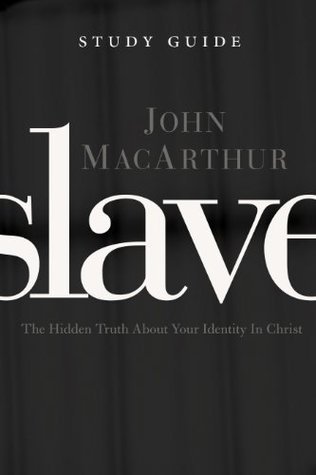
Slave the Study Guide: The Hidden Truth About Your Identity in Christ

Rate this book

Best-selling author and pastor Dr. John MacArthur takes readers deeper into biblical study to revolutionize their relationship with God.

Throughout the Bible, followers of Jesus are commanded to submit to God as their King. They are told to obey and follow, faithfully and without hesitation. Every time Christians utter the word Lord, they make a subtle yet profound declaration-that God is their Master and that they belong to Him. In fact, the Bible describes believers as His slaves. They have been bought with a price and now live for Christ as a people for His own possession.

But go into most churches today, even flip through most Bible translations, and you won't see or hear the word slave anywhere. That's because it has been lost in translation. In this gripping book, Dr. John MacArthur uses deep Bible teaching and historical evaluation to expertly uncover the one forgotten word that restores the Bible's definition of true Christian freedom.

146 pages, Kindle Edition

First published January 1, 2010

352 people are currently reading
2769 people want to read

About the author

John F. MacArthur Jr.

1,344 books1,913 followers
John F. MacArthur, Jr. was a United States Calvinistic evangelical writer and minister, noted for his radio program entitled Grace to You and as the editor of the Gold Medallion Book Award-winning MacArthur Study Bible. MacArthur was a fifth-generation pastor, a popular author and conference speaker, and served as pastor-teacher of Grace Community Church in Sun Valley, California beginning in 1969, as well as President of The Master’s College (and the related Master’s Seminary) in Santa Clarita, California.

Ratings & Reviews

What do you think?
Rate this book

Friends & Following

Create a free account to discover what your friends think of this book!

Community Reviews

5 stars
1,622 (51%)
4 stars
913 (29%)
3 stars
439 (14%)
2 stars
110 (3%)
1 star
47 (1%)
Displaying 1 - 30 of 218 reviews
Profile Image for Mark Clements.
27 reviews3 followers
September 9, 2011
I enjoyed the book but by the end I felt like MacArthur was making a point completely off the topic. This book almost seems like MacArthur's coming out party as a 5-point Calvinist. He goes out of his way to use phrases like "the doctrines of grace." The people he references throughout the book are major names in the Reformed tradition. Please understand, I don't have a problem with Calvinists/Calvinism. I am only commenting on the direction of the book. His analysis and insights about slavery and their application to the believer were challenging and engaging. The author is right--we don't understand the "slave" concept as the original readers did. The challenge to see God as Master is timely.

However, Dr. MacArthur seemed determined to work all 5 points of the TULIP into the book, including "Particular Redemption" (Limited Atonement). In fact, he actually gets all 5 together on 147-48. His observations could have been made without any need to mention those areas by name. His readers would still have gotten the point about slavery being a picture of salvation. IMHO, He went out of his way to get them in and indeed they are in there. If Calvinism bothers you at all this will not be a book you enjoy. His main idea is squelched by his effort to thrust Calvinism into the discussion.

Others will have a problem with his use of the term "Lordship." Dr. MacArthur has taken some heat for what is called by some "Lordship Salvation." His detractors on this point are mistaken. The NT is clear that if you aren't walking with Christ, you aren't part of Christ. Those who love Christ keep His commandments. Dr. MacArthur nowhere says you have to know and believe everything about the Lordship of Christ to be saved. He does say that only those who persevere (continue) in the faith are really true converts. Slaves do not obey themselves or other masters (Satan, mammon, etc.). Slaves recognize their one true Master and they follow His commands.

Like I said, I enjoyed the book but I felt like he was flaunting his Calvinism to the point where it became a distraction. That made the book a bit of a disappointment.
Profile Image for Dan Curnutt.
400 reviews18 followers
March 3, 2011
MacArthur starts the preface of the book with a statement that many will find controversial, or they will just down right be appalled that Pastor John would believe that there has been a centuries old cover-up in regards to a key word in the Bible. He states, "It wasn't until the spring of 2007, on an all-night flight to London while reading 'Slave of Christ' by Murray J. Harris, that I realized there had been a centuries-long cover-up by English New Testament translators that had obscured a precious, powerful, and clarifying revelation by the Holy Spirit." He does go on to say, "Undoubtedly, the cover-up was not intentional--at least not initially."

So, what is that cover-up? It's the translation of the word 'doulos' in the Greek and 'ebed' in the Hebrew. Those words translate to 'slave' but are most often translated as 'servant'. That seems like a small difference to most of us but Pastor John is going to point out how the two words slave/servant or vastly different in what God intended for their usage.

MacArthur believes that our English translators started to use the term 'servant' because of the political backlash of the term 'slave' and the problems that it created over the centuries for English speaking countries. England and America fought political battles and actual wars because of 'slavery'. So, to tell the believer in Christ that he was a 'slave' seemed to carry a very derogatory definition. Servant seemed softer and more palatable for the English speaking world to accept.

But that is not what the Bible intended. MacArthur does a wonderful job of expressing how God the Father and Jesus the Son intended to use the word. Jesus is the Master and we are His 'slaves'. There is no way around that meaning.

Throughout the text MacArthur will share how the people of Jesus time and in the Old Testament would have understood the term Slave. He shares how in the days of the early church roughly 20 percent of all people were slaves, and within the larger cities of Rome, Corinth, Ephesus and Antioch, as many as one-third of the population were legally slaves.

So, when Biblical text makes the statement you will be a 'slave' it has a very definite meaning. You are indebted to Christ (He purchased you with His Blood), you are called to be a 'slave' obedient to what the Lord wants you to do, which is the Great Commission and the Great Commandment.

This book is filled with examples from the Bible, filled with stories of how the early church members accepted readily that they were 'slaves of Christ', that's what "Christian" meant.

My favorite part of the book is MacArthur's discussion of the fact that we were 'slaves to satan/sin' before we knew Christ and that after we came to Christ we became 'slaves to Christ'. You can't serve two masters, you have to choose which master to serve.

There is a lot more I could say, but this review is getting a bit long. This book will not have any new teaching if you have always translated the terms as 'slave' and not 'servant'. But if you have taken the 'softer' route of interpretation you will be challenged to look at the terms in a new way and challenged to examine your life in a new way.

Are you living as a 'slave of Christ' or not? That is the big question.

Enjoy!
Profile Image for Rod Horncastle.
736 reviews86 followers
March 19, 2019
I bought this, read this, then lost this... Whoops! Fell off the back of my Transport truck. (that's what I get for reading at work. NOT the first book i've lost.)

Yep, slaves for Christ- then adopted children. I have no problem with that. But many do - almost all Bible translations remove the word SLAVE and replace it with Bond-servant. But John MacArthur easily shows that this simply is not accurate. So what are people afraid of exactly? Will the South rise again perhaps? Does the Bible call people into slavery with a Cosmic deity? Hmmm...

No, it's about simply being accurate Biblically and theologically. Jesus bought us with a brutal bloody price. He paid our Cosmic debt. We owe him everything. For we were SLAVES to sin. Not "bond-servants" as many might desperately try to claim.

Romans 6:16
Do you not know that when you offer yourselves as obedient slaves, you are slaves to the one you obey, whether you are slaves to sin leading to death, or to obedience leading to righteousness?

Yep, slave is a term many of us can easily comprehend. The Bible even explained this almost 2000 years ago:

Romans 6
18and, having been set free from sin, have become slaves of righteousness. 19I am speaking in human terms, because of your natural limitations. For just as you once presented your members as slaves to impurity and to lawlessness leading to more lawlessness, so now present your members as slaves to righteousness leading to sanctification.

20For when you were slaves of sin, you were free in regard to righteousness. 21But what fruit were you getting at that time from the things of which you are now ashamed? For the end of those things is death. 22But now that you have been set free from sin and have become slaves of God, the fruit you get leads to sanctification and its end, eternal life. 23For the wages of sin is death, but the free gift of God is eternal life in Christ Jesus our Lord.

________________

So why the alteration to Bond-slave???
James 1:1 James, a bond-servant of God and of the Lord Jesus Christ, To the
twelve tribes who are dispersed abroad: Greetings. ...

2 Peter 1:1
... Simon Peter, a bond-servant and apostle of Jesus Christ, To those who have received
a faith of the same kind as ours, by the righteousness of our God and Savior ...

Jude 1:1
... Jude, a bond-servant of Jesus Christ, and brother of James, To those who are the
called, beloved in God the Father, and kept for Jesus Christ: ...

Romans 1:1
... Paul, a bond-servant of Christ Jesus, called as an
apostle, set apart for the gospel of God, ...

Weird eh? Maybe that's why i'm a huge fan of the New living Translation. Sure, it pushes forth a few doctrines (cough, Calvinism! Which I fully embrace) but it seems to get just about everything correct. Here's an example of them not bending to modern political correctness:

New Living Translation James 1:1
This letter is from James, a slave of God and of the Lord Jesus Christ. I am writing to the "twelve tribes"--Jewish believers scattered abroad. Greetings!

A bond servant for Christ just sounds boring and financial. Yawn! We are dealing with issues of life and death. Eternal damnation and purity. The meaning of Life, the Universe, and Everything. I'm not necessarily Jesus' little Buddy. He's my Savior, King, sacrificial lamb, and GOD! Slave is a fair term - but that's not the end of the story:

Here is the end: Romans 8:15
New Living Translation

So you have not received a spirit that makes you fearful slaves. Instead, you received God's Spirit when he adopted you as his own children. Now we call him, "Abba, Father."

Yes, Slaves indeed: but then so much more.
Profile Image for Emma Secton.
207 reviews22 followers
September 2, 2020
Está bueno, pero no me pareció la locura. Bastante material exegético, eso sí. Pero quizás no me aportó demasiado debido a la doctrina a la cual adhiero hace rato, y de contenidos que para mi ya son bastante claros en cuanto a la entrega y sumisión a Cristo no sólo como salvador, sino también como Señor. Fue un poco decepcionante para ser mi primer libro de MacArthur, más un libro como este que es tan conocido y tan recomendado. Lo mejor que me llevo, es un mejor entendimiento de la parábola de los talentos, eso estuvo bueno.
Profile Image for Rick Davis.
869 reviews140 followers
January 12, 2011
Okay, so first a bit of criticism. If you look at the trailer for the book Slave: The Hidden Truth about Your Identity in Christ, you will learn that there has been “a conspiracy to cover up a truth that is so essential to the New Testament that without it we misunderstand our relationship to Jesus Christ.” There is a “hidden word that unlocks the believer’s identity,” which John MacArthur says, “…changes everything I perceive about the Christian life.” Wow, it sounds like The DaVinci Code for evangelicals. The back of the book tells me that “English translators perpetrated a fraud…and it’s been purposely hidden and covered up ever since”! Wow! This is going to be great stuff! What is this crazy conspiracy that has completely distorted the Christian faith for 600 years?

Well, opening the book to crack open this mystery, the preface informs me that the Greek word douloV is probably better translated “slave” than “servant” and that this mistranslation somewhat obscures the meaning of the Greek word. MacArthur assures the reader that, “Undoubtedly, the cover-up was not intentional,” and that’s the last we hear of any conspiracy in the book. Wait, what?! I suppose that the book trailer and blurb will probably find more readers for the book than if it were marketed as a straight theology book. However, it would have been nice if the advertising were more along the lines of, “Hey, I think most English versions mistranslate this particular Greek word, and so the full force of these passages is often missed in our Bible studies.”

Aside from the sensationalist marketing strategies, however, the book is quite good. MacArthur shows that we are more than mere “servants of Christ” but are truly “slaves of Christ,” bought with a price and subject to His will alone. The book is well-footnoted, which I appreciate, and MacArthur synthesizes a lot of thought on this idea of being God’s slave into one place. This is somewhat a continuation of one of the main themes of MacArthur’s teaching, namely that we cannot have Jesus as our Savior, if we do not also have Him as our Lord. Overall the best parts of the book are his expositions of Scripture where he unpacks how the slave idea bears on the way we view our relationship with God, while also remembering that we are slaves who have been adopted by our Master and made part of His household. There are a couple of historical excursions that run on a bit long, and it seemed in a couple of places that the book was straying from the main point. However, he ties it all together very nicely in the last chapter summarizing the force and direction of the book, and the Appendix is a wonderful collection of quotes from Church history that show the idea of being Christ’s slave as expressed by great theologians and pastors.

Profile Image for Mandy J. Hoffman.
Author 1 book93 followers
February 26, 2011
MY REVIEW:

According to the back cover of this book there has been quite the cover up happening in our English translations of the Bible. However, a few short pages into the book we find out that most likely it's not intentional. While the promotion for this book may be a bit misleading, the message inside the cover is not. In fact, it will set you back in your chair with a sober "wow!".

I don't consider this book to be an "easy-read", but neither do I think it is hard to read. It is solid theology and historical facts woven together to teach us how we are not just "servants" of Christ, but "slaves". At first glance it doesn't seem to be a big difference but MacArthur shows us the huge difference in no uncertain terms. The look back into the history of the Roman-Greco slaves is fascinating in that understanding that era greatly aids one in understanding the New Testament.

Personally, I enjoyed the entire book for it's eye opening truth, fascinating historical facts, and personal application. The concept that I was once slave to sin, bought as a slave of Christ, and now have been adopted into God's family has radically changed my view on life.

Slave flows from one chapter to another building upon what we know to teach us what it means to be a slave of God. I highly recommend this book to any one - believer or unbeliever - from early teen to any age adult.

BOOK OVERVIEW:

Best-selling author and pastor Dr. John MacArthur reveals one crucial word that revolutionizes what it means to follow Jesus.

Throughout the Bible, followers of Jesus are commanded to submit to Him as their King. They are told to obey and follow, faithfully and without hesitation. Every time Christians utter the word Lord, they make a subtle yet profound declaration—that God is their Master and that they belong to Him. In fact, the Bible describes believers as His slaves. They have been bought with a price and now live for Christ as a people for His own possession.

But go into most churches today, even flip through most Bible translations, and you won’t see or hear the word slave anywhere. That’s because it has been lost in translation. In this gripping book, Dr. John MacArthur uses deep Bible teaching and historical evaluation to expertly uncover the one forgotten word that restores the Bible’s definition of true Christian freedom.

* * * * *

Special thanks to BookSneeze for the courtesy review copy, but the opinion expressed is strictly my own.
Profile Image for Cassandra.
1,389 reviews27 followers
January 21, 2011
Slave was offered for review on BookSneeze and I snatched it up. I loved John MacArthur's book The Jesus You Can't Ignore and Slave sounded like another great read.

From Amazon's product description: "What does it mean to be a Christian the way Jesus defined it? MacArthur says it all boils down to one word: Slave. 'We have been bought with a price. We belong to Christ. We are His own possession.'"

Unfortunately, the book got off on the wrong foot. The preface talks about an intentional translation cover up, a conspiracy, if you will. While I do believe that conspiracies exist on occasion, I find it rather suspect that multiple Bible translators have intentionally made a mistake. Perhaps it's true, but this accusation made me wary of anything else MacArthur proposes in this book.

MacArthur believes that the Greek word doulos has intentionally been mistranslated as servant rather than slave. He writes that "whenever it [doulos] is used, both in the New Testament and in secular Greek literature, it always and only means slave" (pg 16). Both in this chapter and in others, MacArthur stresses that Christians being a slave to God is completely involuntary.

I am not a Greek scholar, but I looked up one example listed in the footnote: Revelation 1:1. Both in my Bible's Greek dictionary and on Net Bible, I found the following definitions:

doulos <1401>
1) a slave, bondman, man of servile condition
1a) a slave
1b) metaph., one who gives himself up to another's will
those whose service is used by Christ in extending and
advancing his cause among men
1c) devoted to another to the disregard of one's own interests
2) a servant, attendant

from 1210; a slave (literal or figurative, involuntary or voluntary;
frequently, therefore in a qualified sense of subjection or
subserviency):-bond(-man), servant.

Again, I don't know much about Greek, having never studied it. But the definition says that this word can be literal or figurative, voluntary or involuntary. MacArthur asserts that doulos only refers to involuntary slavery.

The chapters dealing with what it means to be a slave to God are actually quite good. Whether we call ourselves as Christians slaves or servants, whether it be involuntary or voluntary, we do have a specific relationship with God. One of the best summations in the book is that "a slave's life was one of complete surrender, submission, and service to the master - and the people of Jesus' day would have immediately recognized the parallel. Christ's invitation to follow Him was an invitation to that same kind of life" (43).

I fully agree with the above statement. A Christian's life should be one of complete surrender, submission, and service to the Master. The discussions detailing parallels between Roman slavery and our Christian responsibilities toward God were really insightful. Too often, the church gets caught up in grace and forgets that the Jesus who said "you shall love the LORD your God with all your heart, with all your soul, with all your strength, and with all your mind" also said "if you love Me, keep My commandments" (Luke 10:27, John 14:15).

All of that said, I had a deeper problem with book. I walked away from it feeling incredibly depressed. As good as the message is about serving God, it was completely overshadowed by the author's belief in predestination. MacArthur states that "God, in His infinite mercy, chose to save those sinners on whom He had set His love in eternity past" (147). There are a few other quotes that address the same issue - God chooses who He will love and only saves those people. Not only does God only love a select few, MacArthur states that everyone else has no choice in the matter; they were born into sinfulness, have no possible chance of responding to the gospel, and will die and be punished for their sins.

I don't have all the answers. I don't understand God completely. But the idea that God may not love me, that He doesn't want me, and that I don't even have a chance in becoming His daughter is repulsive. I've been depressed for a week because of this idea. If this idea is true, then God may have chosen me, in which case He loves me and I have the opportunity to respond to the gospel. But if God didn't choose me, then I am unloved and will be punished for my sins even though I had no choice in the matter. Is that fair? Is that even Biblical?

I can't recommend this book unless you are extremely secure in your beliefs and want to pick out the nuggets available. Slave does have some nuggets of truth and insight, but it is completely overshadowed by the idea that God does not love everyone nor does He want everyone to be saved.

This week I chose to memorize Romans 8:1 in response to reading this book. Another text I need to memorize is 1 Timothy 2:3, 4.

There is therefore now no condemnation to those who are in Christ Jesus,
who do not walk according to the flesh, but according to the Spirit

Romans 8:1.

For this is good and acceptable in the sight of God our Savior,
who desires all men to be saved and to come to the knowledge of the truth

1 Timothy 2:3, 4 (emphasis mine).

I received a reader copy of this book from BookSneeze in exchange for an honest review.
Profile Image for Stacia.
417 reviews
May 1, 2022
There is a lot of excellent information in the book and, I am theologically aligned with what MacArthur teaches. However, the book was a little bit repetitive and spent a lot of time relaying stories of great Christian men. I’m not opposed to that, and maybe it’s because I’ve been reading such theologically thick books, but it just didn’t resonate with me.

Also, I was discussing in a group and so had to answer the questions, which I didn’t find super helpful or edifying.

Still thankful for the book and the author!
Profile Image for Ela.
232 reviews
August 3, 2024
"The only real freedom you are ever going to know, either in this life or in the life to come, is the freedom of serving Jesus Christ." James Montgomery Boice

This book reminded me that the Christian life is one of complete obedience to the One and only Good Master.
Profile Image for David Washington.
Author 1 book7 followers
May 21, 2016
To say that John MacArthur is an influence on my spiritual walk and understanding of God and the Scriptures is an understatement. I listen to his sermons on a regular basis. Some I've listened to more than once if not ten times. So, it's odd that this is the first book that I've ever read from him being as prolific an author as he is.

I received Slave years ago some months after it came out. It's been on my shelf for that amount of time. Because of my recommitment to reading, I decided it was high time to read something by him given the impact that he's had on my life. Though I have more than one book from him, I decided to start with this one.

I began Slave: The Hidden Truth About Your Identity In Christ with a bit of excitement but apprehension as well. I have been hooked on some of the classic theological writers as well as past men who have fervently served the Lord (Ryle, Pink, Tozer, Schaeffer). When it came to some of the modern writings that I've read, it was not bad but it was not that rich, moving, life changing experience that I've had with “old dead men” whose writing have had a profound impact on my life. So, it made me slightly hesitant. However, I knew it was necessary to read a broad spectrum of writers from different time periods and it just didn't make any sense for me not to read this book.

The basic premise of the book is that we are slaves to Christ and that slavehood has implications with it. Dr. MacArthur draws out the historical parallels in Roman as well as Jewish culture and how they mirror the biblical reality of our relationship to Christ as slaves. This he does superbly, keeping it connected to the the main thrust of the book, interweaving myriad Scripture references

He debunks the idea of slavery with its negative connotations and explains the master/slave relationship that Christians have in and to Christ. He explains how the word in Scripture—servant—has been used as a replacement for the better word of slave or bondservant. This makes the subtitle a misnomer of sorts because it's not that it has been hidden as much as it has been ignored and in many instances covered up and shunned. Some of that is due to ignorance and some deliberate.

He continues to explain the ramifications of this, emphasizing how it brings to the forefront the Lordship of Christ. In one section, he states:

The only right response to Christ's lordship is wholehearted submission, loving obedience, and passionate worship. Those who give verbal assent to His deity yet live in patterns of unrepentant disobedience betray the hypocrisy of their profession.


MacArthur goes on to explain how this slavery results in some glorious paradoxes: slave but free, slaves but children of God, slaves but heirs. He remarks in the opening of chapter thirteen:

While nothing in the Bible is contradictory, many of the Bible's most provocative and profound truths appear to us paradoxical. Consider, for example, the truth that salvation is both free and costly, or that to truly be rich you must be poor in spirit, or that to find life you must lose it or that to be wise you must embrace the foolishness of the gospel.


He then presents four paradoxes in reference to being the slaves of Christ: how it brings freedom, ends prejudice, magnifies grace, and displays salvation. It is all wonderfully woven together with a balance that is sublime, encouraging, and challenging.

All that being said, my apprehensions were eliminated. I would read it again. I don't say that about contemporary books but MacArthur's treatment on the subject humbles as well as inspires.

Go get this book. It is time well spent for the Christian in glorifying God.
Profile Image for Ebookwormy1.
1,830 reviews364 followers
0-not-to-read-or-did-not-finish
November 17, 2018
This is why I love Goodreads. This is why it works for me. I thought I wanted to read THIS book, but after spending some time investigating, it was actually a different title I want to explore.

MacArthur is a gifted teacher with a strong no-holds-barred prophetic temperament. As such, he can be controversial. His relationship with Reformed Christianity is tempestuous and his promotion of Lordship salvation questionable. MacArthur seems to need to come to an idea through his own thought patterns, at which point he digs his teeth in and never lets go. Knowing MacArthur's theology is good, and it is merely his presentation I find bittersweet, I was curious about this title after it was recommended by a friend on Facebook. Here's what I found.

Mark Clement's review captures some of these debates about MacArthur's work within the theological community.
https://www.goodreads.com/review/show...

And Mandy J. Hoffman's review complements Mark Clement's, and you can read it here:
https://www.goodreads.com/review/show...

Finally, Dan Curnutt gave an overview of the review, starting with the preface in which MacArthur states he was 'inspired' by the work of Murray J. Harris in his book Slave of Christ published in 1999. Dan's review is here:
https://www.goodreads.com/review/show...

Since it was MacArthur's starting point, and the original author has none of the baggage of MacArthur, I would rather bypass MacArthur, to read Harris' original work. I get the impression that the real revelation on this subject is via Murray J. Harris eleven years prior to this title. MacArthur was captivated by it and, being a highly selling author, kibitzed in his own title. I'll post my review on Goodreads after I read Harris. If you'd like to continue following this thread, my review will be here....

Slave of Christ: A New Testament Metaphor for Total Devotion to Christ, Harris, 1999
https://www.goodreads.com/review/show...
Profile Image for Clark Goble.
Author 1 book14 followers
February 21, 2015
In his book, "Slave", John MacArthur explores the Greek word 'doulos' ('slave' in English) as it occurs throughout Scripture and notes how its meaning has often been lost in modern translations of the Bible. MacArthur than masterfully presents the Gospel through the lens of this 'slave' metaphor as it is depicted in God's Word. As such, the first forty or so pages of this book really blew me away and added a new layer of depth to my understanding to the Gospel.

MacArthur then takes the reader through a progression of what it means to be Christ's slave, God's adopted child, and a citizen of Heaven. Along the way, he presents the tenets of Calvinism wrapped in the context of a 1st Century slavery metaphor.

The book also includes a study guide for small group study and is extensively notated. I highly recommend it.
Profile Image for Connor Petrick.
48 reviews3 followers
June 22, 2024
A 200+ page book that should have been kept under one hundred pages. The teachings of the book are (mostly) true, if excessively bloated with repetition. Its greatest weakness is that MacArthur makes no attempt to distinguish his philosophical commitment to determinism from the biblical gospel, sometimes covertly describing determinism's uglier aspects in the vaguest terms possible (e.g., his description of Particular Atonement was particularly inaccurate and misleading). Even still, much of the book acted as a good reminder of Christ's ownership over those he saves and our obligation to serve him wholly.
Profile Image for Brenton.
47 reviews
September 10, 2020
Excellent! Excellent! Excellent!
If you are a born again Christian you must read this book! It puts into perspective the misconceptions of the word "slave" and how we are actually slaves to Christ! It is very humbling when we consider that we have been bought with a price!
I listened to the Audiobook narrated by JMac himself!
Profile Image for Ben Adams.
158 reviews10 followers
June 27, 2022
The premise of this book is that the Greek word doulos in the New Testament and the Hebrew word eved in the Old Testament have been translated for hundreds of years as "servant," rather than the true translation as "slave."

In terms of actual content, McArthur does a good job explaining the socio-political context for slavery in the Roman Empire, gives examples of how it functioned, and skillfully illustrates how this relationship is mirrored theologically in one's Christian faith. For many Christians this explanation will be informative and convicting. McArthur himself hopes so, as he laments how the tone of many churches' worship, missions, and teaching have shifted over the decades to emphasize an approach to faith that over-emphasizes happiness while it under-emphasizes obligations. Another strength of this book is that McArthur does not ignore the abuses of slavery, try soften the barbarity Early Modern slavery, or pretend that Ancient slavery and Early Modern slavery were two totally different things, with Ancient slavery being much kinder. He dutifully shows how slaves could be abused by the system, and uses it as an opportunity to show why having a good master is the most important thing one can do-- the best master of course being Christ in contrast to the worst master, sin.

Towards the end of the book, McArthur seems to take a sudden turn into Reformed Theology, showing how God's lordship and sovereignty, along with the total depravity of humanity, preclude human choice in the matter of coming to faith. Other readers have found this section to be somewhat off-topic or distasteful (only because of the Calvinism, McArthur does not cross any lines of decorum here), but I will permit him the digression, as it is a natural outgrowth of the slave/master dichotomy.

There were, however, a couple of things that took away from this book as a whole for me. The bombastic language of there being a grand conspiracy or coverup around the translation of slave seemed over the top, especially when McArthur himself ends up admitting that this was probably not intentional. Additionally, I felt that McArthur's whole point here could have been made much more concisely. I often felt like sections of it were too long or repeating themselves long after I had gotten the point.

Overall, I would recommend this book to any Christian hoping to get a larger perspective on their relationship with God or to increase their knowledge of the context surrounding the writings of the New Testament.
Profile Image for Hannah Morse.
3 reviews1 follower
July 22, 2020
Slave was an incredible, godly and encouraging book to read. I highly recommend this book to other believers of Christ. There were some points I learned that I never recognized or noticed. Paster John MacArthur did an amazing job tying in the acronym TULIP, and the gospel message into the book. Because of this book, I understand the importances of being a slave of God and the inaccurate usage of the word ‘servant’ from English version translations. (Ex: King James Version) In other words, I no longer am a slave of sin (or Satan) instead I have given up the old and put on the new to have full submission and devotion to the master. (God) Apart from this, I liked learning about slavery in the first century Roman Empire and the distinction of slave life in that era to the 18th century in the United States. In addition, I admired the explanation for a Christian who transitions from a slave to a son of God since the role of a slave is not eternal, but temporary. Therefore, being adopted into the family of God, delivered Christians from the destitution of sin, provided shelter, security, and became His heirs. As Christians there isn’t anything to be anxious about because the Lord is the Master who is trustworthy, loving, almighty, and takes care of His children. To conclude, we were once His enemies, but were bought with a price through the blood of Jesus Christ, becoming slaves of righteousness, including citizens in His kingdom, and adopted into His family.
Profile Image for Allen Patterson.
73 reviews7 followers
October 22, 2018
This book really did not tell me all that much that I had not heard before. Sure, there was some interesting facts about the history of slavery in 'Old Testament' times and Roman times that I did not know. BUT what made this book so great was it's powerful condensed punch of truth. Most of what I already knew was in just little tid-bits, usually made in passing reference in sermons or books. Oh, but here John F. MacArthur Jr. puts all of the pieces together and really explains what it means to be a slave of Christ. Could it ever really be a blessing, a privilege, an honor to be a slave? Well, if your Master is the Lord Jesus Christ then absolutely unreservedly YES!! You;d have to read his book and much more importantly read THE BOOK - THE BIBLE to even begin to grasp the truth of such things.
Profile Image for L.
14 reviews
December 9, 2025
"To preach Christ as Savior but not as Lord is to present a gospel message that is incomplete."
-MacArthur
Profile Image for FatherSwithin.
43 reviews5 followers
August 14, 2022
Review of slave: The Hidden Truth About Your Identity In Christ , by John MacArthur.

MacArthur’s main point about the term “slave,” as used in the New Testament, is useful knowledge for every Christian to possess, however, there are many distractions that detract from this book. I give it “2 stars,” as it falls far short of a high quality educational or devotional Christian book, whether scholarly or popular.

The first issue—one quickly dispensed with—is its repetition. MacArthur has a way of repeating himself which is renowned in his sermons, and appears equally in his writings, this book being no exception.

That said, there are a number of highly distracting diversions included in the discussion of the term, “slave.” First (though not in any particular order) is his unnecessary attack on the Roman Catholic Church. Part of being a slave to Christ consists in recognizing the Lordship of Christ, as rightly pointed out by MacArthur, and acknowledging Christ’s Lordship over His Church. MacArthur makes the unjust accusation against the Roman Catholic Church that they do not acknowledge Christ as Lord over His Church. Now, if you ask the average parishioner at MacArthur’s Grace Community Church, who is the head of it, most are likely to reply, “Our pastor, John MacArthur.” If you then asked if John MacArthur answers to any higher authority, the parishioner (if they are thinking in a more “spiritual” way) might sheepishly respond, “Oh, well, Jesus Christ is the real Head of the Church, of course.” In the same way, I’m sure that if you asked a Roman Catholic, who is the head of the Church, they would reply, “the Pope.” And if you asked the same follow-up question, they would give you the same answer as the Grace Community Church member, Jesus Christ.

Any cursory search for what Roman Catholics believe about Who is the Head of the Church would almost immediately show this. The Catechism of the Catholic Church states it as well as MacArthur could. Under the heading, “Christ is the Head of the Body,” they write (p. 228):

792: “Christ is the head of the body, the Church.” (Col. 1:18) He is the principle of creation and redemption. Raised to the Father’s glory, in everything he [is] preeminent (Col. 1:18), especially in the Church, through Whom he extends his reign over all things.” [emphasis added]

The life of John Huss is held up as one who proclaimed Christ to be the Head of the Church and was condemned to die for it by the Roman Catholic Church (Ch. 4). But John Huss was not put to death because he taught that Jesus Christ alone is the head of the Church. He was put to death because he denied that Christ gave His authority to His Apostles and to their successors. MacArthur’s attack here is completely unjustified, and perpetuates prejudicial attitudes of the Reformers. As one Roman Catholic writer has so aptly put it: “Some of these beliefs spring from regrettable ignorance of the Church’s teachings; others spring from a spiteful readiness to besmirch the opponent and speak ill of him on every possible occasion.” One wonders if this scurrilous attack on the Roman Catholic Church comes from willful ignorance from a pastor who claims “more than fifty years of translating, studying, teaching, preaching, and writing through the New Testament.” I am Anglican, but it still bothers me that Protestants attack the Roman Catholic Church with such unjust, ill-informed accusations and opinions.

MacArthur’s attack on the Roman Catholic Church, however, brings up another question: Who is in charge of (i.e., who determines) Christian doctrine? Most Christians of MacArthur’s persuasion would say, as MacArthur himself would say, “the Bible.” He would even say, as he paraphrases what John Huss has said, that the Bible has more authority than the Church. As if the Bible was simply dropped from heaven by God one day (as the Muslims believe of the Koran) and that’s all there is to it. The truth is that the Bible was compiled by the Church, and for the Church, as led by the Holy Spirit. The Bible is the Church’s book, not the other way around, just as Jesus said that the Sabbath was made for Man, not Man for the Sabbath (Mark 2:27). Continuing the story of Huss, he quotes him on a point of contention with the Church: “If the Papal utterances [i.e., the Church’s dogma] agrees with the law of Christ [i.e., the Bible], they are to be obeyed. If they are at variance with it, then Christ’s disciples must stand loyally and manfully against all papal bulls whatsoever and be ready, if necessary, to endure malediction and death.”

“If they are at variance with it.” Who is it that determines if the Church is at variance with the Bible? For that matter, who determines if an individual Christian or even a pastor is at variance with the Bible? Who is in charge of Christian doctrine? MacArthur does not say so, but he sets himself up as the one man (possibly also including those pastors of whom he approves) to be the arbiter of Truth.

Despite what many say, the Bible does not interpret itself. And the very people who tell you that it does are awfully eager to open the Scriptures and interpret them for you, just to prove their point! The Head of the Church is Jesus Christ. All Christians believe this. Its earthly leadership is the counsel of Bishops, the successors to the Apostles. What the Church believes is determined by the Church, the Bible, and reason, and not by private interpretation.

John MacArthur is a Calvinist, and does not hide this fact. The trouble with Calvinism is that it doesn’t work. But Calvinism is believed by many Christians (yes, they are still Christians!), and so MacArthur uses this to bolster one of his own terms. He makes the false equivalence between the term, “absolute enslavement” (his own innovation) and the Calvinist doctrine of “total depravity,” drawing this in to bring a little legitimacy to his own teaching (p. 121). If he has convinced you of the truth of “absolute enslavement”, then you must also believe in Calvin’s idea of “total depravity.” And the reverse is also true; if you already believe in “total depravity,” then you must believe his presentation of slavery. It is certainly possible (and I would argue that it is reasonable, as well) to accept some of MacArthur’s presentation of enslavement to sin, without being forced to accept the teaching of “total depravity.” The Christian Church accepts wholeheartedly the concept of our slavery to sin, but has never endorsed the idea of “total depravity,” as currently understood in Calvinistic circles. The Church has made it very clear that human nature was not completely ruined by the Fall, but only weakened by original sin. And original sin, by itself, is enough to condemn us, but we are in an even worse condition by committing actual sins in our lifetime. Only Christ could redeem us. All Christians believe this. But God does not have to force us into believing, force us into faith, as He would have to do if we were “totally depraved” or completely ruined in our nature. We have the choice to accept His sacrifice or reject it. And for all this talk about “total depravity,” even MacArthur has to fall back on Scripture and rhetoric that indicate a choice in the matter. “When we loved nothing but ourselves and our sin, God first loved us, such that we might respond to Him in faith” (p. 131).

The difference between the Church’s understanding of a weakened human nature and that of “total depravity” can be illustrated with an experiment with frog legs. A detached frog leg will lie on a table, unable to move on its own. But if you shock it with electricity, it will move. When it does move, we call this a response: Stimulus / Response. However, there is another way that this frog leg can move. You can use your hands and manipulate it. It will move this way, but we do not call this movement a “response.” It is being forced to move, not responding to a stimulus.

The Church believes that there is something within each of us that can respond to God’s call, whereas MacArthur believes that there is nothing in human nature (in its current fallen state) that can respond, even though he uses this language of response. It is as if his view of human nature is more like a rope. Even with an electrical stimulus, a rope with not move…it will not respond. But it can be forced to move by outside influence…and only by outside influence.
This ”response language” continues with citations of John 15:12 (“…as many as received him…”), for example, and with quotes from other authors. Alexander Maclaren is quoted:

“The Servant-Son makes us slaves and sons…[A]nd if you will trust yourselves to Him, and give your hearts to Him, and ask Him to govern you, He will govern you; and if you will abandon your false liberty which is servitude, and take the sober freedom which is obedience, then He will bring you to share in His [blessings] of joyful service…” (p. 175, emphasis added).

I said earlier that Calvinism doesn’t work. Here in MacArthur’s book, on facing pages, is a perfect example of how it doesn’t work. On p. 172 he writes, “all those who are truly born again will be kept by God’s power and will persevere as Christians until the end of their lives, and that only those who persevere until the end of their lives have been truly born again” (quoting Wayne Gruden.) The first problem is that this “persevering” is presented in a binary way. Either you are persevering or you are not. What happens if you doubt or do not fully believe in some doctrine taught by MacArthur? What if you believe in some charismatic operation of the Holy Spirit, for example, that MacArthur derides? What if your faith waivers at any point in your life, especially at the end when death draws near? Were you never “saved?” Were you never “truly” born again? This is never explained.

But further, on the very next page, MacArthur writes: “Time and again, those who believe in Christ, turning from sin and wholeheartedly trusting in Him, are given the unqualified promise of eternal life.” Well, in the light of the first statement just one page earlier, salvation seems very much qualified, that is, conditional, on persevering until the end of one’s life. It can certainly be believed by anyone, but it can’t be known. And if it is believed, then it might only be believed by someone with enough ego and pride, mixed in with a dash of self-deception, who could do it. This system simply doesn’t hold together.

Another interesting feature of the book is the re-casting of saints, martyrs, and other example Christians from the past into palatable terms for Protestants. It begins with St Ignatius of Antioch (referred to simply as “Ignatius” in footnote #5 on p. 9.) Besides stripping him of his sainthood, MacArthur refers to him only as a “pastor,” ignoring the fact that he was a Bishop in Apostolic Succession.

This pattern of re-casting continues with the aforementioned Huss. MacArthur presents him as someone outside of the Roman Catholic Church, describing him as a scholar (with multiple degrees), professor, and preacher. He says, in passing, that he was ordained, just before noting his appointment as preacher at Bethlehem Chapel (I assume to legitimize him as a preacher). But “ordination” means something quite different to an evangelical, MacArthur’s target audience. What he does not say, and I will say it clearly and precisely, is that Huss was ordained into the priesthood of the Roman Catholic Church.

The last example is John Newton, author of the hymn, “Amazing Grace.” MacArthur uses Newton to illustrate slavery to sin. A man who, himself, was the victim of virtual slavery, Newton eventually left his life in the slave trade (eventually becoming a vocal abolitionist) and his unholy life, and became a strong Christian. The details of his conversion, MacArthur gives in the book. He describes Newton as a “godly pastor” and, no doubt, he was. What MacArthur leaves out for his audience is the inconvenient fact that Newton was ordained as an Anglican Priest in the Church of England (June 17, 1764), although admittedly, one of the more evangelical priests! So there you have it, a Bishop (St Ignatius), a Roman Catholic Priest (Fr John Huss), and an Anglican Priest (Fr John Newton), whose positions in the Church have been obscured by the omission of key facts of their lives.

And speaking of omissions, one final side note on the book and its biased perspective. I have noticed that Evangelicals display an ahistorical view of history. Specifically, that nothing of any doctrinal, or ecclesiastical, or theological importance ever occurred between the period of time just after the Counsel of Nicaea (325) and the Reformation. MacArthur perpetuates this blind spot in Protestantism in the Appendix to the book, titled: “Voices from Church History.” MacArthur quotes from early Christians (mostly Bishops, though you would not know it) through [St] Augustine (d. 430), and then the next “voice” he quotes is from fourteen centuries later, Charles Hodge (b. 1797). This is remarkable, but also typical of evangelicals to ignore such a large swath of Church history.
22 reviews
July 16, 2025
…As with all MacArthur’s books, the research and scholarship that went into Slave is immense. He is correct in criticizing modern Evangelicals for a diluted Christianity. Whenever I see Evangelicals in the news, it usually involves their endorsement of a political candidate, not anything to do with Christ.

There are in-depth chapters on slavery in Rome and how that relates to being a slave of Christ. Chapters on early reformer John Huss and the composer of Amazing Grace, John Newton are both fascinating and inspiring.

Based on these virtues, I learned much and highly recommend Slave.

Unfortunately, MacArthur follows the trend of his other books by inserting the co-eternal, co-equal Triune Godhead doctrine where the Biblical topic doesn’t warrant it. As I’ve stated in my other reviews, I greatly respect MacArthur and esteem him a brother in Christ. However, his unwarranted promotion of the Trinity in this book is so glaring, I felt some of his points needed to be countered for the sake of Christians who would take his word at face value. Also, for the sake of those who avoid the Gospel because of the Triune Godhead dogma.

I have the audio book and will address what is stated in the first six minutes of the chapter “My Lord and My God”. I am grieved to say, virtually everything there is either false outright, by omission or is at least misleading. I can’t tackle every point in an Amazon review, but I’ll touch on what I can.

Briefly: Scriptures used to support the Trinity generally fall into two categories. A. Verses that mention God and Christ. B. Verses that can be translated more than one way. Scriptures that say The Father, Son, and Holy Spirit are one co-equal, co-eternal Godhead don’t exist.

That Christians are complete slaves of the Lord Jesus Christ is not in question. We were bought with His blood, and redeemed by His death on the cross. These are clear Bible teachings, supported by numerous texts.
The problem is, MacArthur claims that because the NT teaches Jesus is our Lord, we must worship Him as Yahweh, the Almighty God of the OT.

First, a few vss. he quotes that can be (and have been) rendered more than one way.

1. Hebrews 1:8. Referring to Jesus, many Bibles say, “…Your throne O God.” However, translations such as the American Translation and Moffat’s say, “…God is your throne.” Hebrews 1:8 is a quotation from Psalm 45:7, which is either about David or Solomon. Note how the Jewish Tanakh renders that: “…your divine throne is everlasting…”
Compare that with 1st Chronicles 29:23, “…Solomon sat on Yahweh’s throne.” Both Psalm 45:7 and Hebrews 1:8 simply mean the Davidic throne was instituted by and is supported by God. It seems that Moffat’s rendering of Hebrews 1:8 is correct.

2. Titus 2:13. “…our Great God and Savior Jesus Christ…” Compare that with 2nd Thessalonians 1:12, which has a similar sentence construction. At any rate, the Holy Spirit isn’t mentioned, so the verse is weak as evidence for the Trinity.

3. Isaiah 9:6. “…Mighty God…” Jesus Christ is the only-begotten Son of God. That He is divine and to be called Mighty God isn’t in question. (Colossians 2:9) However, Yahweh, the God of the OT is ALMIGHTY God.

4. MacArthur claims that because the blind man “worshipped” Jesus after he was healed, Jesus is Yahweh. This is a dusty, dusty argument. See Revelation 3:9, then look up the word for “worship” throughout the NT in a Strong’s. Also, throughout the OT, dignitaries such as David received such obeisance. It was common. For a further discussion, see my short Kindle book, The Only True God by Robert George.

5. “The Great I Am.” MacArthur calls Jesus “The Great I Am”, based, I’m guessing, on John 8:58, as well as various other times where Jesus identifies Himself. “I Am” is NOT a NT name or title for Jesus. No one ever calls Him that. As for John 8:58, even the zealously Trinitarian Passion Translation admits in a footnote that the correct English grammar in that verse is “I WAS” not “I am.”
Jesus was simply saying He existed before Abraham. And as the Son of God, He absolutely did. All other occurrences of “I am” are merely Jesus identifying Himself. “I am the bread of life.” “I am he”, etc.
The aforementioned blind man uses the same expression in John 9:9. I’m no Greek scholar but check an interlinear or three. It’s the same. Paul uses the expression in 1st Corinthians 15:10. (See also Acts 26:29)

The above are hoary Trinitarian arguments that only mention at most two Persons and can be translated more than one way. They’re a weak foundation for the claims MacArthur (and all Triune Godhead devotees) make.

What follows is fairly unique to this book. At least to have it all in one place.

6. A large part of the author’s argument for Jesus being Yahweh centers on the Greek word “Kyrios” which means Lord/Master. A few centuries before Jesus, the OT was translated into Greek. The translation became known as the Septuagint.
The divine name, “Yahweh” appears nearly 7000 times in the OT. It’s there throughout, from Genesis 2:4 to Malachi. The Psalmists used it regularly. Jews used it in everyday conversation. (Ruth 2:4)
Unfortunately, by the time they translated the OT into Greek, the Jews had become extreme in their views and traditions. This is shown by their numerous rules regarding the Sabbath. They had also gone to extremes with the 3rd commandment. They gradually refused to say the Name at all. So, they replaced “Yahweh” with “Lord” in the OT. “Lord” is not a translation, as MacArthur claims, but an unnecessary substitution. This substitution has caused much confusion because verses such as Psalm 110:1 now say, “The LORD said to my Lord” rather than “Yahweh said to my Lord.” In Matthew 22:41-45, Jesus says “The Lord” is the Messiah, Himself.


Not Yahweh. Jesus has been exalted to Yahweh’s right hand. Peter says the same thing in Acts 2:34-36.
In Acts 4:24-30, the disciples pray to Yahweh (see The Passion Translation). In that prayer, they call Jesus Yahweh’s Son and His servant. This would make no sense if Jesus was Yahweh.

The fact is, Christians are slaves of both God the Father (Yahweh) AND Christ. (Please see James 1:1) What MacArthur fails to mention is that in certain households, a slave may call both a father and a son “Master”. Note Genesis 24:5, 65 where Abraham’s slave calls both him and his son Isaac “Master”. This is especially significant because Abraham and Isaac can picture Yahweh who sacrificed His Son on behalf of the world.

This doesn’t conflict with what Jesus said about serving two masters in the Sermon on the Mount. There was no conflict of interest between Abraham and Isaac, just as there definitely isn’t between God the Father and His divine, only-begotten Son.

I hesitate to use this modern, pulpy literary example, but I’m going to because most are familiar with it from childhood. In the Batman comics, the butler Alfred calls both Bruce Wayne and Dick Grayson “Master”. Master Bruce and Master Dick. He serves them both wholeheartedly in that mansion.

So, for a Christian to say Jesus is his Lord in no way means Jesus is Yahweh. We are slaves to both God and Christ, even as James was.
One last point on this issue. According to 1st Peter 3:6, Sarah called Abraham “Lord” (Kyrios).

7. John 20:28. Thomas exclaiming “My Lord and my God” upon realizing the Messiah had been raised and was standing before him. Context is everything. Just 11 vss. earlier, Jesus told Mary Magdalene that The Father was His God. See also Revelation 3:12 where Jesus calls The Father “My God” four times.
Related is 1st Corinthians 8:5, 6 where Paul says there is “..one God, the Father and one Lord, Jesus Christ.”
Thomas exclaimed “My Lord and My God!” the way my good Irish Catholic mother used to yell, “Jesus, Mary and Joseph!” whenever something good and unexpected happened. She certainly didn’t believe Jesus, Mary, and Joseph were the same person. Since God the Father had miraculously raised his Lord to life (Galatians 1:1), Thomas said, “My Lord AND my God!”. (Not, My Lord and God!)
Simple as that.

8. NT vss. where OT quotes regarding Yahweh are applied to Jesus. Many OT vss. are applied to Jesus. Matthew 2:15 quotes Hosea 11:1 and applies it to Jesus. Hosea 11:1 originally applied to Israel. That doesn’t make Jesus Israel. Texts that originally applied to David and Solomon are also applied to Jesus. There are also certain parallels between Joseph’s life and Jesus, as well as Abraham and Isaac, God the Father and Jesus. Such types are common in the Scriptures. It’s that kind of layered depth and prophetic beauty that recommends the Bible as the inerrant word of Almighty God, Yahweh.

So, to sum up, the Apostles didn’t present Jesus as equal with God. (John 14: 28, 1st Corinthians 11:3)

In conclusion:
MacArthur opens his book by saying there’s been a cover-up with most Bibles saying “servant” rather than “slave” in English translations. That may be true. If so, what would MacArthur say to these facts he well knows?

Popular translations use the pronouns “He” and “Who” for the Holy Spirit to personify it. The overwhelming majority of pronouns for Holy Spirit in the NT are gender neutral. Some even do it in the OT where Holy Spirit is NEVER personified. Jews didn’t and do not believe in a co-equal, co-eternal Triune Godhead. Translators also insert “The” before Holy Spirit even though it often doesn’t appear in Greek. This also helps personify it in unsuspecting readers’ minds. Check interlinears for confirmation.

And by leaving the divine name Yahweh out of the OT, it serves to blur the identities of Father and Son in the NT. This is misleading and they know it.

Aside from these claims, John MacArthur’s book Slave is very informative and recommended for learning about a Christian’s servitude to their Lord and Savior, Jesus Christ.


Profile Image for Sally.
907 reviews39 followers
January 22, 2011
"As followers of Jesus, we call ourselves, "Christians." But the fact is this word appears only three times in the New Testament. So the Bible uses a host of other terms to identify the followers of Jesus – children of God, citizens of heaven, lights to the world, members of His body, sheep in His flock. But there is one word used more frequently than any of these. Slave.

"Really? Do a casual read through your English New Testament and you won't see the word printed more than a few times. "That's because," John MacArthur says, "the Greek word for slave (doulos) has been mistranslated in almost every English version – going back to both the King James Version and the Geneva Bible that predated it."" (front inside cover)

Occasionally, I liken myself to AA Milne's stuffed yellow friend of Christopher Robin: "A bear of very little brain." It means that I have difficulty in wrapping my head around complex thought and theory. (Just ask my high school Religious Philosophy teacher!) When I received my copy of 'Slave,' therefore, I expected it would be a long and heavy-going read. After all, the back cover states that "MacArthur unveils" an "essential and clarifying revelation" which is "powerful" and "controversial."

Within a couple of chapters, however, I found it made perfect sense. Throughout the book, MacArthur uses Roman civilization as a context and I could understand the comparisons he makes. We have been bought for a price, just as Roman slaves were bought in the marketplace. Our old master was sin, our new master is Christ. Our new master is a benevolent one, just as Roman masters could be. We are instructed to serve and obey. We cannot do whatever we want and think it's okay, because it isn't. Okay, I get it.

MacArthur also writes of pre-destination. Just as the Roman master chose which slave to purchase, so God has chosen us. Pre-destination is a tricky subject. On the one hand, it makes sense that no one becomes a Christian without God's hand in it. He is all powerful and had plans for us even before we were created (Psalm 139:16). It's also a good feeling to know we're chosen. On the other hand, what does it say about the non-Christians in our lives? Have they not been chosen, or has the time of their redemption simply not happened yet? Still, if you get the concept of pre-destination, you can understand the analogy of us being bought like the slaves in the marketplace.

The back cover states that there has been a "cover-up of Biblical proportions" in the substitution of 'servant' for 'slave,' but I would not go that far. In fact, MacArthur donates very little time to the supposed 'cover-up' and the possible reasons for it. Instead, he chooses to focus on what it means to be a slave in the Christian sense.

Two-thirds of the way through the book, however, MacArthur changes gears. He writes of the Roman master freeing the slave and becoming his father in the eyes of Roman law. The former slave was normally also granted Roman citizenship. I understand the citizenship analogy. Since we are longer slaves to sin, we become citizens of heaven. MacArthur also states that we are now simultaneously both sons and slaves: sons of God and slaves to righteousness. Righteousness? I thought we were slaves to Christ? Here, I do feel like Pooh Bear, and no doubt I will have to carry out further study of this concept.

The truth is, however, this book is not as heavy going as I expected. It looks daunting, but that is because of the massive amount of footnotes. They are difficult to ignore. MacArthur quotes many writers and uses a lot of Biblical concepts. As a result, there is at least one footnote at the bottom of almost every page. In some cases, the footnotes take up a third of the page. The flow of the book, therefore, is often broken as the reader switches focus from the main body of the text to the appropriate footnote and back again. To conclude, this is an interesting book regarding a concept most readers should be able to grasp.

I received this book for review from Thomas Nelson. I was not required to write a positive review and the above opinions are my own.
87 reviews
October 23, 2025
A unique perspective on the doctrines of grace.
1 review
November 24, 2018
I have never read a book so poorly fact checked, so full of misquotes, and so saturated with false logic.

The main premise of this book is that the New Testament word "doulos" means "slave." To prove this MacArthur cites from sources such as "Theological Dictionary of the New Testament" and "Slave of Christ" by Murray J. Harris. However, when one is a Berean and checks MacArthur's sources, you find MacArthur's premise is NOT supported by these works. While "doulos" can mean slave, the "Theological Dictionary of the New Testament" states that when used in the New Testament "the group [doulos and related words] is thus freed from the restriction to the service of slaves which marks its use in non-biblical Gk." Rather, doulos correlates to the Old Testament "ebed" which has a HOST of meanings. True scholars will recognize this as a classic example of exegetical fallacy- specifically an unwarranted restriction of semantic range.

Also grievous is MacArthur's frequent use of Harris' work to "prove" his arguments. Yet Harris and MacArthur define both "slave" and "doulos" differently. MacArthur defines a slave as a person with "no freedom, autonomy, or rights" while Harris writes, "absent from this definition [of slave] is any reference to how slavery was entered and how the service was rendered- whether involuntarily or voluntarily." While MacArthur denies the freedom of the doulos, Harris spends an entire chapter outlining the freedoms of the doulos. It's a classic case of apples and oranges. Harris' work on "doulos" does not support MacArthur's views- even if MacArthur would like it to.

The worst offense of all, however, is that MacArthur's book "Slave" directly contradicts the word of God. Galatians 4:7 states "Therefore you are no longer a slave, but a son. and if a son, then an heir through God." Galatians 5:1 states "It was for freedom that Christ set us free; therefore keep standing firm and do not be subject again to a yoke of slavery." Likewise John 8:36 says "If the son sets you free, you are free indeed." The gospel is clear that in Christ we are no longer slaves. Why then does MacArthur write, "the gospel is not simply an invitation to become Christ's associate; it is a mandate to become His slave?"

When MacArthur writes that the only role of the Christian to Christ is that of slave to the master he contradicts the very heart of the gospel. Does this mean we are not to serve Christ? No- we are still his doulos- but a doulos is so much more than a slave. Is Christ still Lord? Yes- absolutely. But please don't call my sweet Jesus a slave master.

To strengthen his "argument" MacArthur quotes many "experts." Sadly- a review of these citations do not support MacArthur's claim. They, in fact, argue against MacArthur. Nor does the gospel support MacArthur's claims.

Do not waste your money on this book. It's rubbish.
Profile Image for Keiki Hendrix.
231 reviews522 followers
January 13, 2011
The beginning of wisdom, a Chinese proverb states, is to begin calling things by their correct name.

In Slave: The Hidden Truth About Your Identity in Christ , John MacArthur explores the Greek term “doulos” and its mistranslation in many contemporary bible translations which has led to a skewed perspective of the Christians relationship to God.

To say that John MacArthur is a powerhouse of a scholar would be an understatement. His ministry is founded on the study and teaching of the bible as the inerrant word of God. MacArthur’s’ thorough examination of the terms ‘slave‘ and ‘master‘ provided a clear history of each of these words revealing the vast difference in definitions from the early Church time frame until now.

Not being a bible scholar, just your average Christian, I learned much reading this book. The part that had me in total agreement was the discussion of the growing number of ‘easy grace’ teachings and other seeker friendly approaches proving that the enemy need only skew the meaning of a word to redirect the message.

To consider oneself a slave, owned by another and without authority over oneself, is the correct view of a Christian. Prosperity teaching does not promote a slave mentality. How can a slave be interested in their own prosperity when they have no authority?

Overall my take on this book is that it speaks squarely to who do not consider holiness as the Christian standard. The mistranslation of the word ‘doulos‘ is but a small change that has had a very significant impact. Each of the points are well referenced and footnoted throughout the book. It is a short book (only 240 pages) and the focus is s heralding the correct view of a Christians relationship with Christ.

Some books encourage and strengthen my faith. This one did just that. With the wave of shifting morals and seeker sensitive marketing of the Church, it was good to read words of truth.

The truth is that we are all slaves whether it be to God or to sin. We will either recognize our condition and turn to a loving God or we will exalt our importance and continue our lives in deception.

Recommended highly to the new Christian who may be confused about doctrine or the seasoned saint who needs to gain new perspective on his/her relationship to Jesus.

Disclaimer:
The review copy of this book was provided by Thomas Nelson and donated to the library of Westwood Baptist Church.
Profile Image for Davi Ribeiro.
6 reviews
March 8, 2019
Após o meu retorno aos caminhos de Deus, influenciado por uma aula de escola dominical em minha igreja, decidi ler o livro ` Escravo` motivado por um sentimento de grande dívida com o reino de Jesus Cristo. O livro foi escrito pelo pastor John Fullerton MacArthur Jr., conhecido internacionalmente por seu programa de rádio `Graça para Você`, o pastor John faz parte da quinta geração de pastores em sua família.
Leitura indispensável para todo cristão que assim como eu deseja entender seu lugar no mundo moderno, mas principalmente seu lugar no relacionamento com Deus e com sua Igreja. Este livro traz uma informação muito importante para a correta compreensão de muitos textos bíblicos. Motivados por um contexto de abolição escravagista, os tradutores da Bíblia Sagrada escolheram utilizar a palavra “servo” em nossas Bíblias como tradução da palavra original “doulos” que literalmente significa ‘Escravo’ no grego.
No início do livro recebemos uma análise etimológica da palavra `Escravo` e uma rica contextualização do mercado escravo Greco-Romano do primeiro século, período em que o Novo Testamento foi escrito, tornando assim possível compreendermos o que significava ser um escravo naquela época, uma mercadoria sem qualquer tipo de vontade própria e tratada ao bel prazer de seu proprietário. Em sua continuidade é possível conhecer a história do compositor de famosos hinos evangélicos, entre eles “Amazing Grace”, John Newton, um ex-escravo, ex-mercador de escravos e ao final de sua vida escravo de Jesus Cristo que influencia a abolição da escravatura na região Galesa. O desenvolvimento do conceito de o que é ser escravo do bondoso Mestre e Senhor Jesus Cristo nos coloca em uma humilde e agradecida posição de submissão para com o Deus Todo-Poderoso deixando assim o jugo mortal e doloroso da escravidão do pecado. A conclusão desta obra nos permite compreender o paradoxo entre a escravidão e a liberdade que se ganha ao escolhermos Jesus Cristo como nosso Mestre.
Minha impressão foi que as verdades contidas nesse livro, apesar de já tê-las ouvido anteriormente em minha vida, nunca foram tão bem compreendidas por mim como nessa oportunidade. Também me senti compelido a aceitar meu papel de Escravo de Jesus Cristo e desfrutar da Paz verdadeira e de toda a graça a liberdade que a este acompanha. Espero que este livro abençoe a vida de outras pessoas assim como aconteceu comigo.
Displaying 1 - 30 of 218 reviews

Can't find what you're looking for?

Get help and learn more about the design.