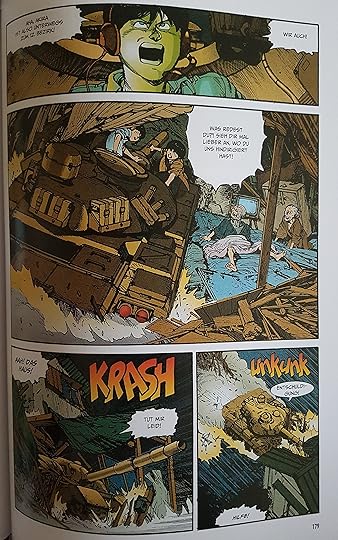
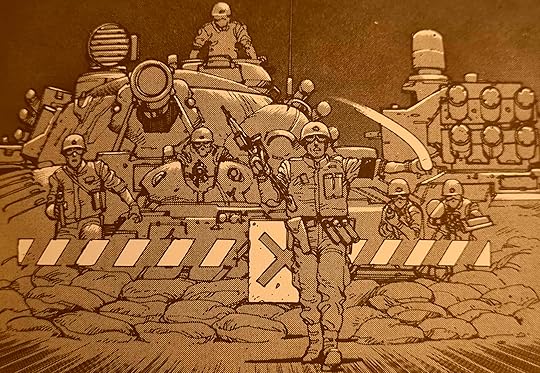
Der "Colonel" nutzt den Ausnahmezustand, der über Tokio verhängt wurde, um militärisch gegen Nezus Untergrundorganisation vorzugehen. Im allgemeinen Durcheinander des Kampfes zwischen Nezus Männern und den Soldaten des "Colonels" kann die Kämpferin Sakaki mit Akira fliehen. Kaneda und Kei gelingt es, einen Panzer in ihre Gewalt zu bringen und damit zu flüchten...
Katsuhiro Otomo is a Japanese manga artist, film director, and screenwriter. For his works in Japanese see 大友克洋. He is perhaps best known for being the creator of the manga Akira and its anime adaptation, which are extremely famous and influential. Otomo has also directed several live-action films, such as the recent 2006 feature film adaptation of the Mushishi manga.
Katsuhiro Otomo was born in the former town of Hasama, in Miyagi Prefecture.
As a teenager growing up in the turbulent 1960s, he was surrounded by the demonstrations of both students and workers against the Japanese government. The riots, demonstrations, and overall chaotic conditions of this time would serve as the inspiration for his best known work, Akira. Some would argue that this seminal work is an allegory of 1960s Japan, and that one could easily substitute the year 2019 for 1969 and leave little difference in the basic story.
The animation from this period (especially the works coming out of Tokyo animation studios Mushi Production and Toei Doga, now known as TOEI Animation) were influencing young Otomo. Works like Tetsujin 28-go, Astro Boy, and Hols: Prince of the Sun would help push Otomo toward a career in animation. However, it was the films coming out of America that were driving his rebellious nature. Five Easy Pieces and Easy Rider would serve as inspiration for Shotaro Kaneda and his biker gang in Akira: rebellious youth who took too many drugs and didn't care about authority or the pressures put on them by their parents' generation.
Otomo has recently worked extensively with noted studio Sunrise with the studio animating and producing his most recent projects, the 2004 feature film Steamboy, 2006's Freedom Project and his latest project, SOS! Tokyo Metro Explorers: The Next, released in 2007.
Otomo grew up a fanatic of American blockbusters, which has influenced his cinematic style throughout his huge career. He grew fond of the work of artists like Moebius, and is often regarded as the person who brought a Westernized style into manga. From the late seventies onwards, Otomo created numerous volumes of anthologies and short stories, which usually ran at 23 pages each. Serialization for Fireball was cancelled, though the premise and themes were later to appear in the Sci-Fi Grand Prix award winning Domu and Akira. Otomo later moved onto directing and creating notable anime like the film adaption of Akira, Memories, and Steamboy. His most recent manga have been the scripting of Mother Sarah and the short story Park released in an issue of Pafu last year. He has also directed several live action films, such as World Apartment Horror, Give Us A Gun/Give Us Freedom, and the 2006 feature film adaptation of the Mushishi manga.
The third volume has a dazed Akira being fought for(!) by all, including Lady M's own meta-humans, Sakaki and co., as well as Nezu's people. The Colonel has huge political problems as Neo-Tokyo reacts to the release of Akira. This all culminates in amazing scenes in the city. Now we're talking, classic dynamic Manga art at its best. A big moment for Akira lore! 7 out of 12 Three Star read. 2020 read; 2012 read (twice!)
Do you remember those scenes in Scooby Doo where Scoobs, The Gang and the monster(s) would be escaping/ chasing each other through multiple doors in a hallway, often leading to some comical switcheroos? The first 75% of this volume was pretty much that, but for an hour, with automatic rifles, one tank, TWO coups d’etat and several magic nuclear children with bowl cuts. 2.7 stars.
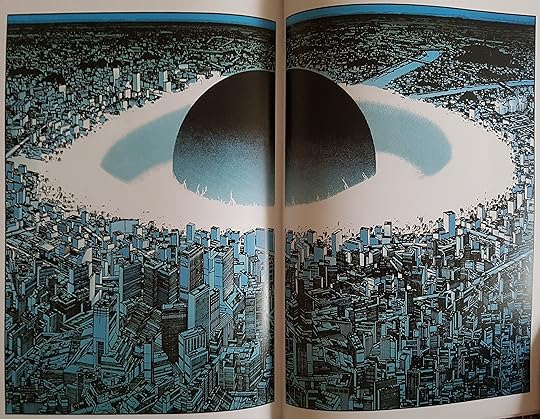
The final 25% or so, meanwhile, features one of the most stunningly beautiful and tragic events ever to be rendered in the graphic novel medium. 4.3 stars.
This entire review has been hidden because of spoilers.
I was seriously ready to give this volume of Akira three stars. Akira's political elements, these huge government experiment-gone-wrong cover-up and opposition vs. terrorist stuff has been a staple for super soldier themed sci-fi stories. So yeah, just three stars. But then it became so exceedingly good in the homestretch. Man, that was some crazy sh*t! It isn't that unexpected from the story perspective, this is bound to happen soon. Yet I'm still so struck with awe on how Katsuhiro Otomo made it.
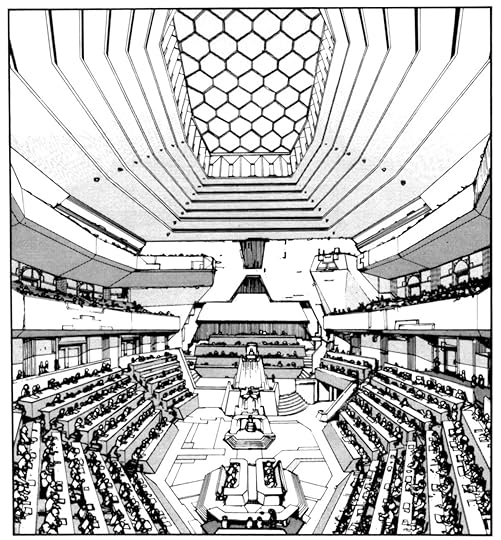
Katsuhiro Otomo's Neo-Tokyo parliament house. Jar Jar Binks is here somewhere, pulling the strings.
Akira volume three is yet another explosive and action-packed ride. And just when you thought it couldn't be bigger and louder than this, the last page tease literally takes Akira to the next level.
My biggest gripe with it - it gets a bit political but apart from that THIS is the Volume that as a fan of the movie makes this read finally pay off!
There is little the movie has in common with the manga - the storylines and even characters are in some cases not only different but more often a completely new addition. Even the conventional good and bad is not such a sure thing any more, which makes you question certain characters' motivations.
While Volume 1 and 2 kind of mirrored the movie this now takes off into a “new” direction. 4.5 out of 5.0 stars
"Sakaki...the future looks bleak...even I cannot stand against destiny." (Lady Miyako)
The graphic novel continues in the moment the previous novel ended. Tetsuo stands at the site of the first destruction (WWIII), has just walked out of the underground facility with Akira, and a satellite sends a missile directly into him. Kei and Kaneda escape with Akira, who has not come into full consciousness. The plot focuses on possessing Akira, a struggle of four forces aiming to take him: 1) Kei and Kaneda (and Ryu, although not with them) 2) Lady Miyako and her trained girls: Sakaki, Miki, and Mozu. 3) Nezu (and soldiers), a servant of Lady Miyako (she calls him "little mouse") who betrays her to obtain Akira. 4) The Colonel (and military backing) and the old-looking kids from the first two novels.
Lady Miyako's kids also have special powers, such as flight and pyrokinesis. The government restricts the citizens to their homes under martial law, and spider-like metal robots kill those who resist peace in the streets (including noncompliance to obey). Kei and Kaneda include another character into the action: Chiyoko - a massive, fighting woman with huge weapons and runs around in an apron.
As in the first two, the action doesn't stop, however the plot lacks in this one. The book serves as a link and doesn't stand alone. For this reason, I enjoyed the first two more than the third. In the crisis, all parties come together and fight to obtain Akira.
SPOILER BELOW:
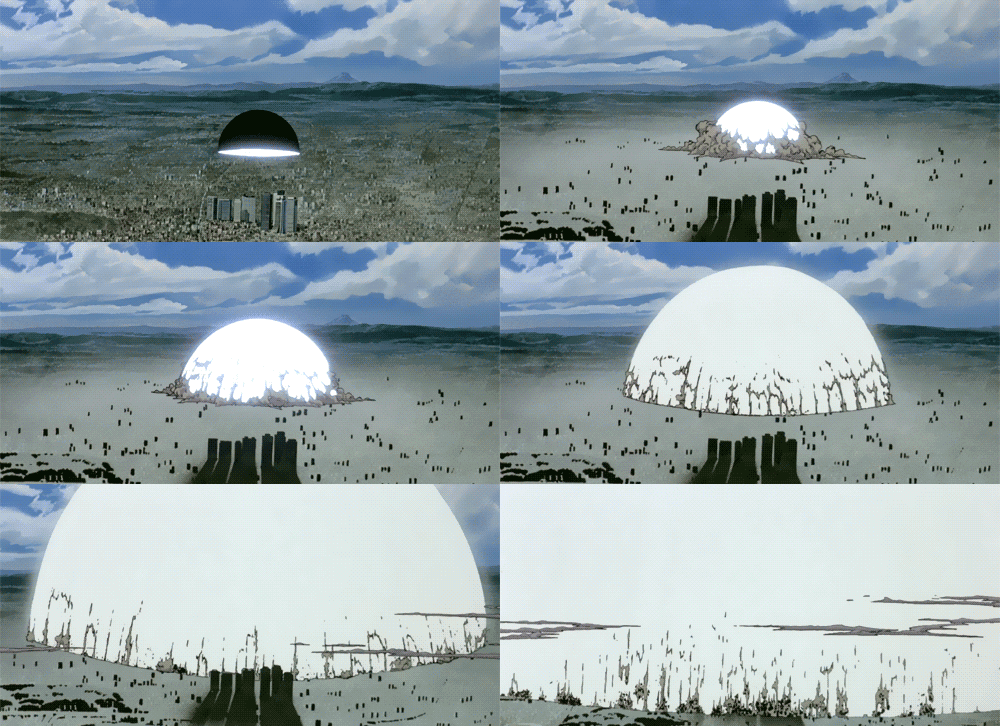
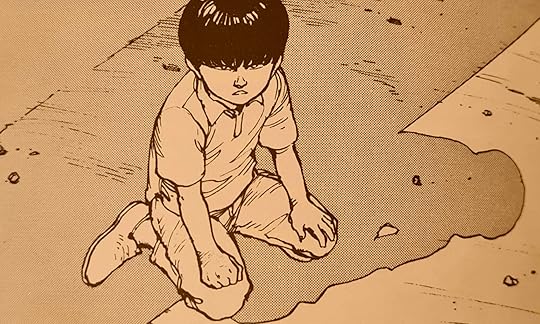
The novel climaxes when Akira recognizes Takashi, an old friend he had known within the organization headed by the Colonel. Nezu shoots at Akira but misses, blowing a hole in Takashi's head. This breaks Akira's mind, who has just come out of hibernation and has not awoken. The moment stirs his power: complete destruction, annihilation, a repeat of Tokyo's destruction.
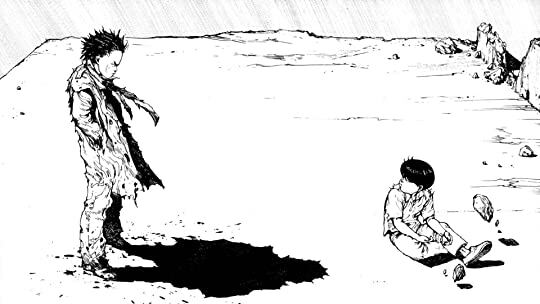
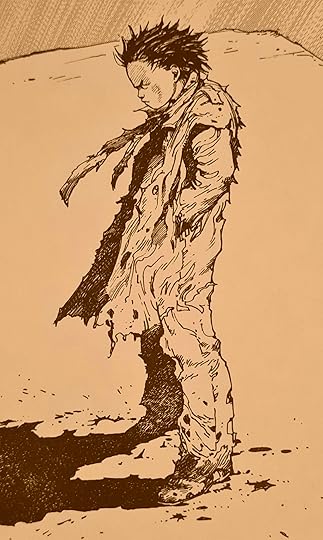
In the end, only the slab and Akira remain. The kids save the protagonists with their special abilities, particularly flight and telekinesis. Walking on the water, a young boy with tattered clothes approaches, stands by Akira on the slab. The return of Tetsuo! We aren't supposed to like villains, but I like this guy. I missed him. He makes the story a thrilling read. I'm glad he came back. He may be one of my favorite villains. The reason may be his turn from friendship and sanity to darkness, a betrayal, an old friend. It makes good fiction. The last panel shows two blurred dots flying into the air, far above the slab and floods.
En el tomo anterior pasaba poco y en este mucho menos, está bien que tiene menos páginas, el exceso radica en el arte que explota su costado narrativo secuencial. Hay momentos de diez o más paginas sin necesidad de una línea de texto siquiera. Si el arte llega a esos niveles y encima con una obsesión por los detalles, tanto de la arquitectura, el manejo de perspectiva, la fluidez cinematográfica y etc, yo compro. Hablamos de unos minutos extras de lectura por un paseo visual exhaustivo y devastador.
With the exception of an incredible concluding sequence in this volume’s final 30 pages or so (a sequence with complex and hyper-detailed drawings of multiple city blocks being leveled), there isn’t much to this volume. A bit of plot exposition, a lot of foot chases, and that’s about it. Yes, Otomo is great with action, but it all moves at the same pace throughout and gets a bit exhausting and one-note.
I'm still unclear on what the Colonel's end game is at this point. Does he have the people's best interest in mind? Is there a more selfish reason for his actions? Regardless he upped the ante in this volume. It adds confusion, chaos, and uncertainty into what is already a powder keg of a situation.
I didn't anticipate that Akira would cause destruction so quickly or on such a massive scale. I'm curious what the implications of that will be. At this time, the rest of the world doesn't know of Akira's existence. Now that Tetsuo is with him it doesn't seem possible to keep him a secret. Who knows what those two are going to get up to.
My biggest issue is with the Espers. Their powers and abilities remain vague. There hasn't been a explanation of what each Esper is truly capable of so right now it seems like each one can do whatever the plot needs them to be able to do.
A pesar de que el tramo final es absolutamente brillante la mayor parte del tomo son distintas persecuciones que a pesar de estar muy bien ejecutadas y con un ritmo tremendo no tienen el excelente pulso, el prodigioso equilibrio entre acción, historia y sorpresa que si tenían los tomos anteriores.
The chase for Akira continues. This was my least favorite issue so far, despite it still being a page-turner.
As a little recap, Tetsuo with his newly discovered paranormal powers has released Akira and set in motion a chain of events that is dominating this volume. Different parties are all looking for the child that has the power to destroy the city and drag the world to the brink of Armageddon.
The first three quarters of the issue were fast-paced and still full of action, but sort of just more of what we already had plenty of. We're being made aware of how urgent it is to find Akira and how powerful he is, but I feel like it wasn't necessary to get that point across over 200+ pages. On the bright side, we finally get to see a tiny bit more of Neo-Tokyo, that doesn't look that different from current Tokyo though, maybe a bit more industrial and run down.
I'm a little disappointed how little characterization there is in the whole narrative, I still don't know much about the characters and while I have been sort of told who is good and who is bad, I am not entirely sure about anyone's motifs, which does not make me feel very attached to anyone in particular.
However, the built-up lead to an intense and impactful ending, that wasn't only beautifully illustrated but also wonderfully told. Because of that, I am still keen to see what is going to happen next, as I am hopeful in terms of a bit of a change in narrative.
I thought the first three quarters of this volume were very dry and uninteresting, full of repetitive chase scenes and no tension do to bland characters and vague plot just like the last two volumes.
I was ready to give up on the series for good this time, but I feel like the last quarter really saved it. It looks like things could finally get interesting and start revealing all of the details that have been kept in the dark for so long. Hopefully the next volume does not disappoint.
This volume was surprisingly weak, nearly 300 pages of people running around and shooting each other, lucky encounters and soldiers and robots who all became bad at shooting a straight line upon encountering any one the main lead. All of these led to Tetsuo and Akira meeting; which could have easily happened at the end of the last volume.
Amazing drawings, as always, especially in the final part of the volume. The author totally succeeds in conveying the tension and his sketches are even more beautiful than usual. The only thing I feel like complaining about is an initial confusion in the plot - everything happens a little too hastily, imo. Aside from that, I really enjoyed the reading.
First 75% of this volume is a convoluted switch-up that involves some 20 characters running around in ruins, army groups chasing revolutionaries and vice versa, mutant children killing each other, more mutant children that we didn't know existed suddenly show up, Kei, Ryu and Kaneda somehow survive total destruction by...walking.
Last 25% though, is something else altogether. It's stunning, one of the best destruction sequences ever drawn in manga and comics in general. It's not enough to save the confusion that precedes it and this volume gets stuck at 3/5.
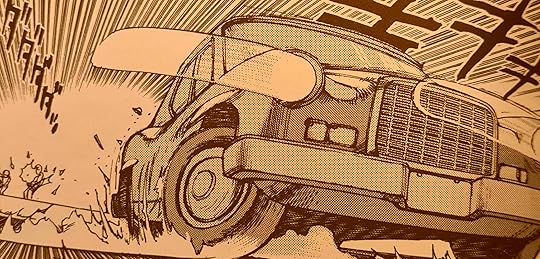
P.s. The robots are supposed to withstand a nuclear attack. Still, two kids and a macho granny manage to destroy one and a guy driving a limo knocks out 5 or 6 of them. Ok.
1. It is a travesty that Chiyoko was left out of the AKIRA movie. I know that the manga wasn't done and all that to base the movie on but she is by far one of the most incredible characters so far. I hope that the supposed series coming out that is more faithful to the manga includes her exactly as-is because I want to be her when I grow up.
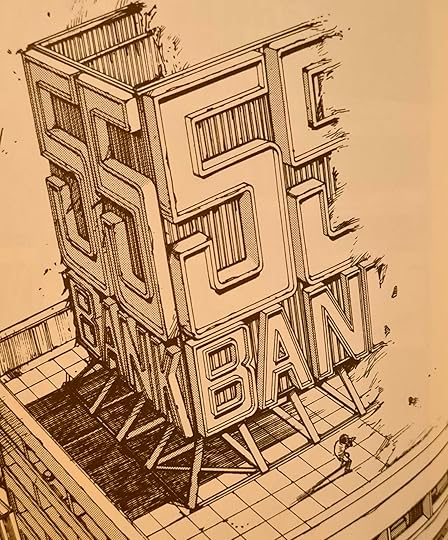
2. Katsuhiro Otomo is a madman. The sheer detail he puts into every building, every landscape, every crack in concrete... just madness. Then you get to the pages and pages and pages of destruction scenes and I literally had to stop and stare at them for multiple minutes just to take them in.
Do not put a tank in the hands of a bunch of kids.
And don’t make Akira angry.
This volume was underwhelming for the most part. Before it got totally insane in the last forty pages and it just managed to get away with a three star rating.
Pues eso, que Akira ha despertado! La trama en este volumen va por caminos más "adultos": conspiraciones políticas, golpes de estado y represión militar. Y justo cuando creíamos que la historia iba por un camino mas realista......bouuuuuuum. El mejor final que he visto en mucho tiempo. El cuarto final del volumen es brutal, con las viñetas más icónicas e impactantes que he visto en mucho tiempo. Es lo que se llama un giro de guión de los que te dejan flipado. Además todo va a la velocidad de la luz. Hubo un momento que había hasta 5 tramas simultaneas de perseguidores de Akira. Impresionante.
Un tomo transitorio que se centra principalmente en el juego político que rodea el mundo de Akira para terminar de una manera apoteosica marcando de manera abrupta la mitad de la serie. Un final de infarto que estoy deseando retomar.
The pace of this volume is less relentless than the second one. The beginning, in particular, allows itself more time to breathe. Overall there’s a bit less action and more plot development, so it feels like it covers more ground. There’s still plenty of high-octane action though, especially in the volume’s final stretch, which I found to be a highlight of the series so far.
I don’t really have anything new to say about the artwork. It’s still very well executed – no dispute there – but it still hasn’t really wowed me. It’s probably just a question of taste, but while reading I keep thinking of how much more I like Taiyo Matsumoto’s art in Tekkonkinkreet, which similarly depicts a dystopian futuristic Tokyo, but which has so much more personality.
In any case, I’m still thoroughly enjoying the series, and I look forward to reading more soon.
This book series so far has been visually stunning. The amount of characters and story elements that didn't make it into the film is a real shame, however the film would have to have a runtime of about seven hours to fit it all in so I can understand that.
Cyberpunkowy klasyk z pędzącą na złamanie karku akcją, co z mojej perspektywy nie musi być zaletą, ale się na tę konwencję godzę. Całość nieziemsko zobrazowana. Nie dziwię się, że w momencie wydania robiła takie wrażenie i ostatecznie była (i chyba nadal jest) pozycją tak wpływową. Obowiązkowo, choćby ze względów czysto poznawczych w temacie historii mangi czy komiksu w ogóle.