The Paradox Men is a science-fiction classic of its kind - a full-blooded adventure story of derring-do and distressed damsels, set after the Third Great War when North and South America are united into one Imperial America. A slave state run by a small noble elite who flaunt their wealth by using, and abusing, the one commodity that only the rich can human labour. But working underground, persecuted by the police, is an organization dedicated to the overthrow of government and the existing way of life and the establishment of freedom'. 'The Society of Thieves was the only organization that flouted authority in America they robbed the rich to buy freedom for the slaves. They were well equipped and trained for their job and had friends and informers in high places ready to reveal where the wealth of the nobles was hidden. And Alar was the best Thief of them all - for he had senses not found in ordinary men, senses that accurately warned him when danger was near. But Alar had amnesia and did not know his true identity though sometimes he sensed that there was a purpose in his actions that was not entirely his own volition. When Keiris, wife of the Imperial Chancellor saw him, she sensed that he was something special and helped him to elude pursuit even though it put her own life in danger. And in trips to the Moon and even the Sun itself, Alar begins to see what part he is destined to play in the struggle for men's freedom.
Also credited as Charles Harness. Charles Leonard Harness was born December 29, 1915 in Colorado City TX. After an abortive stint at Texas Christian University, studying to be a preacher, he moved on to George Washington University in Washington DC, where he received a B.S. degree in 1942, and a law degree in 1946. He married in 1938, and he and wife Nell have a daughter and a son. He worked as a mineral economist for the US Bureau of Mines, 1941-47, then became a patent attorney, first with American Cyanamid (1947-1953), then with W.R. Grace & Co. (1953-1981). His first story, ‘‘Time Trap’’, appeared in Astounding (8/48), and he went on to write a number of well-regarded SF stories, many involving future trials and patent attorneys. A series of patent office spoofs/stories (some co-written with Theodore L. Thomas) appeared under the pseudonym Leonard Lockhard, beginning with ‘‘Improbable Profession’’ (Astounding 9/52). His first published novel, Flight Into Yesterday (aka The Paradox Men), first appeared as a 1949 novella, and was expanded in 1953. The Rose, his most famous novella, appeared as a book in 1966. It was followed by Wagnerian space opera The Ring of Ritornel (1968), Wolfhead (1978), The Catalyst (1980), Firebird (1981), The Venetian Court (1982), Redworld (1986), Krono (1988), Lurid Dreams (1990), and Lunar Justice (1991). His short fiction has been collected in An Ornament to His Profession (1998), which includes not only ‘‘The Rose’’ but a new novella as well.
6.0 stars. On my list of "All Time Favorite" novels. The great novels of the "Golden Age" of science fiction, when done right, are some of the best stories EVER WRITTEN. After having just re-read this story (February 14, 2010), I would put this book in that category (along with other notable examples such as Fury by Henry Kuttner, The Stars My Destination by Alfred Bester, and The Foundation Trilogy by Isaac Asimov). This book is superbly written, has a compelling, fast-moving INTELLIGENT plot, and an outstanding ending with a message. HIGHEST POSSIBLE RECOMMENDATION!!
I picked up this book because it had been compared to Alfred Bester's "The Stars, My Destination," one of my favorite sci-fi novels, AND because it is listed as one of the Top 100 sci-fi novels in David Pringle's excellent overview book. Happily, I found the comparison to be a fair one, and the rating to be just. This is one terrific science fiction novel, as fast paced and colorful as the Bester novel, and featuring a similar use of colorful characters and extravagant imagination. It is really quite impressive how Charles Harness manages to incorporate some fantastic surprise or bit of mind-blowing scientific hypothesizing into every single chapter. Einsteinian theories of the universe, Toynbeean history and non-Aristotelian philosophy are all mixed into a swashbuckling and fast-moving pulp story, with a backdrop of a technologically advanced society on the decline. The story jumps from the Earth to the moon to Mercury and finally to a "solarion," a station that hovers over a sunspot to process the energy of the sun itself. It's all wild and improbable and quite irresistible stuff, if you're game. I highly recommend it.
Check out my full, spoiler free, video review HERE. This is a fantastic book that started as a short story from 1949. Fast pace, full of action, unique setting, intricate plot with lots of twists and turns, plus so many SF ideas, all packed into around 200 pages. This book was influential to many authors including Alfred Bester, which is probably the closest comparison, in terms of style IMO. But unlike Bester, we get heroes that you can feel good about rooting for. Almost all the plot lines are wrapped up and once you figure out the wild ending, and you’re also left with an upbeat, positive message. Highly recommended.
Featured in David Pringle's "Science Fiction: The 100 Best Novels", and originally published in 1949, this is a forgotten Golden Age sci-fi would be classic. Set in a dystopian future where the poor masses are enslaved, the story follows the adventures of Alar, part of a secret society of thieves who steal from the rich in order to free slaves. Alar, suffering from amnesia, races across the solar system to unravel his mysterious past while avoiding capture by an oppressive, heavy handed government who believes he possesses special powers that could derail their plans for war.
Packed with action, intrigue and a smart, fast moving plot the story holds up well today. However, as is common from sci-fi stories of that era, it bases itself quite a bit on some pretty flimsy pseudo-scientific psychological and biological concepts. The plot is actually quite similar, right down to the protagonist's amnesia, to A.E. van Vogt's classic The World of Null-A, published in 1945. And to some extent as well to Alfred Bester's classic The Stars My Destination, published in 1955. But it holds up well on its own as a fun, original, well put together story.
Charles L. Harness' "The Paradox Men" is an uncanny prophecy of cool technology, considering the story was written in 1949! Contains echoes of Alfred Bester's "The Stars, My Destination", a dash of Arthur C. Clark's "2001 A Space Odyssey" (think cave men), a warped version of H.G. Wells' "The Time Machine", and a bit of PKD's "The Minority Report" starring a freaky precog called Meganet Mind. No, not DreamWork's Megamind, mind you. Unfortunately the story was bogged down by brain crushing hard science that would have given Einstein a brain haemorrhage...and endless psychobabble that would have driven Freud insane. Required reading for fans of classic SF.
Los hombres paradójicos (1953) de Charles L. Harness es ciencia ficción clásica de la mejor. Se trata de una distopía en el siglo XXV que utiliza momentos y sistemas sociales de nuestra historia y nos los devuelve aderezados de predicciones futuras. Sociedades esclavistas, viajes en el tiempo, teletransportación, nuevas energías, teorías filosóficas, naves espaciales, amores imposibles, etc, etc. Pero, sobre todo, mucha acción. Y acción siempre rodeada de elementos relacionados con el género, cosa que hay que agradecer. Hay muchas referencias a la cultura (tanto actual como antigua) y, principalmente, descripciones científicas y seudocientíficas que a veces, por su extensión, lastran un poco el ritmo, por lo general frenético. Pero esto no desmerece la clasificación de esta obra entre las más grandes de la literatura de ciencia ficción. Un placer leerla.
Read long, long ago -- I may still have a copy, unless it crumbled away. The review to read here is Jamie's 4-star: "Packed with action, intrigue and a smart, fast moving plot the story holds up well today. However, as is common from sci-fi stories of that era, it bases itself quite a bit on some pretty flimsy pseudo-scientific psychological and biological concepts. The plot is actually quite similar, right down to the protagonist's amnesia, to A.E. van Vogt's classic The World of Null-A, published in 1945. And to some extent as well to Alfred Bester's classic The Stars My Destination, published in 1955. But it holds up well on its own as a fun, original, well put together story."
This would be a novella by current definitions, I think. ISFDB lists many reprints: https://www.isfdb.org/cgi-bin/title.c... AKA "Flight into Yesterday " (1953) Date first read is just a guess. I may have the Ace Double.
‘The Society of Thieves was the only organisation that flouted authority in America Imperial: they robbed the rich to buy freedom for the slaves. They were well equipped and trained for their job and had friends and informers in high places ready to reveal where the wealth of the nobles was hidden. And Alar was the best Thief of them all – for he had senses not found in ordinary men, senses that accurately warned him when danger was near. But Alar had amnesia and did not know his true identity though sometimes he sensed that there was a purpose in his actions that was not entirely of his own volition. When Keiris, wife of the Imperial Chancellor saw him, she sensed that he was something special and helped him to elude pursuit even though it out her own life in danger. And in tripe to the Moon and even the Sun itself, Alar begins to see what part he is destined to play in the struggle for men’s freedom.
Blurb from the 1967 Four Square paperback edition.
Harness, like Bester, wrote far less than his fans would have wished. His style (as Brian Aldiss terms it in the introduction the Four Square SF edition) is Widescreen Baroque, and despite the paucity of his output, one cannot deny that his influence has been a major one on the genre. Twelve years before Frank Herbert gave us Dune we see Harness employing the idea of personal force-shields, which repel bullets and blasters but allow through the relatively slow-moving sword or knife. Thus Harness combines the swashbuckling sword-wielding hero with the Solarion ships, which skate the surface of the sun, and the experimental interstellar ship, which is at the centre of the novel’s mystery. One can see the influence of Harness in many authors’ work, not least Herbert. Echoes of his style and imagery crop up in the work of Moorcock, M John Harrison, Will McCarthy (Aldiss notes in the introduction that Harness ‘shares a weakness for regality (and female rulers) with Van Vogt’ which seems to be also shared by Harrison and also McCarthy – see ‘The Collapsium’) and possibly Brian Aldiss himself. Far in the future, America is a feudal Empire, its titular head being the Imperatrix Juana-Maria, although in reality her ruthless Chancellor, Haze-Gaunt, controls the Empire. His wife, Keiris was once married to the revolutionary Kennicott Muir, who set up the Society of Thieves, a Robin Hood style organisation dedicated to robbing the rich and bringing about the end of institutionalised slavery. Muir is now thought to be dead. One of the best of the Thieves is Alar, the central figure of the novel, a man with no past, since he can remember nothing beyond a few months back. Alar begins a search for the truth, during which he meets Keiris, a woman who seems hauntingly familiar; the Microfilm Mind, a mutant who can deduce the future by memorising and analysing thousands of facts of the present. Meanwhile a vast interstellar ship is being built, raising the hope that Mankind might now reach the stars, but Alar is beginning to suspect that the ship has already returned to Earth and crashed long before it was built, and that he might have been on board. One can argue that the novel is no more than a chase in which relentless enemies pursue Alar, searching for the truth and his own memories, but it is far more than this. It’s a joyful piece of elaborate plotting, as complex and beautifully structured as an orrery, filled with bizarre and memorable characters and featuring a denouement both expected and unexpected.
This is one strange book. Full of action (it starts with the main hero in middle of doing robbery some high aristocrat home). But it’s also full of physics theories about time and space with starship, lunar base and solar expeditions. Ah, and this world definitely is apocalyptically. But most of all this book is about people -their aggression, their petty squabbles that becomes the end of this civilization. I can’t say that I fully grasp all authors thoughts. Maybe I will reread it, but not in the near future-i need time to comprehend it firstly.
Superior pulp SF here. The ideas -and the science- are bonkers; there's a helluva lot going on (arguably too much for 158 pages); and the characters are as heroic, beautiful, hideous, slimily evil, and potentially godlike as you might hope to expect.
Alar has lost his memory and become a Thief - a secret organisation bent on ending the slave-built nation of America Imperial. After a botched job, he suddenly finds himself at the top of everybody's wanted list... as well as harbouring the burgeoning superpowers of Homo Superior - humanity's next level of evolution. What follows is an extended chase sequence that goes from Earth to Lunar torture chambers, Mercury, and eventually to a factory floating on the surface of the Sun(!). During the course of all this he learns to use his eyes in "reverse", transports himself into the fourth dimension to evade capture, and his mysterious -and beautiful, of course- lady benefactor loses both her arms. There's time travel (and distortion), talking monkeys, fencing, the -for this era of SF- ubiquitous gyroscopes, and nuclear war. Harness' writing -if sometimes a little excitable and confused- is a cut above what you might expect, with some surprisingly deep passages and an obvious love of life for life's sake.
So, if you're in the mood for some classic pulpy SF, this is the good stuff.
I read The Paradox Men in this edition. I did not read the novel "Dome Around America" by Jack Williamson that it is paired with in this edition, so this review only applies to the former. The dates started and finished are very approximate as I don't remember exactly when I read it. I remember enjoying reading it, but don't remember much about the plot.
Harness expresses his love of VanVogt and how it inspired him to write a similar type of book in his afterword. He certainly did so - it shares both some of the good and bad traits of VanVogt - but I think his book is better. It suffers from being dated and suffers from the weakness of many of the early pulp fiction - but is still strong enough to recommend.
2015 Review: The Paradox Men loomed large in my mind for a while. I first read about it in Brian Aldiss's SF history, Trillion Year Spree, where he categorizes it as a exemplary example of Widescreen Baroque, comparing it favorable to some of my other favorite SF such as The Stars my Destination and The World of Null-A. I got a nice hardback copy with introductory essays and afterwards, but I had to let my internal hype die down before I gave it a shot. I'm pleasantly surprised to find that it holds up to those other classics, especially after reading a disappointing Charles Harness book (Firebird). There are some clunky expository explanations but it's otherwise a fast-paced novel that may have inspired the shield-based combat of Dune. Like Stars and Null-A, the main character is a man of superhuman potential with a mysterious background. But my favorite character was the villain, the brilliantly named cruel emperor Haze-Gaunt, who's given a strong back story motivated by jealousy and a great ending.
2020 Update: I reread this novel in 2020, after going on a long van Vogt reading jag, and this time I loved it! I don't think I was in the right headspace to appreciate what Harness was accomplishing with The Paradox Men the first time. But after rereading The World of Null-A, realizing how this novel was obviously inspired by Null-A, and considering how both of these novels grew out of serials in Astounding Science-Fiction, I can see how Harness took his inspiration from van Vogt but uplifted Vogtian tropes into a much greater novel. Both Null-A and The Paradox Men feature amnesiac men of action and are full of exciting twists and reveals. However, Harness bolsters The Paradox Men with a stronger sense of history and deeper emotions. Van Vogt's characters and worlds can feel a bit empty, void of affect and unmoored from reality. But Harness imbues his characters with vibrant feelings and shows us clearly how the Earth got from the present day to his dystopic future vision.
Me ha parecido una obra muy influenciada por las novelas más conocidas de Bester, "El hombre demolido" y, sobre todo, "Las estrellas, mi destino". Algo que se nota mucho, primero en la ambientación, como de película de capa y espada del Hollywood de los años treinta y cuarenta pero en cf (por buscar una referencia moderna, yo me imaginé la ambientación de "The Paradox Men" vestida con la fantástica dirección artística del videojuego "Dishonored 2" con el que la novela de Harness guarda un par de curiosos parecidos) y segundo, en el personaje principal, Alar, ese hombre, casi superhombre, obsesionado con cumplir Su Misión, en este caso descubrir su verdadera identidad, aunque en el fondo no deja de ser otra marioneta manipulada por las corrientes de la historia. Porque Alar acaba resultando ser un mecanismo de las teorías de Toynbee, un héroe que una vez transcendido a semidivinidad, dará fin a una cultura agónica para comenzar de nuevo en un ciclo eterno de auge y caída de civilizaciones.
La historia es básicamente cf de acción y aventuras, el ritmo es endiablado y Harness no escatima espectáculo, como en el arranque o al final en la estación solariana, algo que no me extraña que impactase en algunos escritores de su época. La resolución es buena y bonita y el juego de identidades del héroe y su antagonista resulta intrigante y lleno de posibilidades, lástima que Harness tire por la solución más obvia. Por lo demás adolece de las típicos defectos de la cf "clásica" pre-new wave; personajes muy planos, escenas y recursos extraídos del pulp más tirao, algunos diálogos acartonados y explicaciones científicas que aunque se agradece el esfuerzo, resultan pesadas y anticuadas, el charlón sobre viajes espaciales a medio libro corta el rollo muchísimo. Por lo demás una novela que aunque se deja leer y mantiene el tipo, su lectura tampoco resulta imprescindible salvo para interesados en la historia de la cf anglosajona.
A really fun fast read that has held up well. Some of the physics is just wrong (confusing relativistic increase in mass with an increase in rest mass / gravity), outdated (the universe is only 13.7 years old), or half baked ( an event a billion light years away would take a billion years to show up, so you can't take a picture of it yet).
The twists and surprises are setup enough that you can guess what is coming, but the novel is perfect nevertheless. This is great, fast paced story telling with some depth. I was pleased to see that Frank Herbert stole some ideas from this.
Why isn't this more famous? Yeah, you should read it.
I first read this book 40 years ago, so re-reading it was an adventure in meeting my younger self. The book stands up very well. It's a well written story of a Thief (capital T) with no memory of his previous life, and his gradual uncovering of his past, which coincides with a crisis in the murderous totalitarian society in which he lives. I loved the book in it's original day, and it is still very good. I have docked a star because the main female character is a bit of a cardboard cut-out - though this is not unusual in SF then - or now!
Have had this book on my shelves and have been meaning to read it for 30 years. Finally decided it was time to pull it down and check it out. It reads kind of like a more coherently plotted A.E. Van Vogt. If I'd read it 30 years ago when I was in my early twenties (or earlier, in my teens), I probably would have been blown away. Now, I enjoyed it but found it rather dated.
This was an interesting paradox story. The mystery in it is not nearly as difficult as the intro claims, and the ending, given the mechanism that brought it about, is more than a bit frightening—there should be millions or billions of “paradox men” out there, each thinking their vision is the right one.
It is very well-written and a great emissary from fifties sci-fi.
Puntuación paradójica: entre 5 y 3 estrellas. Lo bueno y lo malo de la literatura de ciencia ficción, y también lo bueno y lo malo de los grandes clásicos del género.
Three or five stars: paradox punctuation. The good and the bad of science fiction literature, and also the best and the worst about the commonly considered great classics of the genre.
Golden Age Science Fiction -- featuring swashbuckling science professors! Not much on time travel. Also .....
Fails the Bechdel test. (The Bechdel test asks if a work of fiction features at least two women who talk to each other about something other than a man. The requirement that the two women must be named is sometimes added.)
A Fantastic novel. Particularly I liked the travelling through the space with the velocity exceeding that of light. I think I might consider creating a new folder, the best science-fiction books, with putting this book there.
For the time in which it was written, 1949, this book was very good. Some very interesting science fiction concepts were explored and the characters were well developed. This book is number 10 in the book "Science Fiction: The 100 Best Novels" by David Pringle. On to number 11!
I have given this 4 stars because it is a great example of what it is. What it is is pulpy, overblown high-concept sci fi from the 1940s. Think Planet Stories, Thrilling Wonder Stories, stuff like that -- in this case, Startling Stories. I mean sci fi, not the serious 'sf' that some prefer. When it comes to credibility, we're in Starwars territory. It would make, I suspect, a great comic book.
This edition is from the Crown series 'Classics of modern science fiction', published in the 1980s. From what I can see, it was really 'the sf we could get the rights to'. This book may well be as much of a classic as any in the series. (In fact, my copy is from Greenhouse Publications, an Australian firm, and dates from 1986. In those days, there were barriers to mass importation of books, to encourage the creation of local editions.) It's a small hardback, quite nicely produced, but an odd size.
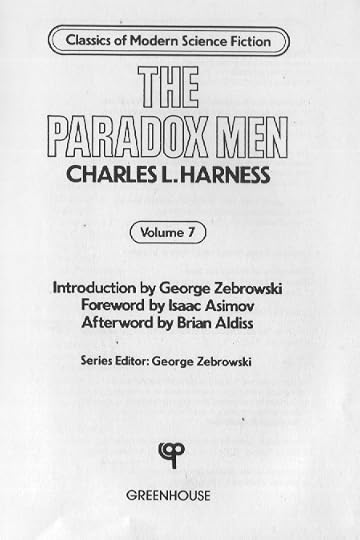
My copy is a hardback without the dust jacket, so there is no point scanning the cover; here is the title page
Harness's story has a history. It was published in one of the pulpier pulp magazines of the late 1940s under the title Flight into yesterday, and then turned into a novel and then half an Ace double, at which point it got the new title. Brian Aldiss and Harry Harrison resurrected it in the UK for some kind of series of forgotten works in the 60s or 70s, and then came this edition in the 80s -- but this edition is revised by the author, so is more definitive than earlier ones.
(Having said that, often a mature author revising an earlier, naive but energetic adventure story is not a recipe for success. John Brunner did it with some of his space operas, and did not improve them. These are not the kinds of tales than benefit from smoothing the rough edges. They are bright, ridiculous melodramas, oneiric and overblown, and toning them down can only lessen them, and rarely adds enough compensations.)
The book has an introduction by George Zebrowski, an afterword by Brian Aldiss (laudatory; I suspect reused from the series of books he edited, noted above), and a note by the author, plus a foreword by Asimov that is common to all the books in the series. So -- a reasonably serious effort at the resurrection of a novel that, I have no doubt, would have created a very real sense of wonder in a susceptible (teenage) reader on first exposure. Does it hold up?
Well, that depends on what you expect. If you want a fast-paced adventure involving planetwide conflict, journeys across the solar system, a mysterious stranger with no memories, sword fights, superhuman evolution, a giggling psychologist/torturer and a voyage into the heart of the sun itself, all within a book that that literally messes with time, space and the transfinite potential of the human animal in an attempt to grapple with the large-scale currents of history, this is the book for you. If you want a complex, high-speed plot that gets neatly tied up with a bow, this might be the book for you. If you want a subtle rendering of the shades of character among a group of realistic figures dealing with the complexities of everyday life, this is not the book for you. If you want realistic scientific extrapolation or beautiful prose, this is not the book for you.
The prose is functional, and of its time, as are the obsessions with Toynbee's theories of history and with non-Aristotelian logic (van Vogt's null-A stories come to mind). The characters are broad -- the sadist, the beautiful wife, the missing genius, the mysterious stranger, the ruthless politician. The pseudoscience is ridiculous except where it goes beyond ridiculous into some kind of realm that suggests something rather inspired; you must just accept it, because it is integral to the tale. An example: in the next iteration of human kind, the ultra-man who will supersede us, the photoreceptors in the eyes that convert light to impulses that the brain interprets can work in reverse, so that thoughts can generate light that then is projected out of the eyes. If you like Dr Who's technobabble, this book may be the book for you...
In short, the book is fun as long as you can adjust your expectations. It is without irony or cynicism. Brian Aldiss called it wide-screen baroque.
If you are interested in science fiction as a field of writing, and what forms is has taken in the past, it is worth a read, because it is an ideal example of space-time juggling, exuberant space opera.
If you like The demolished man and The stars, my destination then I strongly suggest you read it. It pre-dates Bester's novels, but has much in common with them. Bester was a better writer, though.
But, yes, it is preposterous. It's your genuine sci fi.
The Paradox Men by Charles L. Harness offers plenty of rollicking Golden Age science fiction adventure, but even at its svelte page count feels like it has stretched its premise too thin.
A space opera that feels as much science fantasy as it does science fiction, the best parts of The Paradox Men are those that feel they have leapt from the pages of a comic strip or off a matinee serial. Its influence upon later works in either of those subgenres is also apparent. One aspect that it doesn’t really explore is how the Americas by the time of the novels setting are united under a single entity called the American Imperium, a slave-owning empire. The dystopic aspects of such a society aren’t really played up with the story feeling one that is told almost entirely from the top of said society. With the expansion of the work from its original novella into a novel this feels like one aspect that maybe should have been explored more. Especially when the novel version feels padded in other aspects. The way some plot elements feel more like individual vignettes perhaps shows it would have been better if it had continued as separate, but connected, shorter works.
The plot never really gels together as a cohesive whole, despite many characters feeling larger than life or individual set pieces feeling well done. Too much of the plot is wound up in the physics, psychological, or biological concepts that Harness has inserted into the longer version, but more on them shortly. Those elements take away from what does work, which as mentioned is whenever the book devotes itself to swashbuckling action. There is a real filmic quality to these scenes that makes one wish there was an adaptation of the book out there that could deliver these without the elements of the book that let down the overall effort. Many of the characters feel broadly drawn archetypes but actually work better because of that within the context of this swashbuckling space opera. What lets them down is when they get bogged down in explaining scientific concepts that Harness has inserted as throughlines in the novel version. Like everything else in the book, everything is better when there’s swordplay.
Harness does at least write with a level of accessibility for the most part. It makes the action scenes all the better with their snappy narrations. The marked difference between the action scenes and the dialogue scenes is even there to be scene in the prose itself with how differently they are written. The dialogue is where Harness begins to focus more on the scientific concepts, which suffers from the issue of not knowing whether its hard science fiction or mere techno/psychobabble. Regardless of whether its research or imagination, the effect is the same of taking this reader out of the book and impatiently waiting for the next fight. They really harm the pace of the book too, the end result of which is to create a binary pace of breakneck speed during the action scenes and a snail’s pace in slow motion during the dialogue scenes. A book with this pacing in its best scenes and at this short length should not feel like a slog.
The Paradox Men likely would have worked far better had it been kept as a novel, but there’s no denying the excitement in those original, action packaged sequences.
This entire review has been hidden because of spoilers.