Five mysterious billionaires summoned Douglas Rushkoff to a desert resort for a private talk. The topic? How to survive The Event: the societal catastrophe they know is coming. Rushkoff came to understand that these men were under the influence of The Mindset, a Silicon Valley–style certainty that they can break the laws of physics, economics, and morality to escape a disaster of their own making—as long as they have enough money and the right technology. In Survival of the Richest, Rushkoff traces the origins of The Mindset in science and technology through its current expression in missions to Mars, island bunkers, and the Metaverse. This mind-blowing work of social analysis shows us how to transcend the landscape The Mindset created—a world alive with algorithms and intelligences actively rewarding our most selfish tendencies—and rediscover community, mutual aid, and human interdependency. Instead of changing the people, he argues, we can change the program.
This book was fascinating and appalling. It's a close look at the psychology of tech billionaires, drawing the general conclusion that they are actively destroying human civilization because they believe that they'll be able to figure out a way to separate themselves from the rest of us when it all falls apart. Some insights in this. book were genuinely eye-opening to me. I don't feel like I closed the book with any ideas about ways to avert the apocalypse, but I do feel like when the world is burning, I'll at least have a good understanding of why. Strong recommend.
I don't often quote scripture, but I've got to credit whoever wrote the first book of Timothy: the love of money truly is the root of all evil. When you have more money than you can ever use, continuing to make more and more while ruining the world seems more than a little evil to me.
This author is upfront right in the first chapter, letting the reader know that he is a Marxist, who was hired by a bunch of rich guys to help them make decisions about where to locate their doomsday bunkers and how to keep their security forces on their side after The Event (whatever that should turn out to be). Trying to improve the world around them didn't seem to compute—they were much more focused on leaving the rest of us outside their bunker walls.
The very wealthy seem to believe that money makes them somehow superior to regular people. They tend to be libertarian, wanting to go it alone with no responsibilities to other people or to society. I can understand the mindset to some extent: it is nice to have some independence in one's life. However, as much as they may believe they can separate themselves from the rest of humanity, one person simply cannot do all the things: mining, smelting, manufacturing, spinning, weaving, sewing, lumbering, building, mixing concrete, plumbing, electrifying, farming, etc. To get their bunkers built and supplied, they have already relied on a lot of other people. There is no such thing as complete independence. And, as we learned during Covid, being isolated doesn't benefit our mental health.
Then there are the weirdos who want to upload their consciousness to the cloud. I don't understand how this could be a good thing. I think it would be giving up all of the pleasures in life—eating, sleeping, having sex, even just walking in a forest or on a grassland. Smelling wet earth or your favourite food. Plus we would leave our brain structures behind and I doubt that we could feel emotions without those. I have zero desire to be stuck in some data bank somewhere unable to feel happiness, contentment, excitement or anticipation. I volunteer to stay behind to service the machines. When we get all the weirdos uploaded, let's just turn them off, shall we?
The biggest problem with the billionaires? They seem to believe that having billions makes them qualified to lead and that all solutions require technology. I hate to break it to the tech bros, but we already have what we need to make the world a better place. Try kindness and respect for others. Tone down our consumerist impulses and live simpler lives. I'm not anti-technology or I wouldn't be on Goodreads and other such websites, but I do try to limit my time on them.
The biggest problem that I see is a bunch of white men thinking that their interpretation of the world is the only one or the best one. Best for them maybe, but for those of us who want communities and meaningful lives, very unattractive. Unfortunately for them, the saying “Wherever you go, there you are” applies. No matter where they go, they take their essential human selves along. Humans are social primates so likely they won't go alone. There is no escaping humanity--it's built in. Resistance is futile.
If you're familiar with Douglas Rushkoff (and I'd recommend the Team Human podcast very much), there isn't a lot of new information in his latest book. The main thing, as some recent headlines have shown, is the story of meeting tech billionaires who hope to survive the end of the world. Otherwise, this is a good summary of technology critiques from this important social writer.
There's also the chapter on Burning Man, showing how giving capitalists psychedelics doesn't really improve anything in the world when they can't escape the fundamentalist of their mindset. The part on Q-Anon and internet addiction is also very poignant. But overall, I'd recommend other of Rushkoff's older books. He's an important thinker, and I hope the world will further pay attention and think harder about what's not working in society. With a focus on humanity, perhaps we can do better.
There were a couple segments that felt entirely superfluous and sort of outside of the scope of what the book purported to offer but to be honest I was there for the dunking on billionaires (yes, I am a millennial and I think that dunking on Elongated Muskrat is a perfectly fine hobby) and to be comforted that they will, ultimately, not escape the environmental hellscape that we will be entering in great part thanks to them and that's pretty much what I got.
What would you think if a group of rich billionaires invited you to a remote location to get your opinions on the future? And how would you feel after you found out that what they really wanted to know was how to survive a coming global disaster that was of their own making? Where most of us would likely perish but they would be safely protected in their secure bunkers and islands!!??
This actually happened to the author of Survival of the Richest, Douglas Rushkoff, and it prompted him to write this book and dive deeper into how these tech billionaires and hedge fund managers got to that point. These people wanted to know if Alaska or New Zealand would be safer during a climate crisis, how many provisions they should stockpile, and how they could keep their security forces from turning on them if and when money starts losing its power.
Mr. Rushkoff is a writer and professor of media theory and digital economics at CUNY, and something of a futurist. He has written other best-selling books such as Team Human, Present Shock, and Throwing Rocks at the Google Bus. He has been a long-time critic of Silicon Valley and its influence on our lives, and this is one of his most blistering attacks on the mindset that prevails there.
I have heard of people like Peter Thiel constructing a compound in New Zealand for possible escapes, but apparently this is happening in the USA more and more, from the doomsday preppers in Idaho stockpiling guns and ammo to the Silicon Valley tech billionaires looking for escape sanctuaries in underground bunkers, on the ocean, and even in outer space. If we learned anything from the Covid-19 epidemic, it's that we are woefully prepared for any type of global crisis, especially if it requires us to stay home and isolate. Doomsday preparations are great for surviving maybe for a week, but after that nature and human nature start intruding into even the most elaborate plans.
Rushkoff likens the desire to escape from coming disasters, rather than prevent them in the first place, as a part of something he derogatorily names "The Mindset." This mindset is a powerful faith in technology's ability to overcome every challenge, regardless of any inconvenient externalities that might be produced as a byproduct. Externalities like poverty, climate change, pollution, diseases, and even death, are things to be feared and escaped from in large and safe cocoons, all financed by the billions that Silicon Valley has produced in the past decades.
He likens these illusions of safety as returning to the womb. The goal of big tech is to remove all threats, problems, and friction from the real world and return us to the wonderful safety of the womb, where all of our needs were not only taken care of, but anticipated ahead of time. Predictive algorithms are now supposed to look at past behavior and anticipate future behavior, making life as seamless and effortless as if we had 1,000 servants tending to our needs.
Many of the wealthiest got a taste of that womb during the Covid-19 epidemic, when they learned they could stay home in their pajamas and work from home while still earning handsome salaries and watching their stock portfolios skyrocket. Through home delivery services, streaming services, and virtual information bubbles that make sure they didn't see anything too disturbing, many found themselves in a bubble where "The Mindset" seemed to work just fine.
This illusion only worked because there was an army of Amazon drivers, farm workers, and regular people who went out and risked infection because they had no other choice. Those inside of the bubble never saw that side of it, and lost the ability to feel empathy for other people, especially for those less fortunate than them. The pandemic didn't seem so bad because the pajama class was insulated from it, experiencing only minor inconveniences while others risked their lives. Instead, the luckiest and wealthiest experienced something Rushkoff calls the "dumbwaiter effect", where the workers behind all of production are hidden down below and out of sight, as the magical dumbwaiter opens to reveal consequence-free meals.
This book goes far deeper than I anticipated. (I had expected a diatribe against tech titans only- this goes into their way of thinking, which is even better.) Rushkoff examines such things as:
- How capitalism's emphasis on mergers, growth, and payoffs relies on a system of extraction, exploitation, and relentless domination of people and nature. - How people at the bottom are starting to rebel against this pressure to produce at any cost through quiet quitting in the US or tang ping (lying down) in China. - Why going meta through things like financialization and digitization enables exponential growth while obscuring the reality that underlies it all. That's why the financial crisis of 2008 erupted when the bizarre instruments tied to mortgages turned out to be unsustainable based on the actual houses they represented. - How the exponential growth of computers and everything else may be reaching natural limits, and desperate entrepreneurs are looking for game-changing moon shots to extend the illusion just a bit longer. - How technology, behavior modification, gamification and marketing are used and abused to manipulate our buying behavior, voting, and online choices, making us little more than pawns in much bigger games devoted to "The Mindset". - Why the "great reset" that's supposed to save us from climate change is mostly BS. Tech titans claim they have the answers, but they involve a lot of the same strategies that got us into this mess- extraction, profits, and eventual obsolescence of things like solar panels and wind turbines.
Two stories that struck me the hardest about how clueless the tech elites are involved two programs in Africa that appear to have backfired. The shipments of thousands of cheap laptops to African children, once believed to be a cure to poverty, was considered to be a spectacular failure by philanthropists because of its unrealistic expectations. And Bill Gates' shipments of mosquito nets to that continent to prevent malaria may have had the unpleasant byproduct of killing entire ponds of fish when Africans instead used the netting to try and catch fish with the chemical-laden nets. The hubris and cluelessness of those at the top comes not because they are bad people, but because they are sadly out of touch with the reality outside of their bubble. Their wealth and ego insulate them from the many problems that exist outside of their awareness.
In a way this is a depressing book because these leaders - political, business, and military, are the ones we are counting on to guide us into the future. Rushkoff paints a picture of people who are married to The Mindset and unable to think differently. The Mindset- a linear, straight, growth and progress-oriented drive is not something new. It's been the driving force of Western civilization for centuries and it may be reaching the limits of what it can accomplish. While it's given us microwave ovens, medical science, and unlimited entertainment choices, it's also given us climate change, opioid addiction, and staggering income inequality.
So what's the alternative? Rushkoff points to regenerative systems, things that work more in cycles than in straight lines. He states that eventually big tech can't solve everything, and we will need to simplify, slow down, and spend less. Business models will have to be more local and less global, and more cooperative and less hierarchical. It makes some sense, but I can't see how we get there any time soon. The Mindset is entrenched and powerful, but when faced with cataclysm, things could change rapidly. While the rich are hiding in their bunkers the rest of us that survive will be tasked with reinventing things, something that humans have proven very good at throughout history.
So rather than feel like we are all screwed, this is a hopeful book in that it's becoming apparent that even those at the top don't see this things as sustainable. I remain optimistic that the rest of us will figure things out before artificial intelligence (AI) takes over and enslaves us all. The human spirit is more powerful than any algorithm or mindset.
This book is at its strongest in the earliest parts, but instead of going deeper on the escapist fantasies of tech elites, Rushkoff over-extends his analysis of “The Mindset” into a variety of topics that don’t quite cohere. It reads more like a series of columns than a book. He’s also painfully out of his depth on the issues I know most about: on the Green New Deal and climate politics, he asserts that GND advocates are all profoundly pro-economic-growth in ways that reveal their own captivity to the over-cited, under-explicated “Mindset.” Of course, most GND scholarship puts front and center the idea of communal low-carbon luxuries and public spaces; many GND advocates are open sympathizers of degrowth. Rushkoff also repeats anti-solar misinformation with minimal citation to make a hasty point about waste. If he’s so clearly misled and uninformed about a topic I’m very familiar with, it makes me not trust him on issues I know less well!
Overall, a ranging and shallow pop-politics book with a dash of (good) anti-silicon valley analysis.
This helped me through a reading slump. The beginning chapters were most compelling but as this went on there was less about the actual escape plans the billionaires have thought up. I liked the rest but other than feeling like vignettes on interactions with some of these people whose takes are admittedly breathtaking and eye-roll-worthy, there wasn't much more depth (perhaps that's due to the subjects under discussion). Still, I am glad I read it and it was quite a page-turner. If nothing else, it made me think about how much less interacting I want to do with the products from which the tech bros extract their money.
So, I recommend this. If for no other reason than it is interesting to get a look in on these folks who while having amassed insane wealth, have their heads so far up their own rear ends and high on their own fumes that they can't see other humans or that they are themselves bound by finite existence. May fewer people hold them in worshipful awe and regard.
The first 2 chapters are incredible, a must read. Unfortunately it falls off quickly after that.
As a taste, the author recounted an argument he had with Richard Dawkins over multiple pages, which he apparently lost. He concluded that Dawkins is blinded by sciencism and also was photographed on Epstein's private jet, thereby claiming the moral high-ground for himself. I'm not sure what the point of that was, or how it connects to the rest of the book.
I briskly skimmed the rest of this manifesto and donated it to the library. Hopefully someone else gets something out it.
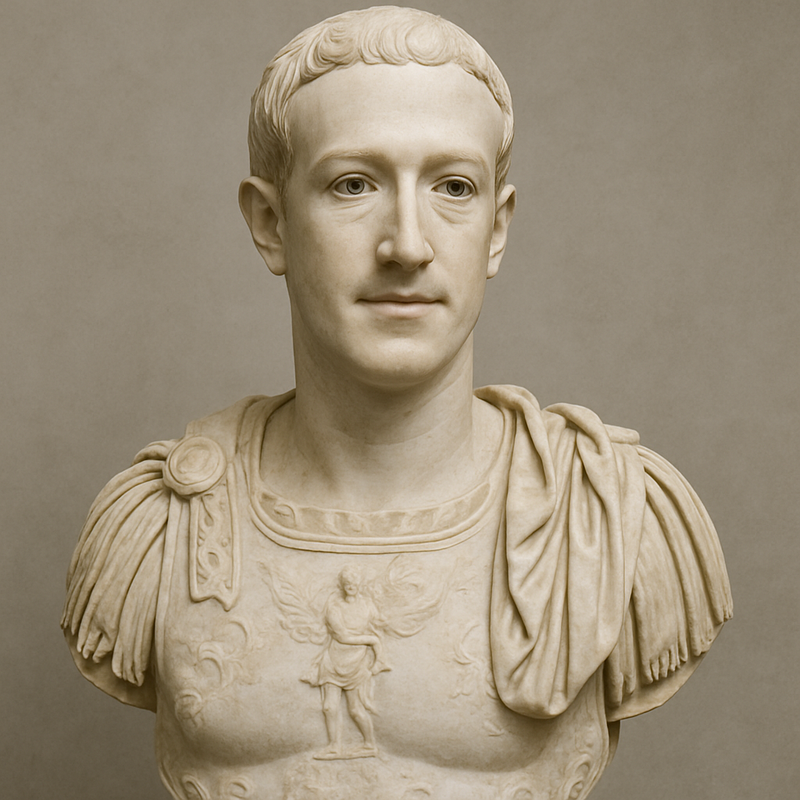
Endlich weiss ich Bescheid über Mark Zuckerbergs bemerkenswerte Frisur ;-) Er huldigt damit seinem großem Idol, dem römischen Kaiser Augustus, von dem er geradezu besessen sein soll. Seine zweite Tochter taufte er August und seine Frau pflegt spasshalber zu erzählen, dass sie zu dritt auf Hochzeitsreise in Rom waren: Mark, sie selbst und Kaiser Augustus.
Potestas non datur, sed tollitur Kaiser Augustus, 63 v. Chr. bis 14 n. Chr.
Der Social-Media-Imperator ist nur eine der milliardenschweren Gestalten im Verein mit Musk, Bezos, Thiel oder Gates. Das Spektrum reicht von wohlmeinenden Philanthropen bis zu faschistoiden Egomanen und alle vereint ein gemeinsamer Geist oder das Mindset, wie Douglas Rushkoff es nennt. In seinem Buch beschreibt der gelernte Medientheoretiker das Mindset mit all seinen Elementen. Es ist eine technokratische, entkoppelte Weltsicht, in der Fortschritt, Kontrolle und Optimierung über alles gestellt werden. Alle Probleme wie Umwelt, Klima, Migration, Krankheit bis zum Tod lassen sich technologisch lösen, was ganz nebenbei für immerwährende Rendite sorgt. Dass man dabei auf eine Katastrophe zusteuert, wird widersinnigerweise gar nicht negiert. Anstatt sich der Verantwortung für die Welt zu stellen, sucht das Mindset nach einem persönlichen Exit: entweder als Luxusprepper in den Bunker, auf die Insel, ins All oder gleich in die digitale Unsterblichkeit. Es ist ein Denken, das auf Separation statt Solidarität zielt – Überleben nicht mit, sondern trotz der Menschheit.
Natürlich geht es nicht nur um die Fantasien der Tech-Giganten. Die Hoffnung auf eine bessere Welt, die wir Anfang der 90er in die digitale Revolution und das Internet setzten, hat sich als naiver Traum erwiesen, der heute schon eher einem Alptraum gleicht. Wie Negri & Hardt schon 2000 geschrieben haben, assimiliert das Empire alles für seine Zwecke. Das Buch ist im Kern der Versuch, die Mechanismen und Details zu erklären, die zu dieser ernüchternden Entwicklung geführt haben.
Rushkoff schreibt sehr zugänglich, lässig und pointiert und lockert seine Betrachtungen mit zahlreichen Anekdoten auf. Das macht die Lektüre unterhaltsam. Eine systematische, fundierte Analyse oder bahnbrechende Erkenntnisse darf man sich nicht erwarten und so manches ließe sich wohl differenzierter und weniger polemisch darstellen. Aber gerade so ist das Buch für ein breites Publikum interessant und bekömmlich. Rushkoff will ja seine Botschaft unter die Leute bringen und das Bewusstsein dafür schärfen, dass wir immer mehr zum kostenlosen Rohstoff für Tech-Konzerne werden, gesteuert von einer abgehobenen und narzisstischen Clique. Im Geschäft mit Social Media und anderen Internetangeboten sind wir nicht die Nutzniesser, wir sind kostenlose Arbeitskräfte und unsere Daten sind die Produkte, die aus unserem Verhalten gewonnen und gehandelt werden und mit deren Rendite sich eine Kaste von Egoisten ihre Fluchtträume finanziert.
PS: Als Appetizer sei aus der Serie des Schweizer Rundfunks "Sternstunde Philosophie" "Douglas Rushkoff – Das Mindset der Tech-Milliardäre" empfohlen, zu sehen auf https://youtu.be/Hgdplv8Mde8?si=Y4Al3...
Interesting beginning - when the book actually talks about the escape fantasies of tech billionaires, as the title promises. Then it goes on a tangent and doesn't do it very well. I know Rushkoff doesn't understand enough about climate change and alternative energy to make the claims he does there, so I'm a little wary on his other sweeping generalisations. Also, yes, Richard Dawkins has a big ego, but at least he's not Noami Wolf. This book is from 2022 and already feels pretty dated.
Vieles an diesem Buch liest sich wie eine bittere Satire, und doch ist es real: Superreiche, die sich von Wissenschaftlern beraten lassen, wie sie die Apokalypse, wie auch immer sie aussehen wird, aber von deren unmittelbarem Bevorstehen sie fest überzeugt sind, am besten überstehen, Tech-Milliardäre, die glauben, auf dem Mars seien sie vor der Machtübernahme der KI sicher (dessen Kolonisierung aber mithilfe von KI betrieben wird), „Philanthropen“, die afrikanische Schulen mit Laptops ausstatten, für die man vor Ort keinerlei Verwendung hat, weil es an Nötigerem fehlt. Schade, das Stanley Kubrick daraus keinen Film mehr machen kann. Douglas Rushkoff beschreibt das „Mindset“ dieser neuen sozialen Klasse, für die sich derzeit der Begriff der Tech-Oligarchie etabliert: Sprösslinge des Silicon Valley, die mit der der Bereitstellung technischer Dienstleistungen im Internet z.T. absurd reich geworden sind und nach immer mehr streben. Dieses Mindset beinhaltet 1. ein Denken in binären Kategorien (es gibt nur eins oder null, richtig oder falsch, schwarz oder weiß), Kritik und Differenzierung gelten demgegenüber als „Rauschen“, das den Fortschritt hemmt und dementsprechend auszuschalten ist. Rushkoff findet es vor diesem Hintergrund symptomatisch, dass es sich meist um Studienabbrecher handelt, die sich nicht in ausreichendem Maße die multidisziplinäre Bildung des amerikanischen College-Systems durchlaufen haben, denen die Geisteswissenschaften weitgehend Terrae Incognitae sind (oder die sich an Denkern wie Ayn Rand oder Steven Pinker schulen). 2. Im Gegenteil priorisieren sie das naturwissenschaftlich-technische Denken (das auch auf wirtschaftliche Zusammenhänge übertragen wird). Ihr wissenschaftliches Denken ist insofern teleologisch, als sie glauben, dass sich mit ausreichend Forschung jedes Problem durch technische Innovation lösen lässt. 3. Dementsprechend kennt dieses Denken nur eine Richtung: Vorwärts, und zwar am besten schneller als alle anderen, die ökologischen und menschlichen Kosten sind, wenn überhaupt, ein „second thought“ bzw. werden sich langfristig schon irgendwie lösen lassen (siehe Punkt 2). Rücksichtnahme ist ein Wettbewerbsnachteil. 4. Darin liegt ein tief verwurzelter Elitismus: Die Tech-Oligarchen sind von ihrer Überlegenheit überzeugt, sie hätten es nicht nur verdient, einen Lebensstil zu führen, der die irdischen Ressourcen über die Maßen eines Individuums belastet, sondern auch politisch zu gestalten, und das nicht zum Wohle aller, denn wer ihnen nicht ebenbürtig ist, ist nicht mehr als Verfügungsmasse als Arbeitskräfte, Kunden und Datenlieferanten, sondern für ihren persönlichen Vorteil. Gegenüber der Demokratie verhalten sie sich destruktiv, und zwar nicht nur in der Unterstützung faschistischer Parteien oder Manipulation der Massen durch Social Media, sondern auch durch „Philanthropie“, indem sie durch vermeintliche Wohltaten letztlich nur ihren Markt ausdehnen, während sie durch Steuerersparnis dem Staat Gestaltungsmöglichkeiten entziehen. 5. Darin liegt auch ein koloniales Denken, das sich zunächst auf den „Cyberspace“, dann auch zunehmend auf die „reale“ Welt richtete. Stellte das Internet anfangs noch einen Raum für die Utopie eines egalitären Teilens und grenzenloser Vernetzung von Wissen dar, wurde es als des „Netz 2.0“ von den Plattform-Kapitalisten und Social-Media-Betreibern vereinnahmt, deren Produkte immer bestimmender für unseren Alltag werden, und das nicht in produktiver Weise (siehe Punkt 4), von denen wir uns immer abhängiger machen. Auch wenn sich die Tech-Oligarchen überlegener Intelligenz rühmen, so sind die Defizite ihres Weltbildes ebenso offenkundig wie verheerend: Mangel an Empathie für die Mitmenschen und fehlendes Verständnis für die Welt und ihre Zusammenhänge als Einheit, als interdependentes System, über das sich niemand erheben kann, ohne dass es Folgen für das gesamte System hätte. Rushkoffs abschließender Appell an den Gemeinsinn, seine Absage an die Ideologie des Wachstums klingt zwar optimistisch, doch bin ich äußerst skeptisch, ob er damit im aktuellen politischen System Anklang finden würde. Aber vielleicht muss erst alles zusammenbrechen, damit wir lernen, dass wir auf dem falschen Dampfer sind. Die Tech-Oligarchen jedenfalls arbeiten aktiv auf diesen Zusammenbruch hin.
Muy alejado de lo que sugiere el título, Douglas Rushkoff utiliza su experiencia personal en el mundo de la tecnología y la cultura digital para diseccionar la mentalidad de los grandes magnates de esta esfera; cartografiar su visión del mundo y los negocios y cómo les guía al tomar todo tipo de decisiones. Esta faceta es en muchos capítulos iluminadora y permite dar una base a las motivaciones detrás de decisiones muchas veces caprichosas para el común de los mortales, como lo que llevó a Mark Zuckerberg a convertir Facebook en Meta. Una búsqueda de nuevos campos por explotar en los que convertirse en dominante, huyendo de una competencia que se vislumbra como limitadora, un residuo del capitalismo a la antigua usanza.
Rushkoff se sirve de todo tipo de anécdotas para cimentar cada capítulo, bien como punto de partida (fui a una reunión con unos yuppies de Palo Alto en el que me cosieron a preguntas sobre cómo controlar a tu equipo de seguridad en el caso de que llegue el fin del mundo), bien como apoyo, y esto hace que el texto sea particularmente ágil. Siempre hay una vivencia extravagante con la cual sonreír, o un momento para descongestionar un capítulo que se está poniendo denso. Inevitablemente, en ocasiones se le ven las costuras. Particularmente cuando para sustentar sus ideas termina incluyendo observaciones para dar cera a quien sostiene posturas contrarias en frases más propias de un blog o un flame de twitter (queda un poco mal decir que Richard Dawkins viajó en el avión privado de Jefrey Epstein en el que está probado que hubo mucho sexo con jóvenes sin saber si fue su caso). Esto y que parte de los capítulos no queden tan fundamentados como otros hace que el libro coquetee con el libelo. No hasta el punto de caer en él pero sí lo suficiente como para enfangar un texto necesario. Porque si queremos descubrir los intrígulis detrás de tanto mogul desnortado que parece salido de una mala novela de ciencia ficción no tenemos tiempo de leernos uno tras otro los escritos de Walter Isaacson y otros biógrafos pop. Este libro permite acercarse al máximo común divisor de todos ellos de una manera ágil y razonable.
Por cierto, a ver si el equipo de Yolanda Díaz se lo lee y no se queda sólo en el título y la portada.
This book is about “The Mindset” of the billionaire tech class, which is obsessed with “winning and escape.” Escaping the rest of us w/ a team of bodyguards when the shit hits the fan. The Mindset seeks only linear progress and straight lines toward growth and progress. “Solutions must make money.” Growth to The Mindset is good. To The Mindset, all solutions demand more growth. If you mention you can’t have endless growth on a finite planet, those following The Mindset will unfollow you. Greta Thunberg was invited to speak at Davos twice; and her speech was ignored - twice. Her speech simply contradicted Klaus Schwab‘s Great Reset. His Great Reset is not about sustaining the Planet – it’s about sustaining capitalism. “Surprise, surprise!” as Gomer Pyle would say. The rest of us need to travel less, consume less, buy local, do mutual aid, do cooperatives; the billionaire class will simply do what it wants. Bounded economics means investing in your local community over the stock market. Scott Galloway says, “capitalism mean being loving and empathetic to corporations, and Darwinistic and harsh towards individuals.” Capitalist control kills community – it creates an iPad, not an usPad. During COVID, Zoom shares increased 700%, Bezos gained $86 billion, and the 5 biggest tech companies saw market capitalization up 50%. COVID showed the way to a fully digitally immersive future away from nature and the planet that sustains us. Tech’s faux reality must never show the true threats to our collective future.
Bill Gates pioneered venture philanthropy as a new kind of colonialism. He demanded Big Pharma needed a profit motive for vaccine development or we’d be at risk of “civilizational collapse.”.” So what if the mosquito nets Gates sent to Africa now poison local fisheries? Villagers instead used them as fishing nets, not knowing that the weave was so tight, it also caught baby fish, and, those nets had insecticide intentionally on them so the water became “unpotable as well.” Thanks, Bill. And Bill Gates is now “the biggest private owner of farmland in the United States; what could go wrong with that? Who doesn’t picture Gates chatting in his Osh Kosh B’Gosh overalls with his hoe – sorry, meant Melinda.
Why Were Witches Killed? In the Middle Ages, women herbal healers were not surprisingly getting better results than male faux doctors a.k.a. bloodletters & leech users. Neither had a clue about the thousand years of proven Chinese natural medicine. But wiping out the witches neatly removed the competition, made medicine an exclusive boy’s club which poo-pooed alternative herbal approaches. Worry not, today’s women get to make a return to male-dominated medicine often as “pretty-enough to be a hostess” Pharma reps.
After Columbus, everything changes w/ the increased ability to destroy, leading to the dominator mindset - think Hitler and today’s billionaire tech class. When colonists landed, the church wasn’t just preaching to the natives, it did the intelligence gathering. Colonizers saw the natives making rope, then made it illegal for them to do so and manufactured it themselves. If the natives grew cotton, you send the cotton back to England to make cloths and then sell them the manufactured clothes at a higher price – colonizer slow fashion came before today’s fast fashion. Growth like a cancer cell soon became all the rage, create new markets (even by forcing them). Make water scarce and you can charge more. You want to increase GDP at home, don’t fix that bridge, build a new one. Don’t forget Enlightenment values included “extraction, hierarchy and accelerated growth” - great for the capitalist’s wallet, bad for the planet’s sustainability. That led to Jeff Bezos who presently has TWO yachts – his main yacht has large sails while the small yacht intentionally doesn’t so it can have a helicopter pad. What? Having to always board your single yacht from land? That would make Lauren Sanchez frown - if Botox would let Lauren Sanchez frown. Luckily, she has two built-in flotation devices if she fell overboard; Jeff thinks of everything.
Fascists today love Nietzsche mostly because of his “The Will to Power”, but don’t know or care that it was actually hobbled together by his fascism loving sister by choosing scrawled bits w/o context which now inspires “tech Übermensch wannabes” like Peter Thiel to increase authority over us mere mortals.
Obviously, AI uses INSANE amounts of energy (increasing climate change) but so does Bitcoin. In fact, “millions of computers around the world now have no other purpose than to prove the value of Bitcoin by spinning their cycles and spending electricity on purposeless calculations. Bitcoin ALONE today increases climate change by demanding more energy daily than ALL of Sweden. Whoa… Greta Thunberg should address the profligate energy use of AI and Bitcoin.
When the author told tech billionaires about alternatives like Extinction Rebellion, Sunrise Movement, Post-Carbon Institute and EarthRights International, one told him,“if they’re so good, why haven’t I heard of them?” Tech billionaires live frozen inside “The Mindset”. To them it makes more sense to reinvent the wheel, at least that way you can spin it while wearing your captain’s hat. Such technosolutions demand “exponential growth, automation over human intervention, forward momentum, platformization, and a disregard for existing conditions on the ground.” They also require expensive conferences for privileged whites where the menu serves non-sustainable items like “baby veal” and imported water in plastic bottles shipped via bunker fuel. COVID created “at least nine billionaires off vaccine profits alone”. Page 133 is all about the insane energy and mining cost of making solar panels.
This was a good book on a potentially important subject. I thought I’d learn MORE, but years ago I thought Obama WAS interested in change, and thought Kamala might one day offer the American people something BEYOND an embarrassing laugh and an equally embarrassing “what can be unburdened by what has been” mantra. Oh well…
Quizá Douglas Rushkoff se dedique a agasajar demasiado al lector describiendo a los superricos de una manera casi paródica, representándolos como gente presuntuosa y alejada del sentir del común de los mortales. Quizá también andaba sobrado de balas con las que tomar venganza de rencillas pasadas. Más de un personaje ilustre sale malparado en el libro. Pero aporta razones suficientes para agotar la confianza —si es que todavía quedaba alguna— en la creencia de que al frente del barco tecnológico tenemos a los más sensatos.
Las conclusiones son demoledoras. Y preocupantes. La mentalidad de esta élite tecnológica camina a través de la megalomanía, el egoísmo extremo y una ignorancia colosal sobre cualquier aspecto social. Y cada vez tienen más poder. Se centran en un capitalismo extremo, donde lo disruptivo, el cambio de paradigma o la ruptura con el pasado son elementos distintivos de sus propuestas de futuro, a pesar de que en ocasiones puedan tener buenas intenciones. No hay lugar para lo comunitario, para un desarrollo sostenible, para el decrecentismo. La sensación final es de que el porvenir nos lo jugamos a una tirada de dados. ¡Y el cubilete lo maneja algún tarado!
Otro punto a favor del libro es la facilidad del autor para trasladar al lector cuestiones bastante complejas de una forma amena y abreviada. Muy recomendable.
In „Survival of the richest“ setzt sich Douglas Rushkoff mit der Denkweise der Superreichen auseinander, die sich auf den drohenden Untergang der Welt vorbereiten , nicht durch gesellschaftlichen Wandel, sondern durch persönliche Absicherung. Er beschreibt Tech-Milliardäre, die sich luxuriöse Bunker bauen, um Krisen zu überleben, oder die Flucht ins All als Ausweg sehen. Dabei zeigt er auf, wie diese Eliten sich von der Realität und dem Rest der Menschheit entfremden, während sie gleichzeitig renommierte Wissenschaftler ausnutzen, um ihre Weltsicht zu bestätigen.
Rushkoff nimmt das Thema mit spitzer Feder auseinander und liefert eine messerscharfe Kritik an den Mechanismen des Spätkapitalismus. Besonders beeindruckend ist seine Analyse, wie die reichsten Menschen der Welt die Ressourcen der Erde ausbeuten, nur um dann vor den Konsequenzen ihrer eigenen Handlungen zu fliehen. Eine spannende Mischung aus Gesellschaftsanalyse und Wirtschaftskritik, die zum Nachdenken anregt.
Say what you will about the Unabomber, but that guy had courage of his convictions. He believed that modern technological society was destroying the earth and making mankind miserable, so he renounced it to live in a shack in the woods and spent his time mailing bombs to people to try to get his message out there (note: the last part is problematic).
Doug Rushkoff, on the other hand, while eager to condemn modern society in all of its failings, is also so thoroughly steeped in it that he doesn't even realize how idiotic he sounds. This is a guy who wants you to know that rich technocrats are ruining the world, but who will happily collect a paycheck from any rich technocrat who offers him one. I noticed at a certain point how Rushkoff's language describing these interactions is always very passive: he was "summoned" to speak at some billionaire boy's club; he was "offered the chance to comment" on somebody's business plan; what he can't quite bring himself to say is "I took their dirty money because I wanted to get paid, and I'm perfectly happy to buy into an awful system if it means I can send my kids to college." He's also happy to let you note all the times rich, important people have sought his counsel, so it's not a purely mercenary calculation: he's also a self-hating star fucker.
I must also note, for someone who has supposedly been thinking about these issues for his entire adult life, Rushkoff seems not to recognize some of the problems with his ideas. As one example: Rushkoff does not believe we can innovate or build our way out of a climate disaster. The only solution he acknowledges is "degrowth," which he never defines but which contextually seems to mean renouncing current western standards of living and discouraging their promulgation in the developing world. To me, the lay reader, that seems like something that will require you to change the minds of a lot of people who are invested in the current status quo. But Rushkoff also decries any kind of public relations or social engineering as unethical and ineffective--indeed, he claims any attempt at societal manipulation inevitably backfires as people recognize the manipulation and rebel against it (this ignores vast swathes of human history, but never mind). So, how, then, do we convince the bulk of the world's population to accept that they won't get McDonald's, Netflix, and air conditioning? Doug seems to think they'll reach this conclusion on their own given time and education, hopefully before the world burns down around his ears.
Honestly, this vies with "The Enigma of Room 622" for worst book of the summer. I need to burn some sage over my ereader before this goes any further.
When billionaires want to be preppers, who do they call? Well, in the case of this book they call Douglas Rushkoff. They drove him to a remote area in the desert and sat at a round table asking him questions like “where is the safest place going to be when disaster happens?“ “Is Alaska or New Zealand going to be safer?“ as opposed to “what can we do to stop a disaster? “ this certainly got the author thinking about all the questions and more and that is where the book comes from. From million dollar farms that would help everyone to underground bunkers for individual families this book covers it all in modern interesting book it was. I didn’t even know billionaires were preppers and that they are actively looking for ways to save them and their families. This book is surprising and informative and most of all interesting. I thoroughly enjoyed this book if you read this book in your mind isn’t blown then you’re for better informed than I am. My favorite chapter was on the aqua nation but all the chapters were very interesting. I received this book from NetGalleyShelf and the publisher but I am leaving this review voluntarily please forgive any mistakes as I am blind and dictate my review.
Seems like a long uninformed rant after the first 2 chapters. A misnamed book that assumes every rich person is an as*hole because they are rich and that technological growth hasn’t done anything for the rest of the society (of course conveniently ignoring all the medical benefits that technology has brought and all the growth of the middle class in all emerging economies). The book is more a manifesto than an informative guide, and a very non coherent one at that.
I’m sure enough people would still like this, because enough people like hating on billionaires, but hoping for any real information on the life of at least some of the evil billionaires (as with any group of people, there has to be a spectrum) is a wasted opportunity here.
Something went horribly wrong with the Internet - this truth became more widely accepted in recent years, and resulted in a movement called Techlash. It is also a topic of a growing number of books, but among those ‘Survival of the Richest’ stands out. I can’t remember any other so eye-opening, so thought-provoking reading in years. The author has both unique access to main players in the big tech scene and an intellectual background that helps to give all that is happening now a deeper context.
If you’re trying to understand what the heck happened with our reality and what you can do to change its disastrous trajectory, it is an essential read. Highly recommended.
Thanks to the publisher, W.W. Norton & Company, and NetGalley for an advanced copy of this book.
I wish the entire book was as powerful as the first few chapters. I think my jaw was on the floor for the stories about ultra-rich escaping the world instead of driving toward solutions. After those very compelling stories the book takes a turn, and covers a grab bag of topics related to modern technology and wealth inequality. Even though I did enjoy the overall book, I am left wanting a sequel that really dives into that mindset of escaping over repairing/improving.
Escape fantasies of the tech billionaires is a very misleading title. Aside from one, maybe two anecdotes in the book, it just sits there as an unfulfilled promise as the author instead pivots to what he refers to as the Mindset, which can be quickly summed up as techno libertarianism, no breakthrough here. Rushkoff then spends the rest of the book on that and takes potshots at his peers. Which is a shame, because I find the original topic fascinating, and there is so much he could of done with that, especially in regard to his opening argument, can you spend your way out of the problems your pursuit of profits have created? Just off the top of my head, what’s the fundamental difference between the redneck with a dugout full of guns and a millionaire with his own private island? How did the rich retreat during Covid? I remember the articles of minor entitled figures getting busted for not quarantining as they jetted about on private planes, so can the rules apply to the rich in a disaster scenario? What does climate change look like to people with gigantic yachts to retreat to? Are they actively trying to accelerate the Event ala the Peripheral? (He touches on this far too briefly) What type of Event are they preparing for and what if it happens slowly, will we signs of their retreat? What about all the questions the millionaires had about their security? Rushkoff may claim that these are all beside the point, and undoing the Mindset that allows these people to validate these questions is more important, but I think his rambling tour of conferences, old arguments with his peers, and the odd allusion to Peter Thiel’s New Zealand ventures (what is he doing there? It’s never explained) doesn’t really serve the point either. All in all I think he should of attempted some interviews with some of these tech bro millionaires. I’m not asking for a tour of the bunker like Lifestyles of the rich and famous, but still, showcasing the extent they are willing to sacrifice the rest of us would have been more impactful than his experiences with the Mindset (again, just techno libertarianism)
Rushkoff is a skilled thinker and a nice person, but this book just didn't gel for me, I think perhaps in part due to the way the book has tended to be marketed in some sectors (and the cover itself). While the book's prose is well-written and its critiques are largely very much valid, I felt like I've just seen a lot of these criticisms of the Silicon Valley technolibertarian mindset elsewhere, and the book didn't feel especially fresh or memorable to me.
Very pleasant narration by Rushkoff in the audiobook version.
The book abandons its title rather quickly and then moves into meager critiques of various people and ideas. The arguments generally stay pretty surface level and the author often comes off rather self-important.
Omggggg if you hate tech bros but can't put your finger on why...this book will help you conceptualize just how terrible it is having a group of wealthy, frequently misguided segment of our society who believes they're smarter than, more just than, and going to save the rest of us!
An interesting take on the current take on the current state of the world, espousing an ideology that is assigned neither to the political left nor right, but in some new direction. Perhaps upwards.
The absolutely cold-blooded takedown of TED Talks or the cheeky comparisons of the standard three-act story structure to the male sexual cycle on their own made this read worth the price of admission.
To be honest, I expected very little from this book, anticipating as I was yet another journalist-turned-expert telling me all about what the world is "really" like. In some ways, this is in that same genre, but it sits high enough that it manages to clear the junk pile. The author is a professor of communication (makes sense), and the topic appears to be the woes of liberal secularism, an ideology so important in its persistent relevance to the modern life, yet so abstract in its descriptions and slippery in its insidious pervasiveness. It's hard to talk about, in other words. There's really nothing dramatically new I learned from this read, but I don't think I've ever encountered a book that has more succinctly and clearly laid out the way secularism, technocracy, and neoliberal evils are woven into our society, and it does it by largely avoiding 50-dollar-words like "secularism" and "neoliberalism." Bravo to that.
Rushkoff, to his credit, knows that the best way to communicate to all parties and get cross-sectional interest in this topic is by looking at the people everyone hates: the billionaires. If everyone's favorite MarioKart healthcare assassin has taught us anything, its that people can unite behind the idea that the largest systems at work in our societies are unjust and that the ultra-wealthy bear a great deal of blame. Though he is very transparent about his Marxist background (something many conservatives will use to immediately write off this book), I think there is something here for everyone and anyone with a sense of our current disconnect. Those most in need of reading it, much like MLK's Letter from Birmingham Jail would suggest, are the liberals who often uncritically find themselves in the thrall of secularism or technocracy; I can't describe how satisfying it was to read the section absolutely filleting Richard Dawkins and new atheism as complicit in the systems that are currently reducing the world to ash (literally and metaphorically).
In this interesting and thought-provoking book, Rushkoff outlines for the reader several interactions with famously wealthy individuals who seem to seek some sort of post-apocalyptic existence. One thing that struck me was how he never talked about the inter-connectivity of the boards of directors of mega-corporations that link arms merchants, prison-industrial complex, pharmaceuticals companies, insurance companies, big agriculture and big oil (just to name a few). Really, he mainly focused on the billionaires like Musk, Bezos and their ilk. I came away with a distinct feeling that he left “old money” alone and focused on high-profile, “new money” billionaires.
Regardless, I picked up some interesting insights, and I will share two or three of them in this review. I have foresworn social media for some time. I never was on Facebook, ever, and I removed myself from Twitter in 2020. I never considered:
“When Facebook’s practices of data collection and user manipulation surfaced, I began to give a speech arguing that on these platforms, ‘We are not the users, we are the product.’ While catchy, it’s not quite true. We are not products of these platforms so much as the labor force. We dutifully read, click, post and retweet; we become enraged, scandalized, indignant; and we go on to complain, attack, or cancel. That’s work. The beneficiaries are shareholders.” (p. 32)
In what was to me an unsurprising revelation, he says, “. . . . research has suggested that after people have gained power, they tend to behave like patients with damage to their orbito-frontal lobes. That is, the experience of wealth and power is akin to removing the part of the brain “critical to empathy and socially appropriate behavior.” (p. 34)
This is an important book because it lays out the problems faced by the world. He pays attention to the fact that, by allowing society to grow and develop as if there are people we can afford to discard, like refuse, we are actually causing even greater problems; that by continuing to feed into the lie of the capacity for exponential economic growth, what we are really doing is making the ultra-rich even more rich at the expense of ourselves and humanity. What is missing is a realistic, concrete set of ideas of sufficient complexity to address this problem.
Still, it was a worthy read and another reader who I respect gave it one more star than I did, so perhaps you will find that star if you read this book.