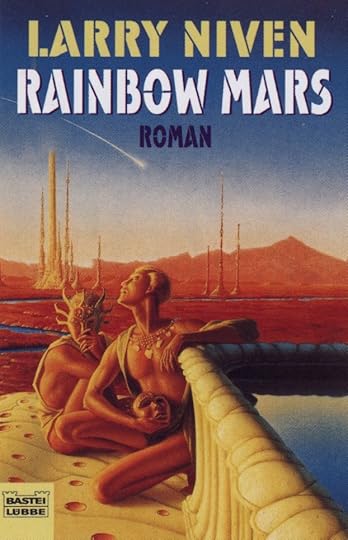
Ein neuer Auftrag für Hanville Svetz: Er soll herausfinden, warum die Marskanäle ausgetrocknet sind und was dies für die Zukunft der Erde bedeutet. Denn der Mars war einmal bewohnt. Als Svetz erfährt, wie die intelligenten Marsianer ausgelöscht wurden, wird ihm klar, dass die Erde bald einem ähnlichen Schicksal zum Opfer fallen könnte. Es bleibt ihm nicht viel Zeit, dies zu verhindern Der fünfmalige Hugo-Preisträger Larry Niven verknüpft Zeitreise und Fantasy, um einen einzigartigen Roman über den Ursprung der "Marskanäle" zu schaffen. ISBN 3-404-24290-4 DM 16,90
Laurence van Cott Niven's best known work is Ringworld(Ringworld, #1) (1970), which received the Hugo, Locus, Ditmar, and Nebula awards. His work is primarily hard science fiction, using big science concepts and theoretical physics. The creation of thoroughly worked-out alien species, which are very different from humans both physically and mentally, is recognized as one of Niven's main strengths.
Niven also often includes elements of detective fiction and adventure stories. His fantasy includes The Magic Goes Away series, which utilizes an exhaustible resource, called Mana, to make the magic a non-renewable resource.
Niven created an alien species, the Kzin, which were featured in a series of twelve collection books, the Man-Kzin Wars. He co-authored a number of novels with Jerry Pournelle. In fact, much of his writing since the 1970s has been in collaboration, particularly with Pournelle, Steven Barnes, Brenda Cooper, or Edward M. Lerner.
He briefly attended the California Institute of Technology and graduated with a Bachelor of Arts in mathematics (with a minor in psychology) from Washburn University, Topeka, Kansas, in 1962. He did a year of graduate work in mathematics at the University of California at Los Angeles. He has since lived in Los Angeles suburbs, including Chatsworth and Tarzana, as a full-time writer. He married Marilyn Joyce "Fuzzy Pink" Wisowaty, herself a well-known science fiction and Regency literature fan, on September 6, 1969.
Niven won the Hugo Award for Best Short Story for Neutron Star in 1967. In 1972, for Inconstant Moon, and in 1975 for The Hole Man. In 1976, he won the Hugo Award for Best Novelette for The Borderland of Sol.
Niven has written scripts for various science fiction television shows, including the original Land of the Lost series and Star Trek: The Animated Series, for which he adapted his early Kzin story The Soft Weapon. He adapted his story Inconstant Moon for an episode of the television series The Outer Limits in 1996.
He has also written for the DC Comics character Green Lantern including in his stories hard science fiction concepts such as universal entropy and the redshift effect, which are unusual in comic books.
What if you had a time traveling machine that sometimes traveled into alternative worlds or even fantasy worlds? Find out in this dangerously funny collection by Larry Niven
Rainbow Mars is a novella of exploring the planet described by Percival Lowell and Edgar Rice Burroughs with their planet wide canals, four armed warriors and beautiful princesses who need rescuing. Plus there are six earlier stories "Get a Horse!" Svetz is sent back in time to capture a horse, but brings back a unicorn instead. "Bird in the Hand" Svetz is sent to get a roc, but returns with an ostrich, which he reverse engineers into a roc. A co-worker swipes a prototype of the very first automobile, causing a dangerous problem in the present. "Leviathan!" Svetz is sent to capture the largest mythical creature that was ever imagined, Leviathan. "There's a Wolf in My Time Machine" Svetz falls in love with a woman who evolved from a wolf. "Death in a Cage" Svetz encounters the archetype of the Grim Reaper. "Svetz and the Beanstalk" Getting up and down on Mars.
Is our hero frightened? YES he is Svetz had not slept in the hours before departure. “You’re scared stiff,” Ra Chen had commented just before Svetz entered the extension cage. “And you can hide it, Svetz. I think I’m the only one who’s noticed. That’s why I picked you, because you can be terrified and go ahead anyway. Don’t come back without a horse…” . . . . . The beast was floating past him. Around its waist was a sphere of weightless water that shrank steadily as gobbets dripped away and rained back to the sea. The beast’s nostrils flared—it was obviously an air-breather, though not a cetacean. It stretched, reaching for Svetz with gaping jaws. Teeth like scores of elephant’s tusks all in a row. Polished and needle sharp. Svetz saw them close about him from above and below, while he sat frozen in fear. At the last moment he shut his eyes tight. . . . . The ghost came solid in an instant. It pulled the Emergency Stop down hard, turned and leapt. It was still a skeleton. Svetz screamed high and shrill, turned and tried to burrow into the hull. He felt the thing land on his back, light and dry and hard. He wailed again. He was in the fetal position now, hugging his knees. Bony fingers tugged at his hand, and he screamed and let go of the stun gun. The fingers took it away.
For those who have not met Svetz it is recommended to read the short stories first before enjoying the novella "Rainbow Mars"
Way back in the sixties, Niven started a series of humorous time-travel stories: Svetz the hero-klutz is sent back from the 31st Century to capture extinct animals, but he never quite finds the "right" beastie.... I remembered these as throwaways, but they've aged well. Rainbow Mars is a novel-length sequel, so you'd be well-advised to thumb over to the reprints first, to properly set the stage for the main event....
Which involves -- hrm, how to say this without spoiling the fun -- a *very* fast-paced visit to a Martian past that's an amalgam of (and homage to) Burroughs, Wells, Bradbury, Heinlein -- with Integral Tree-style beanstalks thrown in as an illustration of Being Careful of what you wish for. Not to mention a Princess of Mars, and how she learned to surf. And sex in a hot-tub. And enough insider jokes and references to challenge the memory of the best-read fan.
"This is my take on Mars, and Yggdrasil, and (God help me) the space program" -- done up in a delicious hard-fantasy soufflé. Bon appetit!
Niven's pretty near the top of his form here -- he obviously had great fun writing this. Rainbow Mars gets mixed reviews -- recursive-sf humor clearly isn't to everyone's taste. If you haven't liked previous light Niven: Svetz, Warlock, Fallen Angels -- this may not be for you. Rainbow Mars may not win him many new converts, but Niven trufans, and readers who like a tall tale well-told, will be well-pleased.
Review first published at Infinity Plus 1999; lightly revised 2015
This is a SFF book that contains a novel plus several short stories. If you plan to read it, my advice is to start with the stories, which in the book follow the novel, but which were written before it, and introduce both characters and situations that are mentioned in the novel. I will also start this review with the stories.
The Flight of the Horse the first story, which according to the author in the afterword was based on his telling it as a cocktail party story that night, without losing any listeners. It introduces our protagonist Hanville Svetz, who lives in our future in the year 1100 PostAtomic (i.e. after 1945), where Earth is so environmentally devastated that there are almost no animals or plants, all open water is a poisonous sludge and UN SecGen is an inherited post. Moreover, natural resources are depleted, so no possibility to try and colonize a new world. The current UN SecGen is about to celebrate his 28th birthday, but mentally (due to inbreeding) he is just about 6 years old, and to get on his good side, the Institute for Temporal Research sends Svetz to the past to get a horse, for the SecGen saw then in 1955 books and now wants one. Svetz is afraid of animals but even more he fears losing his head. Therefore, when he sees a horse pure white, with a mane that flowed like a woman’s long hair. There were other differences [from the book]… but no matter, the beast matched the book too well to be anything but a horse. Leviathan! after delivering a horse and a Gila monster (whom the SecGen saw in comics and which is forty feet long from nose to tail and was equipped with vestigial batlike wings. Otherwise it was built something like a slender lizard. from China), Svetz was sent to get the largest monster that ever lived, which these future historians think was a sperm whale. Bird in the Hand the SecGen wants a Roc, but Svetz manages only to get an ostrich. Guessing that a legend of Roc was based on witnessing ostriches and assuming that they are just chicken (not yet learned to fly) the scientists reverse engineer Roc, while Svetz’s colleague Zeera Southworth is sent to the past to get the first-ever car, which they assume was the first car built by Ford. There’s a Wolf in My Time Machine Svetz successfully captures a polar wolf, but when he returns his time machine wobbles and jumps on a parallel time stream where wolves, not apes evolved into humans. Death in a Cage as Svetz returns from another travel to the past, an apparition appears in his time machine, a skeletal semi-transparent ghost and the Institute for Temporal Research decides to get one for the SecGen.
Finally, the novel itself, Rainbow Mars starts with the death of the current SecGen, replaced by another, who is more interested in renewing the space colonization program than exotic animals and because from the previous stories that an absence of facts about history allows them to get not only real but mythic creatures, they can get to Mars in the time when the channels were real. What follows is a mix of homages to classic old SF Mars of H.G. Wells, Edgar Rice Burroughs, Ray Bradbury and Robert A. Heinlein among others on one hand and classic fairytales and legends, including Yggdrasil, John and the Beanstalk, Jacob’s ladder, which all are allusions for a living plant space elevator. I guess this works nice for fans of old (1890-1950s) SF, but not for other, who would find pieces like Dawn. He flew above dark green canyons cutting through red desert. Far ahead was a row of … something repetitive. He took his time descending. Pyramids. The row began above the canal, and the first was no bigger than a fist. Each that followed was larger, and each had been broken open. Which is an allusion to A Martian Odyssey by Stanley G. Weinbaum incomprehensible.
I liked the stories more than the novel and the start of the novel was better than its finish.
I don't know where or when I got this book but I decided it was about time to read it as it's by Larry Niven (born in Los Angeles in 1938), one of the greatest living science fiction writers today. Published in 1999, it's a novel of 224 pages--"Rainbow Mars"--with five short stories--all about Svetz the time traveler. I had read one of the short stories somewhere and that is "The Flight of the Horse," published in 1969. It's the best story of the bunch and I preferred the short stories overall to the novel, which I thought dragged somewhat. The premise is that future Earth is a severely polluted planet and animals have become extinct. Svetz is sent on missions back in the past to find and bring animals back to the future when they can be cloned and saved. In one story, he is sent to bring back a horse. But who knew that horses have horns? In "Rainbow Mars," Svetz is sent to the Mars of the past to find out the origin of the canals there. While on the Red Planet, he encounters creatures straight out of Barsoom, the Mars of the John Carter stories by Edgar Rice Burroughs. It seems that Svetz is not so much going into the past as into fantasy worlds of the human imagination. I give the stories 3 stars overall, entertaining, but I much prefer Niven's "Ringworld" series. I also prefer books that Niven cowrote with Jerry Pournelle (1933-2017), such as "The Mote in God's Eye" (1974) and "Footfall" (1985). By the way, I have to add that I find time travel to be more believable than humans allowing that magnificent creature, the horse, to become extinct.
Rainbow Mars is a collection of Niven's Svetz stories that Tor published in 1999. It includes an original novel, used as the book title, as well as Niven's first five Svetz stories from 1969 - '73. Three of the stories came from issues of F & SF magazine, one from Playboy, and one was original to an earlier collection of Niven's short fiction, The Flight of the Horse, which was published by Ballantine in 1973. It also included the other four stories; the five are The Flight of the Horse, Leviathan!, Bird in the Hand, There's a Wolf in my Time Machine, and Death in a Cage. The original stories starred Hanville Svetz, a future time-travelling agent in a world where most of the original life forms have been driven into extinction. His job is to go to the past and retrieve samples so the species can be studied and perhaps revived. Due to weird cosmic forces, he always ends up with impossible mythological beasts that aren't at all like he was led to expect. It's cool to see the ever-techy hard syfy guy Niven write fantasy! The novel shifts gears a bit, and his job has changed so that his new boss wants him to go back in time and find out why the Martian canals dried up. An organic beanstalk is involved, and there are a lot of shout-outs to literary versions of Mars from classic science fiction literature, at least some of which won't be familiar to casual readers. It was a good story but lacked some of the humor of the earlier ones. The big problem with the Tor edition is that they printed it in the wrong order. It's important to read the stories before Rainbow Mars the novel, but they printed it with the novel first and the short works at the end. Read the book, enjoy the laughs, but read it backwards!
Supposed to be funny, and a tribute to classic Mars stories including Weinbaum's Odyssey....
Ok, had to give up. I did like the short stories. If I'd read them first, I wouldn't have struggled so with the novella. And maybe I would have liked it more. Bad choice to put them at the end of the volume... after all, they do take place earlier.
I do like the theory that rocs were invented as an explorer's thought that ostriches were chicks of a larger bird, even though it makes no sense. The short stories were funny that way. I gave the part of the novella that I tried to read not even one smile.
Come to think of it, this isn't the only Niven I've not been able to enjoy. I might just give up on him.
This novel is a fast-paced, entertaining, and occasionally funny, fantastical space and time travel romp! Larry Niven's version of time-travel has an unfortunate habit of landing time-agent Hanville Svetz into fictional worlds instead of the past (after all, time-travel is a fantasy). First there was the mission for a horse, which landed him a snowy white horse with a bayonet growing out of its forehead (the book didn't mention that!); then there was the fire-breathing, 40 foot long Chinese "Gila monster"; the mission for a sperm whale ended up with the capture of a harpoon studded, albino behemoth with a drowned, one legged sailor tangled in the lines. 'Rainbow Mars' begins with Svetz returning to his polluted "future" Earth with a snake in tow - a rather large feathered snake - only to find that the Secretary General has died and that the new Secretary General is less interested in extinct animals and more interested in space travel.
So, when Svetz's Institute for Temporal Research is transferred to the Bureau for Sky Domains, the resulting power struggle results in the time-travel machine getting co-opted to travel both space and time to explore Mars in the deep past when the canals were in use, before it became a dead world. Svetz and his companions find themselves on a Mars populated by a variety of fictional Martians from Edgar Rice Burroughs, H.G. Wells, C.S. Lewis, Ray Bradbury, and Stanley G. Weinbaum (no doubt fans of these old, 1890-1950s, SF stories would find these allusions more meaningful). Then there is the enormous alien tree extending into Mars's orbit - Niven's take on the space elevator. The new Secretary General believes such a space elevator would make space travel more feasible, they can save Mars, and also colonize the solar system. Svetz and company are instructed to obtain seeds from this "World Tree". A wild romp through a fictional Mars, back and forth through time, multiple changing timelines, and many almost-disasters averted (or not) ensues.
I loved the time-travel concept and the inclusion of old SF stories. This is my first Larry Niven novel, but it won't be my last. This novel was just pure fun.
Note: My copy of the book only includes 'Rainbow Mars' and not the handful of short stories featuring Hanville Svetz that other publications with the same title may contain. I enjoyed 'Rainbow Mars' so much, that I'm going to track down those other stories.
Time travel! Space travel! The fate of humanity hangs in the balance! Martians from all along the wide span of fiction about Mars! Sorns, Red Martians, Tripods! World trees that reach to the edge of the atmosphere!
And I just literally could not have cared less. This book was a slog and read like a chore. To say the characters were one dimensional is to give them credit for a dimension they don't have. There is no character backstory, their emotions seem to range from mad-I-guess to kind-of-hungry to horny-apparently. We're told the stakes are high, but without a single character to relate to or empathize with, it's hard to take any threat to humanity very seriously.
I will probably attempt to read another Niven story at some point, in spite of this one, because I can only assume he won five Hugo Awards for a reason, but if you are considering picking up a Larry Niven story for the first time I sure recommend against Rainbow Mars.
I have to confess to being a Larry Niven fan, as a writer of 'old fashioned" hard science fiction he is arguably without peer, although I also have to be honest and admit that the years have not been kind to him, as his writing style has become more and more like shorthand as the ideas tumble out, and it takes a lot of concentration to stay with him. Not always the worst thing but looking back at the fascinating read that was Ringworld I have to say that I yearn for the past a little. Here we have the final (up to now) adventure of Svetz, the time traveller, who has featured in a number of time travel short stories starting with "The Flight of the Horse". Niven reasons thus - any competent scientist will tell you that time travel is absolute fantasy, so if you have a time travelling machine, you aren't actually travelling to the past, you're travelling into fantasy. (Hence, in the flight of the horse he brings back a Unicorn, other stories involve him liberating a Roc and a werewolf from the 'past'.) Rainbow Mars is an opportunity, by travelling back in time on this basis, to reference many of the stories based on the red planet over the years, everyone will recognise Burroughs, everyone should recognise Weinbaum, and there are many others. Then throw in a space elevator tree, and the genesis of many Earth myths (Baba Yaga, jack and the Beanstalk, lost cities of gold, etc, etc.) On that basis the book is well plotted and tightly put together, but Niven's style, as previously mentioned, has not got better with age. The book includes the other Svetz stories, and these should definitely be placed at the front, or read first, if you are not already familiar with them.
i cant stand books that are so obviously written by a man. the women in the story were not well developed, and they were only there so the main character could feel like a man. do not read this book. it’s not worth it. the most annoying part is the plot isn’t horrible so i had to finish it, but it was not good.
Larry Niven is great at creating very colorful worlds and creatures, and other of his science fiction books are quite addictive. "Rainbow Mars" is an odd mix. It contains a collection of short stories about a time traveler that goes back to retrieve extinct species in a futuristic earth too polluted and devoid of life other than humans. It also has a newer novel, where time traveling is taken to Mars, exploring the reason behind the channels and the extinction of life in this planet.
I think it would have been better to read the short stories first and then the novel, but they are presented in the opposite order, resulting quite confusing. It was only after reading the short stories that the humor of the main idea behind them hit me. A very confusing scene in the beginning of the novel became clearly a special appearance by Quetzalcóatl. Because science fiction and fantasy aren't really that different from each other.
The short stories are charming and funny. The novel is very confusing, even tedious at some point, although it is kind of funny, as it contains lots of references to other science fiction Martians, such as H.G.Wells' and Bradbury's.
And I should say that the boring sex scenes sprinkled every now and then annoyed me. They added nothing to the story, a story already confusing enough.
If you are a fan of the multitude of stories about Mars, this novel is a great tribute to them all. I really did even realize it until about half way through the book when I started noticing elements of that great old short story, "A Martian Odyssey." I just thought Niven had gotten off another pretty good read until I realized what he was up too. This book reminded me that I had always meant to go back and read Edgar Rice Burroughs' Mars books too.
Really struggled to get into this book for about the first 50 pages or so. Normally I'm critical of books for taking too long to get to the point or getting too bogged down in details but in this case I feel that's exactly what this book was lacking! The pace starts out rapidly and never truly relents, actually building sharply towards the end. This is great but only further highlights the fact that there just aren't enough details early on to make the reader properly understand the concepts involved. So if you can put aside a sense of mild confusion at times then the ride is really quite good, the frenetic pace and palpable tension of the latter stages keeping the reader hooked right until the end.
PS - the version I read did not contain the additional short stories, only the main titular text.
I finished reading Rainbow Mars last night. I haven’t read much Niven recently, but I was a big fan of his back in the late 70s. Rainbow Mars is a collection of a short novel, “Rainbow Mars” and five short stories. The short novel was new in 1999 when the book came out; but the accompanying short stories were all over 25 years old, originally published between 1969 and 1973. All are about Svetz, a government employee from a bleak future, who travels in back time at government expense.
The future in which Svetz lives (about 1000 years from now) knows very little about the past into which he travels. As these are all humorous stories, something nearly always goes wrong when Svetz’s travels, and frequently part of the problem is this ignorance. This aspect of the stories works pretty well in the short stories, but I thought less well in the novel.
The 5 short stories were published together (with a couple of non-Svetz stories) in a 1973 Niven collection, The Flight of the Horse, which I think I read in the late 70s. I remembered them fondly but when I read them again I was surprised how little I actually remembered.
I enjoyed the “Rainbow Mars” novel, but not as much as I thought I would; as it turns out, I enjoyed re-reading the short stories more than the novel.
This is mostly a time travel story about a time in the far future when the Earth is in terrible shape. Time travelers go back in time to pick up fantastic beasts for the zoo that the UN Secretary likes. He is an idiot. Then, the UN Secretary dies and is replaced by another who wants to see aliens. In order to produce aliens, the time traveling department tries going back in time to when Martians existed and tries to bring back some along with a giant vine looking like a bean stalk which could be used as a space elevator. Things go unexpectedly.
Any problems with this story? It depends. It becomes clear early on that whatever timeline they are going back to, it is utter fantasy. There are no unicorns, no dragons, yet they seem to find them in the past. It is also clear that H. G. Wells' War of the Worlds actually happened along with other science fiction stories that seemed to have occurred in the past. Weird.
The author explains all of this in the afterword. With Red Mars, Green Mars and Blue Mars so popular at the time, the author wanted to do something that set it apart... thus Rainbow Mars. I get it.
The main novel is followed by several short stories that probably should have appeared first chronologically, but were not strong enough to draw the reader into the main story. Thus they are tagged on at the end except for one story that is more or less a ghost story. I liked that one. The other stories were good but somewhat anticlimactic after the main story.
Any modesty issues? It is juvenile in the way sexual situations are portrayed. It is sort of an author's joke, I suppose. Scantily clad women seem willing to have sex at the drop of a hat in near vacuum. Yeah. Like that is going to happen. No real details, but sex happens... in one case, group sex. As I say, no real details. The author simply mentions that it is happening.
If I read this book again, I will probably read the first story only. That story is over 200 pages long, so it is most of the book.
This was my first time reading Larry Niven after plowing through Ringworld on a plane a few years ago. Rainbow Mars contains a short novel and several short stories (involving the same characters) that were written before the novel itself. I enjoyed the stories a lot more; they were witty, imaginative, and surprisingly, the characters seemed more vivid than in the much longer novel.
I appreciate what Larry Niven did in this novel from a conceptual point of view, but it just did not work for me. The time-travel is handled in an interesting and thoughtful way, and the eventual plot provided a thought-provoking, original, and elegant way of linking early Martian SF fiction with more recent research on Mars. That said, his style just doesn't work for me: a really heavy emphasis is placed on technical details, a lot of the action is communicated through somewhat elliptical dialogue, the world-building is original but executed sketchily, and the characters are poorly individualized with largely interchangeable personalities and unclear motivations. Just not my cup of tea. It's unfortunate, since the conceptual frame of the book is really original (much like Ringworld, for that matter), but what are you going to do. In any case, there are certainly worse ways to pass time commuting.
I've listened to so many books on tape from the library that my choices are not as large as they once were. Because of this, I decided to branch out and try different types of books. This one was a failure. The story held so many great possibilities! Time travel, space travel, actual life on Mars, and an interesting story line. But, that's all the book had a interesting story line that never took off. There was zero character development. These characters had no dimension, personality, or even thoughts. They just performed their duties like machines. My son tells me he doesn't like books that give him insite into the characters, he just wants the action. He reads lots of fantasy and claims that this is how most of them are written. Perhaps, the same is true with science fiction.
Each of the stories in this book, some of which were previously published as shorts in magazines, centers on a xenophobic and somewhat reluctant time traveler being sent through time to find things to appease/entertain the ruler and/or encourage funding for the time travel agency he works for. But unbeknownst to him or his agency, he is being sent not just backwards and forwards in time but sideways to parallel universes populated with creatures from myth and fiction. The concept is interesting and it could have made for a very whimsical series of tales. Somehow it falls short. The potential isn’t realized. Niven, a highly competent science fiction writer, was apparently trying to stretch himself to write fantasy after meeting with Terry Pratchett but Niven simply does not have Pratchett’s skill with words and ideas necessary to pull this off.
I gave it five stars partly because I've really been wanting to read a thoughtful, creative hard science fiction book again and not another war with aliens book and this fit that bill. It involved time travel and the fantastical mechanics are at first hard to nail down, but the plot eventually emerged and completes before the book does! He then knits together some related short stories that tie into the main theme. Again, room for some confusion, however fun ideas and good writing.
Book was fine. I think the author may have wanted people to spend more attention to details than I was willing to and, as a result, my experience suffered. However, I think I got the whole idea of "messing with time can have unpredictable results". Okay book.
A great Niven book - it's basically a view of time travel as fantasy, combined with the parallel-worlds physics theories. The time travelers go to Mars's distant past and discover alien races from Burroughs, Heinlein, etc., all co-existing on the planet.
A little meandering, but still endearing. Probably the most complex time-travel story so far - keeping track becomes very difficult after a while. And in spite of multiple crossovers, parallel realities, and the works, nobody meets himself, so credits for that.
This book makes some promising concepts, but there's no character development, and many things in the story could have been used as a more complex part of the plot. Fun to read, but nothing to think about.
This book was too discontinuous, and thus I didnt enjoy it as much as I could have. It seemed like the center of the book was good, but the start and end were scattered and discontinuous.
In this novel-length sequel to The Flight of the Horse, time traveler Svetz continues his adventures. Unfortunately the story is both confusing and unengaging.
Read the short stories at the end of book first, then the novel for the best experience. Not hard science fiction, think Princess of Mars not Red Mars.
I was a big fan of Niven in the seventies and eighties, both of his solo work and his collaborations with Jerry Pournelle. But like a lot of writers I read at that time, I kind of lost track of his later work, and indeed was surprised to learn recently that he is still around and still writing.
This book was published in the late 90s, and was originally intended to be a collaboration with Terry Pratchett, but the two were working on other projects and couldn’t find a time convenient to them both to get together, so Niven ended up writing it alone. However he is careful to explain in an afterword which ideas in the book were originally Pratchett’s.
It’s hardly surprising that Sir Terry would be a fan of the author of Ringworld, but is a series of comic short stories that Niven wrote about a hapless time traveller called Svetz that they bonded over here. Svetz lives in the 32nd century, when Earth is on its last legs due to pollution and climate change, most animal life is extinct and little is known of Earth’s history before a nuclear war that occurred at some point.
The world is now ruled by a series of hopeless Secretaries General, all called Waldemaar, all of whom do very little ruling and a lot of indulging their own obsessions. As such, Svetz gets sent on missions to the past to retrieve various things the latest Waldemaar has asked for on a whim. However what Svetz doesn’t know, and we the reader do, is that it isn’t the past he is travelling to, but various works of fantasy and fiction.
As such, when he is sent to retrieve a horse, he comes back with a unicorn. Instead of a gila monster he produces an actual dragon, and when sent for a whale the returned animal is Moby Dick himself.
In this, his first full length novel, a recent mission to Mars has found microbial life once existed on the planet, and the latest Waldemaar becomes obsessed with seeing an alien. As such, Svetz and a pair of astronauts are sent to Mars’ past to find anything, a plant or maybe simple life form, that might make him happy.
What they find instead, though, is that Mars is teeming with various different species of intelligent life. Unfortunately, those species are the ones from Edgar Rice Burrough’s Barsoom stories, from Ray Bradbury’s Martian Chronicles and CS Lewis’s Space Trilogy, as well as the tentacled brains from War of the Worlds complete with tripods and heat rays. On top of this, Ygdrasil, the world spanning tree of Norse Mythology just happens to be present, and is just about to make it’s connection with Earth.
The ideas here are wonderful, and for someone steeped in science fiction such as myself there’s a lot of fun to be had identifying and revisiting these beings. Unfortunately the execution is not quite what it should be. Niven rarely explains who these species are or what is happening, so that someone who has not read the original books would most likely be mystified.
Furthermore, his brain seems to work too quickly, so that he jumps from idea to idea at breakneck speed, so that even if you are familiar with the original works, it is sometimes hard to keep up. On top of this, the book is mostly dialogue based and heavy on spoken exposition rather than actual action, and while some of the ideas are very funny, Niven rarely seems able to build anything amusing beyond the idea itself. This makes it doubly disappointing that Pratchett didn’t stay involved as this is certainly something he would have added to the book.
So overall, if you know your sci-fi and are familiar with the books being referenced, this all quite enjoyable, albeit probably not as much as you’ll be hoping for. If not, I wouldn’t recommend it without going off and reading those other books first.