

What do you think?

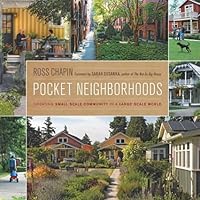
Pocket Neighborhoods: Creating Small-Scale Community in a Large-Scale World
A 2012 Nautilus Silver Award Winner Pocket Creating Small Scale Community in a Large Scale World introduces an antidote to faceless, placeless sprawl ― small scale neighborhoods where people can easily know one another, where empty nesters and single householders with far-flung families can find friendship or a helping hand nearby, and where children can have shirt-tail aunties and uncles just beyond their front gate. The book describes inspiring pocket neighborhoods through stories of the people who live there, as well as the progressive planners, innovative architects, pioneering developers, craftspeople and gardeners who helped create them. Sarah Susanka, author of the best selling Not So Big House series, wrote the Foreword to the book, placing pocket neighborhoods within context of the contemporary trends in housing and community. Ross Chapin begins the book by outlining the shifts in the scale of community and the American Dream over several generations, leading to super-sized houses in a sea of development, then describes a solution to help restore healthy, livable communities. The first section of the book looks at historic precedents of pocket neighborhoods. The second section covers a wide range of contemporary pocket neighborhoods, including New Urban communities, affordable housing, houseboat communities, eco-neighborhoods, and Ross Chapin Architects' own pocket neighborhood examples. The third section focuses on 'cohousing' communities, from Danish origins in the 1960s, to examples across America, Australia and New Zealand, including a chapter on senior cohousing. The fourth section looks at retrofitting pocket neighborhoods within existing communities. Throughout the book are series of "Design Keys" that highlight the essential principles of pocket neighborhood planning and design, and short stories about "Pocket Neighborhood Pioneers" who blazed new trails. The book is filled with rich photographs, drawings, illustrations and site plans, and a Resources section at the end provides leads for the reader to explore the topic in further detail.
224 pages, Hardcover
First published March 29, 2011
Ratings & Reviews
Friends & Following
Create a free account to discover what your friends think of this book!
Community Reviews
Displaying 1 - 30 of 40 reviews

November 23, 2015
This book is a good survey of cohousing/intentional community arrangements. It works best as a coffee table book that you can pick up, be inspired, and put down for a bit. I was hoping for something with more in depth information, especially about retrofitting existing neighborhoods and how these neighborhoods evolve. Instead this book read like a very detailed brochure.
I was also bothered by the cultural homogeneity of the locations and especially of the images. I came away from the book feeling that pocket neighborhoods are at best still in their utopia phase, and at worst inherently exclusive and unfriendly to economic and cultural diversity. Personally, I got the impression these were not something I would be able to find or afford for another 40 years.
If you have never heard of cohousing, definitely let Ross Chapin be your tour guide through these enriching communities. However, if you are ready to answer "How do I create this?" look for something else, or use this book as a springboard for further research.
I was also bothered by the cultural homogeneity of the locations and especially of the images. I came away from the book feeling that pocket neighborhoods are at best still in their utopia phase, and at worst inherently exclusive and unfriendly to economic and cultural diversity. Personally, I got the impression these were not something I would be able to find or afford for another 40 years.
If you have never heard of cohousing, definitely let Ross Chapin be your tour guide through these enriching communities. However, if you are ready to answer "How do I create this?" look for something else, or use this book as a springboard for further research.

August 24, 2015
Living in Silicon Valley I see constant development and looking at it I see blatant flaws like overly small and exposed balconies that will never be used along with little green space or common areas. Are we rebuilding future projects, that horribly failed 60's concept? In this book, Chapin covers how real neighborhoods where people know each other can be made as opposed to soulless megabox apartments and McMansion developments.
Covered are the history of small, deliberate communities along with recent builds. Each section has a list of design patterns used ala A Pattern Language: Towns, Buildings, Construction as well as the process used to get the properties built. Also covered are cohousing developments as well as retrofitting existing neighborhoods to be more community oriented.
While you couldn't design a development with just this book, it can be a valuable checklist if you're looking for a new place to live or are civically active about new development.
Covered are the history of small, deliberate communities along with recent builds. Each section has a list of design patterns used ala A Pattern Language: Towns, Buildings, Construction as well as the process used to get the properties built. Also covered are cohousing developments as well as retrofitting existing neighborhoods to be more community oriented.
While you couldn't design a development with just this book, it can be a valuable checklist if you're looking for a new place to live or are civically active about new development.
April 12, 2011
I should qualify my rating: I would have liked it a lot more if I hadn't already read a lot about the design and structural decisions that encourage neighbors to form communities. I'd already heard of almost all the examples in the book, and the section I was most interested in- retrofitting pre-existing neighborhoods to be more community-friendly- wasn't terribly inspiring. Also, a good amount of focus seemed to be on keeping semi-public spaces private, for only the use of "pocket neighborhood" residents. The author does in some cases address this- pointing out ways neighborhoods can have welcoming entrances for "outsiders" as well- but it often felt a little exclusionary.
Unrelated- one example particularly intrigued me. It was a development planned in the early 1930's as a response to cars taking over neighborhoods; like many cohousing communities planned today, it placed streets/ parking away from homes. It was never completed because the Depression hit, and of course after WWII essentially all development was car-oriented. Based on when cars were becoming ubiquitous, I wonder if the Depression prevented the U.S. as a whole from having a chance to better respond to car culture.
Unrelated- one example particularly intrigued me. It was a development planned in the early 1930's as a response to cars taking over neighborhoods; like many cohousing communities planned today, it placed streets/ parking away from homes. It was never completed because the Depression hit, and of course after WWII essentially all development was car-oriented. Based on when cars were becoming ubiquitous, I wonder if the Depression prevented the U.S. as a whole from having a chance to better respond to car culture.

January 9, 2013
Although the descriptions of the neighborhoods got repetitive (I get that you need five layers of privacy in every yard, you don't have to tell me many times over), this was an interesting book. The urban/infill aspect was noticeably thin, although I suppose this is understandable considering the author's job is to build these neighborhoods new.
My favorite idea from this book was the neighborhood that merged all their backyards into one extensive park/play area.
Eric - I'm interested in hearing what you end up doing to try to invite community on your cul-de-sac. I didn't come away with many immediate ideas for what to do in our yard so perhaps your inspiration from this book will inspire us!
My favorite idea from this book was the neighborhood that merged all their backyards into one extensive park/play area.
Eric - I'm interested in hearing what you end up doing to try to invite community on your cul-de-sac. I didn't come away with many immediate ideas for what to do in our yard so perhaps your inspiration from this book will inspire us!

July 8, 2024
I gotta say, I'm a real fangirl for pocket neighborhoods. The book makes a great case for it, but to summarize, they are a small unit of multiple dwellings that can be overlooked and maintained by their residents while creating an active social realm that is conducive to neighborhood cohesion, safety, and environmental consciousness. The book does a good job of providing examples and pointing out their key design elements that make the places work (a lot of design books will just show examples and leave it at that, which is annoying). If you want a design guide for Pocket Neighborhoods and an understanding of what make them tick, this is probably the best place to start.
However comma, I think this books most interesting trait is the fact that it subliminally provides a startling critique of the economic issues that plague so many new developments today: they are almost exclusively rich, white enclaves. It's been pointed out before but our era of responding to car-centered sprawl with walkable urban (re)developments have kind of been suffering from success since everywhere they've been built, the prices are astronomically high. Pocket neighborhoods are built with small homes, but that doesn't save them from being unaffordable. I know this book wasn't written as a response to the affordable housing crisis or whatever, but it does unwittingly provide some meta-analysis of modern exclusivity and inequality issues. It is never mentioned explicitly but it's there: of the few hundreds of pictures in this book, there are a total of three black people in the entire thing. I know it's not Chapin's fault but... damn.
Anyway good book, go read it if you like little communities and stuff.
However comma, I think this books most interesting trait is the fact that it subliminally provides a startling critique of the economic issues that plague so many new developments today: they are almost exclusively rich, white enclaves. It's been pointed out before but our era of responding to car-centered sprawl with walkable urban (re)developments have kind of been suffering from success since everywhere they've been built, the prices are astronomically high. Pocket neighborhoods are built with small homes, but that doesn't save them from being unaffordable. I know this book wasn't written as a response to the affordable housing crisis or whatever, but it does unwittingly provide some meta-analysis of modern exclusivity and inequality issues. It is never mentioned explicitly but it's there: of the few hundreds of pictures in this book, there are a total of three black people in the entire thing. I know it's not Chapin's fault but... damn.
Anyway good book, go read it if you like little communities and stuff.

December 28, 2015
The book starts with a charismatic forward by Sarah Susanka in which she expresses her hopes for a new revival of small community neighborhoods; or should I say, a more generalized use. She opens the doors to the discussion between neighborhoods designed with the automobile in mind versus those organized with the individuals in mind. She believes this book will be a game changer within the industry.
The book itself is divided into four parts with various chapters; in addition to the forward and the afterword. The first part contains a series of precedents to the pocket neighborhood prototype. The examples are from different parts of the world and presents mostly the advantages of adopting this method. It also defines the pocket neighborhood as a “cohesive cluster of homes gathered around some kind of common ground within a larger surrounding neighborhood”.
On the second part, Chapin introduces some of his works as examples for contemporary pocket neighborhoods. He shows pictures and detailed the development process and the different steps taken into consideration for the creation of the environments and its usages. As well as, the characteristics for future developments.
A group of cohousing communities was introduced on the third part of the book without significant correlation to the communities previously presented. They felt more as additional information could be distributed within the previous two parts. The author did keep the same structure, tone and coherency during all the explanations.
Lastly, the fourth part of the book presents the efforts to include the pocket neighborhood system within existing neighborhoods designed for single families taking privacy as it center. Ones again, steps to introduce the pocket neighborhood were present and the arguments were convincing. This last part serves as an introduction to the afterword.
In general, the book is excellent for those trying to learn more about the history and contemporary development of the pocket neighborhood. Some areas remind me of ‘A Pattern Language’ by Christopher Alexander (1977). I am almost sure many professors will introduce this book to their syllabus next fall. It is perfect to stimulate a great conceptual conversation within a group of architectural pioneers.
It also presents a group of persons already working with the development of pocket neighborhoods and its elements. As mentioned in the book, the necessity of educating contractors, architects, planners, developers, etc. with the advantages of this system is intrinsic to its success.
The book has a great variety of visual elements to present the ideas and elements of the pocket neighborhood. It is full of examples and possible schemes to be implemented. Somehow similar to the Principles of New Urbanism. It is well written and easy to follow for those without an architectural background. Therefore, it will be a great tool to be added into the current sustainable and ecological discussion.
The book itself is divided into four parts with various chapters; in addition to the forward and the afterword. The first part contains a series of precedents to the pocket neighborhood prototype. The examples are from different parts of the world and presents mostly the advantages of adopting this method. It also defines the pocket neighborhood as a “cohesive cluster of homes gathered around some kind of common ground within a larger surrounding neighborhood”.
On the second part, Chapin introduces some of his works as examples for contemporary pocket neighborhoods. He shows pictures and detailed the development process and the different steps taken into consideration for the creation of the environments and its usages. As well as, the characteristics for future developments.
A group of cohousing communities was introduced on the third part of the book without significant correlation to the communities previously presented. They felt more as additional information could be distributed within the previous two parts. The author did keep the same structure, tone and coherency during all the explanations.
Lastly, the fourth part of the book presents the efforts to include the pocket neighborhood system within existing neighborhoods designed for single families taking privacy as it center. Ones again, steps to introduce the pocket neighborhood were present and the arguments were convincing. This last part serves as an introduction to the afterword.
In general, the book is excellent for those trying to learn more about the history and contemporary development of the pocket neighborhood. Some areas remind me of ‘A Pattern Language’ by Christopher Alexander (1977). I am almost sure many professors will introduce this book to their syllabus next fall. It is perfect to stimulate a great conceptual conversation within a group of architectural pioneers.
It also presents a group of persons already working with the development of pocket neighborhoods and its elements. As mentioned in the book, the necessity of educating contractors, architects, planners, developers, etc. with the advantages of this system is intrinsic to its success.
The book has a great variety of visual elements to present the ideas and elements of the pocket neighborhood. It is full of examples and possible schemes to be implemented. Somehow similar to the Principles of New Urbanism. It is well written and easy to follow for those without an architectural background. Therefore, it will be a great tool to be added into the current sustainable and ecological discussion.

October 21, 2011
This book may deserve four stars (or five), but I can't be tempted to give it more than three. I liked it. I liked it quite a lot. But I didn't quite four-stars-like it. Ross Chapin makes good points and his listed design keys are great, but I thought it got a little repetitive. I liked his insights, the history and progression of pocket neighborhoods, and the tales of projects that he has worked on. I also liked the "Neighborhood Pioneers" sections, in that Chapin really credits the work and gives praise to the efforts of people besides himself and other professionals. Many of the neighorhoods featured came about through the hard work and dedication of the people that live in those neighborhoods...regular people. But that's one of the points of a pocket neighborhood, it's about community and coming together. It's very appealing in theory. I'm not sure that I would love living in some of the neighborhoods that Chapin describes, but as far as diversifying housing and living options, as far as taking up less space and curbing urban sprawl, as far as using less and living simply, it's great. I could live in a neighborhood based on this book, modified a little. It's inspiring.

July 29, 2017
Beautiful pictures, beautiful idea! Shared places to eat, gather, play, and garden. Tiers of privacy. Lots of examples. I like the idea of small-scale community, but what happens when someone doesn't get along? Is not responsible for their own children, expecting more from neighbors without similarly contributing, or start to neglect the communal spaces and things get dirty, broken, unkept? How to sustain this interesting idea over time with different kinds of people? Is the solution seeding and maintaining residents with similar base values of sharing and responsibility? This is a good communal planning concept, especially with the idea of smaller spaces. Slightly higher density without losing quality of life.

October 26, 2017
I was chatting with some friends about tiny houses and that made me remember that pocket neighborhoods where a thing. So then I went an looked them up online to show people and found out that this book exists. So of course I checked it out of the library to see. This is really meant to be a coffee table book its kind of repetitive in places and has lots of pretty pictures. Really fails to address class or racial issues, but instead very design focused.
January 11, 2021
Read this book for my thesis project and I am so glad that I did. It changed my perspectives about many things, no 1 being the interaction between neighbors and how we, as architects can encourage it. I have always been an introvert person, I avoid small talks and these neighborly things but this book made me look at things with new eyes. Especially big fan of the concept front back side. So perfect for us introverts. I, myself live in kind of a cul de sac situation and it has brought so much peace and calm in my life because there are no random cars and strangers in your street and it makes you feel like this is part of your home. Looking forward to improve some aspects of this idea and implement in my thesis.

September 12, 2021
Even though this coffee table book was written ten years ago it has even more relevance today as more and more people are imagining how to live in smaller structures yet with richer social connections, and how to do it with a lighter footprint on the earth.
The author, Ross Chapin, throughout the book has wonderful photos of pocket neighborhoods and often explains the pros and cons of the concept but the down fall of these neighborhoods is that they often are not affordable for the middle class, as my husband and I found out after locating newly constructed pocket neighbors in Massachusetts and Rhode Island.
The author, Ross Chapin, throughout the book has wonderful photos of pocket neighborhoods and often explains the pros and cons of the concept but the down fall of these neighborhoods is that they often are not affordable for the middle class, as my husband and I found out after locating newly constructed pocket neighbors in Massachusetts and Rhode Island.
October 26, 2025
Reads like an illustrative show and tell book. Two takeaways are:
1) Really enjoyed the demonstration of design principles that create an enjoyable pocket neighborhood, overlaps with the current macro-conversations around placemaking. Ideas added to vernacular include layers of privacy, defining entrances, and intentional traffic through common areas by design (ex. Walking from parking area through common court to front door).
2) the cohousing overview at the end both integrated a lot of pocket neighborhood ideas (eco-impact, community building, beautiful spaces) and also peaked my interested in the topic. Let me to 2 more cohousing books I’ll be checking out.
1) Really enjoyed the demonstration of design principles that create an enjoyable pocket neighborhood, overlaps with the current macro-conversations around placemaking. Ideas added to vernacular include layers of privacy, defining entrances, and intentional traffic through common areas by design (ex. Walking from parking area through common court to front door).
2) the cohousing overview at the end both integrated a lot of pocket neighborhood ideas (eco-impact, community building, beautiful spaces) and also peaked my interested in the topic. Let me to 2 more cohousing books I’ll be checking out.

July 14, 2024
I keep thinking about this book. I live in an urban area with great neighbors, but we must connect intentionally. It's easy to live in isolation even though we're close in proximity. I loved learning how the scale and orientation of housing can connect people. Learning more about co-housing structures was interesting too. Housing seems to be in continual shortage. Seeing creative solutions to those problems excites me.

December 21, 2018
Incredibly inspiring book highlighting how the built environment can contribute to enhancing social capital. From historical examples to courtyard condos to taking back the alley to cohousing communities, every kind of pocket neighborhood is profiled with concise text, fairy tale photos, and resources for further exploration.

May 24, 2022
The content is great. I really want to develop and live in the kind of pocket neighborhoods Chapin describes. I docked it 2 stars because the photos show only white people. There are dozens of full color photos showing the beauty of pocket neighborhoods, none of which show any BIPOC people. That's a badly missed opportunity to be inclusive.
August 5, 2023
This book is ideal for those who see that there is a lack of community in our cities. Pocket neighborhoods offer a community where one can live safely with security with neighbors close by, someone to borrow an egg from, to boost your car, or to help you up from a fall. There's a shared walkway, front porches, and garages are out back.

May 6, 2022
A fantastic book about developing for building community. I will be incorporating many ideas from this book into a planned development. Excellent book for all real estate developers, planners, architects, engineers and city employees working in planning.

May 28, 2021
Fascinating and inspiring. Pulling together many ideals I hold close under one concept.

December 29, 2022
Read this when I stopped by an out of town library ages ago. Just remembering it now.
April 1, 2025
The said the same thing like 8 times
February 19, 2017
This beautifully crafted book explores neighborhoods both old and new and shares insights into what make them such remarkable places to live in and visit. The book begins with background on historic communities such as Martha's Vineyard and the Garden Cities of the 1900's, and then progresses to today's examples of cottage communities and cohousing. Each chapter is full of beautifully illustrated plans and photos that visually explain each design concept and give a true sense of what it's like to visit these remarkable places. Ross is a developer as well as an architect and shares his own personal insights in the form of case studies that explore the process of designing and building new small scale communities. His vision of pocket neighborhoods are clusters of neighboring houses gathered around a shared open space such as a garden courtyard. This book is an inspirational guide for anyone looking for innovative ideas on community design.

June 6, 2011
The text is disappointingly bland, but I found the concept of pocket neighborhoods -- and perhaps more so, the idea of "connectedness" they are intended to achieve -- deeply exciting.
I would have liked to have "then and now" stories of each of the communities, ideas of what the daily life is like. Flavorless quotes from a few residents aren't enough. The book pretty much gives each community a section and that's that.
Would love to see more passionate book on the subject -- with more photos, please. =)
I would have liked to have "then and now" stories of each of the communities, ideas of what the daily life is like. Flavorless quotes from a few residents aren't enough. The book pretty much gives each community a section and that's that.
Would love to see more passionate book on the subject -- with more photos, please. =)

June 23, 2011
I am really intrigued with the compelling problem of creating a greater sense of community and the extent to which the built environment can be a solution. I was already familiar with the pocket neighborhood concept when I bought the book, as well as many of the specific projects highlighted. Still, it is a beautiful book and offer plenty of food for thought to someone who is new to the concept.

May 28, 2012
Very much enjoyed the concepts & pictures in this book. Not a great deal of depth- more to spark thoughts. Short chapters that makes it easy to pick up and read for 5 mintues or to flip through the pages.
June 3, 2012
As cities around the world become denser places to live, including suburbs, there is a real need to maintain a sense of community. This book has some great case studies and ideas on how to help achieve this.

December 14, 2012
3.5 stars. Great photos and some good design guidelines for building neighborhoods that enable community to happen. Gave me several ideas for making our little piece of property more welcoming and community oriented. I will prolly go back to this book in the future.

August 10, 2015
Pros: Pictures! In full color! A few interesting anecdotes.
Cons: This is kind of like "communities for suburbanites!" Not at all what I was looking for. The housing was homogenous within the community it fit, seemed aimed at well-to-do people.
Cons: This is kind of like "communities for suburbanites!" Not at all what I was looking for. The housing was homogenous within the community it fit, seemed aimed at well-to-do people.

August 3, 2016
It's an interesting idea, and might work in an ideal situation, but I see a lot of ways that it could go wrong. It did address some of my concerns, but it didn't have enough depth to fully convince me.

April 1, 2024
I wish someone would make a television series about all of the places and ideas in this book!
I wish this book would become a #1 bestseller!
I wish every mayor and city-council person would read this book!
I wish this book would become a #1 bestseller!
I wish every mayor and city-council person would read this book!

December 28, 2010
adult nonfiction; urban planning. [reviewed from uncorrected e-galley.] A look at the different ways planners have brought concepts of small community into residential neighborhoods.
Displaying 1 - 30 of 40 reviews