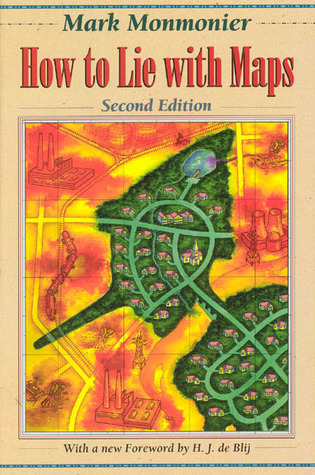
Originally published to wide acclaim, this lively, cleverly illustrated essay on the use and abuse of maps teaches us how to evaluate maps critically and promotes a healthy skepticism about these easy-to-manipulate models of reality. Monmonier shows that, despite their immense value, maps lie. In fact, they must.
The second edition is updated with the addition of two new chapters, 10 color plates, and a new foreword by renowned geographer H. J. de Blij. One new chapter examines the role of national interest and cultural values in national mapping organizations, including the United States Geological Survey, while the other explores the new breed of multimedia, computer-based maps.
To show how maps distort, Monmonier introduces basic principles of mapmaking, gives entertaining examples of the misuse of maps in situations from zoning disputes to census reports, and covers all the typical kinds of distortions from deliberate oversimplifications to the misleading use of color.
"Professor Monmonier himself knows how to gain our attention; it is not in fact the lies in maps but their truth, if always approximate and incomplete, that he wants us to admire and use, even to draw for ourselves on the facile screen. His is an artful and funny book, which like any good map, packs plenty in little space."— Scientific American
"A useful guide to a subject most people probably take too much for granted. It shows how map makers translate abstract data into eye-catching cartograms, as they are called. It combats cartographic illiteracy. It fights cartophobia. It may even teach you to find your way. For that alone, it seems worthwhile."—Christopher Lehmann-Haupt, The New York Times
". . . witty examination of how and why maps lie. [The book] conveys an important message about how statistics of any kind can be manipulated. But it also communicates much of the challenge, aesthetic appeal, and sheer fun of maps. Even those who hated geography in grammar school might well find a new enthusiasm for the subject after reading Monmonier's lively and surprising book."— Wilson Library Bulletin
"A reading of this book will leave you much better defended against cheap atlases, shoddy journalism, unscrupulous advertisers, predatory special-interest groups, and others who may use or abuse maps at your expense."—John Van Pelt, Christian Science Monitor
"Monmonier meets his goal admirably. . . . [His] book should be put on every map user's 'must read' list. It is informative and readable . . . a big step forward in helping us to understand how maps can mislead their readers."—Jeffrey S. Murray, Canadian Geographic
Mark Stephen Monmonier is an American author and a Distinguished Professor of Geography at the Maxwell School of Syracuse University.
He specializes in toponymy, geography, and geographic information systems. His popular written works show a combination of serious study and a sense of humor. His most famous work is How To Lie With Maps (1991), in which he challenges the common belief that maps inherently show an unbiased truth.
The phrase "photo shopped" or "photoshopped" has crept into our daily life. It comes from the software titled Photoshop that allow manipulation of an original photo. When used pejoratively, it means that someone has tried to fool us by changing the image that we perceive.
Maps, as graphic material, can also be used for similar ill-purposes. The way a map displays information can distort either the original data or lead the unwary to false conclusions. Some of the chapter titles: Maps that Advertise Development Maps (or, How to Seduce the Town Board) Maps for Political Propaganda Maps, Defense, and Disinformation: Fool Thine Enemy Data Maps: Making Nonsense of the Census
This book is a clear and clever survey of such manipulations and it opened my eyes to what might be done and clarified what, at times, I had expected. There is a newer edition but this was quite adequate for my needs (and the one my library could get for me).
The case for Mark Monmonier’s How to Lie with Maps as a 4 or 5 star read is defensible. The non-professional cartographer will have little problem reading it and it does have good information. The very first sentence is “Not only is it easy to lie with maps, it is essential”; so maybe it was never intended to be sensational. The intended reader is a novice map maker or someone with a casual interest in making or reading maps. If you have had any training, much of it will be review.
The first 45 pages are basic map concepts. Projections, scale and the like. Roughly the first hour in a one week map making class. Next the reader is advised to avoid mistakes and we begin to get into the discussions of particular decisions and how they affect the way a map might be interpreted. This is 25% of the pages before any actual lies.
The remaining pages vary between decisions a professional map make will make while legitimately serving his customer and a few things that a sharp consumer of maps may want to consider when reading a map. For example, was the map created to serve a limited, possibly selfish purpose, like promoting a business or was it printed to provide a general reader with particular information; how to get off the mountain and back to civilization?
Part of my job is making maps. I am not a professional cartographer. My maps are designed to inform command level decisions. It is important for me to make my maps as informative as possible and to avoid mistakes that might not serve the larger interests of my community. Towards the end of How to Lie with Maps there are reminders to not accept the default setting my GIS program picks for me and to be conscious of the data and its possible meaning.
For example, depending on settings I can paint my map to look like everywhere is terrible, or that very particular areas are terrible. Everywhere is terrible is of little value because it says nothing about where help is most needed. Painting the same areas as terrible every time means that areas that may need help will never get that help.
A better version of How to Lie With Maps would be one less focused on the novice. Monmonier is correct that many map customers do not know what they are looking at or how a map may mislead. I wanted more that would inform my technical awareness and my ethics. How to Lie with Maps is less than my needs.
A lovely little book, a faux primer on how to fool the gullible with different tricks of the cartographers art and actually a guide on how not to get fooled by the same. Monmonier makes the point that all maps are compromises, that many contain errors and more than a few are produced for specific ends--sell a development project in Ethiopia, housing estate a flood plain or a war in Iraq.
Seems simple and the first chapter can be skipped by those who--unlike me-- recall their grammar school geography and map lessons but, like a good map, loaded with useful and interesting information.
Tegelikult otsisin lihtsat lahendust ühele keerulisele geograafilisele probleemile ja AI soovitas just seda raamatut. „Maakaartide abil valetada pole ainult lihtne – see on ka hädavajalik,“ kuulutab autor sissejuhatuses ja temaga tuleb nõustuda. Raamatu lõpuks saab selgeks, et valetatakse nii maakaartide, graafikute, diagrammide kui ülejäänud visuaalsete abivahendite abil. Tagantjärele tuleb tunnistada, et ma olen seda ise ka teinud, mitu korda.
Iseenesest oli huvitav lugemine, kuigi rõhk oli USA kogemustel ja millegipoolest just New Jersey kandil. Päris alguses räägiti Mercatori projektsioonist ja sellele välja pakutud alternatiividest, aga mitte Equal Earthi omast, mis pole ka eriti suur kaotus.
Monmonieril on hea silm iseäralike detailide peale. Üks eriti hea lugu on olematust mäest, mille elava fantaasiaga riigiametnik lisas Colorado kaardile, andes sellele ühtlasi iseenda nime. Alpinistid otsisid seda kaks aastat tagajärjetult taga. Lk 106 on omaaegne graafik Eestist ja tema naaberriikidest 1939-1940 väljarännanud baltisakslaste kohta.
Õnnetuseks leidub ka selliseid kohti, kus autori lohakas kodutöö silma torkab. Need Prantsusmaa piirialade linnade maketid, mis Monmonierile nii sügava mulje jätsid, valmistati mitte ainult puust ja siidist, vaid kasutati ka odavamat materjali nagu paber, kips ja tavaline liiv. Aga tulemus on tõesti muljetavaldav ja seda võib Pariisi muuseumis tänapäevalgi imetleda (üsna pikka aega see võimalus puudus). Nõukogude Liit oli raamatu uue trüki ilmumise ajaks juba minevik, aga autor räägib sellest riigist ikka veel olevikus.
Üks üsna põhjalik peatükk sisaldab näpunäiteid, kuidas riskantseid ehitusprojekte eriti atraktiivsel viisil tutvustada ja kuidas on kõige parem end vahelejäämise korral välja vabandada.
Lõpuks tuleb ära märkida, et mind vaevanud probleemile ma lahendust ei leidnud ja lõpuks pidin ikka tasulise äpi omandama.
A bit outdated, but this book still gives a nice insight into the choices mapmakers face. Especially the chapter about map making programms was very outdated, because a lot of the things mentioned as maybe possible in the future are very common nowadays, such as interactive maps.
The book explains those choices in several chapters explainign as well what can go wrong and how mapmakers can use those choices to give a certain idea of an area. I like maps and geography a lot, so the book was interesting for me. Also there were a lot of pictures with the examples the book gives, which made it easy to understand what the author wanted to say.
This book is a concrete explanation of how the representation of a thing can differ wildly from the thing itself. We all use some form of map practically every day, but we can forget that maps are made by fallible humans. As a result, they can be manipulated with ease to create particular impressions of the world. How to Lie with Maps will arm you with the knowledge necessary to recognize the ways in which the maps you use may be distorting your perspective.
A very thorough and sometimes charming exploration of map construction concerns and challenges, some of which are shared with data visualization at large and some of which are unique or can have an outsized impact when it comes to visually representing land and mapping everything from man-made and natural landmarks to culture and individual behavior onto it. There's some technical parlance, specially at the beginning, but it's explained fairly well. The latter sections on propaganda, disinformation and maps being perceived as authoritative were particularly enjoyable. I also appreciate all the fun anecdotes peppered throughout, such as the soviets attempt at distorting natural features and inhabited locations as a cold war tactic.
How to Lie with Maps reviews the various ways maps can deceive percipients who don’t interpret maps carefully. As stated in chapter one, this book is not meant to help mischievous cartographers. Rather, its purpose is to encourage the general public to be more critical and selective in their map interpretation. The book includes twelve main chapters that explain general categories of cartographic deception. Due to this large amount of specific ideas in the book, it is easiest to divide a critique of its content into a few main parts: positive aspects, negative aspects, and applications.
POSITIVE ASPECTS
The book starts off with an introduction to scales, projections, and how maps are generally created. This helps the average reader understand the tools used by cartographers to produce maps, thus helping to convey the inner workings. The general organization of the book is also helpful. Despite a lot of somewhat disconnected information, the book is generally sectioned off by the purpose of the map or a design principle. This connotes to the reader that how a map is used is just as important as the technique used to accomplish it. Third, How to Lie with Maps is packed full of rich nuggets of insight. One example of this comes from the maps generally used in classrooms. Green designates areas of low elevation, brown medium heights, and white denotes high elevations. Although these are useful ways of depicting information, green is often thought to show lush vegetation, brown to show deserted areas, and white the top of a snow-capped mountain. Of course, these correlations are not always so.
NEGATIVE ASPECTS
The first noticeably problematic aspect of the book is its difficult sentence structure. Long sentences and difficult wording are more consistent with scholarly writings and don’t match the intended audience—that is, the general public. Because of this, reading a sentence twice sometimes did not yield a full understanding of what the author was trying to convey. Dated at 1996, How to Lie with Maps is also not current with today’s modern, connected world. While the book does touch on the use of electronics to create customized, dynamic maps, it ignores the revolution of the internet and cellular technologies. Important advances such as cached map services, cloud computing, and even crowd sourcing has created a whole new set of issues in the reliability of maps and how they are used. Third, many of the visualizations are poorly presented. Words in the text describe areas that are not easily seen without diligent searching of the map area, such as the maps on pages 50 and 91, which describe areas encircled by a mass of other points of information. Another specific example of this issue appears on page 31, where a small-scale map is blown up to be compared with its large-scale equivalent. While this juxtaposition is helpful, the two images need labels or such to help show the comparison.
APPLICATIONS
Despite these drawbacks, the book is an incredibly useful tool for many working GIS professionals as well as the general public. This book comes with high recommendations. Those working specifically in GIS, for example, can use its principles to effectively display data. First, GIS usually yields a lot of data, which can be hard to present effectively. This book helps with design principles to overcome that challenge. Second, those data are often used to make a point or persuade someone. A developer, for instance, might want to persuade a city board to approve his new plan. On the other side of this point, this book helps a city planner see where a cartographer may be trying to present more falsehoods than are necessary on a map. Other persuasive fields can use these principles. Business GIS, for instance, involves a lot of advertising. Maps can be a means of persuading a business board to put a new facility somewhere or withdraw from a certain market. In short, any geographer, as well as common person, can greatly benefit from the information in this book. It truly is a book for anyone wary of cartographic falsehood.
Monmonier's How to Lie with Maps follows in the footsteps of Darrell Huff's How To Lie With Statistics, focusing on the tricks of mapmaking. In short, maps are depictions of information with geographical meaning and as such they may misreport with or without intent. Monmonier introduces the most important cartography notions and gives many examples of "lying with maps" for various purposes. Despite the use of smart phrase-turns and of coining interesting words such as "cartopropaganda"--the use of cartography in propaganda--, the book falls short from its purpose in that it describes only basic (and thus gross) misuses of maps and it over-analyzes these misuses.
"Not only is it easy to lie with maps it is ESSENTIAL."
I'm 100% certain that misunderstanding this title and the above first-sentence was NOT the intention of my parents raising me with an understanding of biblical Old English . . .
Do not let the title fool you - this is one of the best primers on how all maps are - one way or another - a distortion of facts - and how to see the errors in maps. A must read for anyone who makes any type of map or spends time interpreting maps. A Classic!
A solid book about not only mapping misdirection, but also a look at cartography and mapping in general, and a new section on online mapping. It was certainly good to learn some terminology and understand that not all map mistakes are outright deceptions but sometimes inbuilt biases. Further, all maps need to be exclusive in what info they show so they not display a mess.
There are some downsides to this book. One is that general topics like map projections are started but not fully explored, so one is left wanting either more information or wishing the topic wasn’t brought up as fully as it was. Some topics go into depths I wasn’t expecting, like how to use maps to determine if you are getting screwed on property taxes and then how to appeal to city hall. Oddly specific.
I feel this book would have done better to have introduced up front the common “lies”, maybe using fun-to-remember terms, so one could use them as guideposts through the discussion. This wasn’t done, which made it harder to track if what was being described was outright lies, honest blunders, or the necessary white lies of mapping (one term the author used that I liked).
I will also add that the author encourages people to be very sceptical in many ways about maps, sometimes seemingly to the point that maps should be treated as outright suspect. While a healthy skepticism is good, it must be healthy. In an age of conspiracy theories, this book would have done better to explain when a map (and its mapping agency) SHOULD be trusted. When one’s good skepticism says, “This is a good map.” Instead, I can see a book like this used by conspiracy theorists to say almost any map they see is a fabrication.
Still, while the topics chosen seem a bit scattershot, and perhaps one must be selective to keep the page count down, the information itself is well written and the history of US topographic mapping (off topic for the “lies” focus of this book) was fascinating.
I have found this a comprehensive and insightful read.
First of all, it is clear that Mark Monmonier is a professional with deep knowledge in his field. I deeply respect works that draw from several, many times barely related areas, and show how they influence and interact with the field in question. In this book it shows up in how maps can influence politics, military action, public administration.
As someone trained in remote sensing, I found the chapter about airborne photography particularly interesting. I have seen how near-infrared images are sensitive to vegetation, but never thought about applying this knowledge to military camouflage and how those materials are non-reflective in near-infrared, hence identifiable.
I also did not know about the mischievous migrating Soviet rivers and cities, but it definitely makes sense how such forged maps would throw off a possible invading force.
There are so many ways maps can mislead us and I definitely did not expect most of them. An eye-opening read, definitely.
Buku yang sangat menarik karena sudah direvisi beberapa kali sejak pertama kali terbit di tahun 1991. Buku ini menjelaskan bagaimana peta bisa 'menipu' kita, baik itu secara disengaja maupun tidak. Misalnya, secara konsep, data yang ditampilkan peta memang pasti dipilih oleh pembuatnya, mana yang mau diperlihatkan atau pun tidak. Pemilihan itu memang bisa jadi karena kebutuhan, tapi bisa juga untuk keperluan lainnya seperti iklan maupun propaganda. Begitupun perkara pemilihan warna, simbol, dll. Belum lagi perkara kesalahan teknis yang sangat mungkin terjadi: salah ketik, salah layout, atau pun salah cetak.
Buku ini membantu kita latihan berpikir kritis atas visualisasi data dan mungkin menjadi inspirasi bagi yang ingin memanfaatkannya 👀
Note: I bought the second edition of this book before the 22-year-more-recent 3rd edition was released -- which I did not learn existed until I was all but done with the 2nd edition (thanks Amazon?). However, I had access to the 3rd edition through Scribd, so I read the updated last three chapters. I did lightly skim the earlier chapters and they looked mostly unchanged. So this review will be mostly of the 2nd edition, but I will say something about the new chapters of the 3rd edition.
The opening chapters that discuss the conventions and compromise of cartography were my favorite. Maps must necessarily distort reality. At a fundamental level, they are scaled representations of reality that must represent the world through symbols. They cannot show everything so the map maker must choose what to show based on the purpose of the map. They generally aim for accuracy, but that is within constraints. For example, if a road and railroad lie right next to each other, one or both lines may be slightly offset to allow both to be shown.
Many of the remaining chapters talk about ways that maps might be deceiving. The content of these chapters are good, but I'll admit that the "How to Lie with" framing is not one that resonates with me particularly well. I'd much rather have the author play it straight. That said, the framing was mostly subdued enough to not be too distracting.
A map can deceive through cartographic blunders, both from the cartographer and from unintentional sources like print quality. Maps used for advertising and maps used for political propaganda both capitalize on the ability of maps to evoke emotions, especially through the choice of imagery and color. Development maps, such as for neighborhood construction, aim to be more objective but can also try to evoke emotional reactions to use a point, such as showing trees as large and full grown.
Defense maps can be state secrets -- even just knowing where a country is interested in can reveal information -- but they can also be used to spread disinformation to the enemy (although this is harder now that high resolution current imagery is more available). Government maps are not actively deceptive, but they do have to make choices and compromises to create huge numbers of detailed maps on a budget.
My favorite chapter in the later part of the book was on data maps. When maps are representing aggregated data, the choice of how to aggregate the data can make a huge difference in the message delivered. For example, in single dimensional data, the number of buckets used, the boundaries between buckets, and the geographic boundaries of the buckets can result in dramatically different maps. Thinking about the data before placing it on a map, such as thinking about categorizations of are already recognized and looking for underlying, non-geographic patterns in the data, can help make a more honest data map.
The chapter on color was also interesting although the digression into color theory seemed largely unnecessary. The main takeaway is that color is better used to convey category. Using color for scale tends to be ambiguous since colors do not have a natural ordering. That doesn't mean scales should be greyscale, but scales should be a one or two color gradient rather than having a scale with many colors. A map specific challenge with color is that color also can be used to convey the nature of the natural landscape such as green for vegetation and blue for water. The symbolic use of color must be chosen carefully to compliment rather than conflict with this representative association.
The old chapter on multimedia maps was completely obsolete and is what was replaced in the 3rd edition. The 3rd edition adds additional chapters on image maps, prohibitive cartography, and fast maps. Image maps are maps created from overhead imagery, and Monmonier notes them as one of the huge innovations in maps in the twenty-first century. They are complementary to line maps: they contain more details (trees!) but they can be harder to interpret (where is the road through the trees?). The chapter on prohibitive cartography discusses how maps that encode boundaries become the source of truth for what those boundaries are; this can be a source of contention.
Fast maps is Monmonier's term for maps that change or are disseminated quickly. This includes fast spreading memes. It also includes interactive maps. Interactive maps can provide ways for users to inquire into the data more deeply and can move through many levels of detail. In fact, Monmonier brings up a suspiciously familiar 22 levels of detail. (Suspicious because that's what Google Maps uses, even though it's not mentioned by name in that section.)
Overall, this book was interesting, but I tend to be highly interested in maps. I don't have a good sense for how it would read to someone who is casually interested in maps. Probably interesting? But overall, the "How to lie" framing combined with many of the examples being rather dated (even in the 3rd edition, based on my skim) made the book less impactful than it might have been otherwise, so 3 stars overall.
If it were on the syllabus for an introductory course in the geography/cartography space, it’d be a fine addition. For the general reader with a well functioning BS detector… eh… a bit borin. But if you’re stupid—read up.
For traditionally drawn maps designed for grayscale printing, this book is solid. Where it falls short is in its discussion of color and computer design. There is mention of abuses of color as well as a barebones introduction to color theory. There's also some advice on avoiding certain computer pitfalls.
But among the illustrated examples, there are no color prints. As color is such a tricky design element in maps (or anything else that needs to be read and understood by a huge range of people) there should be color examples among the numerous illustrations. In the third edition there are none.
This was a clear, enjoyable book about the use of white lies, propaganda, subtle manipulation, and other distortions of the truth in map-making. The beginning of the book focuses on the basic fact that all maps, to be effective, need to lie - it is impossible to faithfully project a 3-D world on a flat surface, and it is impossible to record every possible detail of real life onto a map. The book describes basic visual variables and the common generalizations (smoothing, selection, displacement, etc.) that are necessary to make a functional map. The rest of the book describes a variety of different ways that maps can distort the truth - honest mistakes, propaganda, deliberate disinformation, and even variations in data aggregation. A map is not a neutral document, but rather an argument, produced by an author for an audience - this book is a guide to help map-users navigate this reality.
I liked this book, but I did not love it. As many reviewers have noted, the book is massively out-of-date. The University of Chicago is threatening to publish a new version "for the digital age" later in 2018 - I am curious to see if that version is actually better. In addition, I wished that the author spent more time exploring the rhetoric and ideology of map-making. While he touched on the topic, I think a deep exploration of historical and contemporary maps would have been fascinating - what do maps say about how people view the world, about their values, about what they view as significant and insignificant? I also think the book would be improved by exploring non-Western maps and mapmaking traditions.
Sharp and readable, but shockingly outdated. It hadn't occured to me when I picked it up, since the book was only written in the 90s (practically yesterday!), but it might as well have been a century ago. The discussion of errors in maps spends a great deal of time on ink transfer; color is assumed to be a luxury, computers are treated somewhat dismissively, and much of the treatment of the logistics of map production is by now hopelessly outdated, along with many of its assumptions about (for instance) what kind of data is readily available and what is not. The chapters on geopolitics, alas, focus almost exclusively on the mysteries of the Soviet Union, and it would also have been extremely helpful for the chapter on color perception to have been printed in... yknow... color.
Nonetheless a pretty witty and insightful book. I would love to enjoy a similarly readable treatment of these topics that was more up-to-date.
Considered to be one of the most influential books in the history of the study of geography. Monmonier captures a really significant movement in cartography from the conception of maps as objective representations of reality to inherent reflections of cartographic choice and focus. Though dated, I have read it several times- both the first and second editions. Monmonier does a decent job of making what could be a very abstruse topic accessible to a general audience with his breezy, though sometimes hokey, style. It's a useful thing to read periodically as an inoculation against the creeping assumption of maps as simple representations, especially in the context of GIS map production.
A simple introduction to how people lie with maps. It has the virtue of being just technical enough that it makes solid criticisms of how maps are made and used, while avoiding getting too far into the weeds. There are better cartography books out there, but this is a fine entry into critical reading of maps in the tradition of How to Lie with Statistics.