

What do you think?

Norman Rockwell's America
A nostalgic collection of Norman Rockwell's scenes of twentieth century American life includes all of the Saturday Evening Post covers plus paintings, drawings, and graphics from every period of the artist's career--with many foldout pages.
313 pages, Hardcover
First published April 1, 1976
About the author
Christopher Finch
70 books37 followersChristopher Finch was born in Guernsey in the British Channel Islands, and now lives in Los Angeles. He is an artist and a photographer who has had one person shows in New York and California, and he is the author of almost thirty non-fiction books including the best sellers Rainbow: the Stormy Life of Judy Garland, The Art of Walt Disney, Jim Henson: the Works, and Norman Rockwell's America. Recently he has embarked on a series of noir-inflected mystery novels set in New York in the late 1960s and featuring the private investigator Alex Novalis. The first of these, Good Girl, Bad Girl, is to be published by Thomas & Mercer in 2013. These books draw on his own experiences in the New York art world at a time when today's SoHo was an urban wilderness with rats frolicking in the gutters and artists eking out a living in barren loft spaces. He is married to Linda Rosenkrantz, an author and a co-founder of the website Nameberry.
Ratings & Reviews
Friends & Following
Create a free account to discover what your friends think of this book!
Community Reviews
Displaying 1 - 19 of 19 reviews

October 18, 2007
Sometimes "by a man's friends ye shall know him" is not at all correct. I've always felt I wasn't supposed to like NR and his often sentimental take on American life. Same people might disapprove of Garrison Keillor too. But I don't care about that, I love them both.

May 21, 2019
I grew up leafing through this fat book on long winter nights and was sad when my mother moved but didn't bequeath her copy into my eager possession. That's ok, because now I can check it out of the library!
I have a special place in my heart for coffee table books about art. It is an actual mood that comes upon me. So I checked out four books this week and they were so thick and heavy altogether that I strained my shoulder hauling them out to the car. Note to self: ask hubby to carry the books back.
Norman Rockwell is one of many illustrators I enjoy revisiting. His paintings tell stories. So while I did scan the written parts of this book, what I actually read was the pictures, their stories, their moods, and their often idealized statements about life in America.
I have a special place in my heart for coffee table books about art. It is an actual mood that comes upon me. So I checked out four books this week and they were so thick and heavy altogether that I strained my shoulder hauling them out to the car. Note to self: ask hubby to carry the books back.
Norman Rockwell is one of many illustrators I enjoy revisiting. His paintings tell stories. So while I did scan the written parts of this book, what I actually read was the pictures, their stories, their moods, and their often idealized statements about life in America.

January 25, 2008
Rockwells artwork is outstanding.
I first became aware of his skill whilst viusiting the home of a Scouting friend in America. Norman Rockwell used to produce work for the Boy Scouts of America magazine - Boys Life and also for the BSA calendars. My friend had several of his pectures from these publications framed... they looked amazing.
It was upon my return to the UK that I ventured to look inti Rockwells artwork... and what a trove I came upon...
Rosie the Riveter, Four Freedoms, Saying Grace andBreaking Home Ties are amongst my favourites. I am no expert on art [paintings in particular] but I know what I like and I KNOW that this man was a great artist. [Someone with greater knowledge than I will probably talk me down, but I see something o Vremeer in his works].
I throw down a challenge to anyone unfamilliar with his works to do a search on the internet, look at his paintings and then say that they don't like his work.... they're simply awesome.
I first became aware of his skill whilst viusiting the home of a Scouting friend in America. Norman Rockwell used to produce work for the Boy Scouts of America magazine - Boys Life and also for the BSA calendars. My friend had several of his pectures from these publications framed... they looked amazing.
It was upon my return to the UK that I ventured to look inti Rockwells artwork... and what a trove I came upon...
Rosie the Riveter, Four Freedoms, Saying Grace andBreaking Home Ties are amongst my favourites. I am no expert on art [paintings in particular] but I know what I like and I KNOW that this man was a great artist. [Someone with greater knowledge than I will probably talk me down, but I see something o Vremeer in his works].
I throw down a challenge to anyone unfamilliar with his works to do a search on the internet, look at his paintings and then say that they don't like his work.... they're simply awesome.
April 19, 2026
i really enjoyed this read! i love that we get just enough biographical information at the start before we get into the works themselves.
"Discharged from the Navy, Rockwell returned to New Rochelle and continued his career. Still in his mid-twenties, he was rich and famous, surrounded by other rich and famous artists of the day such as Clare Briggs, Charles Dana Gibson, Coles Phillips, and
J. C. and F. X. Leyendecker. Prohibition arrived and, like any spirited young man of the day, Rockwell found himself a bootlegger and continued to party into the new decade.
Many events mark this period. The artist built himself a $23,000 studio in early American style; he was invited to help select Miss America; he made the voyages to Europe that the Navy had denied him; he visited South America and North Africa; his wife divorced him."
"Rockwell's best-known production of the war period was the Four Freedoms suite, but in its total seriousness it was not the most typical. Rockwell's most characteristic response to the war was his involvement with the plight of the little guy-the clerk or garage mechanic-caught up in the turmoil of the times. Most of Rockwell's wartime work is filled, surprisingly perhaps, with warmth and humor. He invented Willie Gillis, possibly the most sympathetic of all fictional GIs. He painted soldiers, sailors, flyers, and marines, but with few exceptions, he showed them in informal, off-duty situations. Always he was trying to relate them to their everyday, peacetime environment. This meant, of course, that he had to paint that environment, and the war period saw the opening of the era in which a detailed setting became the norm in Rockwell's work. He also painted civilians and their responses to the war. This was, creatively, an extremely fertile period; it marked the birth of Rockwell's mature idiom."
"Rockwell's new interests led him to the detailed documentation of interiors and architectural settings, and this brought with it its own dividend. Rockwell's later covers and illustrations give us an accurate record of this highly particularized environment.
Often the paint on the walls is no longer fresh and there is garbage in the streets (Rockwell's portrait of America is seldom as flattering as many people seem to think it is); Rockwell's later work is packed with unadulterated, carefuly observed information."
"Many photographs were taken to assist Rockwell in the realization of this composition, but the finished work has a quality which transcends these aids. Shuffleton's Barber Shop has a particular fidelity to its subject matter which could be achieved only in a painting.
This work-impressive by any standards-gives us a detailed account of one small corner of an American arcadia. It is not the hygienic arcadia of television commercials, but a handmade environment; it seems to have been secreted, slowly, by time; it is a perfect fusion of myth and reality. All the information is there: the hunting rifle and fishing rods on the shelves behind the potbellied stove; the frayed cork matting around the barber's chair with its wrought-iron footrest; the shaving bowl in the washbasin; the soft-wood cabinets with their single coat of cream paint; the posters and the comic books; the broom, the facecloths, and the razor strop; the extension cord hung across warped chipboard paneling. The quality of the light as it filters out into the shop is handled with extreme delicacy. Reflected on the porcelain of the washbasin, it becomes warm and creamy although at its source it is white and almost harsh. The blurred reflection in the rear window turns the room in on itself, cutting it off from the outer world.
There is often a touch of sadness to Rockwell's interiors. His may be an America of eternal optimism, but it is certainly not an America of universal fulfllment."
The works that stood out to me the most were:
Shuffleton's Barber Shop 1950
The Gossips, Post cover 1948
The Prom Dress 1949
and
Settling an Argument: Literary Digest cover 1922
"Discharged from the Navy, Rockwell returned to New Rochelle and continued his career. Still in his mid-twenties, he was rich and famous, surrounded by other rich and famous artists of the day such as Clare Briggs, Charles Dana Gibson, Coles Phillips, and
J. C. and F. X. Leyendecker. Prohibition arrived and, like any spirited young man of the day, Rockwell found himself a bootlegger and continued to party into the new decade.
Many events mark this period. The artist built himself a $23,000 studio in early American style; he was invited to help select Miss America; he made the voyages to Europe that the Navy had denied him; he visited South America and North Africa; his wife divorced him."
"Rockwell's best-known production of the war period was the Four Freedoms suite, but in its total seriousness it was not the most typical. Rockwell's most characteristic response to the war was his involvement with the plight of the little guy-the clerk or garage mechanic-caught up in the turmoil of the times. Most of Rockwell's wartime work is filled, surprisingly perhaps, with warmth and humor. He invented Willie Gillis, possibly the most sympathetic of all fictional GIs. He painted soldiers, sailors, flyers, and marines, but with few exceptions, he showed them in informal, off-duty situations. Always he was trying to relate them to their everyday, peacetime environment. This meant, of course, that he had to paint that environment, and the war period saw the opening of the era in which a detailed setting became the norm in Rockwell's work. He also painted civilians and their responses to the war. This was, creatively, an extremely fertile period; it marked the birth of Rockwell's mature idiom."
"Rockwell's new interests led him to the detailed documentation of interiors and architectural settings, and this brought with it its own dividend. Rockwell's later covers and illustrations give us an accurate record of this highly particularized environment.
Often the paint on the walls is no longer fresh and there is garbage in the streets (Rockwell's portrait of America is seldom as flattering as many people seem to think it is); Rockwell's later work is packed with unadulterated, carefuly observed information."
"Many photographs were taken to assist Rockwell in the realization of this composition, but the finished work has a quality which transcends these aids. Shuffleton's Barber Shop has a particular fidelity to its subject matter which could be achieved only in a painting.
This work-impressive by any standards-gives us a detailed account of one small corner of an American arcadia. It is not the hygienic arcadia of television commercials, but a handmade environment; it seems to have been secreted, slowly, by time; it is a perfect fusion of myth and reality. All the information is there: the hunting rifle and fishing rods on the shelves behind the potbellied stove; the frayed cork matting around the barber's chair with its wrought-iron footrest; the shaving bowl in the washbasin; the soft-wood cabinets with their single coat of cream paint; the posters and the comic books; the broom, the facecloths, and the razor strop; the extension cord hung across warped chipboard paneling. The quality of the light as it filters out into the shop is handled with extreme delicacy. Reflected on the porcelain of the washbasin, it becomes warm and creamy although at its source it is white and almost harsh. The blurred reflection in the rear window turns the room in on itself, cutting it off from the outer world.
There is often a touch of sadness to Rockwell's interiors. His may be an America of eternal optimism, but it is certainly not an America of universal fulfllment."
The works that stood out to me the most were:
Shuffleton's Barber Shop 1950
The Gossips, Post cover 1948
The Prom Dress 1949
and
Settling an Argument: Literary Digest cover 1922
This entire review has been hidden because of spoilers.

May 28, 2020
Rethinking Norman Rockwell
Often when some think of Norman Rockwell they picture illustration of an idealized America and sentimentality. Certainly, some of Rockwell’s work is like this; however, some provides deeper insights into American life and Americans, especially during and after World War II. Christopher Finch, in this really very nice volume first published in the Seventies when Rockwell was living, and by the Reader’s Digest, the very epitome of Americana, focuses on Rockwell’s Saturday Evening Post magazine covers from his first for the October 27, 1917, issue to his last on the December 14, 1963, issue (a portrait of John F. Kennedy, recently assassinated).
The large format book provides a broad perspective on Rockwell’s work, concentrating on his Post illustrations, with Finch to not only analyzing various and many of Rockwell’s best known pictures but also tracing and highlighting how Rockwell’s art changed over the years, from idealistic and romantic to more realistic and naturalistic. It’s an enlightening journey, particularly for those who have a one-dimensional view of Rockwell, and perhaps negative at that. Whatever your impressions of Rockwell, after reading and perusing this volume you will gain a new, maybe better, impression of the man, and with this another way of looking at America in the 20th century.
Finch organizes Rockwell’s cover art into these categories: Growing Up in America; Young Love; Home and Family; Growing Old in America; The American Past in Fact and Fiction; Democracy; Americans in Uniform; Americans at Work; The Sporting Life; An American Portrait Gallery; and Christmas. You’ll find the collection contains illustrations you’ve probably seen over the years, here presented in many color plates of decent quality, accompanied by Finch commentary. The back of the book contains small reproductions of every Post cover illustrated by Rockwell from first to last.
For a different and sometimes controversial perspective on Rockwell, the man and his work, you might also find Deborah Solomon’s American Mirror: The Life and Art of Norman Rockwell of interest. In addition to Rockwell’s work, Solomon probes much more deeply into Rockwell’s psyche, including his sexuality, and how it may have influenced his work.
Often when some think of Norman Rockwell they picture illustration of an idealized America and sentimentality. Certainly, some of Rockwell’s work is like this; however, some provides deeper insights into American life and Americans, especially during and after World War II. Christopher Finch, in this really very nice volume first published in the Seventies when Rockwell was living, and by the Reader’s Digest, the very epitome of Americana, focuses on Rockwell’s Saturday Evening Post magazine covers from his first for the October 27, 1917, issue to his last on the December 14, 1963, issue (a portrait of John F. Kennedy, recently assassinated).
The large format book provides a broad perspective on Rockwell’s work, concentrating on his Post illustrations, with Finch to not only analyzing various and many of Rockwell’s best known pictures but also tracing and highlighting how Rockwell’s art changed over the years, from idealistic and romantic to more realistic and naturalistic. It’s an enlightening journey, particularly for those who have a one-dimensional view of Rockwell, and perhaps negative at that. Whatever your impressions of Rockwell, after reading and perusing this volume you will gain a new, maybe better, impression of the man, and with this another way of looking at America in the 20th century.
Finch organizes Rockwell’s cover art into these categories: Growing Up in America; Young Love; Home and Family; Growing Old in America; The American Past in Fact and Fiction; Democracy; Americans in Uniform; Americans at Work; The Sporting Life; An American Portrait Gallery; and Christmas. You’ll find the collection contains illustrations you’ve probably seen over the years, here presented in many color plates of decent quality, accompanied by Finch commentary. The back of the book contains small reproductions of every Post cover illustrated by Rockwell from first to last.
For a different and sometimes controversial perspective on Rockwell, the man and his work, you might also find Deborah Solomon’s American Mirror: The Life and Art of Norman Rockwell of interest. In addition to Rockwell’s work, Solomon probes much more deeply into Rockwell’s psyche, including his sexuality, and how it may have influenced his work.

February 19, 2018
Nice collection. No scout pictures. Good choices for color prints in the book, but I really need "The War Hero" done big and in color. It appears on page 199 in small b&w, then again at the end of the book in the collection of all of the post covers - again in small b&w.
Nice index in the back that has them arranged by category (advertisements, calendars, magazine covers), and arranged within these categories by date.
The collection of post covers at the end of the book number 321 small prints with all the dates labeled and in order. I have another Rockwell book that I will read soon that is strictly the post covers. Anxious to read that one.
I'd really give this book a 4.5
Nice index in the back that has them arranged by category (advertisements, calendars, magazine covers), and arranged within these categories by date.
The collection of post covers at the end of the book number 321 small prints with all the dates labeled and in order. I have another Rockwell book that I will read soon that is strictly the post covers. Anxious to read that one.
I'd really give this book a 4.5

February 8, 2022
Finch takes a chronological journey through Rockwell’s development as an artist. Finch is mostly a fan of Rockwell’s art, but he is willing to point out where Rockwell falls short at different times during his career. The end of the book contains small, black and white reproductions of every Saturday Evening Post cover Rockwell painted. This makes for an interesting side-by-side comparison. If you enjoy Rockwell’s work this book should bring a smile to your face.

May 13, 2023
I love coffee-table books. I especially love those that focus on art. Norman Rockwell’s work has always brought me joy. I started to read this, but it didn’t hold my interest, so I chose to skip that, and just enjoy his illustrations.
“Before the Date” (1949)
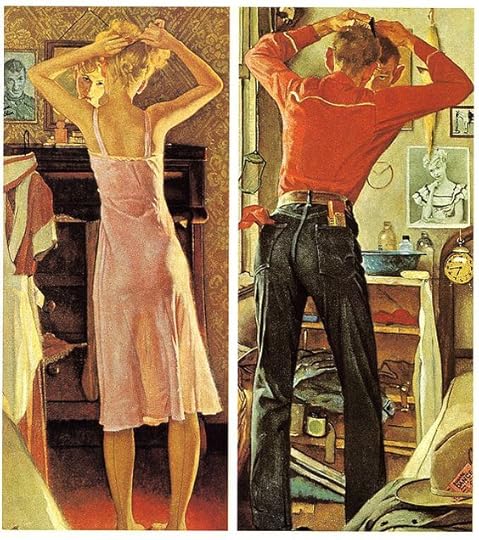
“Before the Date” (1949)
November 23, 2018
“Commonplaces never become tiresome. It is we who become tired when we cease to be curious and appreciative. We find that it is not a new scene which is needed, but a new viewpoint.”
― Norman Rockwell
― Norman Rockwell

April 18, 2025
I bought this wonderful coffee table book at a used book store 30+ years ago for $5 and always smile when I occasionally peruse it. I admire how Norman Rockwell captured the nostalgia and charm of America’s past with his Americana art.

December 20, 2018
I adore Norman Rockwell. This is coffee table book, so maybe I don't get points for reading necessarily--but lots of good fun.
June 30, 2020
Where, oh WHERE are the Rockwells of today, trying to capture and inspire us with the American spirit???

April 20, 2011
This is a very good study into how and what Norman Rockwell paints. And it goes into illustrations other than just Saturday Evening Post covers. (Although all his saturday evening post covers are shown, 9 top a page, in b&w, in the back of the book. I read the first 2/3rds of this book, but after that, started to skim. By then, you know what he was painting and why generally, and although the chapters/categories of what he was painting changed, you started to get so bored reading the details of a majority of his painting and just wanted to look at the paintings themselves more. It was confusing early on when he'd be refurring to a painting/drawing (fig. 81, for example) and you'd have to flip around until you found the item he was discussing several pages away. That happened ALOT! and got annoying quickly. I'd recommend it for fans of Norman Rockwell or art history students but it goes too in depth for your average reader.

May 28, 2016
I love Norman Rockwell. In fact we named named our 7th son bears the name of Rockwell partially in honor of him. To me Norman Rockwell painting have optimism, love of family, love of country, love of God. He is able to see and show the goodness of every age from infant to old age. I love the humor and understanding his paintings have.

December 19, 2011
After visiting the Norman Rockwell museum in Stockbridge, Massachusetts, I just can't get enough of this artist... his talent (beginning at such a young age), and vision of "his time" America is what we all want for ourselves and our children.

August 30, 2008
Norman Rockwell still inspires me to this day. There was a recent exhibition at Union Station in Kansas City that I went to and had the chance to see some of his originals.

May 22, 2012
Another charming overview of this particular painter, fun to read and interesting to examine. The pictures are almsot all in black and white, though.
January 31, 2016
A fantasy on American life, fraught with tenderness.
March 12, 2016
Nostalgia in a book for anyone old enough to remember. I bought this book because we lived in Stockbridge for eighteen years. I used to see Norman Rockwell riding around town on his bike.
Displaying 1 - 19 of 19 reviews