Jump to ratings and reviews
Rate this book

Conan the Cimmerian: The Complete Tales

Rate this book
"Know, oh prince, that between the years when the oceans drank Atlantis and the gleaming cities, and the years of the rise of the Sons of Aryas, there was an Age undreamed of, when shining kingdoms lay spread across the world like blue mantles beneath the stars...Hither came Conan, the Cimmerian, black-haired, sullen-eyed, sword in hand, a thief, a reaver, a slayer, with gigantic melancholies and gigantic mirth, to tread the jeweled thrones of the Earth under his sandalled feet."

So begins the the saga of Conan of Cimmeria, a barbarian from the frozen north of his ancient and troubled world. Included in this compilation of the 18 stories Robert E. Howard completed for Weird Tales during his brief lifetime, are 16 stories, an essay of Conan's world, and the only novel he wrote about this larger-than-life hero, against which all other sword and sorcery characters since have been both derived and measured:

"The Hyborean Age",
"The Phoenix on the Sword",
"The Scarlet Citadel",
"The Tower of the Elephant",
"Black Colossus",
"The Slithering Shadow",
"The Pool of the Black One",
"Rogues in the House",
"Shadows in the Moonlight",
"Queen of the Black Coast",
"The Devil in Iron",
"The People of the Black Circle",
"A Witch Shall Be Born",
"The Jewels of Gwahlur",
"Beyond the Black River",
"Shadows in Zamboula",
"The Hour of the Dragon - Part 1",
"The Hour of the Dragon - Part 2",
and "Red Nails".

860 pages, Nook

First published January 1, 2006

11 people are currently reading
78 people want to read

About the author

Robert E. Howard

2,979 books2,643 followers
Robert Ervin Howard was an American pulp writer of fantasy, horror, historical adventure, boxing, western, and detective fiction. Howard wrote "over three-hundred stories and seven-hundred poems of raw power and unbridled emotion" and is especially noted for his memorable depictions of "a sombre universe of swashbuckling adventure and darkling horror."

He is well known for having created—in the pages of the legendary Depression-era pulp magazine Weird Tales—the character Conan the Cimmerian, a.k.a. Conan the Barbarian, a literary icon whose pop-culture imprint can only be compared to such icons as Tarzan of the Apes, Count Dracula, Sherlock Holmes, and James Bond.

—Wikipedia

Librarian Note: There is more than one author in the Goodreads database with this name.

Ratings & Reviews

What do you think?
Rate this book

Friends & Following

Create a free account to discover what your friends think of this book!

Community Reviews

5 stars
26 (29%)
4 stars
31 (35%)
3 stars
23 (26%)
2 stars
7 (8%)
1 star
0 (0%)
Displaying 1 - 10 of 10 reviews
15 reviews
July 28, 2011
Yes, there have been numerous authors that have picked up the tales of Conan over the decades, but none can really compete with the original 12 books by Robert E. Howard, edited by L. Sprague De Camp.
Profile Image for Gandalf.
15 reviews2 followers
July 28, 2022
Classic stories, but they're just so colored by thheir time it gets hard to read. Due to this being a collection of short stories it gets a bit repetitive. Still, worth reading if you're into sword and sorcery and can stand the racist/sexist attitudes.
Profile Image for a.g.e. montagner.
244 reviews42 followers
unfinished
November 9, 2024
A Note on Method: why and how I read sword and sorcery

I like genre fiction that questions our reality, in the search for different, and possibly better, ways of doing this complex and layered thing: sharing a life on this planet. This is why I like the term speculative fiction, which is incidentally more than the sum of its parts.
But I also like pure escapism, from time to time. When I'm sick, or when my attention span has been shattered by insomnia, I might even need something that makes no high demands in terms of plot, characters and real life implications.
I like the idea of having a batch of short stories (most of these aren't short, but...) to read quickly and independently, without necessarily having to remember where everyone was at in the previous episode. And I like the idea of using sword and sorcery in this guise, a genre whose working-class origins are as old as those of high fantasy. Excellent writers have been practitioners of the form, many of whom I discovered in this discussion; many were probably more skilled than Robert E. Howard, but it would be pretentious not to start here.
I will read critically, because I'm me; but I also have a mind to enjoy the ride.

The Hyborian Age
(●●○○○)

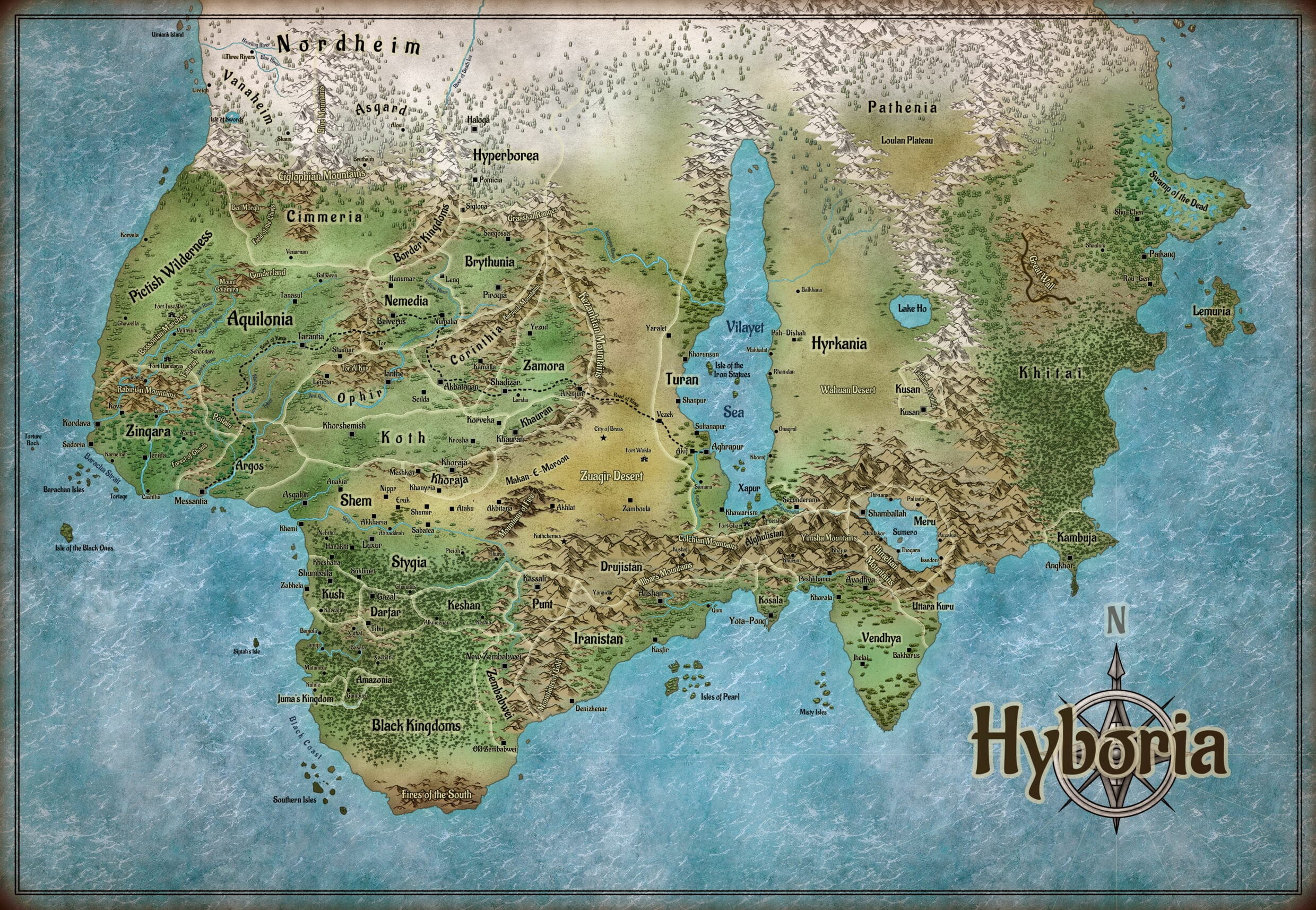
This is the essay in which Robert E. Howard outlines the fictional background to Conan's life and many travels. It is a good occasion to comment on his worldbuilding.

A fictional era of the world, long lost to memory, was famously Howard's shortcut to avoid the demanding research required by historical fiction. This is fine; however different in motive, Tolkien did something similar, and, despite his academic background, the result isn't any more believable than Howard's (incidentally, their maps look very much alike: [exhibit no. 1] [exhibit no. 2]; but that's a topic for a different dissertation).
The Hyborian age is bookended by two natural cataclisms: the first sunk Atlantis, the second created the world as we know it. This is... very practical, however improbable. In the interim, Howard tells us, this is how the Old World looked like. Basically, for the uninitiated: what corresponds to Europe is a solid square of land from the Arctic to the tropic, filling up Mediterranean, North and Baltic seas (this map, however distorted, gives an idea). This beefed up land dominates the map; stumps of Africa and Asia are added almost as afterthoughts. This is... wishful thinking, at best. But let's see what he does with it.
The continent is divided into kingdoms and, in the absence mostly of natural barriers, there are perennial raids, wars and wholesale invasions. This is the easy choice; I can see how non-hierarchical societies would be more demanding to write, and less conducive to the power games that feature prominently in these stories.
What's more interesting is that, time and time again, it is the more barbaric societies that win the day, wiping out opulent and sophisticated empires with suspect efficiency. This is consistent with Howard's endgame, which must be the complete annihilation of this culture; but it's clear that something more profound is at play here. However unsurprising, probably, from someone whose main character is... Conan the Cimmerian. Howard seems to be working under the influence of some version of Oswald Spengler's theory on the cyclical decadence of society. This is... problematic, even at the time. Even worse are the frequent mentions of "pure blood" societies, as if the concept had any meaning. This is... very problematic, to say the least.

Ultimately, however, it's obvious why he wrote 21 tales of Conan, but just this one essay. It drags on and on, and none of it has the narrative force for which Howard is celebrated. He couldn't have carved a career in popular science had his life depended on it. Luckily for us, his life had a different calling.

The Phoenix on the Sword
(●●●●○)

And this is it. This is why we still read Howard nearly a century later.
The literary background is well known to fans: when his last story ("By This Axe I Rule!") featuring his early character Kull of Atlantis was rejected, Howard promptly reworked it into the first of a new legendarium, the first to feature his most enduring creation. As it happens, the first scene of the story shows shady characters plotting the demise of a usurper king. Only a few pages in do we learn that they're planning to kill Conan, king of Aquilonia. His first appearance deserves a quote:

Behind an ivory, gold-inlaid writing-table sat a man whose broad shoulders and sun-browned skin seemed out of place among those luxuriant surroundings. He seemed more a part of the sun and winds and high places of the outlands. His slightest movement spoke of steel — spring muscles knit to a keen brain with the co-ordination of a born fighting man. There was nothing deliberate or measured about his actions. Either he was perfectly at rest —still as a bronze statue— or else he was in motion, not with the jerky quickness of overtense nerves, but with a catlike speed that blurred the sight which tried to follow him.


Many features of sword and sorcery are already here: heroic tales of old, exoticism, political scheming, a general lack of morals, obviously black magic (of the Stygian variety, whenever possible) and swords galore. A lot of swords; also axes for a change, and a mention at least of dancing girls. Lovecraft's influence is also clear, and it's interesting, if well documented, to see this subgenre twining from the start with the (slightly older) Cthulhu mythos. The final duel, which fans nowadays would most probably expect to experience in real time on a screen, is refreshingly well described on the written page.

The Scarlet Citadel
(●●●○○)

King Conan is tricked into battle by former allies, and his army of five thousand is slaughtered into the fields of Ophir. Guess who's the last man standing? He's then captured by the rival kings and seized by the Kothian wizard Tsotha-lanti. Howard dials up the Lovecraftian elements and even namechecks cosmic horror. Nevertheless, he's patently more interested in action than horror, for the most part gliding over the latter; and as a result, the long dungeon sequence is perhaps less compelling than it might have been.
227 reviews
March 14, 2021
Conan???  Seriously, Caleb, Conan????!!!  Well, yes, I confess.  I loved the Arnold movies which were so badly overblown that they were wonderful.  The movies were absolutely true in spirit to the book - which was not a novel but was a collection of short stories and novellas.  Most of them were all published in 1933-34 in the Weird Tales pulp magazine and three of them were published in 1975-76 in collections of one sort or another.  There are also a few unpublished drafts and synopses at the end.  

This should be read in small doses or it will overwhelm you.  I'm about halfway through and currently saturated.  Conan will be shelved for at least 6 months or so.  The language is amazingly overblown and florid.  The action is non-stop and impossibly violent.  Character development?  Who needs character development??
Profile Image for Declan Wiseman.
26 reviews
February 25, 2019
It took me a while to read this, mainly because of uni reading.

A bit dated. A text that is meant to be timeless, completely set in fantasy. And indeed it is, but can any text really escape its era of production?
Issues of gender and race are worth exploring in these collections of tales. Ambivalence shown to many issues within these two main areas.

But ultimately, like a popular Romance, meant to be read for entertainment. Enjoy the big oaf killing everyone, sweet talking an array of women and constant battles against human and extra-human enemies.
Profile Image for Jeremiah .
30 reviews
May 5, 2018
Every Connan story is basically (if not exactly) the same: Connan slaughters his way through legions of men and mythical creatures to "rescue" some woman and then he forces himself on her, pausing only to battle some other demonic entity. These books were clearly written for the teenage boy. There is some interesting lore behind all this slaughter, but after two or three stories, they get repetitive and boring.
Profile Image for Ted Wolf.
143 reviews5 followers
June 8, 2015
I read these stories between reading other things and found them enjoyable although forgettable in their details. There is no clear timeline in Conan's life, so read every story as a stand alone.

I recommend this for people who want a light entertaining read.

A Word of Warning: Howard wrote primarily from 1929 to 1936 and the attitudes expressed in these stories are reflective of those time and will likely offend people who only accept modern sensibilities and attitudes. Also avoid anything to do with the black lotus if at all possible.
Profile Image for Mike.
219 reviews6 followers
February 20, 2013
Got this for Kindle, very cheap. I've read most of these already, but I hope rereading them will stanch my inevitable disappointment over the new Conan movie... which I will see anyway... many of my friends read that sword and sorcery fantasy stuff without realizing how much the genre owes to Robert E. Howard. Alas.
Profile Image for J.W. Metcalf.
Author 2 books27 followers
January 21, 2015
By far my favorite book. The Conan books by Robert E. Howard were the first books I ever read as a kid on my own. (besides the kiddie books). I read all the paperbacks that Howard wrote. I moved on to the other authors that made more tales. I read every Conan book and comic to date. Such a huge fan and I guess it would all start right here.
Displaying 1 - 10 of 10 reviews

Can't find what you're looking for?

Get help and learn more about the design.