Jump to ratings and reviews
Rate this book

Inside Scientology: The Story of America's Most Secretive Religion

Rate this book
Scientology, created in 1954 by pulp science fiction writer L. Ron Hubbard, claims to be the world’s fastest growing religion, with millions of members and huge financial holdings. Celebrity believers keep its profile high. Teams of volunteer ministers offer aid at disaster sites like Haiti and the World Trade Center. But Scientology is also a very closed faith, harassing journalists and others thru litigation & intimidation, even infiltrating high levels of the government to further its goals. Its attacks on psychiatry & its requirement that believers pay as much as tens, even hundreds of thousands of dollars for salvation have drawn scrutiny and skepticism. Ex-members use the Internet to share stories of harassment and abuse. Reitman offers the first full journalistic history of the Church of Scientology, in an evenhanded account that establishes the truth about the controversial religion. She traces Scientology’s development from the birth of Dianetics to today, following its metamorphosis from a pseudoscientific self-help group to a global spiritual corporation with profound control over its followers and ex-followers. Based on five years of research, unprecedented access to Church officials, confidential documents and extensive interviews with current and former members, this is a defining book about a little-known world.

444 pages, Hardcover

First published July 5, 2011

1386 people are currently reading
10775 people want to read

About the author

Janet Reitman

7 books62 followers
Janet Reitman is a contributing editor at Rolling Stone, and the author of "Inside Scientology," (Houghton Mifflin Harcourt, July 2011), which was based on her National Magazine Award-nominated story of the same name published in Rolling Stone in March, 2006. She is the first American journalist to publish a major book on Scientology, and the only writer to have charted its full history.

Reitman also covered the war in Iraq for Rolling Stone and has reported on a wide range of other topics, including the failure of US and international recovery efforts in post-earthquake Haiti; the Duke lacrosse scandal; the death of American aid worker Marla Ruzicka in Baghdad; and the national childhood obesity crisis. She has also reported extensively in Africa, profiling Zimbabwean leader Robert Mugabe, and covering conflicts in Sudan and Sierra Leone.

In addition to Rolling Stone, Reitman's work has appeared in GQ, Men's Journal, the Los Angeles Times Sunday Magazine, and Salon, among other publications. She and journalist L. Christopher Smith live in Brooklyn, New York, with their French sheepdog, Bode.

Ratings & Reviews

What do you think?
Rate this book

Friends & Following

Create a free account to discover what your friends think of this book!

Community Reviews

5 stars
2,539 (26%)
4 stars
4,077 (42%)
3 stars
2,306 (24%)
2 stars
463 (4%)
1 star
183 (1%)
Displaying 1 - 30 of 1,063 reviews
Profile Image for Julie .
4,247 reviews38k followers
May 2, 2012
This is a non fiction book about Scientology. This book gave me nightmares! Like many people I think about Tom Cruise when someone mentions Scientology. That was about all I knew about it. I read a disturbing article in a magazine awhile back that made me want to find out more. ( not the the Rolling Stone article mentioned in this book) If you are just wanting to know what celebrities are involved, there are names dropped, some may surprise you, and others you probably already knew about. But, this book only has one section about Tom Cruise and celebrity members. The first half of the book gives us the background of Scientology, a biography of L R Hubbard, and how the organization (cult) came into being. The beliefs and practices and brainwashing techniques and outright harassment and criminal activity made my hair stand up on end. The second half of the book deals with the changes that took place after L R Hubbard passed away. This section was even worse. After the chapter about seducing celebrities and the Tom Cruise rise and fall, the book deals with children who have grown up in the "church", about the difficulty many face when trying to leave and how their lives are still under scrutiny even if they were strong enough to get out. It also speaks of the internet giving people an inside look at this secretive "religion" and thus spurring a mass exodus. But, Scientology has reinvented itself time and time again, and still remains affluent. So, even though they aren't recruiting people in droves, they are still a thriving corporate organization. Which does not make me sleep better at night. I highly recommend this book, but don't read it right before you go to bed.
Profile Image for Mary.
475 reviews945 followers
December 27, 2012
When I was about halfway through this book I received a rather strange bright pink envelope in the mail. The return address was "The Church of Scientology" here in LaLa land. And, much like those sweepstakes things, it was promising enlightenment and answers beyond anything I'd ever imagined. Holy fuckballs, how did they know I was reading this book?! Are they watching me? Are they reading this right now? For shits and giggles I read through the pamphlet and found a 200 question test. And yes, I did the quiz, which was stupid.

I had hit the jackpot. This was just the kooky stuff I had been reading about...in fact a good portion of reading this book took place near my living room window of which the blinds were often open....they're out there. Or right here near my window...

To be honest I was expecting a lot more from this book. I admit it, I wanted more "batshit crazy" and less information. Maybe because so much of it wasn't news to me. We all already know about the aliens right? And it's touched upon ever so briefly here, along with passed life role-play and billion year contracts and auditing and becoming "clear". We all know they think shrinks are quacks. We all know what they thought of Brook Shields and her post-partum depression. This book is bursting with facts upon facts (in the 50's L.Ron Hubbard earned more from the sales of his books and seminars than the President of the United States was paid). Although things like this were really interesting, to a point, I guess I was hanging out for the real meat and potatoes of what goes on inside the mind of these devotees. I got a little bit of that, but mostly it was too journalistic and not enough personal accounts.

Yes, I guess wanted a freak show.

The first third of the book traces L. Ron Hubbard's childhood and early life, his first marriage and kids (whom he abandoned after coming back from WWII). It was the 50's, PTSD wasn't recognized and American society was ripe with damaged soldiers looking for answers as to why they were, frankly, fucked up. Could it be that you're traumatized by war?! Oh no, it's just that you're simply in need of auditing and you can stop having symptoms of depression, anxiety, nightmares, headaches, heck, you can stop any negative thoughts or feeling by forking over thousand of dollars and your first born and turning yourself over to unqualified cult members. Brilliant! Just be sure you don't piss anyone off or you'll be thrown overboard one of the Scientology ships, or locked in a room for weeks, or be fined tens of thousands of dollars.

The second part of the book was my least favorite. It focused on the power play of leaders after Hubbard's death and the cover up and destroying of records whenever the authorities starting poking around. It wasn't as interesting as it sounds. Oh, and a pretty disturbing incident of a woman who was denied psychiatric care despite literally going insane and eventually dying of dehydration under the watch of church members over a period of weeks. I wish there were more cases like this in the book of real life Scientology defectors, instead we get brief sentences here and there of former members, but none went into any sort of depth about their experience.

The third part was the Scientology we know today. The celebrity factor. We are told about how a then unknown John Travolta joined the church in the early 70's. We learn, rather amusingly, that Elvis Presley stormed out of his only visit to the church declaring that he wanted nothing to do with these crazies....and Priscilla remains a member to this day. And then, finally, the Tom Cruise chapter. Lost, insecure, fresh from Top Gun and a couple of decades before he'd be jumping on Oprah's couch, Tom Cruise joined in the mid 80's and remains their most prized possession and poster boy.

This book contains a very detailed chronicle of Scientology's formation, corruption and utter strangeness. It's at times pretty horrifying and at other times tedious and long winded. A good read for anyone interested in the topic specifically, or for anyone who likes learning about cults, brainwashing and/or idiots. 2.75 stars.
Profile Image for David.
Author 20 books403 followers
January 22, 2019
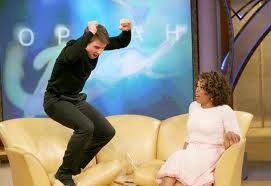
If you're like most people in the 21st century, this may be the image you have of Scientology:

 photo TomCruiseonOprah_zpsae0586c5.jpg

That was Tom Cruise jumping up and down on a couch, while promoting War of the Worlds in 2005 on Oprah. His manic performance while waxing ecstatic over his love for Katie Holmes (wife #3) turned him into a punchline, and this was in the middle of his renewed advocacy for Scientology, a "religion" that is probably most famous for attracting so many Hollywood celebrities, most notably Tom Cruise and John Travolta, but the list is actually quite large.

Of course, this being the 21st century, everyone has access to the Internet and so if you've ever been the least bit interested in Scientology, you have probably also heard about Xenu and "body-Thetans" and all the other crap Scientologists aren't supposed to learn about until they reach "OT3."

Tom Cruise himself, according to Janet Reitman's detailed history of the Church of Scientology and its founder, L. Ron Hubbard, said "What is this sci-fi bullshit?" when the secrets of Galactic Overlord Xenu were finally revealed to him. And yet he went on to become Scientology's most public and effective advocate, and according to Inside Scientology, a one-man cash cow for the church, which has a habit of dramatically overstating its membership numbers.

L. Ron Hubbard himself, a science fiction author who knew all the big names back in the early days of pulp sci-fi, was a huckster, a con-man, and a relentless self-promoting machine. You may consider his ethics and the made-up religion he created to be dodgy at best, but you cannot help but admire how he turned every adversity and setback into a win for himself. By the time he died, he was a Christ-like figure to his followers, who made him and his church incredibly rich.

Inside Scientology is not a sensationalistic hit-piece on Scientology. Reitman tries to be as even-handed as possible, but just reporting the plain facts about Scientology, without the church's PR spin or outright falsification, inevitably casts it in a negative light. There are people, even who have left the church, who to this day insist that the "tech" works and that Scientology helped them. Yet the stories of abuse, of milking members for every dime of their savings and then putting them to work in what amounts to voluntary indentured servitude when their money runs out, of distortions and deceptions, of massive, widespread campaigns of organized harassment and gaslighting and ruinous litigation for the sake of destroying the church's enemies, make one wonder how anyone could see the Church of Scientology in a clear light and not see it for what it is? And for that matter, how does anyone in the 21st century with an Internet connection actually join this "religion" (yes, I'm going to insist on putting that in scare quotes), after reading about Xenu?

Well, in short, according to Reitman, Scientology has indeed taken a big hit since the advent of the Internet and the ability of anyone to go online and read all about their more esoteric/bizarre doctrines and their history. Most new Scientologists today are kids who were raised in the church, and the church does its best to keep its members in a bubble, told to avoid reading critical books or articles or websites and avoid "suppressive personalities" (i.e., people hostile to Scientology). Yet evidently, some are still drawn into it, and the church's "celebrity strategy," which famously netted Tom Cruise, is still keeping their Hollywood org jumping.

Reitman's history goes all the way back to L. Ron Hubbard's early days, and the evolution of "Dianetics" into a full-blown religion. The tactics of the church, which were belligerent and ruthless even in the early days, and led to them essentially bullying the IRS into granting them tax-exempt status in 1993. Reitman is especially critical of Scientology's current leader, David Miscavage, who took over the reins of the church from LRH and is, from Reitman's account, exactly the sort of insecure, micromanaging, thin-skinned egomaniac you never want to see in power.

This is all fascinating stuff, and rather heart-breaking when you see how much damage the "religion" has caused over its relatively brief history. And yet, people still embrace it, even some of its outcasts. Are they really so different from Catholics or Jehovah's Witnesses or Mormons or Muslims? All religions have pretty lurid histories and it's easy to portray any of them as terrible, cult-like conspiracies.

I think after reading this book you will see plenty of differences that mark Scientology as... something else. Still, this book is written as a piece of journalism, not a critique, and the church itself was surprisingly cooperative with the author. So if you are interested in that wacky Hollywood religion with its arcane jargon, and don't just want to read a screed by an ex-Scientologist about how awful Scientology is, Inside Scientology is a very good place to start.
Profile Image for Jason Koivu.
Author 7 books1,406 followers
July 14, 2015
While I lived in Hollywood for a few years I would see Scientology buildings around town and I would wonder what went on inside. It was all very secretive. It still is, but due to books like this and, even more so, the internet the veil has been lifted. Which has left me wondering, if the incredible allegations are made against the Church of Scientology are true, why would humans allow others to do such things to them?

I read this in part to learn more about L. Ron Hubbard. I guess I could've just Wiki-ed him, but this book provided much more info. He reminds me of a Teddy Roosevelt character type. A brash go-getter, who could boast some impressive deeds. But where Teddy turned his wild energies and imagination toward public service, Hubbard turned his towards science fiction writing. That in and of itself isn't a bad thing, unless you let your imagination carry you away. Hubbard's mad desire for macho-man adventure so infused his ego as to warp his stories into tall tales of personal achievement that he himself started to believe. Again, that's no big deal, until you start getting others to believe you, others who then follow you and give you all their money.

When Hubbard passed on, the Church passed into even more controlling, determined, single-minded hands, the hands of David Miscavige, a diminutive, sickly youth who grew into a pint-sized dictator. Miscavige credits Hubbard's teachings for curing him of his youthful ailments and frailty. Such miracles will tend to instill an unbreakable devotion in a youthful, impressionable mind. If you isolate that mind early enough, it will forever believe the legend. It will progress no further, learn nothing new, for it has seen the light. If that mind belongs to a raging A-type personality, it will attempt to shove that light down others' throats.

Anywho, that's enough of that nonsense. I won't detail the entire history. That's what books like this are for.

Many reviews have called Inside Scientology boring. Granted, it is quite textbooky, but I feel like those people were looking for something more People-magazine-salacious with cover-to-cover celebrity stories. That's not what you get here. Famous names are dropped. Whole parts of the books are devoted to the topic of celebrities within Scientology, but this is more history than anything. Having said that, there's plenty on Tom Cruise, as you'd expect.

All the while I was reading, I kept in mind that this is one book and one person's take on the topic, so I'm willing to reserve complete judgement. However, Reitman sources a lot of people, mostly Church "defectors", who spent years, even decades within the organization. There are so many of them that it makes you doubt that they're all lying ax-grinders.

Though mostly negative, Inside Scientology does include a few positives in the Church's favor, such as the charity work they've done during natural disasters. Reitman interviews a Scientologist teenager who grew up in the organization and remains there, and the girl comes off as one of the most well-adjusted people in the whole book. And taking into account that it is such a large, many faceted organization spanning the globe with different divisions, departments, whatever you want to call them, so surely one individual's experience will differ from another. No doubt some have derived positives from their association with the Church of Scientology. There, that's my charitable act for the day.
Profile Image for Marcus.
311 reviews363 followers
December 20, 2011
Once I started reading I couldn't turn away. The story of Scientology has it all--good and evil, drugs and violence and a cast of characters and organizations that put any dystopian fiction to shame. If it wasn't so awful that real people get wrapped up in this, it'd make a great movie or tv series.

Scientology's "auditing" process is flat out scary. It makes such a strong appeal to the libido dominandi, the lust for power, that people seem willing to overlook all other aspects of the doctrines and history of the religion. You are promised that if you learn, and of course pay for, enough tech you will eventually become a powerful enough Thetan to do anything. Levitate stuff, control people, whatever.

Fine. We all know that no amount of auditing is going to get you lifting plates out of the dishwasher without getting off the couch, but apparently (and most dangerously) auditing has enough of a kernel of truth to it to convince people to keep going with it.

Eventually you become so enmeshed that it is difficult to leave the 'church' without losing friends, the significant financial investment you've made and all ties a culture that has changed almost every aspect of your lifestyle, your vocabulary not being the least of it.

I doubt that Scientology is a net loss for everyone that gets involved, but it seems a lot like cocaine. There are apparently a few people that use it and never get addicted, they just enjoy the highs, but it's not something you'd ever give your kids to see if they're one of those people.
Profile Image for Julie Ehlers.
1,117 reviews1,603 followers
January 29, 2021
Janet Reitman's Inside Scientology was published more than a year before Lawrence Wright's Going Clear: Scientology, Hollywood, and the Prison of Belief, but never made the same kind of splash. Now that I've read it, I understand why. This book essentially begins with the birth of L. Ron Hubbard and provides an intense amount of detail around scientology's founding and history. I was often impatient with what I thought was, frankly, more detail than any general reader really needed, but I thought once I'd finished the book I'd be grateful to have all that background knowledge. But now that I'm done... I still feel like it was a little too much detail. It made the reading experience drag and feel like homework.

Fortunately, the second half of the book moves into the present day and is much livelier. In addition to delving into John Travolta's and Tom Cruise's stories, Reitman also presents the stories of numerous ordinary citizens who were really screwed over by scientology and its increasingly abusive leadership. I already knew the upper ranks of of the scientology organization were capable of terrible things, but still, I was honestly shocked.

Scientology doesn't have a huge presence in Philadelphia but it definitely exists here, and I've seen them recruiting at the train station in Old City. FREE STRESS TEST, their sign reads, and as far as I'm concerned a "religion" becomes a cult when it plays on people's stress, anxiety, or depression to try to pull them in. It's deceptive and targets the most vulnerable of our fellow humans. So I do feel everyone needs the information presented in Inside Scientology and I hope the message has gotten out there. If I'm being honest, though, reading this whole tome probably isn't necessary to get the information you need. I rewatched the Going Clear documentary after reading this, and I would recommend that over Inside Scientology. 3.5 stars, rounded down.
Profile Image for Mike (the Paladin).
3,148 reviews2,161 followers
July 13, 2012
What can I say here??? I recommend you read this one.

There are situations in this book that I suspect many or most readers will look at and say, "why would he/she put up with this?". If you've never been in a cultic situation it will be totally incomprehensible. I was some years ago and I often (while reading the book) still have that reaction. Having "gotten away" I'd look at what people allowed to be done to them and worse their children and balk.

Then I made myself think back. If these are the people (or if this is the person) who has THE ONLY WAY OUT - THE ONLY WAY TO SALVATION where can you go? If you've never received an education because you were brought up in the church on a church compound or a church ship (yes I said ship) if you're income, food, housing depends on said church, where can you go? How can you live?

I am a Christian. Scientology isn't. Many cults that consider themselves Christian aren't either for that matter but I'm not debating who or what is Christian here. I'm simply saying look at the reality.

There are many dangers here. People may look at this and think more restrictive laws should come into being. That would be it's own kind of horror. The situation in cults is a different thing and we need to be aware of it in our own lives. We need to be willing to take responsibility. No one can control you unless you give them that control (if they have a gun you might have to be a bit more circumspect, but you catch my drift).

Cults tend to gain members in a few ways. Many people you'll meet here were simply raised in the Church of Scientology. Others come into contact during or after some crisis in their life that leaves them vulnerable. Other people find someone or some group offering idealistic answers when that's what they seek.

I won't make jokes about the churches teachings, though I could and many do. The subject is too serious. Be aware and DON'T, DON'T, DON'T give away your right and ability TO THINK.
Profile Image for Cristy Emmnm.
224 reviews56 followers
July 25, 2011
This is an excellent book that truly does aspire to be as objective as possible when it comes to Scientology's history, founder, beliefs, and practices. The problem is that facts are facts. It's hard to report on corruption, cohersion, cunning, and lies with a positive tone. As a religious studies student throughout high school and in my undergraduate studies along with a life-long interest in American new religious movements (in particular, with Scientology), I knew a lot of the "facts" of Reitman's book. However, to see it so substantiated (and with appendices, footnotes, citations, and named quotes to boot) and to see it condensed into one book was astounding and even mind blowingly surreal. Leaving my personal opinions of Scientology aside and looking at this as a critical analysis or comparative religious work, I rate this book highly and recommend it to anyone with interests similar to my own. If I take into account my beliefs on Scientology as a "religion" or corporation, more like, that benefits from the media in some ways while remaining veritably unknown to the majority of people (even within Scientology), I think it is an essential read. This is happening right now, right around you, and it is an atrocity. It's dumb but it's also wrong.
Profile Image for Marvin.
1,414 reviews5,408 followers
December 2, 2011
I am going to tell you something that nobody believes.

In the early 70s I was dating a girl who was into Scientology. (no, that's not it. Anyone who knows me know I've dated some really weird girls and the only normal one I've dated is the one I'm married to now). She was always giving me tracts about Scientology. I read them and wasn't too impressed. It seems like watered down Freudian psycho-babble to me. But I remembered that every single pamphlet said in bold letters "SCIENTOLOGY IS NOT A RELIGION!. Shortly after this I stopped dating this chick. She really was pretty weird and it wasn't just because she was into Scientology. I could tell you some stories...but I digress...

Anyhow, the part I can't get people to believe is the part where the tracts said that Scientology was not a religion. I wish I still had these pamphlets to show people. This was way before Scientology received tax exempt status as a religion and I expected my former girl friend was smart enough to use these particular pamphlets to try to impress a young guy who was showing some strong ambivalence regarding organized religion. This also shows how far Scientology went to market its ideas for everyone.

Janet Reitman does an amazing job in chronicling the history of what she calls the world's most secretive religion. It is becomes clear in her work that marketing is the organization's strongest suit starting from when Dianetics was a gleam in L. Ron's eyes to the later method of using celebrity endorsements. While this book has been called a even handed approach to Scientology, Reitman realizes you can be only so evenhanded when you are writing about an organization that uses secrecy and heavy-handed tactics to control both its members and its critics. But overall, it is a fascinating look at Scientology, its founder, and those who managed the organization after Hubbard. There's even a long chapter on Tom Cruise, way too long in my opinion, but it does illustrates the extremes Scientology will go to in using and controlling celebrities to promote their ideas.

Overall, a strong book highly recommended for those who want to get a detailed look at a controversial subject.
507 reviews84 followers
December 2, 2011
OMG Scientology. How I like to tease you. I remember going to that Hollywood center of theirs to take that "personality test" where they find something wrong with you that only Scientology can fix. And then my friends and I ran out of there, screaming, before the test was done because man, it was freaky! Hahaha. And I took an e-meter test once, uh... also in Hollywood. They were out on the street for some reason and were uh... giving "free stress tests" to people. I was like, sweet! Paul took a picture of me holding the cans. It's sitting on a desk somewhere in the apartment. When I thought of Damon Albarn it made the little needle jump, hahaha. And then for some reason there was a family outing to that same Hollywood Scientology place for Christmas to see the snow thing that they do. Winter Wonderland. IDK why. There must be a picture of me somewhere standing morosely next to a Scientology santa or carolers or whatever. Then I went to the L. Ron Hubbard Life Exhibition and holy shit! It was a museum of his bullshit! It ended with a display of all his certificates on a wall that moved while orgasmic music played. It was so good. I recommend it to all tourists. hahaha! Scientology.

Anyway about the book. It was as balanced as an objective report on Scientology can be, which means that the conclusion reached is: COS is a bunch of BS. Absolute bullshit, and people are idiots. Strangely though, I think I have more respect for Scientologists as people though I really don't understand them. I mean, I too am an idiot, and there was that one time I discovered I believed Damon Albarn was God. Seriously. But scientologists-as-people aside, The Church of Scientology is TERRIFYING. They took the brother of one of my best friends! He "disconnected" from his family and now they don't see him anymore. Fuckers. hahahaha?
Profile Image for Jeanette (Ms. Feisty).
2,179 reviews2,184 followers
May 29, 2012
This is a challenging read owing to the scope and density of information, but it's a worthwhile pursuit if you want to see an in-depth example of how insanity is contagious. If you don't feel up to the task of reading the entire book, I recommend reading the first three chapters, especially if you're ever crazy enough to consider becoming a member of this so-called religion. The entire organization was created on a foundation of lies right from the start. L. Ron Hubbard was a paranoid egomaniac and a pathological liar.
Profile Image for Jennifer Arnold.
282 reviews6 followers
December 24, 2011
Growing up just a few miles from one of Scientology's major spiritual centers - Clearwater, Florida - I've always had a certain awareness of Scientology and its oddities. As a kid, I remember thinking of them as the strange people walking around downtown Clearwater in their naval-like uniforms. Later, Scientology was the reason we had a few minor celebrity sightings at the Barnes & Noble I worked at (Jenna Elfman, Greta Van Susteren) and one very strange book fair (after which I counted more than $17,000 in cash). Reitman's book didn't change my overall opinion of Scientology (totally not a religion - hello, IRS - but rather an elaborate money making scheme), but it did make me understand a little more why people were attracted to it, at least at first.

Reitman's work is really an even-handed and meticulously researched history of the birth and development of Scientology. She's as fair as possible in presenting L. Ron Hubbard, but there's quite a bit of well, dirt (several abandoned wives and kids,) and general strangeness (it's hard to take the Xenu stuff and the practically supernatural powers that the upper levels of Scientology promises with a straight face). Reitman does a good job with the story of Lisa McPherson, a Clearwater-based Scientologist who died after 17 days of 'treatment' for a mental breakdown in which she was not taken to the hospital for the actual (physical) medical care that she needed until too late (this was a *huge* story back home at the time). There's a good bit of explanation for what was going on at the time of the whole Tom Cruise/Oprah's couch phenomenon. The guy who comes off worst is the 'church's' current leader, David Miscavige, who seems to be a petty, vindictive tyrant - but then, that's what power will do to you. The stories of how the church bullies and harasses its critics and those who dare to leave the church (often with harrowing escapes that aren't helping the charges that Scientology is a cult) may seem outlandish, but Reitman's gone to great lengths to verify each tale that she's included.

Overall, interesting and eye-opening, and extremely well-written.


Profile Image for Ari Damoulakis.
433 reviews30 followers
September 17, 2024
This book was good. This is for me an evil, sinister movement and scam.
The thing that really disappointed me about this book, which I am still looking for, is a book that explains and deconstructs the tests, teachings and beliefs.
But this cult is far from good.
Profile Image for Melody.
2,668 reviews308 followers
January 13, 2012
I will confess that the only reason I picked this book up in the first place was because I wanted to learn if there was any truth to the story (which I love) that Heinlein and Hubbard sat down one night and bet each other that they could each make up a religion and have a huge number of bona fide believing converts in 5 years. Heinlein's Church of All Worlds didn't really take off like Hubbard's Scientology. Sadly, Reitman doesn't mention this story, though this will not prevent me from continuing to tell it.

I soldiered on, despite my disappointment, and was rendered speechless with horror any number of times. I am not a religious type, and I find all of the religions I know anything in-depth about deeply weird, but the Scientologists are batshit. I knew about the aliens. I didn't know about the billion-year contracts, or the tossing people overboard from the yacht for minor infractions. Or the locking them up, or the letting them die from dehydration resulting from psychosis brought on by "auditing". I knew about the money, the corporate model, but not how punishingly avaricious the church was with its rank and file.

It was a fascinating book on a lot of levels. My only minor quibble is that I didn't get a real feel for what, exactly, the devotees get from the various classes/auditings/e-meters & etc. I got a clear picture of the trauma, of the betrayals, of the reporting on one another, of the keeping of files on people- but I really have no understanding of what benefits (and there must be some) there are.
Profile Image for Christopher.
730 reviews270 followers
February 14, 2014
Scientology is a very strange thing. It lies somewhere within the Bermuda triangle of Buddhism, clinical psychology, and the sort of pyramid schemes that clog up the sidebars of the less reputable websites you visit (one weird old trick to...).

First of all, is Scientology a religion at all? According to sociologist Émile Durkheim, religion is "a unified system of beliefs and practices relative to sacred things, i.e., things set apart and forbidden--beliefs and practices which unite in one single moral community called a Church, all those who adhere to them." (The Elementary Forms of the Religious Life) Scientology is and has all those things. The Church of Scientology's website describes it thusly: "Developed by L. Ron Hubbard, Scientology is a religion that offers a precise path leading to a complete and certain understanding of one’s true spiritual nature and one’s relationship to self, family, groups, Mankind, all life forms, the material universe, the spiritual universe and the Supreme Being."

While I personally wouldn't ever join a religion created by a bad science fiction writer, I can see the appeal. It's a big, friendly group of people that wants the best health and wealth for all its members. It's something you can buy into, rather than having to ascribe to lots of hard-to-believe tenants of faith (while there is a general belief in a "Supreme Being", Scientology does not insist upon any dogmatic theology.)

But, you might say, Scientology is a cult! And I agree. Scientology is a religion and a cult. Or at least it started that way. Hubbard was a perfect cult leader, like Jim Jones without the mass suicide or Charles Manson without all the murders. Hubbard was a charismatic and visionary leader. He demanded and received loyalty from his followers. But he also employed a lot of the less desirable methods of cult leaders: cruel and unusual punishments, severe threats, brainwashing, blackmail, etc. His successor, David Miscavige, has employed many of the same techniques.

And you know what else Scientology is? It's a corporation. At its heart, it's a money-making operation and Dianetics is its main commodity.The Religious Technology Center is a corporation that owns the trademarks and copyrights of Scientology and Dianetics. David Miscavige, its chairman, is worth about $50 million. He's no Bill Gates, but he's worth more than Hugh Hefner ($43 million). Somehow, Scientology sells even better than sex. The Church of Scientology has mastered marketing. It uses celebrity endorsement, recruiting famous actors and public faces for their cause (to name several, Tom Cruise, John Travolta, Greta Van Susteren, Elizabeth Moss, Jason Lee, Kirstie Alley, Juliette Lewis, Beck, Sonny Bono, Lisa Marie Presley, Will Smith, etc*. Lots of nuts, but several that you wouldn't expect.) Celebrity endorsement can also bite you in the butt, though; Charles Manson was a member of the Church for awhile in prison.

One of the big problems with Scientology is that it starts its members out with stuff that sounds really good. When you join the Church, you join it for its loving members, its emphasis on therapy over medication. But Scientology is a ladder, and when you get further up on the ladder, it gets weirder and weirder. There's one level in particular, called OT3 (Operating Thetan Level 3), which is often called the "wall of fire", because it's the gateway into the more secretive parts of Scientology. I'd encourage you to read this whole webpage which describes what happens when one reaches OT3, but here I'll give you some highlights After being led into a locked room and having to sign waivers saying you won't disclose the information you'll learn to anyone without the OT3 clearance, you are allowed to read the following enlightening information:

[...]75 million years ago, an evil being named Xenu decided to solve a population problem on his galactic colony by exiling a bunch of people to Earth. Xenu then did a ton of horrible things to these people, like drugging them, placing their bodies around a volcano, and blowing them up with H-bombs.

But that really only took care of the physical problem – Xenu didn’t just want the bodies gone, he wanted to make sure the ‘thetans’ (spirits / souls) of those people didn’t come back and reincarnate on his colony. So when the souls started leaving the bodies, he captured the souls and forced them into a huge implant station that was kind of like a movie theatre. There, he made them watch movies that ‘implanted’ them with false pictures of Christ, and other historical events that Hubbard says didn’t actually happen.

The souls were so screwed up from this implanting that they roamed aimlessly around Earth for millions of years. When human beings started evolving, the thetans started entering their bodies and inhabiting them, and thus these thetans are called ‘body thetans’. And body thetans, says Hubbard, are the source of all human misery.

But that’s just the theory portion of OT3. The practical portion of OT3 involves getting rid of these body thetans. The PC uses the Emeter to locate body thetans that are stuck to his body, and talk to them, auditing them until they blow (go away).


That seems to be the problem with cults. Jim Jones lured people in by offering acceptance, love, and equality; pretty soon, the inhabitants of Jonestown found themselves drinking arsenic-laced Kool-Aid. Likewise in Scientology, one is drawn by the happy, accepting atmosphere and the process of physical and spiritual wellness; but then one finds oneself signing an affidavit that you believe the ravings of an LSD-inspired science fiction writer.

The referenced website also makes the great point that, while all of these beliefs are really strange and laughable, that's not what makes Scientology a bad religion. People can believe whatever they want to believe; that's a basic human right. But what critics of Scientology really need to focus on is the injustice that the Church of Scientology perpetuates. At the very least, it swindles its members of their money. At its worst, though, it denies its members access to basic medical treatments (see the case of Linda McPherson for more on this), it oppresses its members and employees with Mafia-style tactics, and engages in all sorts of legally blurry activity.

So, dear reader, the moral of this review is to be educated! Be educated and be safe!


*Some significant former members deserve mention as well: Patrick Swayze, J.D. Salinger, Leonard Cohen, William S. Burroughs, Christopher Reeve, Jeffrey Tambor, Ricky Martin, Brad Pitt, Van Morrison, Emilio Estevez, Nicole Kidman, Jerry Seinfeld, etc.
Profile Image for Chip Huyen.
Author 7 books4,190 followers
October 23, 2025
This is the first book I've read on scientology, so a lot of information in the book was fresh for me.

However, I wish the book had more of a storyline or a central thesis other than "scientology is a self-help business that disguises as a religion to avoid paying taxes." It reads more like a collection of isolated anecdotes that all follow the same structure. I found myself losing interest in the second half. Once the central thesis was established, I didn't know where the rest of the book was headed.
Profile Image for Mal Warwick.
Author 29 books492 followers
April 6, 2017
Set Up Your Own Religion, and Make a Billion Dollars

When L. Ron Hubbard died in 1986 at the age of 74, one of the world most confounding and controversial public figures passed from the scene — though not from memory.

Borrowing a 19th-century approach to mental therapy from psychiatrists Sigmund Freud, Josef Breuer, and others, as the basis for his own self-help method, Hubbard had become psychiatry’s most prominent critic for its dismissal of the therapeutic techniques he claimed could be administered by anyone without the benefit of training in medicine or psychology.
Having declared in 1945 when flat broke that he would found his own religion, by the time of his death he had built a worldwide “church” through which he amassed an estate of $400 million—$826 million in 2012 dollars.
Never having graduated from college, he styled himself as an explorer, a nuclear physicist, and a philosopher with advanced degrees to match, all the figments of his fertile imagination.
A second-rate writer of pulp adventure fiction in the 1930s and of science fiction in the 1940s and 50s, he attained a ranking on the New York Times bestseller list only through his self-help book, Dianetics, published when Hubbard was approaching age 40.
Upon his passing, Hubbard had achieved a semblance of immortality, elevated to spiritual sainthood by millions of followers around the world who treated his every written word and every utterance as unchallengeable truth.
Adding to the irony of Hubbard’s existence, this champion of mental health and outspoken opponent of psychiatry spent his last several years, by all accounts, an abusive and paranoiac lunatic whose erratic behavior was moderated only by the very anti-psychotic drugs he had crusaded against for more than three decades.

Thus passed from the scene the founder of Scientology.

Since Hubbard had failed to name a successor, a vicious struggle for power in the “church” ensued upon his death. In hindsight, however, the victor in this struggle had been foreordained. Beginning four years earlier, once Hubbard had gone into seclusion, his whereabouts a secret from all but a handful of his staff, a 19-year-old named David Miscavige had begun forcing out all those in Scientology’s leadership who stood in his way. The process resembled nothing so much as the purges launched by Josef Stalin in the 1920s following the death of Lenin. By 1988, the 25-year-old Miscavige stood at the pinnacle, the undisputed leader.

To judge from Janet Reitman’s exhaustively researched and detailed reporting in Inside Scientology, Miscavige has run the multi-faceted Scientology establishment for nearly a quarter-century now with a style that is at once obsessive, rigid, humorless, unforgiving, and dedicated almost exclusively to the pursuit of profit. He appears to exhibit virtually none of L. Ron Hubbard’s good qualities—irresistible charm, a forgiving nature, managerial ability, and a lively imagination—and all of his bad ones, including extreme litigiousness and a tendency to strike out at those closest to him. In recent years, Reitman reports, Miscavige has even demonstrated a clear pattern of severe paranoia much like what drove Hubbard into seclusion, sometimes attacking aides and senior executives with physical violence, at other times submitting them (or anyone else who so much as utters a hint of criticism) to humiliating punishment.

Just as he had engineered the “first Exodus” from Scientology on his drive to power in the 1980s, Miscavige’s extreme behavior led to a second Exodus in the middle of the last decade, driving away most of the senior executives who had managed the far-flung business, in some cases for decades.

As you’re no doubt aware, the Internal Revenue Service classified the Church of Scientology as a religion, exempting all its innumerable affiliates and subsidiaries from the payment of Federal taxes and allowing them to receive tax-deductible donations. However, what you may not be aware—I certainly wasn’t, before reading Reitman’s book—is that the agreement signed by the “church” and the IRS in 1993 came about because the then-Director of Internal Revenue cried chicken in the face of literally thousands of lawsuits filed by the Scientology establishment under Miscavige’s direction and its constant use of private detectives to harass and apparently even blackmail IRS agents and staff.

Janet Reitman’s book began as an article in Rolling Stone magazine but took years to complete. It’s a stellar example of the reporter’s craft, balanced and objective. Yes, balanced: Reitman quotes Scientology officials and long-time faithful adherents at length — and even in the book’s closing thoughts — demonstrating that for some, perhaps a great many, who give over their lives to Hubbard’s “technology” (as he styled it), life can be rewarding. However, there are far too many former Scientologists who have spoken out, especially in recent years, blasting Miscavige’s administration if not the core ideas of Scientology itself, to think of this now six-decade-old movement as anything other than a diversified, multinational business built by a movement that operates precisely like the cult it is so often accused of being.

Like McDonald’s, which earns more revenue from its real estate than from Big Macs and Chicken Nuggets, the Church of Scientology now derives the lion’s share of its income from its real estate holdings around the world. Other businesses contribute additional funds. And yet the “church” itself seemingly continues to gush money, even as the faith is in decline: one of its centers alone, in Clearwater, Florida, the movement’s spiritual headquarters, reportedly was grossing more than $1 million a week as recently as a decade ago. If that’s the case, and hundreds of other Scientology centers in cities and towns around the world remain in business only because they’re profitable (the yardstick the “church” applies), I can’t begin to imagine how large is the asset base ruled today by David Miscavige. If he began 24 years ago with the equivalent of the $826 million that Hubbard left to the movement, surely the “church” today possesses wealth in the billions.
Profile Image for Louise.
1,846 reviews384 followers
September 9, 2012
Last year I was in NYC and passed by the Scientology building on 44th Street. You can't miss it. Its large white sign is used as a directional for anything on the block... Looking for the Paramount Hotel? "See the Scientology sign two blocks down... right next to it". On a rainy evening handsome young people hustled anyone who passed on the sidewalk (I saw no one stop). Large TV screens, also with beautiful people, tell you that you can fulfill your dreams. An open door shows the way to an inviting place to sit out the rain. I mentioned my curiosity, and one person in our group said, "Go in there and you'll never get out." I didn't know how true those words could be for many well meaning people until I read this book.

Janet Reitman has spent at least five years researching this group. I'd had a lot of images, and she put them together: L. Ron Hubbard, the relationship of Dianetics to Scientology, Hubbard's science fiction, how Scientology became a religion and the celebrity involvement. There were people and things I never heard of like David Miscavige, E-meters, thetans, Int Base, Sea Org, auditing, OT levels, Narconon, Purification Rundown, "clearing the planet" and a lot more.

The most ominous new things I learned were how the Scientologists infiltrate legitimate churches, agencies and groups to get advocates; They file frivolous law suits, start whisper campaigns and harass/divide families in order to railroad detractors, defectors and regulators; and use sadistic punishment to keep employees (some who because they were raised within Scientology and because they have no high school diploma, drivers' license or credit cards fear the outside world) in line. It's frightening to think how successful they've been. I see, now, why it has this aura that my friend suggested... that of a deep dark hole.

I expect that every bit of this is true. Not only is it heavily documented, given the way Scientology treats its detractors, this must have been combed by a legal staff. Even if its only half true, its quite an indictment. If there was no legal evidence of responsibility for Lisa McPherson's death, there is moral responsibility. A person who permits this kind of treatment of his staff (or anyone) with no contrition would, of course, design and enjoy a game of executive musical chairs and its aftermath as Reitman describes it.

Now with this book, the word is out. It's time for some one in some regulatory position to act. What other church regularly offers hush money and has senior leadership sign confidentiality agreements upon leaving (escaping is a more accurate word)? Can anyone name some other employer where to leave you need a ladder to escape over a razor wire fence and dodge security guards? As for medical licensing, what would happen to the average person who hangs out a shingle and counsels people by putting them in solitary confinement? Business practices, consumer affairs/truth in advertising, child labor/endangerment, fair labor standards violations, it seems that this organization has run afoul for far too long.

Janet Reitman and Houghton Mifflin and Harcourt are to be applauded for their determination. Given how Scientology treats its detractors, they have are brave.

Tom Cruise and John Travolta need to "Read this book!" and post reviews here for all to see.
Profile Image for Anna.
174 reviews
August 21, 2012
What a long, strange trip it's been. This fascinating book takes us along for the ride, starting out with when a young Lafayette Ron Hubbard, a charismatic writer of pulp fiction who carefully analyzed the market so as to write in whatever genre was selling best, was running his earliest cons. Most notably Hubbard fell in with a Satan worshipping rocket scientist and, after enjoying his offbeat company for a while, ripped him off for thousands of dollars and used the money to buy boats. Money and boats are themes that recur during L Ron's life, he was exceedingly fond of both.

Reitman puts the rise & fall of Dianetics into proper historical context for us: just after WW2 there were a huge number of people with psychiatric disorders like PTSD. In the US in 1950 half a million people were being treated in mental institutions, but there were only six thousand psychiatrists and 600 psychoanalysts (which was the most popular therapy back then). Hubbard spotted a gap in the market a came up with a simple do-it-yourself therapy. All people had to do was buy his book, maybe come to a lecture or two and then they could form Dianetics clubs with their friends and fix all their problems. It was a huge fad and made Hubbard a lot of money for a while, but it wasn't something he could really control. It was too open, too democratic and too vulnerable to the scathing critique of the world's psychiatrists for Hubbard to make lots of money in the long term. So after the fall of Dianetics he set out to create something similar but this time he was determined that it would have to work as a religion - because that was the best way to exert control and keep the psychiatrists' noses out of his business. His new movement, Scientology, was going to treat people's spirits (and become tax exempt).

The story of Scientology is better than fiction. If Hubbard wasn't striding around his English manor house or being thrown out of the pariah state of Rhodesia for being too shady he was sailing the high seas communicating only through his bevy of extremely young teenaged girl Commodore's Messengers. Eventually though it all became too much for him and by the time he died he was a highly paranoid recluse. Then David Miscavige, a young man who'd never known anything much other than Scientology took over and reformed the organization to suit himself. Unfortunately Miscavige is a violent and sadistic bully and Scientology has become steadily more Orwellian as the years have passed. Some of the recent escapes from the high-security Int Base remind me of the lengths people had to go through to escape from East Berlin.

Reitman has conducted extensive research and gives us a lot of insight into how the changes in Scientology over the decades affected the people caught up in them. It's an incredible story and one that is told well. I highly recommend this book to anyone who has had their mind boggled by the occasional newspaper article or gossip column mention of this secretive organization.
Profile Image for Lisa.
750 reviews165 followers
March 10, 2017
Being myself a devout follower of a modern American prophet and the faith that he founded, I felt I owed an objective reading to this book. That being said, this is weird, wacky stuff. L. Ron Hubbard straight out says exactly what he is: a smart dude who knows how to manipulate people for the biggest possible monetary return. There's not much to dispute about who this guy "really" was. You don't exactly have to dig deep to uncover the truth behind the man. He was pretty open about his ways and means. And since this is America, he's welcome (and embraced by many) to do whatever the heck he wants to do to make himself rich and famous. The thing that really blows my mind is that he somehow was able to take his dianetics stuff and transform it into a religion of sorts that gets a tax exempt status. Brilliant, but completely puzzling. The author of this book said that she was going to do something that no one had ever done before: write an objective book on Scientology. She then proceeds to paint a picture of the most wacky, ridiculous, greedy organization imaginable. But what else can you do with this stuff? It's weird. The book itself is a sort of frustrating read, because as the author points out, the genius of Scientology is in its generalities. What exactly do they believe? No one exactly knows for sure. And that isn't an accident. This book is at times interesting, at other times just plain wacky. It's pretty well written, but geesh, what a subject. This will probably be my last jaunt into the world of Scientology. But best of luck to all the thetans out there.
Profile Image for Karen.
443 reviews
April 22, 2019
Any more books about Scientology and I might have to create a shelf here on Goodreads for them. When will I stop reading about Scientology? Well, I guess when I read a book and say "oh, this is just a re-tread of everything else ...". But I haven't gotten to that point yet.

The last books I read were more memoirs and personal accounts. Horrifying and graphic, but also from deeply personal insights that didn't always give the full overview of the actual organization. INSIDE SCIENTOLOGY, however, was a whole other viewpoint.

I finally got the history of a lot of lore, rumors, stories, mythology etc surrounding L Ron Hubbard. For instance, I always knew he started out as a fiction writer, but this book really paints a vivid pictures of a young Ron, writing one pulp novel after another, and spouting tall tales to his drinking/writing buddies every week, so chock full of experience that one pal said to the 20-something "If you've done everything you say you've done, you'd be around 80 years old!" Other parts of this book give the genesis of certain procedures which became the scaffolding of Scientology ... things such as auditing which was devised after Ron's son betrayed him.
This book was like taking a class in Scientology ... and for someone as fascinated as I am, that's terrific. Here are some takeaways:
“Scientology, as its critics point out, is unlike any other Western religion in that it withholds key aspects of its central theology from all but its most exalted followers. This would be akin to the Catholic Church telling only a select number of the faithful that Jesus Christ died for their sins.”

Or this quote, explaining how, once you move up and are completely absorbed, the rug is pulled away and you're left helpless:
"...the Sea Org experience served to "wake us up." Public members, and notably those who've paid enough to become Operating Thetans, are assiduously kept in the dark about how the Sea Org, and the overall church hierarchy, actually functions. "You truly have no idea that things are as bad as they are within the organization," said Donna. "But once you're in, it's like the curtain just drops, and all of a sudden there's absolutely no pretense. You're not there to save the planet, you're not there to help anybody—you're there to get money from people. And you don't have money anymore, so you're a slave.”

Another important note that this book brought out was how Scientology created such a full language of its own - one that would insulate the community and cause a group-think -- leaving very little room for autonomy or questioning.
“It's very, very subtle stuff, changing words and giving them a whole different meaning—it creates an artificial reality," said Walter. "What happens is this new linguistic system undermines your ability to even monitor your own thoughts because nothing means what it used to mean. I couldn't believe that I could get taken over like that. I was the most independent-minded idiot that ever walked the planet. But that's what happened.”

There's also a whole section devoted to the Lisa McPherson death which is so cruel, inhuman, devastating and horrifying that I just can't believe the whole "church" wasn't shut down then and there. These people are monsters.

The only good news is that now, thanks to the internet, the books, the TV shows, the dissenters, it's harder for this group to hoodwink new members with free 'stress tests' and their numbers seem to be dwindling. I hope I live to see this scam / cult / diabolical organization cut at the roots and left to perish.
Profile Image for Chad Post.
251 reviews302 followers
August 4, 2012
I have a certain fascination with cults, including Scientology, so this book was right up my alley. It's basically a history of the growth and decline of Scientology, from a self-help book (Dianetics), to a "religion" with some mega-fucked space opera shit at its core, to a multi-million (billion?) dollar corporation. I mean "church."

What really struck me though is how Scientology's history pretty much incorporates ALL the lessons I learned in business school. Off the top of my head:

* DO ANYTHING YOU CAN TO NOT PAY TAXES. It's in the shareholder's best interest if you fuck over the countries that make you bank. So, pull a GE and evade everything OR become a nonprofit church through suspicious means in one of the most absurd and sweeping IRS rulings ever. (Oh, and for that, fuck you, IRS.)

* SUE EVERYBODY. Gotta protect your assets, yo.

* BACKSTAB TO GET TO THE TOP. OK, maybe this wasn't *explicitly* taught at the Simon School, but it's there all right. And David Miscavige implemented all of the underhanded tactics of an ambitious corporate ladder climber.

* TERRIFY YOUR EMPLOYEES. Taking Jack Welch's "fire the worst employees every year" bit to an extreme, DM's crazy tactics of imprisoning people at Int with fences barbed to keep you IN, and randomly excommunicating employees after a game of musical chairs, represent a CEO at his most unhinged--and most effective.

* BUY INFLUENTIAL PEOPLE TO HELP YOUR BRAND. Tom Cruise is the most well known (and mental) Scientologist, but they've been coaxing help from celebs and politicians right from the start. Even Bill Clinton tried to help them with problems they were having with various European (re: too intelligent to fall for Scientology's scam) countries.

* SELL ICE TO INUITS. At its core, Scientology is a complete load of bunk. But they've made insane amounts of cash by convincing people they can pay for the ability to essentially heal themselves. In the world of business school, this is genius. In the world of rational people, Scientology is evil.

Evil and murderous. Filled with insane people, basically a cult, a total scam, a wart on the face of contemporary society and religion, a pure corporation that cares about nothing except making money, and a fascinating mess. And I'm not even mentioning all of L. Ron's nutty beliefs, or his attempt to take over fricking Rhodesia to found his own Scientology country. Batshit. All batshit.

Profile Image for Alex.
105 reviews20 followers
July 30, 2011
A well-written book on a subject I've always found darkly fascinating. Whether you think the author accomplishes her goal of writing an objective book will depend on (whether you're a Scientologist and) whether you believe objectivity and balance are the same thing. In my eyes she does a solid job of telling Scientology's story without overt judgement but also without finding artificial positives to pair with the frequently awful events she relates.

In the end the story reminded me of a description of Communism I once read -- pure at the edges, increasingly corrupt as you approach the center. (To her credit, Reitman tells the story of people who get a lot of out of their training as Scientologists, though only late in the book -- perhaps because she only felt she could trust the stories of people she met herself, without church minders.) The authoritarian structures of its inner organizations and the arbitrary abuse its workers are subjected to are as horrifying as the lives crushed by the church's relentless pursuit of cash (unlike most other modern religions, of course, Scientology hides its doctrines from all but those who can pay increasingly large amounts of money).

I finished the book angry at the organization, its history, its leaders, and more than any single other aspect its doctrine of abusing the legal system to harass its much-less-rich "enemies" into silence. (And I mean doctrine literally; it's one of L. Ron Hubbard's precepts.) While Scientology may have silver linings for some, it's still a dark, dangerous cloud. I applaud Germany's stance that Scientology does not deserve official religious protections (this is separate, of course, from the individuals' right to practice whatever faith they desire), and I was happy that the end of the book reported that the church, thanks in part to its isolated and inept current leadership, seems to be in decline.

I expect and hope for some interesting discussions on the subject sometime :)
Profile Image for ScrappyMags.
624 reviews386 followers
November 12, 2011
Here's why I gave this book 5 stars - it equates to the # of times I went "Holy S$%t" while reading the book. I'm a college-educated person, raised in a Christian household, but more spirtual than religious in my adulthood. Like many I saw images of Tom Cruise and all the talk of Scientology being a cult and decided that I wanted to make an informed decision for myself about these 'wackos' and thus began a wee bit of fascination with this organization (I don't think it's a religion). I wanted to see what pro and con Scientologists had to say, so I read the websites, watched the videos and then heard about this book. I thought the book seemed fair and unbiased and truly journalistic in nature. What I learned is that Scientology isn't a religion, it's the brain child of a science fiction writer, biased against psychiatry (and likely bi-polar himself) who analyzed business practices and wanted to see what he could do and what kind of following he could cultivate through the power of persuasion. It shows what I see in practically every religion - charismatic leaders charming people into doing some of the dumbest things I've ever heard of, but that's true of pretty much every religion out there. I was intrigued to see how L. Ron Hubbard made this "Scientology" thing happen, so I appreciated the education from the book. It rivalled similar stories of leaders of other religions (and that opened up a whole new topic of interest in my mind). But the book was well-written, though a few spots were slow and pedantic, but generally engaging, well-thought out and definitely provided the type of information I was look for.
Profile Image for Jared.
291 reviews12 followers
March 28, 2012
If even 10% of Scientology's litigation record is true, Janet Reitman has guts for writing this book. As a religion, Scientology is far stranger and far scarier than I would have ever imagined. Certainly, the book takes a hardline and negative view on Scientology, and you have to remember that as you're reading the book--i.e., that you're not getting the "other side's" perspective.

After finishing the book I read Scientology's official rebuttal: an 11-page letter suggesting that Reitman's book doesn't give an "insider's perspective" since she never asked Church leaders for an interview or asked them for an official response. However, considering Scientology's not-exactly-forthright history and history of litigation, I suspect that any "front door" approach on her part would have been met with stonewalling, threatened lawsuits, and the possibility of character defamation. Furthermore, if you read between the lines, the 11-page rebuttal actually supports most of her allegations regarding David Miscavige and L. Ron Hubbard's relationship, the culling of its senior leadership, etc., not to mention the fact that the letter never addresses some of the major scandals--such as the death of Lisa McPherson or the war on the IRS.

Altogether a very insightful and very brave book. Kudos to Reitman for writing it.
Profile Image for Katie.
591 reviews37 followers
May 1, 2015
Absolutely BATSHIT CRAZY. This is told in a no nonsense, non biased non hyped way and it's still the most riveting non fiction I've ever read (rivals some fiction). Every single thing that happened from start to finish is absolutely unbelievable and would be hilarious if it wasn't true.
Profile Image for Nicole Roccas.
Author 4 books85 followers
March 27, 2021
A riveting glimpse into one of the darker fringe religions of modernity with the noir of true-crime, the context of religious history, the rigor of investigative journalism.

3 Things I gained from this book:

1. A lot of "wtf?!" moments. Such as: Xenu, which according to Scientology founder L. Ron Hubbard, was the god-like dictator of the "Galactic Confederacy" who brought billions of his people to Earth (then known as "Teegeeack") in DC-8-like spacecraft 75 million years ago, stacked them around volcanoes, and killed them with hydrogen bombs. The reason human beings get sick or have spiritual struggles is because the thetans (immortal spirits) of these aliens adhere to us. Far out, but I guess it makes more sense given L. Ron Hubbard's other career (besides founding his own religion and, prior to that, dabbling in many get-rich-quick schemes) of writing science fiction. A new piece of knowledge for me that was also a wtf-moment. Moral of the story: think twice about joining a cult-like religion by a money-driven narcissist who doubles as a science fiction connoisseur.

2. A newfound appreciation for weakness. My sense from reading this book and listening to other accounts of people who have left this group is that Scientology harbours a gnostic disdain for the body and temporal reality in general, particularly the weaknesses that result from it. Followers are prohibited or pressured not to seek medical or psychiatric help when needed, which has led to a number of suspicious and wrongful deaths. Perhaps the most disturbing revelation in this book for me was learning that married women in Scientology's higer levels of employ are coerced into getting abortions of children they conceive, even in wedlock, out of the belief that it will distract them from the cause. Hearing the accounts of women who were forced into multiple abortions in order to keep their jobs (after being educated from childhood using scientology methods that make them more or less unemployable in any other professional context) was truly heartbreaking and stomach-turning. I am more grateful now than ever that my religious neck of the woods--Christianity--begins with weakness, namely the Cross. If a religion can not inhabit and provide redemptive meaning of human dignity and frailty, its ultimate end is barbarous.

3. Heightened awareness of the way isolation can make people vulnerable. So many of the people whose accounts this book relied upon came to scientology out of isolation and lack of connection in other areas of their lives. It is easy to scoff at the many "wtf?!" elements of its teaching and wonder why anyone would take Scientology seriously, but when people are isolated and seeking meaning, they are extremely vulnerable. This vulnerability can be exploited even in less inhumane religions, groups, organizations, and cultures. Those in positions of teaching or authority in any human organization must never cease to appeal to people's strength and inner worth, not to their weaknesses and susceptability.

Narration: Stephen Hoye read this book with his mellow Peter-Jennings-esque dulcets, making this book an oddly calming experience given how many (many!) "wtf?!" moments it contained. I guess that's a compliment.
Profile Image for Allison Sesame.
415 reviews
August 8, 2019
Some interesting and disturbing stuff. It feels surreal that parts of this book took place so recently — I was in college when some of this was happening!
Displaying 1 - 30 of 1,063 reviews

Can't find what you're looking for?

Get help and learn more about the design.