Jump to ratings and reviews
Rate this book

How Elites Ate the Social Justice Movement

Rate this book
An eye-opening exploration of American policy reform, or lack thereof, in the wake of the murder of George Floyd and the Black Lives Matter movement and how the country can do better in the future from Fredrik deBoer, “one of the sharpest and funniest writers on the internet” (The New York Times).

In 2020, while the Covid-19 pandemic raged, the United States was hit by a ripple of political discontent the likes of which had not been seen since the 1960s. The spark was the viral video of the horrific police murder of an unarmed Black man in Minneapolis. The killings of George Floyd galvanized a nation already reeling from Covid and a toxic political cycle. Tens of thousands poured into the streets to protest. Major corporations and large nonprofit groups—institutions that are usually resolutely apolitical—raced to join in. The fervor for racial justice intersected with the already simmering demands for change from the #MeToo movement and for economic justice from Gen Z. The entire country suddenly seemed to be roaring for change in one voice.

Then nothing much happened.

In How Elites Ate the Social Justice Movement, Fredrik deBoer explores why these passionate movements failed and how they could succeed in the future. In the digital age, social movements flare up but then lose steam through a lack of tangible goals, the inherent moderating effects of our established institutions and political parties, and the lack of any real grassroots movement in contemporary America. Hidden beneath the rhetoric of the oppressed and symbolism of the downtrodden lies and the inconvenient fact that those are doing the organizing, messaging, protesting, and campaigning are predominantly drawn from this country’s more upwardly mobile educated classes. Poses are more important than policies.

deBoer lays out an alternative vision for how society’s winners can contribute to social justice movements without taking them over, and how activists and their organizations can become more resistant to the influence of elites, nonprofits, corporations, and political parties. Only by organizing around class rather than empty gestures can we begin the hard work of changing minds and driving policy.

251 pages, Kindle Edition

First published September 5, 2023

98 people are currently reading
2308 people want to read

About the author

Fredrik deBoer

4 books819 followers
Fredrik deBoer is a writer. He lives in Connecticut.

Ratings & Reviews

What do you think?
Rate this book

Friends & Following

Create a free account to discover what your friends think of this book!

Community Reviews

5 stars
125 (21%)
4 stars
274 (46%)
3 stars
150 (25%)
2 stars
26 (4%)
1 star
12 (2%)
Displaying 1 - 30 of 100 reviews
Profile Image for mark monday.
1,874 reviews6,306 followers
April 28, 2024
Often misperceived by mainstream journalists and their eye-rolling followers as an anti-woke scold and problematic gadfly, Frederik deBoer is so much more than his reputation. Curiously enough, I've found that it is conservatives who often best understand and even (sometimes begrudgingly) respect this grouchy, funny, acid-tongued, somewhat self-obsessed, anti-nationalist, and very committed civil libertarian and socialist.

I've learned a lot from deBoer and his often thrilling substack has helped sharpen my thoughts on a wide range of sociopolitical topics: mental health and trauma, education and intelligence, social media and legacy media, Diana Wynne Jones and Terrence Malick, “being yourself,” how to offer a genuine apology, “The Left” and the Labor movement, safetyism, self-improvement culture, nimbyism & yimbyism, and of course identitarian politics and virtue signalling and “the elites.” I don’t always agree with him (for example, on Israel) but I almost always either learn from him or get my mind opened to new perspectives. He's my favorite can opener.

This book examines why the U.S. has seen so little tangible gain from various recent social justice movements, in particular BLM and #MeToo. I agree with his thesis: I'd say that at long last exposing and jailing open secret Harvey Weinstein, and the trend of writers now often capitalizing the 'b' in 'black', do not constitute the pinnacle of achievement when it comes to feminism or racial justice. To sum up the points made by the book: these movements have created little ongoing change because they are tied to protests that feel righteous in the moment, but do not have staying power due to their internally divisive social politics and their reliance on social media grandstanding. They are ephemeral by their very nature. They are further hindered by their lack of definitive policy objectives and by the bureaucratic nonprofit industrial complex itself. Most of all, these recent movements have failed because they rely on identitarianism rather than class as an organizing principle.

"How Elites Ate the Social Justice Movement" understands that the zero-sum game played by identitarians of the Right and (more to this book's purpose) the Left are inherently divisive and self-defeating. Or society-defeating, let alone movement-defeating. These games of blame and shame and taking from the privileged and subdividing up those who should all be allies, the basic idea that for one individual or group to gain, another individual or group must lose, is itself a losing gambit in the striving for change, in organizing, let alone in building a just society. A very logical position but - one has to mention - a position that is also kinda ironic coming from avowed Marxist deBoer; communism is nothing if not a zero-sum ideology. But let's not go there too deeply. Because deBoer is indeed a Marxist, he no doubt sees the importance of taking from the capitalist elite class... but he is most decidedly against that identitarian strain that would pit one part of the non-elite against other parts of the non-elite. And because he is not a moralist (although I would guess that he is at least ethically against such a way of looking at advocacy), he comes to this critique from a strategic perspective. Movements don't survive when they begin eating parts of their own body, when they self-cannibalize. Hello, French Revolution! Less bloodily, hello to the strain of illiberal wokeness that yearns to hunt witches and hello modern Republican party that pits MAGA against classically liberal conservatives.

Anyway, a message for progressive identitarians: you can go ahead and take that BLM sign out of your window now and you can stop parroting the phrase "I believe women" - you're only embarrassing yourself if you are still doing either at this point. Signage and jargons do not a movement make. Nor, to this book's point, do divisiveness and the signalling of virtues actually create change. Bringing a broad coalition of people together to insist on substantive policy change is what creates actual change. A rather Kendi-esque stance, of all things. :0


PROGRESS NOTES

Chapter 1: "Whatever Happened to 2020?"

A summation and timeline of what led to the so-called racial reckoning of 2020 (and the subsequent stasis in terms of change). President Drone King, wannabe CEO #I'mWithHer, Occupy Wall Street, my man Bernie, Orange God-Emperor, police reform, "the poisonous atmosphere that developed in left-political spaces" and "the media's increasingly activist rhetoric" are all scrutinized.


Chapter 2: "BPMCLM: Black Lives Matter and the Inevitability of Elite Capture"

An excellent discussion of police violence (bad) and the ideas that black people live in constant danger from police violence (incorrect) and that more policing reduces crime (correct). An overview of the ridiculousness of the "defund the police" dialogue. A reminder that - per basically ALL polling - the majority of black Americans want more policing, not less. An examination of the topic that shall never be mentioned by white liberals: the pervasiveness of black-on-black violence. A shout-out to the excellent paper by Liam Kofi Bright titled "White Psychodrama" - a dense but very compelling work, you should Google and read it. A brief point made regarding the mystery of where all those BLM donations (literally millions of dollars) actually went. A larger point made that the vast majority of BLM protests were actually peaceful and inspirational experiences - a fact often ignored by the anti-woke and by conservatives, who prefer to paint the movement as forever sullied by the repulsive looting and violence that also occurred in a relatively small number of locations.

The overarching goals of the chapter: (1) to point out that the primary concerns of the BLM movement were not the actual concerns of most black Americans; they were and are the concerns of the cozily liberal "professional managerial class". Their ideals constitute what are essentially (to use Rob Henderson's phrase) luxury beliefs; (2) to make clear that nothing of much substance has come from the racial reckoning and all of those protests - even the very sensible 'George Floyd Justice in Policing Act' was a failed bill.


Chapter 3: "My Protest, Your Riot"

A short chapter on why violent protest is stupid. Freddie comes to that point from a strategic perspective rather than a moral one: it just doesn't work in America. We're not other countries: the U.S. has an incredible military apparatus that it would be foolish to challenge; American citizens are in general too safe and too free to want to put themselves on the line, physically, to create change. The reader is also gently reminded that MLK Jr. was himself anti-riot, despite his words being frequently taken out of context by agitators and various commentators.


Chapter 4: "The Nonprofit Industrial Complex"

An uncomfortable examination of what nonprofits can get away with due to their nonprofit status, how they may be corrupted by following the leads of donors rather than the needs of the communities they serve, and how they bureaucratize activism. 'Uncomfortable' for me on both a personal and professional level, as I've volunteered and then worked for the same nonprofit since 1994. Happily, I do work for a social services nonprofit, and Freddie appears to mainly be writing about advocacy nonprofits. I think? Whatever the case may be, I've still seen some of what he's described at my workplace.

Fortunately, I don't see much of the issues concerning lack of transparency, but I am certainly aware of how 'unrestricted' donations (i.e. those donations that don't name a particular program as the target of the donation) go directly to supporting overhead, supplies, and personnel who don't provide services. I've been to many a fancy gala where the rich elite (and their fucking pets!) have been fêted as if all of their deeds were so special and unique, and which function as maturbatory parties for wealthy folks to hang out with their social set. Where is the celebration of the underpaid workers who are actually doing the day-to-day work, where is their expensive party? I've also seen how donors and their plus-sized egos can basically run the show, providing large amounts of seed money to create a program in which they have a personal interest, rather than providing funding for existing programming. For chrissakes, one of our programs is named after the deceased wife of a literal car salesman, who still hasn't paid us everything he promised. (Although the funding was certainly much appreciated - it helped us expand a worthy and needed program.) San Francisco's own General Hospital was renamed for major donor Mark Zuckerberg. Embarrassing.

Regarding the author's chagrin at nonprofits not only taking over advocacy efforts that should be led by volunteer groups, but also bureaucratizing those efforts: I see that all of the time in SF, advocacy coming from well-known advocacy-based agencies, rather than actual grassroots coalitions. Perhaps I'm part of the bureaucratization problem too, since in my role as an executive at my agency, I always strive for us to remain neutral, instead of weighing in on the latest sociopolitical hot topic du jour. I recall a text message exchange I recently had with a more leftist colleague, who after reading this book, asked me "Do you want change or do you want progress?" My response: "Progress. Literally why I consider myself a progressive." Alas, I am an incrementalist, which no doubt Freddie would despise. Sad LOL?


Chapter 5: #MemeToo

The slow fading away of the #MeToo movement is analyzed. Although I would have preferred the author to have included an overview of the many instances of overreach and unjust persecution that occurred due to the blindly righteous, totalizing mentality of many activists (beyond his example of Aziz Ansari), that's just not his goal here. Rather, criticism comes from the premise that political movements which derive their drive and popularity from the virtual sphere (social media, etc.) are destined for failure if those movements don't transform into an offline movement with staying power and that exist beyond feel-good marches and hats. His stance is a surprising echo of Kendi's criticism of movements that attempt to reach hearts & minds instead of aiming to change policy first. Since that position is one of the few tangible recommendations that I agreed with in How To Be an Antiracist, it was easy for me to understand where deBoer is coming from. (Also, I work in in public policy, so I've seen how emotion-based advocacy that does not include specific policy objectives - no matter how vocal and public that advocacy is - can be easily derailed by canny operators and by your everyday bureaucrats.)

Social media-based movements are destined to be ephemeral because social media is itself ephemeral. The public gets bored, gets tired, moves on to the next exciting thing. The author's example of the very mixed public reaction to the Depp vs. Heard trial is an excellent one - hard to imagine such a polarized response coming from both sexes during the prime years of the Epstein/Spacey/Cosby cases. There's also a solid point made, and a callback to his suspicions about nonprofits, in his detailing of how #MeToo-born nonprofit Time's Up imploded shortly after it was revealed that a number of its executives were offering advice to Andrew Cuomo on how he should handle his own sexual harassment case. Elites gonna protect elites!


Chapter 6: Why Are Liberals the Way They Are

Easily the most striking chapter so far. I really appreciated Freddie's insights on the behavior patterns of your garden-variety college-educated, upwardly mobile, and of course hypocritical, do as I say not as I do liberals. Rather than analyze this brilliant section, I'll just quote from it at length:
"A conservative who believes that people usually get what they deserve and that success is determined by hard work can simply luxuriate without guilt in any good fortune. But liberals are bent on seeing their own affluent status in contrast with the financial struggles of those they see, correctly, as suffering due at least in part to structural factors beyond their control. Perversely, this sense of ambient guilt over success seems to compel them to double down on their self-conception as people of discipline who delay gratification and work hard for what they achieve even in the shadow of their own understanding that the life outcomes of any given person lie significantly outside of their own control...

So what we're left with when we consider the people who create our liberal narratives are strivers who question the value of striving, affluent critics of affluence whose behaviors deepen economic inequality, and white people who are arch critics of whiteness. All political groups have their own internal tensions and petty hypocrisies, but the liberal intelligentsia is at war with itself."
Chapter 7: Why Is Class First?

deBoer explains why being a class-first leftist is optimal if you want to actually bring a wide variety of people together to create change. (As a class-first progressive, usually, I co-sign this!) The author reviews the Bernie Sanders campaigns, differentiates between "class-first" and "class reductionist" (the later term is a pejorative), and laments the divisiveness of identitarians. Agree, agree, agree, and so I don't have much if anything to analyze here.

I really appreciated how Freddie again references MLK Jr., who was also class-first, in particular near the end of his life. The basic point being that if we help "the poor" we are helping so many people and that includes POC. If we create initiatives to help "the disenfranchised" we are helping so many people and that includes women and LGBTQ and, of course, folks who live in poverty. If we are supporting "the working class" we are supporting people of all the races and ethnicities and ages and genders. If we critique police brutality as endemic, rather than simply - or only - racializing it, we are getting at the root of the problem, not just its most problematic manifestation. It's just such a no-brainer. I love how this chapter emphatically points out that the more we subdivide, the less our reach is. United We Stand, right? At least on the topic that being poor usually sucks. In other news, it was so freeing the other day to decline joining my agency's latest affinity group. 😀


Chapter 8: To Fight for Everyone

The book's final chapter is similar to the final chapters in most such sociopolitical books: a summing up and a list of recommendations. deBoer underlines the importance of organizing along class lines and building as broad a coalition as possible (to the latter, I really appreciated his critique of how narrowing the shift from 'POC' to 'BIPOC' is). He reminds his readers that using academic, faddish jargon does not appeal to non-academics and non-faddists and he asks organizers not to romanticize youth as "coming to save us" because that ignores the political life cycle of many humans: from progressive to liberal to conservative, as we age. He cautions the organizer to not put to0 much faith in the Democrats and to always build coalitions outside of party lines, while also serving a reminder that Democrats are still a very important part of the organizing process and should not be sidelined. That last bit was surprising!
Profile Image for Chris Boutté.
Author 8 books278 followers
September 11, 2023
My only issue with this book is that Freddie doesn’t write more books. When I learned he was writing a new book a couple of months ago, I was counting down the days. Freddie is one of my favorite writers on Substack, and his previous amazing book The Cult of Smart completely changed how I think of the education system and how we gauge intelligence.

This new book instantly became one of my new favorites, and I binged it in a day. Freddie is a passionate leftist, and this book is a critique of elite liberals screwing everything up. Roughly 99.9% of all other books that are like this are basically anti-woke “why I left the left” books by grifters, but that’s not Freddie. He has sound arguments for criticizing the left as well as thoughtful suggestions for how the left can get their act together and make a more fair and equal society for all.

His book comes off as anti-woke, and I’m sure there are social justice leftists out there coming after him with the pitchforks already, but that’s just what they do. Freddie argues that we need to come together, put class struggles first, and make this country better for everyone. He also explains why so many activist movements fail and what we can do about it.

I love this book and wish I could give everyone a copy.
Profile Image for Jax.
295 reviews24 followers
September 9, 2023
“It’s important to say that when I speak about liberals, I’m not talking about the average Democrat.”

Carl Sagan said that every question is a cry to understand the world. So, what does DeBoer mean? Perhaps this sums it up: “Some lucky centrists out there could have the country they desire with a few minor tweaks, but the leftists need systemic change.” The other question is why would an apolitical person want to read this title? The same reason Sagan cites. To understand the world.

DoBoer is clearly passionate, an activist and self-identified Marxist since adolescence, but he discusses his vision and the impediments to change in a manner that does not feel off-putting. “I have no fetish for civility,” he says, but he recognizes that the way to achieve his social justice goal, “is to create a discourse that’s more careful, more welcoming.”

DeBoer covers a lot of ground analyzing the make up of those on the left and the various approaches in addressing social issues. He covers the use of violence early on, arguing against it; the nonprofit “industrial complex,” which he sees as inefficient and a drain on resources; and online efforts such as #MeToo and why, he says, the unprecedented emotional propulsion faded. Throughout the book, he builds a case for change and offers ways to achieve his goal of rehabilitating far-left American politics.

“I think most people want to come together across difference for the good of all, rather than to be divided into smaller and smaller slices based on identity categories they don’t control.”

This book will be released September 5, 2023. Thank you to NetGalley and Simon & Schuster for allowing me to read this eARC.
Profile Image for Stitching Ghost.
1,483 reviews390 followers
October 31, 2023
I think this one would be more aptly titled as How the Social Justice Movement Keeps Eating Itself, a criticism of the movement I tend to agree with (we leftists tend to be our own worst enemies). deBoer raises a lot of valid points about how and where progressives fail to solidify any momentum gained into actual change so it can be bit of a confronting read.
Profile Image for Jennifer.
3,189 reviews67 followers
November 7, 2023
I agree with the broad strokes of the author, but it is still hard to read this without feeling annoyed in my gut, since the author is cis white man with a PhD who comes off as a pompous ass advocating for the most "logical" means for substantive change (and default implying that movements go nowhere because people become fractured in no small part due to emotion). This sometimes amounts to a colorblind approach to coalition building and emphasis on Marxism and classism that, perhaps unsurprisingly, doesn't require decentering white men like him. The author makes sure to point out that social improvements for the working class benefit everyone, but I would point out that helping solely the white working class does not benefit everyone, which we saw with Depression Era New Deal programs. That said, I think that the author would agree that when the most marginalized among us has their needs taken care of, then everyone will have benefited. However, though he doesn't write so explicitly, he doesn't think that attempting to rally around Black trans women would actually bring about these changes, due to the realistic/pessimistic view that people mostly mobilize in their own interest.

While I think we broadly agree, this book is not nuanced enough for my liking, especially considering the way in which I suspect people will use it to justify not doing the internal and external work of learning to care about people different from them. I agree that, too often, perfect is the enemy of good, and we often need to step back and refocus on substantive, incremental change, what I think is missing from this book for me (the same thing that would likely appeal to others, especially white liberals) is that the tone is so authoritative, and doesn't account for holding multiple truths and feelings/feelings as truth. Again, perhaps this should be unsurprising considering the author's background. The section in which this is a slap in the face is when he says, "Maybe that's not fair...WHO CARES?" Well, I would say that most of the people I know care, and even if, at the end of the day, we will form coalitions with others who hold some beliefs with which we strongly disagree, that doesn't mean that it doesn't cause cognitive dissonance, and that cognitive dissonance is a state that some people live a larger proportion of their lives in than others (especially cis white men). And this matters in terms of personal burnout and wider sustainability of the movement. It also matters to many people, philosophically, when they have to evaluate whether the ends justify the means in a particular situation.
Profile Image for Elle.
376 reviews8 followers
October 14, 2023
Might write out longer notes later but the short of it is that the left has essentially been coopted by academics and Twitter activists, thus watering down the message and preempting any efficacy the left might ever have had (questionable at best, if you exclude labor unions and the Civil Rights movement, whose legacy are in outright jeopardy today) in America.

Sometimes he’s just preaching to the choir—no one who picked this book up in the first place will be remotely surprised, and there’s nothing profound here.

I certainly expected based on the title that there would be a withering criticism of how consumer-based corporations in America had essentially packaged and distributed social justice slogans, doping up the masses with their one-click purchases of virtue, but aside from a few remarks about Hollywood, it wasn’t really there.

Also, much like this review, the edition I read desperately needed a good editor. One typo early in the book misplaced a decimal, rendering a crucial statistic impossible to decipher. Other times, clarity was an issue where it was sacrificed for what I think the author considered pretty or pithy writing. However, I think the overall effect was great, and it’s a great wish of mine that anyone who professes to be left of center in America read this book with a mind sufficiently open to at least concede one or two of his points.

Best chapter: IV. The Nonprofit Industrial Complex (worth reading even if you read nothing else)

Worst chapter: V. #MemeToo (overly simplified diagnosis of why MeToo was essentially doomed: on the latter point we are in agreement—just not on the why)
Profile Image for Mike.
800 reviews26 followers
September 18, 2024
This is a very interesting and well thought out book. The author and I are not in agreement politically. He is a Marxist, which to me is left of left and utopian. I am a right leaning independent, fiscally conservative and though socially more liberal.

DeBoer writes from the perspective of a constructionist instead of an obstructionist. This book is not an attempt to reach out to people like me, it is a request for a big picture, common goal for the Democratic Party. The book is a thoughtful dissertation on the reason that left leaning organizations, and their causes have enjoyed initial success and why they have ultimately failed. Although many noble causes are referenced DeBoer heavily discusses the MeToo Movement and Black Lives Matters in detail and discusses Occupy Wall Street and trade unions in a more general sense. I think he is spot on. I am sure that neither of us would convince the other to switch camps on major issues I would like to think that I could sit down and have a cup of coffee with him and enjoy a debate.

Regardless of your political affiliation, if you have an interest in the current state liberal politics or want to understand the reasons that recent initiatives, particularly MeToo an Black Lives Matters have failed, this is an excellent book. If you are fragile and close-minded you will hate it.
Profile Image for Stetson.
557 reviews346 followers
October 8, 2023
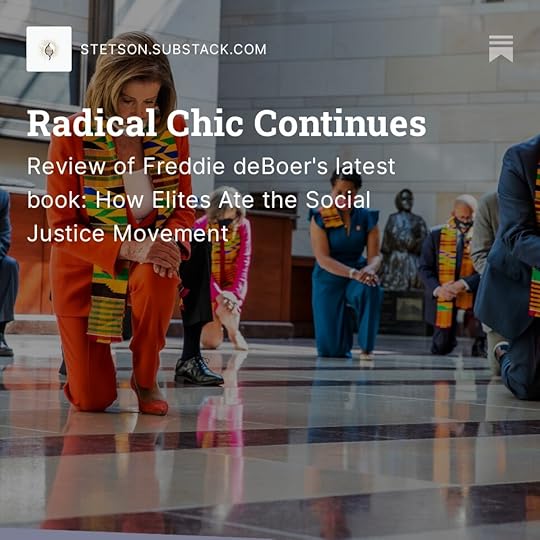
Prolific substacker and self-identified Marxist Fredrik deBoer has returned after his first book, The Cult of Smart, to examine the pathologies that plague social justice movements in America. He contends that progressive and socialist movements have been captured by a particular flavor of affluent, urban liberal. David Brook famously labeled these liberal type with revolutionary aesthetics but bourgeois ethics as bohemian bourgeois or bo-bos.

But deBoer's map of liberal elite capture extends beyond cultural confusion (many have argued that PoMo and identitarian ideas alone have stunted left-wing political activism), he argues that the structure and incentives of social media, nonprofits, the Democratic party, and corporations (woke capital) have rendered radical politics impotent. I think deBoer's diagnosis makes several shrewd points. He does a reasonable, if superficial, job of explaining the competing web of incentives and the different ways that institutional parameters end up diffusing rather than concentrating radical energies. The issue with his critique is that it is somewhat premised on the idea that there is actual authentic radical energy to concentrate. I don't really see any good evidence of this. Similar in situation to deBoer, who now is in his 40s and makes six figures writing at Substack, radical politics are indeed primarily an aesthetic and not something held in the heart of hearts of even those who most vociferously profess such beliefs. This is why deBoer's praise for left wing radicalism rings so hollow in this text. In some ways, this makes for a great read as it illustrates just how the prosperity and leisure available in 21st century America make the expression of radicalism quaint - more a nostalgic reverie than an urgent desiderata.

This book, of course, is not only diagnosis. The prescription is an anachronistic plea to return to a class-based, more yeoman version of Left activism. However, deBoer seems quite aware of the impossibility of such a return for the Left. It is no longer composed of the working class, and those of working class stripe on the Left tend toward more moderate and conservative political outlooks. In sum, deBoer may have delivered a nice eulogy for a bonafide Left in American politics. The aesthetics and rhetoric will remain but liberalism will be all there is.


Extended review at Holodoxa

*Disclaimer: I received this book as an ARC through Netgalley
Profile Image for Steve.
1,189 reviews89 followers
October 12, 2023
I liked this book more than I expected. Freddie DeBoer analyzes some of the social justice movements in the past few years, such as BLM and the #metoo movement, as well as general “movement” issues such as identity politics. DeBoer is a Marxist, but has a very independent frame of mind, and I think he accurately describes a lot of what was (and still is) happening. I’m no Marxist myself, but I appreciate his take on a lot of issues.

Often I find my interest in books dribbling away after they’ve about two-thirds done, but I really liked the last few chapters, very nicely done.
Profile Image for Carolyn Kost.
Author 3 books138 followers
November 19, 2023
Fredrik deBoer delivers a thought-provoking analysis of the challenges and contradictions within contemporary progressive movements. As an academic and a seasoned activist with a Marxist perspective, deBoer explores the evolution of American progressive movements, dissecting their successes, failures, and the current state of the social justice landscape. DeBoer is an important and original thinker. His The Cult of Smart is one of the books I most frequently recommend.

One of the book's notable strengths is its balanced and comprehensive approach. As I was reading any chapter and started to ask, "Well, he didn't address issue x," in another page or two, DeBoer got to it. He meticulously addresses the intricacies of progressive movements, acknowledging both their righteous endeavors and, at times, the seemingly ridiculous directions they take. As readers delve into each chapter, they may find themselves posing questions only to have DeBoer skillfully address those concerns in subsequent pages.

The central theme revolves around the paradoxical nature of progressive movements, with deBoer asserting that, despite significant political consciousness, there has been a lack of substantial change. He pokes fun at the ubiquitous term "reckoning," and highlights the repeated invocation of social justice awareness without a corresponding transformation in societal structures. See Stanford Social Innovation Review's "Stop Raising Awareness Already": "When done wrong, an awareness campaign carries four specific risks: it might lead to no action; It might reach the wrong audience; it might create harm; and it could generate a backlash." Instead, the authors state and deBoer would agree, "we must define actionable and achievable calls to action that will lead a specific group of people to do something they haven’t done before."

DeBoer's critical examination extends to the composition of the contemporary left, where he observes the dominance of college-educated individuals in left-activist spaces. This dominance, coupled with an inability to recruit from the working class, raises questions about the movement's representativeness and its efficacy in addressing broader societal concerns.

A key argument put forth by deBoer is the dichotomy between the left's domination of cultural issues and the right's pursuit of political power. Drawing a contrast with Steven Prothero's work, Why Liberals Win the Culture Wars (Even When They Lose Elections), deBoer emphasizes the need for the left to focus on political power rather than cultural dominance.

The author further explores the challenges posed by the identitarian fragmentation of the left, contending that it hinders the movement's ability to win elections. He delves into the complexities of identity politics, arguing that the supposed unanimity among identity groups is a mirage, and the movement often fails to represent the diverse perspectives within these groups.

A significant chapter scrutinizes the nonprofit sector, revealing its inefficiencies, accountability issues, and its tendency to prioritize fundraising over mission execution. DeBoer argues that the nonprofit industrial complex, with its massive influence on society, drains public coffers, reduces accountability, and perpetuates social problems rather than solving them.

The chapter on "Meme-to" dissects movements like #MeToo, emphasizing the pitfalls of institutionalizing an organic movement and the challenges associated with a lack of clear goals. DeBoer underscores the importance of tangible policy goals over symbolic gestures to effect real change.

One of the central arguments championed by deBoer is the need for a class-first approach in leftist politics. He critiques the contemporary left for focusing excessively on race and identity politics, arguing that a class-focused approach can unite diverse groups under shared economic interests.

In conclusion, "How the Elites Ate the Social Justice Movement" is a compelling exploration of the complexities within progressive movements, urging a reevaluation of priorities and strategies. DeBoer's insights prompt readers to question established narratives and consider alternative paths to achieve genuine social and political change.
Profile Image for David.
9 reviews
January 3, 2024
2.5 stars. Freddie is generally my favorite blogger, and I pretty much agree with everything in here. Still, I found this book flawed.

There is no follow-through on the title's promise to explain how elites ate the social justice movement. Rather, the book is about what the social justice movement is doing wrong as a result of being taken over by elites. (TL;DR: A whole lot.)

I found several chapters compelling, but others (like the #MeToo chapter) mealy-mouthed and filled with "on the one hand, on the other hand" argumentation that isn't typical of Freddie.

Early chapters' focus on legislative victories as the primary or even sole way to improve society felt like a strange argument for a Marxist to make, as did the repeated criticism of defund/abolish the police for being impractical. I think there are far better critiques of defund, and Freddie makes some of them.

The book felt like it needed to be better organized. There was too much redundancy and a disjointed structure throughout.

Through it all, deBoer makes a compelling case that the social justice movement needs to reorient itself toward effectiveness. That means no more political violence or condoning of it, no more academic language, and most importantly, no more factionalism and attempting to pit demographic groups against each other based on level of oppression. The left's move away from a universalist, class-first approach to our activism has been an abject failure, and it's time to return to our roots: fighting for the masses.

LFG.
Profile Image for Dave.
390 reviews5 followers
March 13, 2024
I feel like this book was written specifically for me as it completes a lot of partial thoughts and wonderings I've held. It is admittedly not for everyone, but a solid five-star read for me. Just what I needed to read at just this time in my life. I'm sorry this review doesn't actually tell you about the book, just how I experienced it, but I think I would not do justice in any vain attempt to summarize the key arguments. "How Elites Ate..." is not an attack on the left from the right, so if that's what you're looking for, you'll be disappointed. But it is important constructive criticism of the left from the left, which, if followed, could help make our collective advocacy work take root and grow. TW: Not for the closed-minded.
Profile Image for Jenni.
332 reviews55 followers
July 8, 2025
Love a book from a lefty academic that lovingly criticizes the excesses of other lefty academics. I want to give this book to the couple of 25 y/o crazy-lefties I’m friends with — mostly friends’ younger siblings — that sometimes take it too far on their Insta stories. And idk, the author is a self-proclaimed Marxist with some serious leftist bona fides. Maybe they’ll actually listen.

Lots of great summaries out there already, but my biggest takeaway is that he thinks it’s strategically ineffective for the left to continue with its hyperfixation on identity politics. I basically agree. More importantly, he handles the subject with intelligence, nuance, sensitivity, and always with a focus on what is likely to *actually achieve material gains for oppressed identities* (which should arguably matter more than symbolic things like the language we use or whose voices we center).

3.5, reluctantly rounded down as part of a deflationary effort but could have gone either way even so. Nothing life-changing, but smart and I love a book with nuance. This had it.

P.S. I forgot to update Goodreads for the last like 20 books I’ve read for the past few months. I have a list on a notepad of the recent reads I need to add - hopefully soon I update it and actually add some thoughts for each book!!
Profile Image for Jamie.
383 reviews25 followers
December 29, 2023
A far more niche book than readers might suppose going in, "How Elites Ate the Social Justice Movement" is, at bottom, a polemic aimed at a very narrow audience. Besides providing some of the standard fare recap/analysis of 21st century social justice politics, deBoer takes great pains to emphasize his leftist bonafides and find common ground with contemporary progressives in order to make the case that intersectional identitarianism is an ineffective way of advancing a left-wing agenda. He makes that case very well, but readers who are not themselves leftists who may be coming to this book as fans of deBoer's culture writing will often feel like an acquaintance invited to a family dinner that devolves into heated arguments. That's how I felt, at least. 3/5
57 reviews
November 9, 2023
An entire chapter criticizing nonprofits, who exist because of the failures of government, yet the author seems to suggest nonprofits are the cause of said issues they aim to address.

Whatever.
Profile Image for David.
920 reviews1 follower
January 23, 2024
Breezy, clear, and urgent. The real thrust is imagining how the Left might better work within the actually existing present to improve things. FdB argues well against the various distractions and tactical errors that have emerged. He’s also very calm and clear about how the symbolic can (and mostly has, recently) take the place of real change.

We’re in a moment where we need to start getting some wins or the Earth will continue to die. Let’s get on it.
Profile Image for eel.
9 reviews
September 19, 2024
In How Elites Ate the Social Justice Movement, deBoer offers an alternative perspective for the modern-day liberal, rooted in realism and productive critiques of leftist movements. deBoer examines reasons why these movements failed or died out, highlighting the disconnect between leaders in social justice movements and the people they are trying to help. This is a great read for anyone on the left who wants to be politically active, and equally important for those who are “chronically online”.
Profile Image for James.
777 reviews24 followers
October 6, 2023
Good as individual chapters, but the whole isn't any more than the sum of its parts, and I've read most of the parts in other forms on his Substack.
Profile Image for Julie Yates.
682 reviews4 followers
July 1, 2024
Upping this to 5. As a center-ish voter, I originally thought this book was unnecessary as it was nothing but common sense, but given how often I bring it up in conversation I need to re-evaluate. I think the people who need to ponder the data in this book - the wealthy, white, far left - never will and as a result progress will be stilted.

Highly educated, Marxist, white male member of the activist very left pontificating on how the far left misunderstands the needs of black / brown people, most of which absolutely I agreed with. .

Somewhat funny: He pretty much makes fun of my political leanings [those totally boring middle of the road center center people!] in chapter 6, but I feel like everything he wrote actually validated my voting decisions!! I think the far left is batshit crazy. And, yes, I think the far right is scarier, but leaving me the choice to pick my voting poison doesn't thrill me.

Liberals angry about the lack of bold progressive leadership from Democrats might point to affluent white voters as the source of their problems, but the polling does not bear this out. A 2020 Pew poll, in keeping with decades long trends, found that only 29% of black democrats self-identified as liberal while 55% of white democrats did. Despite the constant radical invocation of people of color as a kind of political Talisman, the left wing of the democratic party is overwhelmingly white. Say this again for the cheap seats!!
Profile Image for Colin.
1,693 reviews1 follower
September 29, 2023
Audible audiobook, read in one day, mostly during a very long run!

This fella is waaaaaay over to the left of me. I approve of his general methodology though: he sees identitarianism as a distraction. It focuses on the wrong things. We end up with actors and CEOs and other attention hogs making irrelevant changes to show how good they are, and a lot of white people self-flagellating about their privilege, but none of it makes any difference to the really downtrodden people who need it most.

And without dismissing racial and gender imbalances he makes a powerful case for a focus on class as being the most likely way to bring about real improvements in the lives of the people who need it. CEOs will not be as keen on this kind of change as they are in putting pride flags in their LinkedIn bio or whatever.

And he definitely has a point about realism vs performativity, even though I am much less enamored of his end goal, which is some sort of sudden, revolutionary change to a socialist system.

So it's a good read. I think I've been reading a lot of fairly right wing stuff lately and it's good to stretch my mind out in the other direction. Might have to do more of that.
Profile Image for Joseph Byrnes.
32 reviews
September 24, 2024
Good prose but ultimately shallow. The basic premise is never engaged with - the relationship between elites and social justice movements isn’t explored. He is really complaining about a lack of organizational capacity on the left - but I’m not see how these two ideas tie together.

So Occupy fails to make a lasting impression because of disorganization - elite capture would positively help then! Experienced leaders with culture power would be helpful.

When discussing me too seeming to lose its culture power without reaching major goals, he specifically places the blame on “the nature of online movements” - through a breif discussion of Times Up’s implosion, which was not attributable to “the natue of online movements” but to very specific organizational dynamics. Thing is, the creation of a real world organization is exactly what he’s calling for, and so the issue can’t the online nature of the movements because the non-online movement imploded for non-online reasons.

There’s just not enough meat on the bones in his analysis to pick this tension apart. There are many more examples.
Profile Image for Alina.
48 reviews3 followers
November 1, 2024
Literally 0. Half-assed, badly written, narrow minded and uneducated money grab. This should have stayed in your journal if you can't back up your claims.

Rioting is one of the only things that works, because the only thing the ruling class cares about is their property. If a rich white man is telling you it doesn't work with nothing to back up that claim, it's for a reason.
1 review
September 7, 2023
As a long term subscriber to Deboer's substack I was predisposed to like this book. Few of the positions he takes come as surprise to anyone reasonably well versed in his writing. What did strike me was how measured he was about it.

On publication day Deboer published a piece headlined No Soft Landings which expressed his unapologetic position on what he perceives to be his going out on a limb. He said "Let me be fractious and unlikable, so long as I say true things and say them beautifully. It was from those principles that this book sprang. They can’t make the book good, mind you. A book can be fractious and unlikable because it sucks. But genuinely challenging arguments are, I will be vain enough to say, rare commodities and getting rarer." This rings true with what I read in his blog, being fractious and unlikeable seem to be second nature to Deboer while his writing is always beautifully constructed to cut to the heart of a matter.

The (audio) book however displays very little of the character "flaws" that Deboer seems to imagine may bubble up, while retaining the high standard of prose and clarity of argument which has always been his greatest appeal. Whether Deboer and his editors had arguments about tempering some of his harder edges, the balance they landed on is perfect. On occasion the author may even go a little too far to make sure the reader understands that he is himself a good leftist and his criticism comes from inside the house in the hope of improving the results of the activism for everyone left of centre. As someone routinely shunned by those he perceives to be his political bedfellows, this is entirely understandable. No amount of qualification has been enough in the past, but the book is certainly less fractious to to me than Deboer seems to imagine it might be.

Wherever one falls on the arguments made, they are never less than compelling and thought provoking. I strongly disagreed with Deboer’s position that socialists cannot view rights as a zero sum game. It may be so when focused on #BLM or #MeToo as Deboer is in this book, but it is clear to many of us that the push for gender identity based rights genuinely clash with sex based rights, most obviously in sports but also in many other ways and there is an important debate to be had on the left about how gender identity rights are facilitated without the imposition women have been made to suffer to accommodate males without any say whatsoever on the matter.

Deboer nevertheless had me convinced that the underlying class based struggle should unite us all behind leaders on the left who make a primarily economic argument for improving the lives of all and space for anyone marginalised to have a voice without fear or necessarily favour. He recognises though that we as straight white men suffer least from setting aside identity politics. Those within or staunchly aligned with marginalised identities may come down more harshly on the positions as laid out. How Elites Ate the Social Justice Movement asks that we have these conversations in a cohesive movement that accepts differences and disagreements and moves away from the social media drive to blow it all up when anyone disagrees.

Profile Image for Paloma.
122 reviews10 followers
March 12, 2024
While I don't entirely agree with every point, I thought this was a very thoughtful take on how, as a progressive movement, we need to ensure we're focusing on meaningful change over virtue signaling or culture war topics. As a very liberal to borderline leftist person who is also an elected official, I really resonated with the deBoer's point that durable change through legislation is a long and hard process made up of baby steps and constant compromise on the road to sweeping change. In order to win these legislative contests, sometimes we have to vote, donate, and campaign hard for folks who we may not completely agree with.

This is so much more meaningful for the regular person than, while valuable in many ways, largely academic conversations or culture war topics. Even though progressive change should occur in every institution, a typical person will not be impacted by for instance the Oscar nominees becoming more diverse. Pushing for a living wage and better workplace protections will actually help many of the most vulnerable individuals. An example from my life is that I've been asked whether I prefer the term Latino or Latinx or Latine to which I reply a more polite version of "just pay me fairly." That's just a personal example of how calling me a Latino or Latinx person doesn't actually do much for me either way, despite it getting so much airtime in progressive discussion, but paying me fairly impacts my life immensely. (For clarity: I really appreciate the intent behind the question and it does make me feel more respected in a space. However, it's not the thing that will deeply impact my life.)

I think it's easy to get pulled into academic discussions to make fighting for rainbow capitalism the end goal. I'm not holier than thou. I've been sucked into this before. And to be fair academic discussions and entry level feminism lessons are important and helped me get started in organizing. Also, while we have capitalism, I'd rather have it be a bit more diverse for sure. That said, these discussions are a start but should not be the main goal of our organizing.
Profile Image for Edward Rathke.
Author 10 books150 followers
December 28, 2023
A good reminder of why I enjoyed deBoer enough to subscribe to his newsletter.

A clear eyed look at the social justice movement, focusing especially on what has happened since 2020, when the US saw the largest protest movement in history. And yet, despite that size, we have seen little material change. For anyone.

Many will willfully choose to ignore the substance of what he's saying, but I think it's impossible to ignore the fact that he's simply correct. We have not seen a change to society commensurate with the size of the protests.

So where did all that go?

Well, that's the subject of the book, and there are a lot of things to blame. But they can maybe be summed up by the following:
1. Funneling energy into professional programs
2. Infighting
3. Focus on symbolism over material

Very worthwhile read.
12 reviews
October 8, 2025
Fundamentally, I agree with this authors ultimate goals, the moving leftward and perpetual critique and re-evaluation (revolution) of any and all political changes (even those we have desired).

However, I find the overall argument for his path to arrive at change to be lackluster.
Yes, compromise is important and necessary. Yes, infighting holds the left back.
Yes, we can aim bigger and compromise when things are better than current state.
All of that is true. It doesn't change the fact that the author seems to advocate for compromise only on his terms, with little willingness to accept criticism that he so freely dishes out.

That being said I think this book would be good for those who want to understand how classical (class first) Marxism would look in the modern day. I don't find the advice to be the best, but I appreciated a different perspective that was from someone with a similar political objective.
Profile Image for Greg.
30 reviews
December 5, 2023
An interesting book with an important message for contemporary liberals. A lot of the book read like an extended blog post, despite the support from academic sources. But the overall point that liberals need to find ways to unite, rather than divide along social identity lines, is powerful and important. It probably says something about how crazy current politics are that a self-described Marxist is arguing for what some would call compromise with those of the other side--that is, focusing on economic issues which affect everyone, rather than racism, sexism, ableism, etc.
Profile Image for Brittany.
1,095 reviews1 follower
April 7, 2025
4.5 stars rounded down for now. I might need to reread it at a later date to bump it up to five stars. The chapter that outlined some of the issues with NPOs (Chapter 4) was absolutely fascinating and presented several arguments I had not encountered before. It left me seriously reconsidering my position on them. I appreciated the many examples of reframing for certain issues.

"...and ordinary people - that is, people not marinating in twitter everyday - ..." got a chuckle out of me. What a cesspool.
Profile Image for Zion DB.
3 reviews1 follower
January 10, 2025
It helped me refine ideas and notions I already had about elite influence in the left, but for every depressing revelation about American politics there was always a commitment to the hope for change. Not in one loud explosive revolution, but maybe through a series of smaller changes in the way we approach politics that can lead to a better society. It’s encouraging but not in ignorant way, it’s pragmatic but not pessimistic about how to improve America. Overall a good read.
36 reviews
March 29, 2024
I found myself very deflated after the George Floyd protests of 2020. Why did no legislation come of them? How and why did my friends and I go from religiously posting social justice material on the socials to basically radio silence? What happened to that revolutionary fever, that spirit of change? This book helped answer these questions for me. It also gave me a much needed alternative POV on how I view leftist organizing.

"The act of dividing the left's constituencies into smaller and smaller identity niches is ruinous for taking action... Ruinous, because the smaller and smaller you slice humanity into groups, the less power those groups have."

I agree with other reviews that the book might be more accurately titled "how the left eats itself," but I found that just as interesting of a topic.
Displaying 1 - 30 of 100 reviews

Can't find what you're looking for?

Get help and learn more about the design.