

What do you think?

The Canceling of the American Mind: Cancel Culture Undermines Trust and Threatens Us All—But There Is a Solution
A timely deep dive into cancel culture, an account of its dangers to all Americans, and the much-needed antidote from the team that brought you Coddling of the American Mind .
Cancel culture is a new phenomenon, and The Canceling of the American Mind is the first book to codify it and survey its effects. From the team that brought you the bestselling Coddling of the American Mind comes hard data and research on what cancel culture is and how it works, along with hundreds of new examples showing the left and the right both working to silence their enemies.
The Canceling of the American Mind will change how you view cancel culture. Rather than a moral panic, we should consider it a dysfunctional part of how Americans battle for power, status, and dominance. Cancel culture is just one symptom of a much larger the use of cheap rhetorical tactics to “win” arguments without actually winning arguments. After all, why bother refuting your opponents when you can just take away their platform or career?
The good news is that we can beat back this threat to democracy through better citizenship. The Canceling of the American Mind offers concrete steps toward reclaiming a free speech culture, with materials specifically tailored for parents, teachers, business leaders, and everyone who uses social media. We can all show intellectual humility and promote the essential American principles of individuality, resilience, and open mindedness.
Cancel culture is a new phenomenon, and The Canceling of the American Mind is the first book to codify it and survey its effects. From the team that brought you the bestselling Coddling of the American Mind comes hard data and research on what cancel culture is and how it works, along with hundreds of new examples showing the left and the right both working to silence their enemies.
The Canceling of the American Mind will change how you view cancel culture. Rather than a moral panic, we should consider it a dysfunctional part of how Americans battle for power, status, and dominance. Cancel culture is just one symptom of a much larger the use of cheap rhetorical tactics to “win” arguments without actually winning arguments. After all, why bother refuting your opponents when you can just take away their platform or career?
The good news is that we can beat back this threat to democracy through better citizenship. The Canceling of the American Mind offers concrete steps toward reclaiming a free speech culture, with materials specifically tailored for parents, teachers, business leaders, and everyone who uses social media. We can all show intellectual humility and promote the essential American principles of individuality, resilience, and open mindedness.
457 pages, Kindle Edition
First published October 17, 2023
About the author
Greg Lukianoff
12 books267 followersGregory Christopher Lukianoff (born 1974) is the president of the Foundation for Individual Rights in Education (FIRE). He previously served as FIRE's first director of legal and public advocacy until he was appointed president in 2006.
Lukianoff has published articles in the Los Angeles Times, The Boston Globe, The Chronicle of Higher Education, The Atlantic, Inside Higher Ed, and the New York Post. His article in The Atlantic, "The Coddling of the American Mind" laid the groundwork for a nationwide discussion of whether or not trigger warnings are harming college health.
He is a blogger for The Huffington Post and served as a regular columnist for the Daily Journal of Los Angeles and San Francisco.[citation needed] Along with Harvey Silverglate and David A. French, Lukianoff is a co-author of FIRE's Guide to Free Speech on Campus. He testified before the United States Congress on the state of free speech on college campuses, and he appeared in the films Brainwashing 101 and Indoctrinate U on the same topic. He has made numerous appearances on nationally syndicated television shows.
Lukianoff has published articles in the Los Angeles Times, The Boston Globe, The Chronicle of Higher Education, The Atlantic, Inside Higher Ed, and the New York Post. His article in The Atlantic, "The Coddling of the American Mind" laid the groundwork for a nationwide discussion of whether or not trigger warnings are harming college health.
He is a blogger for The Huffington Post and served as a regular columnist for the Daily Journal of Los Angeles and San Francisco.[citation needed] Along with Harvey Silverglate and David A. French, Lukianoff is a co-author of FIRE's Guide to Free Speech on Campus. He testified before the United States Congress on the state of free speech on college campuses, and he appeared in the films Brainwashing 101 and Indoctrinate U on the same topic. He has made numerous appearances on nationally syndicated television shows.
Ratings & Reviews
Friends & Following
Create a free account to discover what your friends think of this book!
Community Reviews
Displaying 1 - 30 of 326 reviews

September 22, 2023
"The Canceling of the American Mind" is a lackluster attempt to address an important societal issue. While Lukianoff's previous work, "The Coddling of the American Mind" (with Jonathan Haidt), had some serious shortcomings, primarily misleading interpretations of data and being selectively ahistorical, "Canceling" magnifies those issues and adds some new ones.
Foremost, I should be the primary audience for this book. I am a professor and university administrator, and I have serious concerns about modern discourse. I am open to the idea of a cancel culture as a contemporary phenomenon, but I need to be convinced. This book did little to convince me. While I share the authors' concerns on many issues related to online discourse, their analysis falls stunningly short. After finishing the text, I possess little to no additional understanding of the topic. Instead, I believe that contemporary 'cancel culture' is nothing more than an extension of flawed discourse that has occurred for centuries, if not millennia. People do not seem to have changed, but rather the mode of communication has. The authors need to provide additional, historical evidence to justify their conclusion that discourse has fundamentally changed in the 21st century.
The authors assert that, due primarily to changes in child rearing practices and pedagogy, later generations (Millennials and Gen Z) are largely incapable of expressing reasonable disagreement without resorting to character assassination. However, they do not effectively dissuade the reader from considering the alternative explanation that this phenomenon has long existed, but now information can be shared much more rapidly through modern communication channels (i.e., social media). For example, in 1973 (50 years ago), if I disagreed politically with another person, I may very well turn to the two strategies that the authors describe: the perfect rhetorical fortress and/or the efficient rhetorical fortress. However, my reach would be rather limited. I could discuss this with known persons and perhaps write a letter to the editor (though if I were engaging in these strategies, this letter likely would not be printed). Therefore, in 2023, it may not be that people have changed, but rather that the reach of communication has. I can now turn to social media in an attempt to amplify my message and this can result in the types of effects associated with cancelling someone. The onus of the authors is then to show that people have indeed changed along with communication technology (e.g., an independent, individual-level effect).
The authors also go to great lengths to assert that they are taking a politically balanced view on the issue. They resort to the trope of describing themselves as a liberal (Lukianoff) and conservative/libertarian (Schlott) and thus any bias necessarily cancels out (pun intended). This is certainly not the case, as the authors are much more critical of the political left. This is evident almost solely by the sheer number of pages devoted to issues that they allege rise from the political left, and the authors largely characterize the political right as an injured minority. They devote little attention to the harmful effects of speech and focus much more attention to contemporary boogeymen of the right (primarily Marcuse). The authors proudly take an absolutist position without much of a rationale or a defense against commonly asserted critiques of this position. Instead, they expect the reader to have as much sympathy as they do for the victims of cancel culture (overwhelmingly conservative and white) while not giving much thought to the injury caused by such speech. Their case studies are also quite selectively chosen and interpreted to support their narrative.
Overall, like "Coddling," "Cancelling" reads as an ahistorical polemic on a topic of much societal interest. I acknowledge that this is written for a mass, rather than scholarly audience, yet I can't help but to be disappointed in the lack of rigor in their analysis of the issue. Rather than heeding the critical feedback given to "Coddling," the authors double down on their approach and the result is a text that is far less deserving of any serious attention than Lukianoff's prior work.
Foremost, I should be the primary audience for this book. I am a professor and university administrator, and I have serious concerns about modern discourse. I am open to the idea of a cancel culture as a contemporary phenomenon, but I need to be convinced. This book did little to convince me. While I share the authors' concerns on many issues related to online discourse, their analysis falls stunningly short. After finishing the text, I possess little to no additional understanding of the topic. Instead, I believe that contemporary 'cancel culture' is nothing more than an extension of flawed discourse that has occurred for centuries, if not millennia. People do not seem to have changed, but rather the mode of communication has. The authors need to provide additional, historical evidence to justify their conclusion that discourse has fundamentally changed in the 21st century.
The authors assert that, due primarily to changes in child rearing practices and pedagogy, later generations (Millennials and Gen Z) are largely incapable of expressing reasonable disagreement without resorting to character assassination. However, they do not effectively dissuade the reader from considering the alternative explanation that this phenomenon has long existed, but now information can be shared much more rapidly through modern communication channels (i.e., social media). For example, in 1973 (50 years ago), if I disagreed politically with another person, I may very well turn to the two strategies that the authors describe: the perfect rhetorical fortress and/or the efficient rhetorical fortress. However, my reach would be rather limited. I could discuss this with known persons and perhaps write a letter to the editor (though if I were engaging in these strategies, this letter likely would not be printed). Therefore, in 2023, it may not be that people have changed, but rather that the reach of communication has. I can now turn to social media in an attempt to amplify my message and this can result in the types of effects associated with cancelling someone. The onus of the authors is then to show that people have indeed changed along with communication technology (e.g., an independent, individual-level effect).
The authors also go to great lengths to assert that they are taking a politically balanced view on the issue. They resort to the trope of describing themselves as a liberal (Lukianoff) and conservative/libertarian (Schlott) and thus any bias necessarily cancels out (pun intended). This is certainly not the case, as the authors are much more critical of the political left. This is evident almost solely by the sheer number of pages devoted to issues that they allege rise from the political left, and the authors largely characterize the political right as an injured minority. They devote little attention to the harmful effects of speech and focus much more attention to contemporary boogeymen of the right (primarily Marcuse). The authors proudly take an absolutist position without much of a rationale or a defense against commonly asserted critiques of this position. Instead, they expect the reader to have as much sympathy as they do for the victims of cancel culture (overwhelmingly conservative and white) while not giving much thought to the injury caused by such speech. Their case studies are also quite selectively chosen and interpreted to support their narrative.
Overall, like "Coddling," "Cancelling" reads as an ahistorical polemic on a topic of much societal interest. I acknowledge that this is written for a mass, rather than scholarly audience, yet I can't help but to be disappointed in the lack of rigor in their analysis of the issue. Rather than heeding the critical feedback given to "Coddling," the authors double down on their approach and the result is a text that is far less deserving of any serious attention than Lukianoff's prior work.

April 30, 2023
Full disclosure, I work with Greg Lukianoff at FIRE, and as a result I had the pleasure of reading an early manuscript of this book.
Lukianoff and Schlott do a wonderful job assessing the current moment from multiple angles, the significant social and psychological drawbacks of “cancel culture” (a term they hesitantly use to describe the ways both ends of the political horseshoe engage in petty and destructive tactics to silence or ruin their opposition) and great ideas for how to get ourselves out of it.
As with Lukianoff’s previous book with Jonathan Haidt, “The Coddling of the American Mind,” this will likely become a textbook for all those trying to understand and address the social miasma we’ve been in since roughly 2018.
I can’t recommend this book enough.
Lukianoff and Schlott do a wonderful job assessing the current moment from multiple angles, the significant social and psychological drawbacks of “cancel culture” (a term they hesitantly use to describe the ways both ends of the political horseshoe engage in petty and destructive tactics to silence or ruin their opposition) and great ideas for how to get ourselves out of it.
As with Lukianoff’s previous book with Jonathan Haidt, “The Coddling of the American Mind,” this will likely become a textbook for all those trying to understand and address the social miasma we’ve been in since roughly 2018.
I can’t recommend this book enough.

October 9, 2023
This is a followup to The Coddling of the American Mind, though one of the co-writers is different. For balance, one writer is right-wing and one is left-wing.
The book examines censorship and cancel culture in various fields (education, comedy, etc.), its causes, its effects, and how and why to stop it. Many specific examples (“case studies”) are looked at across the political spectrum. Cancel culture is not just debating someone on social media. It is threatening someone with physical harm (or causing actual physical harm) and working to get them fired or expelled and made a social pariah.
While reading this book, I attended the local comic con. Many celebrities were terrified of being canceled. In fact, Gina Carano was there, and she has been canceled and said very little. It was really sad that we’ve come to this.
The writers believe part of the cause is how Gen Z was raised with constant supervision. Disagreements were always settled by an adult, and today these people often look to authority to settle matters of hurt feelings in addition to actual crimes. Certain zero-tolerance bullying policies taught them that a single misjudgment warrants expulsion with no chance at redemption. Previous generations would be alone with other kids in unstructured play time and learned to settle disagreements on their own. Gen Z is much more pro-censorship than previous generations.
The writing is very engaging, not dry at all, and goes quickly. The arguments are reasonable; there’s no snarkiness or disparagement of any political side. I highlighted a lot. (I will add these in later.)
My only real criticism is this: The authors are opposed laws against teaching critical race theory in schools and then go on to oppose putting kids into affinity groups and groups of victims and oppressors. This is exactly what CRT in schools looks like, so I suspect there is some misunderstanding there. I still accept their argument that laws trying to keep CRT out of schools are poorly worded.
Language: Some rare strong language, usually in quotes
Sexual Content: None
Violence/Gore: Mild
Harm to Animals:
Harm to Children:
Other (Triggers):
The book examines censorship and cancel culture in various fields (education, comedy, etc.), its causes, its effects, and how and why to stop it. Many specific examples (“case studies”) are looked at across the political spectrum. Cancel culture is not just debating someone on social media. It is threatening someone with physical harm (or causing actual physical harm) and working to get them fired or expelled and made a social pariah.
While reading this book, I attended the local comic con. Many celebrities were terrified of being canceled. In fact, Gina Carano was there, and she has been canceled and said very little. It was really sad that we’ve come to this.
The writers believe part of the cause is how Gen Z was raised with constant supervision. Disagreements were always settled by an adult, and today these people often look to authority to settle matters of hurt feelings in addition to actual crimes. Certain zero-tolerance bullying policies taught them that a single misjudgment warrants expulsion with no chance at redemption. Previous generations would be alone with other kids in unstructured play time and learned to settle disagreements on their own. Gen Z is much more pro-censorship than previous generations.
The writing is very engaging, not dry at all, and goes quickly. The arguments are reasonable; there’s no snarkiness or disparagement of any political side. I highlighted a lot. (I will add these in later.)
My only real criticism is this: The authors are opposed laws against teaching critical race theory in schools and then go on to oppose putting kids into affinity groups and groups of victims and oppressors. This is exactly what CRT in schools looks like, so I suspect there is some misunderstanding there. I still accept their argument that laws trying to keep CRT out of schools are poorly worded.
Language: Some rare strong language, usually in quotes
Sexual Content: None
Violence/Gore: Mild
Harm to Animals:
Harm to Children:
Other (Triggers):

October 23, 2023
This is legitimately the only book you need to read about cancel culture, and I could go on and on about how amazing this book is all day. I’ve read plenty of books about cancel culture, and I actually wrote a book about cancel culture after being canceled in 2019 and having it ruin my life for a number of years. Most books on cancel culture are either right-wing people whining about cancel culture and labeling everything under the sun as cancel culture or people on the left either saying cancel culture doesn’t exist or it’s “just accountability.
Lukianoff and Schlott to an incredible job explaining what cancel culture is, what it looks like, and how both the left and the right partake in canceling things they don’t like. The book also has plenty of stories in it about people who have had their lives ruined by cancel culture, and for once, I finally felt like some authors actually understood what happened to me in 2019.
If you want to know why I read hundreds of books each year, it’s because of what happened to me. All I’ve been trying to do is better understand why people are like this and what we can do about it. I wish this book was around in 2019, but I’m glad it’s here for people to learn about it now and learn some solutions as well. It’s not fun, and people don’t understand that it can literally happen to anyone. Everyone thinks they’re immune, but this book shows that even the wokest of the woke can get canceled as well.
Lukianoff and Schlott to an incredible job explaining what cancel culture is, what it looks like, and how both the left and the right partake in canceling things they don’t like. The book also has plenty of stories in it about people who have had their lives ruined by cancel culture, and for once, I finally felt like some authors actually understood what happened to me in 2019.
If you want to know why I read hundreds of books each year, it’s because of what happened to me. All I’ve been trying to do is better understand why people are like this and what we can do about it. I wish this book was around in 2019, but I’m glad it’s here for people to learn about it now and learn some solutions as well. It’s not fun, and people don’t understand that it can literally happen to anyone. Everyone thinks they’re immune, but this book shows that even the wokest of the woke can get canceled as well.
September 26, 2023
How has that Jarrod read the book if it isn't released until 17th October and why couldn't I comment on his comment?
I've not read the book but had to say I had to comment
I've not read the book but had to say I had to comment

October 10, 2023
Greg Lukianoff follows up his bestseller The Coddling of the American Mind with a new co-author, resident Gen-Z member Rikki Schlott, but the same issues plaguing the book, a fear-mongering look into how no one (but really people on the platform formerly known as Twitter) debates properly anymore. The argument in the book is essentially that in the past few years, there has been an age of Cancel Culture, where people across the political spectrum (mostly the left) have been trying to get people fired or removed from positions, creating a chilling effect on speech. Now, are there many anecdotes they found supporting their argument? Sure. If you want to read anecdotes about people who were cancelled over the past decade, then this really is the book for you. But the authors do not do a great job with trying to connect all of these disparate anecdotes together. Additionally there are numerous chapters where the authors clarify that what they are discussing also does not fall into their own definition of cancel culture, but the authors also acknowledge that they chose the term because of its mass identifiability, rather than its applicability to all situations. Both Greg and Rikki work for FIRE (Foundation for Individual Rights and Expression), and if you don’t know that a few chapters in, you really aren’t reading the book. Many of the citations and survey data come from FIRE, and the authors continually mention when FIRE got involved in a cancel culture incident. I think this context is important, because the book is really coming from a place of authors trying to make the work they do sound a lot more important than it really is.
In the first section of the book, the authors walk through their history of cancel culture, from its roots in 1960s academies from unconscious Marcuseans (those who follow Herbert Marcuse's repressive tolerance doctrine, a man and term I had never heard of before even though I apparently follow it), to the political correctness era of the 1990s, to the modern age of cancel culture, which began on college campuses before spreading to mass society. It looks at modern school campuses and how 80% of people have self-censored their beliefs (based on FIRE's own survey data [the company that Greg and Rikki are employed by] which breaks down to only 21% saying they do it often, 32% occasionally, and 30% rarely). The part ends by describing the difficulty a conservative would have in trying to get tenure, facing cancellation dangers at every step of the way (which is an extremely narrow view that in my opinion takes the approach that people with certain viewpoints are entitled to specific employment opportunities and the only thing holding them back is their viewpoint).
The next section details how cancel culture works, which is where the authors detail the argumentation strategies used by those who cancel. Essentially, the authors believe that when people are being cancelled, it is because the people are attacking the person and not their arguments in a way that makes it seem that you cannot attack someone's viewpoint at all. According to the authors, the left relies on what they call the perfect rhetorical fortress, which is a weaponization of the speaker's identity. But the authors do not make it clear what the difference is between recognizing the speaker's identity and relating that to their arguments, and simply attacking the identity. Because it is possible to address both the argument and the identity of the person saying it (i.e. I can recognize Matt Walsh is a cis white man when he attempts to attack transgender people and that Clarence Thomas is a Black man when he strips millions of Americans of their rights and discuss how that informs their actions, but to the authors, that still falls within the traps they defined). On the right, there is what is called the Efficient Rhetorical Fortress, which is essentially that you don't have to listen to liberals, journalists, or experts if they disagree with you. The section ends with a brief look at social media and polarization, which has interesting data but is not explored in significant depth and the authors specifically avoid coming to a conclusion about its relationship to cancel culture.
The final section of the book is focused on recommendations and the authors are really taking a big swing trying to recommend structural changes to all levels of our education system, corporate workplaces, and how parents raise their children (to make sure they are “anti-cancellers”). This section was painful to read and the authority the authors relied upon really fell off. There is no data saying whether the recommendations the authors have would be effective, or if they have been tried before, or if it could lead to other consequences. Given the prior books sales, I do worry about this section being released to an audience that uncritically absorbs these recommendations and tries to implement them (and looking forward to the nightmare college alumni donations employees will have to contend with if the author's recommended list of demands to be attached to their donations starts becoming popular). Between all of these chapters are case studies of various fields (journalism, psychotherapy, stand up comedy, Yale University), which really give the authors an opportunity to kinda lump together some anecdotes about cancel culture in those fields. These chapters were not interesting to read and only forced me to look up many of the stories to see what the final outcome was (and for many nothing really happened, but the book often glosses over final consequences in favor of the fear of something happening, as described below). I didn’t hate reading this book, often it was fun being reminded of some of the stupid things people said that led to their cancellations, but overall, it is an incredibly frustrating read.
The authors mention that culture war fighters have two methods of attack: engagement and persuasion, or ad hominem attacks. To ensure the latter do not happen to them, Greg and Rikki really emphasize throughout the book that they are good people fighting the good fight. Greg even brought back his old co-author Jonathan Haidt to write the introduction essentially stating just that. I won't go into too many more details about that here, to ensure that I am not engaging in these ad hominem attacks, but I did not need to hear the story of how and why Greg hired Rikki at FIRE that many times.
The conflation of cancel culture on the Right and Left is extremely concerning. Most of the book is focused on the kind of cancel culture that makes its way to Fox News or the New York Post, where a professor, or a student, or some industry executive says something that goes against the leftist orthodoxy and then faces backlash. It continually emphasizes that this issue is on both sides, but spends a majority of its pages looking at the "social justice warrior" type of cancellation. The book does spend a chapter discussing the legislative actions Conservative governments are taking to restrict speech in classroom, and then goes right back to complaining about the left. This section gets just about as much space as the one time Kyle Duncan got yelled at when he visited Stanford Law School, the previous chapter. To be transparent there are examples and two other chapters looking at the Right, but these are still vastly outnumbered by the anecdotes criticizing the Left (I am very happy the authors called out LibsofTikTok, who between when I wrote this review and when the book came out has continued to directly cause bomb threats to be levied against schools and hospitals). The authors discuss how the Right has resulted in more specific acts of threatening speech (citing a Reuters report showing that 100 threats against election workers after 2020 met the threshold for prosecution) but does not do a deep analysis over how the speech of the two sides fundamentally differs. Legislation and threats are a significantly greater threat to democracy and society than college students yelling at a speaker or someone sending a mean tweet, but the latter issues are what gets these author's attention. To me, this is the most concerning thing about the cancel culture movement, that it downplays threats to health and safety and highlights and tries to dismiss criticism by lumping it all together as "focusing too much on the speaker" or "motivated by the speaker's own (wrong) viewpoint."
For as much as the authors criticize the use of straw man arguments, their entire book is dependent on it. Their great untruths of cancel culture are the straw man the size of the one from The Wicker Man. That is a necessary function of trying to define two rhetorical fortresses and apply them to two large groups, but also just goes to show the thin strength of the points the authors make in the book. Also, there is such a weird tendency in the book to end arguments with some variation of “while nothing actually happened, think about how scary it would be if something happened.” The authors combine this with emphasizing the chilling effect these cancellations have on speech, so that even when nothing happens, people who hear about it then don't speak because something, or nothing, may also maybe happen to them. Overall, I would not recommend reading this book because I really don't think the authors have anything new to say about cancel culture. Besides collecting a lot of anecdotes and summarizing their employer's survey data, the recommendations are barely supported and are only trying to push people to debate in a way the authors feel more comfortable with.
In the first section of the book, the authors walk through their history of cancel culture, from its roots in 1960s academies from unconscious Marcuseans (those who follow Herbert Marcuse's repressive tolerance doctrine, a man and term I had never heard of before even though I apparently follow it), to the political correctness era of the 1990s, to the modern age of cancel culture, which began on college campuses before spreading to mass society. It looks at modern school campuses and how 80% of people have self-censored their beliefs (based on FIRE's own survey data [the company that Greg and Rikki are employed by] which breaks down to only 21% saying they do it often, 32% occasionally, and 30% rarely). The part ends by describing the difficulty a conservative would have in trying to get tenure, facing cancellation dangers at every step of the way (which is an extremely narrow view that in my opinion takes the approach that people with certain viewpoints are entitled to specific employment opportunities and the only thing holding them back is their viewpoint).
The next section details how cancel culture works, which is where the authors detail the argumentation strategies used by those who cancel. Essentially, the authors believe that when people are being cancelled, it is because the people are attacking the person and not their arguments in a way that makes it seem that you cannot attack someone's viewpoint at all. According to the authors, the left relies on what they call the perfect rhetorical fortress, which is a weaponization of the speaker's identity. But the authors do not make it clear what the difference is between recognizing the speaker's identity and relating that to their arguments, and simply attacking the identity. Because it is possible to address both the argument and the identity of the person saying it (i.e. I can recognize Matt Walsh is a cis white man when he attempts to attack transgender people and that Clarence Thomas is a Black man when he strips millions of Americans of their rights and discuss how that informs their actions, but to the authors, that still falls within the traps they defined). On the right, there is what is called the Efficient Rhetorical Fortress, which is essentially that you don't have to listen to liberals, journalists, or experts if they disagree with you. The section ends with a brief look at social media and polarization, which has interesting data but is not explored in significant depth and the authors specifically avoid coming to a conclusion about its relationship to cancel culture.
The final section of the book is focused on recommendations and the authors are really taking a big swing trying to recommend structural changes to all levels of our education system, corporate workplaces, and how parents raise their children (to make sure they are “anti-cancellers”). This section was painful to read and the authority the authors relied upon really fell off. There is no data saying whether the recommendations the authors have would be effective, or if they have been tried before, or if it could lead to other consequences. Given the prior books sales, I do worry about this section being released to an audience that uncritically absorbs these recommendations and tries to implement them (and looking forward to the nightmare college alumni donations employees will have to contend with if the author's recommended list of demands to be attached to their donations starts becoming popular). Between all of these chapters are case studies of various fields (journalism, psychotherapy, stand up comedy, Yale University), which really give the authors an opportunity to kinda lump together some anecdotes about cancel culture in those fields. These chapters were not interesting to read and only forced me to look up many of the stories to see what the final outcome was (and for many nothing really happened, but the book often glosses over final consequences in favor of the fear of something happening, as described below). I didn’t hate reading this book, often it was fun being reminded of some of the stupid things people said that led to their cancellations, but overall, it is an incredibly frustrating read.
The authors mention that culture war fighters have two methods of attack: engagement and persuasion, or ad hominem attacks. To ensure the latter do not happen to them, Greg and Rikki really emphasize throughout the book that they are good people fighting the good fight. Greg even brought back his old co-author Jonathan Haidt to write the introduction essentially stating just that. I won't go into too many more details about that here, to ensure that I am not engaging in these ad hominem attacks, but I did not need to hear the story of how and why Greg hired Rikki at FIRE that many times.
The conflation of cancel culture on the Right and Left is extremely concerning. Most of the book is focused on the kind of cancel culture that makes its way to Fox News or the New York Post, where a professor, or a student, or some industry executive says something that goes against the leftist orthodoxy and then faces backlash. It continually emphasizes that this issue is on both sides, but spends a majority of its pages looking at the "social justice warrior" type of cancellation. The book does spend a chapter discussing the legislative actions Conservative governments are taking to restrict speech in classroom, and then goes right back to complaining about the left. This section gets just about as much space as the one time Kyle Duncan got yelled at when he visited Stanford Law School, the previous chapter. To be transparent there are examples and two other chapters looking at the Right, but these are still vastly outnumbered by the anecdotes criticizing the Left (I am very happy the authors called out LibsofTikTok, who between when I wrote this review and when the book came out has continued to directly cause bomb threats to be levied against schools and hospitals). The authors discuss how the Right has resulted in more specific acts of threatening speech (citing a Reuters report showing that 100 threats against election workers after 2020 met the threshold for prosecution) but does not do a deep analysis over how the speech of the two sides fundamentally differs. Legislation and threats are a significantly greater threat to democracy and society than college students yelling at a speaker or someone sending a mean tweet, but the latter issues are what gets these author's attention. To me, this is the most concerning thing about the cancel culture movement, that it downplays threats to health and safety and highlights and tries to dismiss criticism by lumping it all together as "focusing too much on the speaker" or "motivated by the speaker's own (wrong) viewpoint."
For as much as the authors criticize the use of straw man arguments, their entire book is dependent on it. Their great untruths of cancel culture are the straw man the size of the one from The Wicker Man. That is a necessary function of trying to define two rhetorical fortresses and apply them to two large groups, but also just goes to show the thin strength of the points the authors make in the book. Also, there is such a weird tendency in the book to end arguments with some variation of “while nothing actually happened, think about how scary it would be if something happened.” The authors combine this with emphasizing the chilling effect these cancellations have on speech, so that even when nothing happens, people who hear about it then don't speak because something, or nothing, may also maybe happen to them. Overall, I would not recommend reading this book because I really don't think the authors have anything new to say about cancel culture. Besides collecting a lot of anecdotes and summarizing their employer's survey data, the recommendations are barely supported and are only trying to push people to debate in a way the authors feel more comfortable with.

December 7, 2023
My dude, the call is coming from inside the house.
Cancel culture is poorly defined, and ends up just being sort of a boogie man catch all for mob online discourse. The examples seem mostly cherry picked from what seems to be mostly Twitter bickering. Highly polarizing moral indignation, categorized and organized in a way to deliver maximum outrage.
The authors, of course profit from increased discord sowed from this fear mongering book. Which seems mostly oriented to just engage maximally with sort of an indignant moral outrage around “can you believe that people are doing that?” Wrapped in the sort of superiority of idolizing free speech.
Do I think people should lose their jobs and fear for their lives for having different beliefs? No.
Do I think we need a reasonable discussion of the changes that are going on in society around this, how mass communication enabling all sorts of voices for better and for worse, to reach millions of other people? Absolutely.
Do I think this is a reasonable discussion of that phenomenon in modern American culture? Absolutely not.
This is sort of a fist shake at the sky and then a lot of empty words about how people need to be nicer when they discuss things. Seems like a bad attempt to create a moral argument while holistically ignoring the actual arguments that people are trying to have. Engages regularly and emotional argumentation and cherry picking of evidence in order to try to make a case.
This is a book that discusses cancel culture under the banner of free speech. This is a political screed with an agenda. And with all the references to the organization the author works at it’s probably just a fundraising tool in a lot of ways.
This book attempts to have a demeanor of reasonability, but mostly just tries to browbeat the reader into agreeing that free speech is the penultimate value. I’m not shitting out this review on Goodreads to say it’s not, but I am saying that they kind of missed the whole point of people trying to raise their grievances.
There seems to be this zeitgeist in culture to elevate marginalized voices. The answer does not appear to be shouting them down while claiming they are the antagonist of free speech.
So this book is just kind of arguing with itself in the corner, while there’s actual tangible things going on in the real world. You can happily give it a miss.
Cancel culture is poorly defined, and ends up just being sort of a boogie man catch all for mob online discourse. The examples seem mostly cherry picked from what seems to be mostly Twitter bickering. Highly polarizing moral indignation, categorized and organized in a way to deliver maximum outrage.
The authors, of course profit from increased discord sowed from this fear mongering book. Which seems mostly oriented to just engage maximally with sort of an indignant moral outrage around “can you believe that people are doing that?” Wrapped in the sort of superiority of idolizing free speech.
Do I think people should lose their jobs and fear for their lives for having different beliefs? No.
Do I think we need a reasonable discussion of the changes that are going on in society around this, how mass communication enabling all sorts of voices for better and for worse, to reach millions of other people? Absolutely.
Do I think this is a reasonable discussion of that phenomenon in modern American culture? Absolutely not.
This is sort of a fist shake at the sky and then a lot of empty words about how people need to be nicer when they discuss things. Seems like a bad attempt to create a moral argument while holistically ignoring the actual arguments that people are trying to have. Engages regularly and emotional argumentation and cherry picking of evidence in order to try to make a case.
This is a book that discusses cancel culture under the banner of free speech. This is a political screed with an agenda. And with all the references to the organization the author works at it’s probably just a fundraising tool in a lot of ways.
This book attempts to have a demeanor of reasonability, but mostly just tries to browbeat the reader into agreeing that free speech is the penultimate value. I’m not shitting out this review on Goodreads to say it’s not, but I am saying that they kind of missed the whole point of people trying to raise their grievances.
There seems to be this zeitgeist in culture to elevate marginalized voices. The answer does not appear to be shouting them down while claiming they are the antagonist of free speech.
So this book is just kind of arguing with itself in the corner, while there’s actual tangible things going on in the real world. You can happily give it a miss.

December 31, 2023
So, I feel a need to put a few caveats before this review:
1. I am not normally an audiobook reader, but thanks to Spotify, I'm trying. This book is only my second attempt. Compared to my first book (Elon Musk, this audio way less successful. The Issacson book had an outstanding reader, and it was organized where each track = a chapter. This book was read by the co-author, Rikki Schlott, and her reading seemed simultaneously sing-songy and monotone. And the tracks didn't correspond to chapters (huh?). So, it's possible that if I read this book in print form, the # of stars might be different. I think a book with a lot of statistical info might be better read than listened to. Or maybe that's just me.
2. One author of the book, Greg Lukianoff, is the founder of FIRE (Foundation for Individual Free Rights and Expression) and an attorney with expertise in first amendment rights. FIRE is an organization toward which I am very favorably predisposed - - so that's my bias from the start.
With that out of the way, I think that overall this book was a worthwhile "read". It discusses cancellation from both the left and the right using statistics and anecdotes. It also outlines how the right and the left both use rhetoric to shut down free speech (the left uses a different approach than the right, arguably a smarter approach, but neither approach seems in any way desirable.) Then, the book wraps up with some prescriptions for helping to preserve a culture of free speech in this country and discusses why it is important to do so.
Overall, I thought the argument was made well, but it does rely quite a bit on surveys that FIRE itself has done, and while there's nothing inherently wrong with that and it's made explicit each and every time, I would have appreciated hearing about additional support and research.
Where I strongly agree with the authors' arguments is that many of the problems stem from within our system of higher education. While I wouldn't describe the text as unduly alarmist, I do find it disheartening that people have moved away from spirited debate of ideas in the one place that debate should be most encouraged. In my mind, there are no ideas so odious that they shouldn't be discussed; in fact, as the book states, it's important to know exactly who is putting forth the ideas with which we vehemently disagree and why they are putting them forward.
I am a bit mad at myself for not reading this book so I could go back and share some of the more compelling quotes from it; quotes from philosophers of yore. In addition, if nothing else, the authors put forward some better educational ideas, and I do think our education system is completely outdated for today's world. It's time for an overhaul.
1. I am not normally an audiobook reader, but thanks to Spotify, I'm trying. This book is only my second attempt. Compared to my first book (Elon Musk, this audio way less successful. The Issacson book had an outstanding reader, and it was organized where each track = a chapter. This book was read by the co-author, Rikki Schlott, and her reading seemed simultaneously sing-songy and monotone. And the tracks didn't correspond to chapters (huh?). So, it's possible that if I read this book in print form, the # of stars might be different. I think a book with a lot of statistical info might be better read than listened to. Or maybe that's just me.
2. One author of the book, Greg Lukianoff, is the founder of FIRE (Foundation for Individual Free Rights and Expression) and an attorney with expertise in first amendment rights. FIRE is an organization toward which I am very favorably predisposed - - so that's my bias from the start.
With that out of the way, I think that overall this book was a worthwhile "read". It discusses cancellation from both the left and the right using statistics and anecdotes. It also outlines how the right and the left both use rhetoric to shut down free speech (the left uses a different approach than the right, arguably a smarter approach, but neither approach seems in any way desirable.) Then, the book wraps up with some prescriptions for helping to preserve a culture of free speech in this country and discusses why it is important to do so.
Overall, I thought the argument was made well, but it does rely quite a bit on surveys that FIRE itself has done, and while there's nothing inherently wrong with that and it's made explicit each and every time, I would have appreciated hearing about additional support and research.
Where I strongly agree with the authors' arguments is that many of the problems stem from within our system of higher education. While I wouldn't describe the text as unduly alarmist, I do find it disheartening that people have moved away from spirited debate of ideas in the one place that debate should be most encouraged. In my mind, there are no ideas so odious that they shouldn't be discussed; in fact, as the book states, it's important to know exactly who is putting forth the ideas with which we vehemently disagree and why they are putting them forward.
I am a bit mad at myself for not reading this book so I could go back and share some of the more compelling quotes from it; quotes from philosophers of yore. In addition, if nothing else, the authors put forward some better educational ideas, and I do think our education system is completely outdated for today's world. It's time for an overhaul.

October 16, 2023
The Canceling of the American Mind by Greg Lukianoff and Rikki Schlott is a "I-told-you-so" sequel to Lukianoff's prior book, The Coddling of the American Mind. Despite its grudge match status, the tone is quite sunny and balanced, attempting to be steadfastly nonpartisan. Unlike the prior book, in which Jon Haidt was a co-author, Canceling produces a more robust empirical record of censoriousness and illiberalism in American discourse. It also engages in a fairly detailed and comprehensive rhetorical analysis that lays bear the strategies that are used to foreclose open debate on sensitive or salient topics in elite spaces and in public discourse more broadly. The primary aim of the book is to show how the "Great Untruths" (adding a fourth to the Coddling's three untruths) are at the center of discourse derangement.
The Three (now Four) Great Untruths:
1) What doesn't kill you makes you weaker
2) Always trust your feelings
3) Life is a battle between good people and evil people
*4) Bad people only have bad opinions
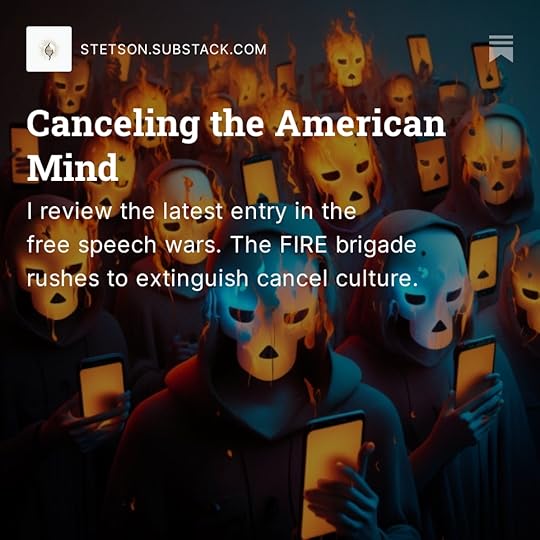
Extended review and personal reflection on Canceling
To accomplish this aim, the book is divided into three main portions with specific sub-objectives: 1) define the much abused term "cancel culture;" 2) Illustrate the mechanisms of cancel culture; 3) offer strategies that may be a salve.
In part 1, Lukianoff and Schlott essentially run with a previous definition provides by a think tank scholar who also works in free speech advocacy, Jonathan Rauch. Rauch's definition of cancel culture alleges six distinguishing components to cancelation: punitiveness, deplatforming, organization, secondary boycotts, moral grandstanding, truthiness. Given the complexity of Rauch's definition, the authors also offer a simpler version:
There is a great deal of coverage of high profile cancellations and then various quantitative examinations of the phenomenon using data mostly collected by the Foundation for Individual Rights and Expression (FIRE). The empirical portion is really the most compelling in terms of contextualizing how impactful this new cultural censoriousness has been. It really closes the door on attempts to dismiss the phenomenon as exaggerated. One of the wildest stats is that more professors lost their jobs due to 2010s cancel culture than in the Red Scare (1947-57) and post-9/11 combined! Plus, these figures only include actual termination not just attempts, which according to contemporary reports appear to be significantly higher now.
And the most useful part of the work is probably the second part, which examines the rhetorical approaches that have been used to foreclose debate. Greg and Rikki outline two defensive postures that destroy discourse: The Perfect Rhetorical Fortress (often deployed by left-wing censors) and The Efficient Rhetorical Fortress (often deployed by right-wing censors). Both rhetorical strategies are variants ad hominem (a basic no-no in honest discussion), where the PRF is a portfolio of deceptive practices and ERF is a blanket dismissal of political enemies. Many readers will be familiar with many of these rhetorical terms (whataboutism, straw-manning, motte and bailey, etc), but many will also noticed that these terms can themselves be used in inappropriate ways to shut down debate. In many cases, errant naming of rhetorical postures has become the latest entry among many "Thought Terminating Cliches."
In the final section, Greg and Rikki outlines a few ways that cancel culture can be mitigated. First and foremost, the argue that parents should increase the freedom and adversity that their children face. Coddling children is a route to censoriousness in their view. In this vein, they propose a number of changes to the educational system through higher ed, including banning litmus tests and encouraging political neutrality at the institutional level.
I generally agree with the diagnosis and recommendations of the authors. However, I am less sanguine that such recommendations will actually provide significant mitigation against censoriousness in the discourse and politics more broadly. I fear this is because the analysis the authors provide is somewhat blind to the factors that created the phenomenon of cancel culture in the first place. They seem to chalk it up to just bad ideas and the existence of social media. I think there are more fundamental issues that can't be reached via discourse. They are beyond ideas. This includes the interactions and tensions among individual and institutional incentives, intra-elite competition, technology, social stratification, and prestige scarcity. In other words, these are material factors that derange social behavior. Fixing these requires major reforms to certain institutions. However, there are some positive signs that the Overton window is broadening in salutary ways (some unfortunate ways it is expanding too), but this seems to mostly be a function of the rapid fragmentation of discourse platforms that was catalyzed by recent monetary policy changes to curb inflation and Elon Musk's purchase of Twitter.
*Disclosure: I received this book as a digital ARC through Netgalley
notes
The "Perfect Rhetorical Fortress" (aka a way to end discussion/debate) entails the following:
1 - Is the speaker conservative?
2 - What's the speaker's race?
3 - What's the speaker's sex?
4 - What's the speaker's sexuality?
5 - Is the speaker trans or cis?
6 - Can the speaker be accused of being "phobic"?
7 - Are they guilty by association?
8 - Did the speaker lose their cool?
9 - Did the speaker violate a "thought terminating cliche"?
10 - Can the speaker or audience be subject to emotional blackmail?
11 - Dark hints that something else is what is really going on
The key factor about the PRF is its optionality. Any of the above "barricades" can be deployed as needed to dismiss a particular argument without real engagement.
The Efficient Rhetorical Fortress:
1) You don't have to listen to liberals, where "liberal" is defined as having the wrong opinion
2) You don't have to listen to experts (even right-wing ones) when they have the wrong opinion
3) You don't have to listen to journalists (even right-wing ones) when they have the wrong opinion
4) And, among a certain selection of MAGA movement types: You don't need to listen to anyone who isn't pro-Trump.
Dirty rhetorical techniques that support the rhetorical fortresses:
1) Whataboutism
2) Straw-manning
3) Minimization
4) Motte and Bailey arguments
5) Underdogging
6) Accusations of bad faith
7) Hypocrisy projection
8 ) Offense archaeology
9) Fabrication
The Three (now Four) Great Untruths:
1) What doesn't kill you makes you weaker
2) Always trust your feelings
3) Life is a battle between good people and evil people
*4) Bad people only have bad opinions
Extended review and personal reflection on Canceling
To accomplish this aim, the book is divided into three main portions with specific sub-objectives: 1) define the much abused term "cancel culture;" 2) Illustrate the mechanisms of cancel culture; 3) offer strategies that may be a salve.
In part 1, Lukianoff and Schlott essentially run with a previous definition provides by a think tank scholar who also works in free speech advocacy, Jonathan Rauch. Rauch's definition of cancel culture alleges six distinguishing components to cancelation: punitiveness, deplatforming, organization, secondary boycotts, moral grandstanding, truthiness. Given the complexity of Rauch's definition, the authors also offer a simpler version:
The uptick beginning around 2014, and accelerating in 2017 and after, of campaigns to get people fired, disinvited, deplatformed, or otherwise punished for speech that is - or would be - protected by First Amendment standards and the climate of fear and conformity that has resulted from this uptick
There is a great deal of coverage of high profile cancellations and then various quantitative examinations of the phenomenon using data mostly collected by the Foundation for Individual Rights and Expression (FIRE). The empirical portion is really the most compelling in terms of contextualizing how impactful this new cultural censoriousness has been. It really closes the door on attempts to dismiss the phenomenon as exaggerated. One of the wildest stats is that more professors lost their jobs due to 2010s cancel culture than in the Red Scare (1947-57) and post-9/11 combined! Plus, these figures only include actual termination not just attempts, which according to contemporary reports appear to be significantly higher now.
And the most useful part of the work is probably the second part, which examines the rhetorical approaches that have been used to foreclose debate. Greg and Rikki outline two defensive postures that destroy discourse: The Perfect Rhetorical Fortress (often deployed by left-wing censors) and The Efficient Rhetorical Fortress (often deployed by right-wing censors). Both rhetorical strategies are variants ad hominem (a basic no-no in honest discussion), where the PRF is a portfolio of deceptive practices and ERF is a blanket dismissal of political enemies. Many readers will be familiar with many of these rhetorical terms (whataboutism, straw-manning, motte and bailey, etc), but many will also noticed that these terms can themselves be used in inappropriate ways to shut down debate. In many cases, errant naming of rhetorical postures has become the latest entry among many "Thought Terminating Cliches."
In the final section, Greg and Rikki outlines a few ways that cancel culture can be mitigated. First and foremost, the argue that parents should increase the freedom and adversity that their children face. Coddling children is a route to censoriousness in their view. In this vein, they propose a number of changes to the educational system through higher ed, including banning litmus tests and encouraging political neutrality at the institutional level.
I generally agree with the diagnosis and recommendations of the authors. However, I am less sanguine that such recommendations will actually provide significant mitigation against censoriousness in the discourse and politics more broadly. I fear this is because the analysis the authors provide is somewhat blind to the factors that created the phenomenon of cancel culture in the first place. They seem to chalk it up to just bad ideas and the existence of social media. I think there are more fundamental issues that can't be reached via discourse. They are beyond ideas. This includes the interactions and tensions among individual and institutional incentives, intra-elite competition, technology, social stratification, and prestige scarcity. In other words, these are material factors that derange social behavior. Fixing these requires major reforms to certain institutions. However, there are some positive signs that the Overton window is broadening in salutary ways (some unfortunate ways it is expanding too), but this seems to mostly be a function of the rapid fragmentation of discourse platforms that was catalyzed by recent monetary policy changes to curb inflation and Elon Musk's purchase of Twitter.
*Disclosure: I received this book as a digital ARC through Netgalley
notes
The "Perfect Rhetorical Fortress" (aka a way to end discussion/debate) entails the following:
1 - Is the speaker conservative?
2 - What's the speaker's race?
3 - What's the speaker's sex?
4 - What's the speaker's sexuality?
5 - Is the speaker trans or cis?
6 - Can the speaker be accused of being "phobic"?
7 - Are they guilty by association?
8 - Did the speaker lose their cool?
9 - Did the speaker violate a "thought terminating cliche"?
10 - Can the speaker or audience be subject to emotional blackmail?
11 - Dark hints that something else is what is really going on
The key factor about the PRF is its optionality. Any of the above "barricades" can be deployed as needed to dismiss a particular argument without real engagement.
The Efficient Rhetorical Fortress:
1) You don't have to listen to liberals, where "liberal" is defined as having the wrong opinion
2) You don't have to listen to experts (even right-wing ones) when they have the wrong opinion
3) You don't have to listen to journalists (even right-wing ones) when they have the wrong opinion
4) And, among a certain selection of MAGA movement types: You don't need to listen to anyone who isn't pro-Trump.
Dirty rhetorical techniques that support the rhetorical fortresses:
1) Whataboutism
2) Straw-manning
3) Minimization
4) Motte and Bailey arguments
5) Underdogging
6) Accusations of bad faith
7) Hypocrisy projection
8 ) Offense archaeology
9) Fabrication

October 29, 2023
This is an even handed, brutally honest, comprehensive study of the cancel culture phenomenon in America. It's not a diatribe against the left, it calls out abuses on the right every bit as strongly, which is what it should do. Cancel culture is a cancer on our way of life, but to eliminate it we must first understand it, and be clear about the extent to which is has embedded itself into the culture.
This is an important book and I highly recommend it to anyone who loves America.
This is an important book and I highly recommend it to anyone who loves America.

November 13, 2023
I really enjoyed this book. I saw Mr. Luckianoff on Bill Maher this weekend and remembered that I still needed to look through my notes and write a review.
This book is at its most persuasive when it discusses cancel culture as a rhetorical technique to win arguments without having to engage with the actual arguments. I love me some rhetorical fallacies, and the nice thing about them is that once you are aware of them you see them everywhere. It’s like when you are considering buying a Jeep and then you happen to notice that there are a lot of Jeeps on the road. Or is that also a fallacy?
This book also does a good job with specific examples of the points they are trying to make. Since they are at FIRE they actually keep a database of these incidents, so I’m sure coming up with suitable examples wasn’t difficult for them. Most of them I remembered vaguely hearing about, but in bits and pieces. The authors are careful not to attempt proof-by-anecdote, like other books on sensitive topics I have attempted to read like War On The West. They illuminate their point and move on.
A lot of the critiques of this book mentioned that “cancel culture” isn’t a thing and even if it is, it’s not well-defined. The authors themselves even admit that they dislike the term “cancel culture” and regret having to use it, but that’s the term that the current cultural discourse is using for better or for worse. They also clearly lay out the working definition they use in the book, and then they list and comment on a few of the other definitions that they have encountered and considered.
Other critiques of this book accuse it of “both sides”-ism. (I just read this accusation in today’s Wall Street Journal yearly round up of books in 2023.) I thought covering cancel culture from the left as well as from the right was a great feature of the book and showed what is the same and what is different in the ways they approach cancelling someone. From what I can tell, FIRE is politically agnostic when it comes to defending free speech. They have defended conservative speech on campus while at the same time successfully filing a lawsuit against the so-called Don’t Say Gay bill in Florida. Old school liberals for the win!
The book lists stats showing that the left has more cancellations than the right especially on campus. But then doesn’t it stand to reason that since there are so few conservatives on campuses that they are cancelling at a much higher rate per capita? Anyway, I think it’s a dumb critique because rhetorical fallacies are rhetorical fallacies no matter who is wielding them.
The authors go through all of the tricks of cancel culture. I’m going to list them here for future reference because (1) I find them so interesting, and (2) being familiar with this list is necessary if you want to vanquish your Twitter enemies or annoy your relatives on Facebook.
First comes a bunch of rhetorical dodges employed by left and right that the authors call “No Man’s Land,”
1. Whataboutism: Bringing up the other side’s alleged wrongdoing
2. Straw-manning: Misrepresenting the opposing argument with a weaker, inaccurate version that is easily refuted
3. Minimization: Trying to dismiss the issue as irrelevant. This comes in four flavors:
(a) This isn’t happening or
(b) It’s happening but in such small amounts as not to warrant attention or
(c) This is happening and it’s actually a good thing or
(d) The people who oppose our argument are the real problem, not the original issue
4. Motte and Bailey arguments: Conflate two arguments, lead with the unreasonable one (the bailey) and then defend it with the reasonable one (the motte). For example, in 2003 my friends and I opposed many of the reasons given for going to war in Iraq only to be accused of “not supporting our troops.” Motte and Bailey is my personal favorite and even though I get the two terms confused, when I learned to recognize this it’s like my world turned color from black and white.
5. Underdogging: Claiming your view is more valid because you are speaking on behalf of a disadvantaged group, some underdog, the “little guy,” the “middle class.”
Next is “The Minefield,” also employed by both left and right. Now instead of dodging the argument, we are using ad hominem attacks.
6. Accusations of bad faith: Imputing a sinister or selfish or ulterior motive to the person you are arguing with. If you are married, you are all too familiar with this one.
7. Hypocrisy projection: Asserting the person you are arguing with is being hypocritical
8. Acting too offended to take the person seriously: Responding to an idea or person as being too offensive to engage with
9. Offense archaeology: Digging through past comments/tweets to find anything that can be used against them, like contradictory speech or something that is now considered offensive
10. Making stuff up: Confidently asserting a lie or accusing the other person of lying to bolster a weak argument
Then we get to what is termed the left’s “Perfect Rhetorical Fortress,” which is a complicated Ptolemaic system that has evolved over the decades on college campuses. The authors archly point out that these techniques are generally used by people from privileged backgrounds, which I think is a little unfair.
1. Is the speaker conservative?: Any argument from a conservative person can be dismissed immediately
2. What is the speaker’s race? Is he or she BIPOC?
3. What is the speaker’s sex?: Accusations of mansplaining, toxic masculinity
4. What is the speakers sexuality? The authors point out that by the time you get to this point, only 0.9% of the population is even potentially worth listening to. 99.1% have to immediately forfeit their argument.
5. Is the speaker trans or cis?
6. Can the speaker be accused of being phobic in any way?
7. Are they guilty by association? Have they worked with a conservative? Published with one? Supported someone who has previously been cancelled?
8. Did the speaker lose their cool? Emotional responses, especially anger invalidates their arguments
9. Did the speaker use a “thought terminating cliche” or a “dog whistle”? Are they “punching down”?
10. Can emotional blackmail be used? Use sadness or outrage to rally others to join against the speaker.
11. Last resort: Darkly hint that something else is what’s really going on. In other words, try to reframe the issue in a context where your general point is still valid even if you can’t win the argument. Say something like, “Regardless, this is all part of a general trend of X.”
Conservatives are the OG cancellers, burning witches and trying to ban dancing in Footloose. Over the decades they have honed their rules down to an “Efficient Rhetorical Fortress.”
1. You don’t have to listen to “liberals,” and anyone with any wrong opinion can be a “liberal”
2. You don’t have to listen to experts, even conservative ones with the wrong opinion on any other topic
3. You don’t have to listen to journalists, even conservative journalists with the wrong opinion on any other topic. (I appreciate how the book makes a distinction between experts and journalists.)
4. [Special MAGA rule] You don’t have to listen to anyone who isn’t currently pro-Trump
These rules are generally rooted in a distrust of authority, which is certainly reasonable and maybe even healthy. But somehow this gets warped into arguing by picking arbitrary sources and facts. This eventually leads to non-falsifiable world views and conspiracies.
So there you have it! Now you can win any argument or destroy anyone’s life, at least as long as there are stupid people on social media and gullible rich kids at Ivy League schools. Please use responsibly…
Definitely recommended, though feel free to skip around. I didn’t get much out of the “What to do about it” section, though I did get a laugh from the section advising companies not to address cancel culture concerns in an all-hands meeting.
This book is at its most persuasive when it discusses cancel culture as a rhetorical technique to win arguments without having to engage with the actual arguments. I love me some rhetorical fallacies, and the nice thing about them is that once you are aware of them you see them everywhere. It’s like when you are considering buying a Jeep and then you happen to notice that there are a lot of Jeeps on the road. Or is that also a fallacy?
This book also does a good job with specific examples of the points they are trying to make. Since they are at FIRE they actually keep a database of these incidents, so I’m sure coming up with suitable examples wasn’t difficult for them. Most of them I remembered vaguely hearing about, but in bits and pieces. The authors are careful not to attempt proof-by-anecdote, like other books on sensitive topics I have attempted to read like War On The West. They illuminate their point and move on.
A lot of the critiques of this book mentioned that “cancel culture” isn’t a thing and even if it is, it’s not well-defined. The authors themselves even admit that they dislike the term “cancel culture” and regret having to use it, but that’s the term that the current cultural discourse is using for better or for worse. They also clearly lay out the working definition they use in the book, and then they list and comment on a few of the other definitions that they have encountered and considered.
Other critiques of this book accuse it of “both sides”-ism. (I just read this accusation in today’s Wall Street Journal yearly round up of books in 2023.) I thought covering cancel culture from the left as well as from the right was a great feature of the book and showed what is the same and what is different in the ways they approach cancelling someone. From what I can tell, FIRE is politically agnostic when it comes to defending free speech. They have defended conservative speech on campus while at the same time successfully filing a lawsuit against the so-called Don’t Say Gay bill in Florida. Old school liberals for the win!
The book lists stats showing that the left has more cancellations than the right especially on campus. But then doesn’t it stand to reason that since there are so few conservatives on campuses that they are cancelling at a much higher rate per capita? Anyway, I think it’s a dumb critique because rhetorical fallacies are rhetorical fallacies no matter who is wielding them.
The authors go through all of the tricks of cancel culture. I’m going to list them here for future reference because (1) I find them so interesting, and (2) being familiar with this list is necessary if you want to vanquish your Twitter enemies or annoy your relatives on Facebook.
First comes a bunch of rhetorical dodges employed by left and right that the authors call “No Man’s Land,”
1. Whataboutism: Bringing up the other side’s alleged wrongdoing
2. Straw-manning: Misrepresenting the opposing argument with a weaker, inaccurate version that is easily refuted
3. Minimization: Trying to dismiss the issue as irrelevant. This comes in four flavors:
(a) This isn’t happening or
(b) It’s happening but in such small amounts as not to warrant attention or
(c) This is happening and it’s actually a good thing or
(d) The people who oppose our argument are the real problem, not the original issue
4. Motte and Bailey arguments: Conflate two arguments, lead with the unreasonable one (the bailey) and then defend it with the reasonable one (the motte). For example, in 2003 my friends and I opposed many of the reasons given for going to war in Iraq only to be accused of “not supporting our troops.” Motte and Bailey is my personal favorite and even though I get the two terms confused, when I learned to recognize this it’s like my world turned color from black and white.
5. Underdogging: Claiming your view is more valid because you are speaking on behalf of a disadvantaged group, some underdog, the “little guy,” the “middle class.”
Next is “The Minefield,” also employed by both left and right. Now instead of dodging the argument, we are using ad hominem attacks.
6. Accusations of bad faith: Imputing a sinister or selfish or ulterior motive to the person you are arguing with. If you are married, you are all too familiar with this one.
7. Hypocrisy projection: Asserting the person you are arguing with is being hypocritical
8. Acting too offended to take the person seriously: Responding to an idea or person as being too offensive to engage with
9. Offense archaeology: Digging through past comments/tweets to find anything that can be used against them, like contradictory speech or something that is now considered offensive
10. Making stuff up: Confidently asserting a lie or accusing the other person of lying to bolster a weak argument
Then we get to what is termed the left’s “Perfect Rhetorical Fortress,” which is a complicated Ptolemaic system that has evolved over the decades on college campuses. The authors archly point out that these techniques are generally used by people from privileged backgrounds, which I think is a little unfair.
1. Is the speaker conservative?: Any argument from a conservative person can be dismissed immediately
2. What is the speaker’s race? Is he or she BIPOC?
3. What is the speaker’s sex?: Accusations of mansplaining, toxic masculinity
4. What is the speakers sexuality? The authors point out that by the time you get to this point, only 0.9% of the population is even potentially worth listening to. 99.1% have to immediately forfeit their argument.
5. Is the speaker trans or cis?
6. Can the speaker be accused of being phobic in any way?
7. Are they guilty by association? Have they worked with a conservative? Published with one? Supported someone who has previously been cancelled?
8. Did the speaker lose their cool? Emotional responses, especially anger invalidates their arguments
9. Did the speaker use a “thought terminating cliche” or a “dog whistle”? Are they “punching down”?
10. Can emotional blackmail be used? Use sadness or outrage to rally others to join against the speaker.
11. Last resort: Darkly hint that something else is what’s really going on. In other words, try to reframe the issue in a context where your general point is still valid even if you can’t win the argument. Say something like, “Regardless, this is all part of a general trend of X.”
Conservatives are the OG cancellers, burning witches and trying to ban dancing in Footloose. Over the decades they have honed their rules down to an “Efficient Rhetorical Fortress.”
1. You don’t have to listen to “liberals,” and anyone with any wrong opinion can be a “liberal”
2. You don’t have to listen to experts, even conservative ones with the wrong opinion on any other topic
3. You don’t have to listen to journalists, even conservative journalists with the wrong opinion on any other topic. (I appreciate how the book makes a distinction between experts and journalists.)
4. [Special MAGA rule] You don’t have to listen to anyone who isn’t currently pro-Trump
These rules are generally rooted in a distrust of authority, which is certainly reasonable and maybe even healthy. But somehow this gets warped into arguing by picking arbitrary sources and facts. This eventually leads to non-falsifiable world views and conspiracies.
So there you have it! Now you can win any argument or destroy anyone’s life, at least as long as there are stupid people on social media and gullible rich kids at Ivy League schools. Please use responsibly…
Definitely recommended, though feel free to skip around. I didn’t get much out of the “What to do about it” section, though I did get a laugh from the section advising companies not to address cancel culture concerns in an all-hands meeting.

March 5, 2026
Oh, to be a fly on the wall at Evergreen State College

November 29, 2023
I'm a big fan of Jonathan Haidt - he's one of the few authors who can talk rationally and fairly about both sides of an issue. So I was pleased to see that there was a spiritual successor to 'Coddling', by way of Haidt's co-author, and another, new author.
But red flags went up almost immediately when in the forward - the very first line of the book - Haidt himself wrote, "Sometime around 2014 something big changed in American society; it was as if a flock of demons was unleashed upon the world."
So much for not 'demonising' people and their opinions. The very language that's so unhelpful to the free speech debate, and there it is, opening up the book.
While the book itself didn't exactly carry that tone per se in its use of language, I think it’s an accurate representation of Lukianoff and Schlott’s approach to views with which they disagree. I’m sure they’d be shocked to hear this, since I’d bet they aspire to be reasonable people who listen to all sides of an issue. Hell, they’ve just written a book criticising both the Left and the Right, so that’s pretty balanced isn’t it?
The problem isn’t that they lean too far Left or Right, but that on every single issue they take a side. They seem unable to say, “So-and-so was cancelled and treated harshly for saying XYZ; on the other hand, people have been hurt by supporters of XYZ and the oppression it has perpetuated.”
To demonstrate how ubiquitous this is, I just went to a random chapter in the audiobook, and there it is: Chapter 6, Case Study: The Fortress in Action: Stanford Law School. It’s a story about federal appeals court judge Kyle Duncan and how his talk at Stanford was protested, disrupted, and significantly cut short – or, in other words, a flock of demons was unleashed on Kyle Duncan. He’s the protagonist here, the protestors the antagonists. There’s no compassion shown to the antagonists; no recognition that Duncan has ruled on issues that impact people negatively; no recognition that people are hurting. It’s all about how wrong the antagonists are, and how just the ‘free speech cause’ is.
Later, Dr Seuss is mentioned, but because Dr Seuss’ publisher cancelled some of his books, that makes Dr Seuss’ work unfaultable. Why can’t Lukianoff and Schlott say, “Admittedly some of the content is objectionable and offensive to many people”? But they can’t seem to do that, because Dr Seuss is automatically ‘good’ if he gets ‘cancelled’. Many of the other examples are like this, and I found myself empathising with the cancellers because their complaints weren’t being recognised by the authors, but instead were being trivialised and dismissed.
Another problem with the book is that many of the anecdotes they tell are simply of people disagreeing and exercising their own right to free speech. I agree that when actions to suppress people’s free speech are taken, that’s crossing a line. But oftentimes they detail how students put up posters and distributed flyers over some issue, and the authors’ point seemed to be, “Look how ridiculous they are! They’re whipping themselves into a woke frenzy!!” I wish they’d given some tips on how people could protest peacefully and effectively the issues that they feel are important and causing people harm.
I did like that they included some practical suggestions at the end of the book for how to handle cancel culture. But it was too little, too late, after what felt like a long stream of curated, worst-case anecdotes. I think cancel culture is real, and it’s a problem, but this isn’t the book that maturely addresses it.
But red flags went up almost immediately when in the forward - the very first line of the book - Haidt himself wrote, "Sometime around 2014 something big changed in American society; it was as if a flock of demons was unleashed upon the world."
So much for not 'demonising' people and their opinions. The very language that's so unhelpful to the free speech debate, and there it is, opening up the book.
While the book itself didn't exactly carry that tone per se in its use of language, I think it’s an accurate representation of Lukianoff and Schlott’s approach to views with which they disagree. I’m sure they’d be shocked to hear this, since I’d bet they aspire to be reasonable people who listen to all sides of an issue. Hell, they’ve just written a book criticising both the Left and the Right, so that’s pretty balanced isn’t it?
The problem isn’t that they lean too far Left or Right, but that on every single issue they take a side. They seem unable to say, “So-and-so was cancelled and treated harshly for saying XYZ; on the other hand, people have been hurt by supporters of XYZ and the oppression it has perpetuated.”
To demonstrate how ubiquitous this is, I just went to a random chapter in the audiobook, and there it is: Chapter 6, Case Study: The Fortress in Action: Stanford Law School. It’s a story about federal appeals court judge Kyle Duncan and how his talk at Stanford was protested, disrupted, and significantly cut short – or, in other words, a flock of demons was unleashed on Kyle Duncan. He’s the protagonist here, the protestors the antagonists. There’s no compassion shown to the antagonists; no recognition that Duncan has ruled on issues that impact people negatively; no recognition that people are hurting. It’s all about how wrong the antagonists are, and how just the ‘free speech cause’ is.
Later, Dr Seuss is mentioned, but because Dr Seuss’ publisher cancelled some of his books, that makes Dr Seuss’ work unfaultable. Why can’t Lukianoff and Schlott say, “Admittedly some of the content is objectionable and offensive to many people”? But they can’t seem to do that, because Dr Seuss is automatically ‘good’ if he gets ‘cancelled’. Many of the other examples are like this, and I found myself empathising with the cancellers because their complaints weren’t being recognised by the authors, but instead were being trivialised and dismissed.
Another problem with the book is that many of the anecdotes they tell are simply of people disagreeing and exercising their own right to free speech. I agree that when actions to suppress people’s free speech are taken, that’s crossing a line. But oftentimes they detail how students put up posters and distributed flyers over some issue, and the authors’ point seemed to be, “Look how ridiculous they are! They’re whipping themselves into a woke frenzy!!” I wish they’d given some tips on how people could protest peacefully and effectively the issues that they feel are important and causing people harm.
I did like that they included some practical suggestions at the end of the book for how to handle cancel culture. But it was too little, too late, after what felt like a long stream of curated, worst-case anecdotes. I think cancel culture is real, and it’s a problem, but this isn’t the book that maturely addresses it.

November 27, 2023
I will start by saying that I agree there are definitely some (maybe even many) instances where cancel culture crosses a boundary. However, This book felt more like something a family member would talk about at a holiday gathering than an educational resource on the topic. There are a lot of anecdotal stories and very little substance to back the claims/ideas up.

March 19, 2024
While this book covers an important cultural and political topic, it’s not without an obvious bias tilt, no matter how much the authors would like to tell you otherwise. One author is noted as being more left leaning, and the other more right leaning, but there’s a marked focus one side the political spectrum.
Another reason I didn’t rate this book higher is because one of the more obvious reasons I can think of that has contributed to the rise in cancel culture is never even addressed, and as a result, possible solutions to that aspect are never addressed.
As other people in my book club also noted, the book isn’t particularly formatted well, and it feels lole it jumps around quite a bit. As with nearly all non fiction I’ve read, I believe the point could’ve been made just as effectively and been cut in half (AT LEAST).
So, while I wouldn’t necessarily recommend the book, I will say that there were certain things that it did get me to think more deeply about.
Another reason I didn’t rate this book higher is because one of the more obvious reasons I can think of that has contributed to the rise in cancel culture is never even addressed, and as a result, possible solutions to that aspect are never addressed.
As other people in my book club also noted, the book isn’t particularly formatted well, and it feels lole it jumps around quite a bit. As with nearly all non fiction I’ve read, I believe the point could’ve been made just as effectively and been cut in half (AT LEAST).
So, while I wouldn’t necessarily recommend the book, I will say that there were certain things that it did get me to think more deeply about.
December 19, 2023
Not a whole lot of new analysis--more of an extended op-ed than breaking new analytical/theoretical ground.

November 3, 2023
Cancel culture is a prominent, ugly feature of public discourse today, yet many claim it doesn't exist. They say there are only "consequences," which amounts to saying that if you're subjected to abuse because you said something controversial, what else did you expect?
Gangs of goons shout speakers down and claim that doing so is part of the right of "free speech." By their logic, DDoS attacks on websites and jamming of radio communications are free speech. They shout "Shame! Shame!" as if anyone besides themselves were acting shamefully. They have only one standard: their authority to command others and demand silence from anyone who doesn't think as they do.
It wasn't always this way. Threats and demands for punishment of heretics have always been around, and some periods in American history have been full of open violence against opposing views, but the present levels of hostility are the worst in decades. In The Canceling of the American Mind, Greg Lukanioff and Rikki Schlott document how frequently people on both the right and the left have come to regard anyone who disagrees as an inherently evil person, an enemy to be brought down.
Cancel culture, as the authors use the term, consists of "campaigns to get people fired, disinvited, deplatformed, or otherwise punished for speech that is — or would be — protected by First Amendment standards." The book examines cancellation from the left and the right, examining the different styles of each.
The first 155 pages are mainly concerned with cancellation from the left, before going into its counterpart on the right. The book makes the case that the majority of cancellation comes from the left, but it's not a wide majority. Left-style cancellation comes mostly from educational institutions; cancellation from the right tends to originate from politicians, and a big piece of it can be traced directly to Donald Trump.
The authors wanted to show as much cancelation activity as possible, to avoid claims of "a few bad apples." I would have preferred more depth and context. For instance, they note with alarm that a poll reported that "40 percent of Republicans said committing violence against the government is sometimes justified," along with "23 percent of Democrats." But "sometimes" is a broad term, and the Declaration of Independence takes the same position. Interpreting poll answers is tricky, and looking a little more carefully at what they might have meant would have helped.
It's hard to tell without some context how seriously to take a statement. It can represent an isolated view by a person without much influence, or it can be a nitpick by someone who doesn't expect anything more than a discussion. With many of the quotes, I couldn't tell.
The parts that examine specific experiences in more detail are far more convincing. We have to wonder how any gang of idiots could get people fired from academic institutions for not caving into pseudo-science such as the denial of biological sex. If ten thousand evangelists demanded the firing of a professor from an Ivy League school for teaching evolution, the administrators would only laugh.
What personally infuriated me the most was the section on the two-bit Stalins who have infiltrated the publishing industry to make big corporations impose tight ideological limits on what may be published. Evidently they envision a future where they'll be in the top positions, deciding which authors will see print based on whether they sufficiently agree with certain doctrines. In a particularly egregious example, a gang declared that publishing a forthcoming book by Justice Amy Coney Barrett would violate their "right" to dictate what may see print, even though the content of the book wasn't yet known. It's odd how little attention this phenomenon got during the latest Banned Books Week.
The parts that try to explain the origin of such authoritarian attitudes aren't as convincing to me. The authors suggest that student cancel mobs are the result of training kids to be afraid of everything and encouraging them to give in to their fears. I don't think this is right. People who are scared try to be quiet and inconspicuous. These are people who believe everyone must submit to their demands, that obedience is their natural right. I admit, though, that I don't have a good explanation for why this attitude has grown so widespread.
What's clear is that the liberal consensus has fallen into weakness, if not collapse. We have two gangs, the "Wokes" and the "Magas," alike in their desire for absolute power but fighting with each other over it. It often seems that the question about our future is only over which gang gets to tear down our freedoms. If Americans who believe in freedom of belief and expression don't stand up against both of them, America's future is grim.
The authors call for a "culture of free speech" to counter this trend. That has its problems, though. Much of cancel culture is genuine free speech; calling someone a Nazi or demanding that a person be fired is free speech. I'd say rather that what's needed is a culture of reason. By this I mean that people should learn to think with their own minds, reject and avoid making unfounded accusations, and identify nonsense as nonsense. Cancel culture relies on people who accept accusations as proof and demands as moral imperatives. We can't expect everyone to be equally good at critical thinking, but people who are committed to honest evaluation can get learn to reject obvious nonsense. It's a tough haul, but it's where the best chance lies.
This review first appeared on my blog on garymcgath.com.
Gangs of goons shout speakers down and claim that doing so is part of the right of "free speech." By their logic, DDoS attacks on websites and jamming of radio communications are free speech. They shout "Shame! Shame!" as if anyone besides themselves were acting shamefully. They have only one standard: their authority to command others and demand silence from anyone who doesn't think as they do.
It wasn't always this way. Threats and demands for punishment of heretics have always been around, and some periods in American history have been full of open violence against opposing views, but the present levels of hostility are the worst in decades. In The Canceling of the American Mind, Greg Lukanioff and Rikki Schlott document how frequently people on both the right and the left have come to regard anyone who disagrees as an inherently evil person, an enemy to be brought down.
Cancel culture, as the authors use the term, consists of "campaigns to get people fired, disinvited, deplatformed, or otherwise punished for speech that is — or would be — protected by First Amendment standards." The book examines cancellation from the left and the right, examining the different styles of each.
The first 155 pages are mainly concerned with cancellation from the left, before going into its counterpart on the right. The book makes the case that the majority of cancellation comes from the left, but it's not a wide majority. Left-style cancellation comes mostly from educational institutions; cancellation from the right tends to originate from politicians, and a big piece of it can be traced directly to Donald Trump.
The authors wanted to show as much cancelation activity as possible, to avoid claims of "a few bad apples." I would have preferred more depth and context. For instance, they note with alarm that a poll reported that "40 percent of Republicans said committing violence against the government is sometimes justified," along with "23 percent of Democrats." But "sometimes" is a broad term, and the Declaration of Independence takes the same position. Interpreting poll answers is tricky, and looking a little more carefully at what they might have meant would have helped.
It's hard to tell without some context how seriously to take a statement. It can represent an isolated view by a person without much influence, or it can be a nitpick by someone who doesn't expect anything more than a discussion. With many of the quotes, I couldn't tell.
The parts that examine specific experiences in more detail are far more convincing. We have to wonder how any gang of idiots could get people fired from academic institutions for not caving into pseudo-science such as the denial of biological sex. If ten thousand evangelists demanded the firing of a professor from an Ivy League school for teaching evolution, the administrators would only laugh.
What personally infuriated me the most was the section on the two-bit Stalins who have infiltrated the publishing industry to make big corporations impose tight ideological limits on what may be published. Evidently they envision a future where they'll be in the top positions, deciding which authors will see print based on whether they sufficiently agree with certain doctrines. In a particularly egregious example, a gang declared that publishing a forthcoming book by Justice Amy Coney Barrett would violate their "right" to dictate what may see print, even though the content of the book wasn't yet known. It's odd how little attention this phenomenon got during the latest Banned Books Week.
The parts that try to explain the origin of such authoritarian attitudes aren't as convincing to me. The authors suggest that student cancel mobs are the result of training kids to be afraid of everything and encouraging them to give in to their fears. I don't think this is right. People who are scared try to be quiet and inconspicuous. These are people who believe everyone must submit to their demands, that obedience is their natural right. I admit, though, that I don't have a good explanation for why this attitude has grown so widespread.
What's clear is that the liberal consensus has fallen into weakness, if not collapse. We have two gangs, the "Wokes" and the "Magas," alike in their desire for absolute power but fighting with each other over it. It often seems that the question about our future is only over which gang gets to tear down our freedoms. If Americans who believe in freedom of belief and expression don't stand up against both of them, America's future is grim.
The authors call for a "culture of free speech" to counter this trend. That has its problems, though. Much of cancel culture is genuine free speech; calling someone a Nazi or demanding that a person be fired is free speech. I'd say rather that what's needed is a culture of reason. By this I mean that people should learn to think with their own minds, reject and avoid making unfounded accusations, and identify nonsense as nonsense. Cancel culture relies on people who accept accusations as proof and demands as moral imperatives. We can't expect everyone to be equally good at critical thinking, but people who are committed to honest evaluation can get learn to reject obvious nonsense. It's a tough haul, but it's where the best chance lies.
This review first appeared on my blog on garymcgath.com.

June 5, 2025
this one was good, but not as good as the coddling of the american mind. i feel like more nuance could've been brought to the book, but i of course love the strong defending of the first amendment and the attitude against censorship

February 12, 2024
other critical comments have already said much of what's wrong with this book, such as the extensive focus on the left and lack of differentiating between the NATURE of cancellations between left and right, the nature of the statements being cancelled, and the fact most the data comes from the company the authors work for and this can hardly be called objective, so ill just say that this book was not very convincing. yes free speech is good and we need free speech but this book did little to provide alternatives or ideas, instead just listed a bunch of anecdotes without really going into them or providing anything to the discussion (and several claims in here lack sources lol)
then there's just several viewpoints that i personally didn't agree with (such as uh. that toxic masculinity is irrelevant when treating a man in therapy who struggles with expressing his emotions in a healthy way. among many others) and anecdotes that, due to the lack of sources provided, seemed more like strawmans (which is funny because the authors say that this is an argument often employed by the left to silence people they disagree with)
then there's just several viewpoints that i personally didn't agree with (such as uh. that toxic masculinity is irrelevant when treating a man in therapy who struggles with expressing his emotions in a healthy way. among many others) and anecdotes that, due to the lack of sources provided, seemed more like strawmans (which is funny because the authors say that this is an argument often employed by the left to silence people they disagree with)

October 20, 2023
This book makes good points, and as someone on an elite college campus, I am particularly appalled by the cancel culture I see here. Yet I also found the tone of this rather preachy.

October 22, 2023
أدى اختراع المطبعة في خمسينيات القرن الخامس عشر إلى تغيرات كارثية في أوروبا: الصراع الديني، وتوسيع نطاق محاكمات السحرة، والحرب الأهلية الثورية. ساعدت التكنولوجيا الجديدة بمشاركة ملايين الأشخاص في المحادثة العالمية.
وفي الفترة القصيرة نسبيًا بين خمسينيات القرن الخامس عشر وخمسينيات القرن السابع عشر، ارتفعت معدلات معرفة القراءة والكتابة من 12% فقط إلى 25% في جميع أنحاء أوروبا الغربية، مما يعني أنه أصبح بإمكان 18 مليون شخص إضافي القراءة والتصارع مع الأفكار الجديدة.
وبفضل الإدراك المتأخر، نعلم أن نتيجة هذه الآلام المتزايدة ستكون في نهاية المطاف ازدهار العلم والفن والإصلاح. ولكن إذا كنت تنظر إلى العالم من وجهة نظر هنري الثامن، على سبيل المثال، في عام 1538، فربما تبدو المطبعة وكأنها تمثل مشكلة أكبر مما تستحق.
كما كان الحال في الأيام الأولى للصحافة المطبوعة، وجدنا أنفسنا في فترة مجنونة وفوضوية في الأيام الأولى لوسائل التواصل الاجتماعي. مرة أخرى، ينضم عدد هائل من الأشخاص الجدد إلى المحادثة الثقافية. ولا ينبغي لنا أن نفاجأ بأن وسائل التواصل الاجتماعي، التي تسمح للمليارات من الناس بالمشاركة في المناقشة العالمية، هي أيضا مخرّبة إلى حد غير عادي.
ومن المفيد أن ننظر إلى الوراء لنرى كيف استجابت شخصيات القرن السادس عشر لهذا التحدي. في عام 1538، حاول هنري الثامن يائسًا إعادة جنّي المطبعة إلى المصباح من خلال طلب ترخيص معتمد من التاج لتشغيل المطبعة في إنكلترا. لكن ثبت أن احتواء انتشار الأفكار أمر مستحيل.
واليوم، يحاول المشرعون أن يفعلوا الشيء نفسه. نشأت المحاولات القاسية لتنظيم وسائل التواصل الاجتماعي من اليمين السياسي في تكساس وفلوريدا واليسار في كاليفورنيا ونيويورك. ومن المؤكد أن المزيد سيأتي بعد طباعة هذا الكتاب.
نعم، أثبت إدخال المطبعة أنه كان مدمرًا للمجتمع والسلطات القائمة. ولكنه سهّل حدوث المحادثات اللامركزية. وفي القرون التي تلت اختراع المطبعة، سمح للمجتمع بالاقتراب من الحقيقة من خلال نشر الأفكار والتخلص من الباطل.
ولذلك، لا ينبغي لنا أن نفقد الأمل في أن تصبح وسائل الإعلام الاجتماعية ذات يوم، على الرغم من الآلام المتزايدة التي تسببها، أداةً للتقدم البشري أيضا.
في عصر التشاؤم التكنولوجي، ما زلنا متفائلين بالتكنولوجيا. ونعتقد أنه مع بعض القواعد الأساسية، يمكن لهذه المنصات الجديدة أن تثبت فائدتها على المدى الطويل. قد لا يكون تويتر أو فيسبوك أو أي منصة أخرى موجودة في ذلك الوقت، ولكن ربما ستنتج بعض أدوات الوسائط الاجتماعية المستقبلية تغييرًا اجتماعيًا إيجابيًا، مثلما فعلت المطبعة في نهاية المطاف.
.
Greg Lukianoff
The Canceling Of The American Mind
Translated By #Maher_Razouk
وفي الفترة القصيرة نسبيًا بين خمسينيات القرن الخامس عشر وخمسينيات القرن السابع عشر، ارتفعت معدلات معرفة القراءة والكتابة من 12% فقط إلى 25% في جميع أنحاء أوروبا الغربية، مما يعني أنه أصبح بإمكان 18 مليون شخص إضافي القراءة والتصارع مع الأفكار الجديدة.
وبفضل الإدراك المتأخر، نعلم أن نتيجة هذه الآلام المتزايدة ستكون في نهاية المطاف ازدهار العلم والفن والإصلاح. ولكن إذا كنت تنظر إلى العالم من وجهة نظر هنري الثامن، على سبيل المثال، في عام 1538، فربما تبدو المطبعة وكأنها تمثل مشكلة أكبر مما تستحق.
كما كان الحال في الأيام الأولى للصحافة المطبوعة، وجدنا أنفسنا في فترة مجنونة وفوضوية في الأيام الأولى لوسائل التواصل الاجتماعي. مرة أخرى، ينضم عدد هائل من الأشخاص الجدد إلى المحادثة الثقافية. ولا ينبغي لنا أن نفاجأ بأن وسائل التواصل الاجتماعي، التي تسمح للمليارات من الناس بالمشاركة في المناقشة العالمية، هي أيضا مخرّبة إلى حد غير عادي.
ومن المفيد أن ننظر إلى الوراء لنرى كيف استجابت شخصيات القرن السادس عشر لهذا التحدي. في عام 1538، حاول هنري الثامن يائسًا إعادة جنّي المطبعة إلى المصباح من خلال طلب ترخيص معتمد من التاج لتشغيل المطبعة في إنكلترا. لكن ثبت أن احتواء انتشار الأفكار أمر مستحيل.
واليوم، يحاول المشرعون أن يفعلوا الشيء نفسه. نشأت المحاولات القاسية لتنظيم وسائل التواصل الاجتماعي من اليمين السياسي في تكساس وفلوريدا واليسار في كاليفورنيا ونيويورك. ومن المؤكد أن المزيد سيأتي بعد طباعة هذا الكتاب.
نعم، أثبت إدخال المطبعة أنه كان مدمرًا للمجتمع والسلطات القائمة. ولكنه سهّل حدوث المحادثات اللامركزية. وفي القرون التي تلت اختراع المطبعة، سمح للمجتمع بالاقتراب من الحقيقة من خلال نشر الأفكار والتخلص من الباطل.
ولذلك، لا ينبغي لنا أن نفقد الأمل في أن تصبح وسائل الإعلام الاجتماعية ذات يوم، على الرغم من الآلام المتزايدة التي تسببها، أداةً للتقدم البشري أيضا.
في عصر التشاؤم التكنولوجي، ما زلنا متفائلين بالتكنولوجيا. ونعتقد أنه مع بعض القواعد الأساسية، يمكن لهذه المنصات الجديدة أن تثبت فائدتها على المدى الطويل. قد لا يكون تويتر أو فيسبوك أو أي منصة أخرى موجودة في ذلك الوقت، ولكن ربما ستنتج بعض أدوات الوسائط الاجتماعية المستقبلية تغييرًا اجتماعيًا إيجابيًا، مثلما فعلت المطبعة في نهاية المطاف.
.
Greg Lukianoff
The Canceling Of The American Mind
Translated By #Maher_Razouk
September 8, 2025
10 points of the research:
1) The Cancel Culture refers to a cheap way to win an argument. The theme involves attacking a person rather than the argument by removing the person through direct attack, invalidation, covert complaints, or mere bullying just because someone has a different political position or perspective.
2) The idea of political intolerance started with Herbert Marcuse.
3) The Cancel Culture originated in the era of political correctness and grew.
4) The elite universities started the trend of censorship. Harvard, Yale, Georgetown, Princeton, Case Western, Tufts, Johns Hopkins, Columbia, Pepperdine, Baylor, Syracuse, UR, Fordham, MIT, Drexel, Vanderbilt, Brandeis, Howard, Dartmouth, and Brigham Young all had average to poor ratings regarding campus censorship.
5) The authors suggested a ban on political litmus tests. This ban includes DEI mandated statements or any requirements within the organization that requires political scanning to ensure conservative equivalents.
6) The Cancel Culture exists in both leftist and right-wing communities.
7) The authors suggested to cut down on bureaucracy to reduce tuition explosion.
8) A scandal exists when half of academic students showed no improvement in critical thinking skills after college.
9) Harvard University accepts more than 43% of white applicants who came from families of alumni or faculty.
10) The word illiberalism explains the behavior of rejecting rational discourse, instead promoting intolerance, fear of difference, the cult of force, discipline, and moral authority.
1) The Cancel Culture refers to a cheap way to win an argument. The theme involves attacking a person rather than the argument by removing the person through direct attack, invalidation, covert complaints, or mere bullying just because someone has a different political position or perspective.
2) The idea of political intolerance started with Herbert Marcuse.
3) The Cancel Culture originated in the era of political correctness and grew.
4) The elite universities started the trend of censorship. Harvard, Yale, Georgetown, Princeton, Case Western, Tufts, Johns Hopkins, Columbia, Pepperdine, Baylor, Syracuse, UR, Fordham, MIT, Drexel, Vanderbilt, Brandeis, Howard, Dartmouth, and Brigham Young all had average to poor ratings regarding campus censorship.
5) The authors suggested a ban on political litmus tests. This ban includes DEI mandated statements or any requirements within the organization that requires political scanning to ensure conservative equivalents.
6) The Cancel Culture exists in both leftist and right-wing communities.
7) The authors suggested to cut down on bureaucracy to reduce tuition explosion.
8) A scandal exists when half of academic students showed no improvement in critical thinking skills after college.
9) Harvard University accepts more than 43% of white applicants who came from families of alumni or faculty.
10) The word illiberalism explains the behavior of rejecting rational discourse, instead promoting intolerance, fear of difference, the cult of force, discipline, and moral authority.

December 25, 2023
Cancel culture has been bugging me for a few years. These authors covered this challenging social topic far better than I could’ve imagined. I think tag-teaming it with authors in two generations was quite smart. I also appreciated in the final chapter they addressed criticism of their ideas–something authors rarely do.
If cancel culture is on your mind, I cannot recommend this book highly enough. Well-researched, fair, and well-written.
If cancel culture is on your mind, I cannot recommend this book highly enough. Well-researched, fair, and well-written.
Read
June 19, 2025Since sahiba wants a review I’ll give only ONE!: I liked the premise a lot, interesting points made. A lot of the “evidence” is misconstrued data but whatever. Also first 1/4 of book talks about free speech at private universities. This doesn’t make much sense since private universities don’t have anything to do with constitutional free speech etc but I get their general point- just wasn’t argued well and they didn’t even mention this caveat once
Authors often strayed from their own thesis to defend the usually rightwing side of a case study. It was distracting
Felt like some things weren’t touched upon that could have been really interesting.
Maybe If you can read it with an open mind and grain of salt there is definitely something to get out of it.
Authors often strayed from their own thesis to defend the usually rightwing side of a case study. It was distracting
Felt like some things weren’t touched upon that could have been really interesting.
Maybe If you can read it with an open mind and grain of salt there is definitely something to get out of it.

October 30, 2023
It's a little unfair but this book has the feel of a Hollywood sequel; rushed, big names missing from the marquee, reliance on callbacks and liberally copies/pasts from the original. It's unfair because, in spite of the above, it does spin off a thread from the first book, focuses it and gives it a succinct but respectable treatment.
I've followed Greg since the original Coddling came out in 2018 and I really value his thoughtful comments on free speech, and there's a lot of that in book. The book serves as a bit of a brochure for the Foundation for Individual Rights and Expression (FIRE), to which both authors are affiliated and that's good because it gives them access to both original anecdotes and data about attacks against free speech. Also, being a 1st amendment lawyer, Greg also understands where the law ends and cultural norms of free speech have to take over. Indeed, one of the main arguments of the book is that the law can only get you so far (They point out N. Korea and Russia have robust free speech laws) if the citizens don't value free speech.
I also appreciated that the book is fairly non-partisan, in that it has "case studies" that have the expected progressive Twitter mobs and woke college kids, but it also spends time on Trump's many attempts to drag and excommunicate folks on the right who speak out against him, and the current trends in Republican States to ban books and police k-12 curriculum.
There are a lot of stories in this book that are guaranteed to get your blood boiling, smug self-righteous, mobs acting like they're saving the world by ruining people's lives. I try to be weary of that type of content because I think it leads to the type of moral reasoning that Coddling, and to a lesser extent this book, proport to oppose. I'm not arguing that it's hypocritical to include these stories here, there's probably no good way to demonstrate the harms of cancel culture without it, but it did leave me with a vague sense of unease or dissonance.
This book also develops the idea of the perfect rhetorical fortress which I thought was a pretty useless framework. They spend a whole chapter iterating through many immutable and mutable attributes that "they" use to summarily dismiss arguments. Then they multiply out the probabilities of someone having any of those attributes all to make the pretty banal point that people dismiss arguments for dumb reasons.
I've followed Greg since the original Coddling came out in 2018 and I really value his thoughtful comments on free speech, and there's a lot of that in book. The book serves as a bit of a brochure for the Foundation for Individual Rights and Expression (FIRE), to which both authors are affiliated and that's good because it gives them access to both original anecdotes and data about attacks against free speech. Also, being a 1st amendment lawyer, Greg also understands where the law ends and cultural norms of free speech have to take over. Indeed, one of the main arguments of the book is that the law can only get you so far (They point out N. Korea and Russia have robust free speech laws) if the citizens don't value free speech.
I also appreciated that the book is fairly non-partisan, in that it has "case studies" that have the expected progressive Twitter mobs and woke college kids, but it also spends time on Trump's many attempts to drag and excommunicate folks on the right who speak out against him, and the current trends in Republican States to ban books and police k-12 curriculum.
There are a lot of stories in this book that are guaranteed to get your blood boiling, smug self-righteous, mobs acting like they're saving the world by ruining people's lives. I try to be weary of that type of content because I think it leads to the type of moral reasoning that Coddling, and to a lesser extent this book, proport to oppose. I'm not arguing that it's hypocritical to include these stories here, there's probably no good way to demonstrate the harms of cancel culture without it, but it did leave me with a vague sense of unease or dissonance.
This book also develops the idea of the perfect rhetorical fortress which I thought was a pretty useless framework. They spend a whole chapter iterating through many immutable and mutable attributes that "they" use to summarily dismiss arguments. Then they multiply out the probabilities of someone having any of those attributes all to make the pretty banal point that people dismiss arguments for dumb reasons.

November 7, 2023
I was excited to read this book hoping for a concrete approach to cancel culture and freedom of speech. I was disappointed that the authors outline Logical Fallacies” and the proceeded to use those same fallacies taking easy name calling and straw men to build a case. It seems they felt that their criticism of the left and the right validated the failure to a consistent use of logic and rhetoric. I believe this book will only contribute to more cancel culture with the right and left borrowing anecdotes from the book to support their position.
I appreciate the work FIRE has done to fight in the courts for freedom of speech for anyone who has been muzzled by cancel culture.
As a PhD student I was hoping for better. I find significant fault with both political parties in the USA. I dont support Hamas or Israel Defense Forces. I am looking for someone who has a serious well thought approach to freedom of speech and thought that will lift national and global conversations.
I appreciate the work FIRE has done to fight in the courts for freedom of speech for anyone who has been muzzled by cancel culture.
As a PhD student I was hoping for better. I find significant fault with both political parties in the USA. I dont support Hamas or Israel Defense Forces. I am looking for someone who has a serious well thought approach to freedom of speech and thought that will lift national and global conversations.

November 1, 2023
Excellent analysis of the current culture plaguing higher education and journalism. Doesn’t pull back punches on either side's offender and provides plenty of case study examples, while importantly acknowledging that not every case will be visible to the public. Some of the book admittingly felt like FIRE patting itself on the back, but with so few organizations safeguarding free speech these days (the ACLU is unrecognizable now), it’s not too surprising.

January 17, 2024
Nothing exciting, or even interesting. Lackluster, as another reviewer very aptly put it. Boring, in other words.
April 8, 2024
What a missed opportunity. The anecdotes are cherry-picked to support evidence of the authors’ lived experiences instead of using existing data to question the bubble they exist within.
December 18, 2023
Back in 2019 I read The Coddling of the American Mind by Greg Lukianoff and Jonathan Haidt, and (grep tells me) I've mentioned it numerous times since then.
Lukianoff is back, with a new co-author, Rikki Schlott. And their mission this time is to explore the epistemic pandemic of "Cancel Culture". Coddling discussed what they called the "three great untruths": "What doesn't kill you makes you weaker." "Always trust your feelings." and "Life is a battle between good people and evil people." This book adds a fourth, called the "Great Untruth of Ad Hominem": "Bad People Only Have Bad Opinions".
Which makes Cancel Culture sensible, sort of. What to do when confronted with people with Bad Opinions? Unfortunately, that pesky First Amendment makes it impractical to jail them. But that Great Untruth allows you to make the logical leap that they are (indeed) Bad People. So go ahead and feel free to do whatever you need to punish them extralegally: ostracise them, get them fired, censor their writings, erase their names from the historical record, … whatever tactic comes to hand is fair game!
The authors do a good job looking at the history (with a shout-out to another great "saw it coming" book, 2015's So You've Been Publicly Shamed by Jon Ronson). If you've been paying attention to this phenomenon over the last few years, you might be familiar with many of their examples, drawn from (of course) academia, (but also) journalism, publishing, science, medicine, psychotherapy, politics, and more. It's a scourge.
Although most of the examples here are products of totalitarian wokeism, the authors go out of their way to criticize both sides of the political spectrum, detailing conservative's ham-fisted efforts to suppress their opponents' opinions in the marketplace of ideas: book banning, "divisive concepts" laws, and the like.
The weakest bit of the book is its discussion of book banning, which edges into an argument that we should just trust librarians to do the right thing without political interference. That is at best a mixed bag. I wince at the "Racial Justice Resources" compiled by the library at the University Near Here, which spans the ideological range from Ibram X. Kendi to Ta-Nehisi Coates. And there's the Anti-Racism Zine published by Portsmouth (NH) Public Library. And those are just the libraries I frequent.
And then there's the recent installation of Emily Drabinksi, self-described "Marxist lesbian" as president of the American Library Association. Who rhapsodized at "collective power" to build a "better world."
I'm unsure how that's going to play out. Marxists do not have the best history with respect to free speech.
The book's subtitle promises a "solution" to Cancel Culture. It's actually multi-pronged, the first being aimed at parents: raise "anti-fragile" and "free range" kids. Other chapters advocate common-sense activism aimed at K-12 schools and universities. And advocate something that's taken hold elsewhere: defund DEI departments, and ban the ideological purity tests known as "diversity statements" in hiring.
Personal note: I got a taste of Cancel Culture a few months back, visiting Caltech for its "Alumni Weekend". Nobel Laureate Robert A. Millikan, also the president of Caltech (1920-1946) is now a campus non-person, thanks to his onetime embrace of eugenics. Millikan Library has been renamed "Caltech Hall" and the bust of Millikan that used to stand outside the Norman Bridge Laboratory of Physics has been removed, to some unknown fate. It's unclear if this effort has actually made anyone's life better.
Displaying 1 - 30 of 326 reviews