

What do you think?

Daisy Bates in the Desert
'He is the greatest German writer of our time. Such poets as Rilke or such novelists as Thomas Mann are dwarfs or plaster saints in comparison to him' Vladimir Nabokov
The story of K. and his arrival in a village where he is never accepted, and his relentless, unavailing struggle with authority in order to gain entrance to the castle that seems to rule it. K.'s isolation and perplexity, his begging for the approval of elusive and anonymous powers, epitomises Kafka's vision of twentieth-century alienation and anxiety.
The story of K. and his arrival in a village where he is never accepted, and his relentless, unavailing struggle with authority in order to gain entrance to the castle that seems to rule it. K.'s isolation and perplexity, his begging for the approval of elusive and anonymous powers, epitomises Kafka's vision of twentieth-century alienation and anxiety.
320 pages, Paperback
Published January 1, 1994
About the author
Julia Blackburn
45 books70 followersJulia Blackburn is the author of several other works of nonfiction, including Charles Waterton and The Emperor’s Last Island, and of two novels, The Book of Color and The Leper’s Companions, both of which were short-listed for the Orange Prize. Her most recent book, Old Man Goya, was nominated for a National Book Critics Circle Award. Blackburn lives in England and Italy.
Ratings & Reviews
Friends & Following
Create a free account to discover what your friends think of this book!
Community Reviews
Displaying 1 - 19 of 19 reviews

January 4, 2009

 http://www.bbc.co.uk/programmes/b05tbw1m
Revisit 2015 is via Radio 4 drama. I shall re-read the book at the same time.

It was late in the evening when K arrived.
From wiki:Kafka began writing The Castle on the evening of 27 January 1922, the day he arrived at the mountain resort of Spindlermühle (now in the Czech Republic). A picture taken of him upon his arrival shows him by a horse-drawn sleigh in the snow in a setting reminiscent of The Castle. Hence, the significance that the first few chapters of the handwritten manuscript were written in first person and at some point later changed by Kafka to a third person narrator, 'K'.
Brod placed a strong religious significance to the symbolism of the castle. This is one possible interpretation of the work based on numerous Judeo-Christian references as noted by many including Arnold Heidsieck.
The book ends mid-sente (my jokette)
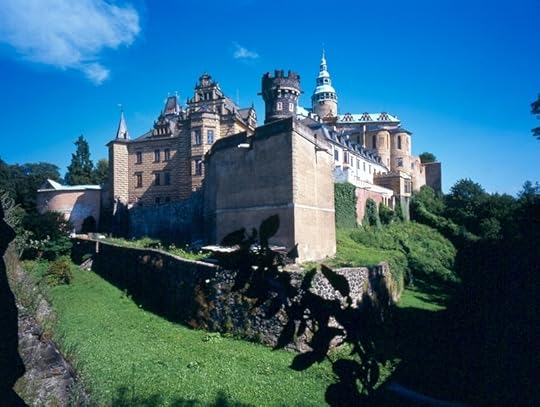 Schloß Friedland The castle that inspired Kafka.
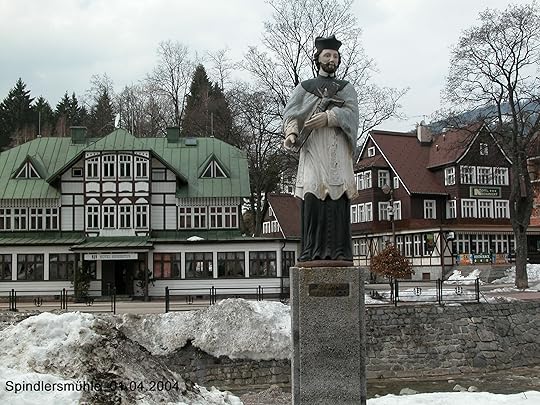 The writer Franz Kafka stayed in Špindlerův Mlýn in the early 1920s, when he was writing one of his most famous works, The Castle.
As with The Trial, the victim here, K, is up against anonymous and oppressive governing forces. Absurdity abounds, which makes for claustrophobic reading. It is night-time more than day, and the locals are twisty characters who distrust this new arrival with disdain.
It is useful to remember that Kafka was a German-Jew, and although he didn't put much weight on his Jewishness, it seems to have influenced his writing. It is generally to be understood that this was not a good time for Jews, nosiree, and it became worse.

July 21, 2013
From BBC Radio 4 - Drama:
1/2: In Franz Kafka's mind-warping novel, set in a bureaucratic wonderland, the hapless land-surveyor known only as K answers a summons to work at the mysterious Castle, only to find himself drawn into a labyrinth of terror and absurdity.
2/2: In Franz Kafka's mind-warping novel, set in a bureaucratic wonderland, while K continues to seek a meeting with the elusive official Klamm, his relationship with Frieda is under strain. He suspects her of maintaining a secret tryst with Klamm, and she of a dalliance with Barnabas' two sisters.
With the Jackie Palmer Children's Choir
Dramatist: Ed Harris
Producer: John Taylor
1/2: In Franz Kafka's mind-warping novel, set in a bureaucratic wonderland, the hapless land-surveyor known only as K answers a summons to work at the mysterious Castle, only to find himself drawn into a labyrinth of terror and absurdity.
2/2: In Franz Kafka's mind-warping novel, set in a bureaucratic wonderland, while K continues to seek a meeting with the elusive official Klamm, his relationship with Frieda is under strain. He suspects her of maintaining a secret tryst with Klamm, and she of a dalliance with Barnabas' two sisters.
With the Jackie Palmer Children's Choir
Dramatist: Ed Harris
Producer: John Taylor

September 1, 2016
I sympathize with readers who never found the patience to make it through a Kafka, especially the novels. It's not easy reading him. They are laborious texts, very meticulously detailed but never allowing you to grasp a tangible reality which you can find familiar and accessible. The dialogues run on forever, people seem to never cease talking and it's never really sure what they are talking about anyway considering the heightened level of uncertainty and self-doubt plaguing almost every character in his books. Everyone contradicts themselves at least once and sometimes even in the same sentence, and everyone's contradicting everyone else all the time, and the novel sometimes feels like an extended argument about god knows what between people you never seem to care about. I get that. I understand why you feel after 10 pages in that it's probably a good idea to give up and read something else.
But then you're not getting the point. Franz Kafka isn't telling a story here, there is no clear message that he wants you to decode and attain a sense of enlightenment about the state of the world or "the human condition". This is an unpopular opinion, I get it. Everyone seems to think that Kafka was very conscious of his politics, and very deliberately and carefully constructed his little hermetic allegorical worlds reflecting ours only exaggerated and grotesque. He was an existentialist, no an absurdist some say, not but he wrote about the Jewish identity and his works have religious significance, oh but no they're written with socialist concerns about the state of the worker in an increasingly hostile capitalist society (cue in the word "Kafkaesque" and use it like you know what it means) etc etc etc. It's wonderful to categorize and contextualize him as all or any of the above because they all work. But this is where you lose me. This is where you lose him, really.
The wonderful thing about this man, and why I profess my love for him continuously, is because he reaches me somewhere deeper and elusive than the intellect. No, Kafka does not make me think at all, not immediately, not absolutely. He does not excite me in that way, and that's perhaps the greatest thing about him. Because what he does is what a Jackson Pollock might do to you. You're not sure what it's about or what it means in terms of pure signification (there is none, sometimes), but it transports you to a "soul state", it reaches you at a level of pure affectivity. The aesthetic experience in this regard is pure emotion, untranslatable, ineffable feeling. You're aware something is happening, and you call it "compelling" and "scary" and "disturbing" or even yes "comical". But Kafka has that amazing ability of transfiguring your immediate world into something absolutely strange and unfamiliar. He "defamiliarizes" reality. And in doing so from such a detached and unemotional point of view, he closes room for signification, and it is for this major reason that however you do contextualize him he will never really fit any category completely. He'll bleed out. No neat little reading can answer for everything he's written and crossed out and left unfinished and requested to be burnt.
It is difficult reading him because his worlds aren't "pleasant". But they are strikingly memorable. They are naked and clean and unapologetically grotesque, and that is why Kafka matters. He shocks you into understanding and empathy. His books really do work as "ax[es] for the frozen sea inside us" and such art is so valuable and perhaps even more than that which works at careful and scrupulous representation and realism. Because Kafka, and I actually believe this, he increases your ability to feel. This is exactly what some arthouse movies do: they alienate the viewer from the world and themselves in each and every way, but if you allow them to get inside you, they'll fill your head with images that'll shock you right out of your carefully constructed comfortable lives. "Why would I do that to myself," I hear you say. Because it's important. It's important to feel and have emotion destroy you and tear you apart, to make you afraid of words and colors, to have you share in the paranoia and claustrophobia of other people, to see the blood on their corpses so you can know horror and absolute despair because all of that makes us bigger, richer, kinder people.
Kafka is important, perhaps one of the most important writers ever, because he allows you to share in the inexplicable terror of our situation, a kind of terror you don't allow yourself to feel because maybe you have a better life than the likes of K. or maybe you've successfully tuned it out. But if you think Art matters for some reason, it is precisely this. To make you bigger from the inside. Kafka does that. Read him.
But then you're not getting the point. Franz Kafka isn't telling a story here, there is no clear message that he wants you to decode and attain a sense of enlightenment about the state of the world or "the human condition". This is an unpopular opinion, I get it. Everyone seems to think that Kafka was very conscious of his politics, and very deliberately and carefully constructed his little hermetic allegorical worlds reflecting ours only exaggerated and grotesque. He was an existentialist, no an absurdist some say, not but he wrote about the Jewish identity and his works have religious significance, oh but no they're written with socialist concerns about the state of the worker in an increasingly hostile capitalist society (cue in the word "Kafkaesque" and use it like you know what it means) etc etc etc. It's wonderful to categorize and contextualize him as all or any of the above because they all work. But this is where you lose me. This is where you lose him, really.
The wonderful thing about this man, and why I profess my love for him continuously, is because he reaches me somewhere deeper and elusive than the intellect. No, Kafka does not make me think at all, not immediately, not absolutely. He does not excite me in that way, and that's perhaps the greatest thing about him. Because what he does is what a Jackson Pollock might do to you. You're not sure what it's about or what it means in terms of pure signification (there is none, sometimes), but it transports you to a "soul state", it reaches you at a level of pure affectivity. The aesthetic experience in this regard is pure emotion, untranslatable, ineffable feeling. You're aware something is happening, and you call it "compelling" and "scary" and "disturbing" or even yes "comical". But Kafka has that amazing ability of transfiguring your immediate world into something absolutely strange and unfamiliar. He "defamiliarizes" reality. And in doing so from such a detached and unemotional point of view, he closes room for signification, and it is for this major reason that however you do contextualize him he will never really fit any category completely. He'll bleed out. No neat little reading can answer for everything he's written and crossed out and left unfinished and requested to be burnt.
It is difficult reading him because his worlds aren't "pleasant". But they are strikingly memorable. They are naked and clean and unapologetically grotesque, and that is why Kafka matters. He shocks you into understanding and empathy. His books really do work as "ax[es] for the frozen sea inside us" and such art is so valuable and perhaps even more than that which works at careful and scrupulous representation and realism. Because Kafka, and I actually believe this, he increases your ability to feel. This is exactly what some arthouse movies do: they alienate the viewer from the world and themselves in each and every way, but if you allow them to get inside you, they'll fill your head with images that'll shock you right out of your carefully constructed comfortable lives. "Why would I do that to myself," I hear you say. Because it's important. It's important to feel and have emotion destroy you and tear you apart, to make you afraid of words and colors, to have you share in the paranoia and claustrophobia of other people, to see the blood on their corpses so you can know horror and absolute despair because all of that makes us bigger, richer, kinder people.
Kafka is important, perhaps one of the most important writers ever, because he allows you to share in the inexplicable terror of our situation, a kind of terror you don't allow yourself to feel because maybe you have a better life than the likes of K. or maybe you've successfully tuned it out. But if you think Art matters for some reason, it is precisely this. To make you bigger from the inside. Kafka does that. Read him.

July 13, 2020
Reading a Franz Kafka novel, especially The Castle, is like suffering from a prolonged disease that does not want to get cured, and you have to endure its infliction, which sucks all the energy out of you, to get through this. And then you will not be cured at all, but would be left in a dizzy, confused state of mind with a bland taste in your heart.

December 13, 2014
An honest & detailed review would be an unsuccessful attempt to describe the genre 'Kafkaesque' and that would be a grave injustice. I would only say that this is a story with allusions pointing to how we in our current lives are meandering meaninglessly to achieve something which might as well be inconsequential.
August 21, 2011
The gist of Kafka's masterpiece is: faced with all the external forces of the world the individual is futile. His thoughts and his actions cannot improve his situation because, ultimately, he is not in control.
The Castle is concerned with a land-surveyor (known only as K.) whose arrival at the village below the mysterious castle is met with resistance at every level of the bureaucracy. Along with The Trial, this novel is often seen as a prophetic vision of the terrorism that may be inflicted by the state upon its citizens. Whereas in The Trial Josef K. is persecuted by state violence for a crime he may or may not have committed, in The Castle is the chain of command and red-tape that oppresses K. Certainly, some of the features of both hold true of the future that unfolded beyond Kafka, but to simply reduce such a masterpiece of literature to a political pamphlet is crude and irrelevant.
As well as his essentially existential argument Kafka challenges many of the conventions of his day, placing his novels firmly amongst the truly modern and innovative. We know nothing about K.'s appearance, Kafka offers no personal history or background for any of his characters, there are no psychological or philosophical observations. Kafka is concerned only with K.'s thoughts and actions as they effect the matter directly at hand, i.e. who should K. seek in order to gain official acceptance into the village, how should he question this official etc. Of course, every avenue is fruitless, and K. is forced to see out his life in conflict with the authorities. Kafka's point is not whether K. deserves acceptance, whether his claim to some administrative oversight is justified or not, when faced with the external force of the world, there is nothing anyone can do. Motives and reasons are unnecessary; things happen sometimes because they do; people and states can persecuate others simply because they are able to.
Nearly 100 years after publication The Castle stands as one of the true masterpieces of literature, concerned with a universal existential problem that every human being at every moment is faced with.
The Castle is concerned with a land-surveyor (known only as K.) whose arrival at the village below the mysterious castle is met with resistance at every level of the bureaucracy. Along with The Trial, this novel is often seen as a prophetic vision of the terrorism that may be inflicted by the state upon its citizens. Whereas in The Trial Josef K. is persecuted by state violence for a crime he may or may not have committed, in The Castle is the chain of command and red-tape that oppresses K. Certainly, some of the features of both hold true of the future that unfolded beyond Kafka, but to simply reduce such a masterpiece of literature to a political pamphlet is crude and irrelevant.
As well as his essentially existential argument Kafka challenges many of the conventions of his day, placing his novels firmly amongst the truly modern and innovative. We know nothing about K.'s appearance, Kafka offers no personal history or background for any of his characters, there are no psychological or philosophical observations. Kafka is concerned only with K.'s thoughts and actions as they effect the matter directly at hand, i.e. who should K. seek in order to gain official acceptance into the village, how should he question this official etc. Of course, every avenue is fruitless, and K. is forced to see out his life in conflict with the authorities. Kafka's point is not whether K. deserves acceptance, whether his claim to some administrative oversight is justified or not, when faced with the external force of the world, there is nothing anyone can do. Motives and reasons are unnecessary; things happen sometimes because they do; people and states can persecuate others simply because they are able to.
Nearly 100 years after publication The Castle stands as one of the true masterpieces of literature, concerned with a universal existential problem that every human being at every moment is faced with.

June 25, 2015
I have finally finished reading The Castle, even if like K., perhaps I don't feel as though I came to a satisfactory conclusion. Some enlightenment. Perhaps.
Writing a review of a novel, written by an author like Kafka, presents a challenge almost as great as those faced by his protagonists. How can I add anything to the words that have already been written about this author, about this book?
However, having lived as an expat for several years, I do share some of the feelings of isolation, perplexity and that nagging desire to fit in, to be accepted. And, understand that it is never truly possible. However, hard one tries, maybe the only place one can ever truly 'fit', is inside our own skin.
This book has been my constant companion through many months of this year, months in which much has changed. At times, I have set it aside, imagining I would never pick it up again. That, like K.'s quest, seemed perhaps to be the way the work was intended to be experienced. In fragments.
I was at first irritated by the long complex sentences, the paragraphs that often seemed without end, with the jarring lack of context, the lack of traditional narrative. But then, I realised, these things reflect the essential nature of our lives. Things happen, there is often no 'story', no big picture. There is no start, no middle, no end.
We exist.
Writing a review of a novel, written by an author like Kafka, presents a challenge almost as great as those faced by his protagonists. How can I add anything to the words that have already been written about this author, about this book?
However, having lived as an expat for several years, I do share some of the feelings of isolation, perplexity and that nagging desire to fit in, to be accepted. And, understand that it is never truly possible. However, hard one tries, maybe the only place one can ever truly 'fit', is inside our own skin.
This book has been my constant companion through many months of this year, months in which much has changed. At times, I have set it aside, imagining I would never pick it up again. That, like K.'s quest, seemed perhaps to be the way the work was intended to be experienced. In fragments.
I was at first irritated by the long complex sentences, the paragraphs that often seemed without end, with the jarring lack of context, the lack of traditional narrative. But then, I realised, these things reflect the essential nature of our lives. Things happen, there is often no 'story', no big picture. There is no start, no middle, no end.
We exist.
October 9, 2017
At long last, I've finished this book. Definitely not an easy read due to huge chunks of text where the characters go on and on in lengthy monologues.
With that said, this book has a lot more going on than The Trial. The Castle talks not only about unresponsive bureaucracy and shadowy figures behind the system, but it also contains themes of alienation and ulterior motives (the bit with Frieda, a seemingly lowly barmaid, WOW), and the sense of anxiety brought on by said themes as well as the Kafkaesque imagery painted by the writer himself.
Speaking about the imagery, the atmosphere in The Castle feels dark and claustrophobic at all times. Long and dark corridors where people just seemingly appear from and disappear into, doors that lead to unexpected rooms, surreal and dimly lit environment etc etc.
It's a damn shame that the novel just ends halfway through the conversation between the main protag K and the landlady about her dress, I feel that Kafka was about to introduce another theme using their conversation as a starting point to something new and thought provoking.
Reread required.
8/10
With that said, this book has a lot more going on than The Trial. The Castle talks not only about unresponsive bureaucracy and shadowy figures behind the system, but it also contains themes of alienation and ulterior motives (the bit with Frieda, a seemingly lowly barmaid, WOW), and the sense of anxiety brought on by said themes as well as the Kafkaesque imagery painted by the writer himself.
Speaking about the imagery, the atmosphere in The Castle feels dark and claustrophobic at all times. Long and dark corridors where people just seemingly appear from and disappear into, doors that lead to unexpected rooms, surreal and dimly lit environment etc etc.
It's a damn shame that the novel just ends halfway through the conversation between the main protag K and the landlady about her dress, I feel that Kafka was about to introduce another theme using their conversation as a starting point to something new and thought provoking.
Reread required.
8/10

January 13, 2012
I think I like Castle. It might not be as good as The Trial, but Kafka does bring a better effort to his alienation of protagonists. This time not only the characters help him do that, but also the setting which was visceral and infuses a sense of amiss in the reader. But, Kafka tries to do too much with the premise. Although the mood of the novel is brilliantly unrelenting, the multilayer structure buckles under its own weight with too many questions, incomplete perspectives and allusions. It doesn't help that he continuously contradicts what he says and make the whole saga a little too sad.
As we often hear, his short stories might just be his best work.
As we often hear, his short stories might just be his best work.

June 1, 2011
Franz Kafka's final, unfinished novel The Castle is a perfect introduction to his oeuvre. Really, there is no other word to describe it than 'kafkaesque'. Everything about it leads back to that. The story concerns the efforts of a land-surveyor simply named 'K.' to gain access to the Castle and confirm his position. Instead of being able to do this he becomes embroiled in a labyrinthine bureaucracy which involves everyone.
Read the rest of my review here.
Read the rest of my review here.
September 20, 2010
tough going but worth it
could any character endure the bureaucratic obstacles, the derision and ostracisation from the village and still remain so unsympathetic - despite K's lack of progress and continued failures to engage anyone he sustained his arrogance throughout
memorable if not likeable
could any character endure the bureaucratic obstacles, the derision and ostracisation from the village and still remain so unsympathetic - despite K's lack of progress and continued failures to engage anyone he sustained his arrogance throughout
memorable if not likeable
This entire review has been hidden because of spoilers.
May 27, 2007
This book is funny. I like how the people move.
February 7, 2008
One of the funniest novels I've ever read.

January 18, 2009
I read this long, long ago in another country and time. The new translation beckons me

January 21, 2018
Everything is detached in this book, alienated. Even the third person narration gives a sense of alienation. K. is a strange person in a strange land, he cannot quite fit into any scene of the story. And yet the events are all told as from K.’s perspective, which gives a warped view of the world. It’s like an Escher drawing, or something.
The flow between dialogue and narration is rather brilliant and accentuates the alienation. I don’t always feel like I’m watching a play when I read The Castle, rather, sometimes it’s as if I’m watching a scene play out in the distance and someone is standing beside me narrating what is happening way over there. It’s a very strange feeling that I’ve never gotten from a book before.
It took me 200 pages, but I realized the word that perfectly describes this book: insufferable. (No doubt some of the insufferability is due to the translation from German, but that’s beside the point.) Every character is insufferable, concerned only with the most minute trivialities of the bureaucratic maze that is the Castle. What amazes me is how Kafka is able to convey this feeling of insufferability so well that I can’t stop reading. It’s like watching a slow motion car crash: extremely difficult to watch and yet you can’t bring yourself to look away. Kafka was writing in I believe 1920-1930, at the height of the totalitarian bureaucracy of the Nazi government, and I can’t help but draw parallels.
As for the characters, it is as if each character’s internal struggle is this: they are trying to claw their way out of the uncanny valley, but they just can’t quite figure out what it takes to get over that last ledge. They kind of remind me of Westworld characters. They are definitely functioning individuals, but they aren’t quite all there. They don’t reason for themselves, or take any active role in their lives: instead they are all purely reactive to the events and happenings of the Castle. They all seem to have an incredible ability to talk at great length about nothing at all, perhaps this is what makes them bureaucrats.
The ethical situation with Amalia’s secret is, by my estimation, a fantastic depiction of Nietzsche’s slave morality. Amalia is the only respectable character in the whole story, besides. Her father says, “I’ll restore Amalia’s honor, it won’t take long now,” but says it sheepishly, in a low voice. He has no idea what honor is, or why it is important. Only that the society and the Castle say that some thing called honor is important, and the man of the house should uphold it, and in attempting to do so his life is drained from him and he is left old and withered. This is a propping-up of an arbitrary morality by the Castle: institutionalized morality. Its absurd, of course. But this is how society works, and this is what Nietzsche taught us. Meanwhile, Amalia is vibrant, bearing all responsibility for the household. She already established her honor as one that doesn’t conform to the very strange moral norms of the Castle. In denying Sortini, against the wishes of her family but congruent with her own conception of honor and morality, she made the single active movement in the entire plot. She is Nietzsche’s ubermensch.
Most striking is the way the Castle constructs a world that encourages slave morality in the Village. It is evident in every character, especially K., who starts the book energized and assertive with getting to his work, but by the end he is pulled in every direction by the insanity of the different Villagers and Castle workers. Each character, by the way, that has a long monologue contradicts themself multiple times: this adds to their insufferability.
At any moment in the book, K. could have just walked away as easily as he had walked into the Village. But he never cuts any interaction short, never even thinks about leaving. He gets caught up in the social strata of the Castle, believes he needs to attain social status, and throughout the story increasingly suffers because of it. I guess he is the bearer of the insufferability of the rest of the characters.
https://bensima.com/2018/01/the-castl...
August 2, 2021
Really good. Seems more coherent and plot driven than the trial; the situations might be extreme, but one can see elements of real life and experience in them. As always, I'm amazed at the length of a single speech or paragraph, and that it never the less remains eminently readable. The passage of time in Kafka's books is also fascinating, and seems otherworldly. It is always at once too quick and yet it couldn't be timed more perfectly
May 13, 2017
full of endless frustation and something like a technical manual

December 2, 2017
Probably my favourite book by Kafka.

January 27, 2018
50 pages too long.
Displaying 1 - 19 of 19 reviews