Jump to ratings and reviews
Rate this book

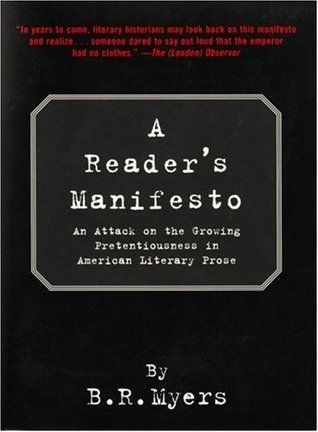
A Reader's Manifesto: An Attack on the Growing Pretentiousness in American Literary Prose

Rate this book
Available for the first time, the full-length, unexpurgated version of the essay that incited one of the most passionate literary controversies ever in American letters . . .

When the Atlantic Monthly first published an excerpted version of B.R. Myers' polemic—in which he attacked literary giants such as Don Delillo, Annie Proulx, and Cormac McCarthy, quoting their work extensively to accuse them of mindless pretension—it caused a world-wide sensation.

"A welcome contrarian takes on the state of contemporary American literary prose," said a Wall Street Journal review. "Useful mischief," said Jonathan Yardley in The Washington Post. "Brilliantly written," declared The Times of London.

But Myers' expanded version of the essay does more than just attack sanctified literary heavyweights.It also:

* Examines the literary hierarchy that perpetuates the status quo by looking at the reviews that the novelists in question received. It also considers the literary award system. "Rick Moody received an O. Henry Award in 1997," Myers observes, "whereupon he was made an O. Henry juror himself. And so it goes."
* Showcases Myers' biting sense of wit, as in the new section, "Ten Rules for 'Serious' Writers," and his discussion of the sex scenes in the bestselling books of David Guterson ("If Jackie Collins had written that," Myers says after one example, "reviewers would have had a field day.")
* Champions clear writing and storytelling in a wide range of writers, from "pop" novelists such as Stephen King to more "serious" literary heavyweights such as Somerset Maugham. Myers also considers the classics such as Balzac and Henry James, and recommends numerous other undeservedly obscure authors.
* Includes an all-new section in which Myers not only considers the controversy that followed the Atlantic essay, but responds to several of his most prominent critics.

Published on the one-year anniversary of original Atlantic Monthly essay, the new, expanded A READER'S MANIFESTO continues B.R. Myers' fight on behalf of the American reader, arguing against pretension in so-called "literary" fiction, naming names and brilliantly exposing the literary status quo.

149 pages, Paperback

First published September 1, 2002

10 people are currently reading
983 people want to read

About the author

B.R. Myers

11 books28 followers
Librarian Note: There is more than one author by this name in the Goodreads database.

Ratings & Reviews

What do you think?
Rate this book

Friends & Following

Create a free account to discover what your friends think of this book!

Community Reviews

5 stars
191 (31%)
4 stars
241 (40%)
3 stars
110 (18%)
2 stars
31 (5%)
1 star
26 (4%)
Displaying 1 - 30 of 128 reviews
Profile Image for Ian "Marvin" Graye.
949 reviews2,786 followers
Want to read
November 15, 2011
My rant about this book and its approach is based on the Atlantic article.

The Attack on Pretentiousness

The article was presented as "an attack on the growing pretentiousness of American literary prose".

Many of us would agree with the need for such an attack.

But every attack must come from a position of its own, and sometimes you have to work out whether you agree with the origin of the attack, before you agree with the attack itself.

So, from what point of view is BRM attacking his victims?

The Victims and Their Crimes

Here is the list of victim authors, together with their crimes:

* Annie Proulx ("Evocative" Prose)

* Cormac McCarthy ("Muscular" Prose)

* Don DeLillo ("Edgy" Prose)

* Paul Auster ("Spare" Prose)

* David Guterson (Generic "Literary" Prose)

Myers Attacks

There might be 20,000 reasons to attack their prose, but what were BRM's reasons?

What style of prose does he posit as an alternative?

What positive emerges out of his rant?

What I Like About What I Like

Here are some of the characteristics and qualities that BRM rates highly:

* popular storytellers

* accessible, fast-moving stories written in unaffected prose

* an excellent "read" or a "page turner"

* a strong element of action

* a natural prose style

* unaffected English

* a plain, honest man, just the author to read on the subway

* the reader is addressed as the writer's equal

* a natural cadence and vocabulary

* the figurative language (like something seen through bad glass) is fresh and vivid without seeming to strain for originality

* movie westerns

* epic language only in moderation

* A good novelist, of course, would have written the scene more persuasively in the first place. Far stranger things happen in Nikolai Gogol's Dead Souls(1842), but we don't need an academic intermediary to argue their plausibility or to explain what Gogol was getting at

* A thriller must thrill or it is worthless; this is as true now as it ever was

* genre-ish suspense

* make sense

* more of a storytelling instinct than many novelists today

* Time wasted on these books is time that could be spent reading something fun. When DeLillo describes a man's walk as a "sort of explanatory shuffle ... a comment on the literature of shuffles" (Underworld), I feel nothing; the wordplay is just too insincere, too patently meaningless. But when Vladimir Nabokov talks of midges "continuously darning the air in one spot," or the "square echo" of a car door slamming, I feel what Philip Larkin wanted readers of his poetry to feel: "Yes, I've never thought of it that way, but that's how it is." The pleasure that accompanies this sensation is almost addictive; for many, myself included, it's the most important reason to read both poetry and prose

* convincing

* As Christopher Isherwood once said to Cyril Connolly, real talent manifests itself not in a writer's affectation but "in the exactness of his observation [and] the justice of his situations."

* British psychological thrillers written in careful, unaffectedly poetic prose

* Suspense

* the old American scorn for pretension

Food for Thought

Hopefully, there is some food for future thought in this list.

However, ultimately, this attack reminds me of the year I watched 37 Alfred Hitchcock films in a row and thought that everything else in film, literature, work, life and girlfriends was absolute crap.

Luckily, I kept my thoughts to myself.

If I hadn't, hopefully I would have tried to praise Hitchcock, instead of just slamming everybody else in my life.

In other words, if BRM had had the guts of his vision, he would have stated the positive of his alternative, instead of heaping negative shit on his victims.

And if he had been genuine, he would have admitted that he loved B movies and pulp fiction more than he loved any definition of literary fiction whatsoever.

Good luck to the man, but just because he loves black jelly beans doesn't mean that there's anything wrong with purple ones.

Except he needed to attack, perhaps discriminately, perhaps indiscriminately, in order to sell copies of the Atlantic and his book.
Profile Image for Barbara K.
709 reviews199 followers
April 29, 2023
The 5 authors pilloried by Myers in this highly entertaining book (Proulx, DeLillo, Auster, McCarthy and Guterson) seem to have survived his critique. The literary establishment has continued to shower praise and awards on them. Indeed, McCarthy’s latest 2 book set was anticipated as the literary event of the year!

Of course, not all literary critics rejected Myers’ arguments. A significant number, especially outside the US, acknowledged that these emperors had no clothes. They agreed with Myers that by and large, they just don’t write that well. That their work is full of affectation and tics and isn’t very readable. He doesn’t buy the argument that anything new (can we say “shiny object”?) is by definition better, and that books, even sentences, that are boring, or redundant, or hard to understand, must reflect a wisdom beyond the ken of the average reader.

Of this group, I’ve read only DeLillo’s White Noise and Auster’s New York Trilogy, both back in the 80’s, and neither made a deep impression on me. I’ve been aware of all the others but opted not to try them. After reading the excerpts Myers cites, I’d say it was wise of me to keep my distance. Nothing I read tempted me in the least, and parts were genuinely off putting.

I will confess to being fond of lucid writing, and equally enthusiastic about creative structure. Olga Tokarczuk, winner of the Nobel prize for literature and many other awards, demonstrates both, and provides insights into human nature that resonate with me. Hillary Mantel and Bernadine Evaristo and Kazuo Ishiguro and Eleanor Catton have all achieved the highest awards, presenting their stories with unique, but easily understandable and meaningful voices. And I find that my favorite form of genre fiction, crime, is full of authors who demonstrate superior writing skills as they relate their compelling stories.

So I guess I’m in Myers’ camp. I read reviews in the NYT and WP, but I don’t commit to a book these days without checking to see what people I respect on GR think. And then I make my own decision.

Many thanks to L C Justin for his review, which brought this book to my attention.
Profile Image for Paul Bryant.
2,413 reviews12.6k followers
November 11, 2011
A lolcat is an image combining a photograph of a cat (usually in a "zany" situation) with text intended to contribute humour. The text is often idiosyncratic and grammatically incorrect, and its use in this way is known as "lolspeak" or "kitty pidgin". "Lolcat" is a compound word of the acronymic abbreviation "LOL" and the word "cat".
Lolcats are commonly designed for photo sharing imageboards and other Internet forums including Goodreads.

Imagine then if you will a lolcat with a rabid grin on its face, a collar round its neck on which is clearly written B R MYERS, its arse perched on a copy of a Rick Moody novel, smacking its paw on its computer keyboard ENTER key - on the screen is the unfeasibly large text "YOUR MESSAGE HAS BEEN SENT". The caption says

I IZ IN ZO MUCH TROUBLE NOW!!


Yep, Mr Meyers was in zo much trouble when he wrote this amusing and - cue gasps - not wholly incorrect tirade against the precious end of recent American literary fiction.

In fact, if you only lived a little nearer, I'd buy you all a copy for Christmas and we could have so many arguments on Boxing Day over our left-over turkey and mulled wine. It would be fun!

"You can shove your Safran Foer where the sun don't shine"

"David Foster Wallace makes James Joyce look like a haddock"

"James Joyce did look like a haddock"

etc etc
Profile Image for Daisy.
283 reviews100 followers
May 29, 2025
Anyone who follows my reviews will have picked up on my disappointment, disenchantment and ultimate dislike of modern American writers. I have read critics and reviewers gush about this or that set of short stories by one or another new stars of the literary scene and they never satisfied me, let alone pleased me. Myers, like all good therapists, has helped me realise it’s not a me problem, it’s a them problem.

that you secretly struggled to see what the fuss was about have been stripped of their majesty here as Myers articulates exactly what I find so problematic. To boil it down to its most reductive, I suppose one could say that it is a matter of style over substance. Style is an interesting concept as it is these writers (Proulx, DeLilo, McCarthy among others) style that elevates them above mainstream literature and yet, as Myers points out, critics and reviewers barely refer to style and often just give a synopsis of the plot. It is however style that readers are interested in, why they choose one writer of hackneyed plots over another.

Myers beef is that the prose employed by these writers use is affected and self-consciously writerly and disguises the banality of the book. That the style is the thing rather than a vehicle for thought provoking prose or a decent plot,

“Our “literary” writers aren’t expected to evince much in the way of brain power. Musing about consumerism, bandying about words like “ontological”…this is what passes for intellectual content today.”

The lack of intellectual writing is something I have picked up on in the short stories. In the absence of anything profound to say on the big issues these writers try to imbue the mundane with significance. Making a cup of tea, opening the curtains in the morning all these things are given undue weight of meaning. DeLilo doesn’t even have the conviction to pretend that these non-events have the gravitas he gives them by tacking on a, ‘but maybe I’m wrong’ on the end of these descriptions. He acknowledges what the reader suspects, that it is just a lot of hot air masquerading as high art.

Anyone who has read modern American prose will recognise some of the more grating aspects of what Myers terms ‘trendy stylistic tics’. The tyranny of conjunctions (those writers who take a very routine set of events and think they are elevating it above the boredom threshold by doing away with punctuation and just using and throughout the paragraph), the lists (breathless lists of consumer products is always a winner with the great and good) and the slide show technique (using multiple metaphors for a single image so that the speed and frequency doesn’t allow the reader time to consider if they work a crime he says Proulx is particularly guilty of).

Ultimately, he laments that what passes for intellectual, literary writing is that which is written to be deliberately inaccessible and the critics and writers conspire in a if you don’t get it then you’re a bit too dim for it. As Myers says, there is the implication,

“If you can’t see why that’s great writing, I won’t waste my time trying to explain.”
“…the cultural elite wants us to believe: if our writers make no sense, or bore us to tears, that can only mean that we aren’t worthy of them.”


This is the recurrent theme of my reviews that I know I’m not a stupid person, that I understand literature from various cultures and time periods but I just never comprehend these modern literary writers, or maybe I understand but fail to see the point of them. What do they actually say? Myers reassures me that often they take a lot of words and devices to say nothing.

Current thinking is that it is more about the writers than what they write and the belief,

” Just because a book is only intermittently readable, you see , doesn’t mean that we shouldn’t spend twenty-five dollars on it and read it from cover to cover.”

I have spent years spending my twenty-five dollars thinking I was missing something but Myers has revealed the snake oil for what it is and so I shall be spending it on Penguin classics from now on and I urge you to as well, once you’ve spent some of it on letting Myers explain why you were right all along.
Profile Image for Left Coast Justin.
615 reviews204 followers
July 25, 2021
This was very amusing, and the intensity of the firestorm that followed more amusing yet.

I think this was less a critique of certain authors, though, than an attack on literary critics who promote and fawn over unreadable books. The authors are just doing their thing; it's the critics and publishing industry that promote awful books and declare them unmissable, when there's thousands of great books appearing every year featuring less-pretentious prose.

Had someone less knowledgeable and droll written this, it could have been a disaster. Well done, Mr. Myers.
Profile Image for A.J..
136 reviews51 followers
June 8, 2008
I've been fascinated for a long time by the apparent war between so-called 'mainstream' and 'literary' fiction. What this little work does is add ammunition to a thought I've long suspected might be true: literary fiction (as opposed to genre fiction [anything that isn't painful to read]) is pretty much the evolution of a high school popularity contest. Instead of prissy prom queens that wear too much mascara, we've got the literatti, a group of college-educated elitists who sit around at coffee bars pretending to like books that nobody with a central nervous system could possibly like (these are the same people that still think being a Democrat is edgy). And in the same breath that they hold up plodding, unreadable modern classics as the divine rationale for reading, they bitch and moan about why their books don't sell.

Anyway, more to the book––er––manifesto, it's a quick read, darn entertaining, and a reassurance for someone like me who walked through the oaken doors of academia with the preconception that professors weren't really the yardstick by which I ought to determine worthwhile literature. It's a good lesson for aspiring writers, too.

It waxes long with examples, so a skim would be sufficient to get the point (which is ironic), but definitely worth the time for English students, writers of all kinds, and anyone generally interested in fiction
Profile Image for Algernon.
265 reviews13 followers
January 22, 2008
Even if you disagree with Myers's thesis, that the literary establishment is puffing up the reputation of bad books and thus degrading the popularity of reading; and even if you disagree with his criticisms of the writers he singles out; grant him that his thesis is clear, heartfelt, and supported with plenty of examples both positive and negative.

This is a book about prose, and addresses the question of what really is good prose, and what isn't. In the course of this, he is suggesting that perhaps the emporer of literary respectability, the elite that looks down on "genre" fiction and elevates bad form over substance, has no clothes.

Shrewdly, Myers counteracts the defense that his examples are unfairly taken out of contest, by favoring excerpts that had been singled out for praise by prominent book critics.

The book is well-argued and witty, and the author is honest about the book's perspective: it is your taste that matters, not the New York Times's, and certainly not his. You may emerge still enjoying Paul Auster or Don DeLillo, and that's fine with Myers.

You may also emerge with some interesting old novels you haven't heard about or forgot about that you may also enjoy. That's a net gain, over and above the remarkable achievement that Myers has written a book of literary criticism that encourages readers to question their assumptions, to read and think for themselves.

Now why would some people disdain that outcome?
Profile Image for Lobstergirl.
1,923 reviews1,438 followers
March 14, 2010
Scathing and delightful, but apparently it punctured few egos, as its targets (pretentious novelists and the critics who love them) were deaf to Myers' complaints. Myers should issue a new version every five years, critiquing five new novelists.

At the risk of falling into "the cult of the sentence" that he decries, here's one of my favorite of Myers':

The further we get from our cowboy past the loonier becomes the hippophilia we attribute to it.

(from a critique of All the Pretty Horses.)
Profile Image for Michael Perkins.
Author 6 books470 followers
April 24, 2021
"Even a nation brainwashed to equate artsiness with art knows when its eyelids are drooping"

The frequently quoted excerpts from the authors that Myers critiques speak for themselves as to how bad and impenetrable their prose is. We convince ourselves that, because of book reviews by critics and awards, we have to admire these writers. A good test, as with any writing, is to try to read this stuff aloud. It makes it obvious that much of it is just goobledegook. When we read silently, it's easy to just skim over it and falsely assume its profound, when it's not.
Profile Image for Daniel.
1,029 reviews92 followers
May 5, 2023
Ah, the pleasures of reading an exceptionally literate and well argued essay that supports all your prejudices. :) This was a blast.

Note, if you are a fan of Annie Proulx, Don DeLillo, Cormac McCarthy, Paul Auster, or David Guterson, you will probably not enjoy this.

The basic premise here is that the modern Literary Fiction Emperors have no clothes, and literary critics are basically involved in a big circle jerk.

Using excerpts from the above authors, selected from reviews which used those same excerpts as examples of "good" writing, Myers points out how the prose of these representative authors is less than it's cracked up to be. Even the longer sentences are syntactically simple, repetitive, and frequently seem muddled, contradictory or just plain meaningless. Excerpts from some other, mostly classic, authors are used for contrast. He suggests the prose of these acclaimed "literary" authors is meant to be skimmed. That this prose is generally on top of stories that would be considered cliche or underdeveloped compared to similar stories in genre fiction only serves to further damn them.

None of the five authors above are writers I have or was ever likely to read, so this hasn't exactly changed my mind, only made me feel a bit more secure in my lack of interest in "literary" fiction, even if I did not feel every example cited was awful.

A shorter version of this book ran in The Atlantic in the summer of 2001, and that version can be found online, but I do recommend seeking out the book version if you're interested in this. The magazine version cut out the examples of good prose from classic authors that Myers uses for comparison, and as amusing as it is to see him take apart some of these big name authors, the lasting value for me will be in the leads to other, more appealing writers that come up as comparions. I'll be going back through this to make note of some of those authors to look into further.
Profile Image for J.
730 reviews553 followers
July 19, 2014
While I didn't agree with everything Myers said (I'm also, to be fair, a big Cormac Mccarthy fan.) The majority of his grievances and criticisms against the writing of people like Annie Proulx, Paul Auster, David Guterson and some of Don Delillo struck me as dead on. In fact, I think the case against pompous, self-important literary fiction is even stronger than the one he makes. Not only does it produce bad, self-important books which too many authors strive to imitate, but it also cheapens our language and turns expression into a vehicle for shallow, hip posturing. Like a lot of polemics, it can be unrelentingly negative, and I wish he would provide more examples of what he thinks good writing is, because the few he does provide are very compelling (Woolf! Balzac!). I actually found myself wishing this was longer, partly so he could provide more examples of well written prose, but mostly because I really wanted to see who else he would gleefully tear apart.
Profile Image for Melissa Milazzo.
Author 2 books18 followers
March 16, 2008
Nothing short of amazing. I've been cringing at Paul Auster and Annie Prolux for years now, unble to finish their works and feeling guilty that I couldn't "appreciate" what was being touted as THE best prose of our era. To me it seemed, well. . . boring. This little manifesto provides a clear, well argued call for readers to trust their own judgement as to what constitutes Serious Literature, or at very least, to demand a good explaination as to why a book should be considered as such.

Highly reccomended.
Profile Image for Takumo-N.
144 reviews16 followers
January 12, 2023
I think I agree with everything. Someday I'll read some of the authors that I haven't and see. I would guess he's completely right about McCarthy, but I do hate him with my whole being, so maybe I'm too biased. I saw a video (I think it was the only one on youtube criticizing this book) where a guy, I would guess white, college educated and with a big gross beard, condescendingly reads the article, of course he's not gonna read the book and see that at the end all his criticism gets addressed by Myers because everybody made the same empty arguments twenty years ago, and tries to explain what McCarthy meant in this or that awful paragraph, one after the other. And if you see the comment section everybody is saying that Myers is just a jealous unpublished author, that's as far as the argument goes, but whatever. The book is really funny and convincing, I have no idea if he is right. I hated White Noise, I loved The Body Artist but I read it eight years ago, maybe if I read it now I will see the vacuous piece of crap that it is, but maybe not. I couldn't even get half way through Cosmopolis. I DON'T KNOW WHAT TO THINK!!! I wish he would've talked about the biggest fraud in american literature David Foster Wallace, but whatta ya' gonna do.

But he recommends some books and authors to make you see what he means. If somebody happens to read this here are the books and authors he recommends:

Christopher Isherwood
W. Somerset Maugham
Cyril Connolly
Hangover Square by Patrick Hamilton
The Second Curtain by Roy Fuller
Caleb Williams by William Godwin
Wild Geese by Mori Ogai
A Dark Night's Passing by Naoya Shiga
Gormenghast by Mervyn Peake


Literature need not answer every question it raises, but the questions themselves should be clear.
291 reviews
September 2, 2007
All you need to read from this book is in the article: http://www.theatlantic.com/doc/200107...

The article is well worth reading. I thought his tone was scathing, and he attacks the work of a few critically acclaimed authors - but his defense for doing so is sound. His criticism extends to the publishing industry, and the literary elite... who propagate literary crap.
If you're looking for an excuse to skip over the critically acclaimed snoozers, this is a great set of ideas to use in your defense.

I don't like that he is unkind about it. Maybe he has to be, but his openly incendiary tone turns what should be an open and free-thinking discussion on modern literary aesthetics into a throw-down.

For a good opposition viewpoint to the article, which is equally well worth reading, see the following article:
http://query.nytimes.com/gst/fullpage...

Profile Image for A.
445 reviews41 followers
January 27, 2022
7/10.

Although not one for literary criticism, I appreciate this essay and the way in which it crystallized my thoughts regarding modern literature. For me, there are two massive barriers which I believe separate the quality of culture (philosophy, literature, art, history, political theory, etc.): 1920 and 1965.

Works before 1920 have a certain exquisiteness rarely shown afterwards. Their best authors have a wide-scoping knowledge of the classics, history, literature, and an ability to think for themselves. They do not externalize their mind with thousands of citations, telling of every viewpoint that exists, but simply use their reason to make assertions. These assertions are not backed up by some non-replicable psychological study or a citation of a philosopher's pet theory, but by a vast swath of knowledge. A prime example of this is Oswald Spengler, or even Dante.

Then, from 1920 to 1965, we see a rise in egalitarianism with the downfall of the European aristocracy/monarchy and after the suppression of any form of identitarianism. There is also a technologization of literature, where more and more machines, radios, TVs, and other devices take away from human to human interaction. This is one reason why I like old literature, though some may disagree. But at least literature in this time period is still not a farce; it is still written for an intelligent reader.

But after 1965 (as Myers shows), literature goes haywire (as does academia). Literature becomes a play upon itself: a true coming of the reign of novelty. Sentences have 12 "and"s, just for effect. Instead of having complex sentence structure with many clauses, we get bullet points. We get superfluous metaphors piling upon superfluous metaphors, just to make an author sound "literary". Perhaps there is dialogue without anyone saying it. And endless critiques of consumerism via the means of a never-ending list of shopping goods people buy. The main thrust of modern "literary" fiction is this: "Take heed of me, O lowly reader; for I am so knowledgable of words that if you do not understand me it is your fault. And if I don't make sense? Ha, that is simply the condition of postmodernity! No one needs to make sense".

And this literary cabal keeps feeding upon itself such that its works become ever more unintelligible, yielding banal insights, and using flowery language to hide its hollow core. Any story that does not follow its rules is shoved in to "genre fiction", meant for base plebs who cannot find enjoyment in not understanding sentences or whole stories.

I am thankful to Myers for waking me up on the true nature of modern "literary" fiction. When you first approach it, you are tempted to submit yourself unto it, saying "show me your ways". You may be tricked into thinking it the best of all literary creations, simply because of its incomprehensible diction and unique style. Plus, the literary critics say it is good!

But once you take a step back, you understand that this is not so, which is where Myer's essay comes in. He warns you: "Beware being tricked by the postmodern magicians!" Penguin classics are the place to go for most of all good literature. I'm glad I read Myers's essay to get outside confirmation that the voodoo currently going on in literature is a fake emperor without any clothes.
Profile Image for Timothy Hallinan.
Author 44 books455 followers
May 14, 2010
AllllRIGHT!!!!!!

FINALLY someone takes a well-organized poke at the most pretentious of lit-fic and the critics who enable it. (Michiko Kakutani, anyone?) He makes a compelling case that a relatively small cadre of writers, publishers, and critics have foisted upon the American reader a barrage of intentionally obscure, overwritten junk in the form of the "important" novel. Along the way he takes passages that critics have praised from writers like DeLillo, Proulx, and McCarthy and simply critiques them, line by line, pointing up the paucity of meaning and the emptiness and inappropriateness of most of the "stylistic" flourishes. It's not that he's hocking for James Patterson -- he appreciates Joyce, Woolf, Balzac, and many other "literary" writers -- but he believes a snob's fraud is being perpetrated upon us, and he makes a persuasive case for it.

EVERYBODY should read this book.
Profile Image for Abigail.
7,999 reviews265 followers
January 24, 2020
I once had the dubious honor of working with an English graduate student who considered me, if not his intellectual equal, then at least as someone in sympathy with his idea of the "life of the mind." This unfortunate state of affairs gave rise to a number of hilariously surreal encounters, particularly when any difference in opinion would arise between us. Of a somewhat parochial understanding, and having assigned me to the role of fellow "intellectual," he was invariably at a loss to comprehend how I could have arrived at any judgment in opposition to his own.

Take, for instance, our discussion of the movie Clueless, which offers a modern teenage adaptation (or satire, depending upon your view) of Jane Austen's classic novel Emma . I can still recall our endless conversation about the (non)-virtues of the film, in which I attempted to convince my friend that although I loved Austen's work, and could appreciate the parallels between her novel and the film, the "cleverness" (?) of the project was not enough to compensate me for the sophomoric and repetitive "humor," or the atrocious performances.

Having himself decided that the movie was a brilliant literary satire, in which a classic work had been "re-clothed" in modern idiom, he was convinced that my lack of enjoyment was the result of some deficiency in understanding. Imagine a conversation in which the following exchange is repeated, ad infinitum: "I understand what the film is trying to do, but I just didn't find it that funny..." "But you WOULD find it funny if you TRULY understood..." I'm afraid that no effort on my part was sufficient to convince him that my distaste did not stem from a lack of comprehension, and could not be remedied by his clarification.

So it is that I am predisposed to sympathize with Myers' critique of the so-called literary elite, and their elevation of a particular style of "serious" literature. How can I resist such a literary populist, or fail to embrace the idea that readers should trust their own instincts, rather than surrender their judgment to a cabal of self-satisfied critics? It is tempting, I think, to praise Myers' work, precisely because the "literary establishment" at which he takes aim does indeed suppress a plurality of views, and discourage a diversity of literary style and genre.

As for the specific authors whose work is examined here - E. Annie Proulx, Don DeLillo, Cormac McCarthy, Paul Auster, and David Guterson - I have not read a single one, and am perhaps ill-equipped to judge the overall justice of Mr. Myers' critique. The passages which he reproduces are certainly absurd, and he assures the reader that they are representative, rather than extraordinary. Perhaps it would be more just to attempt to read some of these authors myself, although modern fiction has never been high on my list of priorities, and the excerpts quoted here are certainly no inducement.

But although in agreement with many of Myers' general points: that contemporary "literary" fiction tends to be poorly written, that it has abandoned story in favor of form, and that it patronizes and bullies its readers, attempting to hide its lack of clarity and skill behind a cloak of false profundity; I nevertheless found A Reader's Manifesto a strangely unappealing read. I do not find Myers malicious, as do some of his critics, and I think it patently absurd that anyone should so expose their own intellectual limitations by accusing him of being a philistine, simply because he will not fall into step with the literary majority...

Perhaps it is Myers' own limitations that prevent me from truly enjoying his book. As a classicist, I do not think it could be said that I have any prejudice against the literature of the past, but I did grow a little tired of the author's almost elegiac insistence upon the superiority of previous generations of writers. It would have been more instructive I think, and strengthened Myers' argument, if he had contrasted the poor quality of today's "serious" authors with some of their more skilled contemporaries. If certain genre authors are doing a better job, then by all means, showcase their accomplishment. If contemporary non-American authors have avoided this trap of pretension, then let us hear about it. It may not have been his intention, but by focusing almost exclusively on bygone authors, Myers seems to imply that accomplishment in literature can only be achieved through some kind of repetition, or return to the past. I am not sure I agree...

I am always somewhat irritated, moreover, by works that are received as brilliantly original assaults upon some accepted truth, but which are in fact just the latest salvo in an ongoing conflict. Anyone who follows the children's literature scene, and has read any works of theory or criticism in this field, will no doubt recognize the "story versus form" argument that Myers advances. As far back as 1981, children's author and editor Jane Yolen was arguing (in a book called Touch Magic: Fantasy, Faerie & Folklore in the Literature of Childhood ) that adults were being drawn to children's literature precisely because it had not abandoned storytelling for avant-garde experimentation in form. To be fair, I do not think that Myers has presented himself as any sort of vanguard, although his condescending throwaway references to the Harry Potter books are somewhat grating.

Finally, I must take a page out of Myers' own book, and judge these matters for myself. I am reluctant to accept the literary discernment of anyone who seems to have such a low opinion of Melville...
Profile Image for Kitap.
793 reviews34 followers
August 5, 2016
Although I don't come from a family of bibliophiles I have been an avid reader of both fiction and nonfiction since I got my first library card at age 6, and for the larger part of my life I focused on what I later learned was called "genre" fiction, particularly science fiction and fantasy. It was only as a bookseller (and SF/fantasy bookbuyer) at a now defunct bookstore in San Francisco that I learned about the distinction between genre and "literary" (i.e., "Serious") fiction. Back in those days (before I challenged myself with genuine literary masterpieces like Moby Dick, The Great Gatsby, Don Quixote, Candide, A Confederacy of Dunces, Catch-22, Zorba the Greek, The Gulag Archipelago, The Deptford Trilogy, and The Scarlet Letter, among others) I believed the hype that the best of the SF I enjoyed was by definition inferior to all those "literary" award-winners (like this gem) over which the fiction mavens fawned, but which left me cold.

A couple years later, while working at another (less pretentious) bookstore, I skimmed with amusement this slim and articulate polemic, and I wondered if perhaps it had been those mavens, rather than me, who had been the clueless ones. After picking it up at a library sale today and devouring it in one laugh-filled session, I know there is no "perhaps" about it; truly the emperor of literary fiction has no clothes. Whereas I had only my relatively limited literary education and naive personal tastes to guide me, and so chose to read and appreciate novels based on their plots, characters, and storytelling, the "afictionados" were guided in their collective opinions by a self-selected cadre of writers and reviewers who evidently sought to convince themselves and their readers that, because they liked books that were pretentious, they weren't "pedestrians" and "philistines."

Contrary to the many negative responses this manifesto received (most of which apparently came from people who either didn't read it or can't follow an argument) Myers doesn't reflexively praise genre crap and poo-poo well crafted literature in an attempt at reactionary, faux populism. Nor does he bewail books that are challenging and that aim for more than just entertainment. Instead he points out—using the very excerpts of poor prose that have earned breathless accolades from the critics—that much of what passes for serious modern American literature is masturbatory pretension, that the contemporary American literary scene is something of a circle jerk, and that readers should trust themselves rather than outsource their opinions to these wankers.

[A]t least the "genre" readers realize that the text is more important than the writer, and they trust solely in their own response to it. Try telling them that someone may not write great thrillers but is still a great thriller writer, or that someone has earned the right to bore them for their own good, or that they should read a half-bad novel because it was ambitiously conceived, and they'll laugh. (125)

568 reviews18 followers
April 6, 2009
A few years back B.R. Myers made a splash with an attack on what passed for greatness in literature and on the literary elite that sets the standard for taste. In a Reader's Manifesto, he includes his original essay along with criticisms of the essay and his response. In occasionally waspish but just as often exasperated tones, Myers attacks the prose style of Proulx, DeLillo, McCarthy, Auster, Moody and others. This means you might, as I did, laugh at some of these sections and feel sheepish in others. I nodded vigorously at his attacks on DeLillo (he uses White Noise which I thought was flat out terrible,) but then got into a huff about his review of McCarthy whose prose I do like.

His attacks on the weakness of the prose (over-wrought, meaningless, retreads of better recent works, humorless and so on) are entertaining, but they do not provide the heart of the book. The main target of the book is the world of the literary review, which praises this prose and heaps scorn on those that don't disagree, essentially using the "they don't get it" argument.

Like the foreign policy and finance establishments, the elites are careful not to be too critical of their review subjects, as they often are hoping for good treatment themselves. The critics publish novels and hope for nice notices and the novelist becomes critics themselves and further praise their friends.

Myers would have readers read the books they like and feel free to call crap crap. He paints the modern literary world as a throwback to the medieval church, where the mysteries of the texts could only be deciphered by the literary priesthood and the readers should just read as they are told. Myers notes an infuriating exchange between Oprah Winfrey and Toni Morrison where Winfrey says she had to re-read and puzzle out certain paragraphs, Morrison replies that she is describing "reading." Myers counters that what she is describing is "bad writing." If you have been flummoxed by seemingly opaque prose, then you will likely enjoy this book.
Profile Image for Todd.
130 reviews15 followers
December 1, 2012
This book dragged me through several emotions. First, I was a bit angry that Myers attacked several works of authors whom I admire (e.g. Cormac McCarthy). Second, Myers made some valid points which I didn't want to initially accept, thus denial. Third, he kept from being ad hominem and focused his attacks on the writing style, use of grammar, and sentence structure of various writers. This was a relief, since other critics I have read usually tend to be brash about the author because of the style, etc.

While I enjoyed this book, and walked away with a lot to think about, it still left me with a bitter taste. I realize that certain features of literature are objective: syntax, use of words, sentence structure, grammar, literary devices, etc. But, literature is also relative to tastes, preferences, and opinions. The first time I ever read Cormac McCarthy, his grammar bothered me. He used too many sentence fragments, he put no quotation marks around his dialogue, and his work was peppered with run-on sentences (Blood Meridian was my first attempt at his work back in 1987). But I was able to overlook these things and try and enjoy the story (I should note that it took me several attempts to get through Blood Meridian).

Myers makes some good points about flowery sentences that do not make sense, and literary devices that do not work, and words that seem superfluous, etc. And I do not disagree with him about these things. However, most of his focus seemed to be on sections of works, certain paragraphs, or sentences. These things are important, but there is more to a novel than merely how a few sentences or paragraphs are arranged and sound. For instance, in McCarthy's novel The Road there are a lot of sentence fragments. But as I was reading the story, those fragments began to make sense in light of the story McCarthy was telling; about a fragmented society, burned and torn. To me, this actually added to the story (although, if this was not McCarthy's intent, and the fragments were out of mere laziness or poor writing skills, I might jump the fence and shout along with Myers. But, I can't help but think that McCarthy used fragments deliberately).

Anyway, this book is worth reading. And Myers is skillful in his criticism. And, for that I appreciated the work. But keep in mind, he is being very critical of a handful of award winning novelists, and for that this book might stir your anger.
Profile Image for Richard.
99 reviews72 followers
June 30, 2011
Yow!

Caustic!

Thought-provoking!

You know me: I like my polemicists to be passionate (what's the point of having a watered-down opinion?) and in this small but explosive tome B.R. Meyers delivers. And how! He gives a rousing horn toot, alerting (post)modern readers to the fact that in today's pretentious literary climate, now more than ever, we are in desperate need of clear, concise, "workmanlike" prose, as it was in the days of yore. Myer takes on several big name authors (two of whom, Paul Auster and Cormac McCarthy, I happen to admire) and shows their often shoddy writing for what it is: high-faultin' style devoid of substance; pretense masquerading as highbrow art. "C'mon guys!" you want to cry as you read the excerpts cited by Myers, "How did this blase oatmeal prose ever get past the editor's desk?"

Myers writes in a terse, ascerbic style that makes Hemingway look florid, and you can tell the guy firmly believes in what he is saying, not merely posturing to make a point. Though I don't agree with 100% of Myers' statements, I have to admire his way of looking at writing objectively instead of just swallowing whatever au courant pablum the lit crit clique is trying to shove down our poor throats.

Yes. I will be a better reader from now on. I will be a better writer, too. No longer will I indulge in tautology. Nor will I string together run on sentences in an effort to create a mantra-like cadence. Never again shall I adopt a tone of half-assed irony to mask the fact that I have no real opinion on the subject matter at hand. And don't even think that I will mix my metaphors. No sir. No more!

Five stars!

Also, hats off to Melville House Publishing. I keep running across their books, and I've enjoyed them all. Way to go, you indie publishers! Keep 'em coming!
Profile Image for Christine.
320 reviews11 followers
April 1, 2008
The best part of this book was the end, where he wrote what the critics said about his book. I whole-heartedly applauded them. This was the first book other than a textbook that I've ever marked up in ink.
I went in hopeful; during the first introduction, he went on about his love for Stephen King and I thought, woohoo! He loves Stevie!! And the cover had this fun little blurb about the author shouting “The emperor has no clothes!” which was sort of amusing. Then in the second introduction, he explained this book's history, which was that he queried it, got denied and pissed off, then self-published it. (I went from woohoo to "oh. all right." in 2 seconds flat, but still wanted to give it a go since I'd heard so many positive things about it.) A magazine picked up parts of it and printed them, he got all sorts of critical attention, both good and bad, therefore bypassing the zone of mediocrity, but ultimately hated the magazine for not publishing the entirety of this "masterpiece" and fought them back for the rights since another publisher, caught by the hoopla, decided to take it on.
The body was irritating beyond belief. He yelled and screamed about certain techniques when one writer used them while lauding them in the hands of another. I only wish I had my ink-covered book handy to toss in a few hundred examples of this. What’s more, his criticisms made me want to go out and buy each of the books he was tearing apart. I think I’ll pick up “White Noise” on my way home tonight.
“The emperor has no clothes?” Hardly.
Profile Image for Ging.
168 reviews16 followers
February 18, 2022
Relentless, methodical, informative, funny. Never read the featured five (six if we include Toni Morrison) authors, but while Annie Proulx, Don DeLillo, David Guterson, and most of all Cormac McCarthy certainly deserved the skewering they got, I didn't find Paul Auster's excerpted prose particularly pretentious, especially compared with the others. In Auster's case, it felt like Myers's gripe was more on how the critics praised his writing as "brisk" and "precise" when it's the exact opposite. Will def check out the authors actually recced by Myers: Saul Bellow, Christopher Isherwood, and W. Somerset Maugham, among several others
Profile Image for Chelsea.
678 reviews229 followers
September 22, 2008
Myers has opinions. Chelsea reads opinions. Chelsea agrees with opinions. Chelsea disagrees with opinions. Chelsea totally agrees that Snow Falling on Cedars is boring. Chelsea shrugs off some of her lingering guilt over having absolutely no interest in diving farther into Cormac McCarthy's backlist. Chelsea continues on with her life.

Fin.
Profile Image for Ebenmaessiger.
420 reviews21 followers
May 10, 2025
ranking, in ascending order, the vitriol of myers’s takedowns:

mccarthy
delillo
proulx
guterson
auster

fun stuff
Profile Image for Thomas J. Hubschman.
Author 14 books25 followers
September 25, 2011
THE EMPEROR’S OLD CLOTHES

As the title implies, A Reader's Manifesto: An Attack on the Growing Pretentiousness in American Literary Prose is nothing less than a call to the ramparts, and if the epilogue is any fair indication, it raised a firestorm of animosity toward its author. "'Boy, are you in trouble,'" wrote a man who enjoyed the magazine version of ‘A Reader's Manifesto,’ [in the July, 2001 Atlantic Monthly] and he was only one of many who urged me to prepare for stern retribution," Meyers writes. "Anyone who wonders why the New York Times Book Review is forced to shed a page or two every few years needs to realize that many Americans regard our cultural establishment as something akin to Orwell's Ministry of Truth."

Even "good guys" like Michael Dirda of the Washington Post Book World came down against the “Manifesto” and on the side of the literary establishment--a cabal of reviewers, university apparatchiks and traditional editors and publishers who glommed onto a French idea about art and for the last four or five decades have run with it as far as their pension portfolios will take them. The current crop divides fiction writing into two kinds: literary and genre, by which they mean books that conform to their strict standard of a plotless narrative in which language is presented more or less for its own sake, versus old-fashioned story-telling in which plot counts and there is a set of reasonably interesting characters. How the state of things literary got to be this way does not preoccupy Myers at great length, but the consequences, in his opinion as well as in the opinion of many ordinary readers to whom I personally showed a copy of his essay, are nothing short of disastrous for anyone who enjoys a good read in the sense that Somerset Maugham or Charles Dickens or Anthony Trollope, or even on occasion John O'Hara and Bud Schulberg, are good reads.

The invective hurled against Myers after the publication of the original essay was so broad and so bitter that, even without possessing a wide knowledge of the field one cannot help but think he must be on to something. He recounts an instance in which a New York editor refused to ride on the same elevator after discovering Myers was on board. And he suggests that Judith Shulevitz, erstwhile mainstay of the New York Times Book Review's back page, telephoned him allegedly to conduct an interview but really for the purpose of gathering information to use against him in an upcoming essay. This kind of down-and-dirty behavior, along with many other instances he alleges of maliciousness and petty vindictiveness, indicates more than a mere difference of opinion about literary ideas. Those reviewers and editors were apparently wounded deeply where it hurts the most--in their articles of faith.

In the Manifesto—it is hardly long enough to be called a book, not by the standard of today's 500- or 700-page tomes--Myers investigates five of the current darlings of the literary establishment: Annie Proulx, Cormac McCarthy, Paul Auster, David Guterson and Don DeLillo. Using the same excerpts from their novels previously quoted by gushing reviewers, he dares to ask if what we are dealing with is not only not literary in any traditional sense of the word but questions whether it is even readable prose. Along the way, Myers--along with his readers, unless they are already converts to the same faith-based mentality as most of the major reviewers and their mentors in academia--has a lot of fun deflating the intellectual afflatus and demonstrating "the best prose stylist[s] working in English now, bar none" to be very naked, flabby and frequently flatulent emperors who, even as they continue to turn such praise into cold cash, probably know in their hearts that they are doing so on false pretenses.

Myers has been received much more sympathetically in Great Britain. One suspects this is partly a question of the Brits getting their own back after so many years of shadowing the American intellectual establishment. I noted that within a year of the publication of Myers’s essay the Booker Prize committee announced—you could almost hear the sigh of relief all the way across the Atlantic--that in the future novels more “accessible” to ordinary readers would be emphasized over their less readable, literary cousins. Score one for the revolution.

This doesn’t, of course, mean Myers is the last word on the subject. That decision should only be made by the individual reader—or in today’s publishing lingo, “consumer”—which is all that Myers is asking. But a very literate friend of mine who managed to collect a number of books by the authors Myers takes on—Snow Falling on Cedars, The Shipping News, All the Pretty Horses, among others—and never was able to finish any of them, after reading Myers’s essay collected them in a pile and put them out on the sidewalk for anyone to pick up. An hour later they were gone. It would be interesting to know how many of those books were then read with more enjoyment than they were by their original owner.

“This is what the cultural elite want us to believe: if our writers make no sense, or bore us to tears, that can only mean that we are not worthy of them," Myers concludes. "They urge us to move beyond our old-fashioned preoccupation with content and plot, to focus on form instead—and then they subject us to the least expressive form, the least expressive sentences, in the history of the American novel.” That’s a heavy indictment, but one has to wonder along with Myers if the reason so many people have turned away from fiction any more challenging than the average whodunit is not so much their unwillingness to exercise their brain cells as it is a question of those cells having been traumatized so many times by bad—very bad—writing being pawned off as serious literature. "Nothing gives me the feeling of having been born several decades too late quite like the modern ‘literary’ best seller. Give me a time-tested masterpiece or what critics patronizingly call a fun read, Sister Carrie or just plain Carrie. Give me anything, in fact, as long as it isn't the latest must-read novel, complete with a prize jury’s seal of approval on the front and a clutch of precious raves on the back…. [O]ne glance at the affected prose—‘furious dabs of tulips stuttering,’ say, or ‘in the dark before the day yet was’--and I'm hightailing it to the friendly black spines of the Penguin Classics."

In a publishing environment where authors are vetted for their photo- and telegenic qualities, where doing good stand-up in chain bookstores counts for more than writing prose that gives enough pleasure that readers want to read and re-read it, where authorial brand names mean as much—or as little--as they do for canned peaches or the latest designer jeans, maybe it shouldn’t seem odd that authors are packaged and marketed by conglomerates more adept at producing canned fruit and dry goods than good fiction. And maybe it shouldn’t surprise us that critics and academics sing the latest lit-tune the way ten-year-olds hum the McDonald jingle. But maybe the reign of literary doublespeak has gone as far as it can go and B.R. Myers has sounded a reveille for us to take back what properly belongs to us “common readers” and not to the literary commissariat that has for so long, and so disastrously, claimed it as its own.


Profile Image for Trin.
2,317 reviews681 followers
December 23, 2008
A nice antidote to the Cormac McCarthy I read a couple weeks before. Myers takes on five critically acclaimed American authors, including McCarthy, with an argument against what he sees as the growing devotion to pretension among the American literary establishment. It’s not just the authors who are under fire here; if anything, Myers directs the bulk of his criticism toward critics themselves, who, he says, laud only the most convoluted, turgid prose stylists and continue to promote the same authors once they are accepted to be part of the literary elite. I have to say, I’m inclined toward Myers’ point of view. I don’t agree with everything he says, but I think he presents his argument clearly and amusingly and I have to admit that I’ve been equally puzzled as to why (to pick on poor Cormac again) long, difficult to parse passages about horses farting are considered great literature.

Myers also includes a chapter in which he rebuts his critics’ response to the original essay, published in a shorter form in The Atlantic Monthly. I tend to think that this sort of thing can too easily become petty and lower the tone of the overall discussion—it’s total “someone is wrong on the internet!” territory—but I empathize; a lot of the reactions Myers quotes do frustratingly miss the point, or read like they’re responding to another essay entirely. (Maybe Pierre Bayard’s way-less-enjoyable How to Talk About Books You Haven’t Read?) Myers’ argument isn’t against reading—or even against “literature”; he did, admittedly, make me feel less inclined to pick up anything by Don DeLillo anytime soon, but he also made me really want to read some Balzac. Fair trade, I say.
Profile Image for David.
865 reviews1,667 followers
February 4, 2008
Well, it's a level above Dale Peck's "Hatchet Jobs", I'll grant him that. Beyond that? Well, I'm not a fan of the method of criticism which dredges through an author's entire oeuvre , selectively presents the worst sentences as being typical, then invites our mockery and rejection of that author's whole body of work. Since this pretty much sums up Myers's approach throughout this expanded essay, it's not an effort that I greet with unbridled enthusiasm.

Sure, maybe it's useful to be reminded that it's OK to have one's own taste diverge from that of the major mainstream critics, though this is something that is evident to me every time I read one of Michiko Kakutani's reviews.

Ultimately, though the book is something of an improvement over the essay, in that it presents more examples of prose that Myers admires, his selective approach to the work of the authors he takes down, and his evident glee in doing so, combine to undermine one's trust in his capacity to act as a neutral reviewer. In particular, I think a summary dismissal of the entire work of Paul Auster and Annie Proulx is unwarranted; by extension, though I am no great fan of Rick Moody or of Cormac McCarthy, my impulse after reading the attack on their work by Myers is to give the remainder of their work the benefit of the doubt.

So while this polemic is interesting, it is ultimately unconvincing. In fact, the overall effect may be to increase one's sympathy for the writers chosen for profiling, surely the reverse of the author's intention.
Displaying 1 - 30 of 128 reviews

Can't find what you're looking for?

Get help and learn more about the design.