Jump to ratings and reviews
Rate this book

Open Door Stories

Rate this book
Valenzuela's first collection of stories in several years features Up Among the Eagles, a group of fourteen stories now published in English, and a selection of the best stories from her books Clara and Strange Things Happen Here.

Up among the eagles. The censors --
The snow white watchman --
Cat's eye --
Flea market --
Legend of the self-sufficient child --
Country carnival --
Generous impediments float downriver --
The Redtown chronicles --
Up among the eagles --
The attainment of knowledge --
One siren or another --
The blue water man --
My everyday colt --
Papito's story. Strange things happen here. Strange things happen here --
The best shod --
The gift of words --
Love of animals --
The verb to kill --
All about suicide --
The celery munchers --
Vision out of the corner of one eye --
Ladders to success --
A story about greenery --
The place of its quietude. The heretics. The door --
City of the unknown --
Nihil obstat --
A family for Clotilde --
Trial of the virgin --
The son of Kermaria --
The minstrels

201 pages, Paperback

First published August 1, 1988

2 people are currently reading
84 people want to read

About the author

Luisa Valenzuela

110 books104 followers
Luisa Valenzuela is a post-'Boom' novelist and short story writer. Her writing is characterized by an experimental, avant-garde style which questions hierarchical social structures from a feminist perspective. She is best known for her work written in response to the dictatorship of the 1970s in Argentina. Works such as Como en la guerra (1977), Cambio de armas (1982) and Cola de lagartija (1983) combine a powerful critique of dictatorship with an examination of patriarchal forms of social organization and the power structures which inhere in human sexuality and gender relationships.

Ratings & Reviews

What do you think?
Rate this book

Friends & Following

Create a free account to discover what your friends think of this book!

Community Reviews

5 stars
7 (28%)
4 stars
10 (40%)
3 stars
8 (32%)
2 stars
0 (0%)
1 star
0 (0%)
Displaying 1 - 6 of 6 reviews
Profile Image for Glenn Russell.
1,511 reviews13.3k followers
March 20, 2022


Open Door – Thirty-two short stories serving as sticks of literary dynamite from Argentinian author Luisa Valenzuela. These stories are simply too hot to handle for any generalization. To provide a sample of their explosiveness, I will focus on one of my very favorites. Spoiler Alert: my analysis covers the complete story, beginning to end.

PAPITO’S STORY
Estrangement: “A thin wall has always separated us. Now the time has come for the wall to unite us.” Julio lives in an apartment building next to a man he never really paid attention to, either in the elevator or along the hallway to their adjacent apartments. This neighbor of his was always so self-absorbed, shouldering the burdens of a harried office worker and jostled commuter, the round of daily living (if you call this living!) in the modern world: performing unending tasks at an office, plodding to and from the train, maintaining half-conscious awareness of the mass of urban humanity in other apartments. With such frightful alienation, Julio’s words: “Now the time has come for the wall to unite us” take on a charged meaning. Great foreshadowing, Luisa!

Urban Algebra: Sure, a few times his neighbor halfheartedly answered Julio’s questions and comments but, in truth, no real in-depth human connection, just stooped shoulders, ashen face and wrinkled suit. But perhaps this way of responding wasn’t such a bad thing, since Julio actually enjoys the freedom he was given to orchestrate their dialogue in a manner to his own liking. Very telling about how we construct our little world, the algebra of our compartmentalized society: you nod and grunt and I’ll fill in all the gaps.

Midnight Shock: Julio judges his neighbor responsible for the uproar that startled him out of a sound sleep one night. What the hell! Who’s doing all the banging on my door at this hour? Open-the-door-you-son-of-a-bitch! Ah, who’s shouting at me? I mean, what do the police want with me? We’ll smash down your door. There’s no escape, we’ve got you surrounded. Goodness, Julio, who’s doing all the shouting and banging? In a police state like the Argentina of this story, the midnight knock at your door to take you off for interrogation, torture or prison is very real for everyone, no exceptions. Julio’s first reaction makes perfect sense since our first thought is always "It’s all about me.”

Truth Comes To Light: Julio moves to his living room and realizes his own door is perfectly fine. The police are banging and shouting one door over, the door of his neighbor. Whew, what a relief! So that’s it - his stooped shouldered little neighbor with his wrinkled suit and bland routine is having his one moment of revolt, his one moment of glory. At this point, Julio dare not open his door – too much risk since, from the sounds of it, the cop doing the pounding and shouting must be foaming at the mouth. Poor, Julio, torn between his curiosity of witnessing the big showdown between the police and his neighbor and the safety and protection of his own skin. A police showdown? Does it ever get any more exciting than this?

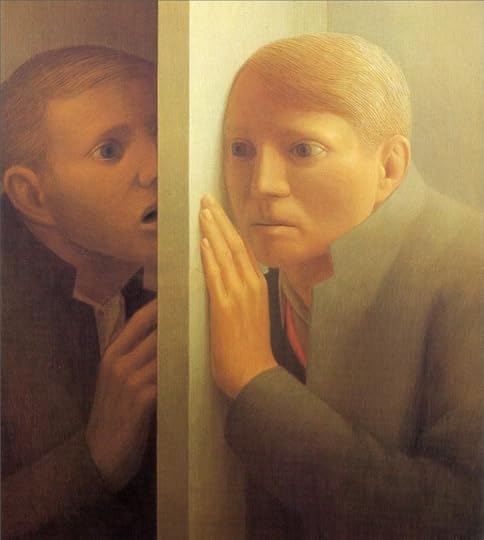
The Big Ear: Julio swings into action, sort of. He offers his neighbor his support by gluing his ear against their common apartment wall. But then Julio has mixed feelings: his neighbor isn’t alone after all; there’s a woman also in his apartment, a woman in a hysterical voice asking about her own skin, saying he must give himself up. He replies: I’m not giving up. The hysterical woman, in turn, says the police will knock down the door and kill both of them. He scoffs: Screw them; we’ll kill ourselves first; come on, babe, kill yourself with me. She says, Papito, you’re crazy; don’t dare say I should kill myself with you. I was always good to you so you be good to me now. Oh, my goodness. Imagine this drama unfolding in an apartment near you – the most memorable neighborhood event, ever!

Bad News: Julio begins to cough as tear gas fills his apartment. Julio quickly runs to open the window and just as quickly returns to once again press his ear to the wall. What intensity! Julio hears the back and forth between Papito and the police. Papito says there’s a woman in here; to let her go or I’ll shoot. Bam! Papito fires his gun just to let them know he’s serious. The cops tell him to let the woman come out. The woman comes out without a word, no good-bye, no wish of good luck for her Papito. Who can blame her? She has more important things to think about – like saving her own skin.

Beyond Terror: At this point, we read: “There’s a deafening nothingness in there, chez Papito. Even I can hear it, though it’s hard to hear things that make no sound. I hear the nothingness and Papito’s breathing isn’t part of it, nor is his terror, nothing. Papito’s terror must be immeasurable, though its waves don’t reach me – how strange – as do those of the gas they are using to drown him.” As in the Luisa Valenzuela quote above – she was the kind of child always poking around wherever there was fear. No doubt about the author using this scene to explore what kind of creature fear really is.

Big Bad Wolf: The police order Papito to come out by the count of three or else they’re breaking the door down. Ear still pressed against the wall, Julio thinks the count of three is nothing, no more time than the trinity, Father, Son and Holy Ghost. Very true, Julio. It’s always the count of three, even going back to the story of The Three Little Pigs. Is the author connecting the police with the big bad wolf? I wouldn’t be surprised.

The Fear That Unites: Julio senses Papito’s terror as if his own. Papito must be running in circles, thinking a powerful telescopic lens is set on his head through the window. Meanwhile, Julio doesn’t turn on his lights – just in case. Papito threatens the police: don’t break the door down or I’ll kill myself. The next thing Julio registers is a shot from inside the apartment, a shot from Papito’s gun that almost obliterates his hearing the cops’ count of three. Reading this section, it’s as if the word “FEAR” blinks on the page between the lines.

Finis: Minutes pass; Julio opens his door, pokes his nose out and managers to sneak into the next apartment unnoticed. Papito is a little rag on the bare floor the police nudge with their boots. They toss him on a stretcher, cover him with a blanket and take him away. Oh, Papito; you are so near, yet so far away. Alone in the apartment, Julio speaks to the remaining blood as if the blood was alive, as if the blood was a red splash of Papito, as if the blood was Papito. Julio tell Papito to shout his name and that he can get him a good lawyer. As per usual, Julio got no answer. For me, this tale underscores how thick the wall of alienation and isolation can be for those living in the grip of a police state. If you are attracted to such tales, Luisa Valenzuela is your author.
Profile Image for Rolando S. Medeiros.
143 reviews7 followers
October 27, 2025
https://naterceiramargem.substack.com...

(...) Vivendo numa fazenda no tempo dalguma guerra, a mulher acaba por ter de que ficar sozinha. Não há homens adultos por perto. Todos foram à guerra. O cenário é de granjas, bois e vacas em campos esverdeados, estradas de terra batida... o menino estuda a mais de quatro quilômetros de onde mora, e tinha vergonha de seu nome: Ariel (que rima com menestrel, ele observa).

Ela (a mãe) tem que dar o jeito dela, tocar a fazenda sozinha. Se sente, inevitavelmente, cansada e solitária. Até que num dia, ordenhando a vaca, olha morro abaixo, e vê, e acha que é uma miragem, sete homens se encaminhando para a vila. “Fechou os olhos e contou como se os tivesse gravado na memória: eram nove. Não era possível, não existiam nove seres idênticos. Era um, no máximo dois, e a sua solidão pregava peças nela, multiplicando o número de homens.”

São sete menestréis, artistas, que estão fugindo do alistamento obrigatório e querem um lugar para ficar. A partir dessa primeira rememoração, e da incursão ao passado, a narração altera o foco e quem toma as rédeas é a mãe: “Há coisas que não se pode dizer a um menino de oito anos, ainda que tenha o cabelo de Alexias e a mão de Antoine e a voz que prometia vir a ser de Michel.”

“E quando servia a sopa aos homens frente à mesa, sentados em bancos largos e estreitos, voltava a contá-los para estar segura do número de sua felicidade. Eram nove.
Profile Image for Bridget Bonaparte.
341 reviews10 followers
September 5, 2021
Gave it a 3 because some of the stories fell really flat for me but it’s hard to rate a collection of stories—“strange things happen here” and “up among the eagles” we’re both excellent. Tonally, they really reminded me of “death and spring” by merce rodoreda.
Profile Image for Rolando S. Medeiros.
143 reviews7 followers
trechos-contos-ensaios
December 16, 2024
All About Suicide — 4/5
Li solto noutra Antologia


‘‘Ismael grabbed the gun and slowly rubbed it across his face. Then he pulled the trigger and there was a shot. Bang. One more person dead in the city. It's getting to be a vice. First he grabbed the revolver that was in a desk drawer, rubbed it gently across his face, put it to his temple, and pulled the trigger. Without saying a word. Bang. Dead.’’


É difícil falar desse conto sem estragar a surpresa para quem vai lê-lo. Basta dizer que eu li sem esperar muita coisa… e acabei nocauteado — alá dizia o amigo do Córtazar.

Grogue, e induzido a voltar ao início.

A autora argentina te engana de muitas maneiras; e de uma muito específica que só vi aqui: pelos pronomes. Depois dessa cena inicial — o suicídio —, o personagem saí andando, revigorado. A narrativa ganha tons absurdos, meio fantástico, meio realismo sujo.

Mas lá no final tudo vai fazer sentido. Há, além da interessante narrativa, uma crítica aos tempos turbulentos vividos pela autora, amarrado e indissociável à forma. É uma aula, por exemplo, para a Nelida Piñon — cito-a somente pela narrativa dela estar fresca na minha memória —, que ao falar da ditadura em um conto o faz pelo modo mais prosaico possível: uma personagem lembrando. Podia muito bem ser um artigo, uma memória, uma autoficção.

Este aqui, impossível. Não podia ser outra coisa. O tema está chapado dentro da forma do conto. A trama te despista completamente. E por isso ele é, diferente do da Nelida, prazeroso e magnetizante — é um conto, mas também é mais.

No meu caso, ela me pegou já na abertura. Já abre na loucura, e entra um narrador do tipo onisciente e intrusão, que depois da cena inicial, começa a “rebobinar a fita” para colocar na mesa as possíveis razões daquela cena inicial. Tem uma coisa no narrador, também, que usa palavras do tipo ‘‘trivialidade’’, ‘‘prazer’’ e ‘‘sensualidade’’ para falar daquela leva de “suicídios” que vem acontecendo na cidade.

E ele vai te levando assim: para entender o ato que põe o conto em movimento não devemos retornar a Ismael (o protagonista) sozinho no bar, na noite anterior, bebendo, pensando no ato e nas consequências, “devemos voltar até o berço, com Ismael chorando por estar sujo de merda e ainda não apareceu ninguém para limpá-lo” (…) "Não, não tão longe. Voltamos demais a fita". Ismael no fundamental; Ismael ministro.

A gente volta até que a fita re-rebobine (?) outra vez e a gente torne à cena inicial; agora, porém, temos um contexto, sabemos mais. E tudo muda completamente. Um giro de 360 graus [sic]. Como também muda quando chegarmos à conclusão. É um contaço par excellence, na definição consagrada: nocauteante e circular. Entre no ringue com essa autora "menor" mas não espere um alvo fácil, a estatura dela engana, deixo-os avisados.


Traduzido pro Inglês pela Helen Lane
Incluso nesta Antologia.
(Recomendo o Original! Li em inglês por comodidade
(ainda não sabia se valeria a pena).
Profile Image for Jeff Hobbs.
1,087 reviews32 followers
Want to read
January 23, 2025
Read so far:

UP AMONG THE EAGLES
*The Censors
The Snow White Watchman
Cat's Eye
Flea Market
Legend of the Self-sufficient Child
Country Carnival
Generous Impediments Float Downriver
The Redtown Chronicles
*Up among the Eagles
The Attainment of Knowledge
One Siren or Another
*The Blue-water Man
The Everyday Colt
Papito's Story

STRANGE THINGS HAPPEN HERE
*Strange Things Happen Here
The Best Shod
The Gift of Words
Love of Animals
*The Verb "to Kill"
All about Suicide--1
The Celery Munchers
Vision out of the Corner of One Eye--2
Ladders to Success
A Story about Greenery
*The Place of Its Quietude

THE HERETICS
The Door
City of the Unknown
Nihil Obstat
A Family for Clotilde
Trial of the Virgin
The Son of Kermaria
The Minstrels

***
*I'm Your Horse in the Night
*Who, me, a Bum?
Displaying 1 - 6 of 6 reviews

Can't find what you're looking for?

Get help and learn more about the design.