Jump to ratings and reviews
Rate this book

Cars at Speed: Classic Stories from Grand Prix's Golden Age

Rate this book
Long before he became a best-selling novelist, Robert Daley was a European sports correspondent for the New York Times. In 1961, he published his first book, Cars At Speed, an historical and contemporary look at Grand Prix and sports car racing at twelve of the worlds greatest circuits.

This hard-to-find and now collectible book, widely considered one of the best books ever written about sports car racing, returns here in a special edition, with a new Introduction by Daley as well as commissioned drawings of each featured circuit.

A rare opportunity to travel back in time to racings golden era, Cars at Speed offers a fascinating look at a time when danger and passion defined racing. Daley discusses the Grand Prix circuits of that era--e.g., Nu00fcrburgring, Monza, Silverstone, Zandvoort, Spa, Monaco--detailing the qualities, history, great races, controversies, and accidents of each. He focuses on the stories of drivers such as the Marquis de Portago, Phil Hill, Stirling Moss, and Jean Behra, among others, recreating the mythical quality of the Grand Prix in its prime.

304 pages, Hardcover

First published January 1, 1962

12 people are currently reading
57 people want to read

About the author

Robert Daley

83 books21 followers
Robert Daley is the author of seventeen novels and eleven non-fiction books. Born and brought up in New York, he graduated from Fordham University, did his military service in the Air Force and began writing stories, articles and books immediately afterward. He was a New York Times foreign correspondents for six years based in France but covering stories from Russia to Ireland to Tunisia, fifteen or more countries in all. Much later he served as an NYPD deputy commissioner, which explains why many of his books have played out against a police background. His work has been translated into fourteen languages, and six of his books have been filmed. He is married with three daughters. He and his French born wife divide their time between a house in Connecticut and an apartment in Nice. France.

Ratings & Reviews

What do you think?
Rate this book

Friends & Following

Create a free account to discover what your friends think of this book!

Community Reviews

5 stars
37 (45%)
4 stars
28 (34%)
3 stars
15 (18%)
2 stars
1 (1%)
1 star
0 (0%)
Displaying 1 - 7 of 7 reviews
Profile Image for Nataliya.
987 reviews16.2k followers
March 25, 2023
“Motor racing is unique. There is no other sport so noisy, so violent. There is none so cruel.”

I’m trying to imagine loving my job so much that I’d be willing to take a significant risk of dying for it, and I really can’t. So really I would have made a crappy race car driver in the 1900s-1960s. (Well, that and the fact that the only time I choose to drive pretty fast is if I’m running late for work, and then I’m terrified by the mere thought of a speeding ticket should I get caught 😅).

“[…] They all crash. This is the central fact of their existence.
Most lives are divorced from violent accident; one forgets how tenuous life really is. Racing drivers, in this sense, are closer to reality than any of us. They are not bemused by the indomitability of man.
They know man for what he is—fragile.
This knowledge is always there.
"Every driver," says Count von Trips, "has a place deep inside him where he is afraid."
Why do they race?”

[…]

“Most of all, motor racing is man gripped by his dream, man pushing out the frontiers of the known and the safe, reaching toward the delicate, the difficult, the dangerous. There is no comprehensible reason why man must do this. Yet he must. And one of the ways he does it is by driving race cars on the outside edge of control, the engine thundering, the wind roaring by, the world beneath his wheels.”
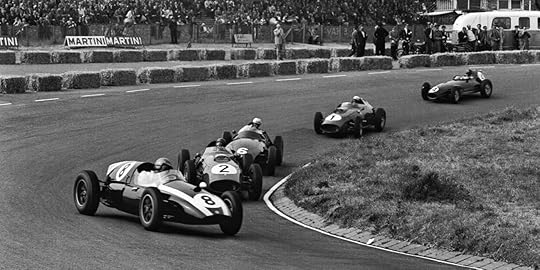


Published in 1962, this book looks at the bloody history of car racing, specifically Formula 1, in the times when with each race the drivers (and often the spectators) had a pretty high chance of not making it to the end alive.

“No matador-de-toros, for instance, has died on the horns in Spain since 1947; but 16 race drivers of Grand Prix stature were killed in the seasons 1957-1961 alone, out of less than 60.”


It wasn’t a super-fancy slick show of racing like it is today (based on my admittedly little knowledge), but pretty scary (and yet decidedly fun, if you take out the death/dying parts) and rough drives where a crash could easily mean the end of your earthly race. Especially in the early years where it seems races were always on the verge of dark comedy and horror show:

“Occasionally the cars had to leave the road to skirt herds of cattle which wouldn't. Individual cars were attacked by dogs, and one at least succeeded in causing a car to turn over.”

“The cars roared away, hurtling round and round the twisty little circuit. Lap by lap the road got narrower and narrower as the writhing, cheering, screaming mass of flesh pressed closer and closer toward the rocketing race cars. Soon there were places where the road had become an alley and men were trying to touch the cars racing by. Men, many of them drunk, tore off their shirts and thrust them like bullfighters' capes into the road, yanking them out of the way of the onrushing "bull" only at the last second. They howled with laughter at this game, while the drivers grew more and more frightened. Some of the drivers shook fists at the crowd, some tried to signal it to please, please move back. The crowd only howled the louder, and played the game with greater disregard for danger.”

“The race went on. Men began to stack the bodies in a neat pile beside the road. The stack got higher and higher as the race continued, and the road ran with blood. The drivers all slowed, passing the spot with horror on their faces and no desire in their hearts to continue.”


And sometimes it was just a surreal slapstick comedy:

“The Grand Prix of Argentina exhibited Latin nonchalance with a vengeance. The circuit usually was swarming with officials, most of them friends of Peron's, none of whom knew anything at all about motor racing. Flag-signaling to drivers was either primitive or nonexistent. One year a political big shot got ready to start the race, but failed to notice that he was standing on the flag. He gave a great upward jerk on the flag handle, nearly upending himself. Half the cars started at this "signal," half didn't. It was a typical Argentina start.”


Apparently Robert Daley didn’t make any friends in the racing community writing this book. It seemed detrimental to the sport — but it seems that deeply loving and admiring the sport did not render him blind to the dangers of recklessness and daring. And to me a guy who loves the sport but yet is realistic about inherent issues in it seems much more credible than someone who’s viewing it all through rose-colored glasses.

The interesting thing is that I know pretty little about racing and Formula 1 (although I’m rectifying that situation tiny bit by tiny bit). But deep knowledge is really not necessary to enjoy reading this book, and Daley writes in a very accessible way even for noobies like me.

4.5 stars.
“Death is like furniture in a familiar room. He knows it is there, but he has not looked at it in a long time.”

————
Buddy read with Dennis.

——————

Also posted on my blog.
Profile Image for Dennis.
663 reviews329 followers
April 8, 2023
Motor racing is unique. There is no other sport so noisy, so violent. There is none so cruel.


This is a highly entertaining book about Grand Prix and sports car racing, from their beginnings up until the early 1960s, when this book was originally published.

It appears to be made up of stories that Daley had previously published elsewhere, as one can tell from a handful of events that make an appearance in several chapters. All of them only once in detail, though, which is why I don’t have any issues with that little bit of repetition. And in any case, the whole thing is so compelling that one barely notices.

The individual chapters are all phenomenal and sure to get motorsport enthusiasts excited – and not only those, apparently, as my reading buddy was at least as excited as I am. The following are not the titles of the chapters but what I consider to be their main themes:

• The beginnings of motor racing, Alfonso de Portago and the end of the Mille Miglia
• Fangio and the madness of the 1953 Argentine Grand Prix
• The Grand Prix de Monaco, Luigi Fagioli and Rudi Caracciola
• The Targa Florio
• Zandvoort and BRM misery
• Spa-Francorchamps, terrible accidents and miraculous escapes
• Le Mans and Pierre Levegh
• The French Grand Prix, Mike Hawthorn and Jean Behra
• The British Grand Prix, intimidating German race cars and Stirling Moss
• Dangerous Portuguese circuits, Phil Hill and Jack Brabham
• The Nürburgring
• Monza and Enzo Ferrari
• American road races, Masten Gregory, Harry Schell and Phil Hill

Through all of them, Daley’s writing is very engaging. He captures the magic and romance of road races particularly well and is at his best when he manages a fine balance between the excitement, the horror and the occasional hilarity of motor racing, at a time when organizers and whole events were amateurish, and safety was an afterthought at best.

Fifteen cars were out of commission by now. Some, like Ascari’s, were wrecked, smashed against fountains in village squares, mired in beanfields below the roads, or had disappeared altogether into ravines or forests.
Boillot slid around bends, thundered through villages whose walls seemed to press in upon the car, inches to spare on either side. In trouble constantly, he grazed trees and bridges, his foot heavy on the accelerator.
He had been driving furiously for eight hours. As he rounded the final turn he was exhausted, the car began to slide wide, and then he lost control of it.
Thirty yards from the finish line it spun three times and crashed into the grandstand.
An emergency crew removed the injured spectators from the welter of splintered wood, then dragged out the car. Boillot and his mechanic were found unconscious beside the road. Limp, soaked, covered with mud, they were slapped awake and thrust back into the car.
It was pointed the wrong way. Too dazed to turn it around, Boillot backed across the finish line in reverse. “Vive la France!” he cried, and fainted.
No other motor race has been won by a car driven backward across the finish line.


To read such a book from a 1960s perspective was particularly interesting. And it seems Daley didn’t make a lot of friends within the community by being blunt about the many terrible accidents that happened in the early days of motor racing. And frankly, still happened for many more years after this book was published. It seems like most people would rather not hear or talk about it during his time.

I think he took a certain delight in it, and occasionally may even be exaggerating, or dramatizing events. Not that they needed dramatizing; motorsport is fucking dangerous, and was especially so back then. But it certainly makes it exciting to read.

If we wonder why a motor racer can continue to race, knowing that death is so very nearly certain if he goes on long enough, tries hard enough, drives fast enough, the answer is that he has thought about death so much, and seen it so often, that it no longer has much significance for him. Once the horror and shock are gone, he does not think about it in the way that you and I do, at all. We think of it physically. We have an emotional reaction. He can think of it only intellectually: If he enters such and such a corner too fast he will probably kill himself.

Sometimes he’s gone a bit too far for my liking, though. When he keeps advocating solid objects for a car that leaves the road to hit, this seems an odd suggestion. But I guess I know where he’s coming from. He’s asking for a challenge instead of circuits that allow drivers to leave the racing line without punishment (a discussion we are still having today), he’s got a deep love for road races, and he’s from a time when cornering speeds were much lower, too. I can understand that circuits that don’t provide much reference for how fast a car is moving might have been a little dull back then. Nowadays you don’t need solid objects next to the track to see how fast these cars are. A couple of esses will do the trick. It’s astonishing how quickly a modern Grand Prix car can change direction. But back then aerodynamics wasn’t much of a factor. And while these cars were pretty fast already in a straight line, lateral grip was nowhere near where it is today. So, yeah, times have changed.

To be completely honest, part of my fascination with the history of motor racing is indeed the risks that drivers took competing in it. Danger and bravery (or insanity – however you want to look at it) is just a significant part of it all. But I don’t want those times back. When Romain Grosjean had his terrible accident at the 2020 Bahrain Grand Prix for instance, I broke out in a cold sweat and just wished for everything to be alright. No, I don’t need that part of racing. Reading about the old times, though? Yeah, I will admit that I enjoy that. Occasionally I was wondering, though, what Daley may be thinking about the new world.

description
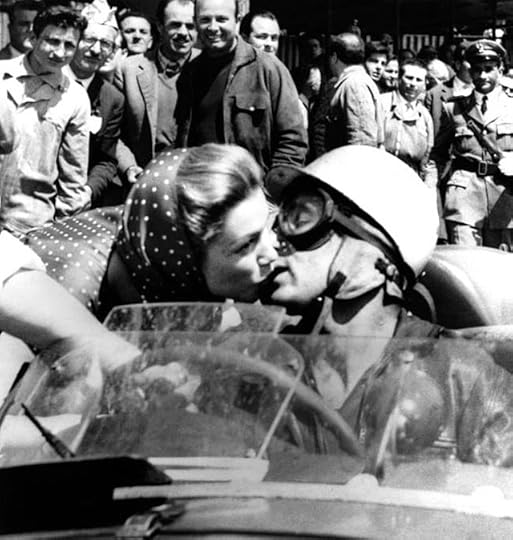
(The Kiss of Death – actress Linda Christian kissing Alfonso de Portago during the 1957 Mille Miglia – moments before he was killed in an accident)

They all crash. This is the central fact of their existence.
Most lives are divorced from violent accident; one forgets how tenuous life really is. Racing drivers, in this sense, are closer to reality than any of us. They are not bemused by the indomitability of man. They know man for what he is—fragile.
This knowledge is always there.
"Every driver," says Count von Trips, "has a place deep inside him where he is afraid."
Why do they race?

[…]

Most of all, motor racing is man gripped by his dream, man pushing out the frontiers of the known and the safe, reaching toward the delicate, the difficult, the dangerous. There is no comprehensible reason why man must do this. Yet he must. And one of the ways he does it is by driving race cars on the outside edge of control, the engine thundering, the wind roaring by, the world beneath his wheels.

Buddy read with Nataliya.
Profile Image for Doug Gordon.
222 reviews8 followers
May 2, 2015
A very good account of the history of Grand Prix and sports car racing up through the 1950s. It was interesting to read these stories in a book that was written in the actual era that it talked about. Books written now about those days tend to look back with some amazement or outright horror at how dangerous racing was, but Daly has a bit more of an accepting attitude about it all. In fact, he talks about not liking the open, flat courses like Silverstone because there is less penalty in going off the road, leading the drivers to be more careless and take more chances. Still, it's hard to fathom anyone allowing a sport today that would kill two or three of its top competitors every year!

Anyone who has read and enjoyed this book should try to scare up a copy of Daly's "The Cruel Sport", also published in the early 60s. It's a large-format book with some of the best photos and writing from that era that I've seen. My Dad bought me a copy for my birthday back when the book was first published about 1962, and it made a life-long Formula One fan out of me!
147 reviews3 followers
March 2, 2014
This book is fantastic. Robert Daley was not a racing driver but seems to understand the sport better than most who have written about it. "Cars at Speed" is also great as a piece of history to show how much the sport has changed since the book's publication.
Profile Image for Aaron Barker.
22 reviews
August 22, 2022
An interesting look into F1 and sports car racing in the 1950's. If you've got interest in this era and subject, it's a compelling read.
Profile Image for Matt.
354 reviews13 followers
January 27, 2014
Instead of "Classic Stories from the Grand Prix's Golden Age," a good sub-title for this one might be "SPEED KILLS!" The author does seem to take a ghoulish delight in detailing the grisly automotive deaths of these Grand Prix drivers.
17 reviews1 follower
January 4, 2015
The essential book on racing in the 1950s. Captures the era like none other.
Displaying 1 - 7 of 7 reviews

Can't find what you're looking for?

Get help and learn more about the design.