Jump to ratings and reviews
Rate this book

Martini: A Memoir

Rate this book
How to live a martini and mix a life.

240 pages, Hardcover

First published January 1, 2005

3 people are currently reading
99 people want to read

About the author

Frank Moorhouse

54 books55 followers
Frank Thomas Moorhouse AM (21 December 1938 – 26 June 2022) was an Australian writer. He won major Australian national prizes for the short story, the novel, the essay, and for script writing. His work has been published in the United Kingdom, France, and the United States and also translated into German, Spanish, Chinese, Japanese, Serbian, and Swedish.

Moorhouse was perhaps best known for winning the 2001 Miles Franklin Literary Award for his novel, Dark Palace; which together with Grand Days and Cold Light, the "Edith Trilogy" is a fictional account of the League of Nations, which trace the strange, convoluted life of a young woman who enters the world of diplomacy in the 1920s through to her involvement in the newly formed International Atomic Energy Agency after World War II.

The author of 18 books, Moorhouse became a full-time fiction writer during the 1970s, also writing essays, short stories, journalism and film, radio and TV scripts.

In his early career he developed a narrative structure which he has described as the 'discontinuous narrative'. He lived for many years in Balmain, where together with Clive James, Germaine Greer and Robert Hughes, he became part of the "Sydney Push" - an anti-censorship movement that protested against rightwing politics and championed freedom of speech and sexual liberation. In 1975 he played a fundamental role in the evolution of copyright law in Australia in the case University of New South Wales v Moorhouse. - Wikipedia

Ratings & Reviews

What do you think?
Rate this book

Friends & Following

Create a free account to discover what your friends think of this book!

Community Reviews

5 stars
24 (42%)
4 stars
15 (26%)
3 stars
13 (23%)
2 stars
3 (5%)
1 star
1 (1%)
Displaying 1 - 8 of 8 reviews
Profile Image for Ian "Marvin" Graye.
949 reviews2,785 followers
January 4, 2022
CRITIQUE:

Companions of the Order of the Dry Martini

A martini is best drunk in the company of another martini drinker, that is, unless there isn't one present, in which case a martini is better drunk alone (or with a bartender (1)), rather than not drunk at all.

In this marvelous memoir, Frank Moorhouse calls these kindred spirit drinkers "martini companions". They're like fellow passengers on a voyage of discovery.

Moorhouse says, "Quite early in my life I developed a taste for stylish bars and clubs away from the egalitarian public bar." This is where he meets, or catches up with, martini companions.

To be a martini companion is to share taste, discernment, worldlinesss, refinement, sophistication, connoisseurship, tradition, ceremony, contemplation, deliberation, analysis, appreciation, celebration, conversation, speculation, debate, and, very occasionally, disagreement:

"I become sad about the imperfections of life most when I hear myself failing my own sought-for human exchanges at the cocktail hour, especially when my conversation becomes intellectually unsafe, reckless in an uncreative way. The martini, however, helps correct failings or obliterates them..."

Dissection of the Martini

Moorhouse adds that -

"It has become part of the custom of the martini drinker to dissect every aspect of the drink, so much so that discussion about the martini becomes cabbalistic...

"The martini is both a simple demonstration and a parody of the Platonic dictum that the unexamined life is not worth living...

"The martini sponsors fellowship, and fellowship and story-telling are our only solace from existential terror."


This memoir is, in effect, a dissection of every aspect of the martini. The undissected martini is not worth drinking, at least in good company. Moorhouse eventually speculates:

"Maybe the martini represents the modernist consciousness..."
The Voltz Perspective

Moorhouse mentions a number of martini companions throughout the book: one is V. I. Voltz, the other is Dr Anderson (who, I presume, is the Australian academic, journalist, editor and author, Don Anderson, who is, at the time of my writing, still alive).

Voltz hails from West Greenwich Village. He never varies his martini recipe - one part vermouth, six parts gin (my favourite version is seven parts gin - I maintain, from experience, that a good martini will make you cough, while a hot curry will make you hiccup).

Voltz believes that "the great martini drinkers just want the gin mixed with mystique."

Moorhouse recounts the legend that Dashiell Hammett drank "like he had no expectation of being alive much beyond Thursday."

When he sent this information to Voltz, he replied, "It may be of interest to you to know that Hammett died on a Tuesday."

description
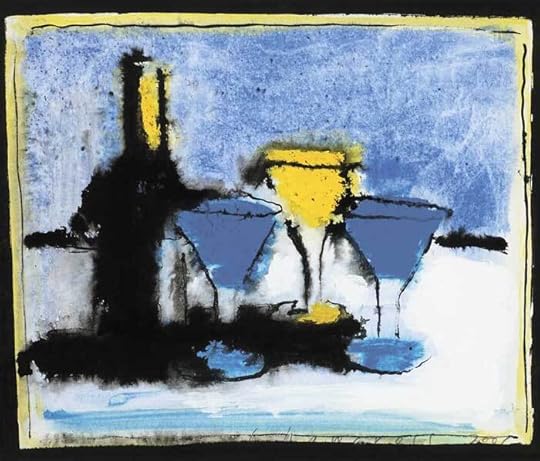
Neil Shawcross - "Still life with martini glasses" source

MEMORIES OF MARTINIS

Room Temperature Martinis

I don't remember the best martini I've ever had. It was probably one that I made at home.

But I do remember the worst I've had.

In Bris Angeles, where the Myer Centre now is, there used to be a bar we called "White Chairs", where a lot of music fans would gather before a gig at Festival Hall. It was named after the white plastic chairs. I think they used to hose them (the chairs) down at the end of the night.

I ordered a dry martini, and received something that was served in a tall glass at room temperature. They'd just had a run on rum and cokes, and had run out of ice. I couldn't drink it, and sent it back, despite my reluctance to waste alcohol.

Sweet Martinis

Occasionally (but rarely), I like to take a break from a dry martini.

For several years, since having our first (at the restaurant Season) in Noosa, FM Sushi and I have enjoyed a home-made midday espresso martini on a Saturday and/or Sunday. To be honest, I'm not sure that this concoction deserves to be called a martini, as much as we enjoy it.

I've experienced two other martini variations, which I'm at pains to describe adequately.

I once ordered a dry martini at a restaurant in Coolangatta called Bellakai. When it arrived, it had a sweet overtone that I appreciated. When I asked, the bartender revealed that it was made with a particular gin, the name of which I can't recall. When I investigated it, all I can remember is that it wasn't especially highly regarded as a gin. But it definitely tasted alright in that martini.

Some time later, I had a version of a martini at a bar in Sydney called Assembly. I don't think it was described as a martini, but it too was sweet. When I tried to match it at home, all I could think to do was add Cointreau (or, say, Grand Marnier). Its sweetness reminded me of orange, which has since made me wonder whether it might have included Angostura bitters (orange version), which was a common ingredient during the 1930's.

One day, I'll get to the end of my martini probe, either via my own investigation, or with the help of a martini companion. I'll let you know when I sort it out.


FOOTNOTES:

(1) V. I. Voltz says, "The bartender should be able to talk a little about the drink he has crafted, discuss your preferences. Should acknowledge that you are a martini drinker, not just any off-the-street drinker. In life, there are drinkers and there are martini drinkers."


SOUNDTRACK:

Profile Image for Rosi Moore-fiander.
11 reviews
November 27, 2014
Quite simply one of the most delightful, entertaining, clever, honest memoirs I have ever had the pleasure to read. Life reviewed with the help of good friends, fellow drinkers, and that most sophisticated of drinks, the martini. I have been inspired to seek out my own perfect martini...it may take a while...olive, anyone?
Profile Image for DoctorM.
842 reviews2 followers
September 11, 2018
Delightful and charming--- Moorhouse takes us on a rambling account of his own life through the martinis he's drunk and the places where he's drunk them. Moments of his own life are woven into bits of martini lore and history, and "Martini" leaves you thinking about both lost love affairs and the vexed question of why pre-1960 drinkers would add a dash of orange bitters to martinis...
Profile Image for Rubina.
1 review4 followers
September 20, 2012
So far so good - if you're an avid martini drinker, you'll appreciate the nuances Moorhouse's memoirs offers.
Profile Image for Jonathan.
994 reviews54 followers
October 26, 2024
Entertaining, informative, very funny. Frank Moorhouse pretty much falls into the category of genius writer in my opinion. I don't think it is possible to read this without craving a Martini.
Profile Image for Evan Wright.
12 reviews301 followers
Read
January 30, 2010
I became interested in this author after reading in the news today that he is boycotting a literary tour in China to protest the Communist government's imprisonment of Liu Xiaobo, lead organizer of the "Charter 8" petition and manifesto. Liu has also been a literary critic and guest lecturer at Columbia University.

Charter 8 was an open letter to the Communist Party leaders of China calling for press freedom and democratic reform. Liu was arrested on December 8, 2008 and later sentenced to 11 years in prison by the government of China.

Frank Moorhouse is an Australian author who has spoken out against the imprisonment of Liu and the overall suppression of free speech in China. His refusal to tour China was done, he says, to draw attention to its government's oppression of its citizens.

I ordered Moorhouse's memoir today, curious to read about his life. Am always interested in people who make unusual moral choices.

Moorhouse wrote the screenplay for the 1985 film, The Coca-Cola Kid, a kind of brilliant small picture starring Eric Roberts before he lost his mind and who is terrific in it. Awesome script.


Profile Image for Miss.
126 reviews5 followers
March 1, 2012
Still reading. Still enjoying it. And then at 157 pages I realized I don't really care that much about martinis.
Displaying 1 - 8 of 8 reviews

Can't find what you're looking for?

Get help and learn more about the design.