Jump to ratings and reviews
Rate this book

The Witches: Three Tales of Sorcery

Rate this book
Les aventures qui nous sont contées dans ce livre troublant appartiennent à l'Histoire.On rencontrera ici une orpheline de douze ans, Anne, qu'on élève par charité dans un couvent, avant de la placer chez une personne singulière. Pieuse avec passion, la petite découvre peu à peu que l'extase n'est pas son lot. Pour forcer l'inconnu, elle suit ses maîtres dont les agissements la mèneront, droit au sabbat, au grand jeu de l'enfer et des maléfices.Élisabeth, elle aussi, est élevée dans la piété la plus rigoureuse. C'est après son veuvage qu'elle s'abandonne, avec des soubresauts, au vertige d'un amour défendu. Charles, qu'elle aime et qu'elle hait à la fois, paiera de sa vie cette passion démoniaque dont il est possédé, tandis qu'Élisabeth, exorcisée, fondera un ordre de filles repenties.Jeanne, enfin, est une vieille bohémienne, issue d'une lignée de " sorcières " de village, ces boucs émissaires qui paient épisodiquement pour les péchés de tous. De passage dans la région, le célèbre juriste Jean Bodin instruit lui-même ce procès, à titre d'expérience, avant d'écrire sa Démonomanie. Sous ses yeux, Jeanne se condamnera lucidement, fatalement, au b-cher, comme si elle répondait à un appel plus profond qui concerne chacun de nous, comme si nous étions frères dans le mal.Trois âges de la nuit. Trois étapes sur le chemin d'une sorte de sainteté à rebours, une tentation obsédante qui ne nous est pas étrangère, car elle demeure de tous les temps. Trois personnages qui ressemblent, par bien des aspects, à certaines héroïnes de Françoise Mallet-Joris et trouvent leur place dans son univers romanesque.

Hardcover

First published January 1, 1969

4 people are currently reading
117 people want to read

About the author

Françoise Mallet-Joris

50 books6 followers
Françoise Mallet-Joris is the nom de plume of Françoise Lilar, a Belgian writer.

She is the daughter of Suzanne Lilar

Ratings & Reviews

What do you think?
Rate this book

Friends & Following

Create a free account to discover what your friends think of this book!

Community Reviews

5 stars
10 (41%)
4 stars
6 (25%)
3 stars
5 (20%)
2 stars
3 (12%)
1 star
0 (0%)
Displaying 1 - 6 of 6 reviews
Profile Image for Heather ~*dread mushrooms*~.
Author 20 books567 followers
August 27, 2014
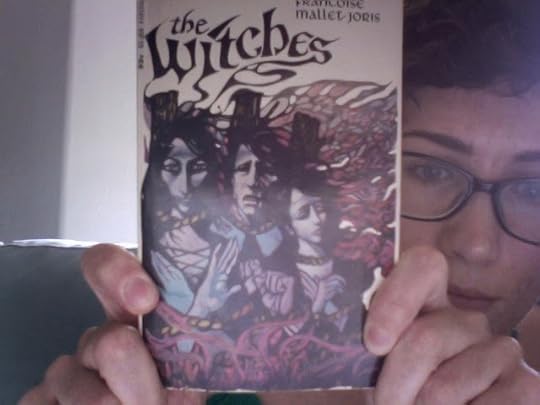
This book has a really cool cover, and I'm sharing it with you.


Also part of my face.

Told in three parts, this book presents fictionalized accounts of three historical women accused of and/or put to death for witchcraft. The French title is Trois âges de la nuit, which translates directly to Three Ages of Night, according to Google.

part one: Anne, or theater (1620)
This part tells the story of Anne de Chantraine, who was burned at the stake when she was only seventeen. Anne grew up with a traveling salesman sort of dad, and then he pawned her off on a convent for orphanages when he realized he couldn't handle a young person who menstruates. At the convent, Anne becomes less a sympathetic character and more child-who-delights-in-evil-beause-she-doesn't-know-any-better. Unfortunately, her downfall begins when she's placed outside the convent in the home of Christiane, a widow who participates in some shady dealings with her brother-in-law, Laurent. Like robbing and devilish bacchanalia, to name a couple.

I very much enjoyed the writing, which flowed quite well for a translation. It seems like none of the poetry was lost. There was a surprising amount of detail and insights into each character, though I have no idea how much liberty the author took with these things.

part two: Elizabeth, or demonic love (1592)
*SPOILERS*
This part is about Elizabeth de Ranfaing, an innocent young girl who doesn't realize how her mother, Claude, manipulates her with religion, because it's basically all she's ever known. Claude is obsessed with molding Elizabeth into the most perfect, pious little subject, and gets freaked out when she thinks Elizabeth is acting too vain or whatever. And Elizabeth, when she feels she's being vain, freaks out too, and punishes herself by denying herself friends and laughter and whatnot. Elizabeth's father gets jealous of all the attention Claude gives her daughter, and as a result Claude and Captain de Ranfaing get all weird about showing each other affection.

Her mother's manipulation results in great psychological ramifications later in Elizabeth's life. Elizabeth gets married off to a fifty-six-year-old man and is a dutiful wife beyond reproach. But she begins a friendship with the family doctor, Charles Poirot, and after her husband dies everything falls apart. The details of Elizabeth and Charles' tragic obsession with each other is pretty riveting. Unfortunately, Elizabeth's mother fucked her up so much that an exorcism becomes necessary. And then Charles is arrested and he's the one burned at the stake. And then Elizabeth feels better about herself and founds an Order to rescue prostitutes.

Apparently mothers and God are capable of ruining everything.

part three: Jeanne, or revolt (1578)
This last part was extremely disappointing to me. The characters were much less compelling and the structure was almost nonsensical. It opens with a woman accused of witchcraft (der) mouthing off to a judge. While that's always fun to read, it quickly got tiresome. Her trial (a sham, of course) is interspersed with her backstory, as well as the backstories of the judge, clerk, and executioner, none of which are very interesting. There were a few lovely paragraphs, but they weren't enough to carry the whole. It actually felt kind of lazy compared to the previous sections. In the author's note, Mallet-Joris said she worked from only one source to tell the story of Jeanne Havilliers, so maybe that's why it lacked depth.

It took me a long, LONG time to read this book. Well, less than a year, but still months. Sometimes it was boring, sometimes it was an exciting page-turner (in the middle section, mainly). The author did take some liberties with facts, but everything felt historically accurate enough, and for the most part, the depth of the characters made for interesting reading. Historically, being a woman is tough and horrifying. Religion and government have never been kind to us.

3.5 stars.

BONUS CONTENT!
Are you interested in learning about psychic sciences such as ... star gazing and yoga? Do you want to know if there's really been "a satisfactory explanation for recurring blackouts?" You're in luck!


(Sorry for the crappy picture quality.)

Edgar Cayce features prominently in the ads of this book, as well as two sensational occult books, ODDITIES and ENIGMAS. Unexplained facts, guys! (How it's a fact if it remains unexplained, I do not know.) There are also a couple of cool-sounding novels, The Druid Stone and Witches' Sabbath. *adds immediately* *expects Nenia to do the same*
Profile Image for Janet.
Author 25 books89k followers
March 10, 2012
Francoise Mallet-Joris was a major French writer who isn't much read in America, but this book deserves a wider audience. It's the stories of three very different women, who all were condemned as witches by the Inquisition for far different reasons. I think of this often, looking forward to rereading.
Profile Image for Hesper.
411 reviews58 followers
June 25, 2015
I was obsessed with this book in high school, for reasons I no longer remember, but which I guess have to do with A) historical witches!! fictionalized historical witches, you guys!!;* B) intense bleakness rendered with swift, clear prose; and C) skipping last period one day junior year with Portia and Isabella** (who never hung out together; Por thought Is was awkward, and Is thought Por was a "social moron"), gorging ourselves on Klondike bars, then getting them to shout "the devil's sperm is cold"*** whilst walking home on a hot spring afternoon.

So yeah. 10/10 would recommend. Assuming a copy can still be found somewhere. I claimed mine at a thrift store that no longer exists.

*Anne de Chantraine, Elisabeth de Ranfaing, and Jeanne Harvillier. The novel is really three thematically linked novellas.

**Not their real names, obviously.

***A sentence fragment from the book (Anne or Jeanne, I think), where it carries a lot more weight than anything a teenage girl might scream for shock value on a dare.
Profile Image for Jean Triceratops.
104 reviews40 followers
February 1, 2023
I … I can’t do it; I’m a mere 28 pages into The Witches by Francoise Mallet-Joris—a far cry from my normal minimum of 50 pages—and I’m throwing in the towel.

Part of my love of reading is a love for experiencing stories on a personal, immersive level. I don’t think movies or television shows can achieve this same level of immersion because we can see the people living these moments. We’re watching them live their lives; we’re not seeing the world through their eyes.

It should come as no surprise, then, that I often struggle with books that have a hard narrator.
If the narrator is also essentially a character—think the narrator from The Turn of the Screw—I can roll with that. And if the narrator is a bit matter-of-fact and exists to impart things we otherwise couldn’t know—think the narrator from Jonathan Strange and Mister Norrell—I can roll with that too.

If the narrator is an ambiguous middle-person pontificating on life and the universe and the nature of being human—think Even Cowgirls Get The Blues—I cannot roll, because I cannot immerse myself in anything but the narrator’s philosophical musings. And while I love books that make me ponder philosophically, I universally distrust books that do the philosophical pondering for you and then hand over their thoughts as if they were facts.

The Witches falls spectacularly into this realm of disembodied pontificating voice. I’ll give you an example paragraph:


Anne had reached the age of fourteen, an age when the worst and the best mingle, and in her shrewdness, her sly, false humility, is it not possible to distinguish a humble and secret need to be loved and accepted, along with a fear of being unworthy? And, too, can one not decipher her need to feel that others were like herself in her effort to find the flaw, the weak point in their lives, since she herself felt invested with sin? Sin is something children feel most keenly, because it is not yet masked by the travesties of social life. The child who tortures an animal, humiliates a comrade, filches an object, or succumbs to impure behavior does not give to its cruelty the alibi of power, to its pride that of merit, to its avidity that of need, to its concupiscence that of love. The child knows evil in an undiluted state, gratuitous, as he is occasionally privileged to know good. Thus, the child may have the spiritual intuitions whose depth amazes. But he has this sensitivity only to lose it afterward, and to recover it only after a thousand transformations.



Most (if not all) of the 28 pages I read read like that. Anne—the protagonist—is only experienced through the voice of this narrator. And oof, what a voice. Love it or hate it, it has a serious presence. There’s no ignoring it.

The funny thing is I don’t feel terribly comfortable judging The Witches. It could be amazing or it could be awful, all I know for sure is it’s not me. Even on the bus, I’d read part of a paragraph and get distracted. I had nothing better to do, but, well, staring out the window seemed nicer somehow. Which is why I’m moving on.

[I read old fantasy and sci-fi novels written by women authors in search of forgotten gems. See more at forfemfan.com]
Profile Image for Olha Yeremenko.
84 reviews6 followers
August 21, 2018
Рассчитывала на более простые истории о процессах над ведьмами, но книга оказалась неожиданно глубокой и реалистичной, с прекрасно прорисованными персонажами. Каждая история - свой путь героини к "колдовству". Наиболее впечатляющей для меня оказалась история Жанны - третья новелла с подзаголовком "Бунт". Но она, пожалуй, и самая трагичная. Хотя счастливого финала нет ни у одной истории в этой книге, конечно. Любопытный очерк об истории колдовства - в конце.
Displaying 1 - 6 of 6 reviews

Can't find what you're looking for?

Get help and learn more about the design.