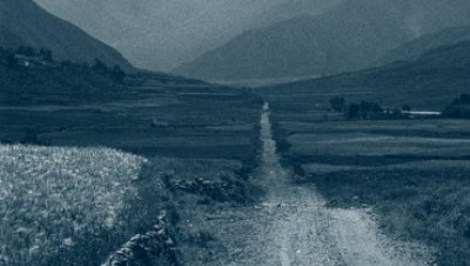
Dukla ist ein verschlafenes Nest in Südpolen, am Rande der Karpaten, nicht weit von der slowakischen Grenze entfernt. Auf dem Marktplatz hat sich alle Leere der Welt versammelt. Ein Wind herrscht, der direkt aus Alaska und Sibirien herüberweht. Mit seinem bröckelnden Mauern und dem Schloss der Fürsten von Brühl, den beiden Barockkirchen und der niedergebrannten Synagoge ist Dukla ein Ort, der eine magische Anziehungskraft auf Stasiuks Ich-Erzähler ausübt. Wie unter Zwang kehrt er immer wieder in das Städtchen zurück, "um es bei unterschiedlichem Licht, zu unterschiedlichen Tageszeiten anzusehen". Sein Versuch, den Geist des Ortes zu fassen, der Materie ihr Gedächtnis zu entreißen, macht die Spurensuche zu einer dichterischen Expedition. Andrzej Stasiuk beschreibt sein Buch als einen 'schwer zu beschreibenden Akt atheistischer Mystik, eine sehr meditative Prosa. Es geht um ein tiefes Eintauchen in jedes Ereignis, darum, all das, was sichtbar ist, zu notieren - um ein postreligiöses Erl eben der Gegenwart.'(LITERATUREN) 'Die Welt hinter Dukla' besticht durch eine ebenso präzise wie lyrische Prosa, deren Metaphorik sich auf eindringliche Weise der Landschaft und den dort lebenden Menschen annähert. 'Es ist ein erotisches Buch des Sehens, eine sexuelle Prosa. Es geht um das konkrete Berühren der Welt.' (wdr nachtkultur leselust)
Andrzej Stasiuk is one of the most successful and internationally acclaimed contemporary Polish writers, journalists and literary critics. He is best known for his travel literature and essays that describe the reality of Eastern Europe and its relationship with the West.
After being dismissed from secondary school, Stasiuk dropped out also from a vocational school and drifted aimlessly, became active in the Polish pacifist movement and spent one and a half years in prison for deserting the army - as legend has it, in a tank. His experiences in prison provided him with the material for the stories in his literary debut in 1992. Titled Mury Hebronu ("The Walls of Hebron"), it instantly established him as a premier literary talent. After a collection of poems Wiersze miłosne i nie, 1994 ("Love and non-love poems"), Stasiuk's bestselling first full-length novel Biały kruk (English translation as "White Raven" in 2000) appeared in 1995 and consolidated his position among the most successful authors in post-communist Poland.
Long before his literary breakthrough, in 1986, Stasiuk had left his native Warsaw and withdrew to the seclusion of the small hamlet of Czarne in the Beskids, a secluded part of the Carpathian mountain range in the south of Poland. Outside writing, he spends his time breeding sheep. Together with his wife, he also runs his own tiny but, by now, prestigious publishing business Wydawnictwo Czarne, named after its seat. Apart from his own books, Czarne also publishes other East European authors. Czarne also re-published works by the émigré Polish author Zygmunt Haupt, thus initiating Haupt's rediscovery in Poland.
While White Raven had a straight adventure plot, Stasiuk's subsequent writing has become increasingly impressionistic and concentrated on atmospheric descriptions of his adopted mental home, the provincial south-east of Poland and Europe, and the lives of its inhabitants. Opowieści Galicyjskie ("Tales of Galicia"), one of several works available in English (among the others are "White Raven", "Nine", "Dukla," "Fado," and "On the Road to Babadag") conveys a good impression of the specific style developed by Stasiuk. A similar text is Dukla (1997), named after a small town near his home. Dukla achieved Stasiuk's breakthrough in Germany and helped built him the most appreciative reader-base outside of Poland, although a number of Stasiuk's books have been translated into several other languages.
Niente trama, non aspettatevi una trama, avverte Stasiuk, e mantiene la promessa: ci offre una serie di pagine, quando più riuscite, quando più deboli o ripetitive, che parlano essenzialmente di luce e memoria.
Stasiuk potrebbe chiamare la luce “mia sorella, mia sposa”, la conosce frequenta e possiede meglio di un pittore e di un fotografo [per quanto riguarda la memoria, invece, ci sono probabilmente fratelli e sposi più significativi]. E, insieme alla luce, naturalmente, anche l’oscurità, suo inesorabile coniuge. È come se ci insegnasse a guardare, più pittore che fotografo.
E per farlo, sceglie di condurci in un luogo di confine per eccellenza, dove le frontiere si intrecciano e modificano la luce e il buio: Dukla, ai piedi dei Carpazi, laddove la Polonia incontra l’Ucraina e la Slovacchia.
È un flusso di coscienza, pensieri, ma soprattutto descrizioni – e mi sono tornati in mente i poeti beat americani. È come non leggere, ma perdersi in fantasie di un sognatore a occhi aperti. Poi, ogni tanto il lettore-ascoltatore si risveglia, si chiede quanto tempo è passato dall’ultima pagina, e dalla sua ultima visita a Dukla, dove, naturalmente, non è mai stato prima, ma invece adesso, condotto dal narratore, che è così automatico assimilare allo stesso Stasiuk, conosce a memoria la chiesa di Santa Maria Maddalena e la statua di Amalia Mniszech, e le vie gli incroci le case le finestre le ragazze la birra le sigarette lo shampoo i bar la gente i tavolini la sabbia l’ombra le foglie… conosce Dukla come se la frequentasse da quando era giovane, proprio come ha fatto Stasiuk, che mischia ricordi di tenera età a osservazioni sul presente (no, il futuro no, mai il futuro: quello richiede immaginazione, e il narratore Stasiuk tende a non fidarsi dell’immaginazione).
Fotografia di Monika Witek.
E il momento migliore in cui Stasiuk coniuga quotidiano a eterno, basso ad alto, ordinario a sublime, è nella descrizione della adolescente che balla in una discoteca all’aperto vista attraverso gli occhi di quel tredicenne che lo stesso Stasiuk fu. Momento di particolare erotismo: sarà per questo motivo che una donna darà alla ragazza della puttana?
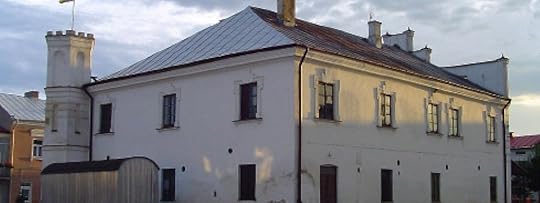
Marketplatz di Dukla.
Stasiuk descrive, e non si ferma all’apparenza, alla superficie, va oltre, più oltre, dà l’impressione di voler entrare dentro le cose e la gente, di volerle indossare come se fossero un guanto, per possederle con la conoscenza, sensoriale prima che intellettiva.
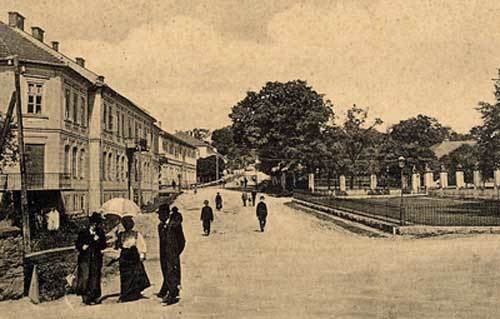
Vecchia cartolina di Dukla.
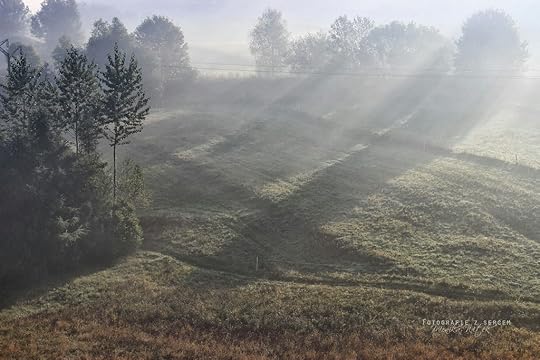
I viaggiatori della fine del Settecento, tanto più se anche pittori, si portavano spesso dietro un piccolo specchio che prendeva il nome dal pittore francese Claude Lorrain, che nel Seicento ha dipinto tra gli altri anche “Paesaggio con danzatori” (cui Stasiuk dedica pagine intense e ‘illuminate’), o era anche chiamato black mirror: si tratta di uno specchio con la superficie tinta di scuro leggermente convesso per distorcere in modo garbato l’immagine riflessa, ma soprattutto per ammorbidire colori contrasti e linee, in modo da ricordare vagamente le gradazioni di colore per le quali Lorrain è famoso. Il pittore, o viaggiatore, dava le spalle al paesaggio, e prendeva in mano lo specchietto, per osservarlo riflesso ma anche rifratto sulla superficie convessa. Stasiuk probabilmente non è tornato a Dukla e non ha attraversato il mondo dietro Dukla con un “Claude glass”, ma ha seguito lo stesso processo, le immagini più nebbiose, morbide di tinta e contrasto, sono quelle della memoria, man mano che si avvicina all’oggi, alla realtà del presente, il fuoco diventa più preciso e dettagliato.
Esempio di Claude Glass.
E io continuo a far ritorno a Dukla, per poterla osservare in diversi colori e ore della giornata…finché si compie quella sorta di miracolo, nel quale la luce si spezza in maniera straordinaria e si intreccia con il tempo in un tessuto trasparente, che ricopre il mondo per una frazione di secondo e allora il respiro viene meno come prima di morire, ma non c’è nessuna paura.
Il tempo è il rovescio dello spazio e attraverso le sue tende le cose si vedono ancora più nitide, se non altro perché non le si potrà toccare mai più.
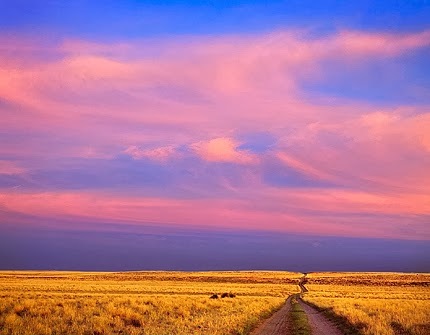
Immagine usata sulla copertina di un altro libro di Andrzej Stasiuk, Wschód.
Ho sempre voluto scrivere un libro sulla luce. Non riesco a trovare un’altra cosa che ricordi più da vicino l’eternità. È buffo che, provando a sopraffare il tempo, torniamo di solito al passato, a quello che è stato modellato, alla forma pronta. L’immaginazione non riesce a inventare niente. Sospesa nel vuoto, ricade come una pietra o si occupa di se stessa, che alla fin fine è la stessa cosa.
Dukla
PS Ho inzeppato di immagini perché questo libro è un invito a farlo, sin dalla copertina che mi è particolarmente familiare.
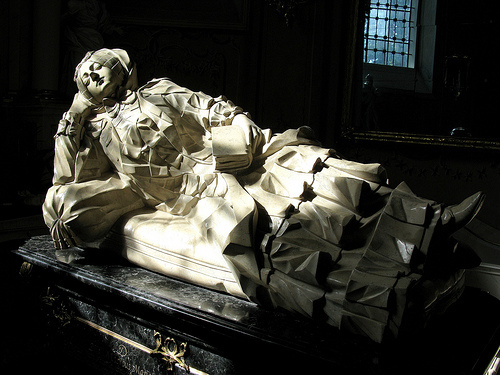
Tomba di Amalia Mniszech nella chiesa di Santa Maria Maddalena a Dukla.
[4.5] Beautiful writing about place and nature around one small town in southern Poland. At least, I think most of this book is gorgeous; if you're one to get enthused by 5-star reviews in the feed but don't always check the book page, you should know that quite a few people on here disagree with me. Also described as one of the country's key books of the post-Communist era – first published 1997. Perhaps a reconnection with non-political subjects, and feelings and philosophising over socialist realism – I don't know enough to do more than guess.
It's structurally strange: one long dreamy episode entitled, 'Dukla' includes many visits, wanderings and memories, and makes up over 70% of the book. Then towards the end, 17 short chapters, some which would be only a couple of pages in a print edition, contain precise and lovely vignettes about nature.
The main chapter has the feeling of both a holiday and being at home in the same town, and mostly alone - perhaps like having several days to yourself in somewhere you've recently moved to, or staying for a while in a place you used to live, from which most friends have moved away. Actually, the writings are drawn from many separate daytrips, the practical details of which are mentioned briefly, yet still it elides together, making it feel like one short period of time. (Its underlying theme is light - an attempt to capture the effects of light in prose rather than pictures; I did not find this so noticeable, but the scenes have strongly visual qualities, like photos or short films.) The writer mentions companions in passing, but the feeling is always of one lone person and his consciousness, meeting and describing this place. Initially, it's like all the descriptions from a book have been pasted together, with none of the plot. I love descriptions, but did nothing but descriptions make the book too slow, hard to get a grip on? At first, yes. Then something clicked, I flung myself into it and read it in a few hours, entranced. It is not precisely organised: it gives the effect of following someone as they decide where to go on the spur of the moment, and hearing inner thoughts of their old memories on the way there and back - but as everything, both inside and outside his head is communicated by words, there's a sense of slipping and sliding between times: principally the mid-1990s, when this was written, and the 70s, when the author was a boy. (For a Pole of his age, or one who's a fan of vintage and retro, these 70s sections would be a feast of nostalgic references. I love the sentence where Stasiuk classifies an outfit historically, like a fashion ornithologist: early Gierek, Różyckiego bazaar in Warsaw. Even if you don't know what that look means yourself, if you pay attention to clothes, you will know of some equivalent - and perhaps also guess at Gierek's significance and duration, for we might conceivably say 'Thatcher' or 'Blair' in such a way, but probably not 'Callaghan' or 'Brown'.)
This book gets under my skin, puts feelings into words perfectly: things I didn't know how to articulate and which I don't think I've found before in other nature and travel writing. Maybe some Slavic race-memory. It's like the bits that were missing when Robert MacFarlane otherwise wrote down much of a feeling of things which I recognised, probably from being raised in the same country at the same time on a lot of the same books and TV. (All these hits make up for the slight misses: a few too many boyhood tales from Stasiuk, too similar to those heard from dozens of other authors, or an excess of mentions of his favourite tomb in the church.) Stasiuk is also more metaphysical than most other writers I've read on these subjects.
especially in the night, when the terrain is stripped of its landmarks, when we’re driving... We’re traveling between place-names in a solution of pure idea. Reality doesn’t put up any resistance, so all stories, all consequences, all the old marriages of cause and effect are uniformly devoid of meaning. Observing a dog out of the window on the same journey: At this time of day smell and hearing slowly lose significance, while sight hasn’t yet acquired it, so it’s best to treat everything as if it were a dream, a figment of the doggy imagination. The feeling of stations, airports, and journeys generally, being places which are nowhere and everywhere, gateways of possibility, places where time pauses or changes shape is one I've always had, and which this year I keep encountering in different books and in other people's reviews. This is another version of same. The idea still hasn't been repeated anywhere near enough to lose its magic. A journey at night has that same feeling tripled.
Whilst these words seem to buzz with summer haze - always gorgeous yet sometimes frustratingly slow: nostalgic smell that makes you long to take a journey without a destination, moving slowly and tediously across a still, ornamental landscape
And I don't think I've ever heard another writer on similar subjects detach and hover above it all this way before, although similar thoughts have occurred to me if I'm feeling very calm and looking at a view for long enough, because of how differently I've felt in front of that same scene some other time: Actually, I’m not doing anything other than describing my own physiology. Changes in the magnetic field recorded by my retina, fluctuations in temperature, differing concentrations of scent particles in the air, oscillations of sound frequencies. That’s what the world is composed of. In a way it's simply the record of a nervous system.
Just occasionally he's delightfully silly, and all this seriousness is broken: I’m only interested in whether time is a disposable item like, say, a Povela Corner paper tissue from Tarnów . Don't know the brand (if it's a brand), but like to imagine it being one of those regionally specific items that used to differ between small newsagents in separate areas of the country.
Especially near the beginning of the 'Dukla' chapter, there are wonderful panoramas of humanity, the sort of thing I've only ever been able to describe as like The Divine Comedy's 'Tonight We Fly', and looking out of the window at night whilst listening to, or thinking of the song (as it felt when for years I was the only person I knew who loved that album. It will never compute that over ten years later, I saw it had become an end-of-gig, lighters-in-air anthem. Its essence is to be alone whilst thinking of distant others, who are more poignant for being distant.) Dozens of them, hundreds, along the whole route thousands of bodies and souls, each one trying in its own way to cope with the day. They were sitting around tables, stoves, televisions. Their heads were populated with all the people they’d ever known or remembered. The people they knew and remembered had their own people, and those people had theirs... R. and I were talking but I kept losing the thread of the conversation, because infinity always inspires awe… An untold number of past beings came together to make up his existence, and each of them was the size of the whole world. Reality is nothing more than an indefinite size of infinities.
The sense of night and its possibilities: I don't think I've ever seen it written in a way that gets closer to the way I feel than this. Very now and very decades or centuries ago and very primal, and with a sensory tang of summer evening: Saturday evening into the bargain. Young men were swaggering along the side of the road, night was coming out to meet them and was so immense that each of them thought they’d see all their dreams come true.
Perhaps the TVs were waiting alone in empty living rooms, like faithful dogs. Leżajsk beer and wine viscid from the heat. The young guys were disappearing in the darkness, girls stood for a moment longer in the ring of light then vanished too. Through the windows of stores the shop girls could be seen in their regular clothes. Their aprons had already been thrown in the laundry. It was a sultry twilight carnival, as the dark hour advanced from the bushes and orchards. That’s where night assembles before it heads out into the world, while they were entering into it, vanishing, passing through the gloom one by one, lighting the way with their cigarettes, and meeting up somewhere in its heart, far from view.
People separate into their selves and their longings, emanate their own half-visible likenesses so the latter might try all forbidden things.
Another night, another place a few dozen miles away: We waited for dusk to fall over Kežmarok, so everything around us would disappear and there’d be darkness, which is the same everywhere, and allows you to breathe freely. Oh but yes, I nearly always feel better in the dark, and somewhere small and remote is best of all. Obligations are on pause, the world is far away; relaxation, and yes, [usually] breathe freely.
And another: In the beginning was darkness and now, at six forty in the evening in 1996, the oldest time is in progress. It always feels that way, especially in places without light pollution, where it gets truly dark. (Except when the moon is so bright you can understand why peasants sometimes worked by it.)
The morning, and afternoon, after: Sunday in a small town, witnessed as a quiet outsider: the gravid Sunday atmosphere. Even the wind was slowly easing off. There was no sign of holiday debauchery. Nothing but a taut, condensing expanse. It embalmed the town, submerged it in transparent sap, as if it were to remain that way forever as a marvel of nature or an educational demonstration of what happens when time is utterly wasted. The only exception was a black mongrel with a tucked-in tail trotting along, blithely unaware it was Sunday. There is something I know and feel here which has always been missing from the many clever evocations of Sunday boredom in British words and music, and I'm not sure I can pinpoint what it is, save that that idea of boredom and sorrow has always been inadequate.
I love the way the words make me feel this place: That night I clambered up to my little attic room in the dark. There was a smell of resinous wood. The boards were radiating the heat they’d absorbed during the long day. I turned on the light. Black ground beetles hid themselves in the cracks of the floorboards. They looked like mobile drops of tar. I could smell them in the heated air. It becomes a blend of really good saunas that still smell of pine, and slightly fusty-smelling rustic wooden European hotels in the 80s or 90s, but also much more alive than any of that.
This metaphor couldn't have come from a middle class contemporary writer in Britain: one showing through beneath another like a shirt under a threadbare sweater, like the skin of someone’s backside under well-worn pants. It has to be from another country, or from someone who's really known what it was like to be poor and among other poor people, for a long time.
The European mainland phenomenon of regular named windstorms – Mistral, Sirocco, etc. - that drive people a little mad, seems to the British so very florid and foreign and Other. It's something I'd love to experience first hand. Turns out this region has one too: The warm southern halny wind hadn’t yet begun to blow. Right now it was probably gathering strength over the Great Hungarian Plain, stretching out its paw and feeling the south side of the Carpathians for fissures, low-lying passes, and broader saddles by which it could break through and descend on the unsuspecting Podgórze region, sowing mental havoc in its inhabitants... Before the halny blows, everything is quiet and alien. Sparks dance inside bodies, nerves grow taut and overheated, the skin stops protecting them and for this reason the boundary between everyday banality and madness grows slender as a single hair.
Other local features: The iron harrows on the wagons, the pitchforks, harnesses, rubber boots on bare feet, the symbiotic smells of stable and home, the powerful age-old interweaving of human and animal existence, curdled milk, potatoes, eggs, lard, no long journeys in search of trophies, no miracles or legends other than satiety and a peaceful death. They stood there, leaning on the wooden helves of their implements, rooted in the earth that would soon shake them off the way a dog shakes off water. Reminds me that horses and carts were still in every day use in Eastern Europe in the 90s, but it looked a hard-knock, dusty-road life, not obviously picturesque. Trying to see those scenes now with later eyes, after discovering the pleasure in the 'metaphorical carry water and chop wood', but still, what strength of mind and constitution it might require to be without so many things I've been used to. Damn, he puts it infinitely better. All that's contained there. Some beliefs from this vanishing world: In my grandmother’s stories the world of supernatural beings didn’t have anything to do with the world of the saints, the church, ritual. The former was an everyday matter, while the latter served as a measure of time, material for invocations and for a moment of respite on Sundays. The ghosts came as visible proof that in essence reality is indivisible, and that things are rather different than they appear.
One journey takes Stasiuk and companions over the border into Slovakia, increasing Dukla's sense of place by widening context: Where can anyone go from Dukla? From Dukla you can only return. It’s the Hel Peninsula of the Carpathians, an Ultima Thule in the form of a town. Beyond here there’s nothing but wooden Lemko cottages and the concrete remnants of Le Corbusier’s bastards—which is to say, things that present no challenge to the landscape. There are never more than two buses waiting at the bus station at any one time. Long-haul trucks from Romania slow down for a moment, for half a mile, then at the Cistercian monastery they floor it again. One of those end-of-the-line small towns. I find them hard: they make me feel like a frustrated, trapped teenager, but then on an island they're usually near a coast and have that distinct coastal rundown-ness ('Every Day Is Like Sunday'). There is only one way back out. Hundreds of miles from the sea, they're not really at the end, there always is somewhere else if you keep going long enough: We’d crossed the Carpathians, fled their northern shadow, and all of a sudden light was omnipresent...
The dumplings, gravy, potatoes, sausage, and cabbage still belonged to the north, but everything else was more like fire than earth. The sulfurous yellow walls of the buildings, the red and orange and pink of flowers in the window boxes of crumbling apartment houses on Vysoká, sweat and suntan, I liked this visual and food-based characterisation of Slovakia (not least because I've just been watching - despite the abundance of deliberately bad jokes – the Hairy Bikers' Northern Tour, which didn't make it quite this far south): Stasiuk indicates a place of transition between Baltic Poland and Romance-language Romania.
Poland's religiosity is most obvious here in a few informational curios about confessionals: In Slovakia both confessor and penitent could enclose themselves in a huge wooden chest. Not like in Poland, where the sinner has to kneel before the eyes of the entire church, his only thought how to rise as quickly as possible and melt back into the throng of decent folk. Later, a long and intriguingly anthropological vignette about what could only be a papal visit (he is never named) reveals that there is such a thing as a portaconfessional. Only in Poland!...? Though perhaps Italy? Philippines?
Stasiuk's nature essays are beautiful and tragic and kind.
The yellow of their peacock eyes has the warmth and brightness you can see in the windows of country cottages as a clear frosty dusk is falling, when it looks as if pieces of the burning western sky have been mounted in the frames. These are hundreds of butterflies which hibernated in an empty room in a house and died there, naturally. So I thought this was going to be one of those books which implicitly show that Europeans think Brits overly sentimental about animals, and that Brits would think Europeans unfeeling. (As is said a couple of times in The Year of Living Danishly, one of the reasons perhaps being that they didn't urbanise so quickly and it's only a generation or two since many more Continentals were living off the land.) Not so. (He's a Warsaw transplant, a downsizer.) I found the vignette of the dead butterflies very sad, assuming this was my projection, that I felt for the creatures themselves as more than a symbol of the passing of time. But the writer must have intentionally infused this feeling: later he tells of rescuing crayfish from a dried-out creek and putting them in buckets of water – not to eat them, as I expected (cf. Nordic crayfish parties), but to take them to another creek, which had water. During a storm, he also rescues a few migrating swallows by opening windows for them, though many others unfortunately died outside: Five swallows flew into the house. They settled on the stove, close to the ceiling. We were able to take them in the palms of our hands. They made no attempt to fly away. The tiny drumbeat of their hearts was unimaginably fast. How precious, in the best possible way.
[Green lacewings - see comment 2.]
Stasiuk is wonderful at winter:
The following simple phrase provoked what I can only describe as raw lust for a proper Continental climate with proper bloody winters: In the night the temperature fell to twenty-two below. I've had this most of my life, and I enjoyed those really cold winters a few years ago – they did not put me off in the least, made me feel more alive even whilst my fingers and feet were numb. (I also love going barefoot on cold stone floors or lino, but unfortunately, chillblains: the spirit is willing but the flesh is weak.) And he understands this: like the delicious tingling in the feet and hands felt by a drunk in the frost.
The barking came from the south, but there were no villages there, and so the sound must have been circling amid the frozen expanses of air like an acoustic fata morgana.
Every branch, every tiniest blade of grass, was sheathed in a transparent cover.
When the frogs come out from beneath the earth and set off in search of standing water, it’s a sign that winter has grown weak. White tongues of snow still lie in dark gullies, but their days are numbered. The streams are bursting with water, its animated, monotonous sound can be heard even through the walls of the house.
He ends, though, with summer. And in a post that's mostly quotes, it's easier to end with the book's last words, for I couldn't so well. (And also, peculiarly, derive a peculiar comfort from the idea of Ozymandian oblivion as presented in the last sentence.) Or high, bright afternoons. At these times the blue looks like painted glass. Hot air rises from the bottom of the Ciechań and between Czumak and Czerteż you won’t see a living soul. There are only adders warming themselves on the old gray roadway. But they’re merely flesh, as everyone knows. And if a weather front happens to be passing through, in the chasmic depths of the blueness long white clouds will show up. They look like bones, like a scattered and hazy vertebral column. Because that’s how things will be at the very end. Even the clouds will vanish and all that will remain will be an endless blue eye hovering over the ruins.
How Uncontrolled Metaphors Can Amount to Bad Writing
Couldn't finish this, despite several weeks of intermittent efforts. The author, Andrzej Stasiuk, is attempting to write photographic images of the town Dukla as the narrator experiences and remembers it in 1996. The book, its narrator says, is about light and time. It isn't driven by plot, and the episodes don't accumulate into a coherent memory of the past.
Fair enough, and exactly on some of my own interests. The problem is that, in this translation at least, Stasiuk isn't a good writer. The problems begin immediately. The book opens with this line:
"At four in the morning the night slowly raises its dark backside as if it were getting up from a heavy dinner and going to bed."
Is "backside" "back," in North American usage, or is it "bum," in UK usage? Either way, it's an odd word and an indigestible image. It's faintly Rabelaisian, slightly awkward, a bit absurd, somewhat comic, and somewhat rude. A reader like Nabokov or Empson might point out it's also illogical: at that hour the night shouldn't be either rising (that would be morning) or going to bed (that happened hours before).
As a reader I don't mind being challenged in this way, provided the author intends me to be thrown off by such an odd opening image. The proof that it's intentional should come in the next few pages, where I'd expect echoes of the humor, the Rabelaisian body imagery, or some such ironic misuse of the sublime.
But the very next line belongs to an entirely different mode, a kind of photographic lyric:
"The air's like cold ink, it flows along the road surfaces, spills to each side and congeals into black lakes."
This is lyric realism, worlds away from "backsides," but we're not given a way to understand the bridge between the two. The opening pages and chapters repeat this sort of problem. On p. 6 there's this mixed image:
"The sky is bursting with the glow, but it remains trapped inside itself like air in a child's balloon."
That's not something I can visualize: it punctures the serious sublime with a playful metaphor, and yet the context isn't playful, it's plangent and lyrical. One more example, among hundreds:
"The hills, houses, water, clouds all had the distinctness of a supernatural photograph." (p. 9)
This is again photographic imagery, and it's easy to imagine. But then the next sentence is:
"In a landscape like that, thoughts sound like mechanical music."
That doesn't fit with the sentence before, but it also doesn't make a comprehensible contrast. And it isn't a metaphor I can understand. Then the next sentence:
"You can watch them, listen to them, but their meaning is always ominous, like echoes in a well."
Is mechanical music like echoes in a well? Are thoughts in "supernatural" landscapes like either?
I won't go on, even though my copy is marked up until p. 105, when I gave up. I can understand Stasiuk's intentions, and the affect is sometimes very strong. He wants to recapture intense feelings he's had looking at deserted landscapes and thinking of his childhood. Mainly he's preoccupied with visual memories of a kind of oppressive absence which is nevertheless a plenary presence. I understand that, and I can feel its effect on his images: it presses his metaphors into some strange shapes. Sometimes he tries hard, repeatedly, to capture that mood, and the result, as Damian Kelleher writes, can be "tiresome." (reviews.media-culture.org.au/) But it's a boredom I would be happy to accommodate if I thought that Stasiuk was aware of the effects of his attempts as writing.
The problem is that he's content to leave each trope as he finds it. Writing has to be more than that: the strangeness of an impression does not always find its way into an equal strangeness of writing. Images like these can be written down, but then they need to be remade as writing.
Uwielbiam te stasiukowe bajania. Z najbardziej niepozornego, zwyczajnego przedmiotu, postaci czy zjawiska wyłania się coś niepowtarzalnego, wartego zapamiętania, bo przecież "[ś]wiat pełen jest szczegółów, od których zaczynają się historie". Mało kto potrafi tak pisać o rzeczach codziennych, o napotkanych ludziach ("Mężczyzna w burej koszuli i drelichowych spodniach wychodzi z domu i zmierza w stronę stajni. Siedem sekund. To wszystko. Już jesteśmy dalej. Niewykluczone, że tej nocy spłodził dziecko, możliwe, że zdąży jeszcze wyprowadzić konia na pastwisko i paląc pierwszego dzisiaj papierosa, umrze. Niezliczona ilość minionych bytów złożyła się na jego istnienie i każdy z nich miał wielkość całego świata."), zdarzeniach ("Straganiarze rozkładają swoje towary. Pod Marią Magdaleną można dostać fluorescencyjne różańce, fosforyzujące Matki Boskie i Sennik Egipsko-Chaldejski, a przy Parkowej piecze się na rusztach mięso.") czy miejscach ("Wyglądał na miasteczko, któremu wyczerpał się zapas zdarzeń."). Piękna, poetycka książka, do zadumania się.
There is a superb opening description of the day dawning. From the beginning you know that this is not a book you can treat lightly - it demands that you concentrate, that you pay attention. It demands that you enter into a partnership. Superb, delicious descriptions, lusciously painted. Staciuk's description of his driving along the country roads, through villages, is so vivid, so evocative. Staciuk acts like a conduit between his eyes and the visual centres of your brain. He describes with a clarity and an emotive detail that regenerates those moments in your imagination as moments you have witnessed personally as you pass the villages on the road. He makes you aware that there are lives there, lives you will never know yet lived all the same. And this is just the first chapter.
There's a sort of stream of consciousness to it all. Rich in description and layers of colour, of heat and strong shadows in the street, that remind me of Bruno Schultz or Poitr Szewc. There's a danger of drifting off in all that heat and colour because, so often, there appears to be no real focus, no story... but Staciuk is a writer and somehow keeps you there as he peels his onion of memories, imaginations and observations. We lose all sense of time. The depth of observation and description gets so dense that one sometimes feels like one is wading through treacle. Just as it starts to get too difficult Staciuk introduces a new image and helps us along, but it's dense and at times very difficult to focus - like sitting through a performance of Schoenberg's atonal stuff; bits are really interesting but others lose you... And then along comes that infatuation with the dancing girl, a delicious piece of writing. And this is the secret of the way Staciuk works; he creates a storm then throws out an anchor. This is a journey, a physical one. Staciuk's visual impressions merge with the memories of other journeys. At the core of the journey is the memory of the girl in white. It really is all about the girl and her ability to fascinate and hypnotise. It's about desire and unrequited lust... and the place where it happened and how getting there, going there, being there, are a melange of memories, feelings and imaginings. Staciuk lies and tells us that it's all about light. It's not. It's about memories and the present and how they collide and jumble in a mishmash of feelings and emotions and impressions. Images flash, coalesce and, for a moment, actually become reality, become the present co-existing with the real physical here-and-now. This journey of Staciuk's reminds me of so many of my journeys in Eastern Europe. Villages merge, the emptiness of the wheatfields fades into the outskirts, ditches and green-painted fences, garden fences, orchard fences, trees and shrubbery. Barefoot girls and dogs and old men flash by. A small group of men and women sit round a table, smoking, drinking cold beers. A horse and cart, the driver sitting slightly hunch-backed under the glare of the sun. All the villages take on a generic quality, all villages, all outskirts look the same... looked the same... will look the same. All these things enter the mind, the memory. All these things become chemically bonded with your thoughts and images and smells and the way the sun shines... There's a point when you're not wading through the treacle any more but drift from his memories to your own and, sometimes, it becomes difficult to differentiate. That's what Staciuk has captured here... the way we drift from reality to memory... and back again. When I was an art student we had to go into town one day and carry out a Dada assignment. We had to record our sensations, experiences, snippets of conversations, smells and sights. That's what Staciuk is doing. It's a layer cake and the layers are journeys at different times. Sometimes the places overlap, at other times it's the impressions that overlap. Some layers are about the girl. One layer is about the Papal visit in '97. Word association, idea association. So now I've finished was wading through treacle worth it? Yes. This story stirred memories and ideas and thoughts - that's what made it hard work, that's also what made it special. We talked and as we talked he reminded me of things and took me down paths I haven't taken in a while...
After the treacle it suddenly flows like a dam opened up. The short stories, brief essays, that follow are almost a relief. Their main theme is about nature but the stories abound with life, death, disappointment, heat and cold. They remind me of the pebbles one disturbs on a hillside that then become an avalanche - but at this stage they're still a cascade of pebbles...
Ich gebe rückblickend 4 Sterne, damals beim Lesen wären es maximal 3 gewesen, weil ich damals noch große Schwierigkeiten mit so ruhiger, kontemplativer, sprachlich und intellektuell sehr anspruchsvoller Literatur. Da ging es mir mit Stasiuk ähnlich wie mit Handke oder Antunes. Bekomme aber direkt Lust das bei Gelegenheit nochmal zu lesen mit großer Vorfreude auf Sprache und Ausdrucksvermoegen.
I was the wrong audience for this book - it was written for those who can easily relate to the scenes, places, and feelings depicted here. Being drawn into an unfamiliar place, with such psychological intimacy, leaves the reader a bit disconnected, sometimes uncomfortable. There are some beautiful descriptions and truly original metaphors throughout the novel. The short pieces at the end felt abrupt, more like haiku than prose. Perhaps better before translation? Dukla is a worthy "Reading the World" choice for Poland but such as to leave me feeling detached rather than involved.
I read this a while ago, and not much has stuck with me, except for the feeling, as I was reading a different Polish novel about one small town, that I had recently read a Polish novel about a small town, which used an interesting form. That's not a great sign for this one, and the other novel (Olga Tokarczuk's 'House of Day, House of Night') was far superior in almost every way: better written, does a bit more with the compendium form, more memorable, less sub-undergraduate philosophising.
I very much like Stasiuk's style of writing, and this is a fine translation as it does not feel forced, apart from the very occasional odd or unknown word. He has a deceptively simple style, but one that carries a huge amount of emotion and evokes a sense of the place and times he writes about. It's never clear how much is reflection, autobiography or fiction, but this does not matter as it is the mood of the book rather than any specific story line that is important.
This book is made up of one main section, a novella if you like, which takes up about two thirds of the length of the book. This is called Dukla, and I found it excellent. This is then padded out with a series of much smaller stories, almost vignettes, which I did not find as strong hence the overall 4 stars rather than 5. Still if you like writing that says at times virtually nothing and yet captures so much, Stasiuk comes highly recommended by me.
Książka była jak sama Dukla, z początku przeciętna, nowa, trochę inna, zdecydowanie nie zachwycająca, lecz z biegiem czasu język staje się coraz bardziej przytulny i można się w nim rozsiąść, jak w wygodnym fotelu i poczuć jak w domu. Nie wiem czy jestem fanką stylu Stasiuka, z początku ta pompatyczność spraw zwykłych wiejskiego życia, wydawała mi się trochę pretensjonalna, choć po jakimś czasie do niej przywykłam. Ciężko mi ją oceniać, więc daje taką trochę nijaką 3, niby fajnie, ale w sumie bez szału. Wolę zdecydowanie Dukle na żywo!! ;))
Licht ist ein großes Thema in diesem Buch, das man am besten im Dunkeln oder in der Dämmerung liest. Eine Handlung im klassischen Sinn gibt es hier nicht. (Wer braucht sowas schon?) Ich habe an einem Abend mit dem Lesen angefangen. Am darauf folgenden Morgen bin ich aufgewacht und hatte den Drang, Nick Cave and the Bad Seeds zu hören. 5 Sterne.
niczego nie można tknąć, by nie poruszyć czegoś innego - nie mogę przestać o tym myśleć, że wszystkie szczegóły, które zauważam, zauważam z jakiegoś mojego powodu i w jakimś moim kontekście nawet gdy patrzę na to co wszyscy, zawsze coś prześwituje pod spodem, co widzę tylko ja
It's Sunday and people are still asleep, that's why this story ought to lack a plot, because no one thing can cover up other things, when we're headed toward nothingness, toward the realization that the world is merely a momentary obstacle in the free passage of light.
and:
So I decided to try and find the house that R. and I had discovered when we were here in the summer. At that time dusk had been falling. We walked down Cergowska, turned into Podwale, then into Zielona. It was an inconspicuous cottage of blackened wood. It stood at the far end of an untended yard. A yellow light shone in the window. Five minutes later and everything would have been completely dark, but the remains of daylight allowed us to take a look at this yard or lot. It was laid out in a truly curious order. Scraps, pieces, and torn lengths of rusty sheet metal had been arranged in a tidy geometrical pile. Someone had gone to a lot of trouble to organize the misshapen pieces into an almost perfect cuboid. Everywhere, rocks, rubble, and brick fragments lay in a pyramidal prism smoothed into an exact cone. Shards and pebbles had been stuck in the crevices between the larger pieces as precisely as a mason would have done. Whole and half bricks had been ordered in a neat hexagonal stack. In another place, leftover roofing paper and plastic sheeting had been gathered together, rolled up and aligned according to type and size. The tubes and rolls had been placed so neatly upon one another in a tapering pile that on the top there was one roll crowning the whole. Wood too had been sorted according to size and shape. Rotten planks in one place, short lengths of thick beams elsewhere in a cubic mound, like building blocks. Next to them lay scrap iron. A snarl of rusted shapes had been disentangled. To one side pipes, rods, rails, channel bars, in other words long thin objects; to another small irregular polyhedrons, old bicycle parts, kitchen fittings, tin cans, and God knows what else. These items, whose shape prevented them from matching one another, had been tipped together to form a rounded semicircle heap, care being taken to make sure nothing jutted out to spoil the relatively even outline. Beneath the overhang of a shed built of sawmill offcuts, glass had been collected. Hundreds, maybe even thousands of bottles had been stacked on one another to form a wall of glass, necks toward the shed, bottoms facing out. Here too a rudimentary order had been maintained. Green, brown and clear glass were each kept together, in addition to which the bottles had been grouped according to size and shape: flat ones were separate from round ones, while half-liter bottles were not mixed with quarter liters, or with one-liter cola or orangeade bottles. The scheme was exceedingly complex, since three colors and multiple shapes give a dizzying number of possible combinations. Then there were jars, also sorted according to their dimensions. A little father still was an old tree with spreading branches, from which there hung loops of string, coils of electric cord, small and large lengths, and snippets, tied together, fastened tight, solid, dangling like horses’ tails. There were also stuffed plastic bags, over a dozen colored sacks filled with who knew what, but certainly something light, because they swung in the breeze. It looked like the creation of the world. A path had been trodden through the heaps of trash. It looked as if the creator of this order strolled around his work, admiring it, straightening it up from time to time.
We went toward the ruins of the synagogue. Birch saplings had taken root in the top of a wall several feet above the ground. We could hear the rustle of young leaves. At this point R. said he really liked the place we’d seen, that the person in that wretched old shack, the worst house on a whole street of big, expensive, ugly houses, that that person was just trying to give meaning to his world, and that was fine, he wasn’t trying to change it, just put it in order a little, the way you organize your thoughts, and often that’s enough to stop you from going mad. That was what R. said, so I gave up on the idea of creation, because it seemed like R. was right.
It's surely me and Dukla is the best in Polish literature. I admit it. And I think I know the resons why. If you suffer from the same ailments I do, you know what you can expect:
1. I lack concentration. When I was young I could read in noisy places and remain concentrated. Years later, I tend to lose concentration, not so much due to external factors, but above all to internal factors: mind wandering.
2. I never liked poetry, probably because I can get into the text. It remains to me like a succession of words, which look nice, but which lack meaning.
3. Poetry in a foreign language, like English is for me, is even more difficult. I'd say that it's impossible.
Dukla is very poetic. It's prose meant to create atmospheres, images, impressions. You can see why I couldn't read it. But I kept on reading just in case. I couldn't abandon a book which looked like a non-materialised promise.
Místy super, často k neučtení. Ale spíš asi záleží na náladě, v jaké to člověk čte: přece jen, lyrická próza, kde se jen tu a tam mihne člověk a autora ze všeho nejvíc zajímají proměny světla v jinak nehybném polském zapadákově
Eerie and bleak. A collection of reminiscences about incarnations of light in the midst of a bizarre romance with a statue of Maria Amalia. Definitely an interesting read, although a bit frustrating at times.
Stasiuk lleva dos décadas reividicándose como voz de una Europa olvidada. Sus novelas hablan del tiempo y la memoria, conjugando en ocasiones lo fantástico y lo cotidiano en una literatura que recuerda a Rulfo y a Llamazares. La lejanía geográfica y cultural, que puede suponer una barrera para todo lector no familiarizado con la historia, la idiosincrasia y las menudencias cotidianas del pueblo polaco, no impide disfrutar de un lenguaje exquisito, delicado, casi poético.
El mundo detrás de Dukla es un libro para ir paladeando lentamente. El autor confiesa que siempre quiso escribir una novela sobre la luz, y nos transporta a Dukla, pequeño pueblo en la Polonia meridional, entrelazando pasado y presente mediante una serie de imágenes casi fotográficas en las que el hombre es un elemento más de este paisaje rural donde el tiempo parece haberse detenido en los días de la era post-soviética. A pesar de su aparente falta de trama, la narración transcurre por senderos casi borrados y no se tiene la sensación de estar ante un mero ejercicio estilístico. Cierra el volumen una serie de textos muy breves desconectados del relato principal, escenas de gran belleza capturadas en marcos en miniatura que recrean una atmósfera desasosegante y en las que la naturaleza es protagonista absoluta.
Un escritor cuyos libros seguiré añadiendo a la pila.
I found this a challenging book to finish. I actually stopped up on my first attempt, started some other books and eventually returned months later.
The imagery in this book demands you spend time with it. Descriptions are not overdone or needlessly lengthy, but by having little by way of a narrative, the book produces more of a mental art gallery than the movie that might appear when reading a novel. Images are rich and enveloping and while they are often in motion, it is rarely at a fast pace. Instead, the scenes of town squares and grandparent's houses are presented for you to lose yourself in like a distant memory brought back by a photograph. Without a plot to hurry things along, this makes for a very different reading experience.
Overall an interesting read but I would find this hard to recommend to most of my book-reading friends. It reads like nothing I have come across before in neither a good nor a bad way, only that it is different. If you're looking for 'different,' then this is certainly one to try.
I have to admit, the start of this book was quite difficult for me. I got about 40-50 pages in, and it took me a long time to get that far. A lot of imagery, beautiful descriptions, very little plot: this is a book that requires a lot of attention.
So I put it down and tried again.... and I'm glad I did. I had to start over, but once I started paying attention and made my way past those first pages, I was hooked. Mr. Stasiuk captures a time, a place, a feeling that most of us have experienced in one form or another, for the Poles of his era the childhood memories of communist times strike a huge difference from what children experience today. All of this is captured in the main story, about the resort town of Dukla, which the author visited as a child and revisited as an adult. The poetic images of summertime, of simpler times, of the days that seem to go on forever - these are the memories that Mr. Stasiuk shares with us and sparks our own reminisces about times and places gone by.
The other brief essays are ok, capturing different thoughts and feelings.
«—¿Sabes que cuando uno va a los bautistas tiene que escupir a la cruz y pisotearla?—Yo no sabía quiénes eran los bautistas. Ella tampoco, pero el miedo se apoltronó entre nosotros, el cielo se oscureció y sentí el vaho caliente de su sudor. —¿Por qué me miras así?, es verdad—dijo. Empezó a hurgar en la arena que la circundaba. Encontró dos palillos, los cruzó y los puso entre nosotros—. ¿Y qué? ¿Tienes miedo?—preguntó, mientras yo permanecía estirado como un perro apretando la arena entre mis manos. Entonces, hizo salir de su boca una gota de saliva que, antes de caer, se convirtió durante un instante en una especie de ampolla. Luego, se enderezó bruscamente y, con el talón desnudo, terminó la faena. Estalló en una risotada y, súbitamente, se puso de rodillas. Me susurró en mi cara: —Esto no vale, porque no es de verdad, ¿sabes? No es de la iglesia ni está bendita. Ya no está, ¿ves?—desparramó la arena en todas direcciones—. ¿Ves? ¡Ya no hay nada!—se levantó, se limpió las rodillas y las manos y me miró desde arriba. Yo no veía más que el contorno de su figura—. Si se lo cuentas a alguien diré que también participaste y que tú fuiste quien me convenció para que actuara así.»
Andrzej Stasiuk nie opowiada historii w tradycyjnym sensie – on ją kontempluje, smakuje i zapisuje jak migawki z podróży, które zatrzymują czas. Dukla to książka o miejscu, w którym świat zwalnia, a każdy detal – światło na ścianie, ruch powietrza, odbicie w kałuży – staje się wydarzeniem.
Stasiuk jak zwykle uwodzi językiem. Maluje Duklę słowami, tworząc literacki pejzaż, w którym banalne miasteczko na końcu świata nabiera mistycznego wymiaru. To proza, którą się czuje, wącha i słyszy – surowa, oszczędna, a jednocześnie hipnotyzująca.
Dla tych, którzy szukają klasycznej fabuły – to nie jest książka. Ale dla tych, którzy chcą zanurzyć się w atmosferze prowincji, jej melancholii i piękna ukrytego w niepozorności – Dukla jest lekturą obowiązkową.
While Stasiuk claims in several places in this gorgeous book to be writing “a book about light”, he writes about light, the absence of light, and everything that light falls on. It is poetic, philosophical, part memoir, part travelogue. While Dukla, the tititular small town, gets most of the writing, the narrator returning to the town numerous times from childhood to adulthood, the series of short chapters at the end of the book about moments in time, times of day, insects and animals, and even a short fable, were tightly written, more cohesive, and impressive.
czas skrzy się na powierzchni zdarzeń, odbija od drobinek powietrza złożonego z głosów, zapachów, wspomnień, płynie tą starą niedotykalną dwa razy rzeką, w której mimo wszystko — jeśli ufać Stasiukowi — taplamy się cały czas, fale przykrywają fale, wszystko wraca, buzuje pod powierzchnią, pamięć kapie, drąży nasze skóry, a my jej pozwalamy, bo tylko tam istniejemy, w tym chwiejnym pomiędzy
I anticipated beauty and reminiscence, I got grayness and endless confusing metaphors. The book was depressing. Left me feeling depleted. Amazing how a book that sets out to describe light could be so incredibly dark.
Plastyczność i geniusz opisów są niewiarygodne, każde zdanie jest urodzajną ziemią dla wyobraźni, czystą synestezją. Teraz jedna z moich najukochańszych książek, zwłaszcza z powodu wyboru miejsca opisu.