

What do you think?
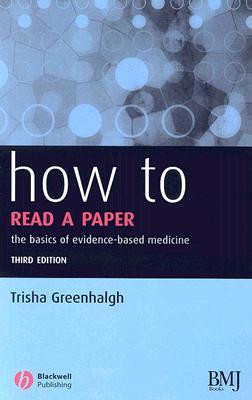
How to Read a Paper: The Basics of Evidence-based Medicine
How to Read a Paper is one of the bestselling texts on evidence-based medicine, used by health care professionals and medical students worldwide. Trisha Greenhalgh’s ability to explain the basics of evidence-based medicine in an accessible and readable way means the book is an ideal introduction for all, from first year students to experienced practitioners.
This is a text that explains the meaning of critical appraisal and terms such as 'numbers needed to treat', 'how to search the literature', 'evaluate the different types of papers' and 'put the conclusions to clinical use'.
New features of the third edition include:
This is a text that explains the meaning of critical appraisal and terms such as 'numbers needed to treat', 'how to search the literature', 'evaluate the different types of papers' and 'put the conclusions to clinical use'.
New features of the third edition include:
248 pages, Paperback
First published April 1, 1999
Ratings & Reviews
Friends & Following
Create a free account to discover what your friends think of this book!
Community Reviews
Displaying 1 - 30 of 40 reviews
August 3, 2015
Are you interested in nutrition? Did The China Study have you totally convinced until you read Good Calories, Bad Calories? Do you wonder, when you see studies cited, if the conclusion the person is drawing is the same conclusion the study authors came to?
If so, this is the book for you. I got out of crazy-restrictive eating by applying the criteria in this book to the various studies on food and "toxins" I saw cited in articles, books, etc. This was NOT an easy read, but it empowered me to critically analyze the info I was getting.
Five stars because "the more you know . . ." (Insert little music chimes here ;))
If so, this is the book for you. I got out of crazy-restrictive eating by applying the criteria in this book to the various studies on food and "toxins" I saw cited in articles, books, etc. This was NOT an easy read, but it empowered me to critically analyze the info I was getting.
Five stars because "the more you know . . ." (Insert little music chimes here ;))

Read
July 12, 2020I really liked learning about Evidence-based Medicine because I had never heard of it before. It was about the use of statistics and the latest research journal publications on populations to inform the clinician’s decisions about individuals. At first, I thought this is what doctors already do, but it turns out that the latest research publications are low on the list of the knowledge sources doctors consult when they encounter a difficult diagnosis. Instead, most doctors rely on i) narrative-based medicine of clinical anecdotes or illness scripts derived from their personal collection of medical experiences or other doctor’s experiences, ii) press-cutting interesting articles from paper versions of medical weeklies, iii) published guidelines or consensus statements by experts who held a conference and are possibly compromised by the pharmaceutical company who sponsored their stay, iv) the advice of their colleagues, v) old textbooks, vi) hunches informed by long experience, and vii) an unsystematic search on Google or PubMed.
Evidence-based medicine is very good to consider because studies show that clinicians often have low level of agreement on diagnoses. EBM can ensure diagnoses are standardized. Furthermore, it provides a way for doctors to take advantage of the rich research resources available in providing the most accurate diagnosis and treatment for their patient. This allows them to judge medical sources according to a ‘hierarchy of evidence’ wherein well-designed randomised controlled trials are most trustworthy, followed by systematic reviews, observational studies like case-control studies and cohort studies, and case studies, bench studies, and ‘expert opinion’ ranked last in trustworthiness. Several nice recommended sources for trustworthy compilations of medical news and information include the Conchrane Reviews, PubMed/ MedLine, Clinical Evidence, DynaMed, ACP Pier, TRIP Database, Global infectious Diseases and Epidemiology Network (GIDEON), Psychiatry Online, and CardioSource.
I really liked learning about Evidence-Based Medicine, however I’m worried it increases the strain on doctors and would only be practical in an ideal world. It involves spending a lot of time reading primary research papers, surveying the methodologies critically to see if the statistics were done right, and querying the right specific research to fit a patient’s age, ethnicity, past history, and other personal considerations. The doctor will have to appraise each paper’s hypothesis, sample size, study design, control, statistical analysis, conflict of interest, and conclusions to see if they fit the patient being diagnosed. While this seem unrealistic, the truth is pharmaceutical companies can take of Evidence-Based Medicine through research publications that make a mockery of statistics, such as clinical trials and patient population that reflect maximum possible response to the drug, comparisons but only with placebos, using only pilot studies instead of randomised studies, omission of fatalities or adverse drug reactions, misleading graphics such as logarithmic graphs that are portrayed as linear, and hints that their work is ‘better’ without specifying who it is ‘better than’. Without close reading of such publications, doctors with limited time might only read conclusions and commit them to memory, passing on faulty information. This is a real problem because pharma companies have huge power asymmetry.
This involves a lot of time, and appetite for novel solutions, that could be resisted by doctors’ other multiple pressures, such as cost realities, time constraints, and the potential for malpractice litigation if the novel treatment doesn’t work like traditional ones. Because of these constraints, imposition of Evidence-based Medicine can just become formalisation and ossification of guidelines and computerised- decision programmes, reducing the ability of the practitioner to customise or personalize care, and stigmatizing the patient’s individual perspective. There’s also the possibility that imposition of EBM would lead ‘bad statistics’ practices to fester—that is, quoting a lot of numbers and odds ratios to silence medical arguments, even if the statistics is bad or inapplicable.
In conclusion, I found EBM ideal but maybe with possible pitfalls to iron out. I am happy I learned about such an interesting topic.
Evidence-based medicine is very good to consider because studies show that clinicians often have low level of agreement on diagnoses. EBM can ensure diagnoses are standardized. Furthermore, it provides a way for doctors to take advantage of the rich research resources available in providing the most accurate diagnosis and treatment for their patient. This allows them to judge medical sources according to a ‘hierarchy of evidence’ wherein well-designed randomised controlled trials are most trustworthy, followed by systematic reviews, observational studies like case-control studies and cohort studies, and case studies, bench studies, and ‘expert opinion’ ranked last in trustworthiness. Several nice recommended sources for trustworthy compilations of medical news and information include the Conchrane Reviews, PubMed/ MedLine, Clinical Evidence, DynaMed, ACP Pier, TRIP Database, Global infectious Diseases and Epidemiology Network (GIDEON), Psychiatry Online, and CardioSource.
I really liked learning about Evidence-Based Medicine, however I’m worried it increases the strain on doctors and would only be practical in an ideal world. It involves spending a lot of time reading primary research papers, surveying the methodologies critically to see if the statistics were done right, and querying the right specific research to fit a patient’s age, ethnicity, past history, and other personal considerations. The doctor will have to appraise each paper’s hypothesis, sample size, study design, control, statistical analysis, conflict of interest, and conclusions to see if they fit the patient being diagnosed. While this seem unrealistic, the truth is pharmaceutical companies can take of Evidence-Based Medicine through research publications that make a mockery of statistics, such as clinical trials and patient population that reflect maximum possible response to the drug, comparisons but only with placebos, using only pilot studies instead of randomised studies, omission of fatalities or adverse drug reactions, misleading graphics such as logarithmic graphs that are portrayed as linear, and hints that their work is ‘better’ without specifying who it is ‘better than’. Without close reading of such publications, doctors with limited time might only read conclusions and commit them to memory, passing on faulty information. This is a real problem because pharma companies have huge power asymmetry.
This involves a lot of time, and appetite for novel solutions, that could be resisted by doctors’ other multiple pressures, such as cost realities, time constraints, and the potential for malpractice litigation if the novel treatment doesn’t work like traditional ones. Because of these constraints, imposition of Evidence-based Medicine can just become formalisation and ossification of guidelines and computerised- decision programmes, reducing the ability of the practitioner to customise or personalize care, and stigmatizing the patient’s individual perspective. There’s also the possibility that imposition of EBM would lead ‘bad statistics’ practices to fester—that is, quoting a lot of numbers and odds ratios to silence medical arguments, even if the statistics is bad or inapplicable.
In conclusion, I found EBM ideal but maybe with possible pitfalls to iron out. I am happy I learned about such an interesting topic.

June 9, 2017
This book is written for doctors so they can understand what medical articles are saying. All doctors should read this, and so should people who would like to know (or think they know) about the state of medical knowledge.
April 22, 2019
A great book for setting the basics of evidence based medicine, paper assessment and choosing the best information sources. However it is could be a bit heavy at times, needing more concentration to understand the subject.
November 26, 2025
¡Ultrasúpermegahíper recomendable!
June 25, 2023
A must read for science students, medical professionals, and clinicians. A comprehensive and to the point guide on all sorts of academic papers. Wish I’ve read it earlier!

September 20, 2021
I did not even hesitate while giving this book a 5 star rating. Just the practical advice inside is enough to merit this rating. But Greenhalgh does not stop there. She takes us by the hand through the world of evidence based medicine, exploring its bright hope for the future and not shying away from presenting its criticisms. That on its own could have been the purpose of the book, an introduction to the world of evidence based medicine. However, Greenhalgh along the way teaches you all kind of research language, paper analysis skills, basic statistical tools and much more. She briefly explains in the beginning who her audience is and how this can be relevant to not only medical students but casual readers interested in learning about medical papers for themselves. I think that not only that but this book is helpful for anyone dealing with any kind of research paper, period. It also tackles a lot epistemological problems with research and information based decision making. This work although educational, has socioeconomic and even political dimensions. A brilliant book, by a brilliant true scientist.

September 1, 2013
Thorough but accessible book looking at how to assess the validity of scientific papers, and why it is important to question the methods and results.

May 31, 2015
Πολύ καλό, περιεκτική, συνοπτικό. Ενδείκνυται για κατανάλωση από υποψήφιους διδάκτορες, χωρίς φόβο και με ελάχιστες παρενέργειες.

November 10, 2022
Как критично да анализираме проучване. Описват се различните видове проучвания и какъв трябва да е дизайнът на едно проучване, когато целим да проверим или открием нещо определено. Харесва ми, че постоянно се говори за ключови въпроси, които постоянно трябва да си задаваме, за да се уверим, че не сме попаднали на лошо проведено проучване и за да може да го интерпретираме правилно. Дават се и добри източници за информация и търсачки и сайтове, в които редовно се публикуват изследвания. Имаше цяла глава за статистика, от която не успях да разбера много, но с научаването на езика и може би на някакви по-основни познания по статистика ще е добре да се върна след време обратно на нея. Препоръчвам я за хора, които се занимават с медицина и вече имат базови познания по доказателствената медицина. 4/5.

July 29, 2024
Great book. It starts with the basics, explaining What EBM is and How to Read Various Types of Papers. It then progresses to how to critically appraise these papers, offering insightful discussions on the overall philosophy of the subject. and finally provides a handy checklist for applying the principles of critical appraisal in practice.
The only downside—and it’s quite bothersome—is the excessive use of internal referencing. For God Sake! utilizing the book margins would have been sufficient and not so irritating.
The Most Memorable Chapters were [1,5, 9,11,12,14, 17] either because they gave me some fresh ideas or because they organized my thinking a little bit.
It's a very long book, it took about 4 months to finish, and probably I will return to it again in the future as a reference.
The only downside—and it’s quite bothersome—is the excessive use of internal referencing. For God Sake! utilizing the book margins would have been sufficient and not so irritating.
The Most Memorable Chapters were [1,5, 9,11,12,14, 17] either because they gave me some fresh ideas or because they organized my thinking a little bit.
It's a very long book, it took about 4 months to finish, and probably I will return to it again in the future as a reference.

October 23, 2020
Treating patients is no longer anecdotal. Medicine is in an age when everything (from diagnosis, to management, to institutional policy making) must be supported by rigorous research, the so-called Evidence-Based Medicine (EBM). And to achieve that, healthcare professionals must learn to navigate literature and know how to find, judge, implement, and even conduct clinical studies - ranging from case series and observational studies to the more advanced clinical trials and systematic reviews. The author does a really great job explaining that, and also answered "can EBM really be applied to patients and benefit them?" In addition, at the end, there are checklists for points to look at while navigating the literature. Highly-recommended and so-much-needed book for everyone in healthcare.
(Note: I finished the book long time ago but only now I reviewed and labeled it as 'Read'.)
(Note: I finished the book long time ago but only now I reviewed and labeled it as 'Read'.)
August 24, 2017
This was a challenging book for me but I do have clients who would enjoy it. I did enjoy the way in which the author wrote, it was light hearted, humorous and that was the entertaining part for me which made a book like this much easier to get through. I thought some of the chapters were long and repetitive. This was not an easy read for me but I did appreciate how the book teaches how to critically analyze information.
March 2, 2021
Immensely helpful resource for anyone wading into medical academic journals and their writing and interpretation. The primers on the math/stats commonly used were fantastic (my favorite example was the verdict of criminals). Will refer back to often. Half the book want really relevant to me since I'm no clinician, but I'm sure those closer to the frontlines would find important takeaways to steer in the direction of EBM. I'm really glad she keeps it updated with newer editions!
August 23, 2017
For some folks
This book was a required text for a course, for the way I learn, it would have been much more helpful if it was recorded on audible so I could listen to it a few times, as it was it took me long enough to read through once.
This book was a required text for a course, for the way I learn, it would have been much more helpful if it was recorded on audible so I could listen to it a few times, as it was it took me long enough to read through once.

January 22, 2018
An introduction into how to read medical literature. I can’t fault it, but at times it keeps too basic. On the other hand, there is no prerequisite for reading it. Great for students or people who have just stayed away from journals.
November 10, 2020
This is a useful tool I will be referring back to when reading papers. Some helpful general information which is great to get you thinking about what you read, how you read it and how you understand it.
May 8, 2026
This is a good book to learn how to systematically read a paper for all it's worth. I ended up not keeping it as it's printed on painfully white paper and the contrast with the black ink gives me a migraine
March 18, 2017
Had to read this for school and it was pretty complex. But informative on how to read a research paper for evidence based medicine. More geared toward those in medical school.

October 19, 2017
Not a topic of major interest - had to read it for my program. Overall, it wasn't as painful as I feared. Quick read.

March 5, 2018
I treat this as my go-to handbook for critical appraisal and evidence-based medicine.
July 28, 2018
If you are a healthcare professional invested in EBP or a librarian who supports healthcare folks, this is actually a five star read.
September 10, 2019
The book was very interesting. Despite the fact that I am not a medical professional the book was readable and easy to understand.

March 31, 2021
I felt like this jumped around a bit. Valuable insight nonetheless.
June 30, 2022
Informative

Read
December 27, 2024Read as part of psychology masters. User friendly, easy to grasp, great find!
April 17, 2020
I was low-key resenting one of my professors for not having recommended this book earlier, then I actually looked into the suggested readings for the class and realized it was listed there all along. Shame on me for not reading this earlier.
It's a great book and I highly recommend it to anyone working in healthcare. It covers the basics and also some recent controversies of EBM in a very easy to follow way, provides many real-life examples and exercises, and is chock-full of useful references for those who want to dig deeper into the subject.
It's a great book and I highly recommend it to anyone working in healthcare. It covers the basics and also some recent controversies of EBM in a very easy to follow way, provides many real-life examples and exercises, and is chock-full of useful references for those who want to dig deeper into the subject.

April 20, 2013
En el mundo científico y medico, que es al que se refiere esta autora, hoy se obliga a publicar trabajos sin contrastar y con una calidad incluso formal cada vez mñas baja, para "prestigio" del hospital, institución y demás, tuene o llueva.
Trisha Greenhalgh nos recuerda lo que debe ser un trabajo científico, no solo un artículo para rellenar un curriculum, que ee slo que hay en España y en Gran Bretaña habitualmente, pais de donde ella es. Alemania y demas tampoco se libran.
Si bien trata de la Medicina basada en la Evidencia, una manera de enteder la medicina que se ha originado en la necesaria atención a masas de pesonas, no a personas, y sobre lo cual tengo serias dudas, pero parece no hay alternativa.
Trisha Greenhalgh nos recuerda lo que debe ser un trabajo científico, no solo un artículo para rellenar un curriculum, que ee slo que hay en España y en Gran Bretaña habitualmente, pais de donde ella es. Alemania y demas tampoco se libran.
Si bien trata de la Medicina basada en la Evidencia, una manera de enteder la medicina que se ha originado en la necesaria atención a masas de pesonas, no a personas, y sobre lo cual tengo serias dudas, pero parece no hay alternativa.

November 18, 2016
The book deals with evidence-based medicine that is presented in an understandable, well-balanced, and full of example manner. It started by emphasizing the importance of reading research papers and ended up in literature counter-arguing the significance of evidence-based medicine in actual practice. My favorite part of the book is Chapter 5 which is entitled statistics for the non-statisticians which is very easy to grasp that is not condescending. It answered by long-time puzzle of how to involve and incorporate patient values and preferences in evidence-based practice. Usable and opens new doors for evidence-based medicine!

October 18, 2012
This is a great book that helps steer individuals into critical thinking skills needed to read a scholarly journal article. It is written from a medial perspective - but I have graduate students in social work read it as part of their introduction to social research methods and they enjoy it as well. Some of the students I work with have stated that there were surprised at how easy it is to read.
Displaying 1 - 30 of 40 reviews