Jump to ratings and reviews
Rate this book

A Tale of Time City

Rate this book
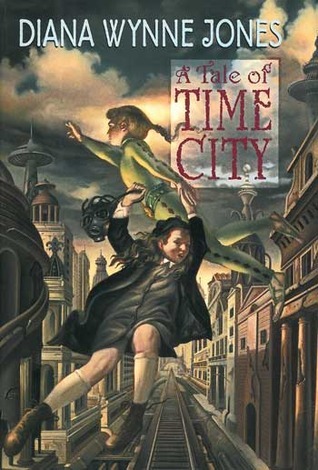
In 1939, an eleven-year-old London girl is kidnapped to Time City, a place existing outside the stream of time and manipulating the history of humanity, where she finds the inhabitants facing their worst hour of crisis. Simultaneous.

327 pages, Hardcover

First published September 1, 1987

199 people are currently reading
4027 people want to read

About the author

Diana Wynne Jones

148 books12k followers
Diana Wynne Jones was a celebrated British writer best known for her inventive and influential works of fantasy for children and young adults. Her stories often combined magical worlds with science fiction elements, parallel universes, and a sharp sense of humor. Among her most beloved books are Howl's Moving Castle, the Chrestomanci series, The Dalemark Quartet, Dark Lord of Derkholm, and the satirical The Tough Guide to Fantasyland. Her work gained renewed attention and readership with the popularity of the Harry Potter series, to which her books have frequently been compared.

Admired by authors such as Neil Gaiman, Philip Pullman, and J.K. Rowling, Jones was a major influence on the landscape of modern fantasy. She received numerous accolades throughout her career, including the Guardian Children's Fiction Prize, two Mythopoeic Awards, the Karl Edward Wagner Award, and the World Fantasy Award for Life Achievement. In 2004, Howl's Moving Castle was adapted into an acclaimed animated film by Hayao Miyazaki, further expanding her global audience.

Jones studied at Oxford, where she attended lectures by both C.S. Lewis and J.R.R. Tolkien. She began writing professionally in the 1960s and remained active until her death in 2011. Her final novel, The Islands of Chaldea, was completed posthumously by her sister Ursula Jones.

Ratings & Reviews

What do you think?
Rate this book

Friends & Following

Create a free account to discover what your friends think of this book!

Community Reviews

5 stars
1,610 (29%)
4 stars
1,956 (35%)
3 stars
1,460 (26%)
2 stars
336 (6%)
1 star
80 (1%)
Displaying 1 - 30 of 437 reviews
Profile Image for Jessica.
604 reviews3,253 followers
May 21, 2019
This is the first Diana Wynne Jones book I ever read. My uncle gave it to me one year for Christmas. It probably changed my life, though I'd be hard pressed to say exactly how.

---

The above is an old review. Having just heard that Diana Wynne Jones has passed away, I've come back to press myself harder to say exactly how her book changed my life. I'd like to apologize in advance for my overwrought and melodramatic language; I have a giant hangover, and am in a highly emotional state.

I was just explaining something from this book to my sister a couple weeks ago. In Time City there are two kinds of ghosts: apparitions of someone who performed the same action so many times that they make a visible imprint, and then those left by someone who does something so significant that it leaves a mark in the air. I guess my reading this book as a kid could have left either kind of ghost: I returned to A Tale of Time City enough times throughout my childhood that reading it was a repetitive activity, but it's the memory of first receiving the book that's the most burned into my mind. My uncle sent it to me in California from New York City, where he lived. A voracious lifelong reader whose own kid hadn't yet reached reading age, that uncle was my model of literary sophistication. At Christmas and birthdays he'd send carefully selected hardcovers that were clearly serious books: children's Literature, with a cosmopolitan capital "L." Each year after A Tale of Time City brought another Diana Wynne Jones hardcover, until either I grew up, or he developed Alzheimer's at a startlingly young age -- I'm not sure which event happened first.

Trying to describe the complex plot of this book is probably too tall an order considering my fragile and weak-brained, bereaved state. It begins with Vivian, a girl being sent out of London to escape the Blitz, which is occurring in 1938, instead of 1940 (I might get some details wrong, since I don't have the book with me and I haven't read it since the early nineties). Vivian winds up being kidnapped by two kids who spirit her away to Time City, a place that's built outside of regular history, and which somehow regulates the passage of time. But there's a problem: some nefarious someone (the Time Lady?) has been screwing around with the mechanisms that keep time running smoothly, and Vivian and her two new friends Sam and Jonathan need to stop them and save Time City and history. There's a lot of time traveling through different ages (Bronze, Iron, etc.) and cool details like the special suits and desserts of Time City. Everything ends in a huge chaotic catastrophic climactic mess that doesn't make a whole lot of sense, which is one of DWJ's special -- and to me, wonderful -- signatures.

A lot of books I've read have had a great impact on me, but when I'm dead in my grave this one may have been the most important. A Tale of Time City was the first book I read that amazed me completely. It was the first work of art I experienced that seemed absolutely perfect. It took me outside of my piddling nine-year-old existence and gave me thoughts and experiences I never could have imagined on my own. It made my life so much more, and so much larger, than it ever could have been before. A Tale of Time City introduced me to (sorry, guys) the sublime capacity of literature.

I was still a kid when I first read it, and didn't fully get yet that magic wasn't real. I didn't know for sure that time travel wasn't possible, that time only moved in one direction -- brutally, ruthlessly forward -- and that you couldn't ever go back later and fix anything, or change things around. I didn't understand yet that I was going to get older, and then keep getting older after that even if I felt done. I didn't know that my uncle would get sick and lose the brain I admired so much, or that my favorite writer would die before I ever got around to meeting her or sending the crazed fan letters I always meant to write. Of course, I'd figure out all that depressing stuff later on, as I'd be crushed by the tyranny of lost time, and an adult life that just keeps on passing me by. But even this horror that's reality couldn't defeat me completely; Diana Wynne Jones had revealed that there was a refuge, a respite, a place outside time. That magic was real, and time travel was possible, that I could duck outside the unmerciful lockstep of days marching me forward towards my own death.

I've been going through sort of an illiterate phase recently, haven't been reading much and definitely have cooled off on reviewing. But Jones's death from lung cancer has reminded me that even at thirty-two, there are still a couple things I do believe in: not time travel or magic in a child's more literal sense, but in books' power to free their readers, and also to confer some immortality on their creators. I know it's super corny to say, but as long as people read her books, Diana Wynne Jones will remain, in some vital senses, alive.

Which is, corny or not, a magic that's real.
Profile Image for Kat!e Larson.
272 reviews29 followers
June 23, 2016
I honestly don't know what my issue is with this book. It's an interesting story with pretty cool characters. But I found it mind-numbingly dull.

Perhaps I went in with too high of expectations, because Howl's Moving Castle is one of my favorite books. Perhaps I just wasn't in the right frame of mind. I really tried to like it. I kept reading, believing I would learn to appreciate it. I never did.

The world felt haphazard and half-explained. I kept feeling that, not only did the characters not really understand what was going on, the author didn't either. Nothing was explained in detail -- from the science and politics to the setting and items they used (I got so lost so many times.) The prose felt messy and jumbled (and not just because of the many misplaced commas and periods -- I don't know who's to blame for those, but they pulled me out several times.)

There were definitely some interesting ideas in this book -- I loved the time ghosts -- but reading it was a slog. Honestly, I wish I'd stopped reading early on instead of pushing my way through three hundred pages.
Profile Image for Flora.
115 reviews12 followers
July 18, 2013
A Tale of Time City is many things: utterly confusing, fantastically imaginative, highly intelligent and unexpectedly complex. Above all, however, it is entertaining.

This book precedes the Harry Potter series, but while reading it you really wonder if JK Rowling was perhaps a Diana Wynne Jones fan. I instantly get a familiar feeling with the way Jones describes her magic - so belonging, logical, rational and wonderfully. Beside that, there's other things - people walking through walls at train stations, for example, and certain types of characters.

On to the "confusing" part however. This book is the most hectic I've ever read from Jones, and I often had to re-read entire paragraphs id pages to get a grasp of what was happening. If you plan on reading this, be sure to keep your attention!

Then, my favorite thing. Jones adds a ludicrous amount of detail to her books, and it all pays off. Reading it is like fitting the pieces of a puzzle together! So many things are foreshadowed or hinted at, and nothing described ends up being unimportant.

Add with that a dash of foul villains, a young and very strong female main protagonist, a bunch of compelling side characters - and you've got yourself a book that makes me ask for more. :)
Profile Image for Nicky.
4,138 reviews1,112 followers
March 25, 2013
As usual, Diana Wynne Jones' imagination runs rampant, giving us a fun adventure with lots of amazing ideas packed in. I want to know what a butter pie tastes like, more than anything, but all of it was interesting and had me trying to puzzle it all out.

It wasn't surprising in any way, to me anyway, because it somehow seemed very typical of Diana Wynne Jones. But it was fun, and hooked me in well.

Not my favourite of her books so far, but that would be difficult to decide anyway...
Profile Image for Tijana.
866 reviews287 followers
Read
June 1, 2020
Priča o Vremenskom gradu (Vremegradu? Gradu vremena? toliko mogućnosti) spada u onaj lepi i najluđi period Dajane Vin Džouns, iako na prvi pogled deluje kao jedan standardni dečji timeslip fantasy u kome devojčicu izvuku iz 1939. u grad koji postoji van vremena (mnogo vas pozdravljaju i Asimovljev Kraj večnosti i Murkokov Tanelorn).
Ono što potom krene da se dešava na mahove i deluje kao da je na korak od Murkoka, mada ima bar dve stvari karakteristične za Dajanu - ludačko poigravanje vremenskim paradoksima i prilično dezorijentišuće iznenadno otkrivanje nečijeg tajnog/istinskog/parcijalnog identiteta na bar tri različita načina. Takođe, i solidno neuobičajeno, u pozadini zapleta formira se jedna potencijalna istorija ljudskog roda koja je dosta mračna i samo skače od jedne epohe ratova do druge ("a ovde, u devedesetim vekovima, imamo dvesta godina najokrutnijih ratova u istoriji u kojima su protivnici jedne druge gađali oružjem koje ide direktno na razaranje uma!") i završava se pošteno nazvanom epohom Depopulacije Zemlje. A ipak je istovremeno roman vedra i razigrana avantura za mlađi uzrast.
Profile Image for Muffinsandbooks.
1,721 reviews1,336 followers
July 11, 2023
3,5 ⭐️
J’ai beaucoup aimé le concept que j’ai trouvé très original ! Les personnages sont hyper attachants et j’ai été tenue en haleine jusqu’à la fin, mais je dois avouer que c’était quand même long… et compliqué wesh. Déjà de base les histoires de voyage dans le temps, c’est jamais très simple, mais alors, j’ai failli décrocher 150 fois. Ok, j’ai peut être même décrocher pour de vrai. Heureusement que c’est bien écrit et qu’on finit par raccrocher les wagons. Une bonne lecture donc, mais rien qui me restera en mémoire pendant des années, on va dire !
Profile Image for Mark.
974 reviews80 followers
January 17, 2012
Wonderful children's time travel book. One of the things I like best about Diana Wynne Jones is how her children are children and adults are adults. What do I mean by that? First, children are not adults. They can't do everything an adult might do. They can't win a sword fight with an ogre. But they are still competent - they might trick the ogre or sneak past the ogre. (It has been a while so I don't remember an example from this book.) Second, adults are adults. In too many YA books the adults are simply stupid. Time City I felt did a great job of showing adults who were just as concerned about the time crisis as the kids, but because of factors like their age, values, and responsibilities had a different view of what was important and thereby wound up hindering the children rather than joining with them.
Profile Image for Amiad.
472 reviews17 followers
November 14, 2021
שני ילדים מעיר הזמן, עיר שנמצאת מחוץ לקו הזמן הרגיל, שולפים בטעות את ויויאן סמית בת ה-11 ממלחמת העולם השנייה ועכשיו היא צריכה לעזור להם להציל את עיר הזמן ואת ההיסטוריה.


אני אוהב את דיאנה ווין ג’ונס ואהבתי את הרעיונות המקוריים בספר, אבל בזאיה שלב כבר לא הצלחתי לעקוב וגם פחות היה אכפת לי.
Profile Image for Bibliothecat.
1,740 reviews77 followers
July 7, 2018


"When your surname is Smith, you need to make very sure that everyone knows just which Smith you are."


At the beginning of WWII, Vivian Smith is on board an evacuee train when two boys decide to kidnap her right out of time. Jonathan and Sam are from Time City which exists outside of regular time and history. Time and the city itself have suffered from disturbances and the boys hope that the Time Lady can put things right again. Vivian soon finds that they thought her to be the Time Lady in disguise and all three are in distraught over the mix-up. With nowhere else to go, Vivian goes along with Jonathan and Sam to try and find the real Time Lady,

A Tale of Time City has a lot of great ideas but wasn't quite what I wanted it to be - this book had so many things going for and against it, that I feel rather conflicted. Time travel stories are awesome - but reading this particular one made me realise one thing: I enjoy time travel stories in which the characters travel to the past or in which characters from the past come into our time, whereas I am much less keen on ones where characters travel to the future. Now A Tale of Time City is neither one nor the other - it is actually very confusing. But I am still inclined to say that it is more on the side of travelling to the future.

I like complex and overlapping plotlines, but I found this book confusing to the point that I had a hard time visualising most of what was going on. Vivian is a character from the late 30's which makes her part of the past. Time City seems a blend of different timelines but as everything is seen through Vivian's eyes, many things that we know in our present are new to her. As a result, Vivian describes items that are unknown to her but that we as readers would already know - e.g. swiping ID cards. The fact that she describes these things rather than naming them constantly made me want to imagine something entirely different altogether. Additionally, so much of Time City is introduced within the first few chapters, there are so many new names and places that I simply could not keep apart.

But the confusion aside, Vivian is an awesome main character with a lot of spunk. She has attitude and a neat thing or two to say. I absolutely loved her as a main character and felt all the more disappointed that the actual story wasn't living up to her. She also seemed to be one of the few rational characters as well as being one of the few who didn't seem to act out of selfish motives.

While I loved Vivian, I was less impressed with Jonathan and Sam. I guess Sam was alright, I just didn't really care for him and I felt his personality was limited to the fact that he liked to eat and breathed heavily. Jonathan, on the other hand, could and should have been a neat character. He was the driving force behind most of their time travel adventures and he is at least part Chinese which I thought was rather nice. But I still found it really hard to like him. What Vivian calls his 'lordly' behaviour, I would simply call arrogant. He cares a lot about the fact that he is from an important family and he rarely sees the error of his ways. I also felt that he was often on the selfish side and it was only very late in the book that he was showing some redeeming qualities.

The other characters were quite the mixed bunch. There is an android named Elio who was rather interesting - it's a shame his background wasn't explored more. The villains turned out to be one dimensional in that they appeared to be doing evil things for the sake of being evil - there was a definite lack of motivation.

Now Time City in itself had a very interesting concept. I loved how it exists outside of or parallel to the rest of time and how the inhabitants were in charge of making sure history flows steadily. Diana Wynne Jones set up a complex and interesting system with how time is managed but she leaves it vastly unexplored. I also wish there would have been more time travel but there sadly wasn't all that much of it. The few time travels we get are all set in the future and, while not my favourite, there were some clever and unique ideas. One period is referred to as the Mind Wars and I must say, it was quite the terrifying concept where peoples' minds could be tampered with.

Like with most of Diana Wynne Jones' books, there is a lot going on leaving no space for any boring moments. Although it may sometimes appear rushed, she usually manages to wrap up her endings quite nicely. This, however, was not the case here. I felt terribly dissatisfied with the lack of explanation of so many things. We don't get enough information about the Time Lady and the choices she has made, we don't really get to see what happens to Vivian at the end of the book and there are just so many loose ends and things I would have wanted to know about. It just did not feel like an end and I was rather annoyed when finishing the book thinking to myself 'That's it?".

So as a conclusion, A Tale of Time City has a brilliant main character in Vivian, has several unique ideas and is anything but boring. But unfortunately, it doesn't explore enough of all the interesting concepts and could have been so much more. Jonathan also needed more space and time to develop into a more likeable character he was showing signs of towards the end. It's among my least favourite of Diana Wynne Jones' books but is still a book that is worthwhile the mention.
Profile Image for Catherine Petrini.
278 reviews4 followers
March 19, 2019
I have loved Diana Wynne Jones's books, and I expected to love this one, too. So I was surprised when I found it alternating between confusing and just plain dull. I liked the main characters, especially Sam; unfortunately, many of the adult characters are too dimwitted to be believable. The ideas here are interesting, but they are never fully developed, and the world building feels unfinished. We get a lot of detail on what things look like, and very little on how they work. The story is set up to be science fiction rather than fantasy, but it's clear that the author was more comfortable writing fantasy; the technology that makes this world work is so unexplained that it might as well be magic. Many of the plot elements seem so contrived that the whole story just doesn't hang together. Overall, I'd say the story has potential, but the book is disappointing.
664 reviews15 followers
July 4, 2015
Rated PG.

That. Was. AWESOME.

For the record, I have never cared about historical dates before this book. Now I actually remember the year that WWII started--and if I learned nothing else from reading A Tale of Time City, this alone would make it SO WORTH IT.

Also, this came highly recommended by some of my favorite authors, including Maggie Stiefvater. If you don't know Stiefvater's work, you need to read The Scorpio Races. As fabulous as that book is, though, Stiefvater acknowledged that she was inspired by Diana Wynne Jones' A Tale of Time City. Well. I cannot pass up recommendations by my favorite authors of works and authors that inspired them.

One of Diana Wynne Jones' greatest talents was her ability to take the most complicated settings and make them work. She could create multiple universes and have circular time and time travel and shifting history, and it would all work somehow. Her stories could be massively complex but totally understandable--well, until the end, sometimes, when things would fall apart into loose chaos a bit.

And every single bit of her talent positively sparkles from every page of this book. Yes, this book has elements of Narnia in it, but it is also the precursor to Meet the Robinsons and Harry Potter, of which this book also reminds me.

Vivian Smith is a young girl living in 1939 London, and she is being evacuated to the country when she is kidnapped by a boy about her age. He takes her through a train wall to his young accomplice in Time City. Time City, by the way, is literally a city pulled out of history. The inhabitants are in charge of monitoring history and providing a storehouse of knowledge. The problem is that Time City is unraveling because time's anchors are being, um, stolen. And with the unraveling of Time City, history is unraveling as well.

However, Vivian, along with her two young kidnappers, are pretty much the only people who know what is going on with history, and the adults are no help at all. Either the children can't tell the adults because they found out this information illicitly, or the adults will not listen.

As such, Vivian, Jonathan, and Sam embark on a series of adventures to rescue time, eating the oh-so-delicious butter pies from 42 Century and trying to figure out who is causing history's major issues.

Yes, the ending is a bit confusing, but that pales in comparison to the sheer scintillating superiority of the rest of the book. Fabulously done, and one of my new favorites.
Profile Image for Nente.
509 reviews68 followers
June 14, 2017
What's the trick with Diana Wynne Jones? She was so prolific that quite a lot of her books necessarily fall below the highest standard, and several of them are quite formulaic - this is one - but I have now read at least 20 of her works and cannot say that I regret reading any, even those I 2-starred as "just ok".
Perhaps I'm touched by the way she sets up her universes. She never wastes much space worldbuilding, and frequently it all comes off as heavily underexplained, but all the time you feel that those worlds exist regardless of anything lost in the telling.
In this one, we get the all-too-usual elements for her: young protagonists, in secret from adults striving to understand the mysteries of their place in fantasy and save it from impending doom; adults stuck in a rut and unable to help or even realize help is needed; conspiracy defeated at the eleventh hour (ummm... at 11:59 would perhaps be more exact, of course); no unnecessary romance; no character growth to speak of: the characters are too busy working out the things external to find time for reflection.
But the charm so apparent in her best works is definitely lacking here.
Profile Image for Claire.
153 reviews17 followers
January 5, 2022
the fact miss diana wynne jones invented running through a london station wall into another dimension...........jkr deserved the shade from ursula k le guin in the intro!!
Profile Image for Julie Davis.
Author 5 books320 followers
December 17, 2013
All the other Diana Wynne Jones books I've read until now were the favorites of a pal who did me the great service of lending them so I could get hooked. This one looked interesting but it has taken me a while to get into the story. About halfway through I am finally warmed up to it and love some of the concepts ... such as the kids who live in Time City but are fascinated by what it is like "in history" when they're quizzing the heroine about WWII and 1938 London.

FINAL
I finished it but it wasn't an easy read. This was a helluva convoluted plot and there were a lot of details about time changing and Time City and suchlike that I think could have been made a bit clearer. Nonetheless it was entertaining enough that I finished it up. If I feel moved to reread it I might get more out of it.
5 reviews
September 28, 2022
After I read the book "A Tale of Time City" it left me thinking. it's one of these books that are confusing, fascinating, intelligent and entertaining at the same time, and Diana Wynne Jones incorporates these elements perfectly together.
I enjoyed every part of the book, and I think anyone who likes reading fantasy and historical event-based novel would enjoy the book as much as I did. It's a book worth reading more than once.
Profile Image for Adrian.
685 reviews278 followers
March 16, 2016
It might be aimed more at the YA market, but I still really enjoyed it. A good story, well written and fast paced from start to finish. A great "time travel" book.
952 reviews17 followers
May 27, 2024
“A Tale of Time City” is one of Jones’s best, and therefore about as good as it gets in children’s (YA? the heroine is 11) fantasy. Or possibly science fiction, because as the title suggests, it’s a time travel book: Time City is located, if not outside of time, then at least outside of the Earth’s time. Jones does an excellent job with the mechanics of time travel, taking a quite original approach to a well-worn plot device. For one thing, she discards the usual questions about whether or not time travel can change history, because time travel is no longer just a way to get from one time to another and history is not just what happened in the past. Instead, time travel is also, in a way, a place, Time City — all time travel starts in Time City, even if subsequent hops go from one moment in time to another — and from its point of view, history is Earth’s entire timeline, with Earth’s future and past existing simultaneously. Nonetheless, it is the case that some parts of history, the Unstable Eras, are always liable to change (it’s never explained why: this is just how things are). The First Unstable Era includes the twentieth century, as Jones immediately hints when we meet Vivian, our heroine, as she is being evacuated from London along with a trainload of other children in the early stages of WWII. Attentive and historically-minded readers will realize that something is up on the very first page of the book, when Jones tells us that this is happening in September 1939. But it’s not simply a question of dates changing: Jones will repeatedly return to the scene of children disembarking from the evacuation train to graphically illustrate just how unstable an Unstable Era can be. By contrast to the fluidity of history, Time City appears to be fixed, simply because it becomes Vivian’s, and so also the reader’s, frame of reference. Also, there are the time ghosts, which are ghosts, but not necessarily of dead people. Time ghosts can be formed simply by repetition — do the same thing at the same time of day often enough in Time City, and a ghost of you will do it at that time forever — but also sometimes by a single event of extreme emotion or importance. Crucially, the latter type of time ghost can be formed by an event that is still in Time City’s future: the ability to see previews of events which are yet to come makes that future seem to be stable. This remains the case even though the actions of the time ghosts themselves don’t come close to giving away the plot: neither the characters or the reader can understand what the scenes mean ahead of time. Which means that the history of Time City (and the plot of the novel) is unstable (as is explained later in the book) in one respect, namely that nobody knows what’s going to happen next.

Nonetheless, the fact that she switches to Time City’s view of history is key to Jones avoiding a classic portal fantasy trap — even if the portal here is a time gate maintained by a Time Patrol, the novel still has the bones of a portal fantasy — in which the fantasy world that the protagonist visits ends up being, like Narnia, merely a play-world in which nothing genuinely meaningful happens. In this novel, it’s quite the opposite: as England in 1939 accumulates changes which make it less and less like the historical one, or even the not-quite-historical version that Vivian is used to, it starts to seem much less real than Time City does. Vivian’s quest is to save Time City, of course, but that’s not because the world she comes from doesn’t need saving, or is too real for a child to save: instead, it’s because her world is beyond saving, with the book’s final visit to England in 1939 revealing a scene that Vivian finds only barely recognizable. Which might be too much for a child to handle, except that Vivian is already primed for this, in a way. After all, the setting that Jones keeps returning to is not Vivian’s home in London, but a strange town in the country that she’s never been to before. Even before the story proper starts, Vivian is perfectly well aware that it’s quite possible that she will never see her home again: she’s being sent away from it so that she can escape even if it’s destroyed. In a sense, then, the rest of the novel simply extends her original journey: she goes much further than she originally planned, but the first step is not through the portal but simply onto the train.

Her flight from home also furnishes an excellent pretext for her presence in Time City: she claims to be Jonathan’s cousin, conveniently also named Vivian — Jonathan being the boy whose mistaken intervention is the reason she ends up there in the first place — a girl whose parents are posted to Vivian’s time to keep an eye on developments in the Unstable Era, and who is, like the natives, now being evacuated thanks to the start of the war. The resulting scene, in which Vivian lies as little as possible while also never telling the truth, is one of many brilliant scenes in the book. Her discomfort at telling all those lies, and her conviction that they are nonetheless necessary, are beautifully depicted, and will win the reader over to her side, assuming that hasn’t happened already. Jonathan is also quite sympathetic, his tendency to create problems thanks to overconfidence notwithstanding. And Jones is very good at showing why the children feel that it is necessary to band together to keep their secret from the adults, even though the adults are friendly, well-meaning, and generally understanding. The plot itself seems to be a classic search for the magic thingummies that will save the day — there are four of them, each in an Unstable Era, so the search takes the children to various points in history, mainly in our future — but Jones throws in a twist here: the search keeps failing. To be precise, it is forestalled: others are also searching, and doing a better job of it. It’s clear that those others must be the bad guys, but not clear who they are until the end, when all is revealed in the highly suspenseful last few chapters and it turns out that the important clues were in the lectures that Vivian received from her tutor (one accepted as a Time Cityite, she is naturally immediately enrolled in school). In the meantime, the book alternates between adventures in history and a different kind of adventures in Time City, as Vivian attempts to hide who she really is. The result is a novel that’s engrossing and imaginative, and, because it’s Jones, wonderfully written and often quite funny.
Profile Image for TheBookSmugglers.
669 reviews1,945 followers
July 30, 2012
I am slowly working my way through Diana Wynne Jones’ books. A Tale of Time City was originally published in 1987 and reissued this year with an introduction by Ursula Le Guinn (alas, my copy is an old one) and I decided to read this one next because I am going through an I Love Time Travel phase.

Time City is a place built on a patch of time and space and for all intents and purposes, outside history. Its inhabitants are Guardians and Observers who have recently started to realise that Time City is degenerating increasingly fast. No one knows what will happen to History once the city crumbles and only Faber John and the Time Lady, its mythical builders can possibly save it.

Two boys, Jonathan and Sam, eavesdrop on their family’s meetings and learn that the Time Lady has actually gone rogue and might be at the centre of Time City’s current problems. They travel back in time – in secret – to stop her. They end up kidnapping young Vivian Smith from September 1939 as she was being evacuated from London at the beginning of World War II. They mistakenly believe that she is the Time Lady in disguise but soon Vivian proves she is just a kid. Bent on returning to her own time, she doesn’t want to have anything to do with Jonathan and Sam but when she comes across her own “time ghost” (an spectral imprint that shows important moments of history and proves that Vivian has a key role to play) in Time City, she realises she can’t leave just yet.

In the meantime, History has started to go awry – WWII now starts in 1938! – and Jonathan, Sam and Vivian need to go back through time to stop those tampering with History.

A Tale of Time City is an adventurous, fun time travel story. Everything fits well and events unfold elegantly with twists that come left and right – as usual with these types of stories. I loved the main plotline, how it was constructed and deconstructed with the usual DWJ’s aplomb.

And as per usual with DWJ’s novels, even in the midst of plot shenanigans, bickering children and high adventures, there are those thought provoking questions woven into the story. For example, the difficult relationship between children and parents as well as the development of the friendship between Jonathan, Sam and Vivian. The three kids are awesome –especially Vivian, who as an outsider presents the story with the necessary critical eye. It is through her eyes that the actions of the inhabitants of Time City are questioned. It is through her eyes that we see how they deal with History with a scientific authority that is both awe-inspiring and uncomfortable. More often than not, they see the past of something that is not real with the hindsight that makes it easier for them to be completely detached. There is one scene when Vivian is holding the gas mask that all evacuees had to carry and someone says how “realistic” it looks to wit Vivian replies: “It’s not realistic, it is real.”

This interesting relationship with History and how distance turns it into something that some might address as less than real, is really well explored.

Another thing I loved about A Tale of Time City was how the questions of “names” and “identity” were incorporated into the story. As the book starts, Vivian stands in that train being evacuated from London, going away from her family and all that she knows and the only thought that crosses her mind is that she needs to keep her identity tag safe because:

“When your surname is Smith, you need to make very sure that everyone knows just which Smith you are”

Later on, there is an examination about the origins of the name Smith and the difference between “common” and “unique”. Not to mention, the very realisation that nothing could possibly be built outside history, not even Time City. It is very clever as usually this author’s books are.

Although not my favourite of DWJ’s novels, A Tale of Time City was definitely a vastly entertaining, engaging story which I highly recommend.
Profile Image for Joaquin Mejia.
91 reviews1 follower
April 26, 2021
A Tale of Time City is a novel about a young girl named Vivian Smith who hails from the United Kingdom during the time of the Second World War. She is taken by two boys named Jonathan and Sam to a place called Time City which oversees the events of history. They go on time-travelling adventures in order to save Time City from danger. This book tells a fun and riveting story. The book's way of presenting revelations made me want to read faster because of how unpredictable I found the story to be very unpredictable.

This is my fourteenth Diana Wynne Jones novel. Most people would call Diana Wynne Jones a fantasy author but A Tale of Time City seems to lean more towards the science fiction genre. It is a story about androids and time-travelling where the characters observe technological advancement and explore the future. This novel might be a good science fiction recommendation for children because it has the elements of the genre while also having enough humor and exciting action to catch the attention of younger readers.
Profile Image for Brandy Painter.
1,691 reviews352 followers
July 17, 2012
Originally posted at Random Musings of a Bibliophile.

I will write it again: Diana Wynne Jones is a genius. Really was there any limitation on what she could write? Her ability to bring to life all manner of ideas from her most amazing mind leaves me awestruck. A Tale of Time City, I confess, is not my favorite of her books. Still. Saying one of her books doesn't live up to its fellows still puts it above almost everything else out there.

Some of my aloofness toward this book may come from my love/hate relationship with time travel stories. (love=Connie Willis; hate=end of Prisoner of Azkaban) There was a lot in the underlying concept about time travel that reminded me of Willis so it definitely falls more toward that end of the spectrum. There just seemed to be way more details given at times, and not enough at others. That is never a complaint I have had about DWJ novel before. The end also wrapped up FAST.

However, I did enjoy the characters, particularly Vivian and Jonathan. I loved the way all three of the kids interacted. Sam and his obsession with butter pies was endearing, as was his typical 8 year old behavior despite being a genius. (By the way: I really want a butter pie now despite not having a clue what one is. DWJ's writer skills at work.) I always enjoy these sorts of stories where the kids have to band together to save the day because the adults are running around pretending nothing is too amiss. I liked how the kids ended up messing up as much as they saved and that there were going to be consequences (though none too horrible) mixed in with their rewards.

When I ordered the re-released DWJ titles I was expecting to like this one more than Dogsbody, but that turned out to not be the case. I like it that the books can still surprise me. This is a vastly entertaining read and, I think, one that would probably appeal more to the MG reader.

Profile Image for Chris.
945 reviews115 followers
March 5, 2021
And it seemed to be true that all your life came flooding into you mind in your last moments. She thought of Mum and Dad and London and the War and Time City, and she wanted to shout at Mr Lee, Wait, I haven't thought of everything yet!

Time certainly does play tricks on you; in my case I was certain I'd read this fantasy when I acquired it a decade and a half ago, but now that I've finished it very little seems familiar other than the initial premise. In a way, however, that's quite appropriate for a novel about time travel in which the past is sometimes not only a different country but also not what you thought it was.

The first thing the title does is remind the reader of A Tale of Two Cities , and whether that was fortuitously arrived at or chosen from the start it does indicate that one of the themes the author intended to make use of was the trope of confused identities: young evacuee Vivian Smith escaping a London about to undergo the Blitz is of a kind with London barrister Sydney Carton during the period of the French Revolution. Dickens' doppelgänger motif is one of a number of parallels Diana Wynne Jones plays with here, and you will note that as well as London being one of the cities of the Dickens novel there's another city involved, Paris in one and Time City in the other: both are in turmoil from a Revolution, Time City almost literally so.

What is Time City? It's a environment outside of time and space: its architecture takes inspiration from our own past, present and, presumably, future, and at times resembles Escher's famous Relativity etching; and if Time itself can symbolised by a clockface, Time City is situate precisely at that infinitesimal moment represented when the clock's hands all point to 12. Its function is to oversee Earth history, filled as it appears to be with periods both stable and unstable; meanwhile its functionaries patrol and where necessary intervene in history, tweaking events to ensure all is well. That is, however, providing that chronons -- particles which destabilise time -- don't attach themselves to someone who then travels through time. Somebody like 11-year-old Vivian.

This is speculative fiction by the truckload, happily mingling SF, fantasy and, as we shall see, a whole heap of myth and legend. Yet such fiction works particularly well when there is a sense of authenticity, of drawing on and reflecting real life, and especially if that sense includes a bit of the author themself. When Dicken was writing A Tale of Two Cities he confessed to "a strong desire to embody" the main idea of his story in his own person: "Throughout its execution, it has had complete possession of me; I have so far verified what is done and suffered in these pages, as I have certainly done and suffered it all myself.”

To some extent this is true of the genesis of Jones's novel, and certainly when we consider its opening. It starts with the familiar story of the evacuation of London children when war was declared in September 1939, accompanied by their name-tags and their luggage and their gas masks. Now, Diana Wynne Jones was herself evacuated from England's capital, first to Wales one very hot August day and then some time later to the Lake District, whereas Vivian Smith goes by train from London to somewhere in the West Country (from suggestive details it could even be Glastonbury); though being only just five, and not the eleven years of age Vivian was, Diana gives a clue later in the play to her birth year when an old penny with 1934 is specifically mentioned. The first few pages of the novel therefore have a vividness that evokes its time really well.

There is more. Along with Vivian two other youngsters feature, cousins Jonathan Walker and Sam Donegal. All three cooperate but they also bicker; in fact they indulge in all the usual kinds of escapades that children with a large degree of personal freedom -- certainly those in Time City -- are prone to. There must have been the same kind of camaraderie between the young Diana and her two sisters, and she will have seen similar loyalties and tiffs in her own three sons. That aspect of the trio feels rooted in reality, though of course most of our investment will be on the character of Vivian. That this character's parents are distant in time, space and emotion is also very telling in relation to the author's own upbringing. Finally, the combination of a semi-divine or divine first name -- Vivian, Diana -- with a very common surname (Smith, Jones) is extremely suggestive of some kind of identification on the author's part.

The plot is a tangle of threads which it's better to read rather than be summarised: it largely involves working out the mystery of who is after certain treasures -- four 'caskets' which relate to the stability of time and Time City -- and how Vivian and the boys may circumvent utter disaster. What I can hint at is the multiplicity of influences from myth, legend and traditional tales that Jones has woven into her narrative. Vivian's name (a unisex name, interestingly) naturally reminds us of the Merlin legend, especially the accounts in which the magician is made to sleep enclosed in a tree or entombed under a stone. Vivian's surname recalls the age-old role of the blacksmith as a community's repository of skills, lore magic and mystery, and also shadowy figures from folksong or associated with prehistoric tombs such as Weland's Smithy. The four metal caskets may remind us of the riddle test in The Merchant of Venice, the key to winning Portia as a wife, or more particularly the various ages of metal -- gold, silver etc -- cited by Hesiod, Ovid and others.

Jones herself being a wordsmith, we enjoy her fun with places in the city such as squares, buildings and avenues with names like Aeon and Whilom, and also official titles like Sempitern. While quite a few characters have anglicised names, others are called Ranjit or Abdul, for example, suggesting a more multiracial ancestry. And there's an android called Elio, a homonym of L-E-O, which makes me wonder whether Jones has also included other zodiacal figures ... but I'll leave future readers to puzzle this out!

Diana Wynne Jones writes novels which at first sight appear thoroughly whimsical, even unpredictable, aspects which may either endear her to the reader or enrage them. Dig a little deeper, though -- as in A Tale of Time City -- and there are layers which reveal that not all is as whimsical and unpredictable as at first appears. But, ultimately, it's as a rattling good storyteller that she'll be remembered, and this novel testifies to that; and when the reader gets to the end and the story starts to wrap up you may exclaim, along with Vivian, "Wait, I haven't thought of everything yet!"
171 reviews4 followers
October 13, 2016
My battered library copy has an introduction by Ursula K. Le Guin, who says this about DWJ, the Queen of Fantasy: "DWJ knows how to tell a story." This is the plain, hard truth. DWJ has a strong innate sense of storytelling, and this is a beautiful and complex novel. First published in 1987, it's still magical today, because it has exactly what any good story needs: brilliant rules about fantasy that DWJ sticks to, moral honesty, and a delicate plot brimming with history (literally) that ties together in an extremely satisfying end.

What truly sets DWJ apart, and why the current crop of YA is so disappointing in comparison (see the Shadowhunter series, the Demon Lexicon series, the Twilight series), is the sheer ingenuity of DWJ's worldbuilding. Everything is carefully planned and thought out, every character is mentioned for a reason, and every action has a specific consequence. She gives her worlds history, and builds that history right into the plot.

This is the line that sent shivers down my spine when I got to one of the points where the first half of the book culminates, and there's this sudden stunned realisation at how beautifully crafted this story is:

Funny, and amazing, this will knock the socks off any DWJ fan.
Profile Image for Angie.
91 reviews8 followers
January 22, 2015
I think I'm starting to see the pattern in Wynne Jone's books where the main character goes on a quest, meets lots of people who provide loads of information that only serves to confuse her/him, and only after we've run out of people to meet does the solution to the mystery present itself.

Patterns notwithstanding, she tells a great story. I'm currently on a quest to reread all the books, so I know I'm reading through them too fast and am sure I am missing things. This is one I'll need to reread again. Why? Because there's so much world building in this one that clues must be popping out everywhere. World building from the details of the clothes people wear, to the food they eat, to the intersection of fantasy and science that lay the foundation of the physics of the world.

This is a book as rich in detail as the butter-pies the child characters love to eat. And I came away wishing, just wishing we had butter-pies in my world so I could enjoy one. I'll have to content myself with the book.
Profile Image for Althea Ann.
2,255 reviews1,209 followers
June 9, 2010
In 1939, England, a young girl Vivian, is being evacuated from London
due to the onset of WWII (a seemingly common premise for a great deal
of British childrens' stories). However, she never makes it to her
destination, as she is kidnapped from a train platform. Her kidnappers
turn out to be two boys around her own age, Sam and Johnathan, who
have brought her to their home, Time City. Time City exists in a sort
of alternate time plane, and is collectively responsible for keeping
things 'on track.' However, things have been going wrong. Time is
slipping, and history is getting confused. Vivian's kidnapping was an
unauthorized bid for heroism by Johnathan and Sam, who were under the
impression that Vivian was a powerful and legendary figure, the Time
Lady. Vivian convinces them that she is, in fact, only an ordinary
girl, but finds herself caught up in the quest to repair the time
line, which involves finding a mysterious casket which could be hidden
almost any place - and any time.
Entertaining, but not among Jones' best works.
Profile Image for Wealhtheow.
2,465 reviews605 followers
November 24, 2012
In preparation for German bombing, children are evacuated from London. Vivian Smith is discontentedly waiting to be picked up by her unknown cousin Marty when an older boy commands her to follow him. Moments later, she finds herself in a strange plastic&metal room. Vivian has been kidnapped through time and space to Time City! Her kidnappers, Sam and Jonathan, are positive that she's the Time Lady who is destroying temporal reality and Time City itself. Vivian, of course, has no clue what they're talking about. All three embark upon an adventure to find the four time locks, hidden throughout time and fiercely guarded.

Adorable, with great details (the description of butter pie, a sweet that is icy on the outside, bubbling hot on the inside, and tastes like creamy butterscotchy vanilla perfection, was mouth-wateringingly memorable) and unforced characterization. Meant more for older children than young adults, but I sure enjoyed it anyway!
Profile Image for Nic.
1,747 reviews75 followers
June 24, 2012
Can't believe it took me so long to get hold of this one! It is, of course, very good. I love that we keep seeing the children who are evacuated from London, and there's so much detail about what it's like to be one of them on a hot train carrying a gas mask and going to live with people you've never met. DWJ was evacuated herself during the war, so this all rings incredibly true.

Also, who but she could write a scene with three separate people named Vivian in one room and make it not only clear but exciting?

And yes, as everyone always says about this book, butter-pies. Just . . . butter-pies.
Profile Image for Hadas Sloin.
299 reviews12 followers
July 4, 2018
I've decided to read "A Tale of Time City" since I loved "Howl's Moving Castle" and wanted to read more by Diana Wynne Jones. Sadly, "A tale of Time City" just didn't do it for me.
There were points I loved about the book - the time city itself was imaginative, exciting, and full of interesting details. Moreover, I loved the small absurd and comic points in the book, in which Vivian understands how stupid adults (and children) can be.
However, something just didn't work for me. I didn't like the heroes enough, and I didn't find the main mystery / adventure exciting enough. I mostly felt this was a book I could easily enjoy in my early teens, but less as an adult.
Profile Image for Jamie Dacyczyn.
1,929 reviews114 followers
August 24, 2016
2.5 It was alright, but not up to DWJ's usual fare. Too many half completed ideas, a rushed-feeling ending with the "bad guys" congratulating each other on their dastardly plan in a stilted manner that felt rather like monologueing. I wasn't really buying the character of Vivian, who didn't seem particularly bothered by her transition from 1939 to futuristic Time City. The adults also seemed to be a bit moronic as well, but that's not uncommon in a childrens' book.

I would have given this book higher stars for the imagination, but it just felt too incomplete.
Displaying 1 - 30 of 437 reviews

Can't find what you're looking for?

Get help and learn more about the design.