This concise but thorough history encompasses the enduring contributions of the ancient Greek mathematicians whose works form the basis of most modern mathematics. Topics include Pythagorean arithmetic, Plato's use and philosophy of mathematics, an in-depth analysis of Euclid's "Elements," the beginnings of Greek algebra and trigonometry, and other mathematical milestones. 1931 edition.
The classic study of Greek mathematics for the general reader.
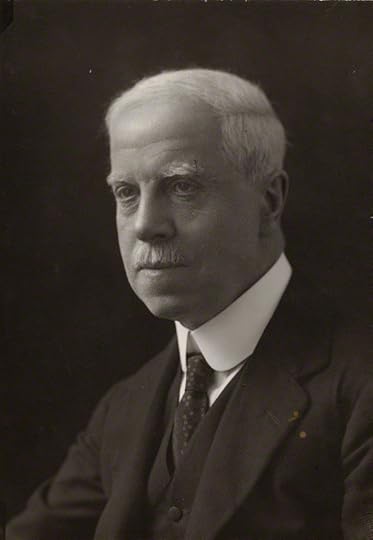
Sir Thomas Little Heath 1861 - 1940 (from the National Portrait Gallery)
This Dover paperback, still in print decades after its first publication in 1963, is an unabridged and unaltered reproduction of the book originally published by Oxford University Press in 1931. The edition I have is the 1963 edition, with a different title - simply Greek Mathematics.
Heath wrote this volume several years after publishing his History of Greek Mathematics, which is also still available in two volumes from Dover. The History was written, in Heath's words from the Preface to the reviewed book, for an audience of "classical scholars" and "expert mathematicians". The Manual on the other hand was aimed at "the general reader who has not lost interest in the studies of his youth".
I certainly have not read this volume all the way through. I view it as a reference. Whenever I have had occasion, over the years, to delve into it, I have never been disappointed, nor have I ever been unable to understand the material presented by Heath. There are figures and equations, certainly. But they depend on little but a knowledge of elementary algebra and some geometry. (Naturally the sorts of equations that I am allergic to, those dealing with integrals, partial derivatives, etc., play no part in a book on Greek mathematics.)
I think the simplest way of indicating what's in the book is to summarize the Table of Contents, which is broken down in more detail than below. I'll also give page numbers so the reader can judge how much material there is under each topic.
I. INTRODUCTORY (1) II. NUMERICAL NOTATION AND PRACTICAL CALCULATION (11) III. PYTHAGOREAN ARITHMETIC (36) IV. THE EARLIEST GREEK GEOMETRY. THALES (73) V. PYTHAGOREAN GEOMETRY (92) VI. PROGRESS IN THE ELEMENTS DOWN TO PLATO'S TIME (112) VII. SPECIAL PROBLEMS (139) [Squaring the circle, trisecting an angle] VIII. FROM PLATO TO EUCLID (171) IX. EUCLID (202) X. ARISTARCHUS OF SAMOS (270) XI. ARCHIMEDES (277) XII. CONIC SECTIONS (347) XIII. THE SUCCESSORS OF THE GREAT GEOMETERS (377) XIV. TRIGONOMETRY: HIPPARCHUS, MENELAUS, PTOLEMY (393) XV. MENSURATION: HERON OF ALEXANDRIA (415) XVI. PAPPUS OF ALEXANDRIA (434) XVII. ALGEBRA: DIOPHANTUS OF ALEXANDRIA (466) XVIII. COMMENTATORS AND MINOR WRITERS (510)
The are followed by three appendices, starting on (520): Egyptian mathematics; Ancient Babylonian mathematics; and Hipparchus and Chaldaean astronomy.
Finally, two indices: One of Greek terms (5 pages), and the regular name/subject index, 16 pages long and very detailed.
Highly recommended to anyone interested in the history of mathematics or in the ancient civilization of the Greeks.
In the case of mathematics, it is the Greek contribution which it is most essential to know, for it was the Greeks who first made mathematics a science.
As a supplement to my interest in the history of science, I figured that I ought to take a look into the history of mathematics, since the two are quite intimately related. This naturally led me to the Greeks and to Sir Thomas L. Heath, who remains the most noteworthy translator, divulgator, and commentator in English eighty years after his death. This book is likely the best single volume you can get on the subject, as it covers all of the major mathematicians in some detail while giving a complete overview.
It is also reasonably accessible (“reasonably” being the operative word). Certainly it is no work of popular math in the modern sense; it is not pleasure reading, and Heath assumes a certain amount of knowledge on the reader’s part. A thorough knowledge of algebra and geometry is assumed, and a few words in ancient Greek are not translated. What is more, large sections of the book are essentially extended summaries and explications of Greek treatises, which makes them almost impossible to read without the original text alongside. Personally I would certainly have appreciated more spoon-feeding, as it was quite difficult for me to prevent my eyes from glazing over.
The book is divided primarily by subject-matter and secondarily by chronology. Heath introduces us to notation, fractions, and techniques of calculation, and then on to arithmetic. Geometry, of course, dominates the book, as it was the primarily form of Greek mathematical thought. Heath summarizes the contributions to geometry by Pythagoras and his followers, and the scattered mathematicians we know of in the years between Thales and Euclid. Once Euclid appears, he writes his famous Elements, which encapsulates the entire subject and which rendered many previous works obsolete. After Euclid we come to the divine Archimedes and the great Apollonius, who put the capstone on the tradition. Ptolemy (among others) made great advances in trigonometry, while Diophantus made strides in algebra (as well as inspired Fermat).
Heath’s account of these mathematicians is largely internal, meaning that he is focused on the growth of their ideas rather than anything external to the science. Reading this convinced me—as if further evidence was needed—that I do not have the moral fiber or intellectual temper to appreciate mathematics. Heath writes admiringly of the works of Euclid and Archimedes, finding them not only brilliant but beautiful. While I can normally appreciate the brilliance, the beauty normally escapes me. Ratios, volumes, lines, and equations simply do not make my heart beat.
Indeed, the questions that I find most fascinating are those that are hardly touched upon in this book. Most important, perhaps, is this: What aspect of a culture or a society is conducive to the development of pure mathematics? Though claims of Greek specialness or superiority seem antiqued at best nowadays, it is true that the Greeks made outstanding contributions to science and math; while the Roman contribution to those fields—at least on the theoretical side—is close to nil. The mathematics of Ancient Egypt amount to techniques for practical calculations. Admittedly, as Otto Neugebauer wrote about in his Exact Sciences of Antiquity, the Babylonians had quite advanced mathematics, allowing them to solve complex polynomials; they also had impressive tabulations of the heavenly motions.
Even so, it was the Greeks who created science and math in the modern sense, by focusing on generality. That is, rather than collect data or develop techniques for specific problems, the Greeks were intent on proving theorems that would hold in every case. This also characterizes their philosophy and science: a rigorous search after an absolute truth. This cultural orientation towards the truth in the most general, absolute form seems quite historically special. It arose in one fairly limited area, and lasted for only a few centuries. Most striking is the Greek disdain of the practical—something that runs from Pythagoras, through Plato, to Archimedes.
Of the top of my head, here are some possible factors for this cultural development. The Greek economy was based on slavery, so that citizens often could afford to disdain the practical. What is more, the Greek political model was based on the city-state—a small, close-knit community with limited expansionist aims and thus with limited need for great infrastructure or novel weapons. The relative lack of economic, political, or military pressure perhaps freed intellectuals to pursue wholly theoretical projects, with standards that arose from pure logic rather than necessity. Maybe this seems plausible; but I am sure many other societies fit this description, not just the Greeks. The development of culture is something that we do not fully understand, to say the least.
This has taken me quite far afield. In sum, this book is an excellent place to start—either by itself, or as a companion to the original Greek works—if you are interested in learning something about this astounding intellectual tradition. That the Greeks could get so far using geometry alone—that is, without variables or equations—is a testament to human genius and persistence.
Magnificent. Great way to learn Greek math, while still maintaining some historical rigor. Highly, highly recommended. This would be a great text for students, to instill a lifelong love of math, proof, and exact logical thinking instead of teaching them rote formulas. Brush up on your conics, or you hit various statements like: "it is obvious from the properties of an ellipse that...." (Okay, I cheated a little and elsewhere found some more streamlined proofs for the Archimedes demonstrations, which are a bit tedious, though amazing.)