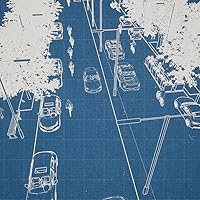
Spatial statistics empowers you to go beyond visual analysis to answer questions confidently and make data-driven decisions.
Thanks to the data and computational power now at our fingertips, data science is in every aspect of our lives. But with so many algorithms and buzzwords floating around, where do you start to solve complex problems or figure out where to go next?
There has never been a more exciting time to learn about spatial statistics. Spatial statistics uses an aspect of geography that helps you quantify patterns and relationships so that you can feel confident in your analysis.
Spatial Statistics Illustrated is an introductory book for learning the concepts behind the powerful spatial statistics tools in ArcGIS.
With approachable explanations and uncomplicated drawings, Spatial Statistics Illustrated gives readers an accessible understanding of some of the most widely used spatial statistics methods, including how they work and when to use them. In a friendly, conversational tone, the authors share techniques that can help you explore your data in meaningful ways; quantify patterns and relationships; understand trends, and make informed, impactful decisions.
This book has something for everyone analyzing data,
seasoned data scientists looking to explore the value that spatial analysis offersGIS analysts looking to expand their spatial statistics skill setnew GIS users discovering the value of spatial statisticsSpatial Statistics Illustrated is a perfect complement to more traditional, technical statistics and spatial statistics texts and is also ideal as supplemental reading for academic courses.
Based on the popular series of Spatial Statistics workshops presented by the authors at the annual Esri User Conference, Spatial Statistics Illustrated welcomes readers into the unparalleled world of spatial statistics.
Over the last 18 years I have been a practicing spatial statistician. Mostly without realizing it, or that it had a name. All of this experience has been centered on the ESRI mapping family of products including ArcPro and an online variant. Because my employer is a relatively large customer of ESRI I have been able to attend 5 of their massively large User Conferences. At these conferences I have had the honor to learn firsthand from Dr. Lauren Bennett and her always superb team of product designers. In addition I have overused her time and that of her team as they gave me much support while I worked through some map based analysis I wanted to build. Beyond my opinion of Dr. Bennett people, I know and respect, respect her and from the way she is greeted and regarded by others in the industry you can be certain her high standing as a person as well as a professional is well earned.
This is said in part to make clear that I read her book as a fan, and to brag about the fact that I have met her; if only as one of her many student customers at ESRI. I have less to say about co-author Flora Vale only because I have had less direct contact with her. Dr. Bennett has a uniformly superior team and by association Ms. Vale is likely to have herown fans and followers among spatial statisticians. Completing this point is that mine is an autographed copy purchased at the 2023 users conference.
It is possible to describe Spatial Statistics Illustrated as an introduction to what is a still emerging ever broadening field of science. It is a very good choice as a first text in a larger course of study. I believe it is more than an introduction. A better term is a survey. The book begins with definition of terms and proceeds from basic to more advanced examples of the types of problems a practitioner of spatial statistics should be able to solve. The customer for this book is most obviously a student, but given its deliberate lack of statistical formula and tight focus on the practice of spatial analysis, the targeted customer is the practitioner.
Emphasizing the fact that its lack of complex formulas increases the accessibility of the book to a less than mathematically minded reader is the fact that a user, backed with a recent version of ARCPro can depend on the software to perform the math. For the advanced academically minded reader, the absence of these formulas, limit the ability to thoroughly analyze the thinking intended to solve advanced statistical concepts. That reader will have many other texts from which to choose. Ms. Vale’s illustrations add critical clarity to the text. The text is careful paced, describing increasing complex ideas. Spatial statistics, and their analysis are inherently, visual. They well served by the lavish, attractive and well-designed illustrations. Care is evident in keeping the images to the minimum necessary detail Lazar-like focused attention to the statistical elements under discussion.
As with most ESRI publications, the book is on very high-quality paper. While short, my copy is about 165 pages it is hardly inexpensive. If your is to be an office copy it can be expected to survive its passages across to many fellow spatial analysts.