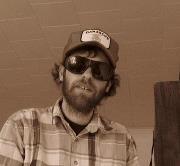
Paul Metcalf (1917–1999) was an American writer. He wrote in verse and prose, but his work generally defies classification. Its small but devoted following includes Robert Creeley, William Gass, Wendell Berry, Guy Davenport, Howard Zinn, and Bruce Olds. His many books include Will West (1956), Genoa (1965), Patagoni (1971), Apalache (1976), The Middle Passage (1976), Zip Odes (1979), and U.S. Dept. of the Interior (1980).
He was the great-grandson of one of his major literary influences, Herman Melville.
Paul Metcalf was born in 1917 in East Milton, Massachusetts. He attended Harvard but left before graduating. In 1942, he married Nancy Blackford of South Carolina and over the next two decades spent long periods in the South. Metcalf traveled widely through North and South America and these travels figure largely in his work. Among his friends and associates were the poet Charles Olson (whom he met when he was thirteen), the artist Josef Albers, poet and publisher Jonathan Williams and the writer Guy Davenport. Later in his career, Metcalf was a visiting professor at the University of California San Diego, SUNY Albany, and the University of Kansas. He died in 1999, near Pittsfield, Massachusetts.
This is one of the great long poems in modern American literature. Never mind that, to my knowledge, Metcalf didn't 'write' a word of it (nor most of his other works), instead he treads like a jackdaw, like the great scholar he is, through various texts (conveniently credited at the back of the book), plucking out what he can use and composing, in collage-form, a poem that manages to capture the continent's primal beginnings, its native heritage, its early European exploration & settlement, into a coherent whole, juxtaposing the vital language of these various documents against newspaper articles and other, more ephemeral, language, to form a work that appears sculpted and has its own rough music. This book really does belong with the others: The Cantos, Maximus, Passages, Drafts, ARK, "A"....and the edition published prior to the wonderful 3-volume Collected Metcalf (Coffee House Books), published by Turtle Island Foundation in 1976, is truly beautiful, with its cat-totem cover and lovely woodcut frontispiece and chapter headings. If you can find a copy, do so.
Wow, Paul Metcalf is 2/2 with me so far on the 5-star ratings. Impressed.
When they say his writing "defies classification," what they mean to say is 1) his prose is poetic, freeform, and independent of even language at times, 2) his work is full of excerpts and quotations that sometimes read more like a research paper, 3) time is often relative or simultaneous, or at least something other than typical, which allows, for example, a novel set in contemporary times to somehow also be historical fiction, 4) and other stuff like that.
As David Foster Wallace says about good writing, you can "hear the click" as you read Metcalf. Every word and sentence is purposeful and perfect. It just works.
Recommended for those who like Vollmann's Seven Dreams series. This could very easily be an iteration of that series.