Does it really surprise anyone that this was one of my very favorite novels when I was 14-16 years old? Anyone? Anyone? No?
Well, it was. In re-reading it, I can appreciate its tremendous influence on me more than ever: my particular taste in gory, squalid, decadent, yet emotional, romantic, and character-driven horror fiction; my own writing style; even my sense of myself as a queer transmasculine person stem in large part from encountering LOST SOULS (and subsequently the rest of Brite's late 80s- early 90s fiction) at a formative age. Brite was in his early 20s when he wrote LOST SOULS, and re-reading it, that's very obvious. Not because it's a clumsily written book: I still think the language is gorgeous, unabashed in its floridity, great at rendering grotesque characters and situations in a way that's both upsetting and alluring. It's just that the emotional timbre and narrative voice of the story is overwrought in a particularly adolescent way. This generally works, as the principal characters are either under the age of 23, or are vampires in a state of perpetual arrested development both physical and emotional/moral/cognitive. It also helps that Brite has a wry self-awareness about some of the more melodramatic and self-aggrandizing ways his characters think about themselves and their situations. Nothing's suburban misfit angst at the beginning of the novel, in particular, is treated with great sympathy but also poked fun at (and it stands in clear contrast to the genuinely traumatic, tragic, and violent situations he encounters later in the story). Still, there are moments where as an adult reader I lose patience with the sincere purple-prose romanticization of nihilistic hedonism and self-destruction, and with LOST SOULS' frequently self-conscious Edginess (some of which, like the way it handles Steve's rape of Ann and a villain's casual N-word dropping towards the beginning, has really, *really* not aged well).
The novel has a bit of a misogyny problem in its treatment of female characters, too, though I will defend its use of monstrous, deadly vampire pregnancy as a repeated plot device. Brite is a trans man, and in that motif I see a very emotionally frank metaphorical handling of the particular horror pregnancy holds for many transmasculine people. I think it is difficult for people of other gender experiences to fully understand that horror; in my opinion, monstrous and deadly pregnancy signifies something different when used by a trans male writer than it does when used by a cis male writer, or by a female writer. That said, the general lack of focus on LOST SOULS' female characters, despite their importance as plot devices, and its inconsistent, victim-blaming, often shallow depiction of Ann, are real faults of the novel.
On the other hand, a lot of Brite's observations on abusive and dysfunctional interpersonal dynamics are keen and insightful. Nothing's willingness to submit to abuse, manipulation, and sexual exploitation-- and eventually to murder-- if it means he can finally secure a sense of acceptance, love, and belonging rings terribly true. Various characters' frantic, self-pitying self-justifications for their acts of violence, cruelty, and cowardice ring true as well. Ghost and Steve's intense, co-dependent homoerotic friendship is alternately chilling, frustrating, sexy, and kind of heartwarming. And I would submit that Ghost (for me, anyway) offers a still-striking and unusual portrayal of what a gentle, non-toxic masculinity could look like.
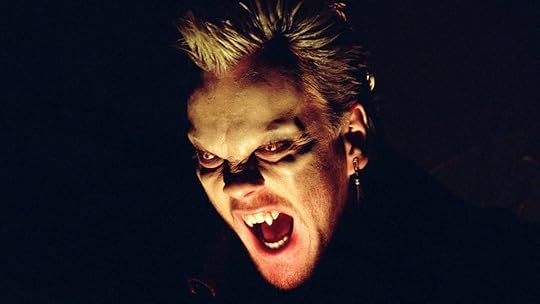
Like BLACK AMBROSIA, LOST SOULS strikes an excellent balance between the sympathetic vampire, the seductive vampire, and the monstrous/evil vampire; its creatures of the night are all three. Also like BLACK AMBROSIA, its vampires are transients who live filthy, marginal lives working odd jobs or living on the money they scavenge from their victims. I maintain that this makes a lot more sense as a vampiric lifestyle than an aristocratic existence of cultured splendor in a Gothic mansion or castle-- at least, if you're using the vampire as a metaphor for addiction, queerness, marginality, and destructive relationships rather than as a metaphor for the way the rich exploit the poor and working classes. The gore scenes are also great here, with eroticism slowly sliding or abruptly diving into grand guignol splatterpunk bloodbaths. If nothing else, LOST SOULS more than holds up as a *vampire* novel-- I'd say it remains one of the better ones out there!