

What do you think?

Vita delle forme seguito da Elogio della mano
Figlio di un incisore e studioso di tecniche e di artisti dell'incisione, Focillon analizza in "Vita delle forme" la vicenda artistica come sistema formale, strutturando il saggio in cinque Il mondo delle forme, Le forme nello spazio, Le forme nella materia, Le forme nello spirito, Le forme nel tempo. Il testo è seguito dal saggio "Elogio della mano".
- GenresArtPhilosophy
134 pages, Paperback
First published January 1, 1934
Ratings & Reviews
Friends & Following
Create a free account to discover what your friends think of this book!
Community Reviews
Displaying 1 - 3 of 3 reviews

Read
June 6, 2015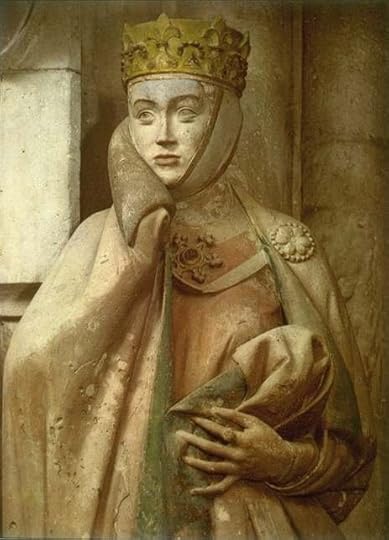
Early Gothic figure from the cathedral at Naumburg
Henri Focillon (1881-1943) was an art historian of great repute and professor at the Sorbonne and later at the Collège de France. He died in the USA while teaching at Yale and working for the cause of Free France, then under the Nazi heel. Of his many books I was first attracted to his Vie des formes (1934),(*) which is a summary of his theory of art. A formalist, he is rather (poetically) abstract in this short text, since he is concerned primarily with the evolution of the morphology of art,(**) but I would like to summarize the aspects of the book that drew me to it in the first place.
In Vie des formes Focillon presents a typology of the evolution of style in art, wherein he proposes that every art form progresses through four stages(***) which he calls Experimental, Classical, Refined and Baroque. In the Experimental stage (which he also refers to as Archaic) a nascent style is casting about for its (often tacit) principles in order to define itself and is therefore experimenting with not always happy results. In the Classical stage the style has decided upon its principles and is, in a stable and secure manner, working out their consequences in concrete works. It is not yet manifesting conformism or academicism. In the stage of Refinement the style develops in the direction of increased elegance and often lands in a state of dry purity. In the Baroque stage, which Focillon asserts is "without doubt the most liberated", the principles of the style are taken to extremes that become their own ends and exhaust all the creative impulse of the style. Then one must recommence from a new beginning, a new stage of Experiment.
Focillon proposes characteristics of each of these stages and illustrates his points using European art over the ages. However - and this is how I was directed to this book in the first place - no less a critic than Kato Shuichi usefully employs Focillon's ideas in some of his essays on Japanese literature and art in Form, Style, Tradition: Reflections on Japanese Art and Society. Of particular interest to me is the suggestion that when artists in one of these four stages look back over art history, they are particularly attracted to art and artists in the same stylistic stage of development as they. Kato used this notion tellingly, but, unfortunately, Focillon does not move beyond a sketch of these ideas in Vie des formes.
Of course, this classification can be no more than a suggestive tool for organizing the incredibly complicated genesis and morphology of artistic styles, which is not likely to be exhaustively "understood" at any point in the future. And one must wonder at the claim of universality through all cultures and times, which clearly rests upon the notion that human beings at all times and places are essentially similar. Here the nature/nurture debate is particularly fierce.
(*) Available in English translation under the title The Life of Forms in Art.
(**) He was a noted expert in medieval sculpture, but he also wrote on 19th century painting and Buddhist art, among other topics.
(***) This was neither the first nor the last attempt to provide this kind of phenomenology of artistic style.
Rating
http://leopard.booklikes.com/post/119...

May 26, 2024
Un libro complessissimo che concentra in 100 pagine quello che uno storico dell'arte, ancora oggi, mette in pratica. Praticamente è un manuale d'uso del conoscitore dell'arte.
Libro che non consiglio assolutamente come prima lettura o anche solo per chi è appassionato d'arte. Letto per un corso d'esame totalmente dedicato a questo libro dove il professore analizzava, capitolo per capitolo, ogni cosa vista la complessità del testo.
Libro che non consiglio assolutamente come prima lettura o anche solo per chi è appassionato d'arte. Letto per un corso d'esame totalmente dedicato a questo libro dove il professore analizzava, capitolo per capitolo, ogni cosa vista la complessità del testo.
November 9, 2020
Vie des Formes, c'est correct. C'est le travail d'un érudit. C'est pointu et y'a des références qui demandent un travail un peu trop intense pour s'accrocher à la lecture (si on veut lire seulement pour le plaisir). La deuxième partie du livre cependant, Éloge de la main, m'a beaucoup plus parlé. C'est très beau, l'écriture est fluide et les idées bien définies. Très cool lecture, & courte en plus de tsa.
Displaying 1 - 3 of 3 reviews