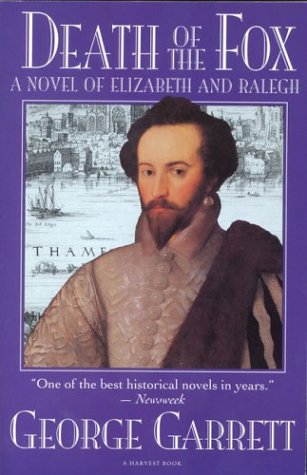
A meticulous re-creation of Elizabethan England that forms a trilogy with The Succession and Entered from the Sun. Here the author delves into the story of Sir Walter Ralegh's fall from favor for alleged conspiracy against James I. Garrett transports the reader to a world of cunning, intrigue, and colorful abundance.
(For the British short story writer, playwright, and political activist see George Garrett)
George Palmer Garrett was an American poet and novelist. He was the Poet Laureate of Virginia from 2002 to 2006. His novels include The Finished Man, Double Vision, and the Elizabethan Trilogy, composed of Death of the Fox, The Succession, and Entered from the Sun. He worked as a book reviewer and screenwriter, and taught at Cambridge University and, for many years, at the University of Virginia. He is the subject of critical books by R. H. W. Dillard, Casey Clabough, and Irving Malin.
This rich tapestry of a book follows the final two days of Sir Walter Raleigh's (or Ralegh's) life. Taking those two days as a framework, it lures the reader into a sequence of dreams, memories and visions that come together to create a vivid picture of Elizabethan and early Stuart England, and the men who lived in it.
Garrett's writing is dense and picturesque and this is a book that demands time to be spent on it. It is really less of a novel and more a series of fictionalised meditations on life in England at this time. There are some passages of surpassing beauty which capture the elegiac sense of a fading golden age seen from the harsh light of day. However, it is not an easy read. The language is archaic and Garnett's sentences are sometimes chopped and truncated in odd ways. In short: it's a challenge, but one which is worth the effort if you appreciate beautiful writing and historical fiction.
Beautifully written. Full of details and rich insights to the people and the situations in which they found themselves. At first odd, to take 700 pages to chronicle the last two days of a man's life, but none of it was gratuitous. Glad I read it.
During his lifetime, Sir Walter Raleigh spelled his surname more than 50 different ways. But he never spelled it the way we write it today.
This has nothing to do with reviewing the book. I just thought it was interesting.
This is an account of the last couple of days before Raleigh was executed. (I guess that's a spoiler, but so is the title of the book.)
Most of the book is in the form of reminiscenses, ruminations, and reflections by the main characters: Raleigh, King James, Edward Coke, Francis Bacon, and others. That treatment made reading it something of a slog for me, but it creates a vivid impression of life among the powerful in England during the last years of Elizabeth I's reign and the early days of King James. There's a wonderful passage in a letter Raleigh writes to his young son. It captures the disruption that occurs when life and society change rapidly and has great relevance to 21st century America.
If I knew more about these historical figures or if I had read the first two books in the series, I would have gotten a lot more out of this book. But as it was, a lot of the scheming, speculation, and in-jokes went over my head.
Death of the Fox is one of the best fictional books that I have read. The book takes you right into the heart of Elizabethan and Jacobean England giving a real insight into the rivalries, religious and political disputes of the time. The meticulous descriptive detail in the writing adds a new dimension to reading. A must read again book.
A book about the reign of Elizabeth I and her trusted ally Sir Walter Raleigh, Death of the Fox was a book that I thought I would like more, but I did not enjoy it nearly as much as I wanted to.
Historical fiction in one of the genres that is the equivalent of baked pasta for me...it is the comfort food of books. And I love the Elizabethan era. But George Garrett tells the story of the rise, fortunes and final downfall of Raleigh in a disjointed, oblique way, and I must admit, it did not grab hold of me until almost the end of the over 700 page book.
Now Garrett is doing more than just telling Raleigh's story, he is trying to show how England was in that time, and how much it advanced during the reign of Elizabeth I. In doing so he uses many different narrative voices, and this is where he lost me. Because some of these voices are first person, but seem to belong to disembodied beings, I had no idea where the narrative was emanating from, or why that voice took over the narrative.
While he does succeed in illustrating England, he would have grabbed me more by sticking to the story of Raleigh, because that story in and of itself is fascinating. How he rose to be the most trusted advisor to the queen, but after her death he was not at all trusted by her successor, James (of course James hardly trusted anyone). I would have liked to see more of the relationship of Elizabeth and Raleigh, instead of getting too few and too only hinted at views, of their relationship.
While I was looking forward to that baked pasta, it seems like it was subbed for with tofu. And while good for you, I really wanted it to be comfort food. Death of the Fox did not do that.
I couldn't state my problem with this book any better than was done by another GoodReads reader:
"...(Garrett) uses many different narrative voices, and this is where he lost me. Because some of these voices are first person, but seem to belong to disembodied beings, I had no idea where the narrative was emanating from, or why that voice took over the narrative."
Supposedly Garrett researched this book for many years, and it shows...but its style was just so distracting....got to about page 310, can't go any further...very rare for me.
Suprisingly, this book failed with me as a historical novel. Not, as in most cases, because the history was bad - in fact, the history was excellent. My problem with Death of the Fox was that it wasn't much of a novel - the POV kept changing (which was extremely distracting) and good chunks of it were bacically historial facts delivered in the guise of dialogue, or, in many cases, monologue. Like being buttonholed by a monomaniacal 16th Century first-person interpreter.
George Garrett was my teacher at Bennington in a summer writing program there in the 1979, co-taught by Nicholas Delbanco. He wrote fiction, some of it historical fiction, poetry, essays. One title I was looking for was a collection of stories he invited dozens of writers to do, to include an image of a man with a hat, or umbrella...
I recently re-read my well-thumbed edition of Garrett's novel, and with the passing of time, it still remains one of my best-loved books of this period. I always enjoyed reading about this era, but Death of the Fox, for me, took it to an entirely level. His depiction of Raleigh is both engrossing and moving, but, more importantly, meticulously searched.