

What do you think?

Children Of The Sun
In 1970s Britain, 14-year-old Tony is entranced by the racism and brutality of the skinhead movement. From white-power rock gigs and race riots to clandestine homosexual encounters, Tony rages through the 1970s, 1980s and 1990s while the far right fragments around him. Early in our new millennium, James, looking for a good story, develops a fascination with closeted neo-Nazis that will bring the narratives of these two men into startling collision.
This is a novel of great imaginative sympathy and range, an extraordinary portrait of an alien Britain and of life lived beneath the radar.
This is a novel of great imaginative sympathy and range, an extraordinary portrait of an alien Britain and of life lived beneath the radar.
391 pages, Paperback
First published August 17, 2010
About the author
Max Schaefer
7 books10 followersMax Schaefer studied at Cambridge and Harvard Universities. Children of the Sun is his first novel.
Ratings & Reviews
Friends & Following
Create a free account to discover what your friends think of this book!
Community Reviews
Displaying 1 - 30 of 63 reviews
January 7, 2016
The memory of this one has lingered on..
It's a very ambitious book. It charts the rise and fall of the Far Right in Britain 1970 -mid 90s, and especially the right's hard core foot soldiers – neo nazi skinheads. Each chapter of the novel is prefaced by cuttings from national newspapers, music papers, magazines of the left and right and the occasional skinzine with pictures of the likes of Nicky Crane and his fellow traveller, Ian Stuart Donaldson, (ISD) lead singer of the white power band Skrewdriver.
The novel is therefore partly grounded in fact and some of the characters appearing are/were real. It opens with the 14 year old Tony who gets his kicks (pun intended!) from being a part of the skinhead movement, the white power part, lots of violence and racist rock concerts and furtive homo sex. The latter is given extra edge because it goes against the essential creed of the neo nazis. A prominent member of the fascist British Movement and right hand man of ISD, Nicky Crane, is actively gay. When not “cleansing the streets” by night of racial “filth” (he was a dust man in the day time) going to prison for his trouble, he was acting as a bouncer at a well known London gay club. When he dies of AIDS in 1993, shortly after ISD's death in a car smash, the movement has fragmented and is falling apart. We follow Tony at the (second) battle of Waterloo – Anti Nazi League v the White Power skins and a more politically correct wing. Afterwards the two latter factions will knock hell out of each other.
Fast forward to the new millennium when being skinhead became a bit of a fashion accessory. James, a young journalist who happens to be gay with a skinhead – Mark II type – boyfriend, becomes obsessed with the story of Nick Crane and the nationalist movement. Through James fact and fiction will start to merge and fresh challenges and questions will arise. Eg - was ISD bumped off?
This reminded me somewhat of Boxer Beetle, similar themes and the same unsettling moves in time, backwards and forwards.
Interesting read..
It's a very ambitious book. It charts the rise and fall of the Far Right in Britain 1970 -mid 90s, and especially the right's hard core foot soldiers – neo nazi skinheads. Each chapter of the novel is prefaced by cuttings from national newspapers, music papers, magazines of the left and right and the occasional skinzine with pictures of the likes of Nicky Crane and his fellow traveller, Ian Stuart Donaldson, (ISD) lead singer of the white power band Skrewdriver.
The novel is therefore partly grounded in fact and some of the characters appearing are/were real. It opens with the 14 year old Tony who gets his kicks (pun intended!) from being a part of the skinhead movement, the white power part, lots of violence and racist rock concerts and furtive homo sex. The latter is given extra edge because it goes against the essential creed of the neo nazis. A prominent member of the fascist British Movement and right hand man of ISD, Nicky Crane, is actively gay. When not “cleansing the streets” by night of racial “filth” (he was a dust man in the day time) going to prison for his trouble, he was acting as a bouncer at a well known London gay club. When he dies of AIDS in 1993, shortly after ISD's death in a car smash, the movement has fragmented and is falling apart. We follow Tony at the (second) battle of Waterloo – Anti Nazi League v the White Power skins and a more politically correct wing. Afterwards the two latter factions will knock hell out of each other.
Fast forward to the new millennium when being skinhead became a bit of a fashion accessory. James, a young journalist who happens to be gay with a skinhead – Mark II type – boyfriend, becomes obsessed with the story of Nick Crane and the nationalist movement. Through James fact and fiction will start to merge and fresh challenges and questions will arise. Eg - was ISD bumped off?
This reminded me somewhat of Boxer Beetle, similar themes and the same unsettling moves in time, backwards and forwards.
Interesting read..

January 22, 2020
Wow. Like being walloped from all directions at once. All the right wing neo-nazi material is uncomfortably relevant, and gay 1970s / 1980s skin heads as political warriors? Who knew extreme right wing politics and fascism were going to be all the rage, once more?
This 2010 novel, part historical fiction and part looking back at how things “used to be” was all too much and yet perfect at the same time. I was up late finishing this, and usually bedtime reading sends me to sleep.
History meets research meets present day horrors meets make believe meets closeted neo-nazis meets ironic distance meets bloodied knuckles. Like I said. Wow.
This 2010 novel, part historical fiction and part looking back at how things “used to be” was all too much and yet perfect at the same time. I was up late finishing this, and usually bedtime reading sends me to sleep.
History meets research meets present day horrors meets make believe meets closeted neo-nazis meets ironic distance meets bloodied knuckles. Like I said. Wow.

September 12, 2010
Superb, stupendous, a brilliant new writer has come along. Started this on Friday, now Sunday, almost finished. Watch this space for review.
Life’s full of little ironies. I left off reading Les Miserables when Hugo went into a seemingly interminible digression about the Battle of Waterloo. I needed a rest so I began reading this as soon as it was given to me. I finished it in two days, coming upon near the end another Battle of Waterloo, this one at Waterloo Station, on 12 September, 1992, and here a vivid and flinty description of all hell breaking loose between the hardened edges of anti-fascist movements and the equally sharp edges of a medley of far right youth fascists, skinheads at this point in time being on both sides.
Schaefer’s descriptive powers are immense, and if there is a poetry of visceral violence it is here (long with a most heartbreaking, lyrical counterpart of tenderness which expresses itself physically). The novel opens with an intensely vivid description of homosexual encounter in a public toilet. The unrelenting realism of the sexual and the violent, often crossing into each other, form a helix that can’t not draw a fascinated and horrified response from the reader. The dualism of this sort of voyeurism parallels the attractiveness of the S/M dyad, the ugly becomes beautiful, the beautiful and innocent something to be violated and destroyed.
The novel’s protagonist is James, a public school and university child of parents who look after him during his prolonged adult adolescence during which he is waiting to become a serious artist, a screenwriter no less. There are many like him in the world in which he moves, so obviously this is more than mere fiction. He is fascinated with the Nazi thug Nicola Crane whose brutal physiognomy and stance adorn the book’s frontispiece, a fascimile from Skins International fanzine, 1983. Crane is one of a list from England’s recent history of far right thugs, stretching from the likes of Stuart Donaldson, psycho and front for the Rock against Communism band, Skrewdriver, to the more homely charms of our own Nick Griffin. (It’s important to note, for reasons that will become apparent that Donaldson and Griffin too were public school boys). Jame’s researches take him and us on a journey along the contours of the 1970s through to the present factionalisms and vaguely articulated sense of such movements as the British National Socialists, the British Movement, the National Front, the British National Party, Blood and Honour, and sundry others. Insights into aspects their activities – such as military training sessions, infiltration into establishment instituions, music, ideologues, connections with strange European bearers of the mysteries of the swastika (which is the symbol for the wheel of the the sun, hence Children of the Sun, a blood-stained s flag touched by Hitler himself being lugged around London in a duffle bag during our encounter with these insights) – are brought to life with scenarios that border on the grotesque (I don’t want to plot spoil but I am referring to a gaga old woman who is too scary to get a part in a horror movie) to the chillingly domestic with a young and earnest Nick Griffin fresh from Cambridge with his leaflets and booklets and intelligent arguments.
Schaefer’s constructed his novel so that James’s research is embodied in a factual framework with a fictional narrative, the main character being Tony whose story begins and ends the book, the ending though with a contrived but satisfying twist. Tony, like almost all of the characters (at least half of whom are ‘semi-fictional’: the blurring of fact and fiction is o only a literary game, it’s largely what the book is about) is broken, violent, tender, inconsistent, intelligent but often inarticulate, swept along and never having the opportunity to grow up. Three kids offer him a glue bag to sniff: he takes it, “I was young once.” The structure is very straightforward and works for what the author is doing, certainly presents an uncomplicated reading of the narrative.
Regarding the history covered in the book, I think you’ll find it interesting, informative and so on, but I’d like now to turn to some aspects of the novel which lift it towards being very good indeed.
It’s about identity, markers, self and other. Of course, it’s got political and ideological aspects but there’s no didacticism, polemic or answer to a sneaked-in question. It lays stuff brutally on the table in a way that shows quite clearly some underlying patterns to the way we all think. I have alluded to three elements: the erotic, the violent and the tender (the latter connected with joy). The tensions between these generate the power of the novel, of the individual. Identity is made of the private (erotic, tender) that may need the other to share with, yet always throughout the relationship of trust, except in the most marvellously paradoxical way right at the end, is precarious and fragile at best. Identity of self – perhaps only James’ boyfriend Adam and some of their middle class friends show a degree of adult autonomy – is the absence which initiates the time-honoured method of finding the self by losing it into the communal. At a gig on Nick Griffin’s Daddy’s farm, Tony is drawn into the heaving, sweating dancing gang of skins, at first conscious of the erotic self that he must hide but then, he
….sees himself repeated in every direction like a hall of mirrors, and understands that this will not wreck him, he is not distinct from it and floating fragile on its surface, but rather it is him, of him and he is part of it, the shouts, the salutes, the sieg from within and around him alike. With one force, one voice, he fills the courtyard.
Yet in one of the smudged photocopies of fanzines and the like that punctuate the novel, we have this in Square Peg no.12, 1986, Why I’m a Skin’:
(a skin is) able to walk anywhere, his passport the astonishment of the sharp mind in the brainless stereotype…
…This animal’s only secondary sexual characteristics are his braces, worn up to exaggerate the width of his shoulders, down to emphasise the curve of his bum.
Another scene (I won’t describe it in detail, it is worth savouring) evokes a Tea Dance with an assortment of the oddest, weirdest, most outlandishly dressed and styled couples and it is here that explicit reference to the word joy is made. Tenderness exists elsewhere too in the little details of lovers’ rituals, yet for the most part it is trodden down (often literally) by sadism, often greeted by paid for masochism. Somehow in the Square Peg quotation and the desire by Adam – a successful BBC producer – to dress as a skin, and to go to S/M skin club and be utterly humiliated, and many other instances of the conflation of dress, power, identity, violence, eroticism, gender simply saturate the novel’s ‘content’ (at the level of ‘representing’ some attributes of the far right movements at a small period of history): James’ intuition that after all his searching in the British Library and other conventional research, he has to find whatever he is looking for by finding out how the virtually absent Nicola Crane feels.
England is not about England nor was it ever.
To me, there were some disturbing overlaps implied between the descriptions of the Fascist ideologues, the ‘thinkers’ and the counterpart in any demagoguery of the ‘far Left’. Even the mystical mumbo jumbo James gets sidetracked into studying then taking on board to the point of becoming paranoid has its symmetry between right and left. The Nazi mythologies are well known, but it’s worth pointing out that you won’t have to click many times to find sites with Deleuze and John Dee sharing the spotlight. The use in the novel of the London Psychogeographical Society’s speculations on the pyramid at the top of Canary Wharf (reprinted in the novel) fits in these days with the more Waterstones texture of psychogeography (indeed Shaefer includes an opening epigram from Iain Sinclair’s Suicide Bridge). The Battle of Waterloo has an awful symmetry about it, and when the police throw a cordon around all the skins to escort them out of the station, they little know that half of the skins have turned, or always been, commie.
More traditionally, old school tensions rise. Piques James turns on his lover, Adam: "This whole sub-skin thing. You get your rocks off by dressing on the ne plus ultra of the lumpenproletariat and pretending you’re powerless. It’s classic English guilt.” Complementing such traditional complaints, there is a diatribe elsewhere against petit bourgeois grammar schools yearning to be like public schools, and the pathetic guy Adam and James go to see for a whipping who turns out to be a wimp with a longing to meet public school boys. It’s these little touches – that public schools aren’t accidentally mentioned on many occasions – that do remind us that while all this stuff is going on there’s a class system out there, and an elite grinding happily away. Fight on, boys.
Schaefer has a sharp eye for the urban detail, just enough slant on something to conjure up the whole. London as, like the S/M tension, horribly fascinating and attractive, a wasteland and pulsing with life at the same time. He gives his more vacuous characters enough words to hang themselves with, his authorial voice an ironic comment rather than the ornate showmanship it may appear to be if you don’t see just how careful he is to maintain precisely the right distance while being intimately connected with every level of the novel’s workings. Some feat.
He’s a clever writer, but doesn’t show off. My guess is that the ‘solipsistic cunt’ who drove across Tottenham Court Road during the anti-Iraq war march is a character from Ian McKewan’s Saturday (also a novel about identity but, well, a bit different). Mind you, when James’ sister has a go at him for making his parents remortgage the house so they can keep supporting their lazy jobless pseudo-artist son, she calls him a ‘solipsistic prick’.
But remember, whatever, whether they’re real clothes, or clothings of ideas, concepts, fantasies, ideologies in the end they are all just skins. We are made of the erotic, the violent, and if we’re lucky, the tender. The rest is just “as if quotation marks swarmed about me like moths.”
Life’s full of little ironies. I left off reading Les Miserables when Hugo went into a seemingly interminible digression about the Battle of Waterloo. I needed a rest so I began reading this as soon as it was given to me. I finished it in two days, coming upon near the end another Battle of Waterloo, this one at Waterloo Station, on 12 September, 1992, and here a vivid and flinty description of all hell breaking loose between the hardened edges of anti-fascist movements and the equally sharp edges of a medley of far right youth fascists, skinheads at this point in time being on both sides.
Schaefer’s descriptive powers are immense, and if there is a poetry of visceral violence it is here (long with a most heartbreaking, lyrical counterpart of tenderness which expresses itself physically). The novel opens with an intensely vivid description of homosexual encounter in a public toilet. The unrelenting realism of the sexual and the violent, often crossing into each other, form a helix that can’t not draw a fascinated and horrified response from the reader. The dualism of this sort of voyeurism parallels the attractiveness of the S/M dyad, the ugly becomes beautiful, the beautiful and innocent something to be violated and destroyed.
The novel’s protagonist is James, a public school and university child of parents who look after him during his prolonged adult adolescence during which he is waiting to become a serious artist, a screenwriter no less. There are many like him in the world in which he moves, so obviously this is more than mere fiction. He is fascinated with the Nazi thug Nicola Crane whose brutal physiognomy and stance adorn the book’s frontispiece, a fascimile from Skins International fanzine, 1983. Crane is one of a list from England’s recent history of far right thugs, stretching from the likes of Stuart Donaldson, psycho and front for the Rock against Communism band, Skrewdriver, to the more homely charms of our own Nick Griffin. (It’s important to note, for reasons that will become apparent that Donaldson and Griffin too were public school boys). Jame’s researches take him and us on a journey along the contours of the 1970s through to the present factionalisms and vaguely articulated sense of such movements as the British National Socialists, the British Movement, the National Front, the British National Party, Blood and Honour, and sundry others. Insights into aspects their activities – such as military training sessions, infiltration into establishment instituions, music, ideologues, connections with strange European bearers of the mysteries of the swastika (which is the symbol for the wheel of the the sun, hence Children of the Sun, a blood-stained s flag touched by Hitler himself being lugged around London in a duffle bag during our encounter with these insights) – are brought to life with scenarios that border on the grotesque (I don’t want to plot spoil but I am referring to a gaga old woman who is too scary to get a part in a horror movie) to the chillingly domestic with a young and earnest Nick Griffin fresh from Cambridge with his leaflets and booklets and intelligent arguments.
Schaefer’s constructed his novel so that James’s research is embodied in a factual framework with a fictional narrative, the main character being Tony whose story begins and ends the book, the ending though with a contrived but satisfying twist. Tony, like almost all of the characters (at least half of whom are ‘semi-fictional’: the blurring of fact and fiction is o only a literary game, it’s largely what the book is about) is broken, violent, tender, inconsistent, intelligent but often inarticulate, swept along and never having the opportunity to grow up. Three kids offer him a glue bag to sniff: he takes it, “I was young once.” The structure is very straightforward and works for what the author is doing, certainly presents an uncomplicated reading of the narrative.
Regarding the history covered in the book, I think you’ll find it interesting, informative and so on, but I’d like now to turn to some aspects of the novel which lift it towards being very good indeed.
It’s about identity, markers, self and other. Of course, it’s got political and ideological aspects but there’s no didacticism, polemic or answer to a sneaked-in question. It lays stuff brutally on the table in a way that shows quite clearly some underlying patterns to the way we all think. I have alluded to three elements: the erotic, the violent and the tender (the latter connected with joy). The tensions between these generate the power of the novel, of the individual. Identity is made of the private (erotic, tender) that may need the other to share with, yet always throughout the relationship of trust, except in the most marvellously paradoxical way right at the end, is precarious and fragile at best. Identity of self – perhaps only James’ boyfriend Adam and some of their middle class friends show a degree of adult autonomy – is the absence which initiates the time-honoured method of finding the self by losing it into the communal. At a gig on Nick Griffin’s Daddy’s farm, Tony is drawn into the heaving, sweating dancing gang of skins, at first conscious of the erotic self that he must hide but then, he
….sees himself repeated in every direction like a hall of mirrors, and understands that this will not wreck him, he is not distinct from it and floating fragile on its surface, but rather it is him, of him and he is part of it, the shouts, the salutes, the sieg from within and around him alike. With one force, one voice, he fills the courtyard.
Yet in one of the smudged photocopies of fanzines and the like that punctuate the novel, we have this in Square Peg no.12, 1986, Why I’m a Skin’:
(a skin is) able to walk anywhere, his passport the astonishment of the sharp mind in the brainless stereotype…
…This animal’s only secondary sexual characteristics are his braces, worn up to exaggerate the width of his shoulders, down to emphasise the curve of his bum.
Another scene (I won’t describe it in detail, it is worth savouring) evokes a Tea Dance with an assortment of the oddest, weirdest, most outlandishly dressed and styled couples and it is here that explicit reference to the word joy is made. Tenderness exists elsewhere too in the little details of lovers’ rituals, yet for the most part it is trodden down (often literally) by sadism, often greeted by paid for masochism. Somehow in the Square Peg quotation and the desire by Adam – a successful BBC producer – to dress as a skin, and to go to S/M skin club and be utterly humiliated, and many other instances of the conflation of dress, power, identity, violence, eroticism, gender simply saturate the novel’s ‘content’ (at the level of ‘representing’ some attributes of the far right movements at a small period of history): James’ intuition that after all his searching in the British Library and other conventional research, he has to find whatever he is looking for by finding out how the virtually absent Nicola Crane feels.
England is not about England nor was it ever.
To me, there were some disturbing overlaps implied between the descriptions of the Fascist ideologues, the ‘thinkers’ and the counterpart in any demagoguery of the ‘far Left’. Even the mystical mumbo jumbo James gets sidetracked into studying then taking on board to the point of becoming paranoid has its symmetry between right and left. The Nazi mythologies are well known, but it’s worth pointing out that you won’t have to click many times to find sites with Deleuze and John Dee sharing the spotlight. The use in the novel of the London Psychogeographical Society’s speculations on the pyramid at the top of Canary Wharf (reprinted in the novel) fits in these days with the more Waterstones texture of psychogeography (indeed Shaefer includes an opening epigram from Iain Sinclair’s Suicide Bridge). The Battle of Waterloo has an awful symmetry about it, and when the police throw a cordon around all the skins to escort them out of the station, they little know that half of the skins have turned, or always been, commie.
More traditionally, old school tensions rise. Piques James turns on his lover, Adam: "This whole sub-skin thing. You get your rocks off by dressing on the ne plus ultra of the lumpenproletariat and pretending you’re powerless. It’s classic English guilt.” Complementing such traditional complaints, there is a diatribe elsewhere against petit bourgeois grammar schools yearning to be like public schools, and the pathetic guy Adam and James go to see for a whipping who turns out to be a wimp with a longing to meet public school boys. It’s these little touches – that public schools aren’t accidentally mentioned on many occasions – that do remind us that while all this stuff is going on there’s a class system out there, and an elite grinding happily away. Fight on, boys.
Schaefer has a sharp eye for the urban detail, just enough slant on something to conjure up the whole. London as, like the S/M tension, horribly fascinating and attractive, a wasteland and pulsing with life at the same time. He gives his more vacuous characters enough words to hang themselves with, his authorial voice an ironic comment rather than the ornate showmanship it may appear to be if you don’t see just how careful he is to maintain precisely the right distance while being intimately connected with every level of the novel’s workings. Some feat.
He’s a clever writer, but doesn’t show off. My guess is that the ‘solipsistic cunt’ who drove across Tottenham Court Road during the anti-Iraq war march is a character from Ian McKewan’s Saturday (also a novel about identity but, well, a bit different). Mind you, when James’ sister has a go at him for making his parents remortgage the house so they can keep supporting their lazy jobless pseudo-artist son, she calls him a ‘solipsistic prick’.
But remember, whatever, whether they’re real clothes, or clothings of ideas, concepts, fantasies, ideologies in the end they are all just skins. We are made of the erotic, the violent, and if we’re lucky, the tender. The rest is just “as if quotation marks swarmed about me like moths.”

October 27, 2017
Max Schaefer's Children Of The Sun is a novel that forced me well out of my political comfort zone. The ideologies connected to the skinhead movement - or at least to most of it - make me cringe, to say the least, but I couldn't help but find this book compelling in a sort of hypnotic way. I frowned and grimaced at the Nazi chants, the cheap racist slurs, the violence, the taste for senseless bloodshed and, yet, I wanted to know more about the characters and their stories.
The novel's structure is ambitious and challenging and throughout the book, we follow two characters but not two parallel stories. Tony's narrative arc starts in the early 1970s when he's a teenager getting close to the skinhead movement while discovering a sexuality that must be lived in secrecy and kept hidden at all costs from his mates. Jumping ahead to the early 2000s we meet James: posh, well-educated, slightly adrift and with artistic ambitions ('[...] what I really want to do is write screenplays [...] like every fucking other person.'). His relationship with Adam, a young man who likes play-acting the part of the skinhead and has a penchant for seedy sexual encounters that James finds at once unsettling and alluring, will push him to investigate the depths of the skinhead underworld under the pretence of working on a script project.
Through Tony's experiences and James's research, Schaefer takes us on a historical and political journey through the constantly shifting world of the British right-wing movements and we're introduced to a number of its key figures, from Ian Stuart Donaldson (leader of the white power rock band Skrewdriver) to Nicky Crane .
Neither of the main characters is sympathetic or particularly nice - I did feel somewhat sorry for the way Tony has to live his life constantly guarding his secret, the urgency with which he lives his existence and embraces his awful ideals made him in my eyes at one time repulsive and tragic. James, on the other hand, is often selfish and self-centred and comes across as childish for the stubbornness with which he pursues his compulsions and inadequacies masquerading them with a veneer of intellectual pretentiousness. The novel's final part shows them confused, alone and adrift.
The novel is seedy and darkly erotic but also rich with historical reconstructions - appearing also in the form of leaflets and fanzines reproduced in between the chapters - and, although I can understand the importance of guiding the readers through the complex world of the fascist and neo-nazi underworlds, I found these parts slightly patronising and tedious at times.
The novel is in any case very interesting and poignant in a sort of deeply uncomfortable way. It was an unexpected discovery and, although not everyone's cup of tea, I can certainly recommend it.
A solid 3.5.
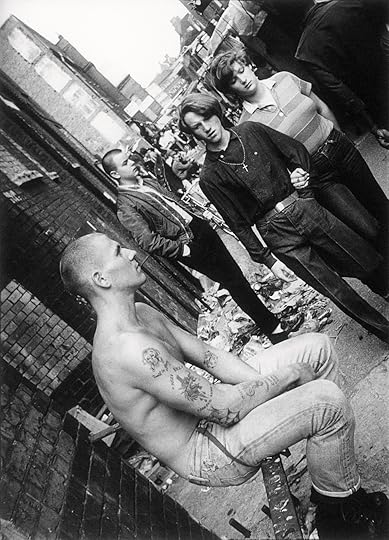
Pic.: Nicky Crane and a friend photographed by Nick Knight in Goulston Street (1979-1980)
The novel's structure is ambitious and challenging and throughout the book, we follow two characters but not two parallel stories. Tony's narrative arc starts in the early 1970s when he's a teenager getting close to the skinhead movement while discovering a sexuality that must be lived in secrecy and kept hidden at all costs from his mates. Jumping ahead to the early 2000s we meet James: posh, well-educated, slightly adrift and with artistic ambitions ('[...] what I really want to do is write screenplays [...] like every fucking other person.'). His relationship with Adam, a young man who likes play-acting the part of the skinhead and has a penchant for seedy sexual encounters that James finds at once unsettling and alluring, will push him to investigate the depths of the skinhead underworld under the pretence of working on a script project.
Through Tony's experiences and James's research, Schaefer takes us on a historical and political journey through the constantly shifting world of the British right-wing movements and we're introduced to a number of its key figures, from Ian Stuart Donaldson (leader of the white power rock band Skrewdriver) to Nicky Crane .
Neither of the main characters is sympathetic or particularly nice - I did feel somewhat sorry for the way Tony has to live his life constantly guarding his secret, the urgency with which he lives his existence and embraces his awful ideals made him in my eyes at one time repulsive and tragic. James, on the other hand, is often selfish and self-centred and comes across as childish for the stubbornness with which he pursues his compulsions and inadequacies masquerading them with a veneer of intellectual pretentiousness. The novel's final part shows them confused, alone and adrift.
The novel is seedy and darkly erotic but also rich with historical reconstructions - appearing also in the form of leaflets and fanzines reproduced in between the chapters - and, although I can understand the importance of guiding the readers through the complex world of the fascist and neo-nazi underworlds, I found these parts slightly patronising and tedious at times.
The novel is in any case very interesting and poignant in a sort of deeply uncomfortable way. It was an unexpected discovery and, although not everyone's cup of tea, I can certainly recommend it.
A solid 3.5.
Pic.: Nicky Crane and a friend photographed by Nick Knight in Goulston Street (1979-1980)

July 26, 2021
Max Schaefer’s debut novel is an ambitious, thoroughly researched historical fiction that explores taboo aspects of the racist side of the Skinhead sub-culture in London.
Divided in two timelines, we follow fourteen year old Tony who is seduced by the racist and violent skinhead movement in 1970’s Britain. And on the other hand, in 2003, we follow James, a young TV-journalist who's looking for an interesting topic to create a screenplay and pitch it for TV in the future. Enticed by the skinhead aesthetic, he comes across the story of Nicky Crane, an ex-neoNazi that came out in 1992 in a TV interview before dying of AIDS in 1993. This particular character will be the thread that connects these individuals in an unforgettable encounter.
It’s been almost a week since I finished this book and I’m still thinking about it. This is undoubtedly a fascinating read whose message isn’t clear at first glance, however the more I think about it the most enthralling the story seems. None of the characters seem particularly sympathetic (especially Tony, I mean…he’s a violent racist, what’s to like about that?), but there’s moments where either Tony or James show certain vulnerability that brings them human complexity. Besides, while they certainly hold different worldviews, their particular proclivities make them cut from the same cloth imo.
Tony’s journey is difficult to stomach, his involvement in reactionary neo-nazi movements throughout the years set the readers in a place of discomfort that go from picturing white-rock gigs full of sieg heils and xenophobic/racist lyrics, to rallies where the skins assault immigrants or face the opposition in a violent clash. This insight is helpful nevertheless to see the division among the nationalists that weakens the movement and rises again, like weeds, with the influence of leaders with a vision of a more structured system, very much like the story of the stormtroopers in pre-nazi Germany. Also, Tony’s underground sexual encounters subtly brings light to the situation many homosexuals lived during the AIDS pandemic.
Adam’s journey is kinder but never less intimate, his obsessive research and motivations have a sexual undertone that’s hidden under a snob façade. The more involved he gets into the topic the more affects the people around him, until he hits a limit, when sees with acute clarity how shallow and perfunctory the subject of his allure is. Funny though, for a story centered on Nicky Crane, there's not much of him on page. There's also no explicity in any of the sexual encounters throughout this story, it shouldn't surprise me and yet it does haha.
The addition of archived zine pages to divide Tony's and Adam's PoV were a smart way to guide the reader through Adam's research progress saving up paragraphs of text explaining it.
Even though these characters don't sound like the most relatable ones to ever encounter, they spoke to me in an inexplicable way, I just...saw part of myself in them.
Personally, i liked this story very much because it captures a very very niche side of the homosexual scene that's seldom tackled, and my niche-lover self felt refreshed by this read. It's interesting, harrowing, thought provoking, and for a debut novel it's quite well written.
Divided in two timelines, we follow fourteen year old Tony who is seduced by the racist and violent skinhead movement in 1970’s Britain. And on the other hand, in 2003, we follow James, a young TV-journalist who's looking for an interesting topic to create a screenplay and pitch it for TV in the future. Enticed by the skinhead aesthetic, he comes across the story of Nicky Crane, an ex-neoNazi that came out in 1992 in a TV interview before dying of AIDS in 1993. This particular character will be the thread that connects these individuals in an unforgettable encounter.
It’s been almost a week since I finished this book and I’m still thinking about it. This is undoubtedly a fascinating read whose message isn’t clear at first glance, however the more I think about it the most enthralling the story seems. None of the characters seem particularly sympathetic (especially Tony, I mean…he’s a violent racist, what’s to like about that?), but there’s moments where either Tony or James show certain vulnerability that brings them human complexity. Besides, while they certainly hold different worldviews, their particular proclivities make them cut from the same cloth imo.
Tony’s journey is difficult to stomach, his involvement in reactionary neo-nazi movements throughout the years set the readers in a place of discomfort that go from picturing white-rock gigs full of sieg heils and xenophobic/racist lyrics, to rallies where the skins assault immigrants or face the opposition in a violent clash. This insight is helpful nevertheless to see the division among the nationalists that weakens the movement and rises again, like weeds, with the influence of leaders with a vision of a more structured system, very much like the story of the stormtroopers in pre-nazi Germany. Also, Tony’s underground sexual encounters subtly brings light to the situation many homosexuals lived during the AIDS pandemic.
Adam’s journey is kinder but never less intimate, his obsessive research and motivations have a sexual undertone that’s hidden under a snob façade. The more involved he gets into the topic the more affects the people around him, until he hits a limit, when sees with acute clarity how shallow and perfunctory the subject of his allure is. Funny though, for a story centered on Nicky Crane, there's not much of him on page. There's also no explicity in any of the sexual encounters throughout this story, it shouldn't surprise me and yet it does haha.
The addition of archived zine pages to divide Tony's and Adam's PoV were a smart way to guide the reader through Adam's research progress saving up paragraphs of text explaining it.
Even though these characters don't sound like the most relatable ones to ever encounter, they spoke to me in an inexplicable way, I just...saw part of myself in them.
Personally, i liked this story very much because it captures a very very niche side of the homosexual scene that's seldom tackled, and my niche-lover self felt refreshed by this read. It's interesting, harrowing, thought provoking, and for a debut novel it's quite well written.

June 13, 2021
I read this story full of disbelief, holding my breath and my chest tightening. This dark story about the British neo-nazi movement and homosexuality was way out of my comfort zone.
I swallowed a few times while reading and didn’t know if I wanted to continue. A fourteen-year-old boy trying to hook up with an older man. The next pages a confrontation between Nazi skinheads and Black men seen from the skinheads POV. Teens shouting S*** H*** and N***** go home. So incredibly repulsive.
While reading this story, I didn’t have any peace. I’m not someone who gets triggered easily but this was just ... let’s say it needs a lot of trigger warnings! It’s gritty and dark and there was so much racism and homophobia, I almost got nauseous sometimes. I’m still not sure what point the author wanted to make with this book. The writing was okay, even beautiful at times but the content? I need to have more than just okay or beautiful writing. Not chapter after chapter with events that disgust me. So, I tried and to be honest, I skimmed the second part of the book.
I received an ARC from Muswell Press and NetGalley in exchange for an honest review.
I swallowed a few times while reading and didn’t know if I wanted to continue. A fourteen-year-old boy trying to hook up with an older man. The next pages a confrontation between Nazi skinheads and Black men seen from the skinheads POV. Teens shouting S*** H*** and N***** go home. So incredibly repulsive.
While reading this story, I didn’t have any peace. I’m not someone who gets triggered easily but this was just ... let’s say it needs a lot of trigger warnings! It’s gritty and dark and there was so much racism and homophobia, I almost got nauseous sometimes. I’m still not sure what point the author wanted to make with this book. The writing was okay, even beautiful at times but the content? I need to have more than just okay or beautiful writing. Not chapter after chapter with events that disgust me. So, I tried and to be honest, I skimmed the second part of the book.
I received an ARC from Muswell Press and NetGalley in exchange for an honest review.

December 31, 2011
It’s hard to form a cohesive opinion on this book, even to decide whether I liked it. What cannot be denied is the depth and thoroughness of the author’s research. The reader is immersed in the world of the far right movement in the 70s, 80s and 90s, a world of skinheads and Nazi salutes, and the chapters are interspersed with copies of posters, newspaper articles and general memorabilia from those days. One of the chief characters is carrying out research into gay membership of the National Front for a possible documentary, and at times it can make for uncomfortable reading as Nazi propaganda is churned out across the page with little criticism to balance.
I enjoyed the high quality of the writing for the most part, though there were times, as the events reached the 1980s, when it began to plod, the narrative moved through an interminable cycle of bars, riots and urinals, and events were so slow I could almost believe I was reading them in real time.
The most difficult element of it for me was establishing what point the book was making. If it was to demonstrate the shifting attitudes to gay relationships over the years it succeeded. The far right stuff was a puzzle, though. Was the author, through his first-person narrator, suggesting that it was hypocritical of the National Front to demonise gays when many of its members were gay? Was he saying ‘actually you can be gay and a thug’, or complaining that gay members had to hide their sexuality and should have been able to be open about it? Whichever way I looked at it, I couldn’t imagine Nazi sympathies would be cause for any kind of pride, gay or otherwise. The character who appraises the narrator’s documentary proposal summed up some of my puzzlement : “...The politics are oddly hard to fathom. I know where you stand on neo-nazism but other people won’t. It doesn’t help that some of the nazi characters seem oddly sympathetic – not least when many of the others are, frankly, cocks.” Exactly.
I enjoyed the high quality of the writing for the most part, though there were times, as the events reached the 1980s, when it began to plod, the narrative moved through an interminable cycle of bars, riots and urinals, and events were so slow I could almost believe I was reading them in real time.
The most difficult element of it for me was establishing what point the book was making. If it was to demonstrate the shifting attitudes to gay relationships over the years it succeeded. The far right stuff was a puzzle, though. Was the author, through his first-person narrator, suggesting that it was hypocritical of the National Front to demonise gays when many of its members were gay? Was he saying ‘actually you can be gay and a thug’, or complaining that gay members had to hide their sexuality and should have been able to be open about it? Whichever way I looked at it, I couldn’t imagine Nazi sympathies would be cause for any kind of pride, gay or otherwise. The character who appraises the narrator’s documentary proposal summed up some of my puzzlement : “...The politics are oddly hard to fathom. I know where you stand on neo-nazism but other people won’t. It doesn’t help that some of the nazi characters seem oddly sympathetic – not least when many of the others are, frankly, cocks.” Exactly.
September 14, 2010
Children Of The Sun by Max Schaefer is perhaps the best novel about gay Nazi skinheads I've ever read. OK, that's a pretty niche market yet somehow Max has managed to write a superb debut novel that interweaves the true story of Oi! icon, Nicky Crane who came out as gay in the early 90s and died of Aids not much later with the fictional stories of Tony, another gay skin living through the 70s and 80s skin/NF scene and James, a modern day gay skin researching Crane and Skrewdriver for a possible tv drama.
The James character seems to be semi-autobiographic with Schaefer expertly moving from the present day London gay scene which has long fetishised skin chic with the evolution of the white noise Oi! movement of the late 70s and early 80s that had homos on the same hitlist as blacks, commies and jews. There are newspaper cuttings and fanzine pieces detailing the gory reality of messy neo-Nazi politics and all manner of cranky 'pyschogeographic' and occult rituals that somehow feed into the potty world of ye olde crypto-fascist yet somehow this makes it all the more compelling.
Crane himself is a kind of ghostly figure, a monstrous meathead with few if any redeeming features who becomes a bogey man for the likes of Anti-Fascist Action and a hero to the footsoldiers of the NF/BM/BNP. The story of his hidden sexuality and those of other gay skins nevertheless doesn't distract from the brutality of their attacks on asians, blacks, reds and anyone else they regard as enemies. Yet as the internecine cracks appear between competing 'patriot/nationalist' factions (Griffin bringing in Italian neo-fascists to advise the NF for example) their warped world view becomes more and more outdated just as their clothes become entrenched in the past. There's a notable scene when the skins hook up with Chelsea casuals to attack a Bloody Sunday remembrance parade in Trafalgar Square and get chased off by even more ruthless AFA activists, then suffer further humiliations as the 'reds' put them firmly on the back foot.
You almost feel sorry for Tony, who genuinely believes in his racist cause as the whole nationalist movement crumbles around him and he's reduced to posting on gay websites as Arealnazi who will 'rape you and beat you and leave you bleeding' - this is where James, who has a penchant for masochistic humiliation, finally hooks up with someone who actually knew his ultimate quarry, the fascinatingly conflicted BM Leader Guard, Nicky Crane.
There's a kind of 'Midnight Cowboy' feel to the rather pathetic figure of Tony, someone who still wears the uniform of racial, sexual and political oppression, even whilst chasing young cock around town,a lost soul with no family or friends to speak of, living on past glories, ritualising his cartoon sadism, washing his clothes in someone's washing machine, clinging to a music and a sub-culture that has almost vanished. Having been a Cockney Rejects fan myself and a brief devotee of Oi! I remember all too well how easily the reductivist mantra of the Nazis was accepted by working class white lads looking for easy targets to blame for their economic plight. Gary Bushell was Sounds token lefty prole writer at the time and promoted Oi! as a true representation of (white) working class culture. It was largely thanks to Bushell that the Rejects in particular became a massive group yet no matter how much he protested otherwise (and he protest-eth too much) there was no excuse for putting a well known nazi like Crane on the cover of an LP whose title ws itself a skit on the nazi mantra 'Strength Thru (J)Oi'
Children Of The Sun has its faults; it is over-written in parts with the author trying a bit too hard to show off his way with a sentence and the whole 'novel about a man writing a drama which turns out to be a novel about a gay nazi' shtick is a little self-indulgent but the structure manages to sustain the plot device and time shifts. These are minor critiicisms however and ambition in a young writer shouldn't be admonished. Schaefer has written a disciplined, intriguing book about a largely obscure figure that sheds a light on a part of Britain's history that most authors and media commentators would prefer to forget. Even if, like the book, this was originally intended to be a film or tv drama, the quality of the writing puts it on a higher level than mere 'television.' Put your boots and Harrys on!
The James character seems to be semi-autobiographic with Schaefer expertly moving from the present day London gay scene which has long fetishised skin chic with the evolution of the white noise Oi! movement of the late 70s and early 80s that had homos on the same hitlist as blacks, commies and jews. There are newspaper cuttings and fanzine pieces detailing the gory reality of messy neo-Nazi politics and all manner of cranky 'pyschogeographic' and occult rituals that somehow feed into the potty world of ye olde crypto-fascist yet somehow this makes it all the more compelling.
Crane himself is a kind of ghostly figure, a monstrous meathead with few if any redeeming features who becomes a bogey man for the likes of Anti-Fascist Action and a hero to the footsoldiers of the NF/BM/BNP. The story of his hidden sexuality and those of other gay skins nevertheless doesn't distract from the brutality of their attacks on asians, blacks, reds and anyone else they regard as enemies. Yet as the internecine cracks appear between competing 'patriot/nationalist' factions (Griffin bringing in Italian neo-fascists to advise the NF for example) their warped world view becomes more and more outdated just as their clothes become entrenched in the past. There's a notable scene when the skins hook up with Chelsea casuals to attack a Bloody Sunday remembrance parade in Trafalgar Square and get chased off by even more ruthless AFA activists, then suffer further humiliations as the 'reds' put them firmly on the back foot.
You almost feel sorry for Tony, who genuinely believes in his racist cause as the whole nationalist movement crumbles around him and he's reduced to posting on gay websites as Arealnazi who will 'rape you and beat you and leave you bleeding' - this is where James, who has a penchant for masochistic humiliation, finally hooks up with someone who actually knew his ultimate quarry, the fascinatingly conflicted BM Leader Guard, Nicky Crane.
There's a kind of 'Midnight Cowboy' feel to the rather pathetic figure of Tony, someone who still wears the uniform of racial, sexual and political oppression, even whilst chasing young cock around town,a lost soul with no family or friends to speak of, living on past glories, ritualising his cartoon sadism, washing his clothes in someone's washing machine, clinging to a music and a sub-culture that has almost vanished. Having been a Cockney Rejects fan myself and a brief devotee of Oi! I remember all too well how easily the reductivist mantra of the Nazis was accepted by working class white lads looking for easy targets to blame for their economic plight. Gary Bushell was Sounds token lefty prole writer at the time and promoted Oi! as a true representation of (white) working class culture. It was largely thanks to Bushell that the Rejects in particular became a massive group yet no matter how much he protested otherwise (and he protest-eth too much) there was no excuse for putting a well known nazi like Crane on the cover of an LP whose title ws itself a skit on the nazi mantra 'Strength Thru (J)Oi'
Children Of The Sun has its faults; it is over-written in parts with the author trying a bit too hard to show off his way with a sentence and the whole 'novel about a man writing a drama which turns out to be a novel about a gay nazi' shtick is a little self-indulgent but the structure manages to sustain the plot device and time shifts. These are minor critiicisms however and ambition in a young writer shouldn't be admonished. Schaefer has written a disciplined, intriguing book about a largely obscure figure that sheds a light on a part of Britain's history that most authors and media commentators would prefer to forget. Even if, like the book, this was originally intended to be a film or tv drama, the quality of the writing puts it on a higher level than mere 'television.' Put your boots and Harrys on!

September 28, 2021
3.5 stars
Covering the neo-nazi movement in the UK from the 70’s to the 00’s, this book is well researched & educational but gritty & hard to read due to the litany of violence, racism, & homophobia that’s relentlessly & graphically depicted.
[What I liked:]
•The prose is intense & immersive in a way I found engaging. Sometimes it’s almost beautiful; usually it’s confronting & in your face—even when describing an idyllic setting—which fits the overall tone of the book. Sometimes it veers into purple territory, but not often enough to have dampened my reading experience.
•I like that this is an unabashedly queer book.
•The subject matter is pretty interesting, & I learned a lot from it. Partly because of the continuing rise in nationalist & neo-fascist groups in my own country, & partly because of my interest in the history of rock music, I’ve done some reading on the movements this book covers. I especially liked the inclusion of articles on the politics & the music reviews (including perspectives from both pro- & anti-fascist activists). Those helped frame & give shape to the chronology of the book since it spans several decades.
•The story is built on compelling contradictions, on characters’ attempts to compartmentalize conflicting & self-destructive beliefs. This unfolds over time against the constantly shifting loyalties in the neo-facist movement(s), in different ways for different characters, & is realistic in the sense that it never gets wrapped up neatly or happily resolved for most of the characters. This framework provides the space & depth to explore the many difficult themes the book takes on.
[What I didn’t like as much:]
•Some of the prose is a bit purple, in the sense that some descriptions are OOT & come across as trying too hard; it’s slightly comical at times when I’m pretty sure it wasn’t intended to be.
•Tony is a hard to read character. I felt a lot of sympathy for him: the ostracized kid with no friends or family support, sucked into a toxic movement that he can’t escape, afraid to be himself & find intimacy.
All the same, I can’t respect his lack of direction, his failure to stand up for himself, that he seemingly never matures emotionally or ethically even by late middle age, that he “solves” his issues with violence & substance abuse, that he never questions nor truly owns his professed beliefs, & that he really TRULY is deplorably racist at heart.
•James is just straight-up a hard to like character. He’s selfish, doesn’t treat his partner well, is petty & passive-aggressively mean, to some extent gets off on his fascination with real life hard core fascists, & doesn’t value himself enough to accept the love & support he’s offered.
•It’s kind of the point of the book so there’s no false advertising, but there’s no break from the extreme racist/fascist/homophobic rhetoric & violence. It’s hard to read, painful & nauseating. I don’t think the book is meant to glorify this stuff, but sometimes it got near to crossing that line (or that’s how it felt to me; that’s not the writer’s intention according to the afterword), especially with it seeming to condone Adam’s casual cosplaying as a skinhead & his fetishization of an evil, toxic movement.
•Um, whatever happened to Dennis? I feel cheated that we never find out.
CW: racism, homophobia, graphic violence, underage sex, literal fetishization of Nazis, substance abuse
[I received an ARC ebook copy from NetGalley in exchange for my honest review. Thank you for the book!]
Covering the neo-nazi movement in the UK from the 70’s to the 00’s, this book is well researched & educational but gritty & hard to read due to the litany of violence, racism, & homophobia that’s relentlessly & graphically depicted.
[What I liked:]
•The prose is intense & immersive in a way I found engaging. Sometimes it’s almost beautiful; usually it’s confronting & in your face—even when describing an idyllic setting—which fits the overall tone of the book. Sometimes it veers into purple territory, but not often enough to have dampened my reading experience.
•I like that this is an unabashedly queer book.
•The subject matter is pretty interesting, & I learned a lot from it. Partly because of the continuing rise in nationalist & neo-fascist groups in my own country, & partly because of my interest in the history of rock music, I’ve done some reading on the movements this book covers. I especially liked the inclusion of articles on the politics & the music reviews (including perspectives from both pro- & anti-fascist activists). Those helped frame & give shape to the chronology of the book since it spans several decades.
•The story is built on compelling contradictions, on characters’ attempts to compartmentalize conflicting & self-destructive beliefs. This unfolds over time against the constantly shifting loyalties in the neo-facist movement(s), in different ways for different characters, & is realistic in the sense that it never gets wrapped up neatly or happily resolved for most of the characters. This framework provides the space & depth to explore the many difficult themes the book takes on.
[What I didn’t like as much:]
•Some of the prose is a bit purple, in the sense that some descriptions are OOT & come across as trying too hard; it’s slightly comical at times when I’m pretty sure it wasn’t intended to be.
•Tony is a hard to read character. I felt a lot of sympathy for him: the ostracized kid with no friends or family support, sucked into a toxic movement that he can’t escape, afraid to be himself & find intimacy.
All the same, I can’t respect his lack of direction, his failure to stand up for himself, that he seemingly never matures emotionally or ethically even by late middle age, that he “solves” his issues with violence & substance abuse, that he never questions nor truly owns his professed beliefs, & that he really TRULY is deplorably racist at heart.
•James is just straight-up a hard to like character. He’s selfish, doesn’t treat his partner well, is petty & passive-aggressively mean, to some extent gets off on his fascination with real life hard core fascists, & doesn’t value himself enough to accept the love & support he’s offered.
•It’s kind of the point of the book so there’s no false advertising, but there’s no break from the extreme racist/fascist/homophobic rhetoric & violence. It’s hard to read, painful & nauseating. I don’t think the book is meant to glorify this stuff, but sometimes it got near to crossing that line (or that’s how it felt to me; that’s not the writer’s intention according to the afterword), especially with it seeming to condone Adam’s casual cosplaying as a skinhead & his fetishization of an evil, toxic movement.
•Um, whatever happened to Dennis? I feel cheated that we never find out.
CW: racism, homophobia, graphic violence, underage sex, literal fetishization of Nazis, substance abuse
[I received an ARC ebook copy from NetGalley in exchange for my honest review. Thank you for the book!]

September 14, 2021
Narration was good.
Thanks Netgalley. I guess this book has been around for some time, but it was offered to me as a audiogalley.
Im still not sure if this was based on truth and i couldn't be bothered to research it anyway. So im calling it fiction, period.
Follows the story of a group of skinheads in the UK in the 70's-early 90's, as well as a gay journalist and his search for a skinhead racist who was also a closeted gay man or was one of many. People today are shocked that homosexual men and women come from many levels of society and hide who they are all the time. In this case a man who is very much a racist pos skinhead happens to also be homo sexual. I didn't like the synopsis and some of the reviews i read. There was so surprising thin line that separates aggression from tenderness as a review/synposis stated, the skinhead, tony was a racists asshole no matter who he was fooling around with.
And James the jorno wasn't much of a interesting character, in fact no of the book was interesting to me. and not because of the subject matter, I love an unusual love story, it was just everything about these people was bad an they had no redeeming qualities and i couldn't get past it.
Thanks Netgalley. I guess this book has been around for some time, but it was offered to me as a audiogalley.
Im still not sure if this was based on truth and i couldn't be bothered to research it anyway. So im calling it fiction, period.
Follows the story of a group of skinheads in the UK in the 70's-early 90's, as well as a gay journalist and his search for a skinhead racist who was also a closeted gay man or was one of many. People today are shocked that homosexual men and women come from many levels of society and hide who they are all the time. In this case a man who is very much a racist pos skinhead happens to also be homo sexual. I didn't like the synopsis and some of the reviews i read. There was so surprising thin line that separates aggression from tenderness as a review/synposis stated, the skinhead, tony was a racists asshole no matter who he was fooling around with.
And James the jorno wasn't much of a interesting character, in fact no of the book was interesting to me. and not because of the subject matter, I love an unusual love story, it was just everything about these people was bad an they had no redeeming qualities and i couldn't get past it.

December 31, 2011
When I first heard about Children of the Sun, I assumed the title was taken from the classic sixties psyche single of the same name by The Misunderstood, but anyone who reads the book can see that it actually invokes Savitri Devi, a particularly bonkers and unpleasant exponent of post-war Nazi occultism, and one of the founding members of the World Union of National Socialists. That said, the focus of this ‘novel’ is very much on English neo-Nazi scum of the Thatcher era; although Devi does appear in extended fictional form, partly on account of the fact that she died in England on the same day that the moronic bonehead band Skrewdriver played their comeback gig in London.
The book intercuts two narratives, which are joined at the end. One is about a lumpen south London secretly gay Nazi skinhead called Tony; and the other concerns the middle-class liberal James, whose family is financially supporting his research into the far-Right, so that he can write a TV script about British Movement activist and amateur porn star Nicky Crane. Schaefer uses the first narrative to undermine reader expectations, his main character Tony is complete low-life, and in every fight sequence I was rooting for him to be annihilated; so it was a major disappointment that this piece of trash survives right the way through to the end of the book.
Read the full review here: http://stewarthomesociety.org/blog/ar...
The book intercuts two narratives, which are joined at the end. One is about a lumpen south London secretly gay Nazi skinhead called Tony; and the other concerns the middle-class liberal James, whose family is financially supporting his research into the far-Right, so that he can write a TV script about British Movement activist and amateur porn star Nicky Crane. Schaefer uses the first narrative to undermine reader expectations, his main character Tony is complete low-life, and in every fight sequence I was rooting for him to be annihilated; so it was a major disappointment that this piece of trash survives right the way through to the end of the book.
Read the full review here: http://stewarthomesociety.org/blog/ar...

March 28, 2022
Terrifying, but very compelling.

July 25, 2012
Max Schaeferʼs debut “Children of the Sun” falls into a genre I hardly ever read, in fact it's well outside my usual comfort zone. What could be further away from my own life experience, i.e. that of a pretty liberal minded married women, than that of a gay skinhead living in Britain during the 1970s and 1980s?!?! An exciting book cover and a text that includes copies of newsprint from those times promise an interesting perspective into a very strange world.
Schaefer gives us two fictional storylines, alternating between Tony, a young skinhead and clandestine gay and his life during the 1970s and 1980s, and James who is openly gay living with his boyfriend in London in 2003, and starts research for a film project on the life of Nicky Crane, a real-life neo-Nazi and openly gay man who died of Aids in the 1990s. Tonys life is filled with violence and secretive encounters. James, who narrates his experiences in the 1st person appears as a middle class young man whose growing fascination with the neo-Nazi subculture worries his friends.
I was quite impressed how Schaefer uses language to immerse the reader into those different worlds that over time become closer and closer. Tonyʼs dialogues are rough and violent, James much more intellectual and emotional. In addition to this are the copies of far-right newsprints as well as a few regular newspapers.
The result is that the characters have time to develop on their own in a very non- judgemental way. Some of the most memorable scenes for me are ones where skinhead Tony beats up an innocent black man or tries to pick up a young man for a one-nighter - and I feel like Iʼm right in his head seeing the world through his eyes. I feel sympathy for him on his way to prison more so than for the poor black guy whoʼll end up in the hospital.
The intent of this book is quite ambitious and creates some very memorable scenes. But in parts Schaefer doesnʼt quite fulfill it. As much as I like the intent of using language and style to describe the different worlds it sometimes makes for some very difficult reading. There are words that are unfamiliar to me (British?), too many names and fractions of different neo-Nazi groups to keep track of, dialogues that hint at something but not quite tell me whatʼs going on. Considering that most readers will find the world described in the book utterly foreign there need to be more explicit explanations to make sense of it.
In conclusion, Iʼm very glad that I picked up this book giving me an insight into a foreign world that we all need to be able to better understand. Some more editing could have really helped to take this book from a good one into an outstanding one.
Schaefer gives us two fictional storylines, alternating between Tony, a young skinhead and clandestine gay and his life during the 1970s and 1980s, and James who is openly gay living with his boyfriend in London in 2003, and starts research for a film project on the life of Nicky Crane, a real-life neo-Nazi and openly gay man who died of Aids in the 1990s. Tonys life is filled with violence and secretive encounters. James, who narrates his experiences in the 1st person appears as a middle class young man whose growing fascination with the neo-Nazi subculture worries his friends.
I was quite impressed how Schaefer uses language to immerse the reader into those different worlds that over time become closer and closer. Tonyʼs dialogues are rough and violent, James much more intellectual and emotional. In addition to this are the copies of far-right newsprints as well as a few regular newspapers.
The result is that the characters have time to develop on their own in a very non- judgemental way. Some of the most memorable scenes for me are ones where skinhead Tony beats up an innocent black man or tries to pick up a young man for a one-nighter - and I feel like Iʼm right in his head seeing the world through his eyes. I feel sympathy for him on his way to prison more so than for the poor black guy whoʼll end up in the hospital.
The intent of this book is quite ambitious and creates some very memorable scenes. But in parts Schaefer doesnʼt quite fulfill it. As much as I like the intent of using language and style to describe the different worlds it sometimes makes for some very difficult reading. There are words that are unfamiliar to me (British?), too many names and fractions of different neo-Nazi groups to keep track of, dialogues that hint at something but not quite tell me whatʼs going on. Considering that most readers will find the world described in the book utterly foreign there need to be more explicit explanations to make sense of it.
In conclusion, Iʼm very glad that I picked up this book giving me an insight into a foreign world that we all need to be able to better understand. Some more editing could have really helped to take this book from a good one into an outstanding one.

October 19, 2016
During the 1970s and 80s, the United Kingdom saw a large rise in neo-Nazi groups. One of the main figures in this was a tough street brawler named Nicky Crane. What many of his fellow skinheads didn't know, or chose to ignore, was that Crane was gay. In fact, there was a whole lot of gays in a movement that denounced gays as perverts and often participated in gay bashing.
That odd bit of history is the basis for this novel, which follows the adventures of a young gay skinhead growing up in those times, and also a gay researcher from the modern day looking into Britain's fascist past. The researcher is, one presumes, trying to figure out why so many gays ended up being neo-Nazis. Some other reviews of this book complain that this question is never answered. I suspect that's because the question is unanswerable. I don't blame the author for this because I certainly don't have an explanation for it!
I do, however, have some problems with this book, which gave me one of the most uneven reading experiences I've ever had. The story of Tony, a teenager growing up in the neo-Nazi movement of the 1970s, is riveting. We get an inside look at how groups like the National Front operated, and we get a feeling for Tony's split identity, fueled by his infatuation/hero worship of Nicky Crane.
I had no sympathy, however, for James, a modern day trust fund baby researching the movement by looking at old fanzines and leaflets in the British Library. James is obviously a stand in for the author, and we get pages upon pages of chattering class pretension about fine dinners, expensive French cider, and an unearned sense of superiority. Why is it that British writers of a certain social class can never stray far from their comfort zones? As my wife pointed out, the author was playing to the interests of his publisher's audience: "Granta readers need this reassurance." I suppose they do. It comes off as the literary equivalent of a "safe space" for rich people.
So I found myself increasingly annoyed by James, who had nothing to add to the story other than his own self-obsession. Still, the writing is excellent, and the book is illustrated with reproductions of old National Front literature that make for fascinating reading. If the author had the guts to cut out James entirely, and only keep Tony's story, this would have been a five-star book.
That odd bit of history is the basis for this novel, which follows the adventures of a young gay skinhead growing up in those times, and also a gay researcher from the modern day looking into Britain's fascist past. The researcher is, one presumes, trying to figure out why so many gays ended up being neo-Nazis. Some other reviews of this book complain that this question is never answered. I suspect that's because the question is unanswerable. I don't blame the author for this because I certainly don't have an explanation for it!
I do, however, have some problems with this book, which gave me one of the most uneven reading experiences I've ever had. The story of Tony, a teenager growing up in the neo-Nazi movement of the 1970s, is riveting. We get an inside look at how groups like the National Front operated, and we get a feeling for Tony's split identity, fueled by his infatuation/hero worship of Nicky Crane.
I had no sympathy, however, for James, a modern day trust fund baby researching the movement by looking at old fanzines and leaflets in the British Library. James is obviously a stand in for the author, and we get pages upon pages of chattering class pretension about fine dinners, expensive French cider, and an unearned sense of superiority. Why is it that British writers of a certain social class can never stray far from their comfort zones? As my wife pointed out, the author was playing to the interests of his publisher's audience: "Granta readers need this reassurance." I suppose they do. It comes off as the literary equivalent of a "safe space" for rich people.
So I found myself increasingly annoyed by James, who had nothing to add to the story other than his own self-obsession. Still, the writing is excellent, and the book is illustrated with reproductions of old National Front literature that make for fascinating reading. If the author had the guts to cut out James entirely, and only keep Tony's story, this would have been a five-star book.
March 3, 2022
I would call this one of the most powerful, brilliant and intelligent novels that I have read in a long time. The Nazi/skinhead revival of the 1970s/1980s seems all the more relevant and frightening now (I am writing the review in March 2022 though I read it back in 2014) - it is all the more depressing to realize this (even more so when I reread this in February 2023). I have attempted to try and write more, analyse and explain what the novel saying about Britain past and present and about hate and why it flourishes even amongst those who should reject it. But nothing seemed right, or more honestly it seemed superfluous. What this novel is about is immediately apparent. What need to e said is that this is a superb, brilliant and important piece of story telling - I can not recommend it enough.

November 3, 2015
This book never loses its dogged focus, and its frantic pace - Just like the skinheads it's about. It explores the politics of hate from the perspective of the individual, the sense of belonging they seek. An interesting touch is the juxtaposition of the liberalism of the modern world with the identity crisis of the post war generations that seemed to have made them pick up hate as an outlet. Schaefer eschews any superfluous, flowery prose, providing a steady stream of almost journalistic detail while still managing to inject his own brand of angular, jarring imagery.

May 4, 2022
It's 400 pages and could be 250.

May 30, 2022
Brilliant. Disturbing. Tender. Violent. British. Skinheads. Gay. 1970 to early 1990s.
This is a wonderfully researched, gay historical novel of a Very niche topic: exploring the intersection and contradictory worlds of the (white nationalist/neo-fascist) British Movement (BM) and the outcast queer youth in its ranks.
The story follows Tony, an abandoned (?) boy of 14, cruising for sex in public toilets, who meets a skinhead and joins his friend group. His life mirrors the famous gay BM leader Nicky Crane who died of AIDS. Tony joins the fights and the rallies. And afterwards he’s hanging out at gay skinhead clubs tenderly dancing with other young lads.
The second story follows modern-day James. He’s a gay London university student researching Nicky Crane and the British Movement for a screenplay. As he researches he becomes obsessed with the culture, history, and eroticism of that era’s white neo-fascism.
Eventually, the 2 stories collide.
The writing is detailed and super-researched! Every chapter starts out with historical clippings that take you right into the time. It all flows so really well. The character development and details are so vivid you kinda wonder where the author and characters separate.
The book is mostly a story of queer youth - it just happens to be set in the back-drop of white nationalist 1970s-90s Britain.
For those unfamiliar, there’s a lot of overlap between queers and passionate social movements (fascists, leftists, anarchists, etc.).
This book is NOT for everyone. It has lots of triggers. But it’s brilliant. And you’ll be thinking about it for some time afterwards.
This is a wonderfully researched, gay historical novel of a Very niche topic: exploring the intersection and contradictory worlds of the (white nationalist/neo-fascist) British Movement (BM) and the outcast queer youth in its ranks.
The story follows Tony, an abandoned (?) boy of 14, cruising for sex in public toilets, who meets a skinhead and joins his friend group. His life mirrors the famous gay BM leader Nicky Crane who died of AIDS. Tony joins the fights and the rallies. And afterwards he’s hanging out at gay skinhead clubs tenderly dancing with other young lads.
The second story follows modern-day James. He’s a gay London university student researching Nicky Crane and the British Movement for a screenplay. As he researches he becomes obsessed with the culture, history, and eroticism of that era’s white neo-fascism.
Eventually, the 2 stories collide.
The writing is detailed and super-researched! Every chapter starts out with historical clippings that take you right into the time. It all flows so really well. The character development and details are so vivid you kinda wonder where the author and characters separate.
The book is mostly a story of queer youth - it just happens to be set in the back-drop of white nationalist 1970s-90s Britain.
For those unfamiliar, there’s a lot of overlap between queers and passionate social movements (fascists, leftists, anarchists, etc.).
This book is NOT for everyone. It has lots of triggers. But it’s brilliant. And you’ll be thinking about it for some time afterwards.

February 19, 2023
A fascinating exploration of hatred, queerness, and the far right. A lot hard to keep track of— all the splinter groups, the bands, who was who. The present day timeline never quite coalesced into a compelling story, with not much happening, and conversely the past sometimes felt like it was barreling towards the obvious conclusion. Tony was a great character, hard to read but that felt like it was in line rather than a flaw.
The book felt like a labour of love— clearly Max Schaefer had spent countless hours researching these figures and the skinhead movement, and it felt like he wanted to showcase all his research. The book spurred many Wikipedia reads, so successful there
Overall, a very good but not great book. Serves to remind me that this movement, despite our best wishes, didn’t go away after WWII
The book felt like a labour of love— clearly Max Schaefer had spent countless hours researching these figures and the skinhead movement, and it felt like he wanted to showcase all his research. The book spurred many Wikipedia reads, so successful there
Overall, a very good but not great book. Serves to remind me that this movement, despite our best wishes, didn’t go away after WWII

August 2, 2011
Terrible beginning to middle; it was just endless pages of exposition and excessive detailing of the formation of various splinter groups of the larger British neo-nazi movement. Tony's narrative in particular dragged on. I must admit though, the ending was unexpectedly tender and earned the book an extra star. I'm not sure if I just couldn't get into it because of my relative lack of experience with the culture of various far-right groups or that the writing was just not the best. For fulfilling a niche as specific as gay neo-nazis (or, even more specifically, gay British neo-nazis) it is certainly a sucessful book of entertainment. As a piece of literature, it is somewhat lacking. If this book is to Max Schaefer what short stories were to Truman Capote, the man might have some potential. It is all too expected that this particalar author will fall to either the clutches of niche marketing of cultural products in a depressingly Horkheimerian way or into the abyss of obscure mediocrity.

January 9, 2015
I admire Mr.Schaefer for attempting to write a novel about quite a difficult subject matter.
But I kept losing interest in the narrative and didn't much care about the contemporary characters.
Perhaps a straightforward non-fiction book about Nicky Crane and his cohorts might've been more successful.
What a contradictory lot they were! Paki-bashing one minute and sieg-heiling all over the place, then off to a reggae club for a spot of dancing before tottering home to shag one another. OK, so I'm over-simplifying! But that's what it boiled down to.
It's a fascinating story, but for me this book didn't tell the tale very well.
But I kept losing interest in the narrative and didn't much care about the contemporary characters.
Perhaps a straightforward non-fiction book about Nicky Crane and his cohorts might've been more successful.
What a contradictory lot they were! Paki-bashing one minute and sieg-heiling all over the place, then off to a reggae club for a spot of dancing before tottering home to shag one another. OK, so I'm over-simplifying! But that's what it boiled down to.
It's a fascinating story, but for me this book didn't tell the tale very well.

June 8, 2015
I'm ambivalent about this novel, Schaefer's writing is certainly like I've never seen before, informal and subjective at some points, vulgar and objective at others, however his story failed to keep me hooked long enough, it had no message to give and got lost in a thick verbosity, even he seemed to have given up on it eventually. Ultimately I found myself finishing the book with zero idea of what Schaefer was trying to say or what had become of his characters.

Read
June 14, 2023A cross between a novel and a history of the skinhead movement, which didn’t entirely work for me. I think I would have preferred one or the other. The writing can be brilliant at times, but utterly banal at others. I enjoyed most of it but not enough to score it as a 4.

June 1, 2016
Unbelievably good first novel. It had me from the start: intense, even urgent writing; and an ambitious theme. Perhaps the best political gay novel there is.

April 10, 2023
This book is not for everyone. A book about secretly gay neo-nazis is always going to have limited appeal. Add to this the very explicit racial violence and you know this isn’t going to be an easy read. That being said, if you can accept the necessary (but challenging) violence and racial language, then this is a strangely compelling read. The story revolves around two men coming of age in different eras of Britain’s brash, violent and highly neurotic gay skinhead culture. Schaefer’s debut novel is built on two alternating narrative threads. The first focuses on Tony, a teenager whose sexual awakening occurs at nearly the same time he becomes involved in England’s white-power movement of the '70s. The second thread, set in 2003, concerns James, a young writer researching the very movement that Tony was involved in. Alternating between the two time periods is a revealing conceit: It shows how time transformed skinhead culture from something that was brutally racist to a relatively benign sex fetish. I’ve always been a big fan of novels that revolve around taboo subjects and/or unlikable/dark protagonists, and this novel has both. Immediately we are introduced to Tony, who goes from cruising in the men’s bathroom to committing extreme racial violence and hate crimes in explicit detail. If you can’t get past this first chapter, this novel won’t be for you. We deeply explore the mindset and perspective of Tony, both a gay man and a neo-Nazi, as he explores his life as he navigates both the underground gay scene and the skinhead subculture of London. This book uses these two timelines to explore neo-Nazi subcultures and groups and how they operate and how they’ve changed. This book easily took the reader behind the curtain to show the behind the scenes of people and groups like this, and it did it without glorifying or justifying these groups, while at the same time giving empathy to these characters as full human beings with complexities and nuances. I liked how hypocritical Tony’s gay identity was with his identity as a neo-Nazi, and it was interesting seeing all the places that hypocrisy took him throughout the story, even going as far as having sex with guys from different races despite his beliefs. I liked how this book showed Tony adopting this subculture just as a way to find an identity, and how he was molded more and more by that environment and changed because of that. It was interesting seeing how these different neo-Nazi groups operated, especially seeing how many different factions there were since not all of them saw things in the same way or believed in all the same things. Seeing the neo-Nazi rock and roll subculture and how they operated and advertised themselves was an interesting piece of history. While I did like the idea of two separate perspectives and timelines that intersect with this subculture at the centre, it was not at all satisfying. James’s perspective wasn’t as interesting, and Tony’s was much more engaging and overtook all my interest. While I did like how this book explored a taboo subculture, I thought that it was all very surface level. I would have liked to see more of these characters upbringings and beliefs outside of this underground identity, but all we really got was the idea that this identity became more of a style and that many of these gay neo-Nazi (or just the ones in this story) were just lost lonely boys playing dress up and wanting some sort of real intimacy. I like how the AIDS epidemic was the wake up call that these characters weren’t invincible and couldn’t ignore their gay identity. I liked the small explorations of how gay men can fetishizes their oppressors in order to cope and process, but it was so brief and should have been the main focus of James’s perspective. I liked how Tony and James’s stories intersected, but I was left feeling like I wanted more from it and this story as a whole. I think having more black and Jewish characters in both timelines would have elevated the story and given a full perspective while having someone who existed outside of this subculture and showing how it effected them and their lives. This small change would have been so much more interesting and given an opposing perspective that would give this look at a gay subculture so much more nuance and depth, but the writer doesn’t go there. I also think that we should have explored the darker corners of the gay neo-Nazi subculture, it would have given a fuller picture and shown us that for some men, this wasn’t just a style or a fetish. I’m surprised that I wanted to see more of the hate crimes from the beginning, but I ended up wanting to see how far these gay neo-Nazis would go in service of their beliefs, and I felt like the hate crimes in the beginning of the novel reflected more of young punks and adolescences using racism as a vehicle to take out their anger. In the end, this book felt like it never truly explored its subject matter outside of the main cast of characters, and I think that was a major missed opportunity, but other than that, I liked this book as a character study of two characters in the gay neo-Nazi subculture of London.
September 14, 2024
This book is not for everyone. A book about secretly gay neo-nazis is always going to have limited appeal. Add to this the very explicit racial violence and you know this isn’t going to be an easy read. That being said, if you can accept the necessary (but challenging) violence and racial language, then this is a strangely compelling read. The story revolves around two men coming of age in different eras of Britain’s brash, violent and highly neurotic gay skinhead culture. Schaefer’s debut novel is built on two alternating narrative threads. The first focuses on Tony, a teenager whose sexual awakening occurs at nearly the same time he becomes involved in England’s white-power movement of the '70s. The second thread, set in 2003, concerns James, a young writer researching the very movement that Tony was involved in. Alternating between the two time periods is a revealing conceit: It shows how time transformed skinhead culture from something that was brutally racist to a relatively benign sex fetish. I’ve always been a big fan of novels that revolve around taboo subjects and/or unlikable/dark protagonists, and this novel has both. Immediately we are introduced to Tony, who goes from cruising in the men’s bathroom to committing extreme racial violence and hate crimes in explicit detail. If you can’t get past this first chapter, this novel won’t be for you. We deeply explore the mindset and perspective of Tony, both a gay man and a neo-Nazi, as he explores his life as he navigates both the underground gay scene and the skinhead subculture of London. This book uses these two timelines to explore neo-Nazi subcultures and groups and how they operate and how they’ve changed. This book easily took the reader behind the curtain to show the behind the scenes of people and groups like this, and it did it without glorifying or justifying these groups, while at the same time giving empathy to these characters as full human beings with complexities and nuances. I liked how hypocritical Tony’s gay identity was with his identity as a neo-Nazi, and it was interesting seeing all the places that hypocrisy took him throughout the story, even going as far as having sex with guys from different races despite his beliefs. I liked how this book showed Tony adopting this subculture just as a way to find an identity, and how he was molded more and more by that environment and changed because of that. It was interesting seeing how these different neo-Nazi groups operated, especially seeing how many different factions there were since not all of them saw things in the same way or believed in all the same things. Seeing the neo-Nazi rock and roll subculture and how they operated and advertised themselves was an interesting piece of history. While I did like the idea of two separate perspectives and timelines that intersect with this subculture at the centre, it was not at all satisfying. James’s perspective wasn’t as interesting, and Tony’s was much more engaging and overtook all my interest. While I did like how this book explored a taboo subculture, I thought that it was all very surface level. I would have liked to see more of these characters upbringings and beliefs outside of this underground identity, but all we really got was the idea that this identity became more of a style and that many of these gay neo-Nazi (or just the ones in this story) were just lost lonely boys playing dress up and wanting some sort of real intimacy. I like how the AIDS epidemic was the wake up call that these characters weren’t invincible and couldn’t ignore their gay identity. I liked the small explorations of how gay men can fetishizes their oppressors in order to cope and process, but it was so brief and should have been the main focus of James’s perspective. I liked how Tony and James’s stories intersected, but I was left feeling like I wanted more from it and this story as a whole. I think having more black and Jewish characters in both timelines would have elevated the story and given a full perspective while having someone who existed outside of this subculture and showing how it effected them and their lives. This small change would have been so much more interesting and given an opposing perspective that would give this look at a gay subculture so much more nuance and depth, but the writer doesn’t go there. I also think that we should have explored the darker corners of the gay neo-Nazi subculture, it would have given a fuller picture and shown us that for some men, this wasn’t just a style or a fetish. I’m surprised that I wanted to see more of the hate crimes from the beginning, but I ended up wanting to see how far these gay neo-Nazis would go in service of their beliefs, and I felt like the hate crimes in the beginning of the novel reflected more of young punks and adolescences using racism as a vehicle to take out their anger. In the end, this book felt like it never truly explored its subject matter outside of the main cast of characters, and I think that was a major missed opportunity, but other than that, I liked this book as a character study of two characters in the gay neo-Nazi subculture of London.

September 4, 2021
Many thanks to Netgalley and Saga Egmont Audio for providing me the audiobook version of Children of the Sun in exchange for an honest review.
And to be honest, this is a hard book for me to rate and review. Like many other readers, this book was definitely out of my comfort zone in a political sense. Since it focuses on the skinhead movement, i.e neo-nazism in England, I would definitely not consider this book as a light read. There are many trigger warnings, including the following: violence, homophobia, rape, child abuse, racism, racial slurs, pedophilia, erotica.
This book taught me a lot of historical things that I wasn't familiar with. I didn't know that homosexual individuals had a hand in the skinhead movement in the 70-80s. And reading about these characters was fascinating, to say the least.
The story was complex and the characters were compelling. The author knows what he's doing and he knows these characters like he's met them in real life.
The structure of the book was kinda challenging for me because it switches p.o.vs and timelines and I listened to it as an audiobook. I was often lost, trying to make sense who are the characters in the chapter.
There are two MCs narrating their own stories. First we have Tony and his story starts in the 70s. He's a a gay teenager but gets involved in the skinhead movement. Then we have the other MC, James and his story starts in the early 2000s. James has a complicated relationship with the teenager Adam who is quite promiscuous. James' ambition to write a screenplay about the neo-nazi movement gets him involved in shady, dangerous things.
I couldn't get attached to the main characters, as they weren't the most likeable people. And their life choices weren't the smartest.
The audiobook's narrator (Joe Jameson) did an excellent job. Listening to Children of the Sun as an audiobook heightens the aggregation of the story. I found that to be a positive thing.
As a compelling narrative filled with historical details and serious societal problems, I do recommend this novel to anyone who likes to get out of their political comfort zone. Just beware of the trigger warnings.
Rating this book is especially difficult for me. The writing style is 5/5, but I just didn't feel the story on a personal level, so I'm giving it 3.5 ⭐
And to be honest, this is a hard book for me to rate and review. Like many other readers, this book was definitely out of my comfort zone in a political sense. Since it focuses on the skinhead movement, i.e neo-nazism in England, I would definitely not consider this book as a light read. There are many trigger warnings, including the following: violence, homophobia, rape, child abuse, racism, racial slurs, pedophilia, erotica.
This book taught me a lot of historical things that I wasn't familiar with. I didn't know that homosexual individuals had a hand in the skinhead movement in the 70-80s. And reading about these characters was fascinating, to say the least.
The story was complex and the characters were compelling. The author knows what he's doing and he knows these characters like he's met them in real life.
The structure of the book was kinda challenging for me because it switches p.o.vs and timelines and I listened to it as an audiobook. I was often lost, trying to make sense who are the characters in the chapter.
There are two MCs narrating their own stories. First we have Tony and his story starts in the 70s. He's a a gay teenager but gets involved in the skinhead movement. Then we have the other MC, James and his story starts in the early 2000s. James has a complicated relationship with the teenager Adam who is quite promiscuous. James' ambition to write a screenplay about the neo-nazi movement gets him involved in shady, dangerous things.
I couldn't get attached to the main characters, as they weren't the most likeable people. And their life choices weren't the smartest.
The audiobook's narrator (Joe Jameson) did an excellent job. Listening to Children of the Sun as an audiobook heightens the aggregation of the story. I found that to be a positive thing.
As a compelling narrative filled with historical details and serious societal problems, I do recommend this novel to anyone who likes to get out of their political comfort zone. Just beware of the trigger warnings.
Rating this book is especially difficult for me. The writing style is 5/5, but I just didn't feel the story on a personal level, so I'm giving it 3.5 ⭐

February 19, 2020
This book has been sitting on my bookshelf for some time now. I finally decided to give it a go, and it was certainly an intriguing read and very different subject matter than I normally tackle. It's a weird topic and I'm not entirely sure what the author's goal was in writing this book. Does he want the reader to sympathize with these main characters? Does he want us to feel bad when the skinheads are getting the crap beaten out of them by people protesting their actions and views? Does he just want to give us a glimpse into this world and understand it? I just don't know. I'm puzzled by the motivation and why he wrote. Granted, it's a subject I've never really thought about and I'm not sure I will again.
This novel follows two main protagonists in two separate timelines. The first thread follows Tony who begins the story as a young kid in the 70s who gets brought into the world of British Neo-Nazis. We follow Tony as he traverses the splintering of various racist organizations, the world of hate music, and his struggle with being a gay man in this environment up through the 90s. The second thread follows James, a young gay man who gets obsessively lost in his research into Nicky Crane, a gay Neo-Nazi who died from AIDS. James treats the world of Neo-Nazis as a fetish, enthralled with the clothing, music, clubs, and everything else. Not necessarily the rhetoric and beliefs, but everything else which doesn't exactly make him a delightful character.
Each thread is written in a very different style that takes some getting used to, as does the British slang and style of writing. But I have to come back to the thought - Am I supposed to feel bad for these two men who are fully involved in the world of hate but still have to hide and struggle with being found out as gay? Most of the things they say, believe, and act out are pretty vile and reprehensible. There is plenty of hateful language throughout the book and at times I felt I needed to wash my mouth and brain out with soap for even reading some of these phrases and thoughts. I'm not saying that there is nothing interesting about the idea of gay Neo-Nazis. It's certainly an intriguing and disturbing idea. I'm just saying I'm not sure this was the best book to explore that world.
This novel follows two main protagonists in two separate timelines. The first thread follows Tony who begins the story as a young kid in the 70s who gets brought into the world of British Neo-Nazis. We follow Tony as he traverses the splintering of various racist organizations, the world of hate music, and his struggle with being a gay man in this environment up through the 90s. The second thread follows James, a young gay man who gets obsessively lost in his research into Nicky Crane, a gay Neo-Nazi who died from AIDS. James treats the world of Neo-Nazis as a fetish, enthralled with the clothing, music, clubs, and everything else. Not necessarily the rhetoric and beliefs, but everything else which doesn't exactly make him a delightful character.
Each thread is written in a very different style that takes some getting used to, as does the British slang and style of writing. But I have to come back to the thought - Am I supposed to feel bad for these two men who are fully involved in the world of hate but still have to hide and struggle with being found out as gay? Most of the things they say, believe, and act out are pretty vile and reprehensible. There is plenty of hateful language throughout the book and at times I felt I needed to wash my mouth and brain out with soap for even reading some of these phrases and thoughts. I'm not saying that there is nothing interesting about the idea of gay Neo-Nazis. It's certainly an intriguing and disturbing idea. I'm just saying I'm not sure this was the best book to explore that world.

July 7, 2022
Beautifully crafted and artfully written from the perspectives of two protagonists over two eras. This book was brave enough to show the sensitive humanity of skins, which you rarely see, as well as give a glimpse into their action over pen on street battles. The implosion of course came from within rather than externally. To live in a world of war and violence that never seems to end takes bottle whatever side you're on. Working class lads were not influenced by the culture but lived, fought and acted locally. i was curious if they did anything kindly for their white neighbours. was there a wider community?
Really enjoyed the vulnerability of all the characters and the love and longing between them as well. Ironically Sarah was the most amoral character in the whole book. Phil and Tom weren't even worth bothering with. James and Adam's relationship lacked any humour or banter and though i admired their ability to stay masculine in a gay relationship it was so sane it was difficult to swallow. gays are a wash of insecurities and neurosis at the best of times.
The descriptions of orange streetlamps under curtain, car and traffic noise, trees, cold and light will stay with me. Poetic and delicately observent and lovely. Very original and masterfully done. The beauty of nature and the modern day.
Really enjoyed the vulnerability of all the characters and the love and longing between them as well. Ironically Sarah was the most amoral character in the whole book. Phil and Tom weren't even worth bothering with. James and Adam's relationship lacked any humour or banter and though i admired their ability to stay masculine in a gay relationship it was so sane it was difficult to swallow. gays are a wash of insecurities and neurosis at the best of times.
The descriptions of orange streetlamps under curtain, car and traffic noise, trees, cold and light will stay with me. Poetic and delicately observent and lovely. Very original and masterfully done. The beauty of nature and the modern day.
This entire review has been hidden because of spoilers.

October 23, 2023
I wanted to read a book that centered queer experiences, and this book certainly accomplished that. However, this book is incredibly triggering (and not in the typical way of books about lgbt struggles). The narrator really gets into character and has no problem spewing racial slurs and nazi ideology.
And I think that’s something that really turns me off about this book. It’s sympathetic to the people who get sucked into the neo-nazi movement, which could be an interesting perspective if done well. However, the book has no great revelation or disavowal about nazis being… bad. In fact, for most of the book characters are actually fetishizing the neo-nazi aesthetic and that is never examined.
This is probably (hopefully?) because the author assumes that people think Nazis are bad. Indeed, if you read closely, you do come across quite a bit of criticism of Nazis- both through the hypocrisies in their statements and just how heinous the nationalistic movements’ actions were. However, it seems to want to make some of these same points about police, black people, and especially anti-fascists.
Overall, if I think about this outside of the lens of enjoying queer media for the sake of representation, I don’t find a lot to like in this book.
And I think that’s something that really turns me off about this book. It’s sympathetic to the people who get sucked into the neo-nazi movement, which could be an interesting perspective if done well. However, the book has no great revelation or disavowal about nazis being… bad. In fact, for most of the book characters are actually fetishizing the neo-nazi aesthetic and that is never examined.
This is probably (hopefully?) because the author assumes that people think Nazis are bad. Indeed, if you read closely, you do come across quite a bit of criticism of Nazis- both through the hypocrisies in their statements and just how heinous the nationalistic movements’ actions were. However, it seems to want to make some of these same points about police, black people, and especially anti-fascists.
Overall, if I think about this outside of the lens of enjoying queer media for the sake of representation, I don’t find a lot to like in this book.
Displaying 1 - 30 of 63 reviews