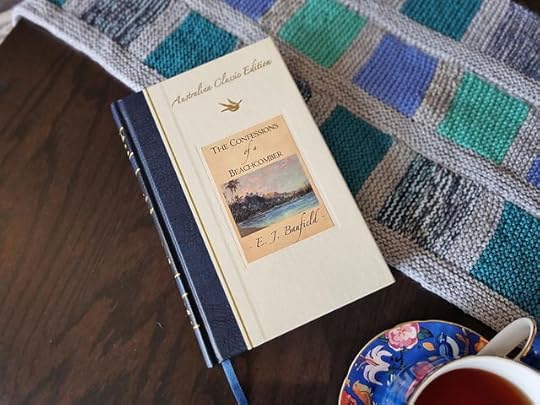
Australia's beloved "Beachcomber" takes you on a detailed visit to his tropical island paradise where civilization was scarcely known, and the comings and goings of a wide variety of birds, animals, and sea creatures was much more important than stock options, market share, or technological advances. Banfield reminds us why Eden was a good place to live.
One of my favourites. A bloke living in Townsville is told he is going to die, so goes to Dunk Island and lives for another 20 years. How to live a simple life and my dream job, beachcomber.
A Banfield quote was my mantra to help me deal with the loss of our home in the late 1980s due to Mr Keatings recession we had to have - I had pinned to my office wall: 'If you wish to increase a man's happiness seek not to increase his possessions, but to decrease his desires.' As a result I sought out the source - and found 'Confessions' - love it. I think that quote was a life saver.
The true lover knows too that in her least conspicuous moods, Nature is as consistent and as wonderful as when in her exuberance she carpets a continent with flowers, and when all the forests of a country, at her bidding, don a mantle of yellow.
“If the day and the night are such that you greet them with joy, and life emits a fragrance like flowers and sweet-scented herbs, is more elastic, more starry, more immortal—that is your success." Thoreau
One of my ideas of paradise or heaven is a tropical island to explore for eternity, and I stumbled on this writer who knows how to see and describe the flora and fauna exquisitely on an island between Australia and the Great Barrier Reef. There was less racism and colonialism in it than I expected but it was there; and the author and his wife had servants and privilege to live as they did. They were inspired by Thoreau and while the writings are primarily naturalistic rather than philosophic, there was a deep love for the land and sea was refreshing and dear to my heart.
But the first morning of the new life! A perfect combination of invigorating elements. The cloudless sky, the clear air, the shining sea, the green folded slopes of Tam o' Shanter Point opposite, the cleanliness of the sand, the sweet odours from the eucalypts and the dew-laden grass, the luminous purple of the islands to the south-east; the range of mountains to the west and north-west, and our own fair tract-awaiting and inviting, and all the mystery of petted illusions about to be solved! Physic was never so eagerly swallowed nor wrought a speedier or surer cure.
My chief desire is to set down in plain language the sobrieties of everyday occurrences—the unpretentious homilies of an unpretentious man—one whose mental bent enabled him to take but a superficial view of most of the large, heavy and important aspects of life, but who has found light in things and subjects homely, slight and casual; who perhaps has queer views on the pursuit of happiness, and who above all has an inordinate passion for freedom and fresh air.
Two and a half miles off the north-eastern coast of Australia—midway, roughly speaking, between the southern and the northern limits of the Great Barrier Reef, that low rampart of coral which is one of the wonders of the world—is an island bearing the old English name of Dunk.
Other islands and islets are in close proximity, a dozen or so within a radius of as many miles, but this Dunk Island is the chief of its group, the largest in area, the highest in altitude, the nearest the mainland, the fairest, the best. It possesses a well-sheltered haven (herein to be known as Brammo Bay), and three perennially running creeks mark a further splendid distinction. It has a superficial area of over three square miles. Its topography is diversified—hill and valley, forest and jungle, grassy combes and bare rocky shoulders, gloomy pockets and hollows, cliffs and precipices, bold promontories and bluffs, sandy beaches, quiet coves and mangrove flats. A long V-shaped valley opens to the south-east between steep spurs of a double-peaked range. Four satellites stand in attendance, enhancing charms superior to their own.
Feebleness and dismay vanished with the first plunge into the still sleepy sea, and alertness and vigour returned, as the incense of the first morning's sacrifice went straight as a column to the sky.
You may follow up the creeks until they become miniature ravines, or broaden out into pockets with precipitous sides, where twilight reigns perpetually, and where sweet soft gases are generated by innumerable plants, and distilled from the warm moist soil. How grateful and revivifying!
When there are eight or ten islands and islets within an afternoon's sail, and miles of mainland beach to police, variety lends her charms to the pursuit of the Beachcomber. Landing in one of the unfrequented coves, he knows not what the winds and the tides may have spread out for inspection and acceptance. Perhaps only an odd coco-nut from the Solomon Islands, its husk riddled by cobra and zoned with barnacles. The germ of life may yet be there. To plant the nut above high-water mark is an obvious duty. Perhaps there is a paddle, with rude tracery on the handle, from the New Hebrides, part of a Fijian canoe that has been bundled over the Barrier, a wooden spoon such as Kanakas use, or the dusky globe of an incandescent lamp that has glowed out its life in the state-room of some ocean liner, or a broom of Japanese make, a coal-basket, a "fender," a tiger nautilus shell, an oar or a rudder, a tiller, a bottle cast away fat out from land to determine the strength and direction of ocean currents, the spinnaker boom of a yacht, the jib-boom of a staunch cutter. Once there was a goodly hammer cemented by the head fast upright on a flat rock, and again the stand of a grindstone, and a trestle, high and elaborately stayed.
These observations of mine are admittedly casual and unprecise. Not the life of a single bird or insect has been sacrificed to prove "facts" for personal edification or entertainment. Cases in which points were inconclusive have been allowed to remain undecided. The face of the administrator of the law here is rigidly set against the enforcement of the death penalty, simply because the subject is beautiful, or rare, or "not understood." With the aid of a good telescope and a compact pair of field-glasses, birds may be studied and known far more pleasurably than as stark cabinet specimens, and, perhaps, with all the certainty that the ordinary observer needs. Patience and a magnifying glass put less constraint on insects than lethal bottles and pins.
Perhaps the most interesting and entertaining of all the birds of the island is that commonly known as the weaver or friendly bird, otherwise the metallic starling, the shining calornis of the ornithologist, the "Tee-algon" of the indigenous tribes. Throughout the coastal tract of North Queensland this bird is fairly familiar. In these days it could not escape notice and comment, for it is an avowed socialist establishing colonies every few miles. There are four on Dunk Island, and though not permanent residents, spending but little more than half the year with us, they are among the few birds who have permanent homes. In some lofty tree they build perhaps two hundred nests in groups of from two to six. With all these nests weighting its thinner branches the tree may look wearied and afflicted, but it obtains direct benefit from the presence of the birds. The nests, deftly built of tendrils and slender creepers and grass are domed, the entrance being at the side, and so hidden and overhung as almost to escape notice. Each August the birds appear, coming from the north. and until the middle of March, when they take their departure, they do not indulge in many leisure moments.
Apart from the bulk and the fantastic shapes of coral structures, there is the beauty of the living polyps. That which when dry may have the superficial appearance of stone plentifully pitted—a heavy dull mass—blossoms with wondrous gaiety as the revivifying water covers it. The time to admire these frail marine flowers is on an absolutely calm day. All the sediment of the sea has been precipitated. The water is as transparent as rock crystal, but like that mineral slightly distorts the object unless the view is absolutely vertical. It is a lens perfect in its limpidity. Here is a buff-coloured block roughly in the shape of a mushroom with a flat top, irregular edges, and a bulbous stalk. Rich brown alga hangs from its edges in frills and flounces. Little cones stud its surface, each of which is the home of a living, star-like flower, a flower which has the power of displaying and withdrawing itself, and of waving its fringed rays. Each flower is self-coloured, and may represent a group of animals. There are blues of various depths and shades from cobalt to lavender, reds, orange and pinks, greens, browns and greys, each springing from a separate receptacle. All are alike in shape—viewed vertically, many-rayed stars; horizontally, fir-trees faultlessly symmetrical in form and proportion. These flowers all blossom, or trees, or stars, are shy and timorous. A splash and they shrink away. The hope of such wilderness—as barren-looking as desert sandstone—ever blossoming again seems forbidden. Quietude for a few moments, and one after another the flowers emerge, at first furtively but gathering courage in full vanity, until the buff rock becomes as radiant as a garden bed.
I read this as background for my next novel to be set in north-east Australia.
At the beginning of the 20th century, E. J. Banfield, along with his wife, chose to move to a small island (Dunk Island) off the Queensland coast for his mental and physical health. They lived there for 25 years, until Banfield's death. The book, written after they'd been on the island for about a decade, is a natural history of the island with detailed descriptions of the wildlife, as well as some stories about and observations on the island's original indigenous human inhabitants. It is a book of its time, yet affecting in its enthusiasm for wildlife and life in general.
While the writing style is formal and old fashioned, and does not flow due to use of impersonal passive voice, it is however worth persevering as, in hindsight, it conjures up vivid images of the place and lifestyle, now past, that he describes. In this sense, it is indeed a classic work in Australian literature. Inspired by the images of life on Dunk Island, I then watched the film, Age of Consent. I feel that the background reading enriched my viewing experience.
I was told that this was essential reading for anyone contemplating a trip to Australia and that it was almost the holy grail of a travelogue mixed with natural history.
While not actually convinced that there was a quest for such a book, I found it less easy to read than I expected and not as interesting. I see many people have enjoyed this, so perhaps I had been over-sold the experience.
At least my trip to Australia more than lived up to expectations.