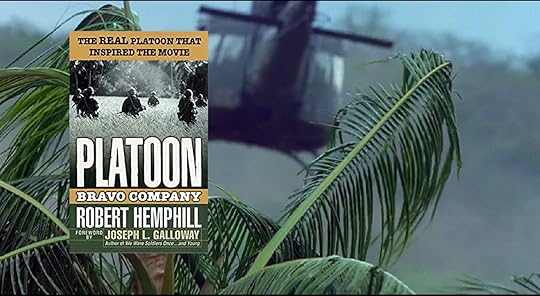
Lieutenant Colonel, Retired Robert Hemphill takes us back to his fighting days in Vietnam when he commanded Bravo Company, 3rd Battalion, 25th Infantry Division--the same unit director Oliver Stone fought in and presumably based his Oscar-winning movie Platoon on.
Fresh off a promotion and brand-new to Vietnam when he was unceremoniously given command of Bravo Company, the worst fighting unit in the 25th Battalion, Captain Robert Hemphill had to prove his courage and skill as a commander over the next five months--taking Bravo into an endless seres or search and destroy missions, reacting to midnight mortar attacks and ambushed, and trying desperately to not only keep his men alive, but also keep sane in the madness of Vietnam. Then, just when Hemphill was getting the hand of it, the NVA unleashed their 1968 Tet offensive, and Bravo was plunged into the most horrific fighting of the war.
From the days of immense boredom to electrifying, toe-to-toe battled with the NVA, this riveting account at last tells the real story of Platoon .
Interesting story. My problem was so many military acronyms and having to remember and/or having to stop to look up the terms took me out of it frequently., making it a bit difficult to read.
No longer satisfied with the Julian calendar, Pope Gregory XIII thought it prudent to introduce the self-serving Gregorian calendar late in 1582, setting in stone the improvements on, and displacement of the former for the latter. Fastidiously used in most parts of the 'count hours rather than make hours count' world, the Christianity flavored timetable occasionally veers back into its lane in favor of tradition. Ending the major cold and looking forward to the start of spring, the Chinese lunisolar calendar was a major force on many of the surrounding cultures in Southeast Asia. In particular, the Vietnamese Tet Nguyen Dan coincides with Big Brother to the North's calendar and reflects the Festival of the first day that begins on the new moon that appears in the thirty days following January 21. Firmly entrenched in the '365 and a wake-up' mentality, many of the 2.5+ million service members who served during the Vietnam War had nary a thought for Tet, save that it was a time of cease-fire. IF the VC & NVA held true to their word and agreement.
Deep in the jungle, the great equalizer, around Jan 31, 1968, the Vietnamese New Year, with the commencement of which the NVA and Vietcong launched a nation-wide offensive against every population center in South Vietnam, was B Company, 3rd Battalion, 22nd Infantry of the 25th Infantry Division "Tropic Lightning". Operating around Dau Tieng, NW of Saigon in III Corps, Tactical Zone (Military Region 3), close to the Cambodian border, on the edge of the Michelin Rubber Plantation, just south of War Zone 3, with direct influence on the Ho Chi Minh trail, notoriously used to infiltrate men, materiel, and weapons to fight Uncle Sam. PLATOON BRAVO COMPANY is the story of the combat infantryman in day-to-day existence under the gun in the field. Punching his ticket for a field command from October 1967 to February 1968 in the thick of things was Captain Robert Hemphill, responsible for making decisions and giving orders that directly affected the lives, health, and futures of 160 other people, a mentally awesome task. No REMF lily, the combat Commander got used to the draining, deep emotional impact of the job yet still had to endure the peacetime ration of bureaucratic crap in country--paperwork.
Published in 1998, PLATOON BRAVO COMPANY repeatedly emphasizes that combat in Vietnam was not a fast paced Hollywood action picture but was endless boredom punctuated by moments of intense action. Almost repudiating this notion, Hemphill meets the requirements for the all important CIB on his second day in command; like all infantry soldiers, it's what he'd been looking for for a long time. Giving a solid background on the unit(s) depicted in the movie PLATOON, its auteur Specialist 4 Oliver Stone, 2nd Platoon, PLATOON BRAVO COMPANY is the perfect companion to the fine book PLATOON LEADER by James R. McDonough, and could've easily been titled COMPANY COMMANDER as it allows a detailed look at what a combat commander does on a day to day basis. If you didn't know how to work a PRC and follow protocol & call signs, you'll definitely know after reading this book and its intricate and minute radio procedures. Taking care with the particulars of the era and the Vietnam War, Captain Hemphill elaborates on Killer Junior, gladhanders, battery five, and F-10 dry holes. In the end, he insists, Bravo Company and its men were the best; the officers and NCOs were the best as they were given room to do their job, and soldiers must have respect for and be responsive to military discipline. Namely the ingredients needed for the perfect recipe of a very successful command, which the author keeps reminding was nothing like what transpired during the 120 minutes of the 1986 Oscar winning feature film. Rolling heavy on nostalgia, Hemphill cautions that while lifting off in the chopper after the change of command ceremony (curtailed due to mortar threat), he realized that it's true--you can never go back. PLATOON BRAVO COMPANY, however, allows a trip back to 'Nam: the terror, the heat, the bugs, the fear, and the firefights. It's a fascinating look at a small slice of the Vietnam War, a forgotten place a long time ago, yet still hauntingly fresh in America's psyche.
Platoon: Bravo Company is an autobiographical novel about Cpt Robert Hemphill's five months, (1 Oct 1967 - 18 Feb 1968) as Commander of Bravo Company, 3/22 Infantry, 25th Infantry Division during the Vietnam War.
The events of Cpt Hemphill's service in Bravo take place from October 1967, to February 1968 in the Corps 3 area, partly near the Cambodian border, during the Vietnam War. In this time, Hemphill commands Bravo during the most frantic time of Vietnam, the Tet Offensive, and garners much respect for the once struggling company, proving their worth during many successful missions and defensive operations, most notably of which being the New Year's defense of Fire Support Base Burt. However, Hemphill's problems don't end with NVA and VC aggressors, as there are also a few situations involving conflict with superiors or friendly fire, that even caused death. Yet, the Company carries on through this, developing into one of the more accomplished companies of their battalion with Cpt Hemphill's brilliant leadership.
I decided to give this book four stars for its great perspective of the Vietnam War, with specific details of weapons, tactics, and events that happen in the story. It also has a nice flow that doesn't stray too far into the psychology or drama of war, but favors a direct approach that keeps the reader in the action. While the writing features a wealth of dialogue straight from the action (or as close as it can be), along with frequent use of military code and slang, the writing has spelling errors once in a while that hinder the reading, and some of the radio chatter can be redundant. But these minor faults do not keep Platoon: Bravo Company from being a compelling, well authored story. I would recommend this novel to anyone interested in Vietnam War history, as well military history. It is also a good story for action fans. I wouldn't recommend it to children younger than their teenage years, due its content and specific nature. It also wouldn't be too compelling to those who want a war story filled with drama and deep thought, as it doesn't divulge in these areas as much as some other stories do. All in all, Platoon: Bravo Company is a great writing on the Vietnam War from someone who served in some of is toughest conflicts, and it is a great read for generally everyone.
"Like it or not, the Vietnam War occurred - let's make the best of it!" from the late Robert Hemphill's introduction to his account of his experiences as a company commander could serve as a mission statement for this book. It appears that Lt. Col. Hemphill wrote this book largely to refute Oliver Stone's depiction of the Vietnam experience in his movie "Platoon." He states in his introduction that "After years of being subjected to a constant barrage of negative information and misinformation, the American public came to believe that the Vietnam War was wrong..." and he urges readers to "discuss the positive aspects of Vietnam." Basically, the book is propaganda for those who would say that the United States should have stayed in the war and would have won it if only the public hadn't turned against it. That aside, Hemphill's first-hand accounts of the actions that occurred, although colored with negative opinions of the upper echelons of command, of armored units generally, and his judgments of particular individuals (most of whom he provides with aliases), are no doubt accurate recollections of the events he personally witnessed. However, his writing employs a lot of military jargon that he does not always translate well to the non-military reader. His narrative is also dominated by radio communication using code names and acronyms - again, not always with sufficient explanation to enable the reader to easily follow who is speaking and what is going on. The book is best suited for a reader who has either had experience in the military or who is an avid follower of jargon and tactics. For such a reader, this book might read almost as a conversational recollection among old friends who share the same experiences and point of view. Unfortunately, his introduction makes clear that his intended audience is the general public.
Robert Hemphill’s Vietnam War memoir was readable and insightful. It was interesting to see the tactics, experiences, and operations of Bravo Company. This book portrays the Vietnam War in a fairly positive light, which is why I wish that the author had addressed how negative American opinion had affected the moral of the United States Army. This book was interesting to read because the author incorporated the radio transcripts of his communications with his platoon commanders, other units, and superiors into the dialogue.
Bravo Company yang menjadi sorot pelaku cerita dalam buku Platoon ini memang grup tentara GI US yang legendaris pada perang Vietnam pada kurun waktu awal 70-an. Perjalanan misi militer mereka selama perang Vietnam merupakan kisah nyata dan pengalaman yg tak terlupakan khususnya bagi veteran perang yang masih hidup hingga buku ini diterbitkan ..
Robert Hemphill did a fair job telling his story and events of the Vietnam War. However, this is a book with alot of military lingo and only the experienced really can follow easily enough...in the back is a section explaining all the military stuff for non military
Good read. Hemphill keeps the book interesting even though the battles were told from his perspective talking over a radio to command his soldiers. Well done.