Peter Bogdanovich, known primarily as a director, film historian and critic, has been working with professional actors all his life. He started out as an actor (he debuted on the stage in his sixth-grade production of Finian’s Rainbow); he watched actors work (he went to the theater every week from the age of thirteen and saw every important show on, or off, Broadway for the next decade); he studied acting, starting at sixteen, with Stella Adler (his work with her became the foundation for all he would ever do as an actor and a director).Now, in his new book, Who the Hell’s in It, Bogdanovich draws upon a lifetime of experience, observation and understanding of the art to write about the actors he came to know along the way; actors he admired from afar; actors he worked with, directed, befriended. Among Lauren Bacall, Humphrey Bogart, James Cagney, John Cassavetes, Charlie Chaplin, Montgomery Clift, Marlene Dietrich, Henry Fonda, Ben Gazzara, Audrey Hepburn, Boris Karloff, Dean Martin, Marilyn Monroe, River Phoenix, Sidney Poitier, Frank Sinatra, and James Stewart.Bogdanovich captures—in their words and his—their work, their individual styles, what made them who they were, what gave them their appeal and why they’ve continued to be America’s iconic actors.On Lillian “the first virgin hearth goddess of the screen . . . a valiant and courageous symbol of fortitude and love through all distress.” On Marlon “He challenged himself never to be the same from picture to picture, refusing to become the kind of film star the studio system had invented and thrived upon—the recognizable human commodity each new film was built around . . . The funny thing is that Brando’s charismatic screen persona was vividly apparent despite the multiplicity of his guises . . . Brando always remains recognizable, a star-actor in spite of himself. ” Jerry Lewis to Bogdanovich on the first laugh Lewis ever got “I was five years old. My mom and dad had a tux made—I worked in the borscht circuit with them—and I came out and I sang, ‘Brother, Can You Spare a Dime?’ the big hit at the time . . . It was 1931, and I stopped the show—naturally—a five-year-old in a tuxedo is not going to stop the show? And I took a bow and my foot slipped and hit one of the floodlights and it exploded and the smoke and the sound scared me so I started to cry. The audience laughed—they were hysterical . . . So I knew I had to get the rest of my laughs the rest of my life, breaking, sitting, falling, spinning.”John Wayne to Bogdanovich, on the early years of Wayne’s career when he was working as a prop “Well, I’ve naturally studied John Ford professionally as well as loving the man. Ever since the first time I walked down his set as a goose-herder in 1927. They needed somebody from the prop department to keep the geese from getting under a fake hill they had for Mother Machree at Fox. I’d been hired because Tom Mix wanted a box seat for the USC football games, and so they promised jobs to Don Williams and myself and a couple of the players. They buried us over in the properties department, and Mr. Ford’s need for a goose-herder just seemed to fit my pistol.”These twenty-six portraits and conversations are unsurpassed in their evocation of a certain kind of great movie star that has vanished. Bogdanovich’s book is a celebration and a farewell.
Peter Bogdanovich is an American film historian, director, writer, actor and critic. He was part of the wave of "New Hollywood" directors (which included William Friedkin, Brian DePalma, George Lucas, Martin Scorsese, Steven Spielberg, Michael Cimino and Francis Ford Coppola, among others), and was particularly relevant during the 1970s with his film The Last Picture Show.
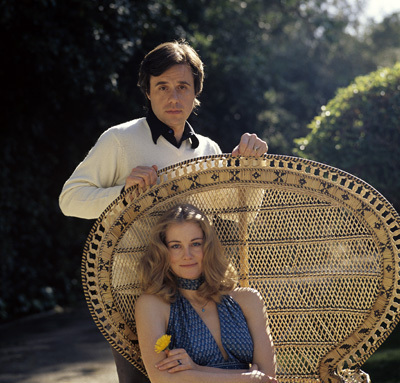
Bogdanovich insieme a John Ritter e Dorothy Stratten interpreti del suo “They All Laughed -…e tutti risero”, 1981, insieme a Audrey Hepburn e Ben Gazzarra. La storia della Stratten è raccontata nel film di Bob Fosse “Star 80”: iniziò la carriera sulla rivista Playboy, si sposò col suo manager Paul Snyder a 19 anni, l’anno dopo, durante le riprese del film, si innamorò di Bogdanovich e andarono a vivere insieme, ma Snyder non la prese bene, e così la uccise, suicidandosi subito dopo. Per Bogdanovich fu uno shock dal quale si riprese dopo molto tempo.
Peter Bogdanovich conosce bene il cinema e lo ama. Conosce tutti gli aspetti della settima arte, ne ha praticato, e pratica tuttora, diversi: regista, sceneggiatore, attore, aiuto regista, regista della seconda unità, montatore, compositore di brani musicali.
Per il mestiere d’attore ha una fascinazione particolare. Lui stesso ha cominciato proprio recitando: ancora adolescente ha seguito le lezioni di Stella Adler, regina degli insegnanti di recitazione, maestra di gente come Marlon Brando. Bogdanovich va a teatro tutte le settimane, più volte: lì, sul palcoscenico, ha imparato a conoscere gli attori da vicino.
Altra donna importante nella vita di Bogdanovich fu Cybill Shepherd, alla quale fu a lungo legato e che diresse in ben quattro film.
Se come regista non ha certo mantenuto le promesse dei suoi esordi (nessun altro suo film ha raggiunto l'intensità e la bellezza di “The Last Picture Show-L'ultimo spettacolo”), come storico di cinema è tra i più importanti d'America. I suoi libri d’interviste con i grandi registi del passato (Orson Welles, Ford, Hawks, Lang) sono pura magia, così come lo è questa raccolta di saggi e conversazioni con gli attori che ho letteralmente divorato.
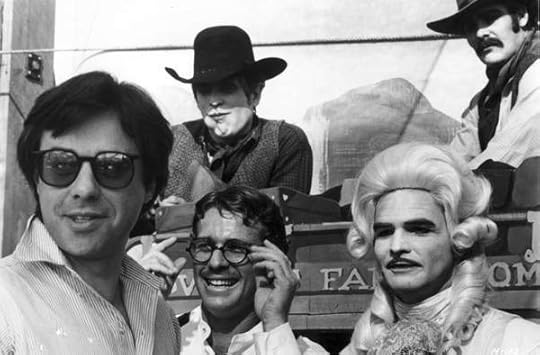
Peter Bogdanovich sul set di “Nickelodeon - Vecchia America” insieme a Ryan O’Neal e Burt Reynolds, 1976.
Ci sono ritratti di attori che Bogdanovich ha incontrato, oppure solo sfiorato, o frequentato, o dei quali almeno conosce le persone che sono state loro vicine - altri sono amici, amici anche veri e cari, o colleghi di lavoro, con i quali si è costruita nel tempo conoscenza e complicità.
Magnifica istantanea: Bogdanovic con Orson Welles e John Huston se la ridono insieme di gusto.
Bogdanovich ha amore e rispetto per il suo mestiere, per la sua storia, per tutti i suoi aspetti, per i suoi colleghi, passati e presenti. E inoltre, è spinto da grande curiosità: i ritratti che vengono fuori sono esaurienti, affettuosi, competenti, credibili, appassionanti.
Bogdanovich sul set con Ben Gazzarra. I due hanno lavorato insieme in due film, quello citato sopra e in “Saint Jack”.
Gennaio del 1954, Bogdanovich ha 14 anni, e ha appena assistito a una matinée teatrale – fuori del teatro si ferma a leggere i manifesti, quando si accorge che a mezzo isolato di distanza c’è Marlon Brando che cammina proprio nella sua direzione. Brando era in città (NY) per girare Fronte del porto. Il ragazzino chiede un autografo alla star. La star non rifiuta: continuando a camminare si fa dare carta e penna e firma. Poi si allontana. Il ragazzino rimane sul marciapiede con il suo tesoro in mano.
Per anni custodii gelosamente il pezzetto di carta con la firma di Brando, e l’ho tenuto nel portafoglio sino ai vent’anni. Quella sera, sull’autobus che mi riportava a casa, provai una magica sensazione d’essere speciale, di far parte del numero degli eletti; altrimenti perché mi sarebbe toccato in sorte un simile incontro? La mia tasca interna irradiava luce come oro in fusione. Custodiva la prova materiale di un miracolo, di una benedizione. Certo non avevo mai provato niente di simile, prima. Forse è l’improvvisa prossimità al genio, al talento o alla celebrità; la vecchia storia del riflettore che illumina anche te perché sei momentaneamente risucchiato nell’alone di luce che circonda una star, e brilli di gloria riflessa. È un’emozione che ho provato molte volte, dopo quell’incontro casuale con Brando, ma mai con la misteriosa intensità della prima esperienza.
Cos’altro si potrebbe aggiungere? Qui c’è tutto, c’è l’essenza. Bogdanovich è un’anima antica.
Peter Bogdanovich e Barbara Streisand hanno lavorato insieme su “What’s Up, Doc’ - Ma papà ti manda sola?” nel 1972.
Peter Bogdanovich has long been a dichotomy for me. His manner of personal presentation usually seemed incredibly self-serving and egotistical ... and that occurred to me again with his lengthy introduction to this book. Yet, he had so much knowledge and so many intriguing stories about the motion picture industry that he was willing to share with anyone who had a genuine interest. As far as film history was concerned, he was a walking encyclopedia. It is no wonder that his close acquaintance, Orson Welles, would alternate between both lavish praise of Bogdanovich and then be highly insulting in his cruel remarks about him.
I ordered this book (and Bogdanovich's book about Directors) soon after listening to the TCM podcast, "The Plot Thickens." He was the first subject of the series, and I listened in rapt appreciation to every episode.
That is very similar to my experience with WHO THE HELL'S IN IT: CONVERSATIONS WITH HOLLYWOOD'S LEGENDARY ACTORS. Twenty-five performers are featured. Although he hadn't met Lillian Gish, Humphrey Bogart or Marilyn Monroe, each segment was worthwhile in its own way. Of those he did know, only the segment on Audrey Hepburn seemed too "worshipful." That was particularly surprising since he had directed her in "They All Laughed."
Some of the best segments were about performers I had very little interest in knowing more about. Marlon Brando, Stella Adler, Jerry Lewis, Frank Sinatra and River Phoenix were ones I would have usually skipped over ... and, had I done so, I would have missed an amazing amount of worthwhile knowledge. The Brando interactions were "accidental" and "quirky," yet I wanted to know more. The Jerry Lewis section is HUGE (easily the largest part of the book). However, the insights from Lewis about his work and the perspectives he shared about Hollywood and fame held me spellbound.
One very short section about Montgomery Clift will likely haunt me from now on. Bogdanovich was young and working as an usher at a movie theater when a very fragile Clift arrived with an escort to see one of his films at a retrospective. He left the main auditorium at one point for the lobby, and that was where Bogdanovich had his interaction. I won't include a spoiler, but it brought a tear to my eye.
My sole major regret is that the comments about Boris Karloff were way too brief. Indeed, I'd read all of them before from other sources. It wasn't that the material was poor. It wasn't. Yet, Karloff's stories about his experiences had delighted me before, and I had hoped that Bogdanovich's insights would have expanded upon them.
In addition to those already mentioned, the other featured "players" are:
* Cary Grant * Jack Lemmon * Dean Martin * Sal Mineo * James Stewart * John Wayne * Henry Fonda * John Cassavetes * Charlie Chaplin * James Cagney * Marlene Dietrich * Anthony Perkins * Ben Gazzara * Sidney Poitier
I think I can guarantee that you'll be shown a side of each of them that you likely weren't aware of before.
Bogdanovich mentions in the Introduction that he wanted to share these stories because he had worked as a Director with a number of young performers who stared at him with a blank expression when he mentioned Cary Grant or James Cagney. He worried that modern audiences had lost the fascination with the people who made a significant impact on the cinema, and who laid a foundation that has been built upon through the years. (I think he would have been encouraged by the large recognition factor they have among young folks on current web sites such as Letterboxd.) They will certainly learn something and be entertained here. I consider myself fortunate to have read it.
At one time I only knew three things about writer-director Peter Bogdanovich. I knew he was the auteur behind The Last Picture Show, I knew he had a reputation for being a film buff and historian, and, finally, I knew he was in a relationship with Playboy Playmate Dorothy Stratton when she was murdered by her ex-lover. Back in the early 1990's, as a journalist, I attended the press junket for his feature film, The Thing Called Love, and participated in interviewing him, but the only thing I recall from those interviews was that I received an unexpected hug from the late River Phoenix, a then unknown Sandra Bullock was enchanting, and Anthony Clark was hilarious. Once again, I stopped following Peter's career, although upon reading his book, I know I've seen some things he's done, unaware that they were his.
Who the Hell's In It is a truly fun read. Peter, whose career is more exciting that I'd have imagined, both as a writer-director and as an entertainment journalist, provides the reader with insights into 25 actor's who his own life has touched, some based on long-standing friendships, like Jerry Lewis and Jimmy Stewart (just to name a few) to some he met in passing, Marilyn Monroe. For the most part, however whether it's Sal Mineo, John Wayne, Dean Martin, Cary Grant, or Marlene Dietrich (who became a friend of his after a chance meeting on an airplane), Peter has some great tales to tell. I'll admit there were a few chapters I wasn't looking forward to; actors like Ben Gazzara, Anthony Perkins or John Cassavetes, but once I got to them, found them interesting. If Peter has accomplished anything, as a film buff myself, and someone who has directed his own indie film and written many screenplays, I feel that I've somehow failed as a fan of films having not seen nor appreciated the work of Cassavetes.
The true beauty of this book is the fact it honors old Hollywood; Peter was lucky enough to come onto the scene early enough to meet, interview and befriend many from Hollywood's Golden Age. In talking with younger people today, some of these names have been forgotten, which is a shame, because each and every one of them has created work that is worth going back and enjoying. I was recently playing a game of trivia with my younger brother-in-laws and their wife and girlfriend, and the answer to the question, regarding the movie White Heat was James Cagney. I remember one of them looking at me incredulously and asking, "How do you know that?!" I believe the proper response was, "How in the hell didn't you?"
If you love Hollywood and classic Hollywood, this is a MUST READ book. I think I'll seek out some of Peter's other books.
Lots of repetition in these chapters each profiling a movie star. Some stories are repeated when writing about one star that involves another star included in the book. The Frank Sinatra, Dean Martin and Jerry Lewis chapters are the worst wit this deja vu. Speaking of Jerry, Bogdanovich spends more pages on this movie actor/director than any other and it is plodding. You'll ,also, be treated to a lot of Bogdanovich's hobnobbing (with his girlfriend Cybil Shepherd) with ALL the stars. Peter sure knew how to ingratiate himself with the Hollywood legends. Ego is on full display here. But, it is still entertaining.
Who the Hell's in It - Conversations With Hollywood's Legendary Actors by Peter Bogdanovich, director of The Paper Moon http://realini.blogspot.com/2017/04/t... and other faboulous films
9 out of 10
Peter Bogdanovich mentions in the book the conversation he has had with Orson Welles, a titan of cinema, the revolutionary that gave audiences Citizen Kane http://realini.blogspot.com/2023/09/c... for some critics, the best movie ever made
In this book, Orson Welles says that ‚the actors make or break a motion picture’, but we get from the scripture of this art, Adventures in The Screen Trade http://realini.blogspot.com/2017/02/a... by William Goldman, winner of two Oscars, for Butch Cassidy and The Sundance Kid and All The President’s Men, that there are more elements needed, in the chapter where he combats the notion that we have , author films’
That was a time when Alfred Hitchcock was celebrated and acclaimed as the sole responsbil for the mega success of his productions, whereas William Goldman explains that the director is just one of the ingredients, actors are extremely important (before the arrival of Artificial Intelligence, we could say that they had been sine qua non, but now, maybe they will be replaced by computers, avatars, AI)
The writers, producers are vital, and he quotes Jaws, where special effects are crucial – in the age of Transformers, Marvel dominating blockbusters, special effects could be more than half the end product – the shark is a computer fabrication, albeit it is argued that when absent, he is even more terrifying, and then we have music, Chariots of Fire depends on the vibrant, exhilarating music composed by Vangelis
We get quite a few anecdotes, some of which you can find online, in videos or through other medium – John Wayne is supposed to have tried to scare Henry Fonda, when they were working in Mexico, with John Ford, if i am not mistaken, and the idea was to porduce a giant snake, that will scare Fonda and cause laughter
Only Henry Fonda was not afraid of snakes, while John Wayne aka the Duke was, so it was a reverse prank...the latter has been for many years, was it more than a decade, America’s favorite actor, those serving in the military saw him as their hero, a role model, in spite of the fact that Wayne had not been serving in World War II, just as many other stars, directors had been fighting in the front lines...
Trumbo http://realini.blogspot.com/2017/07/t... is a ilm where we see John Wayne in another role, that of conservative, one that would fight communism – which i find praiseworthy, see the end of the note, if you have the patince and time to lose, where i vaunt my participation in the 1989 revolution against Ceausescu and the commies – but a hard line fellow as well
Many, if not most actors have a rather unlikable, to use an euphemism, side, just like other massive creators – read Intellectuals http://realini.blogspot.com/2014/06/i... by Paul Johnson to see what Leo Tolstoy, Henrik Ibsen, Ernest Hemingway, Jean-Jacques Rousseau and others were up to – and one was Ryan O’Neal, who works with his daughter on Paper Moon, only to be eclipsed by the latter...
We find what a ruffian the actor could be (and think about the Depp trial to see what others do) from The Kid Stays in The Picture http://realini.blogspot.com/2015/09/t... by Robert Evans, another major book about things Hollywood and making picture, however boastful it is
Robert Evans had been an actor, before becoming a producer and the head of Paramount Studios, he produced The Godfather http://realini.blogspot.com/2017/08/t... Chinatown, Rosemary’s Baby, Love Story, The Great Gatsby and more, the first few are not just part of the Hsitory of Cinema, but some of the best 10 to 100 films (the first in one of the top five)
He worked on Love Story with Ali McGraw, who would become his wife, then leave him and marry Steve Mc Queen, and with Ryan O’Neal, the latter proving a very disagreeable fellow, when asked to compnasate for the fact that his partner in the film got sick, and they needed someone to promote the motion picture
The list is long however – we have atrocious accusations and judged cases involving actors, producers, Harvey Weinstein is one of the most outrageous – and decades back, on the set of Marathon Man, Dustin Hoffman behaved ruthlessly versus the cast, crew members, for the most selfish, petty reasons http://realini.blogspot.com/2017/04/t...
There was a danger – in fact, it is still very perilous – that movies that depend on the comic books, Aqua Men, Supermen and the like, will dominate the boxoffice and theaters, to the point where we will see mainly these silly contraptions, that is if we choose to, i for one avoid them all the time, Martin Scorsese has taken a stand some days ago, warning about this prospect...we have some hope from megahits like Oppenheimer http://realini.blogspot.com/2023/08/o...
Now for a question, and invitation – maybe you have a good idea on how we could make more than a million dollars with this http://realini.blogspot.com/2022/02/u... – as it is, this is a unique technique, which we could promote, sell, open the Oscars show with or something and then make lots of money together, if you have the how, I have the product, I just do not know how to get the befits from it, other than the exercise per se
‘Fiction is infinitely preferable to real life...As long as you avoid the books of Kafka or Beckett, the everlasting plot of fiction has fewer futile experiences than the careless plot of reality...Fiction's people are fuller, deeper, cleverer, more moving than those in real life…Its actions are more intricate, illuminating, noble, profound…There are many more dramas, climaxes, romantic fulfillment, twists, turns, gratified resolutions…Unlike reality, all of this you can experience without leaving the house or even getting out of bed…What's more, books are a form of intelligent human greatness, as stories are a higher order of sense…As random life is to destiny, so stories are to great authors, who provided us with some of the highest pleasures and the most wonderful mystifications we can find…Few stories are greater than Anna Karenina, that wise epic by an often foolish author…’
Writer-Actor-Director Peter Bogdanovich never took to heart the old adage, "never meet your heroes." In both his earlier book on directors ("Who the Devil Made It") and this companion volume, Bogdanovich shares stories of the famous friends (and a few acquaintances) he made in over 40 years in show business. Though some chapters were based on profiles done on magazine assignments (such as Jack Lemmon), most seem written or updated for this book published in 2004. Many are intimate and loving stories of actors he was friends with. For example, Cary Grant, Ben Gazzara, John Cassavetes and Jerry Lewis benefit from thoughtful profiles--perspectives unlikely to be found elsewhere. There's also a good bit of background on the professional and personal ups and downs of Bogdanovich's career, too. Since the director also has a strong background as a film historian, his insights on acting are especially worthwhile. Recommended.
Peter Bogdanovich creates critical/biographical portraits of 25 film performers, from major stars to more peripheral but nonetheless important figures. Most of these are personal reminiscences of actors with whom he worked in some capacity, though there also perceptive chapters on people with whom he had only tangential contact. All of the chapters are insightful, but I have to commend him for giving me more positive views of people like Jerry Lewis and John Wayne and highlighting less well-known figures like Stella Adler and Ben Gazarra.
Bogdanovich's books on film are interesting and fun for anyone with an interest in the golden age of film This one is not quite as interesting or informative as his book WHO THE HELL MADE IT, which comprises his interviews with many great directors, including Alan Dwan, whose work dates back to the silent era.
Love this book. Love Peter Bogdanovich's writing. Twenty-five interviews/articles with movie stars, from Lillian Gish to Marilyn Monroe. Lots of details and explanations about the studio system in American films, the directors. Humphrey Bogart, Marlon Brando, Montgomery Clift, and Cary Grant are all included and explained. A great book.
This is a readable collection of reminiscences, interviews, Q&A, and commentary on actors familiar to the author. Readers, like me, who enjoy movies and grew up watching most of the stars in this collection will find these essays revealing how the actors personal character traits affects the actors acting persona and visa versa. Some of the essays, like the one on River Phoenix, also reveal the author’s admiration and affection for the star being written about.
Readers may find that these essays will either create a list of movies to watch or add to one’s list. My list definitely got longer.
I enjoyed Bogdanovich’s insider perspective coming from his experiences as an actor, director, and writer. He provides insightful views on the craft of acting and about the actors themselves as exemplified by the following samples:
Boris Karloff displayed “the finest example of true professionalism and grace. . . . As an actor or man, Karloff was a tough act to follow.”
Sinatra was “an actor of songs.”
Audrey Hepburn’s glamour, charm, talent, and beauty was “the human basis” for all the roles she played whether it be a princess, “a wild girl of the forest,” a pioneer woman, a Greenwich Village bohemian, or a cockney flower girl; yet, the romance she played on the screen was missing in her off-screen life.
Sidney Poitier was as “magnetic and mythic at a distance at a distance as he was in close-up.” (p. 451). He lived and built a career during a time of “bigotry, inequality, racism, becoming the first black actor to be a major star and nominated for a Best Actor Oscar (“The Defiant Ones,” 1958), and then the first of his color to receive the Best Actor Oscar (“Lilies of the Field,” 1963). “One has to profoundly admire Sydney Poitier, if for no other reason than that he carried an impossible burden with enormous grace and empowered millions by depicting beauty and hope in the face of despair, as well as conspicuous decency and courage.” Throughout his life and career, he carried “stoic dignity and calm, focused introspection . . . As a special human being he represents far more than the sum of his roles, because, finally, the part he was given to play in life, and in which he has triumphed, is among the toughest of all.” (p. 456)
With just over a dozen movies (most of so-so quality) and in barely a decade, shy and insecure Marilyn Monroe “rose to be queen of a town and a way of life that nevertheless held her in contempt. That she died a martyr to pictures at the same time as the original studio star system—through which she had risen—finally collapsed and went also to its death seems too obviously symbolic not to note.” (p. 490-1)
(Bought at a used bookstore near Hudson, NY for 50 cents): Peter Bogdanovich’s 2004 collection of profiles and interviews of 25 film stars is a total delight. Even at almost 500 pages, it’s a fun, fast read. The author has worked with most of the subjects as a director (Audrey Hepburn, Ben Gazzara, Sidney Poitier), or had long, admiring friendships with them (Cary Grant, Jimmy Stewart). He analyzes their style and appeal with precision and objectivity, though he goes a bit overboard on Jerry Lewis, devoting 70 pages to the manic comic director-producer-writer-clown. Lewis was never one of my favorite, but Bogdanovich’s profile offers explanations of his juvenile appeal and surprising masterful technical mastery behind the camera. Many of the pieces had appeared in journals and there is some overlap in stories. Several include the tantalizing prospect of a Western to be directed by Bogdanovich, written by Larry McMurtry and starring John Wayne, Stewart and Henry Fonda. When the project failed to materialize, McMurtry turned his screenplay into the Pulitzer Prize-winning novel Lonesome Dove and continued with many prequels and sequels.
I most enjoyed the snapshots of the stars at work. An on-set visit to Jack Lemmon during the filming of Billy Wilder’s Irma La Douce was my favorite for its intimate capturing of the actor’s day-to-day life. I just viewed Bogdanovich’s first film Targets and his portrait of its star Boris Karloff takes us into the changes in Los Angeles, the movies and the actor’s checkered career. The recent death of Gena Rowlands gave the chapter on her husband John Cassavetes an added melancholy and a strong desire to rematch their quirky, intense films.
The volume is bracketed with portraits of two screen goddesses of different eras and influences whom the author briefly encountered in real life: Lillian Gish and Marilyn Monroe. Gish was the first movie incarnation of innocence and Monroe the last avatar of sexiness in the Hollywood studio system. Both chapters give us the director’s insights into what the movies give us and how its stars filled our dreams.
Like his hero Orson Welles, Bogdanovich never quite recaptured the stunning success of his first feature (The Last Picture Show, one of my favorite movies), but this book imparts his lifelong love of cinema and its stars.
Un libro molto interessante in cui il grande regista Peter Bogdanovich racconta i suoi incontri con i più grandi attori di Hollywood. Il libro si apre e si chiude con due occasioni in cui il giovanissimo Bogdanovich "avvistò" Lilian Gish e Marylin Monroe senza avere l'opportunità di avvicinarle: alle due attrici vengono dedicati due profili toccanti. Il secondo capitolo è dedicato a Bogart, che il regista non ebbe l'opportunità di conoscere ma al quale ha comunque deciso di dedicare un capitolo per il suo grande legame emotivo con questo interprete. Per il resto si va da incontri estemporanei (Montgomery Clift), a conoscenze più o meno intime protrattasi per qualche intervista, serate mondane o le riprese di un film (Marlon Brando, John Wayne, Henry Fonda, Boris Karloff, James Cagney, Jack Lemmon, Sidney Poitier, Charlie Chaplin, Marlene Dietrich, River Phoenix), per arrivare a grandissime amicizie durate per anni come quelle con Stella Adler, Cary Grant, Jerry Lewis, Sal Mineo, James Stewart, Anthony Perkins, Ben Gazzara, Audrey Hepburn e soprattutto John Cassavetes, definito da Bogdanovich come il suo migliore amico. Inoltre, il libro offre tantissimi aneddoti interessanti e soprattutto riesce a riassumere le complesse personalità di tante star diversissime tra loro, facendo venir voglia di recuperare tutti i loro film.
This is the companion volume to Bogdanovich’s Who the Hell Made It in which the author has written entertaining summaries of the lives and work of 25 famous actors. The chapters are centered around the author’s interactions or relationships with the actors – if he had any. In some cases, e.g. Marilyn Monroe, his personal relationship may be just that he once sat behind them in an acting class. In several cases, the chapters are constructed from earlier journalistic pieces PB had researched and written.
There is a lot of interesting historical information here, as well as the author's personal insight into the psyches of the actors he knew or interviewed. Yet after a while, the chapters sometimes seemed like a farrago of nostalgia, overblown appreciation of the mediocre, narcissism, and gossip. I felt that his other volume about directors told me much that I didn’t know, but that I didn’t benefit nearly as much from being told how funny PB thought that Jerry Lewis was or what great actors Dean Martin and John Wayne were. After all, we are unlikely to know how Lubitsch made his movies (or how movies are made at all), but anybody can watch Rio Bravo or The Bellboy.
One thing I always loved about Peter Bogdanovich, is that despite all his years of experience in Hollywood, and his success as a film director, whenever he popped up on some kind of movie documentary you could tell that he was still very much a fan. Unjaded. Still enthralled by it all.
This quality is readily apparent in this charming collection of his essays about a number of famous, and mostly old-school actors. Most of these essays are little memoirs about Bogdanovich's relationships with these actors. Some of them he knew very well (John Wayne, Cary Grant) while others he knew from one movie (Boris Karloff) or from sitting next to them on the plane (Marlene Dietrich), while at lest one he never met (Bogart). The portraits he paints of these people are warm and interesting, he explores their lives and their art, and he provides insight into what made them so good at what they did. If you love old movies, this is a good one to read.
Peter Bogdanovich, of course, had a massive ego. The tales he tells in this book about various Hollywood actors are frequently about him in some way. But there's a sad throughline, not only of his need to connect himself with these people, and to boast about the beautiful women he was involved with during his life, but also a wistfulness about those who were gone too soon, whether he knew them well personally or not. The chapter about River Phoenix is especially sorrowful. There are some great stories of the legends he got to spend time with - Cary Grant, Jimmy Stewart. Bogdanovich constantly seeks approval for his work from the golden age actors and directors that he got to know. And you can feel the grief that he carries around from his many losses. But he was fortunate to know these people and he has a deep admiration for and understanding of their achievements on film.
A very human, satisfying inside look at numerous great actors. The author is a huge fan and knew many of these stars on a deeply personal level. His enthusiasm for this project and his admiration is truly contagious. I'm still sad that I finished this book. It's been my welcome bedtime companion for months.
Upon relection, I do have one caveat. I'm sure one could gush about the heroic qualities of many people in less famous occupations. Surely the truck drivers, and warehouse workers that provide for you have had equal challenges and performed admirably, they just don't have a camera on them and are only appreciated by a small group.
Peter Bogdanovich was certainly an interesting personality within Hollywood, adept at chronicling the past with a focus on particular directors (Orson Welles, Howard Hawks, John Ford). Here he documents what he knows -- from personal experience -- about the lives and careers of particular actors (Jimmy Stewart, Cary Grant, Audrey Hepburn, Jerry Lewis, Marlon Brando, Ben Gazzara, etc. etc.). Sometimes reading more like an autobiography of Bogdanovich than a detailed examination of the stars, the result is very gossipy and sometimes cringeworthy but never less than compulsively readable.
A brilliant collection of portraits of actors, mostly from the classic days of Hollywood and the studio system, told by someone who had met nearly all of them. Fascinating insights into the reality of movie making as well as *life* in general, as well as death - of careers and of people. I found this oddly life affirming, and the chapter on River Phoenix, whose last completed film was directed by Bogdanovich, was particularly moving.
Some minor repetition and a few of the remembrances are slight, but overall this is a fantastic look at the kind of movie star that doesn’t exist anymore. The how’s and why’s are explored in great detail and with true insight. Sure there’s a lot of him in here, but that doesn’t make it less essential.
Excellent book, covering the later stages of the golden age of Hollywood, PB was actually there at the time and seems to have inveigled himself into the whole show business world at a relatively young age. He has great recall of events and I have immense respect for him as an author, director and raconteur.
I always found Bogdanovich to be self-absorbed but was hoping he could avoid that in writing. I made it to page 22 of the 37-page introduction. The longest chapter of a book should not be the introduction. Whatever interesting bits about stars that might be in this book weren't worth slogging through Bogdanovich thinking he's as interesting and important as his subjects.
Another great book about Hollywood from a Director that really cares about the business! Sort of A continuation of Who The Devil Made It, that Bogdanovich also wrote -- it is set up the same way, a chapter per personality. Really good reading!
Interviews with and about 25 famous Hollywood actors and actresses including Humphrey Bogart, Cary Grant, Audrey Hepburn, Henry Fonda, Marlene Dietrich and many more. Uneven of course but really fascinating for movie lovers. Highly recommended, 5 stars.
Most names in the book have their own biography/memoir that I’ve read and are better than these summaries of “how I met the person.” Sometimes I was just bored because it was such a personalized story.
Peter Bogdanovich's nice collection of memories, recollections, stories about, interviews, etc. with a wide variety of "Hollywood"/movie stars. The author comes across as kind of a Zelig figure in the world of acting.