

What do you think?

Midnight Rambles: H. P. Lovecraft in Gotham
A micro-biography of horror fiction’s most influential author and his love–hate relationship with New York City.
By the end of his life and near financial ruin, pulp horror writer Howard Phillips Lovecraft resigned himself to the likelihood that his writing would be forgotten. Today, Lovecraft stands alongside J. R. R. Tolkien as the most influential genre writer of the twentieth century. His reputation as an unreformed racist and bigot, however, leaves readers to grapple with his legacy. Midnight Rambles explores Lovecraft’s time in New York City, a crucial yet often overlooked chapter in his life that shaped his literary career and the inextricable racism in his work.
Initially, New York stood as a place of liberation for Lovecraft. During the brief period between 1924 and 1926 when he lived there, Lovecraft joined a creative community and experimented with bohemian living in the publishing and cultural capital of the United States. He also married fellow writer Sonia H. Greene, a Ukrainian-Jewish émigré in the fashion industry. However, cascading personal setbacks and his own professional ineptitude soured him on New York. As Lovecraft became more frustrated, his xenophobia and racism became more pronounced. New York’s large immigrant population and minority communities disgusted him, and this mindset soon became evident in his writing. Many of his stories from this era are infused with racial and ethnic stereotypes and nativist themes, most notably his overtly racist short story, “The Horror at Red Hook,” set in Red Hook, Brooklyn. His personal letters reveal an even darker bigotry.
Author David J. Goodwin presents a chronological micro-biography of Lovecraft’s New York years, emphasizing Lovecraft’s exploration of the city environment, the greater metropolitan region, and other locales and how they molded him as a writer and as an individual. Drawing from primary sources (letters, memoirs, and published personal reflections) and secondary sources (biographies and scholarship), Midnight Rambles develops a portrait of a talented and troubled author and offers insights into his unsettling beliefs on race, ethnicity, and immigration.
By the end of his life and near financial ruin, pulp horror writer Howard Phillips Lovecraft resigned himself to the likelihood that his writing would be forgotten. Today, Lovecraft stands alongside J. R. R. Tolkien as the most influential genre writer of the twentieth century. His reputation as an unreformed racist and bigot, however, leaves readers to grapple with his legacy. Midnight Rambles explores Lovecraft’s time in New York City, a crucial yet often overlooked chapter in his life that shaped his literary career and the inextricable racism in his work.
Initially, New York stood as a place of liberation for Lovecraft. During the brief period between 1924 and 1926 when he lived there, Lovecraft joined a creative community and experimented with bohemian living in the publishing and cultural capital of the United States. He also married fellow writer Sonia H. Greene, a Ukrainian-Jewish émigré in the fashion industry. However, cascading personal setbacks and his own professional ineptitude soured him on New York. As Lovecraft became more frustrated, his xenophobia and racism became more pronounced. New York’s large immigrant population and minority communities disgusted him, and this mindset soon became evident in his writing. Many of his stories from this era are infused with racial and ethnic stereotypes and nativist themes, most notably his overtly racist short story, “The Horror at Red Hook,” set in Red Hook, Brooklyn. His personal letters reveal an even darker bigotry.
Author David J. Goodwin presents a chronological micro-biography of Lovecraft’s New York years, emphasizing Lovecraft’s exploration of the city environment, the greater metropolitan region, and other locales and how they molded him as a writer and as an individual. Drawing from primary sources (letters, memoirs, and published personal reflections) and secondary sources (biographies and scholarship), Midnight Rambles develops a portrait of a talented and troubled author and offers insights into his unsettling beliefs on race, ethnicity, and immigration.
- GenresNonfiction
288 pages, Hardcover
Published November 7, 2023
Ratings & Reviews
Friends & Following
Create a free account to discover what your friends think of this book!
Community Reviews
Displaying 1 - 6 of 6 reviews

December 27, 2023
Midnight Rambles: H.P. Lovecraft in Gotham is a comprehensive biography of H.P. Lovecraft's time in New York from 1924-1926. David Goodwin has done an excellent job of collecting all the source materials, which provides an insightful look into Lovecraft's tumultuous time in Gotham. The book covers his marriage to Sonia H. Greene, his writing aspirations, and his many midnight walks around the streets and suburbs of New York. Although the book provides a careful study of Lovecraft, it also includes many uncomfortable and problematic sections covering Lovecraft's anxieties and prejudices. Goodwin's writing style helps readers better understand both Lovecraft and his work.
March 10, 2024
David Goodwin has written a gem of a book on H.P. Lovecraft and HP's time in New York City. Viewing New York through Lovecraft's eyes show you a lost version of the Big Apple with its historic buildings and lands not yet taken over by industrial boom of the 1950s and onward. You also get a clear and sobering look at Lovercraft's twisted and hateful views of society and people. Through it all you get a portrait of a gifted writer falling in love with a woman who would become his wife and city he would explore voraciously and then, within the span of a few years, detest for the rest of his life. This is a great story, expertly written. I highly recommend it.

December 7, 2024
Real Rating: 4.25* of five
The Publisher Says: A micro-biography of horror fiction’s most influential author and his love–hate relationship with New York City.
By the end of his life and near financial ruin, pulp horror writer Howard Phillips Lovecraft resigned himself to the likelihood that his writing would be forgotten. Today, Lovecraft stands alongside J. R. R. Tolkien as the most influential genre writer of the twentieth century. His reputation as an unreformed racist and bigot, however, leaves readers to grapple with his legacy. Midnight Rambles explores Lovecraft’s time in New York City, a crucial yet often overlooked chapter in his life that shaped his literary career and the inextricable racism in his work.
Initially, New York stood as a place of liberation for Lovecraft. During the brief period between 1924 and 1926 when he lived there, Lovecraft joined a creative community and experimented with bohemian living in the publishing and cultural capital of the United States. He also married fellow writer Sonia H. Greene, a Ukrainian-Jewish émigré in the fashion industry. However, cascading personal setbacks and his own professional ineptitude soured him on New York. As Lovecraft became more frustrated, his xenophobia and racism became more pronounced. New York’s large immigrant population and minority communities disgusted him, and this mindset soon became evident in his writing. Many of his stories from this era are infused with racial and ethnic stereotypes and nativist themes, most notably his overtly racist short story, “The Horror at Red Hook,” set in Red Hook, Brooklyn. His personal letters reveal an even darker bigotry.
Author David J. Goodwin presents a chronological micro-biography of Lovecraft’s New York years, emphasizing Lovecraft’s exploration of the city environment, the greater metropolitan region, and other locales and how they molded him as a writer and as an individual. Drawing from primary sources (letters, memoirs, and published personal reflections) and secondary sources (biographies and scholarship), Midnight Rambles develops a portrait of a talented and troubled author and offers insights into his unsettling beliefs on race, ethnicity, and immigration.
I RECEIVED A DRC FROM THE PUBLISHER VIA EDELWEISS+. THANK YOU.
My Review: S.T. Joshi's two-volume I Am Providence is the go-to biography of this awful human being whose fiction output changed what we know as horror fiction. It's a much more...worshipful isn't too strong a term, but let's use the slightly less judgmental term "positively inclined"...take on his entire life.
We don't get that tone here. The author focuses on Lovecraft's New York years. It's pretty much impossible to make the time he spent in the place that inspired the utterly despicably racist story "The Horror at Red Hook" anything but dark and negative.
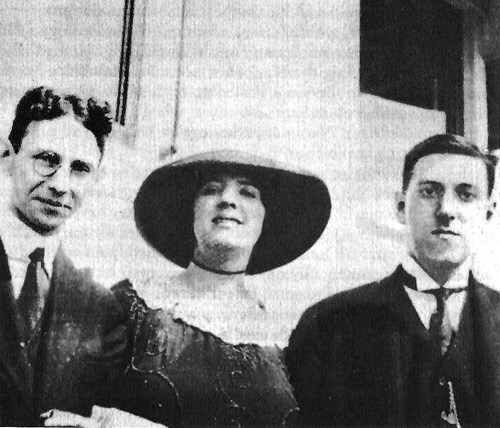
Rheinhart Kleiner introduced his mutual friends H. P. Lovecraft and Sonia H. Greene during a boat tour of Boston Harbor in July 1921. The three were attending an amateur journalism convention in the city.
That is both true, and misleading. This narrowly focused life of Lovecraft isn't a hatchet-job. It is, instead, a careful look at the whos, whats, and whys of Lovecraft coming into himself as a person and a writer.
That he wasn't a very nice person, well, you know what? Facing up to the real person who typed the words that formed the stories you love or loved is not something we can avoid in the twenty-first century. The fascinating part to me was that there needn't have been this curdling of his heart. There was a window for someone to reach into his heart and pull out a kinder human being. Sonia Greene certainly tried this feat.
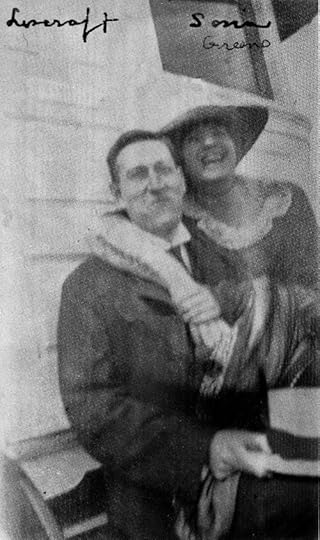
Greene grew more intrigued by Lovecraft throughout the Boston convention. This marked the beginning of their relationship.
A brief moment of happiness. It beggars belief to me that this smiling boy is H.P. Lovecraft, whose sour unsmiling visage is reproduced on so many book covers.
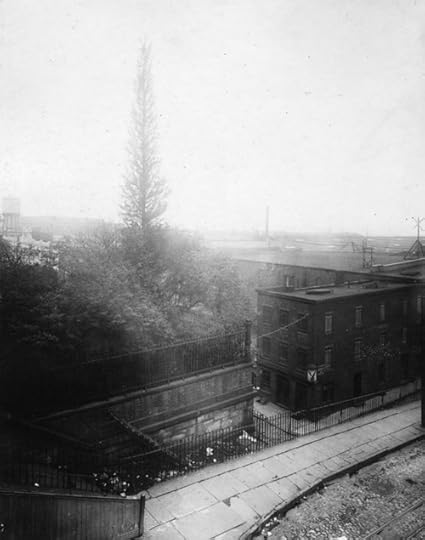
While Lovecraft strolled through Brooklyn Heights one evening, a neglected garden captured his attention. This might have been the grounds of the James S. Rockwell House.
His environs always influenced his creative process, naturally. Seeing such sights in Brooklyn, an urban space, would've charged up his future use of the surprising, hidden facet of his stories' settings. As a matter of fact he seems to have found the experience more formative than most others he would have while living in New York.
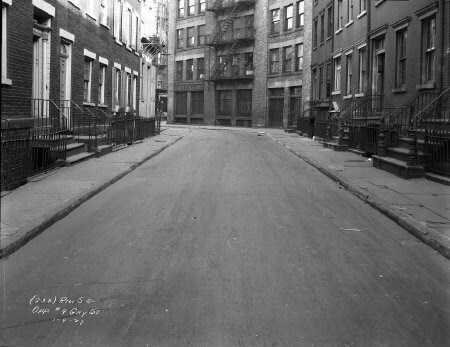
Lovecraft regularly wandered New York City’s nighttime streets to discover buildings reflecting the architectural styles of colonial and early America. He described Greenwich Village’s Gay Street as a “quaint, curving little alley.”
That it is! Still looks like this, too. It doesn't seem to have sweetened his world-view....
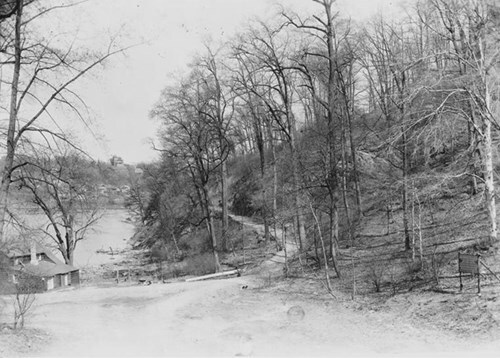
When exploring New York City, Lovecraft sought pockets of nature largely unblemished by urban development. Today’s Inwood Hill Park in Manhattan stood as such a space.
Holy carp! That's INWOOD?! My goodness, a hundred years makes a big difference.
I think my point's made. This is a terrific book about the nasty guy who refined and codified the tropes and topics that now make up "cosmic horror." He is seen here on the cusp of all the floods of words that would make this enduring contribution to our culture. I was drawn into this story by the details I did not know, despite the trajectory and ending being already familiar.
I'm convinced your young Lovecraft/horror reader will be as taken with this read as I was. I can't get all the way over the hump to five stars because I dislike Lovecraft that much. That's probably a testimonial to how well Author Goodwin did his job.
The Publisher Says: A micro-biography of horror fiction’s most influential author and his love–hate relationship with New York City.
By the end of his life and near financial ruin, pulp horror writer Howard Phillips Lovecraft resigned himself to the likelihood that his writing would be forgotten. Today, Lovecraft stands alongside J. R. R. Tolkien as the most influential genre writer of the twentieth century. His reputation as an unreformed racist and bigot, however, leaves readers to grapple with his legacy. Midnight Rambles explores Lovecraft’s time in New York City, a crucial yet often overlooked chapter in his life that shaped his literary career and the inextricable racism in his work.
Initially, New York stood as a place of liberation for Lovecraft. During the brief period between 1924 and 1926 when he lived there, Lovecraft joined a creative community and experimented with bohemian living in the publishing and cultural capital of the United States. He also married fellow writer Sonia H. Greene, a Ukrainian-Jewish émigré in the fashion industry. However, cascading personal setbacks and his own professional ineptitude soured him on New York. As Lovecraft became more frustrated, his xenophobia and racism became more pronounced. New York’s large immigrant population and minority communities disgusted him, and this mindset soon became evident in his writing. Many of his stories from this era are infused with racial and ethnic stereotypes and nativist themes, most notably his overtly racist short story, “The Horror at Red Hook,” set in Red Hook, Brooklyn. His personal letters reveal an even darker bigotry.
Author David J. Goodwin presents a chronological micro-biography of Lovecraft’s New York years, emphasizing Lovecraft’s exploration of the city environment, the greater metropolitan region, and other locales and how they molded him as a writer and as an individual. Drawing from primary sources (letters, memoirs, and published personal reflections) and secondary sources (biographies and scholarship), Midnight Rambles develops a portrait of a talented and troubled author and offers insights into his unsettling beliefs on race, ethnicity, and immigration.
I RECEIVED A DRC FROM THE PUBLISHER VIA EDELWEISS+. THANK YOU.
My Review: S.T. Joshi's two-volume I Am Providence is the go-to biography of this awful human being whose fiction output changed what we know as horror fiction. It's a much more...worshipful isn't too strong a term, but let's use the slightly less judgmental term "positively inclined"...take on his entire life.
We don't get that tone here. The author focuses on Lovecraft's New York years. It's pretty much impossible to make the time he spent in the place that inspired the utterly despicably racist story "The Horror at Red Hook" anything but dark and negative.
Rheinhart Kleiner introduced his mutual friends H. P. Lovecraft and Sonia H. Greene during a boat tour of Boston Harbor in July 1921. The three were attending an amateur journalism convention in the city.
That is both true, and misleading. This narrowly focused life of Lovecraft isn't a hatchet-job. It is, instead, a careful look at the whos, whats, and whys of Lovecraft coming into himself as a person and a writer.
That he wasn't a very nice person, well, you know what? Facing up to the real person who typed the words that formed the stories you love or loved is not something we can avoid in the twenty-first century. The fascinating part to me was that there needn't have been this curdling of his heart. There was a window for someone to reach into his heart and pull out a kinder human being. Sonia Greene certainly tried this feat.
Greene grew more intrigued by Lovecraft throughout the Boston convention. This marked the beginning of their relationship.
A brief moment of happiness. It beggars belief to me that this smiling boy is H.P. Lovecraft, whose sour unsmiling visage is reproduced on so many book covers.
While Lovecraft strolled through Brooklyn Heights one evening, a neglected garden captured his attention. This might have been the grounds of the James S. Rockwell House.
His environs always influenced his creative process, naturally. Seeing such sights in Brooklyn, an urban space, would've charged up his future use of the surprising, hidden facet of his stories' settings. As a matter of fact he seems to have found the experience more formative than most others he would have while living in New York.
Lovecraft regularly wandered New York City’s nighttime streets to discover buildings reflecting the architectural styles of colonial and early America. He described Greenwich Village’s Gay Street as a “quaint, curving little alley.”
That it is! Still looks like this, too. It doesn't seem to have sweetened his world-view....
When exploring New York City, Lovecraft sought pockets of nature largely unblemished by urban development. Today’s Inwood Hill Park in Manhattan stood as such a space.
Holy carp! That's INWOOD?! My goodness, a hundred years makes a big difference.
I think my point's made. This is a terrific book about the nasty guy who refined and codified the tropes and topics that now make up "cosmic horror." He is seen here on the cusp of all the floods of words that would make this enduring contribution to our culture. I was drawn into this story by the details I did not know, despite the trajectory and ending being already familiar.
I'm convinced your young Lovecraft/horror reader will be as taken with this read as I was. I can't get all the way over the hump to five stars because I dislike Lovecraft that much. That's probably a testimonial to how well Author Goodwin did his job.
September 5, 2025
Goodwin seems even more obsessed with race than Lovecraft (coming from the opposite direction, of course) but he does not explore HPL's theorizing on the subject, notably laid out in his letters to James Ferdinand Morton. So his treatment of the subject is abundant but superficial, more a matter of scolding Lovecraft for his beliefs than analyzing them.
Goodwin also has a tendency to engage in posthumous mind-reading, based on skimpy or non-existent evidence. For example, he twice suggests Lovecraft used hotel stationery in a symbolic way, to represent key moments in his life. Had he been more familiar with his subject, he'd have known that Lovecraft routinely looted hotels for writing materials. and used them out of frugality, not to express emotional subtexts.
However, it is impossible not to like this book, mainly because Goodwin handles HPL's relationship with Sonia with far greater understanding and compassion than Joshi, who tends to be dismissive of her. For what it's worth, I think Goodwin is right: within his limitations Lovecraft both loved and esteemed Sonia. I would add that he would be far from unique among writers in ultimately choosing self-interest (or self-preservation) and mastery of his craft over attachment to another.
Goodwin also has a tendency to engage in posthumous mind-reading, based on skimpy or non-existent evidence. For example, he twice suggests Lovecraft used hotel stationery in a symbolic way, to represent key moments in his life. Had he been more familiar with his subject, he'd have known that Lovecraft routinely looted hotels for writing materials. and used them out of frugality, not to express emotional subtexts.
However, it is impossible not to like this book, mainly because Goodwin handles HPL's relationship with Sonia with far greater understanding and compassion than Joshi, who tends to be dismissive of her. For what it's worth, I think Goodwin is right: within his limitations Lovecraft both loved and esteemed Sonia. I would add that he would be far from unique among writers in ultimately choosing self-interest (or self-preservation) and mastery of his craft over attachment to another.

September 6, 2024
Insomuch as it completes what it sets out to do--namely, detail H.P. Lovecraft's two-year stint living in New York with his wife Sonia Greene (at first together, then as a bachelor while she worked elsewhere), then one cannot fault the book. It is a thorough survey of his time there with plenty of referenced resources to prop up the narrative with biographical fact. So, full four stars for that.
Unfortunately, the man himself comes across as an elitist, racist, entitled and hypocritical prig. Of course, we already know this, but it's especially sad considering the fact that this writer was immersed in a great cosmopolis for two years, extensively walking its streets and palling around with an intellectually/culturally diverse crowd, and he refused to let any of that shift his deep-seated, nasty prejudices.
It is a wonder that anyone took a liking to him--most of all his own wife, a Jewish woman herself who seemed to escape the man's virulent anti-Semitism--but hey. He, at least, showed himself to be a charismatic and amiable person with the people he deemed worthy of his affection. Life is full of contradictions, I guess.
Unfortunately, the man himself comes across as an elitist, racist, entitled and hypocritical prig. Of course, we already know this, but it's especially sad considering the fact that this writer was immersed in a great cosmopolis for two years, extensively walking its streets and palling around with an intellectually/culturally diverse crowd, and he refused to let any of that shift his deep-seated, nasty prejudices.
It is a wonder that anyone took a liking to him--most of all his own wife, a Jewish woman herself who seemed to escape the man's virulent anti-Semitism--but hey. He, at least, showed himself to be a charismatic and amiable person with the people he deemed worthy of his affection. Life is full of contradictions, I guess.

April 7, 2023
Author David J. Goodwin presents a chronological micro-biography of Lovecraft’s New York years, emphasizing Lovecraft’s exploration of the city environment, the greater metropolitan region, and other locales and how they molded him as a writer and as an individual. Drawing from primary sources (letters, memoirs, and published personal reflections) and secondary sources (biographies and scholarship), Midnight Rambles develops a portrait of a talented and troubling author and offers insights into his unsettling beliefs on race, ethnicity, and immigration.
The book is well written, interesting and a significant source for all, that love the writings of Lovecraft and those who like to know about the times.
The book is well written, interesting and a significant source for all, that love the writings of Lovecraft and those who like to know about the times.
Displaying 1 - 6 of 6 reviews