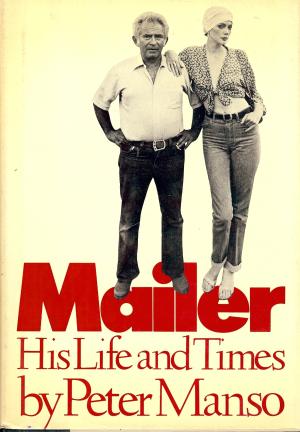
Peter Manso published a highly readable oral history of his then-hero and mentor Norman Mailer in the '80's titled " Mailer: His Life and Times". Manso, a good writer in all other respects, has republished the book with a lengthy afterword in which he repays the insult Mailer had paid him when it turned out the biography displeased him greatly.
Mailer and Manso were close friends during the eighties, with Manso admitting as much that he was , more or less, Mailer's acolyte. The pair even shared a beach front house in Providence , Rhode Island. Mailer had written to the local paper ""P.D. Manso is looking for gold in the desert of his arid inner life, where lies and distortions are the only cactus juice to keep him going."
Ouch, that hurts. But what puzzles me is that Peter Manso has seemingly nurtured the hurt for over thirty years and now takes a few too many pages to give his account, share gossip, insult Mailer friends. The aggrieved author seems less a wounded innocent than a gold digging punk . The lesson, I suppose, is that one ought not live with their heroes.
I'd agree that Manso's Mailer biography is a fascinating read as far as it goes; it's hard to go astray when you've a group of interesting people giving an intimate account of a singularly intriguing and often brilliant personality like Mailer. But based on this, Manso's introduction to the new edition just sounds like sour grape he wants everyone to take a sip from. The problem with having heroes who embody every virtue and ambition one wants to cultivate for their own is that heroes will betray you, intentionally or otherwise.
I've no idea what went on between the two men while they occupied that beach front property, but it's very possible Mailer had other things he wanted to do besides listen the sound and sight of a dedicated fan- boy sucking up; perhaps Manso crossed over from being a mere acolyte and exhibited a malignant sycophancy. Or maybe not; Manso would have served himself better getting over a three-decade old slight and finessed his remarks a tad more. It was Mailer's particular genius to make himself , as subject, fascinating in ways a reader wouldn't have suspected. That same talent isn't Manso's. Would that he merely republished his worthy oral history and gone onto another book.
Simultaneously confirms and challenges just about every idea I’ve had of Mailer since I read THE NAKED AND THE DEAD as a teenager. He is both as bad and as good as he’s cracked up to be, though perhaps not always in my previously assumed directions. It was interesting to see George Plimpton defend him, and fascinating to see Gloria Steinem describe him as a man imprisoned by embracing the stereotypical male superiority discourse. It is rare to see recognition of the fact that men who buy into patriarchy are as trapped as the women they confine; it’s an easier prison to live in, I suppose, if your whole orientation is to perceive yourself as a guard.
This is a very long, definitive oral biography of Norman Mailer. Unfortunately, I felt toward this bio the same way I felt toward his letters. The FIrst 150-200 pages are fairly interesting covering his life up until about 1960. After that it gets boring quickly. Just like his letters.
By the mid 1960s (page 400) i started skimming pages with 250 pages (and almost 20 years) to go. Manso stops the biography in 1984.
Mailer was definitely a man of his times. A commie in the 40s. A "white negro" in the 50s. A liberal/leftist in the 60s. And then a member of the literary establishment. Almost all his political writings are dead as a 30 year old newspaper. On a personal level, his "Friends" quoted in the book come off as people I wouldn't want to know. For example, his biggest friend in Hollywood was Shelly winters. And we get a lot of quotes from Diana Trilling.
Sidenote: I had to laugh at the quote from Gene Kelly on Mailer's visit to Hollywood in 1949. Gene obviously thought he was a deep intellectual and political thinker and not just a Hollywood hoofer.
Composed almost entirely of interviews, this reads like The National Enquirer because, apparently, Mailer lived most of his life that way. What I learned is that Mailer was "empty" inside, and so he tried on numerous personas in an effort to find himself like a crab trying on shells. Alfred Kazin thinks this is because of the Holocaust, that Mailer wants to be tough so as to defend himself against anti-Semites by no longer being Jewish, by being a rebel even though "he's riding the waves exactly like a surfboard"(650). Diana Trilling implies his macho act hides a secret fear of women and states that the major confusion for Mailer is between metaphor and reality -- the artwork being more important than reality, overriding reality. For example, in The White Negro two hoodlums stomp an old man to death and "in that very act experience more love than they'd known in their entire lives. . . . That was bad writing because it was bad thinking because it was bad being" (285-286).
On page 520 Trilling wonderfully details Town Bloody Hall, a Theater of Ideas debate between Mailer and four feminists. As Trilling has written elsewhere, Germaine Greer "consented to be on the panel because she wished to meet Mailer and go to bed with him. . . . By being so overt in her desires, Miss Greer had scored a victory for our sex; transcending reticence, she had transcended traditional femininity and moved all of us up a notch in the scale of male-female equality." Watching it on youtube, I was shocked by how often Mailer played the persecuted victim. His bluster disguises his whining. He rightly tells a questioner she makes no sense, but 75% of the time, his charge applies to himself as well. Perhaps Mailer's obsession with dialectic forces him to juxtapose insight and incoherence.
Gloria Steinem, always so wise, states: "His idea of what a man should be . . . dictates that men should be aggressive, take chances and father many children. It's an exaggeration of a patriarchal ideal that is impossible to achieve and has enormous penalties, more so for women but also for men, who are under stress, have heart attacks, then go off to war, get killed, do a whole lot of destructive stuff to live up to this code. Norman is compelled to live up to his masculine image. He's in a prison"(588).
Norman's attraction to violence leads him to defend a hanger-on who had sadistically beaten up a homosexual. Mailer tells Steinem, "'I'll be devoted to this guy for the rest of my life because I once saw him in a fight, he was getting knocked down again and again, and he kept getting up.' I said, 'Norman, anybody who'd grown up in a poor neighborhood could tell you he should have stayed down.' He never forgave me for that because I had questioned his ethic of what was admirable" (502).
In my opinion, what makes Mailer a great writer despite everything is his determination to be honest by revealing all. He lays himself bare on the page. This book is gossipy and aimless, but worth seeking out for, if nothing else, Allen Ginsberg's quotes. I could listen to him forever.
Author Peter Manso published a highly readable oral history of his then-hero and mentor Norman Mailer in the '80's titled " Mailer: His Life and Times". Manso, a good writer in all other respects, has republished the book with a 44 page afterword in which he repays the insult Mailer had paid him when it turned out the biography displeased him greatly. Mailer and Manso were close friends during the eighties, with Manso admitting as much that he was , more or less, Mailer's acolyte. The pair even shared a beach front house in Provincetown , MA. Mailer had written to the local paper ""P.D. Manso is looking for gold in the desert of his arid inner life, where lies and distortions are the only cactus juice to keep him going."
Ouch, that hurts. But what puzzles me is that Peter Manso has seemingly nurtured the hurt for over thirty years and now takes a few too many pages to give his account, share gossip, insult Mailer friends. The aggrieved author seems less a wounded innocent than a gold digging punk . The lesson, I suppose, is that one ought not live with their heroes.
I'd agree that Manso's Mailer biography is a fascinating read as far as it goes; it's hard to go astray when you've a group of interesting people giving an intimate account of a singularly intriguing and often brilliant personality like Mailer. But based on this, Manso's introduction to the new edition just sounds like 44 pages of sour grape he wants everyone to take a sip from. The problem with having heroes who embody every virtue and ambition one wants to cultivate for their own is that heroes will betray you, intentionally or otherwise. I've no idea what went on between the two men while they occupied that beach front property, but it's very possible Mailer had other things he wanted to do besides listen the sound and sight of a dedicated fan- boy sucking up; perhaps Manso crossed over from being a mere acolyte and exhibited a malignant sycophancy. Or maybe not; Manso would have served himself better getting over a three-decade old slight and finessed his remarks a tad more. It was Mailer's particular genius to make himself , as subject, fascinating in ways a reader wouldn't have suspected. That same talent isn't Manso's. Would that he merely republished his worthy oral history and gone onto another book.
Needed to take a shower after reading this. In compiling a massive oral biography of Mailer -- featuring interviews with Allen Ginsburg, Shelley Winters, Gloria Steinem, George Plimpton, Liz Smith, Rip Torn, Kurt Vonnegut, James Baldwin, Mailer's secretaries, two of his wives, his mother, and many, many more -- Peter Manso largely concentrates on the gossip: the parties, the drinking, the backstabbing (and, in two notorious cases, real stabbings), and especially the fighting among the intellegentsia and literati. By the end I felt I learned more about the self-serving personalities of the interviewees than about Mailer's work. There are some illuminating moments when Manso juxtaposes tales about Mailer with the fruits of his subject's creative labor -- for instance, when a classmate of Mailer's speaks of the young writer's interest in studying the charred corpses that were being dragged out of a famous Boston nightclub fire, and then the description of such corpses in an early short story -- but these are few and far between.
As for Manso's bridge-burning afterword for the new edition of the book: due to their falling out I'm not sure if I completely trust Manso in all his accusations of Mailer's mendacious vindictiveness, but I actually found his appraisal of the detrimental affect of schlocky publisher Lawrence Schiller and official archivist J. Michael Lennon on Mailer's later years sadly accurate. Still, Manso really wallows in the mud here: if I read it correctly, I'm pretty sure he at one point admits wondering why Mailer didn't kill himself at the end of his life rather than suffer the indignity of a hospital-set demise.
This tome is certainly not for his detractors and is effectively an authorized biography in the oral history mode. As such, there is direct commentary from a broad range of the personae of Mailer's heyday: Allen Ginsberg, George Plimpton, Shelly Winters, Mailer's Mom--to name a few. The book does not gloss over Norman's less artful moments such as the stabbing of his wife Adele or his gin besotted soliloquy at the Village Gate while campaiging for mayor of NYC. Of course these incidents built his legend and he embraced them as evidence of his fallible humanity, thus building his legend moreso. What a nut.
Thought I'd try something biographical. The arrangement of the book is as a wonderfully well organized collection of the memories of all of the people that surrounded Norman throughout his life as well as much quoting Norman on Norman. This wouldn't be, however the place to start in terms of true biography. It's charming informality is both it's strength and weakness. Some surrounding context and history are missing. But it really captures the emotional context of his life, and the timber of those most influential in his evolution.