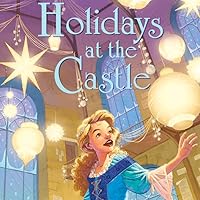
«Cuando Jocelyn Brandon murió (a una edad muy avanzada, como es lo normal en el caso de los magos), legó su casa a su nieto Andrew».
Andrew siempre ha adorado la casa, en especial sus vidrieras mágicas. Pero ahora, al verse como dueño de ella, se da cuenta de que las cosas no son tan fáciles como pensaba: para empezar, están la guardesa, tiránica y vengativa, y el jardinero, maniático y gruñón (pero que, al menos, tiene una hermosa sobrina llamada Stashe). Además, no hay que olvidar a Aidan Cain, un huérfano de doce años que aparece un día para solicitarle protección de unos seres mágicos (entre otros, Titania, Oberón y Puck) que lo persiguen, ni al señor Brown, un siniestro vecino que trata de invadir la barrera mágica que protege la casa. Y, sobre todo, está la magia. De la autora de El castillo ambulante, una novela con ecos de El sueño de una noche de verano.
Diana Wynne Jones was a celebrated British writer best known for her inventive and influential works of fantasy for children and young adults. Her stories often combined magical worlds with science fiction elements, parallel universes, and a sharp sense of humor. Among her most beloved books are Howl's Moving Castle, the Chrestomanci series, The Dalemark Quartet, Dark Lord of Derkholm, and the satirical The Tough Guide to Fantasyland. Her work gained renewed attention and readership with the popularity of the Harry Potter series, to which her books have frequently been compared.
Admired by authors such as Neil Gaiman, Philip Pullman, and J.K. Rowling, Jones was a major influence on the landscape of modern fantasy. She received numerous accolades throughout her career, including the Guardian Children's Fiction Prize, two Mythopoeic Awards, the Karl Edward Wagner Award, and the World Fantasy Award for Life Achievement. In 2004, Howl's Moving Castle was adapted into an acclaimed animated film by Hayao Miyazaki, further expanding her global audience.
Jones studied at Oxford, where she attended lectures by both C.S. Lewis and J.R.R. Tolkien. She began writing professionally in the 1960s and remained active until her death in 2011. Her final novel, The Islands of Chaldea, was completed posthumously by her sister Ursula Jones.
One thing I've always liked about Diana Wynne Jones' books for children is that she makes no artificial barrier between adults and children; they're all people. So rather than have the grownups dismiss or disbelieve the children's real concerns for no apparent reason other than that they're grownups, in her books parental and other adult figures listen, understand, and get stuck in to the magic. In Enchanted Glass, Diana Wynne Jones takes this a stage further: even though the book is obviously aimed at children and young teenagers, the main protagonist is an adult in his thirties — and a real adult at that, not just an older person with a childish personality. I found the switching of viewpoints between him and the twelve-year-old secondary protagonist a good way of showing that there is no real difference between people of different ages, just different personalities.
In this book, Diana Wynne Jones takes a lot of themes she's touched upon in previous stories, reworking them and improving them in new ways. Melstone House has a very similar atmosphere to Chrstomanci Castle, with Andrew Hope as a more believeable and rather more interesting Chrestomanci reminiscent of a more sympathetic Rupert Venables from Deep Secret. There's a lot about names, their power and variation (think Eight Days of Luke); some clannish villagers, some wise, some annoying (like The Pinhoe Egg); and references to greater powers (Black Maria or, better, Power of Three). And I've always loved the way she depicts the working of magic: natural, powerful, and almost instinctive to the practitioner, not at all mechanical the way Harry Potter magic can be.
There's a well-constructed plot, with a nice little — not so much a twist as a flourish— at the end, but this takes second place to the enjoyable character interactions and atmosphere. This was a nice gentle change for me from plot-driven books where bad thing after bad thing happens and only begins to start coming right near the end. I particularly liked her handling of Andrew and his half-forgotten memories of his grandfather, subtly hinting — but never explicitly saying — that his grandfather had made sure the memories would resurface as they were needed.
I have a suspicion that in writing this book towards the end of her life, Diana Wynne Jones is deliberately looking back over her career and picking out some of her favourite ideas and giving them a work over. And I think she succeeds: it was certainly good enough for me to read it twice in quick succession, just because it was such an enjoyable world to be in, with such nice people to get to know.
This is Diana Wynne Jones at her very best, a mixture of magic, humor, and sheer delight as an absent-minded professor inherits/encounters his grandfather's house, his magical field-of-care, two tyrannical servants, a giant, a weredog, a beautiful secretary, and a young boy hiding from the magical forces who are trying to kill him.
Don't worry if you're confused, it will all be sorted out in the end, as Andrew gets his head out of the clouds and begins to figure out the puzzle that has been left to him, along with the help of the orphaned Aidan, the weredog, the beautiful secretary, and . . . you get the picture.
This book was so utterly delightful that I was smiling goofily all while I was reading it. I really think that Diana Wynne Jones is at her best when she's gently mocking English life. There was a bit of a feel of "Wallace & Gromit: Curse of the Were-Rabbit" here as the village prepares for the annual fete, complete with people obsessively growing enormous vegetables and planning where to put up the bouncy castle! Mixed up in the fete, of course, you have the usual (wonderful) mix of magic and humor that were her trademarks.
I am quite sad to finish this book, as the wonderful author has recently passed away. She leaves a wonderful legacy, however.
On the death of his grandfather, Andrew leaves his professorship to run the family home...and the accompanying magical estate. As he grows used to his new responsibilities, he remembers more and more of what his grandfather taught him about magic, and he starts noticing encroachment on his magical lands. Andrew tries to beat back the fairies' slow invasion with the (sometimes inadvertent) help of his fellow villagers.
This is a lovely book, and I absolutely love the way the village, Melstone House, and magic are described. Andrew has a way of thinking about reality as a mere option that I really enjoy. The whole story is a wonderful mix of woodsy magic and old timey village life, with thoughtful and determined main characters I liked as people. I would have adored this book completely, save for two quibbles:
Ovo je poslednja knjiga koju je Dajana Vin Džouns objavila za života, i nema lepog načina da se ovo kaže - oseća se zamor. Imala je sedamdeset šest godina i već dugo je bolovala, a Enchanted Glass je njen trideset-i-neki roman, možda bliže četrdesetom; roman dakle, preskačemo priče, eseje i raznorazne kraće stvari. Prosto nije bilo šanse da se barem u nečemu ne ponavlja. A možda je i do toga što je ovo brat bratu njena trideset druga knjiga koju ja čitam... od čega bar desetak više nego jednom... -_- To sve na stranu: ovo je šarmantna, vedra knjiga za decu koja nikog neće iznenaditi osim desetogodišnjaka kojima je i namenjena - rasejani profa-čarobnjak koji nenadano dobije na staranje klinca daljeg rođaka i malo englesko mesto u kome svi stanovnici deluju ljupko ekscentrično i seju nejasne nagoveštaje o lokalnom plemstvu, a vilinski svet treperi nadohvat ruke. Veliko finale je po meni dosta otvoren i s mnogo ljubavi izveden omaž Volasu i Gromitu tj. Prokletstvu zekodlaka i sve u svemu - ovo nije postidna poslednja knjiga.
I had to choose the UK edition, as the cover of the US version is totally lame. Who do they think it's going to appeal to? Boys won't want to read it because it has rainbow swirls, and girls won't want to read it because it's about a smelly boy. I certainly felt stupid finishing it in Starbucks this afternoon (though I did get to sit next to the old lady with a Kindle and her iPad-wielding elderly husband again... the second time I've encountered these tech-savvy retirees).
So this is a pleasant book with thoroughly delightful characters, but I have to admit that I often didn't have a very good idea of what was going on. There's something about faerie kings and magical doppelgangers and mysterious parentage and the eponymous glass that does... I'm note sure what. Something magical. It involves magnets? It's quite like Howl's Moving Castle in that way; that book also told a confusing story about very likable characters. I suss that's just Diana Wynne Jones' style -- she doesn't work to over-explain everything, allowing for the mystery in the magical to remain. This is probably more of a problem for her adult readers; kids get wrapped up in books in a different way, and the linear aspects of the plot are less important, because of course the magic colored glass is magical, like, no doy.
It's better to focus on the quirky, slightly familiar characters -- the fussy gardener, the grouchy housekeeper -- which all have the same last name, Stock, which is probably DWJ's little joke, especially considering all the scattered references to A Midsummer Night's Dream.
I've got a whole stack of DWJ to enjoy, but I really wish I'd encountered her as a kid, because I think that's when she was meant to be read.
EDIT, SPOILERS:
Oh, so I totally forgot to mention one really weird thing about this book, which requires a reveal of one of the key mysteries. Specifically, we find out that one of the main characters, a young boy, is not, in fact, the offspring of the fairy king but of a seemingly benevolent old magician, who dies on page one. The boy's mother seems to have been a bit of a problem child, sent to the magician for "looking after" by her grandmother when the girl was a teenager. Um, so basically the 60-something magician had sex with a 16-year-old (this is excused by stating she "threw herself at him," and also maybe because women can bewitch men with spells?), knocked her up, and blamed it all on fairy magic. I guess it worked! I'm totally going to file that away for future reference. Also, WTF, DWJ?
Brilliant audiobook reading of another excellent Diana Wynne Jones tale.
(Though... I didn't notice this the first time around but I could have really done without the final, last-page revelation that feels... deeply problematic)
Una historia adorable y llena de magia para niños y no tan niños. Con guiños al sueño de una noche de verano. Y por supuesto, me han encantado los homólogos. Después de que las criaturas mágicas cómo Titania, Oberón , Puck y otros lleven tantos años viviendo en un área, la magia, crea a personas humanas muy similares a estás. De tal manera que Shaun es el homólogo de Groill, un adolescente gigante que todavía está creciendo.
I picked it up because I had it in my scribd library and was looking for something whimsical and fun to read. I had never read any of Diana Wynne Jones books before, but I saw Neil Gaiman had given this book 5 stars and he is one of my favourite authors.
This was very different from middle grade fantasy that I have read before. It feels very magical throughout the book (although in the beginning there's just small things happening) it really captures this whimsical feeling. But the best thing about this book were all the colourful characters, not only our main characters were great but all the side characters had very distinct, and often quite funny personalities. These characters gave the entire book quite a lighthearted and endearing feeling, even while some dark things were happening.
I would really recommend this to anyone that loves middle grade fantasy, and anyone that doesn't. I'm sure you'll love this book.
This is a perfect cozy delightful story. Found family, quirky cranky side characters, an intriguing magic system and Diane's lighearted humorous yet not shying away from issues such a grief writing style.
3.5 stars. To be fair to this book, I think if I had the paper book as well as the audiobook and could've switched back and forth like I usually do, I'd have enjoyed this a lot more.
Having only the audiobook and a wandering, distracted mind didn't contribute to maximum enjoyment of this one. I can almost bet I missed a paragraph here or there while multi-tasking that I'd have caught had I switched to the paper book at night.
Saying that though, I always enjoy this author's writing. Her magic is bright and whimsical for the most part, which is perfect for me because I don't like dark fantasy (or dark anything, I read to escape).
I'd have liked to see the enchanted glass of the title developed more. I enjoyed the young characters but I could've done without the instalove that developed toward the end of the story. I believe this was the last book DWJ wrote and I wonder if it was meant to be the first of a series. I have a feeling that maybe it was and it'd make more sense to kick off a series than as a standalone.
The audiobook was well done; however, without the paper book to switch back and forth to, I'd need a lot more rewinding to really absorb the world she created here.
Diana Wynne Jones is my all-time favorite author, and I really enjoyed this book. However - especially compared to her previous work - I felt like the characters and world-building weren't as strong, and it had the younger feel of The Pinhoe Egg as opposed to the older feel of something like Fire and Hemlock. The idea of "counterparts" didn't go far enough. But I did love another DWJ read and hope I continue to get one every few years!
This was a cute story, overall, and I liked the idea of the Field-of-Care and the fae involvement and whatnot. I do wish some things were explained more, though, like what causes the creation of counterparts? And, honestly, if
The characters could've used some extra development, I think, but they were fun enough, in their way. The romance definitely needed more development, though. I mean, it goes from
I liked Rolf, though, he was cute.
Oh, speaking of needing development, the Enchanted Glass didn't seem to play as heavy a role in the story as one would expect from the title. I'm still not 100% sure I really understand how it worked.
And I was a bit disappointed in the way the bad guy was dispatched. I mean, I was hoping it would be more proactive on the parts of our protags, and not basically them just
Speaking of how things work - I kept hoping there was more to Andrew not remembering all the stuff his grandfather taught him in his youth. Something actually related to the
So...
Cute enough story, but lots of things could've been developed more, and probably fairly forgettable, ultimately.
***
Now that I've done the review, I do want to comment on a few things which gave me pause for being in a kid's book.
When Andrew's grandfather Jocelyn Brandon Hope dies, Andrew Hope inherits Melstone House and land. However, all is not what it seems -- Jocelyn Hope was in fact a magician and the surrounding land is deemed a 'field of care', meaning that Andrew has to 'beat the bounds' in order to retain its magical power. Andrew's childhood fondness for Melstone House now becomes complicated by its infusion with magic, especially the strangely coloured glass on an inside door and a counterpart he discovers in the grounds. More confusion reigns with the presence of a stern housekeeper and a stubborn gardener and the arrival of a twelve-year-old orphan called Aidan Cain needing protection from stalkers. Then there is neighbour Mr Brown, who seems intent on trespassing on Andrew's field of care. Luckily he has an ally in the gardener's niece Stashe to counteract all the events conspiring against him.
Like many Diana Wynne Jones titles, half the fun of Enchanted Glass for adult readers comes not just in being pulled along by the storytelling but in attempting to read between the lines. A feature of this fantasy is the links with Shakespeare's A Midsummer Night's Dream -- key fairy characters, namely Oberon, Titania and Puck, reappear here, and there is a temptation to go searching for other covert appearances: are Andrew and Stache, for example, equivalent to Theseus and Hippolyta?
There are in addition various themes, such as the country custom of Beating the Bounds and the nature of the set of two enchanted windows, that beg to be developed further than is here, which suggest a possible sequel was planned before the author's untimely death. I do also wonder about those middle and last names of Andrew's grandfather, as the author's Clifton home was around the corner from a prominent Bristol landmark, Brandon Hill, and near a community arts centre in a converted chapel called the Hope Centre, which Jones must have known: how many other personal in-jokes must there be in this very English novel?
However, and this is also a mild criticism of some of Jones' books, there is the feeling of a rushed ending and of unresolved issues which slightly mar one's enjoyment of a tale well told, but she is so inventive that I would be ungenerous if I couldn't forgive her this one flaw. Enchanted Glass is chockfull of her ideas, fizzing and popping away like indoor fireworks, and it is marvellous to view it all through the tinted spectacles of her imagination.
I love DWJ and would rather have a new book from her than almost any other children's author I can think of, and I had a lot of fun reading this one: neat magic, excellent characters, very funny. That said, though, I did think it was rather derivative of a couple of her other recent books (The Pinhoe Egg and House of Many Ways came to mind a lot), so I wouldn't put it with her top-rank books.
I've followed DWJ's books for a loooong time - I can't say with authority that I've read all of them, but I've certainly read most, at one time or another. My husband grabbed this for me when he saw it at the library. It's engaging and well-constructed, with likeable characters, as usual... but there are a couple of things about it that really kind of bother me. First, within the first two chapters, we have three dead mothers and a dead grandmother in the backgrounds of the various main characters. Dead mothers are such a common trope in fiction - I wish we'd get over it - and surely an author of DWJ's skill and inventiveness could construct her characters with less of a body count. Second (spoiler!!): Right at the end of the book, we learn that one main character is not in fact the offspring of the fairy king, but is the result of a liaison between his teenaged bad-girl mother and the elderly respectable magician to whom the teenage mother was sent for straightening out. (The teenage mother was also the respectable magician's second cousin.) The book expects you to just take this in stride with a smile - "oh, they're all related, how nice" - which is what the character who finds this out does. But I'm kind of horrified! If that happened in real life, we'd call it statutory rape & it would (rightly) retroactively ruin the elder magician's reputation. With both the dead mother and the statutory rape, I almost feel like DWJ's been writing too long? - she's starting to treat plot points as only plot points, without thinking about the emotions and reactions they would provoke if they were real-world events... Anyway. It left me cross. Diana, what gives?
Beautiful Beautiful Beautiful. I was so excited to have a brand-new DWJ book to read, that wa unrelated to what had come before. New characters, new people to meet. Her standard themes were there, where she gathers a group of disparate people into one place, antagonistic toward each other they may be, with the right characteristics to step up to the plate to defeat the bad guys when the other members fail. Diana Wynne Jones knows and illustrates the value of the group and the individual's unique spot inside that group.
Based on a Spoiler Shakespeare, it was insanely amusing to me that many of the characters were surnamed Stock. This book drew off others she's written in the last decade, including Pinhoe Egg (towns made up of related people) and The Merlin Conspiracy (unseen life bubbling beneath the surface of the environs) and the were-dog lovingly harkened back to Howl's Moving Castle.
Though less subtle than some (Fire and Hemlock) it still carried some adult themes, or at least older-reader's theme, and had an older protagonist as well as a child for another viewpoint. It's charming, and yet there are some underdeveloped ideas in there, not the least of which is the eponymous glass. I would have been happy with another hundred pages of action.
I would like a ten-book series, please and thank you. Grown-up Aidan stories 2k15! Aidan solves crimes for Faerie! Aidan learns deep complex magical spells to perfect apple pie! I DON'T CARE.
This book has a lot of the great writing - characters especially - for which I love DWJ. Not one of my favorites of hers, but they can't all be Howl's Moving Castle. (Or Chrestomanci. Can we have more Chrestomanci now pretty pretty pleeeease?)
An interesting first: I'm pretty sure no other DWJ book has ever mentioned the Internet, though quite a few have included computers.
I like the idea of the glass itself, and the fact that the fairies are the classic Oberon-and-Titania set. I like the way Aidan and Andrew see magic differently when they take off their glasses, though that isn't really explained at all. Some of the characters are fabulous. Mr. Stock and Mrs. Stock are both fun, and the whole little town is pretty neat.
I love DWJ's ability to make me like flawed characters by not pretending they have no flaws. I'm thinking here mostly of Stashe - from when she first appears, I thought she was kind of bossy, and I was concerned because a lot of authors write characters who they, and the other characters, clearly admire as "strong and capable," but who to me just scream PUSHY. I liked that Aidan and even Andrew recognize that Stashe is kind of bossy, but like her anyway, rather than being totally blind about it. Characters with poorly-treated flaws can be even more annoying than characters with no flaws at all. DWJ, though, always seems to handle this well.
Reluctantly, I have to admit I found the book a bit slow and disjointed. If it weren't for how interestingly DWJ writes everyday events and character interactions, I'd have been bored. It's not even that I have a problem with reading about more domestic-type activities - it's more that this book just seemed not to hold onto tension very well.
Also, it jumped point of view a lot, often without even a line break, which could be a little confusing. I liked both Andrew and Aidan, but the book couldn't seem to decide which of them it was about. The jacket and cover make it out to be definitely Aidan, probably because he's the age of the target reading audience. Indeed, the plot with the most tension is his, but he doesn't appear at all for some time.
I liked that some things weren't neatly wrapped up - like the scene where Aidan talks to the power in the chapel. There were other things for which I might have liked a little more explanation, but in some cases, I know not to expect it. When it comes to the Big Source Behind the Magic (like the oak tree/chapel power), DWJ often likes to leave things vague, which I think works okay. Not sure why, after Andrew's big dramatic banishing, the Puck and others can still come back, but maybe they just can't settle and live there anymore.
I kind of wanted more to be made of the Fete. I knew from early on that it would have to be the scene of the denouement, and that it would have lots of wacky Melstone characters and giant vegetables and so on, and I was really looking forward to it. Unfortunately, I felt like it was a bit rushed and, at the same time, consisted largely of lists of things that didn't move all that smoothly or work into the plot that well.
The free-for-all at the Fete, in particular - well, I think it's hard to write big free-for-all scenes without seeming a bit self-indulgent. I even felt that way a little about the battle at the end of Harry Potter and the Deathly Hallows, although it mostly works pretty well there. Maybe it's because when a lot of things are happening simultaneously, authors want to write them all out in kind of a list, which makes it seem like our POV character is just standing there taking it all in. In the best cases (and I think Deathly Hallows does do this for most of the battle, just not quite all), the reader only gets the wacky happenings of which the POV character would be immediately aware, e.g. the ones that are threatening him or in which he is participating, or maybe those involving the POV character's closest friends/romantic interest/etc. When an author has spent a long time developing a big cast, and now they're all involved in one big wacky fight, it's natural to want to show what all of them are getting up to, but it has to be done in a way that makes sense. I'm going to preempt this by saying I feel like a bad fan for suggesting that Rowling has done this better than it is done in Enchanted Glass, and just want to reiterate that DWJ IS MY FAVORITE AUTHOR IN THE WORLD, but I think Deathly Hallows did do this quite well for the most part. The key was that Harry kept moving. He had good reason - he had his own goal, and the stakes were high. But moving through the battle - especially when he occasionally gets cornered or stops to help a friend - was a good way for him to glimpse a lot of the crazy action without seeming like a spectator.
Returning to the review at hand, I'd just like to also say that the very end startled me big-time. In a way, it's one of the darkest twists I think I've ever read at the end of a DWJ book, and all the more startling for how light the rest of the story is. In another way, it doesn't change much at all.
*POSSIBLE SPOILERYNESS* I had already wondered a bit, though, how nice a guy Jocelyn Brandon really was. I was certainly startled that he used to call Stashe a "silly little bitch." When she called him a curmudgeon and started to say "He used to call me . . ." I was definitely expecting something playful, not genuinely offensive.
Also, I got the US cover, and even though it's a small thing, I'm sad to see that the colors of the glass on the cover vary from the arrangement specifically described in the book. In particular, the fact that the purple pane is mentioned multiple times as being the all-important middle piece makes me just wish what whoever was in charge of coordinating the cover illustration had gotten it right.
This entire review has been hidden because of spoilers.
Andrew Hope inherits his grandfather's field-of-care, although he's a bit vague on what that entails. He has his hands full with the housekeeper and his gardener, who dislike change almost as much as they dislike each other. Then young Aiden shows up on his doorstep. Having a twelve-year-old boy about the place rather opens Andrew's eyes to the magic he's been forgetting.
Overgrown vege and walking the boundaries. Magical knacks and cauliflower cheese. Racing results and polishing glasses. Stained glass and barbed wire. A charming stand-alone story from a favorite author. Loved Professor Hope's longsuffering manner in the face of mayhem. A sort of belated coming-of-age for the man. "World of his own!"
Enchanted Glass is Diana Wynne Jones’s last published book before her death on March 26, 2011. The novel is a charming young adult standalone in Wynne Jones’s trademark style, beloved by many and unique in British children’s literature. Professor Andrew Hope—he isn’t really a professor; he just happens to work at a university—inherits the old Melstone House and its ornery retinue after the death of Andrew’s grandfather, Jocelyn. Of course, Jocelyn was more than just an old country esquire; he was also the local wizard, and Andrew inherits Jocelyn’s magical field-of-care along with the house. Then Aidan, a clever orphan, shows up on Andrew’s doorstep, and the pair quickly come to realize that there’s more to this whole “field-of-care” thing than meets the eye.
Hilariously quirky characters This will come to no surprise to long-time readers of Diana Wynne Jones: the characters in Enchanted Glass are delightful. There is Mrs. Stock, the commandeering housekeeper who enforces her opinion on proper living room furniture arrangement by cooking up a dreadful cauliflower cheese each lunchtime. There is also Mr. Stock (no relation to Mrs. Stock—it’s just that kind of town), the grouchy, prize-winning gardener who announces his displeasure by dumping an enormous box of inedible vegetables on the kitchen table each morning. There is also Groil, the gentle giant who eats those vegetables after Andrew hides them on top of the woodshed. My own personal favorite is Stashe, Andrew’s bossy sparkplug of a secretary who prowls the house looking for papers to organize and problems to solve, but becomes a problem of her own when Andrew begins to notice just how attractive she is.
The other characters are no exception, and you’ll have fun meeting each in turn. Andrew’s trials with household management are full of gentle, sparkling humor, which more than offsets this next point:
Not all that much happens For all the quirky characters and magical mishaps, Enchanted Glass is surprisingly thin on plot. Although Jones obviously and happily did not intend to write a thriller here, the novel is still more a series of discoveries rather than a series of conflicts. The climax, while hilariously slapstick, is barely brought about by Andrew or Aidan. The villains—drawn from Shakespeare’s A Midsummer Night’s Dream and from older, deeper English mythology—are funnier than they are scary. And for a long while at the beginning, not too much happens other than Andrew and Mrs. Stock waging war over the position of the piano in the living room.
Joyful, breezy writing Luckily, Jones makes this work. Like I said, the humour is gentle, but occasionally Jones surprises with a wickedly funny joke or adult problem—not enough to be inappropriate for young readers, of course, but adding enough sophistication to make Enchanted Glass a fun read even for an adult. The prose brings the word “rollicking” to mind, and the dialogue is perfect. This is an easy, happy read, and it’s easy to see why it’s great for young readers, but a welcome and refreshing break for older readers, too.
Why should you read this book? Enchanted Glass is a shining example of why Diana Wynne Jones is a household name for children’s literature. Fun, buoyant, and full of good humor, the story is bound to put anyone in a happy mood, and the witty prose is sharp enough for the most discerning reader. Save this one for a sunny day, find a tree to read under, and don’t forget to bring a sandwich.
I should know by now not to mind the terrible covers on Diana Wynne Jones books. That said, if there’s one thing I know about my bookish self, it’s that I’m incredibly snobby about cover art. So, even though I trust her storytelling implicitly (and explicitly, for that matter), I was put off by this ugly cover and didn't read Enchanted Glass right away. I now wish I had, because in this middle grade fantasy Diana has created a marvelous story, characters and place, and I can see that I’ll be returning to visit its magic again and again.
Have you read Diana Wynne Jones? She’s famous (and rightfully so) for writing fantastical stories about worlds tilted just enough off the reality axis to make strange happenings normal, and to make off-kilter responses to those happenings absolutely necessary. Did that make sense? Let me try again. DWJ is a genius, and she’ll show you magic in a way that is completely new, and sideways, and just-as-it-should-be, all at the same time. Stumbling into one of her worlds only becomes, as Alice said of Wonderland, ‘curioser and curiouser.’
Is it quite clear that I loved this book? I’ll tell you why, then. Enchanted Glass is a double story: it follows thirty year-old professor Andrew Hope and a quite young (12? 13?) Aidan Cain. Andrew has been given a task, but isn’t quite sure what it entails. Aidan is being chased by dangerous not-humans. They each have magic, and they are each drawn to Melstone House… But what are they to do about Aidan’s predicament, and what is Andrew’s inheritance that he can’t find or remember? Unraveling these mysteries will take all of the courage, concentration and luck that both Andrew and Aidan can muster. It is a challenge that will change Melstone, and their lives, forever.
What that summary doesn’t convey is the charm and wit and rightness of Jones’ writing. While there’s always a ‘something large and potentially world threatening’ going on in the background, the characters live very much in the moment, and their actions feel real and justified. Those characters are also authentic: if they’re smart, they’re often blind to a particular problem. If they seem simple, there is something hiding beneath the surface. And even the side characters are never, ever extraneous to the story. That is why a story about a small, magical village feels important and true and beautiful, and why I love Diana Wynne Jones’ writing.
If I must find something to pick over, it’s that there aren’t any female main characters in this story. But there is generational diversity (old, young, in-between!) and species diversity, and most importantly, the end result is a magical tale masterfully told.
Recommended for: all ages, fans of fantasy, fans of Diana Wynne Jones, and anyone who liked J.K. Rowling’s Harry Potter and the Philosopher’s Stone.
Any new book by Jones is a delicious treat, a reason to put down whatever else I'm doing and curl up with a cup of tea. This one, however, came with special poignancy because I received it just after I learned of her death. So I opened the pages with a kind of sadness, not wanting to admit that in many ways, this was farewell. (If there is another book to be published posthumously, I don't know of it.)
And found magic. Within a few paragraphs, her clear prose and unaffectedly direct storytelling had drawn me into a world in which magicians bequeath not only fine old houses but fields-of-care as well. Only in this case, the old magician left it "rather too late," meaning without personal instruction as to exactly what a field-of-care is and how one cares for it. A few pages later, Andrew Hope is struggling not only with his magical inheritance but with the two classically-Jones abrasive and recalcitrant retainers, Mr. Stock (who expresses his disapproval in the form of boxes of gigantic and inedible vegetables) and Mrs. Stock (no relation to Mr. Stock, who expresses hers by waging war as to the positioning of the piano in the living room). By the time young Aidan (the boy on the rainbow-hued cover) arrived, I had become part of the household as well.
In tone rather than details, Enchanted Glass reminded me very much of the first Jones book I fell in love with, Charmed Life. Even when the characters were at risk, I always felt safe in her hands. Even the most eccentric and unappealing personages were treated with respect and often made invaluable contributions to whatever quest was underway. After all, in worlds where a prince can be enchanted into a turnip-headed broom, where spells are woven into cloaks, centaurs attend fantasy conventions, and fallen stars walk among us as dogs, every moment carries the possibility of wondrous adventure.
I don't need to be convinced to buy or pick up a Diana Wynne Jones book. She has been, and will always be, one of my favourite authors, full stop.
However, this one is definitely a kids book - almost DWJ-lite: all the tropes in a neat little bite size package. I read it in a couple of days and ticked off all her usuals as I was doing so.
Tall, unassuming yet powerful youngish man - tick. Young boy with magic talent that he is unaware of/unable to use yet - tick. Antagonistic but necessary household helper/s who end up being good sorts - tick. Fairy lore - tick. A romantic relationship that doesn't consume the characters' every waking moments (thank heavens) - tick. An ending that is really a new beginning - tick.
Plus a hundred others, all things I would have expected from her books. It was nothing life-changing, but I enjoyed the time I spent there. Perfect for a younger reader who wants to explore outside the romance/fantasy box.*
*On this note, I would like to thank the gods of fate or life or Mother Nature or Titania herself that I am too old for this spate of YA romance/fantasy that has popped up over the last few years. If I hadn't devoured every DWJ book I could get my hands on as a teen, and instead had to read book after book about a magic user/shape shifter who also had tremendously painful and earth-shattering romantic exploits at the same time, I'd probably be reading 50 Shades of Grey right now...
I think I might be in love... I gulped this book down marveling all the while how can a story so magical be so casual, so matter of fact about it? The mythical characters strolling nonchalantly into the story, the ancient magic radiating from everything in sight brought with them only the surprised remembrance, as if like Andrew I had simply forgotten about it all and now that I have remembered again nothing could be more natural.
It's one of those books that make me bemoan the fact that I did not grow up in an English speaking country and hence was devoid of Diana Wynne Jones' bewitching stories as a child (add to it no Roald Dahl, Alan Garner, Philippa Pearce, T.H. White - the list goes on...). Still, I'm grateful I can discover them and be put under their spell now.
The self imposed restriction on buying books (I have to diminish THE PILE of compulsively bought books by at least 30 until I'm allowed to add to it again) is driving me insane right now, because there's nothing I want to do more than run out as soon as bookshops open tomorrow morning and buy EVERYTHING I can find by Diana Wynne Jones.
DWJ usually tells a good story and always manages to tie up all of the details into a tidy bow by the end of her books. However, Enchant Glass has some problematic details and plot points, including a lot of fat phobia, a weird implication that women university students often try to seduce professors to get out of bad grades, a bad representation of a person with a disability, and a very nonchalant attitude towards a 'relationship' between an man in his 50s and a 16-year-old girl.
This entire review has been hidden because of spoilers.
I admit it, the cover art pulled me in on this one. While there's something familiar in the slightly-mischievous Harry Potteresque look the protagonist, Aidan Cain, is wearing, it was actually the visible colors pouring through the stained-glass window in the angled ceiling and wrapping around Aidan and the dog that made me grab this book. I can only assume it goes back to my love of all things half-scientific, half-magical: it reminds me of the Northern Lights, which I still have yet to see with my bare eyes.
With the appeal of the cover fresh in my mind, I cracked this book open to see what lay inside. I realized immediately that the inside flap text was slightly misleading: it portrays the central character as Aidan, but the first chapter of the book, and many others, are from the older Andrew's perspective. They are both main characters, and the plot requires both their large contributions to balance out the story.
I liked Andrew from the start. His history and its application to his current position as inheritor of Melstone House were enjoyable to contemplate. Clearly, he was the wizard of the story, in more than one sense, despite Aidan's magical abilities; Andrew, as the adult, was aware from the start of the importance of certain plot details, and grasped the significance of others as the plot progressed. Aidan, an entertaining and powerful character, is generally a boyish boy who plays soccer, meets the giant that eats the unwanted vegetables laid out on the shed roof every night, and rescues the were-dog Rolf from the clutches of Mr. Brown and his mysterious forces.
The book is populated with other highly entertaining characters, as well. Tarquin, the one-legged retired jockey, and his daughter Stashe (short for Eustacia, not Mustache, btw) were my favorites, but Mr. Stock and Mrs. Stock (no relation), the two staff members in Andrew's aging mansion, made a hilarious pair of curmudgeonly caretakers, and their oft-clashing Master Plans for Andrew and the mansion helped drive the plot in excellent ways.
The buildup to the reveal of what "counterparts" were, and why they were a problem, was nicely done. I was quite eager to see what they'd be and how they fit into the world of Andrew and Aidan, and I was not disappointed. The explanation and its subsequent manifestations (as well as explaining prior characters) left me grinning, and the interaction between counterparts became crucial to the plot.
The main thrust of the plot wasn't quite what I expected at the end, and I'm left with the curious feeling that this book will have a sequel. Either that, or the denouement didn't do its job. Most of the book follows the premise that Aidan is half-faerie, a son of Oberon himself. Oberon wants to kill him so he can't take over the faerie throne. Aidan's in possession of a wallet that magically makes money in the exact amount he needs, but Oberon and his minions can trace its magic. This leads to a final confrontation at the Fête, which is resolved, it seems, happily. And then, at the end, Oberon does a one-eighty and proclaims that he's not Aidan's father after all, and claims the boy's an...uncle...of Andrew's instead!
Let's throw some mud on old Jocelyn Brandon and label Aidan's mum a trollop all in one go, shall we, and then we'll leave Andrew on the doorstep with this knowledge at the very end of the book, unsure how to proceed. The end!
Heh. That feels far too much like reality just intruded into this lovely, exciting fantasy world. I can't figure why this was the preferred ending. It might manage to explain Aidan's gifts in that they come now from Jocelyn's bloodline rather than Oberon's. But it honestly feels like someone came in and jotted across the last page of Ms. Jones' manuscript, then submitted it to her publisher without her knowledge. It makes a mockery of the whole book, a case of supremely mistaken identity, and an unnecessary tale in the whole. Such an abrupt ending cannot possibly leave me satisfied. Perhaps that's my fault for not being a child of the British Empire, and not being in the proper target audience. I might be overthinking this, and there could be a cultural issue I'm missing. But personally, I recommend stopping reading on page 290 with the following:
"Oh yes," Aidan said happily. "Everything's all right now."
...and call it a good story.
I'll happily give this 4 of 5 stars, but a logical ending of some sort would have pushed another star on there. Alas.
This entire review has been hidden because of spoilers.
This is not literature. Obviously not. However I enjoyed it mightily as a bedtime read. Well, most of it anyway. The first 3/4 went by very quickly, and I remember remarking to my husband as I lay there reading, "I better put this away or I'll be here till 3 AM."
However. Titania and Oberon? Really? Kids (for whom this book was most definitely intended) would probably not get the Midsummer Night's Dream reference unless someone had taken them to the play or they had seen the DVD. And then it just kind of came to pieces from there. Every time it looked like something suspenseful or dangerous might happen, it was just...nothing. (Like, what was the deal with the coloured liqueurs that seemed to be alive?) The magician's nephew (well, grandson) always manages to pull a magical "rabbit" out of the back of his mind when he needs it, even though he consciously knows from nothing. Kind of like Harry Potter--and yes, this was published after all that happened--the magical "chosen one" who knows nothing of the craft and yet manages to do everything right first time, unlike the other Hogwarts kids who had been steeped in it from day 1 as part of their lives.
The ending was disappointing. Yeah, storms and lightning and thundering voices and all...but it was all very Archers, with the village fete and the ro-mance between the adult MC and The Girl, and the country yokels. If she could just have developed some of the situations a bit more before tying it all up into a big messy package with a tatty bow, it would have been 5 stars.
É um livro infanto-juvenil que me deixou encantada. Tem magia, que chega devagarinho, e o leitor vai descobri-la à medida que as personagens a descobrem. Neste aspeto, é um livro iniciático... Aidan Cain perdeu a avó que o criara e vai tentar encontrar a ajuda de um tal Jocelyn Brandon. No entanto ,apenas encontra o professor Andrew Hope, neto do anterior, já falecido, que é seu herdeiro e está a braços com a casa nova e a herança que recebeu, acossado por empregados bizarros e exigentes. Passado numa aldeia inglesa com todos os seus traços distintivos (até um festival, com concurso de bolos e vegetais), rapidamente os dois se veem cercados por seres estranhos, uns amigáveis e outros sinistros. É uma história deliciosa: Aidan descobre onde pertence à medida que Andrew descobre que também pertence ali, naquele sítio. A descoberta desta autora foi uma boa surpresa :já ali está o «Castelo Encantado», ou seja, a base do filme de Miyazaki...