

What do you think?

The Worlds of Dune: The Places and Cultures that Inspired Frank Herbert
"An impressive work of granular Dunesploitation."
- Empire Magazine
Some writers build worlds. Others birth entire universes.
In the decades since its publication, Frank Herbert’s Dune has become arguably the best-selling and certainly the best-known science fiction novel ever written. So how did an ex-Navy newspaperman from Washington State come to write such a world-conquering novel? And how was he able to pack it with so many layers of myth and meaning?
Herbert’s boundless imagination was sparked by a dizzying array of ideas, from classical history to cutting-edge science, from environmentalism to Zen philosophy, and from Arabic texts to Shakespeare’s tragedies.
Beginning on Arrakis and going planet by planet, The Worlds of Dune offers a supremely deep dive into Herbert's universe – detailing along the way the many diverse strands that he wove into his epic creation to offer a visually rich accompaniment to this sci-fi legend.
- Empire Magazine
Some writers build worlds. Others birth entire universes.
In the decades since its publication, Frank Herbert’s Dune has become arguably the best-selling and certainly the best-known science fiction novel ever written. So how did an ex-Navy newspaperman from Washington State come to write such a world-conquering novel? And how was he able to pack it with so many layers of myth and meaning?
Herbert’s boundless imagination was sparked by a dizzying array of ideas, from classical history to cutting-edge science, from environmentalism to Zen philosophy, and from Arabic texts to Shakespeare’s tragedies.
Beginning on Arrakis and going planet by planet, The Worlds of Dune offers a supremely deep dive into Herbert's universe – detailing along the way the many diverse strands that he wove into his epic creation to offer a visually rich accompaniment to this sci-fi legend.
368 pages, Kindle Edition
Published September 26, 2023
About the author
Tom Huddleston
37 books46 followersAuthor also writes as T.H. Huddleston
I'm Tom Huddleston, author of fiction and non-fiction for adults and children.
As T.H. Huddleston, I'm the author of satirical Gothic horror THE CRACKS, publshed by Titan Books in 2026.
I've also written books on famous creatives including DAVID LYNCH: HIS WORK, HIS WORLD; THE WORLDS OF GEORGE RR MARTIN and THE WORLDS OF DUNE, all about the inspirations behind the greatest SF novel of all time.
For younger readers, I've written original adventure stories like the FLOODWORLD trilogy (FLOODWORLD, DUSTROAD and STORMTIDE), along with several episodes in the WARHAMMER ADVENTURES and STAR WARS: ADVENTURES IN WILD SPACE series.
I also write about film and TV for publications including Time Out, the BFI and The Guardian, and I sing in a folk-rock band called The No Sorrows.
I was born in Kendal and raised in North Yorkshire, though I now live in London. I realise that I almost have the same name as Loki, but rest assured I'm not him: I'm slightly rounder and a lot less famous. However, I have managed to make him admit that it's his family who spell their name wrong, not mine.
If you have any questions, please get in touch!
I'm Tom Huddleston, author of fiction and non-fiction for adults and children.
As T.H. Huddleston, I'm the author of satirical Gothic horror THE CRACKS, publshed by Titan Books in 2026.
I've also written books on famous creatives including DAVID LYNCH: HIS WORK, HIS WORLD; THE WORLDS OF GEORGE RR MARTIN and THE WORLDS OF DUNE, all about the inspirations behind the greatest SF novel of all time.
For younger readers, I've written original adventure stories like the FLOODWORLD trilogy (FLOODWORLD, DUSTROAD and STORMTIDE), along with several episodes in the WARHAMMER ADVENTURES and STAR WARS: ADVENTURES IN WILD SPACE series.
I also write about film and TV for publications including Time Out, the BFI and The Guardian, and I sing in a folk-rock band called The No Sorrows.
I was born in Kendal and raised in North Yorkshire, though I now live in London. I realise that I almost have the same name as Loki, but rest assured I'm not him: I'm slightly rounder and a lot less famous. However, I have managed to make him admit that it's his family who spell their name wrong, not mine.
If you have any questions, please get in touch!
Ratings & Reviews
Friends & Following
Create a free account to discover what your friends think of this book!
Community Reviews
Displaying 1 - 23 of 23 reviews

November 26, 2023
The Publisher Says: Some writers build worlds. Others birth entire universes.
In the decades since its publication, Frank Herbert’s Dune has become arguably the best-selling and certainly the best-known science fiction novel ever written. So how did an ex-Navy newspaperman from Washington State come to write such a world-conquering novel? And how was he able to pack it with so many layers of myth and meaning?
Herbert’s boundless imagination was sparked by a dizzying array of ideas, from classical history to cutting-edge science, from environmentalism to Zen philosophy, and from Arabic texts to Shakespeare’s tragedies.
Beginning on Arrakis and going planet by planet, The Worlds of Dune offers a supremely deep dive into Herbert's universe—detailing along the way the many diverse strands that he wove into his epic creation to offer a visually rich accompaniment to this sci-fi legend.
I RECEIVED A DRC FROM THE PUBLISHER VIA EDELWEISS+. THANK YOU.
My Review: Glorious illustrated companion to the Duneiverse was published in October 2023 to coincide with the pre-WGA/SAG strikes release of Dune Part Two. Now scheduled for release on 1 March 2024 in the US (per IMDb), the companion film to 2021's gorgeous Dune means we can finally show the marketing case for a beautiful, informative arty book about how Frank Herbert came up with the ideas, and examined the cultures, that he based his utterly engrossing work on.
Take a gander at this table of contents...the in-book design's beautiful to my eye, the clarity of information presentation is usable, and the synopsis is amply supported by the part and chapter titles:
Part One: ARRAKIS
Chapter One Desert Planet
Chapter Two The Fremen
Chapter Three The Spice
Part Two: CALADAN
Chapter Four House Atreides
Chapter Five Paul Muad'dib
Chapter Six Lady Jessica and the Bene Gesserit
Part Three: GIEDI PRIME
Chapter Seven House Harkonnen
Chapter Eight Piter De Vries and the Mentats
Chapter Nine The CHOAM Corporation
Part Four: KAITAN
Chapter Ten House Corrino and the Padishah Emperor
Chapter Eleven The Landsraad
Chapter Twelve The Spacing Guild
An introduction to Herbert's life whizzes along in just over ten pages, and there are the usual things in the back matter: An Epilogue, notes, credits, sources, etc.
This is not a long book, nor is it a scholarly evaluation of Dune in all its genre glory. This is a book for the aficionado of the world of to have for their display and their aesthetic pleasure. It will not elucidate matters of great debate within the Duneiverse, nor will it enlighten most long-time fans about most matters around the creation of the Duneiverse in print or on screens. The point of it is to make the reality of the great work beautiful and ready to seduce the eyes:
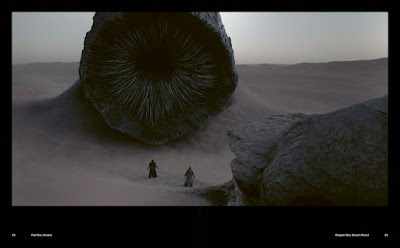
A gift to give that shows you listened, a gift to yourself if you're a genre fan, a beautiful object to have and enjoy.
In the decades since its publication, Frank Herbert’s Dune has become arguably the best-selling and certainly the best-known science fiction novel ever written. So how did an ex-Navy newspaperman from Washington State come to write such a world-conquering novel? And how was he able to pack it with so many layers of myth and meaning?
Herbert’s boundless imagination was sparked by a dizzying array of ideas, from classical history to cutting-edge science, from environmentalism to Zen philosophy, and from Arabic texts to Shakespeare’s tragedies.
Beginning on Arrakis and going planet by planet, The Worlds of Dune offers a supremely deep dive into Herbert's universe—detailing along the way the many diverse strands that he wove into his epic creation to offer a visually rich accompaniment to this sci-fi legend.
I RECEIVED A DRC FROM THE PUBLISHER VIA EDELWEISS+. THANK YOU.
My Review: Glorious illustrated companion to the Duneiverse was published in October 2023 to coincide with the pre-WGA/SAG strikes release of Dune Part Two. Now scheduled for release on 1 March 2024 in the US (per IMDb), the companion film to 2021's gorgeous Dune means we can finally show the marketing case for a beautiful, informative arty book about how Frank Herbert came up with the ideas, and examined the cultures, that he based his utterly engrossing work on.
Take a gander at this table of contents...the in-book design's beautiful to my eye, the clarity of information presentation is usable, and the synopsis is amply supported by the part and chapter titles:
Part One: ARRAKIS
Chapter One Desert Planet
Chapter Two The Fremen
Chapter Three The Spice
Part Two: CALADAN
Chapter Four House Atreides
Chapter Five Paul Muad'dib
Chapter Six Lady Jessica and the Bene Gesserit
Part Three: GIEDI PRIME
Chapter Seven House Harkonnen
Chapter Eight Piter De Vries and the Mentats
Chapter Nine The CHOAM Corporation
Part Four: KAITAN
Chapter Ten House Corrino and the Padishah Emperor
Chapter Eleven The Landsraad
Chapter Twelve The Spacing Guild
An introduction to Herbert's life whizzes along in just over ten pages, and there are the usual things in the back matter: An Epilogue, notes, credits, sources, etc.
This is not a long book, nor is it a scholarly evaluation of Dune in all its genre glory. This is a book for the aficionado of the world of to have for their display and their aesthetic pleasure. It will not elucidate matters of great debate within the Duneiverse, nor will it enlighten most long-time fans about most matters around the creation of the Duneiverse in print or on screens. The point of it is to make the reality of the great work beautiful and ready to seduce the eyes:
A gift to give that shows you listened, a gift to yourself if you're a genre fan, a beautiful object to have and enjoy.

September 27, 2023
I received an Advanced Review Copy of this book and my thanks to the team of NetGalley, the publisher and the author for the copy.
I have been a fan of the Dune series since I read the first part way back in the early 90's. One of my earliest books in the sci-fi sphere.
In Dune, Frank Herbert had created a sci-fi universe very rarely matched by others. The desolate worlds and the life has inspired latter generations of writers and creators.
Tom in this book has taken the concepts of Dune and explored the world that influenced Frank and in turn the story. This book is a deep dive into the person Frank and his life and influences that shaped his thought and how we see it reflected in the worlds of the book. Contemporary influences and inspirations that led to the lasting effects that the book(s) have left on the sci-fi vertical.
The book is a treasure trove of information for the series fans and we have information about Frank's life, his way of life, his family especially his aunt and wife which influenced his thought especially the way he saw women that come up in the way he portrayed them in the books. His honest attempt to write an article about controlling the spurt of dunes in the Pacific area could be seen in full glory in the books.
This book is full of suitable illustrations from the movies as well as from behind the scenes while shooting and Frank personally. The book is very well researched and is one that I would like to own.
Full marks to Tom for this beautiful book.
I have been a fan of the Dune series since I read the first part way back in the early 90's. One of my earliest books in the sci-fi sphere.
In Dune, Frank Herbert had created a sci-fi universe very rarely matched by others. The desolate worlds and the life has inspired latter generations of writers and creators.
Tom in this book has taken the concepts of Dune and explored the world that influenced Frank and in turn the story. This book is a deep dive into the person Frank and his life and influences that shaped his thought and how we see it reflected in the worlds of the book. Contemporary influences and inspirations that led to the lasting effects that the book(s) have left on the sci-fi vertical.
The book is a treasure trove of information for the series fans and we have information about Frank's life, his way of life, his family especially his aunt and wife which influenced his thought especially the way he saw women that come up in the way he portrayed them in the books. His honest attempt to write an article about controlling the spurt of dunes in the Pacific area could be seen in full glory in the books.
This book is full of suitable illustrations from the movies as well as from behind the scenes while shooting and Frank personally. The book is very well researched and is one that I would like to own.
Full marks to Tom for this beautiful book.

October 2, 2023
An excellent overview of the influences and inspiration for Frank Herbert’s Dune. It covers the planets, cultures, great powers and more. Well researched, and beautifully illustrated (including photos from the most recent film), there was a lot of information that I found really interesting. A great read.

December 29, 2023
Dune is one of the very few SF novels I read as a teenager that still provide me with enjoyment even now. So I was intrigued to hear of this handsome coffee table book which delves into the various real-life inspirations that fed into Herbert's classic book.
Although I knew about a few of them most of it was new to me and together with copious illustrations and photos this is a nice little package.
Also, a mention should be made about the neat cover design which is roughly stippled along the lower portion - like sandpaper
Although I knew about a few of them most of it was new to me and together with copious illustrations and photos this is a nice little package.
Also, a mention should be made about the neat cover design which is roughly stippled along the lower portion - like sandpaper

July 15, 2026
I make no secret that Dune is one of my all time favourite epic science fiction books - yes it can get heavy at times and some scenes are a little dated now but the who concept and gradure of the story never ceases to amaze me - and with recent films to mark testament to - nor does it cease to amaze others as well.
The book explore many of the aspects of the authors life that that both shaped and influenced him and helped set him in his path to writing Dune and the other sequeals. It is interesting that it intentionally avoides the later books that his son added to the canon from notes that were found in his late fathers possession.
So if you want to learn more around the authors work and his life this book is exccellent starting point. True it does take a rather rose tinted view at times but still its an excellent starting point and for me just adds more to my knowledge.
The book explore many of the aspects of the authors life that that both shaped and influenced him and helped set him in his path to writing Dune and the other sequeals. It is interesting that it intentionally avoides the later books that his son added to the canon from notes that were found in his late fathers possession.
So if you want to learn more around the authors work and his life this book is exccellent starting point. True it does take a rather rose tinted view at times but still its an excellent starting point and for me just adds more to my knowledge.

September 11, 2023
An intricate and insightful book of Frank Herbert and his creation of 'The Worlds of Dune'.
Part biographical, part background of everything that inspired Herbert to create the Dune worlds and characters. This book can be seen as an unofficial introduction into the quite daunting books that make the Dune series.
Dune devotees will feast on the array of inspiration that Herbet researched for over six years, read insights on how Herbert envisioned the different aspects of Dune, and is generously filled with various illustrations and photos of research, inspiration, and of behind the scenes of the Dune movies, mini-series, and books.
Part biographical, part background of everything that inspired Herbert to create the Dune worlds and characters. This book can be seen as an unofficial introduction into the quite daunting books that make the Dune series.
Dune devotees will feast on the array of inspiration that Herbet researched for over six years, read insights on how Herbert envisioned the different aspects of Dune, and is generously filled with various illustrations and photos of research, inspiration, and of behind the scenes of the Dune movies, mini-series, and books.
September 9, 2023
This is a great book for any fan of the Dune books or movies. It’s very detailed and has great photos and facts. It was a good read.
October 1, 2023
Great read

March 16, 2025
Fun!!! Full of insights into the Duneiverse and a great short read while I wait for Chapterhouse: Dune from the library.

February 19, 2026
This book was fire. I went in knowing almost nothing about Frank Herbert, and, honestly, that made the experience even better. It felt like I was discovering everything for the first time. The images throughout the book were awesome. Really well chosen and perfectly matched the ideas being discussed.
What I liked most was the author's tone. The analysis read neutrally and non-judgmentally when talking about different cultures, politics, or ideas. It was really thoughtful without ever feeling preachy. Sometimes I could sense the author's opinions, and I often agreed with them, especially when discussing Herbert himself. How can one write a book about saving the environment when advocating for the destruction of it around one's own home?
The book touches on so many big topics, ranging from psychology, war, and even sexuality. One thing that surprised me was the discussion of homophobia in Dune. I had never really thought about it before, so that perspective was pretty eye-opening. I also loved the section about Herbert's "beef" with other sci-fi creators, especially his issues with Star Wars.
Overall, I applaud the author for writing such a thoroughly researched piece. It answered many of my questions about Dune while also leaving me with new ones. If anything, it made me want to finally read the novel in its entirety. It also inspired me to keep writing and thinking more critically about the world!
(I am also biased thinking Dune 1984 is the best adaptation of the book.)
What I liked most was the author's tone. The analysis read neutrally and non-judgmentally when talking about different cultures, politics, or ideas. It was really thoughtful without ever feeling preachy. Sometimes I could sense the author's opinions, and I often agreed with them, especially when discussing Herbert himself. How can one write a book about saving the environment when advocating for the destruction of it around one's own home?
The book touches on so many big topics, ranging from psychology, war, and even sexuality. One thing that surprised me was the discussion of homophobia in Dune. I had never really thought about it before, so that perspective was pretty eye-opening. I also loved the section about Herbert's "beef" with other sci-fi creators, especially his issues with Star Wars.
Overall, I applaud the author for writing such a thoroughly researched piece. It answered many of my questions about Dune while also leaving me with new ones. If anything, it made me want to finally read the novel in its entirety. It also inspired me to keep writing and thinking more critically about the world!
(I am also biased thinking Dune 1984 is the best adaptation of the book.)

October 6, 2025
What an incredible little read! This looks like a coffee table book, and though it has a fair amount of lovely images, it’s a very compelling and readable analysis of the sources of the greatest science fiction novel. Not just fluff. Recommended for fans!
August 25, 2023
My thanks to both NetGalley and the publisher Quarto Publishing Group – White Lion, for an advance copy of this book that looks at the many events and influences that the author Frank Herbert brought to one of the most seminal books in science fiction.
Frank Herbert once wrote: "It is not the present which influences the future, thou fool, but the future which forms the present. You have it all backward. Since the future is set, an unfolding of events which will assure that future is fixed and inevitable." This is almost a perfection summation of how Frank Herbert created one of the most different, challenging and memorable science fiction books, one that has influenced many, influenced ideas, and made filmmakers create art that is still discussed today, the novel and series Dune. Herbert drew on many things, events, knowledge, facts and oddities in his own life to create Dune, and one could say that all these events culminated into book form. A mix of political, environmental, spiritual, psychedelic, and good old speculation, based on research and a live lived. In The Worlds of Dune: The Places and Cultures that Inspired Frank Herbert, Tom Huddleston, looks at the man, his life, and the times and how these came together to form a classic.
The book begins with a look at Frank Herbert's life and upbringing, his interest in reading, his sort of ungoverned life, and his aunts that helped raise him, giving him an appreciation for women that would show in his writing. Herbert was also interested in the indigenous people that lived around him, forming friendships, and watching and learning from the people their ways of survival and thoughts on dealing with nature. A time in the navy gave him ideas for his first book, his second wife helped him both in writing about strong women, and in her supporting the family while he worked on writing for a profession. Writing speeches for a Senator, gave him an introduction to both politics, and the power of favors, which would show in his writing about the Landsraad, the governing body of the Great Houses and the Emperor who controlled the universe. The biggest influence came as an attempt to write a nonfiction article about the efforts to control the growth of dunes, something that had never been attempted in such size before in the Pacific Northwest. The article never appeared, but the research and ideas fermented in Herbert's brain, until he began writing a story that soon appeared in a monthly science fiction magazine. And a phenomenon was born.
A very well-written and well-researched look at the creation of Dune, that is also lavishly illustrated. Following the biography about Herbert the book is broken down into an atlas of the worlds mention, along with chapters on the Spice Guild, corporations, and historical events. Each chapter features various influences from eastern philosophy, yoga, environmentalism, psychedelic, and more. Huddleston is quite good at describing many different ideas and tying them into the story. The book is illustrated with photos from the two movies, sketches from the Dune movie that was never made, and classic book covers. There is quite a lot covered, and Huddleston has done a very good job of bringing everything together and not going off in weirding ways.
A book for fans of course, but a book that might help struggling writers as an inspiring tale of a man who never gave up on his writing as Frank Herbert never did. To think that Dune was published by Chilton Books is just very funny to me. Also writers can learn to draw from their lives to make their books more personal, and to take an interest in many things, for no one knows where a spark of an idea could come from.
Frank Herbert once wrote: "It is not the present which influences the future, thou fool, but the future which forms the present. You have it all backward. Since the future is set, an unfolding of events which will assure that future is fixed and inevitable." This is almost a perfection summation of how Frank Herbert created one of the most different, challenging and memorable science fiction books, one that has influenced many, influenced ideas, and made filmmakers create art that is still discussed today, the novel and series Dune. Herbert drew on many things, events, knowledge, facts and oddities in his own life to create Dune, and one could say that all these events culminated into book form. A mix of political, environmental, spiritual, psychedelic, and good old speculation, based on research and a live lived. In The Worlds of Dune: The Places and Cultures that Inspired Frank Herbert, Tom Huddleston, looks at the man, his life, and the times and how these came together to form a classic.
The book begins with a look at Frank Herbert's life and upbringing, his interest in reading, his sort of ungoverned life, and his aunts that helped raise him, giving him an appreciation for women that would show in his writing. Herbert was also interested in the indigenous people that lived around him, forming friendships, and watching and learning from the people their ways of survival and thoughts on dealing with nature. A time in the navy gave him ideas for his first book, his second wife helped him both in writing about strong women, and in her supporting the family while he worked on writing for a profession. Writing speeches for a Senator, gave him an introduction to both politics, and the power of favors, which would show in his writing about the Landsraad, the governing body of the Great Houses and the Emperor who controlled the universe. The biggest influence came as an attempt to write a nonfiction article about the efforts to control the growth of dunes, something that had never been attempted in such size before in the Pacific Northwest. The article never appeared, but the research and ideas fermented in Herbert's brain, until he began writing a story that soon appeared in a monthly science fiction magazine. And a phenomenon was born.
A very well-written and well-researched look at the creation of Dune, that is also lavishly illustrated. Following the biography about Herbert the book is broken down into an atlas of the worlds mention, along with chapters on the Spice Guild, corporations, and historical events. Each chapter features various influences from eastern philosophy, yoga, environmentalism, psychedelic, and more. Huddleston is quite good at describing many different ideas and tying them into the story. The book is illustrated with photos from the two movies, sketches from the Dune movie that was never made, and classic book covers. There is quite a lot covered, and Huddleston has done a very good job of bringing everything together and not going off in weirding ways.
A book for fans of course, but a book that might help struggling writers as an inspiring tale of a man who never gave up on his writing as Frank Herbert never did. To think that Dune was published by Chilton Books is just very funny to me. Also writers can learn to draw from their lives to make their books more personal, and to take an interest in many things, for no one knows where a spark of an idea could come from.

October 19, 2023
My thanks to Quarto Publishing Group Frances Lincoln for a temporary digital edition of ‘The Worlds of Dune’ by Tom Huddleston.
The subtitle of this attractively presented coffee table book is ‘The Places and Cultures that Inspired Frank Herbert’ and that describes its contents well.
Since its publication in 1965, Frank Herbert’s ‘Dune’ has become a phenomenon and is among the best-known works of science fiction ever written. Huddleston seeks to answer the question as to how an ex-Navy newspaperman from Washington State came to write such a world-conquering novel incorporating many layers of myth and meaning?
He explores how Herbert’s imagination was inspired by a wide array of ideas, from classical history to cutting-edge science, from environmentalism to Zen philosophy, and from Arabic texts to Shakespeare’s tragedies.
Huddleston begins with Arrakis and then considers the other planets as well as the institutions that made up Herbert’s epic creation. ‘The Worlds of Dune’ is accompanied by many illustrations and photographs, including from its two film adaptations. There are also plenty of notes and an index.
I was interested to read of Frank Herbert’s youthful friendship with Henry Martin, a Hoh man who had grown up on La Push, the Quilete reservation well known from the ’Twilight’ saga. As a result Herbert incorporated the attitudes of First Nations Peoples towards the land. He was also very committed to ecology and this too was reflected throughout his narrative.
Overall, I found ‘The Worlds of Dune’ a fascinating analysis that provided me with insight into the themes of the Dune series. This is a book that is sure to please lovers of science fiction.
The subtitle of this attractively presented coffee table book is ‘The Places and Cultures that Inspired Frank Herbert’ and that describes its contents well.
Since its publication in 1965, Frank Herbert’s ‘Dune’ has become a phenomenon and is among the best-known works of science fiction ever written. Huddleston seeks to answer the question as to how an ex-Navy newspaperman from Washington State came to write such a world-conquering novel incorporating many layers of myth and meaning?
He explores how Herbert’s imagination was inspired by a wide array of ideas, from classical history to cutting-edge science, from environmentalism to Zen philosophy, and from Arabic texts to Shakespeare’s tragedies.
Huddleston begins with Arrakis and then considers the other planets as well as the institutions that made up Herbert’s epic creation. ‘The Worlds of Dune’ is accompanied by many illustrations and photographs, including from its two film adaptations. There are also plenty of notes and an index.
I was interested to read of Frank Herbert’s youthful friendship with Henry Martin, a Hoh man who had grown up on La Push, the Quilete reservation well known from the ’Twilight’ saga. As a result Herbert incorporated the attitudes of First Nations Peoples towards the land. He was also very committed to ecology and this too was reflected throughout his narrative.
Overall, I found ‘The Worlds of Dune’ a fascinating analysis that provided me with insight into the themes of the Dune series. This is a book that is sure to please lovers of science fiction.

November 6, 2023
The Worlds of Dune by Tom Huddleston takes a detailed and fun look at the various influences that went into Frank Herbert's world (universe) making.
This volume is both an attractive volume and rich in the small elements that made the worlds of Dune seem so fully formed. Huddleston doesn't simply point out the influences, whether religious, cultural, or literary, but offers insight into how Herbert did more than borrow ideas, he engaged with them and by extension forced the reader to also engage.
Dune is one of those novels (and to a lesser extent, for me, the other novels) that will be different for the reader each time through it. My first-time reading Dune was junior high school, the early 70s, when this along with Tolkien and a few Bradbury and Asimov novels were required reading. It was mostly just amazing, what deeper thoughts might have hit me were barely, if at all, understood. Every rereading since has brought new insight into both the novel(s) and myself. This volume gives some background into many of those things that sparked fascination as well as consideration.
I don't think this would be an introduction for readers who haven't read or watched Dune, too many allusions to what happened and which characters reflect certain influences. This would, however, be ideal for someone who has just finished the novel(s) and is curious about what could possibly have contributed to such a realistic fictional world. And, of course, those who have been reading Herbert for half a century will both revisit things they knew and learn a lot of new tidbits. All in all a fun and informative read.
Reviewed from a copy made available by the publisher via NetGalley.
This volume is both an attractive volume and rich in the small elements that made the worlds of Dune seem so fully formed. Huddleston doesn't simply point out the influences, whether religious, cultural, or literary, but offers insight into how Herbert did more than borrow ideas, he engaged with them and by extension forced the reader to also engage.
Dune is one of those novels (and to a lesser extent, for me, the other novels) that will be different for the reader each time through it. My first-time reading Dune was junior high school, the early 70s, when this along with Tolkien and a few Bradbury and Asimov novels were required reading. It was mostly just amazing, what deeper thoughts might have hit me were barely, if at all, understood. Every rereading since has brought new insight into both the novel(s) and myself. This volume gives some background into many of those things that sparked fascination as well as consideration.
I don't think this would be an introduction for readers who haven't read or watched Dune, too many allusions to what happened and which characters reflect certain influences. This would, however, be ideal for someone who has just finished the novel(s) and is curious about what could possibly have contributed to such a realistic fictional world. And, of course, those who have been reading Herbert for half a century will both revisit things they knew and learn a lot of new tidbits. All in all a fun and informative read.
Reviewed from a copy made available by the publisher via NetGalley.

June 28, 2024
Dune and its sequels are books that occupy an interesting place in the modern pantheon of Sci-Fi greats. The series is undoubtedly immensely influential, and is one of the landmark series that shaped the genre as it stands in the modern day. But there's also arguments about the content of the series, with some people viewing it as a white saviour story or ineffective in its arguments against authoritarian, messianic leaders, and others pointing out that its stance on homosexuality in particular is VERY dated.
As such, this book was of great interest to me as a fan of the franchise, as it really delves into the inspirations behind the franchise, and of course the man who created it all, Frank Herbert. Honestly, I found it so fascinating! A lot of the inspirations are pretty obvious, such as the Bedouin tribes being an influence for the Fremen, but there were elements I hadn't considered, such as CHOAM being influenced heavily by the East India. I was also intrigued by the description of Asimov's Foundation series as being the 'Anti-Inspiration' for Dune; a series all about predicting the future due to the science of studying masses of people, and a series about a single, messianic individual granted prophetic visions, is one hell of a way to explore two different versions of the same sort of idea!
And of course, this book is more than just a fantastic insight into the development of Dune and its sequels... its also a beautiful collection of artwork and photography, including some wonderful prints of old school sci fi artwork, and photos from both the David Lynch and the Villeneuve film adaptations! Overall, I'd say this book is a must read for any Dune fans!
As such, this book was of great interest to me as a fan of the franchise, as it really delves into the inspirations behind the franchise, and of course the man who created it all, Frank Herbert. Honestly, I found it so fascinating! A lot of the inspirations are pretty obvious, such as the Bedouin tribes being an influence for the Fremen, but there were elements I hadn't considered, such as CHOAM being influenced heavily by the East India. I was also intrigued by the description of Asimov's Foundation series as being the 'Anti-Inspiration' for Dune; a series all about predicting the future due to the science of studying masses of people, and a series about a single, messianic individual granted prophetic visions, is one hell of a way to explore two different versions of the same sort of idea!
And of course, this book is more than just a fantastic insight into the development of Dune and its sequels... its also a beautiful collection of artwork and photography, including some wonderful prints of old school sci fi artwork, and photos from both the David Lynch and the Villeneuve film adaptations! Overall, I'd say this book is a must read for any Dune fans!
March 21, 2024
I really, really like the old textbook, no dust jacket format. And it's a breezy read with lots of delightful but (mostly) unnecessary pictures. Didn't really learn much new about Dune or Frank Herbert, having previously read a few non-fiction books about Dune. But I did really enjoy the tangents about literature, film and art of the periods that were direct or indirect influences on Dune.
The author is obviously a woke, social justice type and describes many things as "problematic" when dealing with Herbert's middle eastern and native American influences. In today's politically-divided world, the author has trouble coming to grips with the fact that Herbert worked for a couple Republican political campaigns AND was an environmentalist.
I did, however, learn that Iron Maiden wrote a song about Dune and I, unfortunately, listened to it.
The author is obviously a woke, social justice type and describes many things as "problematic" when dealing with Herbert's middle eastern and native American influences. In today's politically-divided world, the author has trouble coming to grips with the fact that Herbert worked for a couple Republican political campaigns AND was an environmentalist.
I did, however, learn that Iron Maiden wrote a song about Dune and I, unfortunately, listened to it.

March 3, 2024
A pretty good and easy to read summary of the various real-life inspirations Frank Herbert drew upon when creating the world of Dune, some of which are not common knowledge.
It is well written and although it does not go too in depth (nor does it aim to), it includes a bibliography for the reader to explore if they wish to dig deeper.
I enjoyed the format and the accompanying images, including a few full-page photographs from the 2021 movie. The granular cover deserves an extra star - it is perfect if you like to fidget with something as you read.
Definitely recommend if you're looking for a casual introduction into the behind the scenes of Dune.
It is well written and although it does not go too in depth (nor does it aim to), it includes a bibliography for the reader to explore if they wish to dig deeper.
I enjoyed the format and the accompanying images, including a few full-page photographs from the 2021 movie. The granular cover deserves an extra star - it is perfect if you like to fidget with something as you read.
Definitely recommend if you're looking for a casual introduction into the behind the scenes of Dune.

June 23, 2025
College research essay published into a novel with pictures. Author goes into rants about his feeling instead of the source material. “Mavel comics properties like doctor strange and iron first have run into trouble for trading on lazy tropes. “”It can’t have help franks view”. If the reader has read Dune: The Butlerian Jihad they will have trouble finishing the chapter house Atreides . Brian Herbert’s material conflicts with the information listed in this book. The book shows effort on research was done but personal expression kills the author credibility.

March 22, 2024
A fantastic, book for fans of the 'Dune' series. Dive into the intricacies of the world built by Frank Herbert's imagination. Trace the inspirations and symbolism. With the rebooted movies coming out, this would be a great gift for a true fan.

February 7, 2024
Wonderful insight into the genius that created the Masterpiece that is Dune
March 15, 2025
Great
June 28, 2025
A great premise for a book and some really interesting background on Herbert's inspiration and sources.
January 4, 2026
Phenomenal book on the inspiration/ backstory of Dune, with Huddleston discussing Herbert's inspiration from real-world history. Fantastic pictures also. 5 stars.
Displaying 1 - 23 of 23 reviews