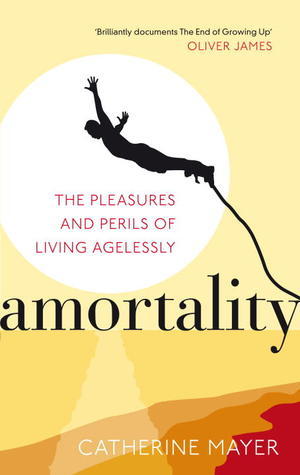
A timely, provocative book about the aging revolution and the radical shift in how we perceive age and growing older Does your real age match the age you feel? When do we reach middle age? When, if ever, are we old? The way we age and the way we perceive age has changed radically. As we embrace new experiences, relationships, and gadgets, we barely stop to look at our watches let alone consider whether our behavior is "age appropriate." In this provocative and timely book, Catherine Mayer looks at the forces that created amortality—the term she coined to describe the phenomenon of living agelessly. As she follows this social epidemic through generations and across continents, she reveals its profound impact on society, our careers, our families, and ourselves. Why be defined by numbers? Are you amortal?
Catherine Mayer is an author, journalist, activist and speaker. Her novel TIME/LIFE was published in hardback by Renard Press and as an audiobook by HarperCollins on 9 April 2025, with the paperback and ebook launching on 14 May 2025. Her next nonfiction title, Send Them Victorious: Royal Women, Their Battles and Why We Should Care, is scheduled for publication by HarperCollins in March 2026.
Her books include the best-selling biography of King Charles III, Charles: The Heart of King (first published 2015, new edition 2022): and Amortality: The Pleasures and Perils of Living Agelessly (2011), Attack of the Fifty Foot Women: How Gender Equality Can Save the World! (March 2017, paperback Feb 2018) and, with her mother Anne Mayer Bird, Good Grief: Embracing Life at a Time of Death (Dec 2020, paperback Feb 2022). She also contributed to Dear NHS (2020) and Poems that Make Grown Women Cry (2016).
She co-founded the Women’s Equality Party in 2015 and served as its president until December 2024. She is also a co-founder of Primadonna Festival.
She started her career in journalism at The Economist, went on to hold deputy editorships at Business Traveller and International Management magazines and contributed regularly to the German edition of Forbes. For 11 years she worked as a London-based correspondent for the German news weekly, FOCUS. In 2004, she joined TIME as a senior editor, and later became London Bureau Chief, Europe Editor and, finally, Editor at Large.
She ran a data and technology think tank, has written and performed one-woman shows, a two-hander with Grayson Perry, and a theatrical piece for the Globe Theatre, stood as a candidate in the 2019 European elections, has served as President of the Foreign Press Association in London and as a judge for the Women’s Prize for Fiction and co-curated the 2020 Festival of Death. She is on the founding committee of WOW-the Women of the World Festival. She has won awards for her journalism and her activism.
Since the death of her husband, the musician Andy Gill, she has released two EPs by his band Gang of Four, executive-produced the tribute album, The Problem of Leisure: A celebration of Andy Gill and Gang of Four, and manages his music estate.
This book has been a big disappointment, especially because it had sparked in me a huge interest after having read an article by its author, Catherine Mayer, published in the TIME magazine back in 2011, the year of the publication of the book. I immediately ordered the book at that time. However, it has been waiting on my bookshelf for fifteen years, until 2026, to finally read it. I love the review by Martin Raybould: https://www.goodreads.com/review/show.... I couldn’t have said it better myself in so few words. All the book is based on two premises: 1. People are living on average a much wealthier life compared to prior generations. We eat better, we have better jobs, we are in better shape and we are more knowledgeable. In one word, we are stronger (not yet immortals) in the widest sense of the word. Consequently, we expect more from life and we feel capable of achieving more, too. 2. As a consequence of 1., age in society and how society perceives age is changing. Moral values have changed, too. You can read this very well in the book “Homo Deus”, by Yuval Noah Harari, an authentic masterpiece of our time which I strongly recommend. As a result of 1. and 2. and quoting the book: “Our mental and physical ages are on divergent tracks” and, toward this, there are two ways to act: one is living according to the conventional values of society. The other is living ‘amortally’ (ageless/ blind toward age). So far, so good, even if it could be said more about what living ageless means: Does living ageless mean going onto a stage at the age of 80 and playing rock’n’roll like Mick Jager? Or wearing piercings and mini rock at the age of 68 like Madonna? The summary at the end of the book is good: “Amortality is a product of a world that has normalized certain traits, favors individualism over collectivism, has lost faith in God and public life”.
Now, why did I find this book disappointing, even though the underlying research idea was good? For two main reasons: One is, to a large extent, the silly and freaky approach adopted by the author, in my opinion completely losing focus and undermining the importance of the philosophical and sociological subject under discussion. I do not know whether she did it deliberately, trying to be funny and original and intending at the same time to catch more readers, or just because she is not an intellectual. I tend to believe more of the first reason, because I must admit that there is a remarkable research work behind this book and a considerable amount of collected data. The problem is that at some point Catherine Mayer brings the topic down to a kind of tabloid-style gossip, losing all academic seriousness. She also takes, to support her arguments, a weird bunch of celebrities who do not represent society: Music stars, like Mick Jager, Michael Jackson, Malcolm McLaren or Bob Geldof, Hollywood celebrities like Woody Allen or Liz Taylor, Playboy Magazine Owner Hugh Hefner, Claude Vorilhon (Raël), leader of the UFO religion movement, Dr Jeffry Life, healthy-aging ‘guru’; Jack LaLanne, fitness pioneer; Jim Jones, the religious and cult leader who led over 900 people including 300 children to commit suicide in Jonestown in 1978 … none of these people represent society. On top of that, she spends lots of pages presenting agencies like ‘Exit Deutsche Schweiz’, which assists people to self-determination in deciding about death matters and offers ‘dignified’ end-of-life care or ‘Dignitas’, which literally provides physician-assisted suicide. Both these companies have by the way their headquarter in Switzerland. Or recovery clinics like the Betty Ford center visited by Elizabeth Taylor and the Charter Nightingale clinic visited by Michael Jackson for instance. She talks as well too long about chemical drugs, like TA-65 telomerase, Resveratrol, sildenafil (viagra), vardenafil (levitra) or tadalafil (cialis), all piles that are supposed to extend your youth and your virility … too freaky, neither philosophical nor sociological. More appropriate for a Vanity fair or Health’s men article than for an essay.
The second reason is the author’s writing style (note: I am not a native English speaker). The English used is plenty of idioms, slang expressions, etc. Did the author intend to appear ‘amortal’ in the usage of the language as well? To me this is an inappropriate way of writing an essay and makes it harder to read for foreigners like me, used to read technical and academic papers in a more standard English.
Finally, two words, literally two, to the test at the end of the book to determine by yourself whether you belong to the amortals: worthless and superficial.
My takeaways:
- “Phases of life: Childhood, adolescence (quite new in fact), young adulthood (allegedly, many languages do not have a word for adulthood at all), middle age, retirement, golden years, decline, benchmarked against a series of culturally determined expectations”. - “I find change rejuvenating”. - “[…] in failing to grow old as we used to, we’re failing to grow up. That is partially true and amortality is [because of this] partially to blame”. - “Age disappears in direct proportion to the vitality of your ideas”. - “There's chronological age, there’s biological age and there is psychological age”. - “What matters is the quality of the relationships we form, the quality of the parenting we provide”. - “The thing of which I have the most fear is fear”, by Michel de Montaigne. - “I always say shopping is always cheaper than a psychiatrist”, by Tammy Faye Bakker. - “Time is a great teacher, but unfortunately, it kills all its pupils”, by Hector Belioz. - “We are rich in labels: bipolar, neurotic, addictive, narcissistic, obsessive, compulsive, depressive, …”. - Christianity vs. Judaism: “Christianity prepares its flock for death. Judaism encourages their faithful to focus on life. In Judaism in a funeral, it is said, “he was good to life”. It is not life being good to you, it is you being good to life. Judaism believes in preservation of life. There is as well in Judaism a little bit of Ayn Rand selfishness: Be good at yourself, then to your loved ones and afterwards to the rest. - Song by Peggy Lee, “Is that all there is?”. - “To stay young, to save the world, break the mirror”, from the Poem ‘Brake the mirror’ by Nanao Sakaki. - “People who are religious do have much lower rates of mental illness”. - “The 12 steps of alcoholism help beyond alcoholism”. - Richard Dawkinks, author of ‘The greatest show on earth’ and the Nightwish 20 min song feat. him. - Ray Kurzweil and his book ‘The singularity is near’ & the documentary about him ‘Transcendent man’”. - “Bad practice to invent all for your retirement. Enjoy the here and now”. - “Another reason why women win in longevity is because women menstruate along 4 decades or so, losing iron in the process. Iron plays a very important role in our cells’ ability to produce free radicals”. - “Almost everything that is great has been done by youth”, by Benjamin Disraeli. - “Age gives no reliable indication of ability or even experience”. - “Research suggests a linkage between retirement and physical and mental deterioration. Married people and part-time workers after retirement tend to suffer less of these declines thank human support and activity”. - “[…] Aunt Mabel, who regrets her colostomy because she can’t find shoes to match the bag […]. Never accept, without question, medical advice”. - “Eat well, exercise regularly, and maintain positive involvement with the world”. - BBC Sitcom “Absolutely fabulous”. - EPCOT Experimental Prototype Community of Tomorrow, designed by Walt Disney. - William Gibson, inventor of the cyberpunk and author a.o. of ‘Neuromancer’ (Sprawl trilogy). - Steve jones (geneticist) author of ‘Almost like a whale’. - Generation bold. - TMT: “Terror Management Theory”. - Sun city in California retirement community in Phoenix, founded by Del Webb.
One wonders what inspired Catherine Mayer to discover herself amortal and write this rich, intelligent, amusing and fascinating book. She married into rock, notorious for its ageless practitioners, and maybe the answer lies there. Early on she quotes the Ampleforth school head who jokingly described his job as preparing his boys for death, and from then on she very thoroughly darts around quite the opposite theme. This is about the growing number of fish who defy the river current and turn in the opposite direction. Someone once said that happiness is when we ignore the past and cease to worry about the future, and Mayer’s very thorough analysis seems to prove the point. As increasing liberties, opportunities, not to mention IQ’s, have pollinated a Me-generation eagerly making the most of life and least of death, the teenager phenomenon born in the 1940’s has, often with a bit of cosmetic and therapeutic help, metamorphosed into a trait spanning more and more peoples’ entire lifetimes. The book is riddled with fascinating references to often surprising social changes defying tradition as well as prime examples of past and present amortals, people who have remained cognitively young throughout their lives. They are apparently not particularly children-prone. One side effect has been population decline. There has been an inverse correlation between birth rate and life span. 49% of European households occupied by couples have no children staying in them; the Russian abortion rate approaches the birth rate of that country; declining birth rates in western countries appear due to potential mothers holding off and then having to battle age-declining fertility in order to conceive. My only reservation was that the book seemed to peter out right at the end. Or was it me? Still a good read.
There is a new generation of "young- aged” amongst us, they are up for anything that is challenging. They are fit, smart and adventurous. They live longer, have masses of energy and expect to stay healthy for much longer than the previous generation. They take up scuba-diving at 70 and open new on-line businesses after retirement. The world is theirs for the taking. The whole concept of “amortality” is rejection of the traditional life style based on families and extended families. The amortals are selfish, narcissistic and live for themselves. They have their own blend of spiritual ideas that they mix and match to suit them and they date on-line. They use plastic surgery; they exercise a lot and eat right. Basically they create a new social network based on people with similar interests. There is a strong belief in their circles that science soon will provide them with the answer for longevity. They believe that a “fountain of youth” is near to explore. If it sounds familiar read an “Amortality: the pleasures and perils of living agelessly” by Catherine Mayer.
"Amortals have plenty of attitude. In our assumptions of agelessness and blindness towards age, we crisscross a fine line between resilience and denial, optimism and absurdity" - page 261.
The main problem I had with this book is that all the main points it covered I had already encountered in prior reading and research, so I did not gain anything new from this book, but that was my problem.
However, if you are looking to provide yourself with an introduction to the issue of amortality and how to go about living with an ageless mentality then this book is the place to start.
Catherine Mayer is a highly knowledgeable writer who uses her own life and many people she knows to illustrate the many points of the research this book collects together in what is essentially a manifesto on how to go implementing an ageless existence.
Thought-provoking and very much needed for the times we live in.
"Apibūdindama nemirtinguosius, paaiškinau, kad išskirtinis jų bruožas yra tai, jog "nuo atsisveikinimo su paauglyste iki mirties jie gyvena taip pat, puodelėja tuos pačius siekius, dažniausiai daro ir naudoja tuos pačius dalykus."