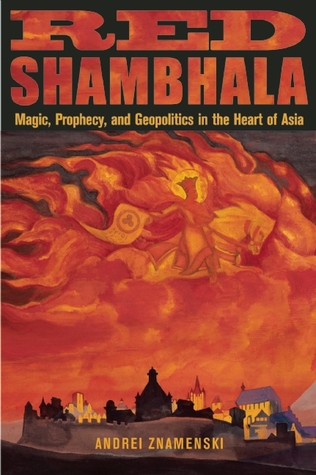
Many know of Shambhala, the Tibetan Buddhist legendary land of spiritual bliss popularized by the [date] film, Shangri-La. But few may know of the role Shambhala played in Russian geopolitics in the early twentieth century. Perhaps the only one on the subject, Andrei Znamenski’s book presents a wholly different glimpse of early Soviet history both erudite and fascinating. Using archival sources and memoirs, he explores how spiritual adventurers, revolutionaries, and nationalists West and East exploited Shambhala to promote their fanatical schemes, focusing on the Bolshevik attempt to use Mongol-Tibetan prophecies to railroad Communism into inner Asia. We meet such characters as Gleb Bokii, the Bolshevik secret police commissar who tried to use Buddhist techniques to conjure the ideal human; and Nicholas Roerich, the Russian painter who, driven by his otherworldly Master and blackmailed by the Bolshevik secret police, posed as a reincarnation of the Dalai Lama to unleash religious war in Tibet. We also learn of clandestine activities of the Bolsheviks from the Mongol-Tibetan Section of the Communist International who took over Mongolia and then, dressed as lama pilgrims, tried to set Tibet ablaze; and of their opponent, Ja-Lama, an “avenging lama” fond of spilling blood during his tantra rituals.
Andrei Znamenski, a native of Russia, has studied history and anthropology both in Russia and the United States. Formerly a resident scholar at the Library of Congress, then a foreign visiting professor at Hokkaido University, Japan, he has taught various history courses at Russian and American universities. Among them are World Civilizations, Russian history, and the History of Religions. Znamenskis major fields of interests are Shamanism, Western Occult and Esotericism, Russian history, and indigenous religions of Siberia and North America. Znamenski lived and traveled extensively in Alaska, Siberia, and Japan. His field and archival research among Athabaskan Indians in Alaska and native people of the Altai (Southern Siberia) resulted in the book Shamanism and Christianity (1999) and Through Orthodox Eyes (2003). After this, Znamenski became interested in the cultural history of shamanism. Endeavoring to answer why shamanism became so popular with Western spiritual seekers since the 1960s, he wrote The Beauty of the Primitive: Shamanism and Western Imagination (Oxford University Press, 2007) and edited the three-volume anthology Shamanism: Critical Concepts (2004). Simultaneously, he continued to explore shamanism of Siberian indigenous people, traveling to the Altai and surrounding areas, which led to the publication of Shamanism in Siberia (2003). Between 2003 and 2004, he resided in Japan, where along with his Japanese colleague, Professor Koichi Inoue, Znamenski worked with itako, blind female healers and mediums from the Amori prefecture. During the past several years, he has been researching prophetic legends of nomadic people of Inner Asia (Shambhala, Geser, Oirot, Amursana) and how these legends inspired indigenous and European spiritual seekers. The result of this research is his most recent book Red Shambhala: Magic, Prophecy, and Geopolitics in the Heart of Asia (Quest Press, forthcoming June 2011). With all of the action and suspense of a bestselling mystery novel, it takes you on a thrilling journey into the underground occult agenda of the 1920s Soviet Secret Police. It details the zealous Bolshevik commissar Gleb Bokiis and renowned occult writer and Rosicrucian Alexander Barchenkos attempts to fulfill a mysterious Tibetan prophecy which tells of a coming fifth and last Buddha known as Lord Maitreya, a mystical Christ-like world leader. Their goal was to reach out to Tibetan Buddhist wisdom to conjure a divine era of Communism. Red Shambhala shows how that romantic dream quickly caught the attention of die-hard revolutionaries, staunch nationalists and theosophical occultists, forging a most unlikely 20th century enterprise. Bolshevik secret police, Tibetan lamas, the famed occult couple Nicholas and Helena Roerich, and the right-wing fanatic baron Roman von Ungern-Sternberg known as "Bloody White" embarked in unison on dangerous expeditions through Mongolia, Tibet and farther to the Himalayas. Supernatural urgency solidified the pursuit of their common goal: to discover the Maitreya Buddha and his mythological land known as Shambhala, a land of pure mystical bliss where inhabitants enjoyed god-like capabilities. For all of these impassioned crusaders victory meant bringing the dawn of perfect man and obtaining the keys to a benevolent all-powerful ideal society that would serve as the beacon for the humankind.
Red Shambhala adds useful information about esotericism during the early Soviet experiment and the Great Game in Central Asia in the 1920s and about the theosophical egoism of Nicholas Roerich.
What it is less good at it, though scholarly and well written, is tying these threads together into some sort of analysis of what was going on in all these theatres - and how they relate.
There are fuller stories to be told of the high point of theosophical political influence in the West and the survival of esoteric silver age esotericism in the early Soviet Union.
The Great Game, of course, is a well told story and recent interest in the fairly marginal figure of the 'Bloody White Baron - 'https://www.goodreads.com/review/show... - adds to the relatively easily available works of Peter Hopkirk.
As so often, we are talking of a surprisingly short period in human history covering a huge geographical canvas. Closure comes with Stalin's bloody purge of every still standing 'esoteric' Communist.
Here, I think a trick is lost. The purges were a widespread phenomenon and the esoteric dead might simply have been caught up in the bloodiness but I suspect there is more to it than that. It was not just a case of eliminating old Bolsheviks as rivals but of eliminating all traces of their ideas.
There is no doubt that Stalin was intelligent and very aware of the dialectic between communism and nationalism. He had played a leading role in formulating policy at the beginning of the regime.
There is a line that could be drawn from Stalin's very early policies on the national question which were highly sophisticated through to today's tensions in the Ukraine. They remain relevant for study.
It is also clear that esoteric communism was a very 'bourgeois', even post-aristocratic, phenomenon, that dabbled with ideas that were close to those underpinning volkisch nationalism to the West by the 1930s.
Eliminating rivals thus seems to have combined here with the elimination of ideas about expending national energy in Eastern empire-building while threats were building to the West. Stalin seeks to stabilise the line with China and Japan rather than engage in imperial adventurism.
There are potential insights here into the edginess with which Stalin regarded the Japanese and why he could not feel comfortable declaring war on them until after the US had dropped its atomic bombs. The Nomonhan Incident was a Soviet victory but not one encouraging further risk-taking.
Exaggerated or not, the possibility of a fanatical Buddhist or Mongol rising to seize Siberia helps to explain much that might otherwise be obscure - including the hurried forceful repression of the lamas. The role of the Buryat minority as potential fifth column must be taken into account.
In a sense, the story is also very modern in being about what amounts to a struggle between arguments about hard power (realism) and soft power that still resonate.
Stalin was a hard power man - a realist - whereas Comintern policy, much like modern Western liberal internationalism, was thoroughly muddled, using rhetoric and bluff to try to achieve the unachievable.
The Great Game was really a game for realists like the Dalai Lama of the period and the British Empire which was well served by its canny political agent for Tibet. In being a realist, Stalin was actually reverting to the pragmatic approach to the East of mainstream Tsarist officials.
The theory that you could mobilise a region with a quasi-communised esoteric Buddhism ignored the inherent internal contradiction between international communism and nationalism, especially faith-based nationalism. Stalin was, of course, an expert in the 'nationalities'.
Again, we see the same today where soft power advocates continue to believe that they can contain and then control 'moderate' versions of similar obscurantist faith-based movements in faraway cultures. Clearly they cannot ...
Stalin, faced by a highly developed neo-faith-based national socialism and ideologically antipathetic to religion, was not going to tolerate these Comintern fantasies. Their proponents thus got rolled into the purges.
There is also a bigger story to tell about the artist and esotericist Roerich, a highly ambiguous character who is possibly the epitome of the spiritual adventurer, but, to be fair, this is not Znamenski's job here.
Even today, Roerich remains hard to assess both in pragmatic terms of who he was actually working for and why but also what he means to history ... Znamenski adds new suggestive detail to consider.
There is no Roerich without theosophy and no understanding of Roerich without entering into the spirit of the decadent auto-didacticism of the silver age gentry and their aspirant hangers on.
Theosophy now strikes us to be as nonsensical in practical terms as alchemy although an open mind would see both as psychotherapeutic analogical modes of thinking useful for personal development.
Across the West, new forms of imaginative thinking had emerged disconnected from reality but still one that was creative in the arts if destructive in politics - although this latter judgment took some time to become clear.
The Communists in the Soviet Union (though not in Europe) were not immune from the infection of idealism despite Marx's strictures against utopianism. This had been a major intellectual struggle in the mid-nineteenth century but is really a struggle between types of mind.
Theosophical thinking could be highly progressive (Annie Besant springs to mind) but also a home for half-educated upper class minds confused by modernity and projecting a desire for stability into the future.
These types are analogous to some trans-humanists today, declasse individuals seeking a new way to cohere against history and deal with anxiety through a new eschatology. This is a quasi-religious 'spiritual' pattern that repeats through history, evading and avoiding material and social reality.
Evasive intellectually innovative movements based on redirected class pain generally do turn into quasi-religious movements and then soon start to dabble in political solutions to the crisis of the time. This was clearly something Stalin could not afford.
From Madame Blavatsky to Nicholas Roerich is about half a century. Half a century is ample time for an irrational movement to peak. And peak it did against the brute realism of the interwar period.
Roerich's performance art in Central Asia is thus, like Baron Ungern's, more of a footnote amidst the chaos than something of great significance to Central Asian history.
Such outliers are dabbling in a vacuum with opportunities for otherwise marginal figures who would remain marginal or end up in jail in their heartlands. These are the adventurers of etidorhpa ...
Opportunities for eccentricity are always provided by the margins of empire but the conditions in the heartlands that create such outliers and the mentalities that lead to their adventures remain interesting.
Roerich is also interesting because he represents another ambiguity within the esoteric ... what often starts as progressive change becomes a form of traditionalist primordialism, politically of the right, under pressure.
If you look at the works of two 'spiritually'-inspired artists, Roerich and Kandinsky, you get a sense of this ambiguity where romantic traditionalism can either become abstraction or primordialism.
We think of Stravinsky's 'Rite of Spring' as modernist but it could equally (especially in the light of Roerich's designs for the stage performance) be seen as a purification of tradition.
I have argued elsewhere that even contemporary trans-humanism has these throw-back golden age aspects which represent its own search for purity. It perhaps shares a form of occult magical thinking with theosophy.
In this context, a communism that was materialist and looked to Marx and the West as a dynamic form of social change seems to have magically incorporated silver age magical thinking in an underdeveloped society.
Stalin was a brute but in terms of the progressive and materialist agenda based on radical social transformation, he was probably right to 'deal with' this highly conservative trend within the movement.
Still, the book is highly readable (if you can remember to connect the names as they appear) and it should stimulate a desire to know much more about the many worlds it touches on.
The collapse of the Qing Empire in 1912, and the fall of the Russian Empire in 1917 led to a great tumult across north and central Asia. Znamenski, a professor of history at Alabama State, uses the Tibetan story of Shambhala as a frame to examine the stories and millennarian movements that arose after the disintegration of the old empires. This book includes, but is not limited to, the story of the painter Nikolai Roerich, who set off to Tibet in an attempt to establish a theocratic government inspired by the esoteric Theosophy movement, or the warlord Ja Lama, who claimed to be the reincarnation of a Dzungar warlord and held much of western Mongolia in the 1920s.
The chaos meant that new alliances formed, some perhaps of sincere belief, some of political opportunism. One of the most striking events is the involvement of the Communist Party of the Soviet Union, where the spy agencies listened attentively to the opinions of occultists, and when the Red Army moved into the city of Urga (now Ulaanbataar) in 1921, they pronounced Shambhala. There is a photograph of a Tibetan thangka (painting on fabric) with the image of Lenin's face.
The book contains an epilogue, not a conclusion, and a summing up of events or causes would have been appreciated. I speak no Russian and I have no familiarity with the scholarship so I have no idea how to evaluate that aspect of the book. But I found that it combines a lot of information on a novel subject, and the look at messianic movements in this period is a fascinating read.
An account of several overlapping attempts to forge common cause between Communism and Tibetan Buddhism by assorted nuts, chancers, pan-Mongol nationalists and (saddest, these) true believers in the original values of socialism who realised the bloody, anti-intellectual chaos into which Russia so rapidly descended post-Revolution was not bringing the workers' paradise any closer. At the hub of them all was the myth of Shambhala - the lost Himalayan paradise which also inspired the Western Shangri-La, a land free from disease, want and vice which does bear more than a passing resemblance to the Marxist utopia. To Tibetans and Mongolians, it was a vision of liberation from the Chinese yoke; to yearning Russians, an idea which might enable them to raise the nation out of the mire. Especially if there was anything to the stories which suggested that Shambhala's rulers had access to advanced physical and spiritual sciences which might enable them to truly build a new socialist human... (I saw another book came out recently which addressed that same strain of techno-spiritual idealism among the Bolsheviks. Alas, it was by John Gray, whose writing always feels so smugly and aggressively opposed to any attempt at improving anything that it suggests to me some nightmare hybrid of Eeyore and Clara Oswald. So, despite my interest in the topic, I shan't be reading that one)
By now, everyone knows about the Nazis' occult interests, if only via Indiana Jones. It's perhaps more surprising that the early Soviets also had their esoteric wing, given that in theory they were all about science and rationality. But then, consider how pseudo- much of that science was (from historical materialism itself through to renouncing relativity and enshrining the doctrines of the perfidiously ludicrous Lysenko), and what a rush of innovations the early 20th century brought, and it's not so strange that special divisions were investigating thought transference and the like, or that they could see a case for making common cause with lamas in the interests of anti-colonialism. The degree to which the Russians were seriously interested in a fusion of faiths, rather than simply seeing the beliefs of oppressed people as a useful lever and step towards Communist orthodoxy, obviously varied from individual to individual and time to time; sadly, we never quite hit the perfect mixture to justify an 'In Soviet Russia, enlightenment achieves you!' For many of the interested parties, Znamenski uses the wonderfully double-edged term 'seekers'; my guess would be that this at least slightly an accommodation with publishers who are a wing of a theosophical group (similarly, when Blavatsky crops up she's treated without the open disdain I normally expect, albeit in guarded enough fashion to suggest the author hasn't drunk the Kool-Aid either). Alas, he doesn't just use the term but rather overuse it, alongside a couple of curious formulations (most noticeably 'the Lhasa ruler' for the Dalai Lama - would one call Angela Merkel 'the Berlin ruler'?); I suspect that this may just be a result of writing in a second language, and heavens know he does a lot better than I could in Russian - even the thee/thou confusion in one prophecy cited early on is no worse than I've seen in some Thor comics by native Anglophones.
"Healthy skepticism and moderation, rare commodities at that time anyway, never visited the minds of the individuals I profile in this book. In this sense they were true children of their time" - a fine summary of the cast, though the punchline is slightly lost, in that these were all people who saw themselves as at odds with their time, dreamers of a lost ancient kingdom which might open a new route to the future. But as with watching an old historical drama, you can always see the time of origin as much as the intended destination. Aside from a passing appearance by the ghastly Baron von Ungern-Sternberg they all skew leftwards, but even the more superficially appealing characters have bloody hands; the current Dalai Lama may be a fluffy soul, but this is an era when his earlier incarnations headed a fractious faith which still utilised human sacrifice and some pretty dark sex magic. And while the cryptographer Gleb Bokii, with his love of practical jokes and disinclination to abuse the material perks of his position, is definitely less of a monster than most Soviet secret policemen, he still had a hand in some of the regime's early concentration camps, and his belief in free love* too often lapsed into unpleasantly predatory behaviour. Comparatively, the painter Nicholas Roerich and his wife Helena did very little demonstrable damage, but they come across as thoroughly poisonous individuals - so devoted to the utopian blueprints they received from their spirit guide that they regarded everyone they met, even their own family, purely in terms of utility to that vision. Again, that wholly instrumental understanding of other humans has uncomfortable echoes in the century's more well-known monsters. (Also, Nicholas apparently liked to portray himself as a reincarnation of the fifth Dalai Lama. Sadly, it's never made entirely clear how this would work given all the subsequent Dalai Lamas would also presumably be reincarnations of the fifth Dalai Lama - I kept thinking of Sir Arthur Streeb-Grebling and the fossilised body of baby Jesus. Though one might also consider that, if the powerful and ambitious could multiply reincarnate, it would explain why almost everyone with a past life story used to be a royal or other significant figure, never a slave or peasant. Hell, maybe that's why so many of the modern world's nonentities have such an advanced sense of self-worth - everyone humble or relaxed is contentedly kicking back in the afterlife, while the megalomaniacs compete at franchised rebirth)
One exception to that damning judgment of the dramatis personae does deserve a mention, though - not least for being one of the main reasons I initially borrowed this. The British spy Frederick Bailey only plays a supporting role, but seems like just the sort of Boy's Own hero for whom, if for nothing else, the British Empire was so brilliant. At one stage, undercover and ostensibly working for the Soviets, he's tasked to track down the British spy Bailey - I would have loved a bit more on how he got out of that one.
*Worth noting here the passing appearance by another Bolshevik who laboured under the name Semen Dimanshtein. The Party's gain was porn's loss.
When Europe failed to follow Russia's steps into Bolshevism and Mongolia turned out to be the first non-Soviet recruit to the cause, much of the revolutionary effort was directed east. 'Setting the East Ablaze' by Peter Hopkirk and other books tell this story. Still other books about the Whites and the occult connections of fascism tell the story of how the other side was really into New Agey Willfolk UrThrust and bizarre pseudo-cult views of eastern spiritualism. But none in English talk about the left's engagement with such things.
Unlike the right, the left largely were not believers but rather seeking to use the mythology of Shambhala and other things to help spread their message amongst the Mongols, Tibetans, and others. Though they ended up using quite a few true believers as they went forward. Most noteably the artist Nicholas Roehric, visually one of my favorite artists but definitely a class-A asshole as a person.
Many instances of the narrative slip into some informal editorializing that sabotages the scholarly feel of the rest of it, but this is a really great study of an overlooked topic in English nontheless.
Note to sane people: my real, and by real I mean concise and legible, review of this book is at the end. Read on here for my own reason for becoming so enamored with this book presented as mucho blah blah blah, followed by some sketches of the subject matter.
A fantastic place to start for all who take ideas like parapolitics, the deep state, and deep politics seriously, even if only as a working thesis suitable for a productive methodology.
The CIA did not invent the blending of fringe elements (who often didn’t line up with the party line or ingrained policy and ideology), religious radicals, misguided militants, the occult (yes…the occult), ethnic minorities, grand geopolitical schemes, and highly motivated foreign policy all together in a great mix of policy and operations and law and not law and action. A lot of these were certainly Ideas (or, normally I believe government types call them “proposals”) that probably sounded fairly reasonable when presented as justified policy decisions at the long conference table. Well, as long as the presenter stuck with pushing the ends. The means are an entirely other story. Probably even a completely different department in the relevant agency, I’d imagine. Actually, forget the whole ends and means thing now. Half the time these secret operations precede policy. The deed is done, catch up Mr.President. We took care of that rogue scientist, Director. Why’d we do that again? The Temporary Vice Chief Analyst at the Mid-Southeast-Asia/Zone-Southwest/Area-Coastal-addition// Semi-Partially-Inland-butnottooinland-and Eastern Capitol Suburb Desk should know. When’s he back from REDACTED again?
We’re talking here about SECRET operations. Operations that may or may not have secret outcomes. Political processes with goals that may be perfectly normal from the state’s view and remain fairly pedestrian until the intelligence units, typically highly autonomous, decide they should be the ones making the calls. Capturing that peninsula in order to secure an excellent natural port is common sense. Releasing rabid bats across the area to encourage “depopulation” of the current occupying peninsular government’s settlements there all while at the same time covertly promoting the Catholic Minority, who also happen to have an extremely active and popular maximalist art movement centered around a group of extremely pious but avant garde artistically and craft oriented youngsters who embrace militancy in the communities and more than occasionally direct “violence” (only vandalism, for now) towards the sparsely decorated and image free peninsular government sponsored Protestant churches. Also, everybody loves them because they’re at all the local farmers markets selling their little (religious) modern-ish paintings and super affordable but well made tableware. Wow, those kids must be doing great! That pottery wheel alone runs $8000! And the truck they scoot around in, damn! I should have been an artist smh. There just soooooo well off here our beautiful, unnamed peninsula! Woah! Who left this crate of fully lubricated, so fresh you can taste it high caliber rifles right here(7.62x51, assault rifle or easily converted sniper rifle. What else you need in this world?) !!!!!! Money only grows on the trees spooks plant. This is because they’re the government. Except they’re the part of government that has no other segment of government supervising them. “Top secret. National Security” the man in sunglasses says as he walks over to the massive intaglio presses and starts stuffing his three duffle bags full of brand spanking new, freshly cut $100 bills straight off the National Treasury production line. And high autonomy (sometimes called “little to low oversight) for those types is absolutely typical, so typical it may go very, very far in defining the very typology of these kinds of government agencies. It may sound extreme, but it may also be fair to say that these groups don’t even operate as agencies or organized departments at all times, sometimes they’re really just the verb: pure operations. What I’m getting at is, badges notwithstanding (and these types shed identifiers at will), the bonds among spies and secret police agents, especially amongst themselves, are endlessly dissolvable and in turn, endlessly reconfigurable. This is the essence of everything dr their internal power struggles to the great game of flipping and unflipping double agents into triple and quadruple agents and so forth, the British Spy’s favorite job, I’ve heard. (I think I’m right on point about spies only pretending to belong to anything or anybody and therefor refuse to elaborate further. Thanks).
From the Leninist Soviet Union’s OGPU in the 1920s to the Sultan of Brunei’s JKDN and up to the Literature Specialists, Computer Scientists, and pretend Embassy Staff who get sent running across the world by our near and dear CIA, they’re all the same. Nobody is watching these watchers, as a matter of course and as is typical for their subject matter. Huh? What’s that? You want to institute a Public Government run watchdog group for spies to make sure they’re actually only poisoning foreigners? Ha! Won’t happen. Why? That’s classified, buddy. Because who wants to send their kids to die in the first invasion wave anyways? Let the spooks use their brains and duh, of course, sometimes their binary chemical weapons with each precursor applied in rapid but perfectly gapped sequence by an unsuspecting migrant worker paid off to fall off, but not before their job is done of course. No harm no foul! Crisis averted. What? No. Impossible. We deny everything. We can’t even find Kuala Lumpur on a map! Much less get a neurotoxic chemical broken down into its stable precursor components. Practically edible before you mix them together and create a biological weapon. Oh by the way (sorry almost forgot), as a matter of routine we do not comment on these things. And all the congressmen nod. But of course, of course. Thank you for your (clandestine) service.
Getting back on track, we’re not talking about congressmen anymore but members of the presidium or ministers or, I don’t know, worker-representatives on the council of the Congress of Workers and blah blah blahs and et ceteras.
The early Soviet Union was having some trouble in Mongolia and oft forgotten brother with a cooler name (imho) Tuva and even down (or up I suppose?) to Nepal and Tibet, where endless worries about a centuries old religious plutocracy still ruled. This wasn’t just a concern of the Soviet Union, but also of the people living in those areas.
I’m going to try and keep this short, because over explaining will do nothing but reveal my ignorance of the intricate motions and plots described clearly (extremely readably as well, frankly) and also show off my forgetfulness (this review is overdue 🫣).
If you want to hear about how a side branch of Soviet Intelligence wound up recruiting a charlatan huckster faux-biologist expert in shamanism with a profoundly honest belief in Hyperborea to help take advantage of millenarian, folk-revolutionary movements centered around the idea of Shambhala (basically a local version of “the Kingdom Come,” Judgement Day but as a ruling regime or empire that will cleanse, free the right ones, oppress the wrong, kill, return, and organize) in Mongolia + surrounding regions and Nepal by way of flexing a indigenous eschatology of destruction, a prophesied warrior-savior, rudimentary anti imperialism, self determination, and redemption in service of Marxism-Leninism, Then this your stop
The book also sketches out the secret ritual practices of the higher level practitioners of Vajrayana and Tantric Buddhist practices in the land of bald guys with polished heads and orange robes, the types usually hanging around in a barely accessible mountain monastery storing scrolls of the the original Pāli texts of Buddhism. Turns out that there’s the drinking male ejaculate involved. Some blood too. Forgot if they ate that as well, but it’s involved. Oh, and some of the most important leaders, various Abbots of Monasteries across Nepal and Tibet, also had armies. Yeah, fairly big armies, too ( worth remembering that in the mountains there can be only one huge and magnificent thing: the mountains. Still, pretty darn big armies were involved. To be fair, the taxes on the common people along with the stacks of gold in the coffers of the more powerful monasteries could both likely compete).
Red Shambhala covers a time of forgotten local “imperialism” and the ideologically driven foreign policy of the early Soviet Union. [Typically, this is not called imperialism and I don’t think it should be either but it’s convenient shorthand, even though picking a different term would have probably been shorter than this added note here. In any case, the ideologically driven foreign policy is the early “Leninist” USSR is by far the most interesting topic. -ed*]
It traces lines from big-C Communism, to angry peasants tired of taxes and inconsiderate invaders who didn’t bother to build roads or even a school or two, to the early nationalist impulses of a formerly nomadic people who in midst of transition were still figuring out what borders meant, to Intelligence Agents and Operatives who were free to just “try things out” regardless of whether it was an experimental covert pistol or a plan to clandestinely spread apocalyptic prophecies across the wind blown steppe of Central Asia in order to (hopefully, I suppose? Those Spies sure seemed hopeful, not to say well, nevermind….my handler may be reading this. Intelligence agencies keep our countries safe! Always remember folks !) foment a properly Soviet-aligned Central Asian communist revolution Which, by the way, would also piggyback on and be inspired by Buddhist end of the world prophecies and the hoped-for return of a lost warrior monk type fella who had been just hanging out in Siberia for 100 years (ok, well at least that part sounds somewhat USSR-ish). And all the way back again to the esoteric practices of a highly organized Buddhist politico-religious bureaucracy that apparently centered their secret, internal promotion rites around doing various fun and not fun things with bodily fluids during the most critical period they faced since one or two, or more, Historical Chinese empires realized that climbing the mountains to get ‘em probably would suck, and also not work at all, and then settling for the go around, surround, oops now our culture is inbound method (classic long game) of domination. Now the abbot-warlords were getting nervous in their alpine hideouts. Their base of their power started to shift and shake and lose its foundation because of the invasions of things that don’t come from any of the cardinal directions, but encroach first in heads, hearts, ideas, and commodity flows: the modern world had shoved its ever-searching head through their isolated monastery doors at nearly the same time it walked right into the yurts far down below. Even in the most literal, basic sense: the way people lived changed. First in the steppe plains, but the Abbots were neither dumb nor blind. Oh oops, also an intrepid revolutionary government had just formed to their north and west, even to their somewhat east/north east. But surely, no….they wouldn’t bother? Would they? There’s no way the Buddhist apocalypse, occult pseudo scientists who saved themselves from the Red Terror by becoming drinking buddies with some kind Cheka fellas, and the Eternal Science of History and Revolution, materialist Marxist-Leninism, could possibly decide to hug and make up? Turns out they did much more than that and even did some kissy kissy and inappropriate fondling.
To sum up: There’s a lot here. The author does an absolutely fantastic job of writing a readable, truly fascinating book that in subject matter has nothing of close compare, especially in English. The author comes across as a read expert in the relevant subject matter but he does not ever commit the great sin that usually comes with that- He never pushes conclusions through. He is not really making a particular argument. That would be a weakness had he not outlined that clearly in his own words. This is a well research survey of a nearly totally forgotten side quest that occurred during a time of rapid, shocking change. This is a book that gives you all the different threads that run through this part of history and make it that: history.
Znamenski expertly unties the knot and hands you each line that had converged to make those events possible. What you want to do with them, is your choice.
Even if it’s just to gawk, great choice. This is a great read, every page is a surprise, whichever individual part of this history you are familiar with (Communism? The early Soviet Union? Shamanism? Tibetan Buddhism? Chinese Warlords in Tibet. Nepal? Millenarian Philosophy? Hyperborea lol?) doesn’t matter: they way it all comes together will leave you peering down rabbit holes you don’t know existed.
Great fun, great facts, great place to let the clash and clamor of otherwise unimaginable history stimulate and animate your own projects, from research to polemics to even finding inspiration for your currently WIP Sci-Fi paracosm. Don’t forget that it’s not an imagined future, though. It’s a lived past.
*Full Disclosure: I, the author of the review, am also the editor. I am very out of practice on both fronts.
When the Soviet Union realised it could exploit emerging nationalist movements in Asia to serve as a vehicle for communist revolution, a series of schemes and campaigns to mobilise the peoples of east and inner Asia to action. Esoteric knowledge, long the fascination of theosophists and humanists in Europe, America, and Russia, now held the key to world revolution. Communist plans were afoot to liberate Mongolia, transform Tibet, and bring the mythical kingdom of Shambhala into the physical world.
This is a fascinating and readable history of Soviet designs on Central Asia and the complex interplay between religion, nationalism, and communism in the interwar period as the Great Game between the UK and Russia moved into its latest phase. It is the history of the myth of Shambhala, a Mongolian revolution, counter-revolution, and another revolution, the story of communist dreams to turn Tibet into a vanguard for Asian liberation, and how Nicholas Roerich, mystic artist, envisioned himself as the incarnation of the Dalai Lama and leader of a pan-Buddhist empire.
These disparate people and stories are all connected by the myth of Shambhala - a kingdom beyond this world where hidden knowledge and perfect harmony are found, waiting to redeem the world and save the true faith. It also became the hope of certain members of the Soviet secret police to transform Soviet citizens and usher in a new age.
Amid the fall of empires and the spectre of world revolution, the interwar era was a tumultuous time. It’s no wonder that these episodes of history have not received the attention they deserve but Andrei Znamenski has created an engaging and well-researched narrative and reveals that despite the legends, the quest for Shambhala was a lot more real than many would have imagined.
I will admit that the title had me hesitant about reading it because I thought it would be something where the author really believed in the esoteric occult and that this would be more like, “Chariots of the Gods” historical research. Actually, it comes off as a serious research on the geopolitical manipulation of the Tibetans and Mongols by the Bolsheviks and Nicholas Roerich in the early 1920s using the Shambhala prophecies. It is an easy read for laymen and not a boring, scholarly text. The author is a native Russian and a lot of his information comes from Russian sources not available in English.
The book is broken down into eight chapters and an Epilogue, in addition to a preface, list of the major individuals involved, photos of the individuals or some of the locations, and footnotes. The eight chapters, are the following:
1) The history of the Shambhala prophecies and details of the various important characters in the prophecies 2) The history of the Mongols and Tibetan political power and their connections / beliefs in the Shambhala prophecies 3) Alexander Barchenko, the “Red Merlin” 4) Gleb Bokii, top Soviet cryptographer and one of the creators of the gulag system 5) Some other minor Bolshevik players and Baron von Ungern-Sternberg (not very much as the author admits that his book is more about the Bolsheviks, but had to talk about the Baron’s role in all of this to understand how they used his own actions to get the Mongols support) 6) The Eastern Secretariat of the Comintern, the Red Mongol army, Ja-Lama, and the Red Amursana 7) Nicholas & Helena Roerich’s history and their occult order, the Great White Brotherhood 8) Nicholas & Helena Roerich’s expedition into Mongolia to bring about the Shambhala prophecies
I had never heard of any of the bizarre historical events described in this book. I'm almost convinced that this was one of the strangest periods in history, second only to the Hellenistic era. The story itself is astonishing.
What struck me most, however, is how the book reveals the ways in which people who cannot cope with the reality around them can end up deceiving both themselves and others, simply to avoid confronting the horrors unfolding before their eyes. Those with vivid imaginations, sincere faith in goodness, and dreams of utopia often become tools in the hands of political movements that are driven not by idealism, but by cold calculation, power, and violence.
The book also shows that some individuals will stop at nothing to fulfill the grand fantasies they have about themselves, feeding their own delusions of greatness regardless of the human cost.
That said, I found the book itself rather uneven. It feels loosely edited, with the narrative often jumping between topics in a way that can be difficult to follow. Some sections deserved much more development, while others could have been condensed considerably. In my opinion, the first half is significantly stronger than the second, which becomes increasingly repetitive and less focused.
Despite these shortcomings, it remains a fascinating, unsettling, and ultimately very sad story.
The collective quest undertaken in the early decades of the twentieth century by disparate cliques of spiritual seekers and utopian reformers to rediscover and make manifest for the benefit of their own societies an ancient, esoteric Eastern wisdom is part tragedy, part shaggy dog story. In their attempts to appropriate for their own universalizing geopolitical ends the messianic prophecies of Inner Asia's indigenous peoples, mystically inclined idealists within the state apparatus of the nascent Cold War's superpowers - and the romantic adventurers drawn into their orbits - were too often blind to the nationalistic particularism in which those prophecies were grounded, as much as they were to the manipulations to which they themselves were being subjected by political pragmatists and intelligence operatives in each and every corner of the Western-Soviet-Asian strategic triangle. In the end, many of these dreamers were consumed by their crusade, their vision of the Shambhala kingdom brought back to Earth still unfulfilled.
Andrei Znamenski's Red Shambhala is a fascinating guide to Shambhala (a mythic kingdom in Tibetan Buddhism) and its uses and abuses by primarily non-Tibetans. The book explores many little-known areas of magic and mysticism, including occult experimentation in early Soviet Russia, painter and mystic Nicholas Roerich's claim to be a dalai lama, and the life of anti-bolshevik von Ungern-Sternberg. An exceptional book that shines a light on previously unexplored mysticism and magic in Russia and Asia. Znamenski is a true scholar.
A very interesting look at many of the Russian figures who became enmeshed in the Central Asian Great Game of the 1920s. It also serves as a counterpoint to the glut of books and TV shows on 'Nazis and the occult ' As Znamenski often points out, in the early 20th century, fascination with theosophy, spiritualism and the occult was widespread across America, Europe and even among the anti-religious Bolsheviks.
After the Bolshevik revolution in 1917, the new Soviet Union had to set about establishing relations with its geographic neighbors. With China and British-ruled India nearby, Kazakhstan, Tibet, Tuva, and Mongolia became hotly contested territories. Znamenski's book provides a handy overview of the strategies and tensions, the ploys and subterfuges. But in the middle of it all was magic and prophecy. Tibet was rumored to be the home of Shambhala, a utopia of mages with secret knowledge and magical technologies. The Soviets had an interest in making themselves seem friendly to the mystical legends, and were themselves interested in any paranormal techs Tibet could offer. And anything the Reds wanted, the West wanted as well, in a kind of chakra arms race. Now throw into the mix Nicholas and Helena Roerich, and the son George, who had emigrated from Russia to the US before the revolution, fell under the mystical spell of Madame Blavatsky, and undertook a lifelong quest to find Shambhala and somehow insinuate themselves as reincarnated lamas with the right to rule the hidden kingdom. Their quest for magical and political power intertwines with the geopolitics of secular powers, in ways as goofy and unpredictable as the plot of a Coen brothers' film.
Andrei Znamenski's Red Shambhala is a fascinating history of Russia's involvement in the Great Game/Tournament of Shadows in Central Asia [most especially Tibet and Mongolia] during the 1920s and 1930s. There are a wild collection of romantic adventurers and spiritual eccentrics to be found here.
The book is best during the opening chapters dealing with a historical background for the Tibetan/Mongolian myth of Shambhala and its historical significance, as well as the Soviet interest in Central Asia and the Russian characters drawn to explore and exploit the cultural/spiritual nature of this part of the world.
Later chapters suffer from the lack of an analytical frame, but this is small beer when dealing with the wild adventures on offer for the Russians as they seek to leverage a Buddhist myth or discover mind control techniques to create the perfect Soviet citizen.
Highly recommended for both those interested in espionage, the Great Game, and spiritual enlightenment. Great fun and very accessible.
I heard about this book from a pod cast called stuff they don't want you to know. I really dig anything about shambhala and discoveries of lost culture s