Jump to ratings and reviews
Rate this book

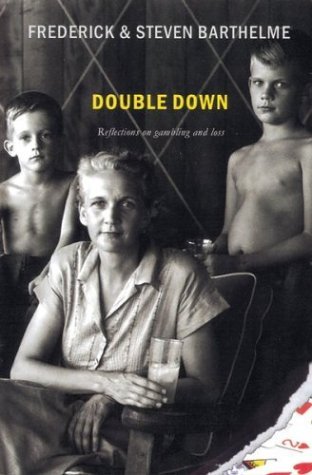
Double Down: Reflections on Gambling and Loss

Rate this book
"So each night begins. One of us picks up the other and we drive into the Mississippi darkness, headed for a place where everything is different." This first nonfiction book by Frederick Barthelme, author of BOB THE GAMBLER, and his brother and colleague Steven is both a story of family feeling and a testimony to the risky allure of casinos. Within a year and a half, the authors had lost both of their parents, less than a decade after their brother Donald died. Their exacting father had been a prominent modernist architect in Houston; their mother, the architect of this family of seven, which she "invented, shaped, guided, and protected." "We were on our own in a remarkable new way," the Barthelmes write, "and we were not ready." What followed was a several-year escapade during which the two brothers lost close to a quarter million dollars in the gambling boats off the Mississippi coast. They played to enter that addictive land of possibility. Then, in a bizarre twist, they were charged with violating state gambling laws, fingerprinted, and thrown into the surreal world of felony prosecution. For two years these widely publicized charges hung over their heads, shadowing their every step, until, in August of 1999, the charges were finally dismissed. DOUBLE DOWN is the sometimes wryly told, often heartbreaking story of how Frederick and Steven Barthelme got into this predicament. It is also a reflection on the pull and power of illusions, the way they work on us when we are not careful.

208 pages, Hardcover

First published January 1, 1999

5 people are currently reading
173 people want to read

About the author

Frederick Barthelme

55 books81 followers
Barthelme's works are known for their focus on the landscape of the New South. Along with his reputation as a minimalist, together with writers Raymond Carver, Ann Beattie, Amy Hempel, and Mary Robison, Barthelme's work has also been described by terms such as "dirty realism" and "K-mart realism."He published his first short story in The New Yorker,and has claimed that a rotisserie chicken helped him understand that he needed to write about ordinary people.He has moved away from the postmodern stylings of his older brother, Donald Barthelme, though his brother's influence can be seen in his earliest works, Rangoon and War and War.
Barthelme was thirty-three year editor and visionary of Mississippi Review, known for recognizing and publishing once new talents such as Larry Brown, Curtis Sittenfeld, and Amy Hempel early in their careers.

Ratings & Reviews

What do you think?
Rate this book

Friends & Following

Create a free account to discover what your friends think of this book!

Community Reviews

5 stars
35 (17%)
4 stars
83 (41%)
3 stars
58 (29%)
2 stars
20 (10%)
1 star
2 (1%)
Displaying 1 - 27 of 27 reviews
Profile Image for Brian.
Author 1 book1,240 followers
March 30, 2016
This is the book that treads meaningfully upon the question of gambling addiction. Written by both Frederick and Steven Barthelme (younger brothers of the literary stalwart Don), it is intimate in its honesty about what makes a family, about losing one's parents, about that green-eyed demon Gamblor. This is the book I want my family to read when they ask why I spent too much of my 20s and early 30s in Las Vegas at a blackjack table. This is the book that makes me want to read all of the Barthelme brothers' works.
Profile Image for Neil Campbell.
Author 2 books13 followers
December 12, 2017
Think this is one of the most smugly ignoble books I've ever read.

Their father is undoubtedly one of the most unpleasant people it has ever been my misfortune to meet in print, a sad, needy, attention seeking little man who bullied his family mercilessly. Steve and Rick are two pussies, utterly unheroic figures. Father never grew up and neither did they. Seems to me they feared and hated him and took revenge by effectively involving him in their gambling - he was with them in the casinos to all intents and purposes, still alive and well and tormenting them.

They would show him there was really nothing else they could do with his money, all it was fit for was throwing away. It was tainted at source.

What they share with father is an impenetrable self-regard laced with feelings of inferiority. Their fellow gamblers are patronised by Steve and Rick from the lofty heights of their academic eirie and superior achievements, as they see them.

They skim the surface of emotion, they don't feel, Papa made sure they never would. That is to say at some point in childhood they ceased to feel - grew armour - their only defence against his relentless psychological assaults and lethal projected inferiority complex.

They were never truly addicted. These guys were always just playing at it - with somebody else's money. They never get down to the bare bones, there was always a cushion, and very cushy jobs.

Update: Further to Peter's comments below, I'm updating this review to pay tribute to the excellent quality of the writing throughout: the book is a joy to read from a literary point of view.
Profile Image for Guy Choate.
Author 2 books25 followers
February 13, 2012
While I wish it dealt a little less with the family stuff and a little more with the gambling, this was a great read. I was also unsure about how some of the legal issues turned out. However, I'm a gambler and these guys nailed exactly what it's like to be a gambler. Their attitudes toward the casino were spot on, and I found myself laughing (to keep from crying) out loud in some of the descriptions of the game of blackjack.
439 reviews
August 16, 2020
Great story, excellent writing.

Wikipedia says Fred Barthelme’s “work has been described by terms such as ‘dirty realism’ and ‘Kmart realism’”—literary genres I’ve never heard of, but sound like a good-enough classification of this kind of story.

https://en.wikipedia.org/wiki/Frederi...

Al Alvarez’s rave review put Double Down on my radar.

https://www.nybooks.com/articles/2000...

I read Double Down some years ago and liked it. Now I’ve reread it twice more in quick succession and come away very impressed by the artistry of their prose style, though exhausted by the story, too. Their style reminds me of Don DeLillo: highly detailed analysis of small things, anatomizations of mundane aspects of contemporary life, of the world around them and meandering excavations of memories of their own past and its meaning. A lot of the distilled observations they make struck me as profound, philosophical, good advice for living (well), maybe gambling, too.

A. O. Scott wrote an informative review of Fred Barthelme’s book Bob The Gambler, the gist of which I think applies equally well to Double Down.

https://archive.nytimes.com/www.nytim...

Louis Menand wrote about Donald Barthelme for The New Yorker, historicizing the style of his writing in a 7,000-word essay that also includes a brief summary & defense of Fred and Steve’s excellent adventure.

https://www.newyorker.com/magazine/20...

The New York Times reports that the Barthelme brothers were acquitted of charges:

https://www.nytimes.com/1999/08/09/us...

I took a huge amount of notes from this short book. (It’s only 55,000 words.) Reviewing them would be like rereading the book itself. The text is dense. Unpacking it is taxing, but also rewarding.

At one point, while reading Double Down, a thought came to mind of something Stuart Hampshire had once said about Elaine Scarry:
Elaine Scarry is reviving, in her style of thought, a tradition that might have been thought to be dead or dying. It is the grand style of Ruskin and Pater, which became a principal inspiration for Proust in the long passages of his novel where he was trying to be more precise in describing his impressions and sensations than any novelist had ever been before. In this style, the secret of life is to be found in the arts of attention, in an exaggerated noticing, as in Ruskin's The Stones of Venice.

"Précisez, monsieur," Proust irritably commanded the young Harold Nicolson, who was trying to describe for him a diplomatic reception during the Conference of Versailles. Every flicker of an eyelid has meaning, and perhaps the flicker of an eyelid has beauty, if one comes close enough to it and stares long enough and intently enough, without shame or prejudice. Language, masterfully used, can bring the reader very close to the observing person's sensations and can both engender and record the acute reactions, the "hyperesthesia," that are the outcome of strained attention.


Here are some excerpts from Double Down:

"We were trained in feigned indifference. Everyone did it, but for us it was a family thing, helped you get by in the family. Lots of fast folks in the family, people who were always thinking, always ahead of you, so what we practiced was making everything look like nothing, smoothing stuff out, taking things in stride. Do otherwise and you were vulnerable, at risk, somebody was sure to make a joke at your expense. So you level everything out; you don't get too excited, don't get too let down. Once you master the drill, everything is equal and you don't get cut up too bad. You won't lose an argument because you can not care your way out. Day to day, no matter what went before our eyes, this queer moderation became a well-worn defensive weapon."

"Neither of us worried much about losing. We drove to the coast, played all night, lost two or three or five thousand dollars, went home, taught our classes, made jokes about how horrible it had been, and waited for the next chance to go. In hindsight, this response—not being horrified—should have tipped us that something wicked was afoot."

"An advantage of being raised by our parents—our father in particular, who was a great pragmatist, and a great one for thinking himself more resourceful, more ingenious, and more resolute than any problem—was that we never felt there was anything we couldn't do. There were many things we never tried to do, many things we didn't want to do, but it never occurred to us that if we wanted to do something, we might not be able to. This kind of extraordinary haughtiness could only have been genetic, and our lives were a history of the gradual disabuse of this notion.

. . . we lost a quarter million dollars over a couple of years. We lost the money because we played, because we wouldn't give up, because giving up was unheard of, because our parents were dead and there was no order to our lives. We were running free in the world, messing around, and we didn't give a shit, and nothing mattered.

I didn't like one line in this paragraph, which I've highlighted:

"If Father hadn't taught us a tenacity that boggles the mind, if he hadn't shown us what it's like to believe yourself to the exclusion of all other evidence, if we hadn't replicated his own anarchic arrogance, if he hadn't taught us always to imagine the self as better than the other, then surely the moment would have come in this bottle-rocket gambling trajectory when recognition would have set in and we would have slowed the pace, shrugged, and said, well, there's one thing we can't do. But that didn't happen.
Profile Image for Ensiform.
1,516 reviews148 followers
December 19, 2011
The authors, two writer brothers who teach at the same university, slipped into a gambling fever, losing a quarter million dollars in the years following their aged parents’ deaths. This is a lucid, compelling book: the sense of addiction, the timeless, weird feeling one gets when gambling, is brought vividly to life. There’s also some measure of self-analysis: the brothers conclude that guilt and grief fueled their two-day-long losing sprees, and they appear to aptly judge themselves. They are falsely and bizarrely accused of cheating the casino (they lose thousands in the night they’re accused); their description of the indictment and booking, their sudden notoriety and helplessness at the indifferent, lying corporation that is the casino, is a scarily real morality tale. On the minus side, the book does engage in a bit too much of this analysis; it gets repetitive. Also, they drop the story of their indictment too early, leaving the conclusion (dismissal of the charges on the DA’s request) unexplained.
Profile Image for Sera.
1,314 reviews105 followers
November 23, 2008
Wow, this book is awesome. It's about two brothers who are gambling addicts. The book not only gives tremendous insight into this disease, but it also shows how the brothers found ways to feed it.
Profile Image for Clay.
453 reviews8 followers
October 2, 2023
Despite the cover blurbs, this wasn't all the "gripping." And there wasn't much on the gambling front, either, at least in the amount of time devoted to the activity in the text. It is more of a rumination of the author's familial relations and how those might be related to the gambling that they engaged in. This seemed more like a chance for the authors to come to grips with the deaths of their parents and the events in their lives that soon followed.

There is some expectant agitation with the discomposure of the brothers when they are accused of a felony crime. However, the trepidation one feels peters out at the end of the text without resolution (except the resolution is given on the first page at the end of an introductory paragraph to the work).

I was teaching at the University of Southern Mississippi during two of the years wherein the early events of the book take place. Though I didn't drive down to Gulfport with nearly the frequency the authors did, their description of the highways was familiar to me.
Profile Image for Prentiss Riddle.
24 reviews6 followers
November 25, 2021
Sometimes beautifully written, sometimes unnecessarily repetitive, but overall a good read.

One thing is hard to forgive, though: they set up a story for which they provide no ending. At a minimum, later editions should have included an epilogue.
This entire review has been hidden because of spoilers.
587 reviews
August 23, 2024
I thought this was very entertaining and enjoyed the writing. I do not know if I understand the urge to gamble any better now than I did before, but still, I found it interesting to see what they were thinking and doing.
Profile Image for David.
1,442 reviews38 followers
September 3, 2017
Two college professors lose mother, father, and $250,000 in just a couple years of gambling. As two stars says, "it was OK."
Profile Image for James.
185 reviews9 followers
October 19, 2017
novelist writes the real life parable about the time he incinerated his parents in a casino along the Mississippi
2,669 reviews
June 19, 2018
This book was a surprisingly interesting book about the effects of gambling on the lives of the characters.
Profile Image for Joan Schweighardt.
Author 20 books154 followers
July 2, 2018
Great memoir about two brothers (both English professors) who don't themselves really understand their gambling addiction, but who can write about it very objectively and entertainingly.
Profile Image for James.
591 reviews9 followers
August 1, 2023
Come for the gambling; stay for the truths it tells about your relationship with your parents. This knocked the wind out of me.
23 reviews
May 12, 2024
Although a bit repetitive and redundant, DD is an interesting look into the lives of the average addicted gambler and the 'reasons' for that addiction.
Profile Image for Eli.
68 reviews
February 1, 2025
This book gets that gambling is about losing, and so is everything else.
Profile Image for Marguerite Hargreaves.
1,421 reviews29 followers
March 27, 2011
An interesting look at compulsive gambling, from two thoughtful writers who have been there. It's an urge I've never experienced, though I know people who have. The Barthelme brothers provide the interior view, and put it in the context of their own family history, which they believe predisposed them to their shared addiction. Maybe the most fascinating dynamic is that two rather ordinary people can react to loss (of their parents) with such reckless gusto. That makes the book a cautionary tale. I'd have liked to hear a little more from the people around them. The brothers explain their enabling of each other, but write as though they live in a bubble. There was at least one other sibling, spouses and friends who might add their own insights.

"Money isn't money in a casino. At home, you might drive across town to save a buck on a box of Tide, but at the table you tip a cocktail waitress five dollars for bringing a free Coke. You do both these things on the same day."

"Appearing blase took the place of more standard protections, like powerful religious faith or ideological righteousness, class snobbery or contentious sophistication, those happy spiritual add-ons that serve to free us from thinking too much about what we're doing."

"The money wasn't the point. The perfect thing had happened. The possibility of perfection was something most of our friends and colleagues at the university where we worked no longer believed in. They had grown up, become wise, accepted things as they were. but everybody in the casino believed. However crude, however dizzy, however self-deluded these people may have been, they knew how to hope, how to imagine life as something other than a dreary chore. They imagined that something wonderful might happen."

"Gambling is a child's vice practiced largely by adults."

"A community of vice makes hypocrisy unnecessary."

"We believe in magic. Magic goes on. We can't explain it, can't even begin to."
Profile Image for Christopher Roth.
Author 4 books37 followers
October 22, 2012
I have no interest in gambling per se, but this looked like a well written and quirky memoir. The first-person-plural narration--the only time I'd seen that before was in The Virgin Suicides, and there it was a gimmick, but here it's because there really are two narrators--is a surprisingly successful experiment. My enjoyment of this was all the more surprising given that I can't sympathize at all with the impulse not only to gamble all one's money away but even to gamble some of one's money away. To me, it's simple: look at people who own casinos. They're multi-millionaires. That couldn't be the case if it were possible for players to get the remotest edge or have anything like a decent chance of breaking even. Therefore, it is like flushing money down the toilet. Don't get me wrong: I'm all for spending money on pleasurable things, and I am a big supporter of vice. But I don't find flushing money down the toilet entertaining. And it is sort of painful to read about. I don't really respect these guys very much. Also, the family history which they relate so directly to their gambling addiction doesn't even begin to amount to an explanation, but I suppose that's one of the things that makes it an honest memoir: they know there's a connection, and I agree that there must be, but they have only the vaguest theories as to what it is. Addiction memoirs are all the rage, but drugs and sex as addictions typically make better books than a gambling addiction does. Still, this was a good read.
Profile Image for RiskingTime.
25 reviews3 followers
September 5, 2014
“Double Down” is a book written by two literature professor brothers who become addicted to casino gambling in Mississippi. The book describes their family backgrounds, outlook on the world, and then goes on to describe their casino gambling experience. This book mostly gets on my nerves because I feel if I ever met the authors, I would want to tell them how spoiled and selfish they are. I felt frustrated reading about their gambling experience because they had clearly lost control. Their gambling compulsions seemed like a symptom of a comprehensive naiveté of the world around them. It reminds me of many of my friends with social science and humanities PHDs who seem completely clueless about the world around them outside of their sheltered academic lives.

Maybe it was the author’s goal to show how seemingly well educated professors could fall into the depths of irrationality by a gambling addiction? I wonder whether their psychology would have otherwise manifested itself into some other degenerative behaviour if not for the money brought on by a small inheritance. I imagine some kind of twisted sexual deviance would have appeared at some point in their lives. Maybe it already has...
Profile Image for Louise.
1,548 reviews87 followers
April 8, 2009
The fascinating story of Frederick & Steven Barthelme and their three year gambling splurge in Mississipi casinos. Both brothers teach at the University of Southern Mississipi and are well educated men who find themselves spiralling downward!

From back cover:

"When both of their parents died within a short time of each other, Frederick and Steven Barthelme inherited a goodly sum of money. What followed was a binge during which they gambled away their entire fortune-and more. And then, in a cruel twist of fate, the were charged with cheating at the tables. Double Down is a true story, a terrifying roller-coaster ride deep into the hearts of two men and into the world of floating Gulf Coast casinos. With a mixture of sadness and wry humour the Barthelmes present a compelling look at the aura of gambling-the feel of the cards, the sounds of the crowds and reflect on the lure of challenging the odds, the attraction of stepping into the void. A cautionary tale, the brothers were eventually exonerated-it is a book that, once read, will never be forgotten."

Profile Image for Joe.
239 reviews65 followers
September 30, 2010
The writing about gambling is really good - there's a certain clarity that really shines at times. There are a few other things going on here: the brothers confront the applicability of the teachings of their strong-willed father in their grown up lives, react to the death of their parents, and briefly explore the ennui of being middle class intellectuals without children. There's also the story of their court case, which has lots if potential, but gets abruptly dropped at the end, which is a bummer. All in all I still recommend this book. It's a quick, fun read.
Profile Image for Daniel.
89 reviews4 followers
March 24, 2014
This is a memoir by two brothers who gambled away a bunch of inherited money. I expected it to be a straightforward recounting of their exploits, but it ended up exploring the psychology and history that led their choices (largely their upbringing and relationships with their parents). I enjoyed the whole thing and particularly liked the self-analysis about why they continued playing even though they knew they'd lose big over the long term.
Profile Image for Andrew.
202 reviews17 followers
December 19, 2007
Decent book about 2 presumably well-educated and responsible brothers who are compulsive gamblers in the gulf coast. As I recall, they are college professors who have otherwise normal lives, but can't control the gambling...
Profile Image for Mit Rennat.
7 reviews1 follower
April 5, 2013
It is never interesting to read about two detached rich men who pretend to be actual people with actual problems. Let us not forget that this shit really happened and why did I waste my time reading this trash?
Profile Image for Sarah.
32 reviews
June 25, 2008
Hated it. My entire book group hated it. 6 years after reading it (our 2nd book) we still laugh about how bad it was.
Profile Image for Nate.
86 reviews1 follower
August 8, 2008
A brutal de-glamorization of gambling, makes me never want to enter a casino again. Not that I hang at 'em much now.
Profile Image for Cindy.
1,251 reviews37 followers
March 20, 2011
Two brothers with a gambling addiction is discussed amid a background of family relationships. Fascinating. Guilt over their dying parents is addressed.
Displaying 1 - 27 of 27 reviews

Can't find what you're looking for?

Get help and learn more about the design.