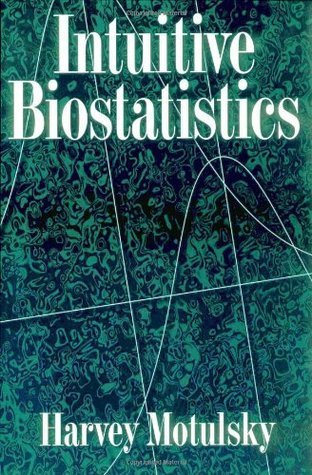
Designed to provide a nonmathematical introduction to biostatistics for medical and health science students, graduate students in the biological sciences, physicians, and researchers, this text explains statistical principles in non-technical language and focuses on explaining the proper scientific interpretation of statistical tests rather than on the mathematical logic of the tests themselves. Intuitive Biostatistics covers all the topics typically found in an introductory statistics text, but with the emphasis on confidence intervals rather than P values, making it easier for students to understand both. Additionally, it introduces a broad range of topics left out of most other introductory texts but used frequently in biomedical publications, including survival curves. multiple comparisons, sensitivity and specificity of lab tests, Bayesian thinking, lod scores, and logistic, proportional hazards and nonlinear regression. By emphasizing interpretation rather than calculation, this text provides a clear and virtually painless introduction to statistical principles for those students who will need to use statistics constantly in their work. In addition, its practical approach enables readers to understand the statistical results published in biological and medical journals.
I think that when I took stats during my university courses, the focus was all wrong. It was like this:
here are some numbers, put them into the formula for the t-test, when the number that comes out is below 0.05 write "I reject the Null Hypothesis with a p-value of X". I never really learned about the basic assumptions behind this test (and all the other ones), nor did I learn about how to interpret and actually think about these results. Did I make mistakes in my analysis? What are possible mistakes? What could I do better? What did I actually do there?
Here's a great book for exactly that set of problems - it starts off with an introduction and explanation of all the basic words and teachings of statistics (p-values, cutoffs, etc.), then goes to the basic tests (t-test, non-parametric tests, ANOVA etc.).. each method isn't introduced from the math angle, in fact the book has maybe 5 to 10 formulas, but lists the basic assumptions of the method and what you can glance from the results.
One caveat: Like most statisticians, Motulsky has opinions: 95% CIs are more intuitive to understand than t-tests, basing analyses on smoothed data is crap, etc. Might not be everyone's cup of tea. Motulsky also the author of the GraphPrism software for statistical analysis so that one's frequently featured (example: "I made this analysis using Graphpad."). To make up for that, there's an appendix on R and Excel.
Can a book be bad that features 4 or 5 XKCD comics? Can a book be bad when the author trawls amazon.com and writes bad reviews for fraudulent study guides? Or who writes rad reviews about Dragonball (boring reality would say that this was a child of Motulsky, but I want to believe)?
Recommended for: scientists, decision makers, other people who regularly work with statistics.
Slightly recommended for: Students - there might be too much high-level detail and opinion in here if you need to cram for a test, there are other books for that which focus on the actual math. But if you want to work in stats later it might be a good decision to read through this book.
At least during our undergrad time we had the same statistics lectures and they really were completely pointless to what you will later on need as a scientist. Learning about the odds of playing roulette etc. is fun (at least to me), but it's nothing that you will need for actual data analysis later on. This book instead gives lots of practical advice. And most of that advice you should have gotten before starting to collect any data.
All in all the book didn't contain too much stuff that was really new to me, but it was funny to read anyway, not only because of all the comics it includes, but also because the writing is genuinely funny in many places (my office mates gave me strange looks for laughing while reading it).
I have to disagree with Philipp on the take that it's probably not for students who need to cram for an exam. The book is a pretty quick read I would say and it introduces so many important things that I guess it will be a great help in doing the actual cramming, because you a much better idea on why certain details are important and where they enter the game.
Motulsky summarizes baic statistical methods highlighting their usefulness as well as common misunderstandings and misuses. He does this with a minimum of mathematics making this text quite useful for those struggling with or not in need of the mathematical details. The book can serve as a nice review of the bottom line as well. I recommend the book for any who need a good grasp on statistics and who are not experts.
-You don’t need to know how statistics work to use them; you do need to understand the list of assumptions a test is based on and the conceptual traps to avoid.
-predicting outcomes that have already occurred isn’t not probability (predicting some random future event) but rather quantifying your own ignorance
-Published probabilities are quantitive statements about informed beliefs (eg presidential polls)
Very accessible for non-stats experts. More of an "advanced beginner / intermediate" reference than his "Essential Biostatistics" book. If you're interested in biopharma clinical trials, I'd read EB first and then get this if you want to go deeper.
It was really interesting, all things considered. I definitely think it’s so important in understanding especially in regard to research in healthcare.
The authors point out early on that this is a statistics book for scientists, not mathematicians. This is a rare beast -- scientists tend to write books about science, leaving the statistical manuals to be written by, well, non-scientists.
As an example, consider Type I vs. Type II error. This has something to do with alpha, right? On page 110, several specific scenarios are given along with recommendations for values of alpha and how it will affect Type I and Type II errors. That is something I can remember.
The coverage isn't intended to be encyclopedic (no "vodka" test?) and I haven't used the book as a reference yet, but so far I've enjoyed reading it straight through and expect to keep it very close at hand as I design experiments.
This text avoids as much hardcore math as it can, taking a more realistic approach for biomedical scientists: There are software packages that will help you with much of the math, and there are professional biostatisticians who are valuable for a reason. This book gives you the information you need to carry out most basic statistical analyses while offering additional resources for those who are interested. I think this is a good reference text for graduate students, and probably a good textbook for statistics courses aimed at people who aren't primarily mathematicians. There are ways in which the text could be improved, I'm sure, but overall I think it deserves a place on the shelves of bench scientists.
This book is a must read for those who want to understand better what they are reading in healthcare research. Every commonly used term in biostatistics has been covered adequately for understanding. Loads of useful non-mathematical tips that are explained with simple clarity.
Haven't gone through the last section of review questions and answers, but I believe they will be very useful. Will go through them soon!
Um dos melhores livros de bioestatística, escrito pelo fundador da GraphPad Inc, uma empresa que comercializa entre outros produtos o software GraphPad. Este livro procura se concentrar nos fundamentos e aplicações da bioestatística, sem se aprofundar no formalismo matemático. É um livro para quem já possui conhecimentos básicos de estatística e não para iniciantes da área.
My old KZSU friend Sam Wang suggested this as a fun read. I look forward to seeing how compares to two favorite by Edward Tufte, Envisioning Information and The Visual Display of Quantitative Information, from my days teaching technical communication and writing to engineers at Stanford.
Excellent self-help book for laboratory scientists in understanding concepts of basic biostatistics. Written by the creator of GraphPad Prism, a common quick statistics software used by lab scientists. It doesn't contain much technical details though, one would need a proper stat textbook for that.
4.5 stars really. Despite some (minor) flaws, this is still the book I recommend to anyone in the biological sciences interested in a reasonably accessible statistical text that covers the basics.
An excellent introduction to a wide breadth of statistics with a focus on (1) practical application and (2) the true theoretical basis and not (3) a bunch of math problems.