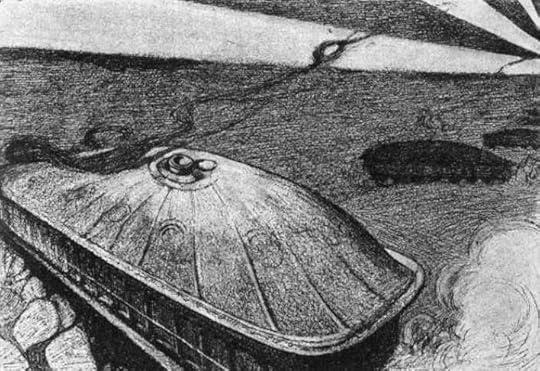
"The Land Ironclads" originally appeared in the December 1903 issue of the Strand Magazine and set in a war similar to the First World War. The Ironclads are 100-foot-long (30 m) machines with remote controlled guns and accommodation for 42 soldiers, including 7 officers.
The story is one of those responsible for Wells' reputation as a "prophet of the future", as the eponymous machines seem to anticipate the tanks of World War I. His rather sketchy battle between countrymen and townsmen also carries echoes of the Boer War and his 1898 novel The War of the Worlds, which also features a struggle between technologically uneven protagonists.
***
The story opens with a war correspondent and a young lieutenant surveying the calm of the battlefield and reflecting upon the war. The two opposing sides are dug into trenches, each waiting for the other to attack, and the men on the war correspondent's side are confident in their coming victory. They believe that they will win because they are all strong outdoor-types - men who know how to use a rifle and fight - while their enemies are towns people ... "a crowd of devitalized townsmen ... They're clerks, they're factory hands, they're students, they're civilized men. They can write, they can talk, they can make and do all sorts of things, but they're poor amateurs at war." The men agree that their "open air life" produces men better suited to war than their opponents' "decent civilization".
In the end, however, it is shown that the "decent civilization", with its men of science and engineers, triumphs over the "better soldiers" who, instead of developing land ironclads of their own, had been practicing shooting their rifles from horseback, a tactic which became obsolete the second the land ironclads appeared on the battlefield.
The story ends with the entire army captured by a dozen or so of the land ironclads, and the last scene is of the correspondent comparing his countrymen's "sturdy proportions with those of their lightly built captors", and thinking of the story he is going to write about the experience, noting both that the captured officers are thinking of ways they will defeat what they call the enemy's "ironmongery" with their already-existing weaponry, rather than developing their own land ironclads to counter the new threat, and also noting that the "half-dozen comparatively slender young men in blue pajamas who were standing about their victorious land ironclad, drinking coffee and eating biscuits, had also in their eyes and carriage something not altogether degraded below the level of a man."
Herbert George Wells was born to a working class family in Kent, England. Young Wells received a spotty education, interrupted by several illnesses and family difficulties, and became a draper's apprentice as a teenager. The headmaster of Midhurst Grammar School, where he had spent a year, arranged for him to return as an "usher," or student teacher. Wells earned a government scholarship in 1884, to study biology under Thomas Henry Huxley at the Normal School of Science. Wells earned his bachelor of science and doctor of science degrees at the University of London. After marrying his cousin, Isabel, Wells began to supplement his teaching salary with short stories and freelance articles, then books, including The Time Machine (1895), The Island of Dr. Moreau (1896), The Invisible Man (1897), and The War of the Worlds (1898).
Wells created a mild scandal when he divorced his cousin to marry one of his best students, Amy Catherine Robbins. Although his second marriage was lasting and produced two sons, Wells was an unabashed advocate of free (as opposed to "indiscriminate") love. He continued to openly have extra-marital liaisons, most famously with Margaret Sanger, and a ten-year relationship with the author Rebecca West, who had one of his two out-of-wedlock children. A one-time member of the Fabian Society, Wells sought active change. His 100 books included many novels, as well as nonfiction, such as A Modern Utopia (1905), The Outline of History (1920), A Short History of the World (1922), The Shape of Things to Come (1933), and The Work, Wealth and Happiness of Mankind (1932). One of his booklets was Crux Ansata, An Indictment of the Roman Catholic Church. Although Wells toyed briefly with the idea of a "divine will" in his book, God the Invisible King (1917), it was a temporary aberration. Wells used his international fame to promote his favorite causes, including the prevention of war, and was received by government officials around the world. He is best-remembered as an early writer of science fiction and futurism.
He was also an outspoken socialist. Wells and Jules Verne are each sometimes referred to as "The Fathers of Science Fiction". D. 1946.
Believe it or not, and despite this being a story by the wonderful H. G. Wells, I fully expected it to be kinda lame. I mean, Land Ironclads, or rather, TANKS is kinda something we all know something about.
Well, on the contrary, let's put this in perspective. This is still more than ten years before WWI, when trench warfare and horseback cavalry and ruddy-complexioned bullyboys are everything. The idea of a land ironclad, as opposed to the seaworthy kind that really showed their mettle, years before, was still just a concept that needed proving.
In the story here, it's all in the heart of battle, feeling every inch the trench warfare, and encountering these monstrosities with their overwhelming force was quite a shock. Glorious and terrible.
Perspective is everything.
Here's the odd bit tho: These aren't the kinds of tanks we're used to. When we got a glimpse of the technological marvel inside, with the camera obscura and the precise mechanism to track and mark each sniper bullet by simple science, using nothing more than a world of 1904 could provide, I kinda got blown away.
I'm quite tempted to do a little research to see if any hobbyist has attempted to replicate the design. I mean, I don't quite care if the whole tank is replicated, but the mechanism to blow up a live image and aim with amazing precision like this has got my imagination pumping.
Honestly, I'm rather impressed. I got a lot more than I expected out of this, AND it got my heart pumping.
ENGLISH: In 1903, Wells made one of his successful prophecies about war technology, comparable to his prophecy about the atomic bomb in The World Set Free. In this case, what he foresees is the use of armoured fighting vehicles (tanks) in trench war, as they were used during the First World War, when they successfully replaced cavalry, and in all the later wars.
ESPAÑOL: En 1903, Wells hizo una de sus acertadas profecías sobre la tecnología de la guerra, comparable a la que hizo sobre la bomba atómica en The World Set Free. En este caso, lo que prevé es el uso de vehículos blindados de combate (tanques) en la guerra de trincheras, como se usaron durante la Primera Guerra Mundial, cuando reemplazaron con éxito a la caballería, y en todas las guerras posteriores.
(1903) "No," he said, presently; "I'll write that other article, 'Is War Played Out?'"
Over a decade before the invention of the tank, Wells imagines a fantastical version of it in this short war story. It’s really less a story and more a moment, showing how such a machine would appear to an unsuspecting enemy. But it’s enough for Wells to make a larger comment on the future of warfare, in which the softness of civilized man can be compensated for by technological prowess—a far-seeing notion then, but something we take for granted now, when, say, an obese woman sitting behind a computer can drone-strike a more primitive and virile enemy thousands of miles away.
Towards the end is a tour inside the vast tank. It’s funny to see Wells construct his futuristic weaponry using Edwardian resources. His longtime conflicted feelings between the primitive and the civilized, the old and the new, are embodied throughout the story in the character of the war correspondent and his shifting sympathies.
Wells'in zamanının çok ötesinde bir şeyleri hayal edip hikayelerine aktaran bir yazar. Bu kitapta da bir çok kısa hikayesinden oluşmakta. Hepsi güzel olmasa da iki tanesi zamanının ötesinde fikirleri bize aktarıyor.
I learned a lot from this story. For example, did you know that circa 1900, guns didn't make explosive noises when fired? Instead, they had voices, and literally shouted the word "Bang!"
An absolute must-read, especially for students, in order to appreciate the genius of Wells as a writer of science fiction. One also should read this with the accompanying original illustrations. Tanks are taken for granted these days as part of the modern world, but at the time of this writing, they were just a concept. Seeing tanks in action through the eyes of a writer who had only prior seen combat on horseback really paints them as the terrible machines of death that they are.
Short and to the point, though perhaps a little cartoonish, this early work of Mr. Wells is worth the investment of your time.
At 30ish pages, this must've amounted to quite a long article in Strand Magazine in 1903. This quite accurately foretells the shape of WW1 a decade before it happened, with trenches and 'land ironclads' which are tanks, albeit rather large fantastic ones that bear some similarity to the tripods in War of the Worlds. Being entirely military, and seeming now more like history rather than prophecy, I didn't find it the most enjoyable of reads, but the philosophical ending applies even more to warfare nowadays with remote-controlled drones and missiles. Worth a read. 3.25/5
Interesting, and famously prophetic story about the development of "Land Ironclads" - land based Battleships, or what we would now think of as a kind of gigantic Tank. The story is exciting, and historically interesting - but suffers from appallingly disconcerting racist language and imagery in place's.
I read this for my Ages of Science Fiction lit class and, honestly, I expected to hate it. It was originally written in 1903 and the writing took me a hot minute to get into. Fair warning, this is a product of it's time and there is casual racism. If you can get past the writing and the casual racism, it's a quick read and a pretty interesting look at the war machine. Wells gives no names to the characters and you're completely imursed in the world. I could see what Wells was painting.
Damn dirty apes ride their horses and land ironclads to war. Trench warfare dates back to ancient Rome. Da Vinci invented the tank in 1487. Gatling invented the machine gun in 1861. . . so it’s an ironclad bore.
The Land Ironclads - This begins describing a dark alien-like beast that is the horror of those expected to resist it. Turns out a little more human-engineered, but still a disturbing dystopian vision. ****
God this novella is so nonsensical and boring...I can't even believe he predicted tanks and all that other shit in modern armored warfare so easily. Infantry is no challenge in the time of war for those hangry war machines.
The source of much controversy in the the early 20th century, as Wells describes, what is essentially a fairly intriguing idea for the tank, which Winston Churchill apparently later attributed to him. The story however is really about the battle that rages between the best people and the best equipped, which science and technology triumphing - although to some degree at the expense of humanity. There are some great reflections on the never ending battle with the evolution of technology and its implications for our lives.
H. G. Wells predicts the 20th century again, though his 'land ironclads' - 80 to 100 feet long, carried on rotating feet and armed with remote-controlled rifles - are closer to the Nazis' proposed Landkreuzer or his own tripods than anything ever actually realised. Still, he's a terrific writer and you can't deny the eerie prescience of his tale.