Every day, Rupa's grandmother wears a beautiful Indian sari. Each is brightly colored and very beautiful. "Don't you ever want to wear a gray skirt and red blouse with round buttons like Mommy or a green dress like me?" Rupa asks. But Dadima prefers to wear her traditional saris. She shares with her granddaughter all the wonderful things that saris can do--from becoming an umbrella in a rainstorm to providing a deep pouch to carry seashells. Soon Rupa's own imagination is sparked as she envisions saris protecting her in the scary Gir Jungle, bandaging up an injured knee, and holding a special secret for her and Dadima to share.
Kashmira Sheth provides young readers with a unique view of Indian culture and tradition through this affectionate, sensitive portrait of a grandmother and her American granddaughter. Hindu words defined and sprinkled throughout the text further add to the authenticity of the story. Yoshiko Jaeggi's sweeping, colorful, and fanciful watercolor illustrations capture the extraordinary bond of love that unites families across generations despite cultural differences. A note from the author and instructions for wrapping a sari are included.
Kashmira Sheth grew up in Bhavangar, Gujarat, for eight years, when she was three she joined Montessori school. She lived with her grandparents, because her parents lived in Mumbai three hundred miles away from Bhavangar. At eight years Sheth, left Bhavangar, for Mumbai. She did her studying there until she was seventeen. She left Mumbai, to go to college, in Ames Iowa to do her BS at Iowa State University. Many people ask her why she chose Iowa. "I chose Iowa State, because my uncle worked there as a professor." is the answer. She is the author of 7 books, two of them are picture books, called "My Dadima Wears a Sari." and "Monsoon Rains"
She has three books meant for teens. The fist one is called "Blue Jasmine"; which is about a girl named Seema who moved from India to Iowa. The second one is called; 'Koyal Dark, Mango Sweet'; this book is about a girl who is sixteen named Jeeta, her two sisters are married and now its her turn. Trouble is she does not want an arranged marriage. The last one and the most currents one is called, "Keeping Corner". This one is about a girl who is thirteen, named Leela, is widowed. She was married at age nine, and was about to be sent off to live with her husband. But her husband gets bitten by a venomous snake, and dies. Leela faces hardship, anger, and frustration. She is forced to shave her head, and never ever wear jewellery or colors. This takes place in the Gandhi era. Sheth is publishing a book called "Boys Without Names." in 2010 Kashmira Sheth is now with her two daughters; Neha and Rupa, her husband in Madison Wisconsin.
This lovely picture-book from Indian-American author Kashmira Sheth and Japanese-American illustrator Yoshiko Jaeggi is a celebration of both the loving bond between a grandmother and her granddaughter, and the beauty of the sari. Narrated by young Rupa, whose beloved Dadima, or grandmother, wears a different sari - a traditional Indian dress, created from a cloth that is wrapped around the body in a particular way - every day, My Dadima Wears a Sari highlights one of the realities of immigrant life - that the younger generation may dress differently than the older one - while also emphasizing the fact that family love and shared traditions can bring the generations together.
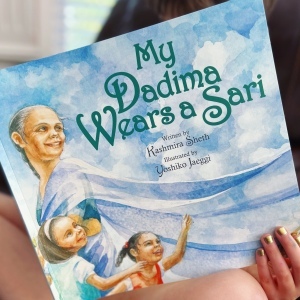
As Rupa questions her Dadima about her saris, asking whether she ever wants to wear anything else - something more like the clothing that Rupa's mother wears - Dadima explains the many different ways she can use her versatile garment. The back and forth between grandmother and granddaughter makes for an engaging read, especially once Rupa gets into the act, imagining some rather adventurous uses for the sari that Dadima probably never dreamed of. The accompanying watercolor illustrations by Jaeggi are just charming, with beautiful colors and expressive faces and figures. I liked the swirling saris that can be seen in some of the paintings (such as the one on the cover), and the family cat that appears in many of the scenes! All in all, a sweet picture-book exploration of the world of an Indian-American girl and her family, one I would recommend to young readers looking for stories about grandparents, or to those looking for books featuring Indian and/or South Asian characters.
A similar theme to Mama's Saris, this time featuring a grandmother and her granddaughters and how the young ones learn all the beautiful and useful things about saris (the colors, the fabrics, the way the sari can be a hood in the rain, a fan in the heat, and a basket to hold seashells at the beach!) not to mention the family tradition such as the sari that dadima wore when she came to America, and when she got married. A sweet story with a nice multi-generational element.
This story is about a little girl whose name is Rupa. Rupa lives in an extended family home, and she watches her grandma wear saris every day. Rupa starts to question whether, or not her grandmother gets tired of wearing a sari. When she asks her Dadima which means Grandmother in Hindi her Dadima answers, "Never." Rupa's Dadima explains why she never gets tired of wearing a sari. Rupa's Dadima explains a sari can become a fan, a pouch for collecting seashells or an umbrella, just for starters. Rupa ties a knot in the corner of Dadima’s pallu—the end of her sari—to remind her to hug Rupa. Dadima shows her granddaughters more of her saris. Dadima explains the story behind each sari. Dadima talked about how she still has her first sari, her wedding sari and the one she was wearing when she came to America. Dadima shows the girls how to wear a sari. The girls told they look alike Dadima hugs her, Rupa unties the knot she makes every time Dadima hugs her. This story has a vivid depiction of family, it shows how meaningful traditional clothing can be. In the end, the author Includes a personal note detailing her memories and associations with saris as well as photographs and instructions on how to wrap one. Dadima's Sari is a fiction. What I liked about the book is Rupa wasn't the only one talking. It gave the perspective of both Rupa and Dadima. In the end, the author talking about her memories made this story wholesome. I didn't see anything that the story was missing. I think the author made the story very clear. I didn't see any biases or assumptions made other than Rupa questioning if her grandmother is tired of wearing a sari. The story could be used as a teachable moment with students by talking about what each of our grandparents teaches us or if students don't have grandparents what traditions are passed through their families. For example, Rupa's grandmother talked about how saris have been passed down through the generations. This book would be great for students for grades 1 and up.
From the moment I saw this book on the library shelf, I was captivated. The cover of the book drew me in immediately with it's elegant text style and the colorful watercolor illustration of a smiling grandmother wearing a flowing blue and gold sari standing beside two elated young girls, presumably her granddaughters. As I read the book, I was taken by not only gorgeous, detailed illustrations, but by the feelings of comfort, curiosity and zeal radiating from the story. There is the feeling of comfort emitted by the close relationship between the girl, Rupa and her dadima (grandmother). The dialogue between Rupa and her grandmother is open, friendly, as Rupa questions her grandmother's choice to wear the traditional East Indian clothing known as a sari. Her grandmother takes all of the questions in stride, explaining the histories and memories and many possible uses of the saris.
This story made me think of the many hours my sister and I spent with our maternal grandmother begging to know the histories behind each item we encountered in my grandparent's home. From the photos, dolls and toys left in my mother and aunt's old bedroom to the old-fashioned sewing table (with wrought iron foot peddle, but sans the sewing machine) to the miniature Shabbat (Jewish sabbath) set on the shelf. Patiently our Bubbie (Yiddish for grandmother), would answer our endless questions. Like Rupa and little Neha's dadima, our grandmother, too, invited us to use our imagination as we, too, found many uses for otherwise ordinary items.
This review was originally written for The Baby Bookworm. Visit us for new picture books reviews daily!
Hello, friends! For our last review of AAPI Heritage Month, we’re reviewing My Dadima Wears a Sari, written by Kashmira Sheth and illustrated by Yoshiko Jaeggi, a lovely tale of tradition and cultural dress celebrating its 15th anniversary of publication.
Rupa’s dadima (Hindi for “grandmother”) wears a sari every single day, morning and night, at home and around town. She wears cotton saris and silk saris, tucking the pallu – the end of the sari – in tightly or letting it flow in the breeze. One day, Rupa asks Dadima why she doesn’t wear Western-style clothing like Rupa’s mother and little sister, Neha, and Dedima replies simply that she’s never even thought to, as she loves her saris and finds them very useful. For example, her sari can be used to fan herself and her granddaughters in the heat, or protect them from rain, or form a makeshift pouch for collecting seashells. When Neha joins them and asks her own questions about Dadima’s saris, the girls’ grandmother invites them to see the three most important saris of her life, and learn how to tie a saris of their own.
A beautiful look at cultural dress, and the ties it can have to one’s identity and memories. Sheth’s text balances nicely between conversational and poetic, highlighting the bond between the family as well as their emotional connection to the saris. Jaeggi’s pastel-heavy watercolors create charming characters and a beautiful sense of motion in the fabrics, though I feel it fails to capture the vibrance of color in traditional saris; Dadima’s red-and-gold wedding sari, for instance, reads as a faded rose rather than a rich scarlet. Backmatter features an author’s note on her own connection to saris, as well as photographic instruction on how to tie one. The length of the book makes this best for older elementary readers, as it does take a little more time to finish, but JJ loved the artwork. Overall, this is a lovely way to pay tribute to the cultural relevance of saris, and we enjoyed it. Baby Bookworm approved!
(Note: A copy of this book was provided to The Baby Bookworm by the publisher in exchange for an honest review.)
Summary: The book "My Dadima Wears a Sari" is about an Indian grandmother and her two granddaughters. One day one of the granddaughters, Rupa asks her grandmother why she always wears a sari. The grandmother wears a sari because she was not raised in America and it is tradition to wear them in Indian. The grandmother tells the children about all of her sari's and why she wears them. In the end, the granddaughters also want to wear one as their grandmother.
Themes: Different cultures(Indian). Learning about your roots. Tradition. Family.
Personal response: I think it was a sweet book and it gave me some knowledge about clothes in India. There was a lot of colors in the book because the clothes were so coloring and had a lot of pattern on it. It is different because it starts with Rupa naming all the places her grandmother wears her saris and then the "real story" starts.
Recommendation: I will recommend this book for children in the age of 4-7. You can use it to teach children about different clothing in different cultures and traditions.
By Kashmira Sheth, Illustrated by Yoshiko Jaeggi Summary: Rupa's Dadima, grandmother, always wears a sari, an Indian traditional wrap. Dadima tells Rupa all of the uses for her multiple colors/patterned sari. Rupa and her sister want to have their own sari's, but Dadima says they can wear one of hers. Dadima tells of her first sari, her favorite, and special saris. Evaluation of Illustrations/Text: The illustrations fill the page in detail and color. The text is in small paragraphs per page at the bottom, top, or middle of the page. Strategies for Use in the Classroom: Helps student understand the dress of the Indian woman in a fun and interesting way. Locate specific vocabulary words - The students will not know that the words "Dadima", "sari", and "pallu" are, so using the words in context and explaining the meaning can help students understand the story and culture.
This story was a solid first effort at making a picture book for the author Kashmira Sheth. She did well at introducing me to some Sanskrit words and Hindu culture. The book starts with some simple sentences that gradually develop into a story format. I was taken through the mind's eye of Rupa's (protagonist) Dadima to the beach, jungle, and her birthplace of India. Beautiful images only enhanced the author's text but she makes it easy for me to feel welcomed into an unfamiliar territory. The visual aide with the author's daughter reinforces the theme of family present in the writing and was a pleasant surprise at the end of the book. This story shows the importance of family relationships and how traditions are passed down. Even if the history behind the tradition is hidden in childhood, it still serves as a piece or a key to identity and culture.
This is a beautifully illustrated book and the story is an excellent account of multigenerational respect and love. The story is an authentic presentation of Indian culture lived out in America. It will give those of Indian heritage an appreciation and respect for their own heritage and give non-Indian readers an opportunity to glimpse into the home of a family that spans three generations. The beautiful traditional sari is represented lovingly and I think shows the gracious living one can accomplish while wearing their accustomed garment.
I think this culturally explicit book would be a wonderful addition to libraries.
I received a complimentary copy to facilitate a review. Opinions are mine, alone and are freely given
"My Dadima Wears a Sari," follows a young girl and her dadima, or grandmother, who teaches her grandchild about the sari she drapes herself in everyday and its uses and significance. Through her grandmothers teachings, the young girl learns the significance of the sari and feels a deeper connection to her grandmother.
In the classroom, students could be assigned to write a coherent and original essay on what they would use a sari for based on Dadima’s original uses in the book. Students will complete the essay by stating if they would ever wear a sari or not and why. Students could also explore the significance of a tradition in their own family and present to the class.
Told from the point of view of a girl child speaking about her dadima, my 6yo figured out that dadima means grandma and discovered that she really likes saris. She wants me to find a way to get her one. She wants us to go to India so she can get her own.
This book is beautifully worded and drawn. It sheds light on traditional Indian attire for women and girls in a way that little kids can understand... AND it sent us to Google images looking up "real" saris.
I even learned something about sari usage and tradition from this book and showing your littles that you learn new things too, is another beautiful thing about this book.
This is a lovely tribute to all the benefits of wearing a Sari. When a young girl asks her Dadima why she wears a sari and if she doesn't instead want to wear a dress or skirt, her grandmother shares all the wonderful things she can do with a Sari: protect from the weather, carry shells from the beach, and even provide protection from a leopard attack! The dadima in the story offers a gentle reminder of the importance of cultural attire as well as a history of this family tradition. End papers show photographs of instructions by the author's daughter for wrapping a sari. Most of the illustrations are a soft pastel match with the gentleness of the story.
This is a really sweet story about embracing your heritage and loving your grandmothers, and I am so here for it. It makes me think of my own family and childhood even though no one in my family would have worn a sari at any point. I thought the tutorial at the end was especially great. Illustrations were cute too.
Very cute book that celebrates saris. There is even a part at the end where there are instructions on how to wear a sari. There is so much love between the family members in this book. It's very sweet, My only complaint is that it's a little bit long.
Great story! A little girl is at her Dadima's house, her grandmother, and noticed that she is always wearing a sari. Curious, the little girl starts asking questions as to why she wears them, when she wears them, what they are made from, and what can they do? Dadima proceeds to explain all of the reasons for wearing them, her cultural background. She explains that a sari can be used as an umbrella, to carry seashells, and to hide from monsters. The little girl was so inspired, she asked Dadima if she could wear a sari too! I would use this book in the classroom when learning abut different cultures.
Another beautiful book by Kashmiri Sheth about traditional Indian culture. In this book, a grandmother explains to her granddaughter why she wears a sari and why she has so many. It is a book many students will treasure as they think about their own special memories with their grandparents. This book can be used to teach students about passing on traditions throughout generations, and why they are important to culture.
This story reminded me quite a bit of "What Can You Do With a Rebozo?", a story about the shawl worn by Mexican women. The sari in "My Dadima Wears a Sari" is a form of dress worn by women in India. The book features a grandmother and her two granddaughters; the grandmother wears many different beautiful saris, and the eldest granddaughter asks her grandmother if she ever gets tired of wearing a sari. The grandmother explains all the different uses a sari has and shows her granddaughters all of her saris, including some special ones from the past.
I found this book to be more of a family story and much more traditional than "Rebozo." The grandmother shares her experiences through her clothing, taking her granddaughter's back to India when she got her first sari, her wedding day, and the day that she immigrated to the United States. The illustrations in this book are very soft and beautiful, and the backgrounds resemble different patterns of cloth, which I thought was unique and adds to the theme of clothing. I particularly enjoyed the diagram in the back of the book showing readers how to actually tie a sari. The author, Kasmira Sheth, grew up in India and so has thorough knowledge of the sari and Indian culture. I would recommend this book for primary grades as a multicultural read-aloud.
There was good dialogue between the characters. The curiosity of the granddaughter brought many questions one would have about their own culture. The illustration brought out the peacefulness of the story.
A young girl, Rupa, notices the beautiful saris that her Dadima (grandmother) wears everyday. Rupa wonders if her Dadima ever gets tired of wearing her saris and wants to wear everyday clothing like her mother does. Her Dadima proceeds to tell Rupa all the things she can do with her sari, such as using it to fan themselves on a hot day or to bury seashells collected from the beach. Dadima shows many of her different saris to Rupa and her young sister, Neha. Dadima also shows them 3 of her special saris-her first sari, the sari she wore when she arrived in America from India, and her wedding sari. This book can help children understand how pieces of clothing can be apart of an individual's culture and family customs. Children are able to understand the importance of Dadima's saris and how much they mean to her. This book also has a multigenerational element. Dadima says that her dadima wore a sari, as well as her dadima's dadima. Rupa and Neha admire Dadima and want to wear saris as well. This shows children how cultural traditions can be preserved by being passed down from one generation to the next.
This is another story which captures the readers from the very beginning. The unique perception of Indian culture and traditions are highlighted by the author in this story. A girl describes how her grandma wears saris every single day and she is not tired of wearing them every day.The grandmother shares her unique ideas of how a sari can be a multi-purpose help in times of need.The illustrations are very simple and neat with soft colors. The pictures are brilliantly painted.The story takes us one step further by tying the emotional bond between two generations besides their cultural differences.The story captures your heart. The interesting part of the story is that at the end there are pictures of instructions to wear a sari.
An excerpt from the book-"Her smile fills her face like the big, round moon fills the sky."
A beautiful story of family. I love exploring the connection between granddaughter and grandmother across cultures. Beautiful illustrations and it taught me a lot about saris. Would recommend to have in a classroom.
An excellent multicultural book. Rupa wonders why her grandmother always wears saris instead of pants or a skirt. Her grandmother replies that she never thought of wearing anything but a sari. You can do so many things with a sari - hold seashells, take shelter from a sprinkle, play hide and seek. Little sister Neha joins the two as they go to grandmother's room to look at her saris and she tells them about her favorites. Then she dresses the two granddaughters in saris. Lovely illustrations in soft colors bring the characters and story to life. At the end, the author writes of her experience wearing a sari, and on the last page, the author's daughter, Rupa, models how to wrap a sari.