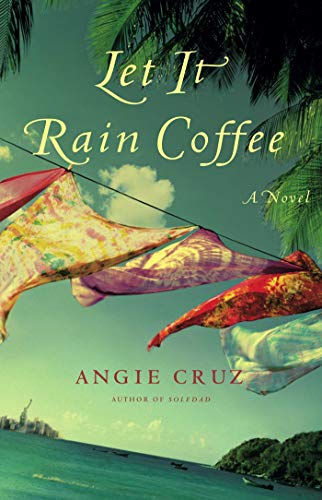
Before reading this review, you really must learn something about the history of the Dominican Republic. The majority of the flashbacks concerned the Presidency of Trujillo, but there are other aspect of the country's history that are essential to understanding the story. Also, if your Spanish is as bad as mine, you might not know the exact meaning of about 10% of the dialogue, but you can pick it up within the context. Do not let that scare you off from this amazing book. I just finished it in a 4 hour reading spurt and really and truly felt as if I had been caught completely within the Colon family. [return][return]*****Spoiler: Santo, Don Chan's son, dies very early in the book, but his death is pivotal to the story***** [return][return]The majority of the book revolves around Esperanza and Don Chan, their fractured relationship, and its impact on Bobby and Dallas, Esperanza and Santo's children. Don Chan joins the family in New York shortly after his wife dies in the Dominican Republic. Don Chan and Esperanza have never seen eye-to-eye, as Esperanza remembers the Dominican Republic (the D.R.) as a dirty, foul, poor country to attempt to scratch out a living. She is addicted to the drama "Dallas," and is determined to live the life of the Ewings. To that end, she is is ducking calls from collection agencies about her credit card bills and working double shifts as a home-care nurse in order to make ends meet and provide for the family. To do so, she must leave her children in the care of her father-in-law, Don Chan, who is elderly and beginning to suffer from Alzheimer's. [return][return]Don Chan, on the other hand, remembers the DR as a country of promise and expectation, especially after the fall of Trujillo. During Trujillo's reign, Don Chan was an "Invisible," working underground against Trujillo and his regime. But when Trujillo is killed and Dona Caridad dies, Don Chan loses his will to fight, preferring to impart his wisdom on the next generation and wonder about what could have been. Left to care for his grandchildren, he laments Santo's death and the fact that Santo chose to follow Esperanza to New York rather than work for change in the DR. [return][return]As the book progresses, Santo's death creates new meaning for all the members of the Colon family, the realization that they must stop believing that life owes them something (whether it is an 8-bedroom ranch, a leather jacket, or a democratic government) and instead embrace life as an opportunity, a chance to change their situations and embrace the future. This realization is hardest for Esperanza, as she has lived all her life with the goal of being just like the Ewings (off "Dallas") but when she comes face-to-face with J.R. Ewing, she finally begin to see life as it is instead of the way she always assumed it would be handed to her. Her actions and behavior sets the stage for the final, moving pages of the book, were it becomes clear that Santo's death, more than his life, has finally inspired his family to move forward and change their lives. [return][return]I can't write much more without giving away the entire book, but I can say that for every student of Latin American culture, this book should be required reading. Angie Cruz should be commended for this excellent addition to the fiction bookshelves, not just the Latin American fiction bookshelves.