The enfant terrible of the Viennese art scene, Klimt was notorious for his portraits of beautiful women. Illustrated with color reproductions, this book profiles the women who figured in the artist’s life and on his canvasses. The author looks beyond the standard assumption that Klimt was a hard-hearted philanderer, pointing instead to his committed and loving relationship with Emilie Flöge that prevailed despite the parade of beautiful women who wandered in and out of theartist’s studio. Partsch demonstrates Klimt’s role in the evolution of portrait painting, which helped usher in the age of Expressionism.
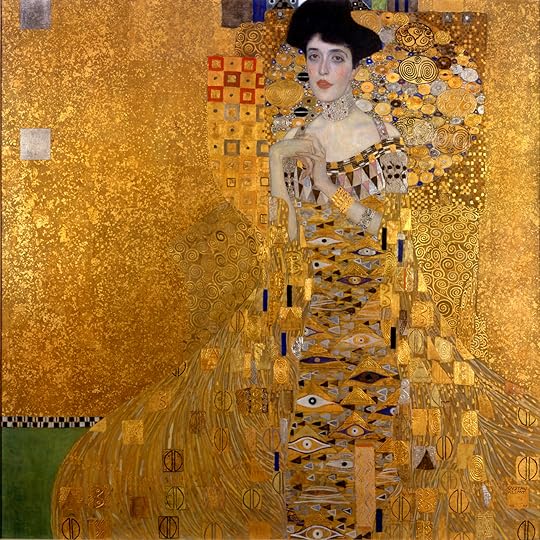
I was always indifferent to the paintings of Gustav Klimt until I saw the actual paintings at an exhibit in New York at the Neue Gallery. The one’s I saw (such as the Portrait of Adele Bloch-Bauer) are quite large (138 by 138 cm). So the reproductions that one sees in an art book are a significant condensation of the actual work. The details visible in these large canvases are brilliant and certainly make Gustav Klimt a very unique artist with a distinctive use of colour patterns.
There are a good range of paintings in this book – all of women. But unfortunately none of his landscapes (the title says so!). These paintings are extraordinary in that in addition to the wonderful colours the women just seem to be floating. They are surrounded by textured panoplies of beautiful quilt-like designs. These colourations elaborate the sensuousness of the paintings.
The text in this book is somewhat disappointing. There are basically abrupt discussions of the models that Klimt used. It would seem that Klimt believed in free-love and this was more or less kept hidden after his death. He had children with several different women who were his models. Some of these women were very wealthy, but others less so. We are not given anything revealing on what inspired Klimt and I came out of this book with very little knowledge of Klimt’s life.
But the reproductions in this book make me enthusiastic to know far more about this artist and this brought my evaluation to 4 stars.
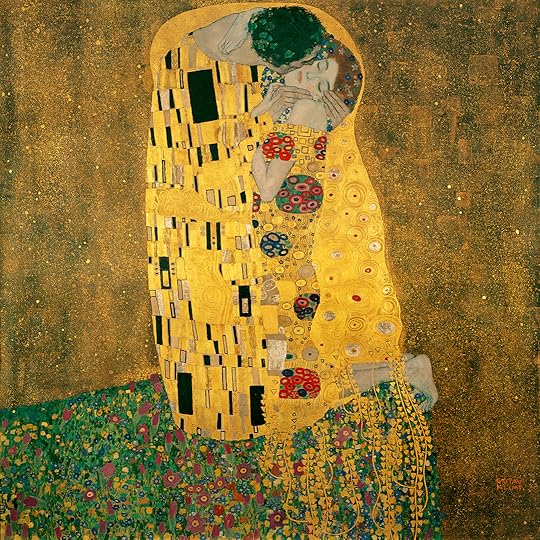
This reads like a terrible graduate thesis: it's a mess. (Perhaps the editor/publisher just shuffled words and pictures around any ol' way.) But there is a good variety of Klimt's work and some of his paintings truly stun. If you can't access the brilliantly written "Lady In Gold" by Anne-Marie O'Connor, this will do until you can. Or even better, go to the Belvedere museum in Vienna for the world's largest Klimt exhibit. Seeing "The Kiss" is worth the trip! (But Vienna is indeed fantastic.)
This is a great introductory book to the work of Gustav Klimt. His most famous works are featured along with a selection of drawings and photos from his life. If you're interested in Klimt, but you're not sure if you want to buy one of the large coffee table books, then this is a good place to start.
The 4th star is mostly credit to Klimt - rather than the author; esp. his line drawings which I hadn't seen before. As for the text, I can honestly only rate this 3-stars (neutral?) because I haven't read any of the other Klimt books ... and can only assess by comparison.; so not necessarily a negative reflection on this author's text. Although there seemed to be little conveyed re Klimt's motivation & psychology, this might not be the author's fault, so much as Klimt's reticence (she says that his writings were all very brief and almost business-like). I'll be reading some other books about this subject.
This book left me disappointed. The prints of Klimt’s most important works are quite nice and of good quality but the accompanying text does not add any value. The latter consists of nothing more than a series of anecdotes, based on hearsay and speculation about the painter’s personal life and his relation to women. I did not even once have the feeling that I was offered an insight in what makes Klimt a fascinating artist. “Klimt, the painter and women” would have been a much more appropriate title.
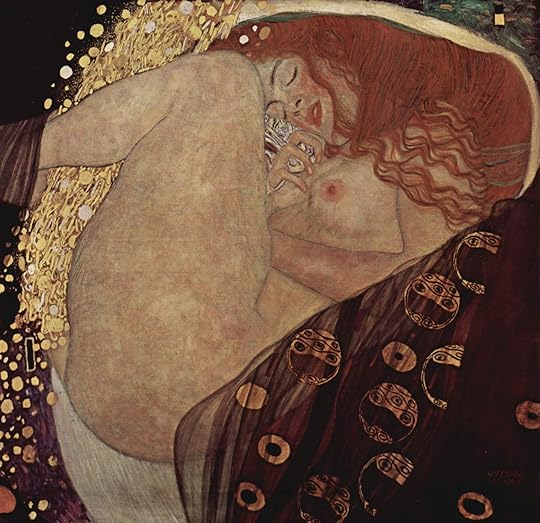
(A free admission of choosing a book by its cover - that painting ('Danaë') is so sexy!)
As a work of art history, I thought the factual and pictorial content were very well balanced, and the 'biographical notes' at the end give a very helpful overview of chronology, if like me, you like to keep track of how old anyone was at any particular time.
The factual content is very concise concerning the artist himself, his associations, society and period. The illustrations show the development of his portrayal of women - and of their eroticism as well. And there are photographs too, of the artist and his life-long chum (for want of a better term!) Emilie Flöge.
It feels like the book fails to deliver though, on the characters: of the artist, and Emilie, and anyone else involved. If there is a drama (and Klimt declared himself to be uninteresting) that remains obscure. This author seems to want only to present verifiable fact, and not do more than make suggestions about interpretation.
His involvement with women is still the central subject though, and his estate accepted four of fourteen claims for maintenance when he died. Whilst cold-shouldered by the art establishment, he was evidentally an extremely successful, lauded, and controversial figure in his own lifetime. One can imagine he was also charismatic, and that the women he succeeded with, both working-class models and society ladies, were as inclined to his advances, as he was to pursue them.
I knew nothing about him before. Now if the chance arises, I'll be very keen to see his works for real.
I love Gustav Klimt and I love this book. Mainly because it has most of his paintings, including the studies for some of these. And the author provided details which I had never noticed before, allowing me a fresh look at these paintings and giving me a glimpse into his life as well. And yes, his relationships with his subjects, the women.
An interesting, quick read. I'd have preferred the author to delve far more deeply into her analyses, however, either by drastically increasing the amount of text she wrote, or by narrowing the focus of the book itself.