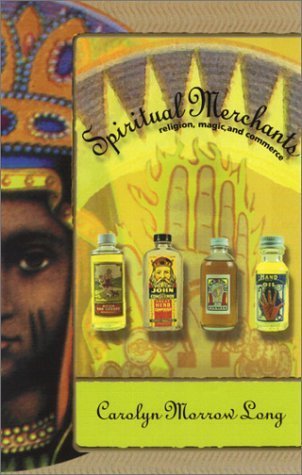
They can be found along the side streets of many American herb or candle shops catering to practitioners of Voodoo, hoodoo, Santería, and similar beliefs. Here one can purchase ritual items and raw materials for the fabrication of traditional charms, plus a variety of soaps, powders, and aromatic goods known in the trade as “spiritual products.” For those seeking health or success, love or protection, these potions offer the power of the saints and the authority of the African gods. In Spiritual Merchants, Carolyn Morrow Long provides an inside look at the followers of African-based belief systems and the retailers and manufacturers who supply them. Traveling from New Orleans to New York, from Charleston to Los Angeles, she takes readers on a tour of these shops, examines the origins of the products, and profiles the merchants who sell them. Long describes the principles by which charms are thought to operate, how ingredients are chosen, and the uses to which they are put. She then explores the commodification of traditional charms and the evolution of the spiritual products industry—from small-scale mail order "doctors" and hoodoo drugstores to major manufacturers who market their products worldwide. She also offers an eye-opening look at how merchants who are not members of the culture entered the business through the manufacture of other goods such as toiletries, incense, and pharmaceuticals. Her narrative includes previously unpublished information on legendary Voodoo queens and hoodoo workers, as well as a case study of John the Conqueror root and its metamorphosis from spirit-embodying charm to commercial spiritual product. No other book deals in such detail with both the history and current practices of African-based belief systems in the United States and the evolution of the spiritual products industry. For students of folklore or anyone intrigued by the world of charms and candle shops, Spiritual Merchants examines the confluence of African and European religion in the Americas and provides a colorful introduction to a vibrant aspect of contemporary culture. The Carolyn Morrow Long is a preservation specialist and conservator at the the Smithsonian Institution’s National Museum of American History.
REALLY useful, for anyone considering going into the occult-shop business, or selling anything related to New Age products. Just about the only text ON this subject, so we're lucky it's a good one.
Amazing, well-researched book about botanicas, hoodoo drugstores, root workers and the spiritual products industry. Ms. Long has a lifelong passion for the subject and she is careful to document all the steps in her research (and to call out mistakes she has found in others' work). The book is respectful and curious in tone, without being sensational or voyeuristic in any way. FASCINATING!
PS -- I stayed up late reading this on New Year's Day. Got up on January 2, turned on the radio and the dumb morning show DJs were talking about whether or not rootwork is real. I turned the station, not wanting to hear uninformed opinions and what was playing? Superstition by Stevie Wonder.
Read this for American Black History Month. This is the kind of subject they don't teach in school...and probably won't. If you do an essay on it, you'll probably get an "A." Now with the preceding hype aside, we can go into the review itself. If this book could get seven stars, I would give it that. I respect the author's tenacity in researching this subject, considering the odds she faced as a white woman in the attempt of investigating the dying mystical practices among Afro-Americans...and similar practices thriving in Latino communities. It's not a comfortable read, because it shows how business destroys a spiritual practice by sometimes going too far to make as much money as possible as many times as possible at the expense of customers...who in this case, actually go out of their way seeking products and services without being prompted. Here, it's in the area of the metaphysical, but in my not-so-humble opinion, if profiteers can do this in the realm of magic(k) and spirituality, in some cases, not even being aware or caring about the most basic knowledge on how magic or spirituality work in theory or in practice, they can get away with it anywhere without knowing anything about any subject at all. And they do. And they continue to make it and fake it as they go along, causing all kinds of misinformation, mischief, and damage in their wake...damage that is difficult to clean up because of bad press. No area is sacred, nor will it be. If money can be made, even if an industry is regulated or not, or whether it's even legal or not, it will be made. Remove the subject of spirituality and magic, and replace it with subjects like selling food, clothing, transportation, or any other necessity, and the similarities are clear. You are no longer marketing an item; you are now marketing images, experiences, and even status, with the product used only to stand in for the ideal. (Starbucks, McDonald's, Ford, Nike, Pepsi & Coke...in these last two cases, the drinks have no nutritional value, but that's not important anymore.) And once a business stops being lucrative, they simply throw products in the garbage, pack up, and leave. Or they just sell the business off to an interested buyer which might be more unscrupulous than the first...or just totally abandon it. Nevermind what the value might be to a loyal customer base. Money is money. Anyway, this is not some dry history, nor is it all shocking and dark moments. Yeah, there are some gut-wrenching places and horrifying events, but there are times in the book where I just had to say, "You've got to be joking!" and laugh. But the problem is, this kind of abuse of people's trust really isn't that funny; it's serious. I never could fully trust the business world anyway, but after reading this, I have to come away and say that if there was such a thing as the satanic, the Devil could be declared a god of business. It's that despicable. This isn't just Capitalism at work....this is pure Capitalist extremism. (Making deals with the Devil, anyone?) Carolyn Morrow Long tries her best to be neutral about the subject of this business side of magic and spirituality, but in a few places, and understandably so, it's just too difficult to do. Since I've been in a shop that sold items she describes in her book, I know what she's talking about. A few pieces of merchandise simply break the limits of acceptance for me...Why would anyone go so far as to sell mysticism in spray cans....really?? Yet these as metaphors are transferable to the marketing practices in other fields of business. However, Long does point out that spiritual merchants, just like in any other business arena, do range from those who really care about what they're doing and about their customers and employees on one end, all the way to those on the other end who treat their product, their employees, their customers, and even their storefronts and warehouses with the utmost contempt...all they care about is making as much money as possible whenever possible. *POLITICALLY INCORRECT STATEMENT ALERT* As it stands, almost all the owners of spiritual merchandising past and present, not counting the rootworkers themselves, are either white or Jewish....hardly any of them are Black-owned. (This isn't including Latino owners, of which are many now; however, most cater to less magical and more religious Latino communities.) I think that's scary....understandable but scary, considering that once again, still another piece of Afro-American culture is disappearing, or is being ripped off by the dominant culture here in the United States for the sake of consumption and even entertainment. Before people start saying, "This is what happens to people that are ignorant of science" or "Well, this kind of practice is forbidden by God anyway," remember, neither science nor religion is immune from these kinds of abuses in marketing what they themselves offer to the public, so it's best not to point fingers. There is no way science nor religion is all that pure, pristine and blameless. Needless to say, marketing, advertizing, and sales have already made major inroads into their respective fields, making both of them look questionable and all but as suspiciously illegitimate, as in the way magic is presently viewed by both. And because secular law is not perfect either, because of so many loopholes, not even it can always, or even will always, regulate so-called legitimate practices that go on in the name of science or religion. The law is supposed to be neutral, but most of us know it's not. It's because it's heavily influenced by the opinions of the scientific, religious, and mainstream social communities. An example of this is Ms. Long mentioning the justice system's practice of racial profiling in the arrests and convictions of suspects practicing as rootworkers or selling spiritual products and services through the mail, citing laws that make practicing medicine without a license and selling fraudulent products illegal. (Question: What criteria were they using in order to determine the fraudulence or the legitimacy of a product or practice? Probably random criteria, if any.) Realistically speaking, this was a rather long stretch to use these kinds of secular laws to drag people into court, let alone using laws pertaining to herbal and symbolic remedies. This activity was out of their league to attempt to prosecute because they didn't fully get what was really going on, but did it matter? It's like dragging Jesus into a Roman court to get convicted. Like, what? Oh, and the news media, which is also supposed to be neutral, had more mercy on whites than they did blacks. That doesn't happen anymore, does it? What else has the law and media selectively let others get away with now, and why? I'll leave readers to figure that out. This is a really good book, but I suggest to avoid reading it if you're not prepared for the reality of business practices, the good, the bad, the ugly, and the shameful. After all, business does permeate every level of our society...you can't get away from it. Some people go into business because they want to help others. Some people do it because they want to make bank. And some are in business because they accidentally filled a niche when they least suspected it. I know I'm making these comments from a broader perspective, but I hope such a book makes us think about the businesses we run or start, or the companies we work for or apply to work for in general. Are we willing to be or work for someone, even if unethical or immoral, just to make a living? What would that say about us? Can we, or even should we, be more conscious, maybe even cautious, of what we're doing for a living? Or should we just shrug and say to ourselves, "Eh, it's a living...."
Carolyn Morrow Long's Spiritual Merchants: Religion, Magic, Commerce examines the history and operation of 20th Century American spiritual supply sellers of African-American Hoodoo, New Orleans Vodou, and Cuban Lukumí. CML's extensive research and interviews with current and former workers through the supply chains create both an interesting angle to view the history of race relations in the United States, as well what was at publication a first-of-its-kind exploration of the interaction between capitalism and 20th Century (Afro-)spirituality. She details the move from traditional Hoodoo spiritual practices - which largely relied on herbs, roots, and household items like saltpetre or lye, through the assistance of a spiritual worker - to the creation and eventual domination of a spiritual market selling items of questionable traditional veracity to individuals encouraged to perform work for themselves. In the twenty years since the book's publication, a revitalization of traditions has occurred, leading to new trends that favour the 'old style' of the 19th Century among largely middle class practitioners often without close family connections to Hoodoo and New Orleans Voodoo, as well as the emergence and collapse of a white American practitioner base - all issues that would make for a fascinating follow up were someone to write it.
My one critique of this book is that CML doesn't really analyze the fact that the majority of the spiritual merchants in her book, and particularly those who started the businesses, were Jewish. Connections between Black and Jewish Americans, particularly in the early 20th Century, are worthy of greater attention in understanding exactly how and why nearly all the spiritual businesses serving Black clientele in the northern industrial cities were owned and operated by white Jewish people. Another topic that would make for an interesting read if there are any scholars out there willing to take it up!
Growing up in the South, some of these spiritual products were a common site to see. This book, helps to familiarize with the business of it all. Exploring, briefly, the history of Voodoo, Hoodoo, Obeah, and the influences that built the practices, the author enters into the world of the people that make these products on a larger scale. First the author examines the previous hoodoo practice, as recorded in several oral history documents, and first hand accounts of freed slaves, Douglass, for example. Afterward, tracing the appearance of companies creating and producing these products previously only found in the woods, in the home, or given to one by a root-worker. The history spans from the earliest known manufacturers, to the present leaders of the business, Indio Products. The last chapter is dedicated entirely to John the Conqueror Root, its many attributes, and chronicles its usage.
It is an interesting insight into a business that, as the book demonstrates, keeps to itself, for the most part.
This is a great book for spiritual merchants-tarot readers, witches who charge, folks who light candles or create rituals for clients--anyone who is in the business of magic will appreciate this and enjoy the read. Long takes her readers through the history of Spiritual mercantilism focusing heavily on the old fashioned Conjure candle shop of early 20th century America and the newer Botanicas that have spring up in border states and all over California. Images of old labels and ad copy spice up the narrative which is well researched and clear.
Fantastic book on the spiritual products industrial complex. Cat Yronwode comes off as a perfect purveyor. And I would love to meet Thomas 'Pop' Williams at Eye of the Cat in Columbia, SC.