Treasury of verse by the great Victorian poet includes the famous long narrative poem, Enoch Arden, plus "The Lady of Shalott," "The Charge of the Light Brigade," "Break, break, break," "Flower in the crannied Wall" and more. Also included are excerpts from three longer works: The Princess, "Maud" and "The Brook."
Works, including In Memoriam in 1850 and "The Charge of the Light Brigade" in 1854, of Alfred Tennyson, first baron, known as lord, appointed British poet laureate in 1850, reflect Victorian sentiments and aesthetics.
Elizabeth Tennyson, wife, bore Alfred Tennyson, the fourth of twelve children, to George Tennyson, clergyman; he inevitably wrote his books. In 1816, parents sent Tennyson was sent to grammar school of Louth.
Alfred Tennyson disliked school so intensely that from 1820, home educated him. At the age of 18 years in 1827, Alfred joined his two brothers at Trinity College, Cambridge and with Charles Tennyson, his brother, published Poems by Two Brothers, his book, in the same year.
Alfred Tennyson continued throughout his life and in the 1870s also to write a number of plays.
In 1884, the queen raised Alfred Tennyson, a great favorite of Albert, prince, thereafter to the peerage of Aldworth. She granted such a high rank for solely literary distinction to this only Englishman.
Alfred Tennyson died at the age of 83 years, and people buried his body in abbey of Westminster.
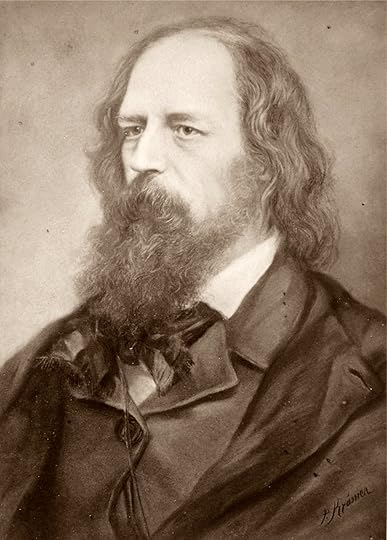
Do I like Tennyson? I wasn't sure. Like many, perhaps, I had an image in my mind of a brooding, bearded patriarch:
and a hazy memory of poems read at school such as "Locksley Hall", but no lines actually sprang to mind. So in a way I went into reading him "blind". I was surprised.
Poem after poem seemed to be about women - beautiful, passive women - and full of the poet's melancholy, and feelings of aching desolation. Perhaps these were his early poems, I wondered. My selection was taken from Tennyson's entire oeuvre; there were 96, including a long 150-page poem at the end, so it covered most of his moods. I did notice a change, a move towards a more narrative style as I continued reading, but much of the time the messages remained morbid.
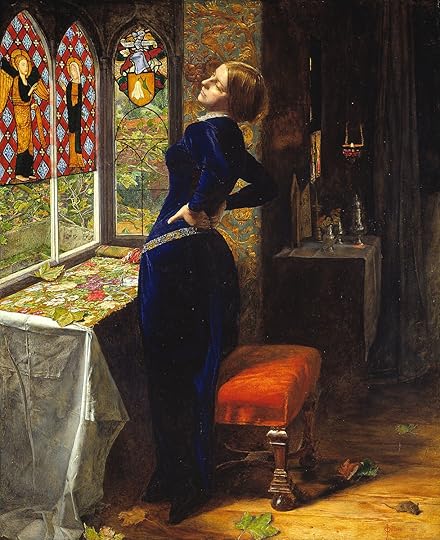
What the dark, sensuous imagery reminded me of, was the saturated colours used, and feelings evoked, by the Pre-Raphaelite Brotherhood:
- "Mariana" by John Everett Millais
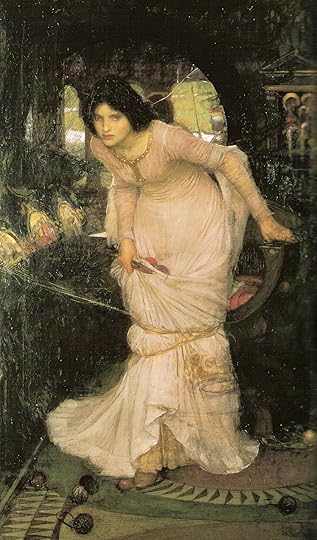
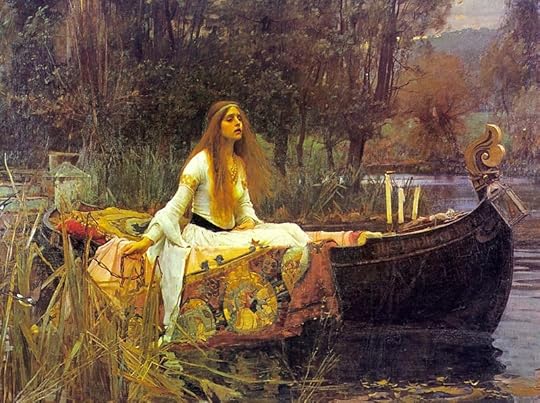
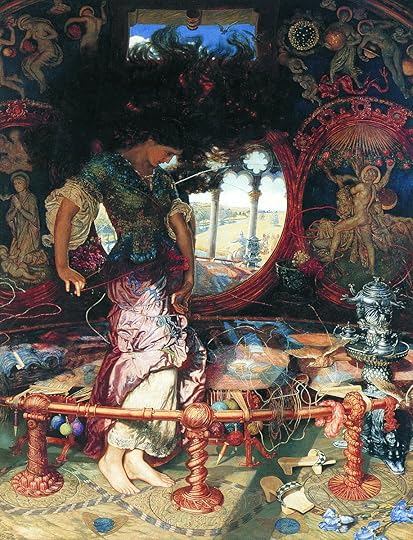
Sure enough, I found that those painters much admired Tennyson, and often used his poems as inpirations for their paintings. Tennyson lived from 1809 to 1892, and most of the Pre-Raphaelite Brotherhood were painting a little after those dates. Their early hard-edged, symbolic, naturalistic style began in 1849 and quickly developed into a moody, erotic medievalism. Here are three paintings by John William Waterhouse of "The Lady of Shalott":
and another by William Holman Hunt of her:
And Sidney Harold Meteyard ...
It would be interesting to go through many of their images, and those of Dante Gabriel Rossetti, Edward Burne-Jones and William Morris too, and see the connections between painting and poem. The feelings they evoke are so very similar.
I enjoyed "The Lady of Shalott", and also "Mariana" which felt like an early working out of the idea; of the grief, melancholy and loss. But the continuous line of perfect, motionless, characterless, ideal women did lose me after a while ... "Claribel", "Lilian", "Isabel", "Madeline", "Adeline", "Eleanor", "Fatima", "Oneone", "Rosalind", "Margaret", "Kate... " Yes, the language was beautiful in all these poems. They were lush and lyrical, sensuous bordering on sensual; the imagery and mood inventive, and perfectly conveyed. You could sink into the poet's language; swoon at his words. It was a bit like eating a towering confection of perfectly sculpted icing sugar, or an entire box of turkish delight, perhaps. A little went a long way.
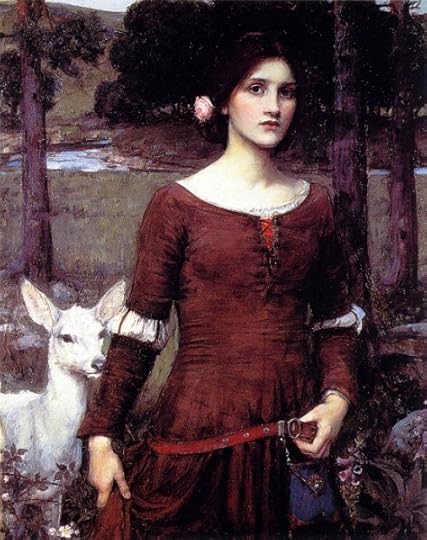
The later poems I liked better. "Lady Clara Vere de Vere", "Dora", "Godiva", "Lady Clare":
- "Lady Clare" by John William Waterhouse
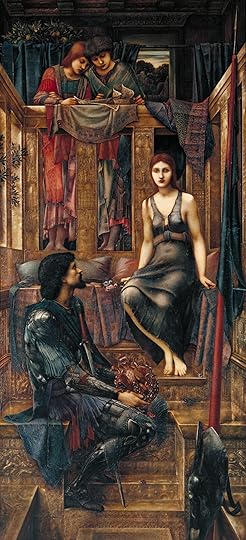
and "The Beggar Maid":
- "King Cophetua and the Beggar Maid by Edward Burne-Jones"
all are still focused on a particular female, but held more interest for me.
Perhaps it was the cleverly constructed metre, or the rhythm I enjoyed; perhaps the actual story of "Dora", or of "The Lady of Shalott". I sank happily into "The Day-Dream", a narrative poem with several long stanzas, based on the story of "Sleeping Beauty". The trio of poems, "The May Queen", "New Years Eve" and "Conclusion" read together as a piece, moved me greatly; I felt so sorry for the optimistic, bright young girl of the May.
And some of the Nature poems I enjoyed, although they were all rather pessimistic in feel. "Nothing Will Die" was followed by "All Things Will Die", (although I preferred to read them the other way around). "The Dying Swan", "The Death of the Old Year" and "The Blackbird", I enjoyed all these; they touched and moved me, although they made me very sad. I liked "The Ballad of Oriana" and "Edward Gray". Overall it is the narrative poetry which attracted me the most.
So I will not attempt to analyse this poetry. Many more have done this better than I could, and I now know that Tennyson's work is not poetry which speaks meaningfully to me. I feel sated with its imagery, but it is too yearning; too inward-looking and too full of despondent isolation.
But I can recognise its greatness:
"With blackest moss the flower-plots Were thickly crusted, one and all: The rusted nails fell from the knots That held the pear to the gable-wall. The broken sheds looked sad and strange: Unlifted was the clinking latch; Weeded and worn the ancient thatch Upon the lonely moated grange. She only said, "My life is dreary, He cometh not," she said; She said, "I am aweary, aweary; I would that I were dead!"
- "Mariana"
-"Mariana in the South" by John William Waterhouse
As thro' the land at eve we went, And pluck'd the ripen'd ears, We fell out, my wife and I, O we fell out I know not why, And kiss'd again with tears. And blessing on the falling out That all the more endears, When we fall out with those we love And kiss again with tears ! For when we came where lies the child We lost in other years, There above the little grave, O there above the little grave, We kiss'd again with tears.
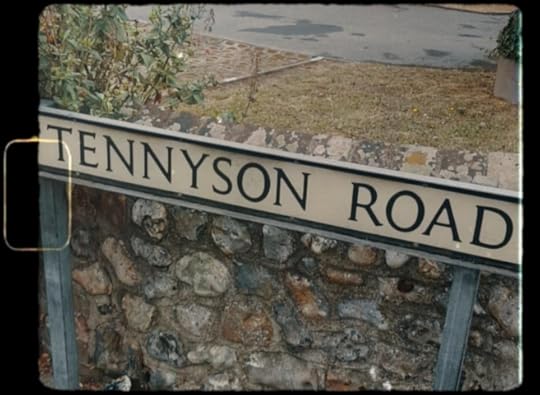
My hometown has a great number of roads named after writers, and namely, poets. Not far from my home are Tennyson Road, Byron Road, Shelley Road, Wordsworth Road, Milton Street, Chaucer Road, Browning Road, Longfellow Road, Shakespeare Road… All gathered in a labyrinth of residential roads just before the seafront. Here is the Tennyson Road sign, photographed by me:
The poems that stood out among the rest were “Ulysses”, “The Song of the Brook”, “The Lotos-Eaters”… and the two greatest poems in there, which deserve five, even six stars, were “Locksley Hall” and “Enoch Arden”. These are up there with some of the truly greatest poems I’ve read recently, especially the former.
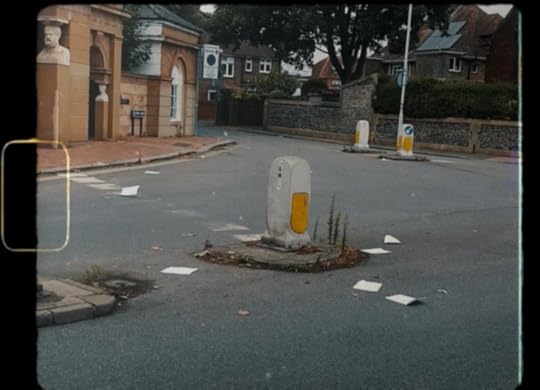
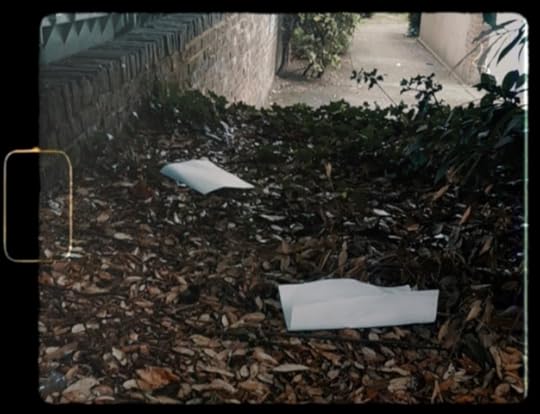
Though not the final poem in the collection, I actually read “Enoch Arden” last. It is a long and moving narrative poem, not unlike the story of Homer’s ODYSSEY. A man goes to work at sea and does not return for 10 years. His wife believes he is dead, and has children to raise. To comfort her, their childhood friend comes to aid. I will say no more, the story is tragic – and Tennyson is a brilliant poet, no doubt about that. This poem was still on my mind as I wandered along Richmond Road in my hometown to take the photograph of Tennyson Street road sign. Then, returning home, back along Wykeham Road, there were papers everywhere – strewn across the pavement and road, fluttering about like leaves. There was something both eerie and poetic about them, floating about. As I progressed down the road I saw some caught up in the bushes and some drifted up to front doors, as if they meant to knock. As soon as I reached the end of Wykeham Road and passed under the stone heads of Park Crescent and began up Clifton Road, the papers were gone, left behind.
3.5 stars. I think in this case, reading just a selection of poems is quite enough - some of them as excerpts from longer ones - and it gets me a good 'best of' view of the author. Some of the poems were breathtaking, some were okay, and some were eyebrow-raising. About 9 were what I'd call favorites for me.
Into the jaws of Death, Into the mouth of Hell (The Charge of the Light Brigade)
Rereading 'The Lady Of Shalott', which I've read somewhere else, again was a stunner. Perhaps rereading some poems after a few years really brings something out of them? My unfavorite was 'Locksley Hall' (for its prejudicdes); some poems felt uneven, too long, or interesting but wearying. I feel his quality in poems stayed pretty good, and some poems are quite short.
Tears, idle tears, I know not what they mean, Tears from the depth of some divine despair Rise in the heart, and gather to the eyes, In looking on the happy Autumn-fields, And thinking of the days that are no more. (The Princess)
His 'in memoriam' poem - long - for his friend Hallam (Tennyson named one of his sons after him), is a really good view into grief: how sharp it feels at first, how Christmases afterwards feel awkward, but gradually grief becomes less, and things end in a wedding scene. I did wonder, while reading this poem, on how deep the relationship between the men got - Heterosexual Life Partners trope level, or even more, at least on Tennyson's side, even if unconsciously so? Well, one can keep wondering...
I hold it true, whate'er befall; I feel it, when I sorrow most; 'Tis better to have loved and lost Than never to have loved at all. (In Memoriam A.H.H.)
But one can see how much variety of poetry styles he used, how the mood in the poems is varied, not just dark mood poems but also 'noble', beautiful, showing that the author had read well of other literature (the classics, of history etc.). Yes, there is something for everybody here, and something that will not work for everybody too, but it pretty sufficient to just read a 'selected' to see the brilliant bits.
”Tennyson knew his magician’s business.” - Aldous Huxley
Reputation – 4/5 Tennyson’s age is long past. It ended almost as soon as he died. We now think of him (if we think of him at all) as the preeminent poet of the Victorian era, during which time he was England’s Poet Laureate for 42 years. He took the title over from Wordsworth in 1850 and held it until his death in 1892. His poetry sold by the thousands while he was alive, and for another 20 years after. But after about 1920, people stopped reading him. A testament to his shift in popularity can be confirmed by an eBay search for vintage editions of his works. There are countless Tennyson printings from the late 19th Century that now sell for less than $50. It’s harder to find Tennyson collections from the 1920s because no one was printing them.
Like Dryden and Pope, Tennyson’s reputation suffers from a shift in cultural values. The Victorian era was long when considered as the lifetime of one monarch, but short when considered as a cultural movement. That old world was shattered forever by 1918, and Tennyson’s verse is now just another casualty tossed in the grave with the Crystal Palace and Utilitarianism.
Point – 5/5 As a boy, Alfred, Lord Tennyson never thought of being anything other than a poet, and his early dedication to his craft stood him in good stead. He read and wrote poetry insatiably and he absorbed everything he studied. He could imitate anyone from Spenser to Shelley. How clear is the concentration of Keats’ style in this oft-cited stanza:
”So waste not thou, but come; for all the vales Await thee; azure pillars of the hearth Arise to thee; the children call, and I Thy shepherd pipe, and sweet is every sound, Sweeter thy voice, but every sound is sweet; Myriads of rivulets hurrying thro’ the lawn, The moan of doves in immemorial elms, And murmuring of innumerable bees.”
A textbook example of assonance. Tennyson had a wonderful ear for lyric and rhythm, but he did not rely on it too heavily. Very little of his poetry is ethereal or abstract. When he writes a pastoral in the style of Wordsworth, he is less wordy, more worthy. When he writes a ballad, it takes the traditional form a short story in verse with the rhythm of a song. The Lady of Shallot sets the standard for the neo-medieval ballad. It had an enormous effect on Tennyson’s contemporaries and still holds up today. Tennyson is a prime example of a master craftsman who can handle all the traditional forms and techniques with ease.
But he was also an originator. And his most famous innovation was the dramatic monologue – a character speech addressing either the reader or an implied audience. It is a form derived from the blank verse soliloquies found in the plays of Shakespeare and Marlowe. Some of the most famous lines in English are lifted from these speeches. Mark Anthony’s “Friends, Romans, countrymen, lend me your ears,” and Tamburlaine’s “And shall I die, and this unconquered?” are the ancestors of the form Tennyson developed.
Ulysses is Tennyson’s most perfect achievement in the dramatic monologue. In it we hear the hero of Homer’s Odyssey as an old man reflecting on his past life of war and travel and wondering if it is really his fate to fade away in old age. Or… can he gather his men for one last adventure?
”There lies the port; the vessel puffs her sail; There gloom the dark, broad seas. My mariners, Souls that have toil’d, and wrought, and thought with me,— That ever with a frolic welcome took The thunder and the sunshine, and opposed Free hearts, free foreheads,—you and I are old; Old age hath yet his honor and his toil. Death closes all; but something ere the end, Some work of noble note, may yet be done, Not unbecoming men that strove with Gods. The lights begin to twinkle from the rocks; The long day wanes; the slow moon climbs; the deep Moans round with many voices. Come, my friends. ’T is not too late to seek a newer world.”
It is one of those few poems that are positively thrilling. Thrilling in the same way as a speech in Macbeth or King Lear. It is no exaggeration to say that its drama is on par with Shakespeare. Only it is just one scene.
The longest poem in this collection is a blank verse story about a man named Enoch Arden. It was immensely popular in Victorian times, and is, almost surprisingly, still good today. Another old-time favorite is Locksley Hall, a medium-length poem following the mind of a young man who is rejected, forlorn, and then resolved. But its 19th Century morality is painfully clear, and I doubt a common type of goodreads user will be able to keep from calling it racist and sexist and rating the whole book one star in retaliation.
And here we return to the problem of Tennyson today. His morals and subject matter are outdated to us – synonymous with the Victorian era – and his poetic technique – though uniquely combined in Tennyson – we find scattered in other poets of wider appeal like Keats, Wordsworth, and Shakespeare. I don’t think it’s an overstatement to say that Tennyson is the most widely skilled poet in English. He can do Byron and Shelley nicely, Keats very well, and Wordsworth oftentimes more tolerably than Wordsworth, himself. He can even do some Shakespeare. If Tennyson had been born in an age with greater poetic force, he would easily have been one of the greatest English poets. Even just 30 years earlier he might have towered over the other Romantics as a summation of all their powers. But as it is he ends up in a sort of no man’s land of English poetry. The time in which he lived makes him into a poet of a specific period, and he is denied the universality that his artistry merits. It’s a fate that other first rank poets like Pope have also suffered, and one that I think ought to be rectified.
In light of the whole of English poetry from Chaucer onwards, Tennyson can be considered the last truly great figure. He offers a logical end to the English tradition by combining conventional forms with his own innovations, all with an exceptional poetic sensibility and a keen eye on the past. And appropriately, there is something elegiac about all of Tennyson’s poetry. Even when he is robust and energetic, there is always a stately solemnity to him. It’s as if he knows he’s delivering a eulogy for not merely his age, but for the whole tradition, and he does so with the dignity and eloquence that we have come to expect from a Victorian gentleman.
Recommendation – 4/5 There are two things that I think Tennyson does better than any other poet. The first is his uniquely English stoicism. The Victorians were known for their “stiff upper lip” and Tennyson expresses that sort of reserved manliness in verse. Even his elegy for his best friend, In Memoriam A.H.H (not included in this selection), is not the least bit weepy. It’s overarching sentiment is expressed in the immortal lines:
”I hold it true, whate'er befall; I feel it when I sorrow most; 'Tis better to have loved and lost Than never to have loved at all.”
They are lines that could have been written by Seneca. Another flawless example of Victorian stoicism comes in the form of The Charge of the Light Brigade, a tribute to the cavalry regiment in the Crimean War that was torn to pieces obeying unwise orders.
The second field in which Tennyson is unmatched is his medievalism. Before Tolkien, there was no writer who could evoke the Middle Ages so well. Tennyson’s most medieval work, The Idylls of the King is too long for this short selection, but there are other pieces like The Lady of Shallot and Merlin and the Gleam that are sure to please fans of King Arthur.
Personal – 4/5 I don’t care for medievalism at all, but Tennyson is so good at it that even I don’t mind his fascination with that realm of escapism. His stoicism always keeps him from becoming too much like a fairy tale.
In my view, Tennyson fits perfectly into that succession of exceedingly “English” poets. I have in mind those poets whose very “Englishness” makes them perennial favorites in their own country, but relatively ignored outside it. Spenser, Milton, Dryden, and Wordsworth are the great poets I have in mind. Not being English, I lean towards that tradition of poets whose work is more beloved abroad. Chaucer, Pope, Byron, and Browning are a few of the great English poets whose work has always been more popular outside of England and in translation.
But despite Tennyson’s sometimes overwhelming Englishness, his mastery and masculinity win me over. That’s not to say he cannot be tender. One of his short lyric poems (unfortunately not included in this selection) is a meditation on trust in a relationship. Vivien’s Song is the admonition of a profound and honest woman, and expresses the poison of distrust in metaphors that are unforgettable:
”’In Love, if Love be Love, if Love be ours, Faith and unfaith can ne’er be equal powers: Unfaith in aught is want of faith in all.
‘It is the little rift within the lute, That by and by will make the music mute, And ever widening slowly silence all.
‘The little rift within the lover’s lute Or little pitted speck in garnered fruit, That rotting inward slowly moulders all.
‘It is not worth the keeping: let it go: But shall it? answer, darling, answer, no. And trust me not at all or all in all.’”
There is a certain way my professor used to say he liked something: he used to say it in a way that is sort of an attack on any opposite opinion, as if if someone did not like that particular thing, they had some 'splanin to do. Try and picture that sort of expression used in the following statement: I LIKE TENNYSON. I like him a lot. I love the way he takes periphrial characters, like Mariana or Oenone, and creates beautiful laments for them. I like the way he embraces the Romantic, yet stays solidly in the realms of melancholy, which strikes me as being decidedly true to life as regards real people's emotions. (I've felt more like the Locksly Hall guy than I've ever felt like Wordsworth's or even Eliot's narrators.) I love the old school morals, like unabashed patriotism and solid Jesus referances. I like just about everything about him. Also, in this volume The Lotus Eaters was right before Ulysses. Now, Ulysses deserves some consideration for the coveted My Favorite Poem of All Time award, and I'd read The Lotus Eaters before, but I'd never read them back to back like that. I am now convinced that this is the best way to read these two poems: moving from the stately, elaborate and rhetorical chorus to the clear, individual and declarative monolouge is AMAZING. It makes me want to write essays again. Also, the line in Ulysses about "all experiance" being "an arch wheretro'/ gleams that untravell'd world whose margin fades/ forever and forever when I move" is the best expression of the innate human longing for heaven that I have ever heard. Oooh so good.
Light, so low upon earth, You send a flash to the sun. Here is the golden close of love, All my wooing is done. Oh, the woods and the meadows, Woods where we hid from the wet, Stiles where we stay'd to be kind, Meadows in which we met!
Light, so low in the vale You flash and lighten afar, For this is the golden morning of love, And you are his morning start. Flash, I am coming, I come, By meadow and stile and wood, Oh, lighten into my eyes and heart, Into my heart and my blood!
Heart, are you great enough For a love that never tires? O' heart, are you great enough for love? I have heard of thorns and briers, Over the meadow and stiles, Over the world to the end of it Flash for a million miles.
My second bit of Tennyson of the year the recommendation of a friend of some more poems to check out. I found this collection to be generally really good overall. There were some poems I wasn't the biggest fan of but they were easily in the minority here (and mostly dealt with war). This collection also made me reconsider my opinion of Maud (which was here only as a small excerpt) to be much more positive as I found the language so much prettier and engaging than I remember it being as I read the whole poem . Another favorite from this collection was The Lotos Eaters and generally a lot of the poems that dealt with the story of Odysseus (except for Ulysses which I tried and tried to get but kinda slipped from me). Maybe this is just because I read the Odyssey this summer and really enjoyed my time and I feel like Tennyson does the story as much justice as Homer did. I also really enjoyed Enoch Arden which I don't have many comments on.
Returning to Tennyson after a brief spell, I’ve just finished Christopher Ricks’s edition of Selected Poems, and I’m struck anew by the extraordinary energy, versatility, and breadth of vision that make him a truly towering poet. My favorite works tend to be established classics on the order of “Mariana,” “The Kraken” “The Lady of Shalott,” “Locksley Hall,” the monodrama “Maud,” which gets better as it goes along, “The Charge of the Light Brigade,” overexposed though it has become, and “Crossing the Bar,” among various others, including the parts of the “Idylls of the King” excerpted here and familiar from my recent reading of that epic work. This is an artist who still deserves every inch of his great reputation. Highly recommended.
Of the five suggested Tennyson poems to read, I finished The Dying Swan, In Memoriam, The Lady of Shalott, and The Lotos-Eaters. I skipped the Idylls of the King because I tried reading that some time ago, and quit. It's quite long, and I am doing the bear minimum of poetry reading.
I thoroughly enjoyed Tennyson's poems, especially The Lady of Shalott, The Lotus-Eaters, and In Memoriam. His poetic style is rhythmic and simple and pleasant, and his themes are emotional, as he deals with loss and grief and sadness. The Lady of Shalott is Medieval and The Lotus-Eaters is Greek mythology. Initially, I sensed he may be an orthodox Christian, but a little research explained how his faith was more emotional than rational, and I can definitely see that.
I am making a mental note that if I ever read more poetry, I will read Tennyson!
This is a good edition easy to use in the classroom and affordable. The editorial note is brief but covers up important facts such as a Chronology of important dates and events concerning Tennyson's life. This however does not include an introduction so for new-readers might find it to be an obstacle but a trip to a library will solve that, I guess.
The collection covers 56 of Tennyson's most memorable poems. Also included here are extracts from "The Princess", "Maud" "Idylls of the King", poems from "In Memoriam: A.H.H" and closing the collection with "Crossing the Bar" just Tennyson had requested.
Those wanting a more comprehensive edition must of course look elsewhere otherwise considering the price, this may be one of the best of Tennyson's selected poetry editions out there so worth buying.
Poetry is far from my area of expertise. I love to read a good poem, but I read poetry so rarely that I can hardly call myself an expert.
With Tennyson, I find I have a bit of a mixed relationship with his work. Some I really enjoy, whereas others I don’t care much for. Writing a full review for any single one of the poems within this collection is hard, as some are better than others. Just know his poetry offers up many different aspects. Whilst you will notice some similarities between them – the overuse of ‘for evermore’ for example – each poem does have an individual feel. Even if it is something as simple as being able to read it to the tune of ‘Row, Row, Row Your Boat’ (I’ll leave you to work out which of the poems I’m referring to here).
Overall, a decent enough read. Some will stick with me more than others will, but overall the collection was enjoyable.
Tennyson's poetry was very good in that it was substantial in meaning and was excellent at weaving in themes and motifs. I just found it to be not very insightful, ultimately, or breathtaking — there was nothing about it that made me think to myself, "I want to jot down this quote and save it!!" For me, poetry is really good when I continually stumble across lines that I want to record and save; and unfortunately Tennyson's writing just didn't capture enough truth for me to be in awe.
"The lights begin to twinkle from the rocks: The long day wanes: the slow moon climbs: the deep moans round with many voices. Come, my friends, 'Tis not too late to seek a newer world. "
I read the 168-page Poetry Bookshelf volume, and I only wish it were longer!
It's my first real chance at the poet, but long coming: I memorised The Brook years ago, enchanted by the cadences and vivid imagery.
Tennyson perfectly combines a very modern simplicity with old, beautiful language; and his carefully noticed details keep the narratives freshly coloured (compare the first to Wordsworth, and the last to Browning).
I loved that this still had the power to make me pull out a pencil to furiously underline, particularly remembering how this was Laura Ingalls Wilder's treasured gift as a young woman.
Dans cette anthologie de poèmes, le rythme est d'une grande fluidité, en particulier dans The Lady of Shalott, où il va par moments jusqu'à épouser la progression de l'intrigue. De très nombreux mythes sont présents, en particulier la légende des chevaliers de la Table Ronde, ainsi que des héros contemporains à qui le poète prête ses propres idéaux. Omniprésence du désespoir ou tout du moins d'une certaine mélancolie. Une lecture ancienne qui résonne encore en moi, par la beauté du triptyque à déchiffrer : amour-mythe-mort.
i bought this book when i was working on 'i am a camera.' i had no money at the time and this book was twice as expensive as all the other tennyson books, but it was also much more beautiful than the other ones. i stood in the aisle of biography books and picked it up and put it down and picked it up again, all the while concocting ways i could save money in other areas and have the better book. i decided for the next few weeks i would just eat my dinner out of cans, clutched the book to me and spent the whole day falling in love with it. i love it still and i read it on sundays and whenever my soul cries out for beauty and inspiration and something of the divine.
I have known Tennyson's poems for a long time without knowing I did; "The Lady of Shalott" is beautifully put to music by Celtic singer Loreena McKennitt, about a lost time of chivalry, knights, and damsels in distress, as well as mirrors cracking. "Tithonus" is a hauntingly written poem about a man granted immortality but not the gift of staying young. Other poems that I have read so far are written in such a potently lyrical, saddened, sharp style as to be wholly original and startling. Tennyson's despair, sadness, and sense of being lost comes through clearly, and is one reason why I very much identify with his work...
Tennyson is one of my favourite poets - I especially love his Idylls of the King which retells the legend of King Arthur, his knights, his love for Guinevere and her tragic betrayal of him, and the rise and fall of Arthur's kingdom.
Few poets bewitch like Tennyson. Ulysses I read again and again, and I wonder about Crossing the Bar for my funeral. His obsession with death chimes with me, and it was grief that made him a great poet. It can have its upside.
Q: Who is the greatest poet writing in English after Wordsworth's time and before Eliot's? A: Tennyson.
Thanks to my friend Larry for his oft-repeated request that I read "In Memoriam A.H.H." as soon as practically possible. His insistence turned out to be entirely justified!
I love Tennyson, I have had to read his poems in English atm and I surprisingly like his works. Tithonus is my favourite, I think, along with The Lotus Eaters
I love Victorian poets and Tennyson is probably my favorite. "Maud" is my favorite poem; it's so dark and twisted. I wish poets still wrote things like this today.