

What do you think?
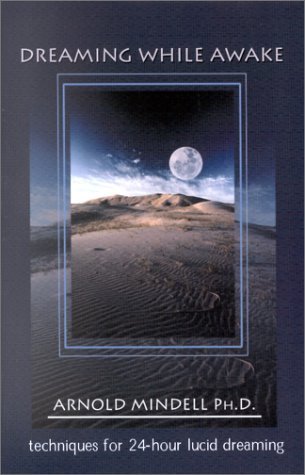
Dreaming While Awake: Techniques for 24-Hour Lucid Dreaming
Dreaming While Awake Techniques for 24-Hour Lucid Dreaming Arnold Mindell, Ph.D. "Dreaming" is the basis for human consciousness; we do it all day, every day. Subtle signs or events of particular meaning that we tend to miss, ignore, or misinterpet during waking hours become the seeds of our night dreams. These dreams, then, are often elaborations of subtle signs that we regulate to the fringes of our consciousness. How can we learn to control this cycle, and what can we learn from this process about ourselves? Dr.Arnold Mindell asserts that in order ot utilize the power of dreaming we must "catch the seeds of dreaming" while awake; we must "become aware of every moment," noticing subtle feelings before they unfold and become differentiated into the ideas and emotions that occur in night dreams, often manifesting later as symptoms of mental illness. Mindell gives dreaming new importance in the context of mystical traditions, quantum physics, and western psychology, and provides powerful dreaming applications for body work, chronic symptom work, and relationship/group therapies. -Author of over a dozen books including "The Shaman's Body" (HarperSanFrancisco, 1993 - over 42,000 sold) - Mindell has more than thirty years' experience as a therapist and conflict resolution facilitator - Tells how to use dreaming as a practical application for healing, stress-reduction, and health using simple exercises with easy steps
288 pages, Hardcover
First published January 1, 2000
Ratings & Reviews
Friends & Following
Create a free account to discover what your friends think of this book!
Community Reviews
Displaying 1 - 15 of 15 reviews
February 15, 2011
I read this book via the suggestion of a Facebook friend (thanks Nathan!). The core concept of this book is to encourage you to develop your ability to experience lucid dreaming 24 hours a day. To people who are heavily tied to objective logic, this book is completely irrational and does nothing but suggest that people develop inner delusions. I wouldn't recommend it to Ayn Rand fans for example. But to those who are willing to forgo logic and perhaps even language, and move into the realm of feelings and emotions, this book is quite interesting.
On the surface the book reads like many other new age self help books. Mindell points to many non-western cultures and how the most important part of reality is the dream world. Aborigines, Buddhists, various native American tribes and many eastern cultures, all have some belief system that can roughly be translated to represent a dream or dreamlike space from which reality arises. Although he would like to dispense with east vs. west, it's a handy set of terms to discuss the cultural differences that cause westerners to de-emphasize or marginalize (his preferred term) our dream in waking life.
We've all done it, fleeting and irrational thoughts of all sorts enter our consciousness every day and we discard them as illogical or having no basis in reality. It's what our culture rather strongly encourages us to do. Say, you're walking along and you get a strong feeling that something bad is going to happen, but you have no logical reason for thinking that. You try to suppress it or forget it. Five minutes later you find out that something bad did happen within that time frame. This is part of what Mindell refers to as the dream. Many times these dreams during the day are "non-verbalizable" (his term). That is to say, you can't really describe them with words or speech. At least not in any way that others would be able to take in and relate to.
Going further, Mindell suggests that we've fooled ourselves into focusing on the "little I" instead of the "big I". We are too concerned about our individual selves that interact with the concrete happenings and objects around us when we're awake. He refers to the reality that we all perceive as being real as "consensus reality" or CR for short. Instead, we should learn to be the "big I" which is your relationship to everything else in the universe. That is, we are the force between every person, animal, object, star, etc... (I'm sure I'll lose some people at this point because it is, frankly, a very far-fetched notion. But I'm still willing to work with the idea myself, so I pressed on)
As you become more aware of your "big I" and your connection to everything else, your perspective shifts. You are no longer the active participant in reality. One example of this he uses is the simple act of sweeping the floor. You are no longer moving the broom and sweeping the floor. Instead the broom is moving you. It becomes a dance in which the dirt is swept away. You ARE the broom. The broom is you. There is no longer any separation. This really is a very difficult concept to pass along the experience from without sounding a little crazy. I don't blame anyone for thinking it's flaky. But, it is still a very interesting mental exercise.
In each chapter, he adds successively more and more layers at which this kind of mental framework can be used to resolve problems. First at the level of the little and big "I". Then he extends that into your relationships with those who are close to you. Following that he moves up the chain to groups (employers, causes, political parties). Finally ending with the world itself and how each nation relates to another. In each case he takes what he's spoken about in the previous levels and adds a little to the ideas so they work at larger scales.
As I read the book, I tried shifting my perspective as he suggested. It was very interesting and quite relaxing. But even more startling was that sometimes it would lead me to better performance in what ever task I was engaged in. I don't have any scientific proof of that, but I did see definite differences. This comes as no surprise to me because I've been experimenting for decades with the effect that changes in mental perspective have on my relationship to reality. This is part of what I see in his ideas, a simple change in perspective that removes your consciousness from CR and places it in the dream time.
I've developed my own notion as to what he's tapping into and it has nothing to do with anything that resembles mysticism. The key points he mentioned which resonated with some information I read in another book called Emotional Intelligence are that the dream field that is the "big I" is non-verbalizable and lacks any concept of time. There is one part of the human brain that lacks language and a concept of time and it happens to be the part of the brain that is fully formed at birth: the amygdala. This is the main reason that most people have no memories of being born or being a newborn or even the first few years of life. There is no language at that point in time. But the amygdala still has it's own set of language and time free memories. I believe that what he's really encouraging people to do is to bridge the communication gap between your "reptile brain" and your logical "conscious" brain. It's yet another form of being "whole brained".
On the surface the book reads like many other new age self help books. Mindell points to many non-western cultures and how the most important part of reality is the dream world. Aborigines, Buddhists, various native American tribes and many eastern cultures, all have some belief system that can roughly be translated to represent a dream or dreamlike space from which reality arises. Although he would like to dispense with east vs. west, it's a handy set of terms to discuss the cultural differences that cause westerners to de-emphasize or marginalize (his preferred term) our dream in waking life.
We've all done it, fleeting and irrational thoughts of all sorts enter our consciousness every day and we discard them as illogical or having no basis in reality. It's what our culture rather strongly encourages us to do. Say, you're walking along and you get a strong feeling that something bad is going to happen, but you have no logical reason for thinking that. You try to suppress it or forget it. Five minutes later you find out that something bad did happen within that time frame. This is part of what Mindell refers to as the dream. Many times these dreams during the day are "non-verbalizable" (his term). That is to say, you can't really describe them with words or speech. At least not in any way that others would be able to take in and relate to.
Going further, Mindell suggests that we've fooled ourselves into focusing on the "little I" instead of the "big I". We are too concerned about our individual selves that interact with the concrete happenings and objects around us when we're awake. He refers to the reality that we all perceive as being real as "consensus reality" or CR for short. Instead, we should learn to be the "big I" which is your relationship to everything else in the universe. That is, we are the force between every person, animal, object, star, etc... (I'm sure I'll lose some people at this point because it is, frankly, a very far-fetched notion. But I'm still willing to work with the idea myself, so I pressed on)
As you become more aware of your "big I" and your connection to everything else, your perspective shifts. You are no longer the active participant in reality. One example of this he uses is the simple act of sweeping the floor. You are no longer moving the broom and sweeping the floor. Instead the broom is moving you. It becomes a dance in which the dirt is swept away. You ARE the broom. The broom is you. There is no longer any separation. This really is a very difficult concept to pass along the experience from without sounding a little crazy. I don't blame anyone for thinking it's flaky. But, it is still a very interesting mental exercise.
In each chapter, he adds successively more and more layers at which this kind of mental framework can be used to resolve problems. First at the level of the little and big "I". Then he extends that into your relationships with those who are close to you. Following that he moves up the chain to groups (employers, causes, political parties). Finally ending with the world itself and how each nation relates to another. In each case he takes what he's spoken about in the previous levels and adds a little to the ideas so they work at larger scales.
As I read the book, I tried shifting my perspective as he suggested. It was very interesting and quite relaxing. But even more startling was that sometimes it would lead me to better performance in what ever task I was engaged in. I don't have any scientific proof of that, but I did see definite differences. This comes as no surprise to me because I've been experimenting for decades with the effect that changes in mental perspective have on my relationship to reality. This is part of what I see in his ideas, a simple change in perspective that removes your consciousness from CR and places it in the dream time.
I've developed my own notion as to what he's tapping into and it has nothing to do with anything that resembles mysticism. The key points he mentioned which resonated with some information I read in another book called Emotional Intelligence are that the dream field that is the "big I" is non-verbalizable and lacks any concept of time. There is one part of the human brain that lacks language and a concept of time and it happens to be the part of the brain that is fully formed at birth: the amygdala. This is the main reason that most people have no memories of being born or being a newborn or even the first few years of life. There is no language at that point in time. But the amygdala still has it's own set of language and time free memories. I believe that what he's really encouraging people to do is to bridge the communication gap between your "reptile brain" and your logical "conscious" brain. It's yet another form of being "whole brained".

August 26, 2013
I ordered this book because I thought it had something to do with lucid dreaming, though it didn’t really, not lucid dreaming in the conventional sense, and because I love and admire Arnold Mindell.
This must be the deepest book I’ve ever read through to the end, and the most difficult to comprehend. I had to read most of the sentences several times. Mindell has his own vocabulary for things, and some parts of the book might have been more comprehensible had this not been the case.
The book is about “the Dreaming”. This is the energy behind everything, “the life force of all living beings”. Everyday reality or CR (consensus reality) corresponds to the bright side of the moon, while the Dreaming corresponds to the dark side of the moon. If you ignore the Dreaming background to reality, you marginalize (Mindell’s favourite word) “the deepest unformulated experiences that create your actions in everyday life”.
Every time you ignore sentient (Mindell’s second favourite word) perceptions, i.e. generally unrecognized dreamlike perceptions, you have “overlooked the spirit of life, your greatest potential power”.
I had to look up the word “sentient” in the dictionary, since Mindell kept using it and I kept having difficulty in understanding what he meant by it. According to Webster’s Desk Dictionary, “sentient” means “able to perceive by the senses” or “experiencing sensation or feeling”. I don’t actually think this definition helped me much.
We are told that ignoring the Dreaming is an undiagnosed global epidemic. Most of us suffer from a chronic form of mild depression because we have been taught to focus on everyday reality and forget about the Dreaming background. This depression is the sense that something in your life is missing. We are out of touch with the core energy of life, the Dreaming.
“Dreaming is the origin of all your experiences, including your sense of meaning and your deepest beliefs.”
There are apparently three layers to reality: 1) consensus reality, or everyday reality 2) Dreamland, the area of dreams (I understand the author to mean here the dreams we have when sleeping) and 3) Dreamtime, or the Dreaming (vague feelings and intuitions that can barely be verbalized).
Jung and Freud have spoken of the Dreaming in terms of the subconscious or unconscious mind. To Native Americans, Aboriginal Australians, etc, “the sentient Dreaming world is the basis reality”. These “energetic tendencies that dream everyday life into existence” are called by Taoists “the Tao that cannot be spoken”. Chuang Tsu referred to Dreaming as the “Primal Force”, Native Americans talk about “the power of the Great Spirit”, while physicists refer to “quantum wave functions”.
To catch actions and thoughts as they arise from the Dreaming, you must be mindful and concentrated, or lucid.
Dreaming is the basic energy of the universe.
Dreaming happens all the time, just before new thoughts and actions arise.
The author states:
“Because you are Dreaming all day long, I wish to expand the idea of lucid dreaming to mean being awake during Dreaming not only at night but also during the day.” He calls this process “24-hour lucid dreaming”.
Mindell explains that marginalization means taking something that was in the centre of your awareness and placing it in the “margins” of your focus, thereby ignoring it.
He explains that “sentient” refers to the “automatic awareness of subtle, normally marginalized experiences and sensations”
He tells us that objects are continually “flirting” with us and catching our attention. We are anything that catches our attention. The “little you” assumes that feelings about whatever it observes can be marginalized. The “Big You” sees the little you and the things catching its attention as all being potentially valuable. We are what catches our attention. The environment is an aspect of the larger Self.
The above should give you an idea of what this book is about. As stated, it is a deep book, and thus not for everyone. You will need to concentrate on it to extract its meaning.
I found the book illuminating. It challenged me to take a step further in self-development. I would highly recommend it to those who are willing to devote their time and concentration on it and Mindell’s paradigm of the world/universe.
This must be the deepest book I’ve ever read through to the end, and the most difficult to comprehend. I had to read most of the sentences several times. Mindell has his own vocabulary for things, and some parts of the book might have been more comprehensible had this not been the case.
The book is about “the Dreaming”. This is the energy behind everything, “the life force of all living beings”. Everyday reality or CR (consensus reality) corresponds to the bright side of the moon, while the Dreaming corresponds to the dark side of the moon. If you ignore the Dreaming background to reality, you marginalize (Mindell’s favourite word) “the deepest unformulated experiences that create your actions in everyday life”.
Every time you ignore sentient (Mindell’s second favourite word) perceptions, i.e. generally unrecognized dreamlike perceptions, you have “overlooked the spirit of life, your greatest potential power”.
I had to look up the word “sentient” in the dictionary, since Mindell kept using it and I kept having difficulty in understanding what he meant by it. According to Webster’s Desk Dictionary, “sentient” means “able to perceive by the senses” or “experiencing sensation or feeling”. I don’t actually think this definition helped me much.
We are told that ignoring the Dreaming is an undiagnosed global epidemic. Most of us suffer from a chronic form of mild depression because we have been taught to focus on everyday reality and forget about the Dreaming background. This depression is the sense that something in your life is missing. We are out of touch with the core energy of life, the Dreaming.
“Dreaming is the origin of all your experiences, including your sense of meaning and your deepest beliefs.”
There are apparently three layers to reality: 1) consensus reality, or everyday reality 2) Dreamland, the area of dreams (I understand the author to mean here the dreams we have when sleeping) and 3) Dreamtime, or the Dreaming (vague feelings and intuitions that can barely be verbalized).
Jung and Freud have spoken of the Dreaming in terms of the subconscious or unconscious mind. To Native Americans, Aboriginal Australians, etc, “the sentient Dreaming world is the basis reality”. These “energetic tendencies that dream everyday life into existence” are called by Taoists “the Tao that cannot be spoken”. Chuang Tsu referred to Dreaming as the “Primal Force”, Native Americans talk about “the power of the Great Spirit”, while physicists refer to “quantum wave functions”.
To catch actions and thoughts as they arise from the Dreaming, you must be mindful and concentrated, or lucid.
Dreaming is the basic energy of the universe.
Dreaming happens all the time, just before new thoughts and actions arise.
The author states:
“Because you are Dreaming all day long, I wish to expand the idea of lucid dreaming to mean being awake during Dreaming not only at night but also during the day.” He calls this process “24-hour lucid dreaming”.
Mindell explains that marginalization means taking something that was in the centre of your awareness and placing it in the “margins” of your focus, thereby ignoring it.
He explains that “sentient” refers to the “automatic awareness of subtle, normally marginalized experiences and sensations”
He tells us that objects are continually “flirting” with us and catching our attention. We are anything that catches our attention. The “little you” assumes that feelings about whatever it observes can be marginalized. The “Big You” sees the little you and the things catching its attention as all being potentially valuable. We are what catches our attention. The environment is an aspect of the larger Self.
The above should give you an idea of what this book is about. As stated, it is a deep book, and thus not for everyone. You will need to concentrate on it to extract its meaning.
I found the book illuminating. It challenged me to take a step further in self-development. I would highly recommend it to those who are willing to devote their time and concentration on it and Mindell’s paradigm of the world/universe.
May 25, 2011
This book is quite inspiring and helpful to our every day life. I say that because it tells us and shows us how our hidden feelings affect our life. It provides readers techniques to help to sort out problems, in which most of the problems are caused by the hidden feelings we had but being neglected for a long time. In order to notice those hidden feelings, we need to be lucid all the time, not only during dream state but also during waking state. If we achieve that, life will be easier and much more beautiful than you never have expected.

August 19, 2012
This book has been a life changer for me. After some 7 years of serious meditation much has happened. There have been instances where there has been simple acceptance, as insubstantial phenomenon has allowed the continued occurence and the expansion of my experience of another level of perception that I did not really understand and which I did not really see as being linked except as something that has arisen as the result of my practice. This book takes those experiences and places them within a coherent context that makes sense to me and certainly points to a way forward onto ground that a few years ago I would simply have dismissed.
Another revelation was the essense of what Aborigial people in Australia call the Dreaming. It was something well beyond my own experience,or so I thought, and it has been something I have never really looked at. I have however, had some contact with peoples to whom it is the greater part of the way they experience their lives. These people were Montgnards in Vietnam and Laos, traditional Balinese communities and the orang asli in Malaysia. In their presence I was certainly aware of at least the timbre of their experience and there were at times discussions about its nature. I didn't always understand intellectually but instictivley I did sense something there, just beyond my reach that had great value. I thought it inaccessible to me, now I find common ground and a flow of perceptions into my own life that seems to come from that same place.
This is worth exploring for me. I am both excited with a new direction and the coming of another level of understanding of my life and my soul.
Another revelation was the essense of what Aborigial people in Australia call the Dreaming. It was something well beyond my own experience,or so I thought, and it has been something I have never really looked at. I have however, had some contact with peoples to whom it is the greater part of the way they experience their lives. These people were Montgnards in Vietnam and Laos, traditional Balinese communities and the orang asli in Malaysia. In their presence I was certainly aware of at least the timbre of their experience and there were at times discussions about its nature. I didn't always understand intellectually but instictivley I did sense something there, just beyond my reach that had great value. I thought it inaccessible to me, now I find common ground and a flow of perceptions into my own life that seems to come from that same place.
This is worth exploring for me. I am both excited with a new direction and the coming of another level of understanding of my life and my soul.

February 4, 2008
Although I appreciated the content and intention of this book, three stars is being generous. I found the writing to be childish and redundant, therefore, irritating. I like the concepts though and would still recommend checking it out.

June 8, 2019
I can't believe this guy is a clinician. He rambles on, making loose connections of the type only frequent and robust doses of psychedelics can facilitate, then wraps each talking point up with a self-satisfied "free your mind" smirk.
Every example and citation he gives reads like a "and then everyone clapped" tumblr story, but I think the most annoying aspect of this book was the quantum theory. He believes, since he doesn't understand it, his audience also won't, so whenever he hits a wackadoo woo plot hole in his busted-ass theory he likens it to the uncertainty principal or makes egregious claims about how Jung was *really* talking about photons, and you can see in the text he's absolutely certain this not only covered his ass, but also somehow proved his utter lack of a point.
Every example and citation he gives reads like a "and then everyone clapped" tumblr story, but I think the most annoying aspect of this book was the quantum theory. He believes, since he doesn't understand it, his audience also won't, so whenever he hits a wackadoo woo plot hole in his busted-ass theory he likens it to the uncertainty principal or makes egregious claims about how Jung was *really* talking about photons, and you can see in the text he's absolutely certain this not only covered his ass, but also somehow proved his utter lack of a point.

January 1, 2022
DNF.
The concept is interesting but the writing is hard to follow. Words are renamed to suit his preference, and he uses so many similar words to mean totally different things, eg "dreaming" and "dreamland" represent VERY different parts of consciousness.
I really really wanted to like this book, but I must believe that there's other books that cover the topic of mindful awareness in a much clearer manner.
The concept is interesting but the writing is hard to follow. Words are renamed to suit his preference, and he uses so many similar words to mean totally different things, eg "dreaming" and "dreamland" represent VERY different parts of consciousness.
I really really wanted to like this book, but I must believe that there's other books that cover the topic of mindful awareness in a much clearer manner.
September 27, 2017
I guess the concepts, as others have said, are interesting enough, but his presentation and his propensity for redefining terms to suit his ends are too annoying to make this a beneficial, let alone enjoyable read. Best avoided all together.
October 11, 2020
Do the exercises. They work!
Arnie is a legend. Being awake and aware enriches our lives. Explore how we are all connected and 'flirt' with each other and the Tao.
Arnie is a legend. Being awake and aware enriches our lives. Explore how we are all connected and 'flirt' with each other and the Tao.

February 27, 2017
With Arnold Mindell books it is like this: you need to keep on reading them and you are never done. Every time you open it, you again may discover another layer of reality.

January 13, 2008
I found this book very annoying to read because of the way it was written. It was choppy. Mindell's concepts are better represented in his other books.

December 30, 2009
Interesting concepts, but a little hard to follow.

June 22, 2012
Mi aspettavo molto da questo libro, ma speravo in un approccio più pratico... troppo teorico per essere interessante.
March 30, 2013
Kindle Ebook

May 11, 2013
Прекрасная книга для перечитывания.
Displaying 1 - 15 of 15 reviews